
Cloud-Centric MDR Services Market Size and Share
Market Overview
| Study Period | 2021 - 2032 |
|---|---|
| Market Size (2027) | USD 8.06 Billion |
| Market Size (2032) | USD 19.28 Billion |
| Growth Rate (2027 - 2032) | 19.06 % |
| Fastest Growing Market | Asia-Pacific |
| Largest Market | North America |
| Market Concentration | Medium |
Major Players *Disclaimer: Major Players sorted in no particular order Image © Mordor Intelligence. Reuse requires attribution under CC BY 4.0. | |
Cloud-Centric MDR Services Market Analysis by Mordor Intelligence
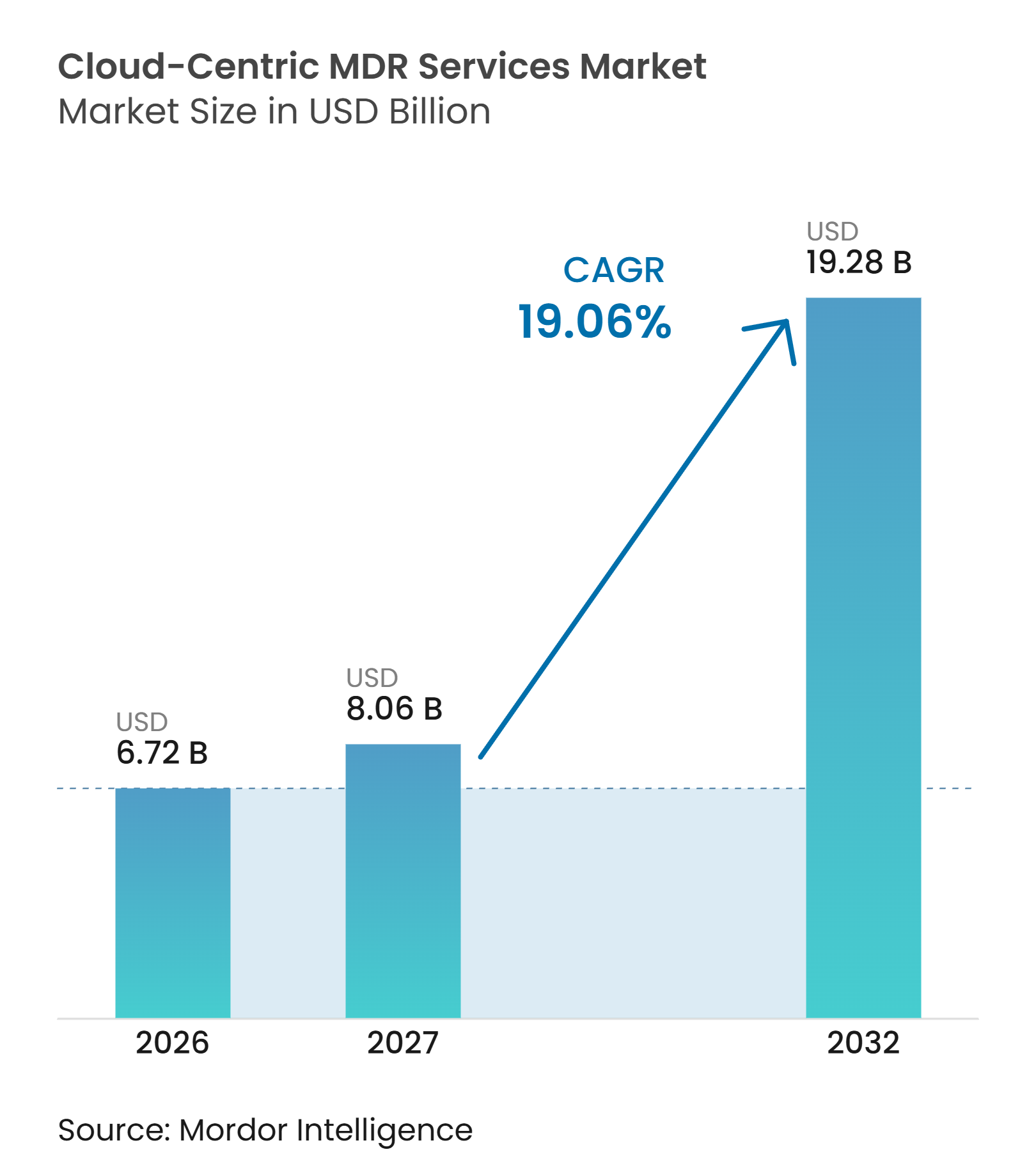
The cloud-centric MDR services market size is projected to expand from USD 6.72 billion in 2026 to USD 8.06 billion in 2027, and to USD 19.28 billion by 2032, registering a CAGR of 19.06% between 2027 and 2032. The cloud-centric MDR services market is being shaped by hybrid and multi-cloud adoption, which increases the number of identities, workloads, and control planes that security teams must monitor. Persistent skills gaps make it difficult to sustain a fully staffed internal security operations center, particularly when continuous coverage is required. Identity misuse now affects cloud workloads, SaaS applications, and service accounts, placing greater emphasis on continuous monitoring than on perimeter controls. Providers are responding by offering broader telemetry coverage, automated investigation, and response workflows that operate across cloud environments. Consolidation is also changing competitive positions, as larger vendors combine threat intelligence, automation capabilities, and managed services.
Key Report Takeaways
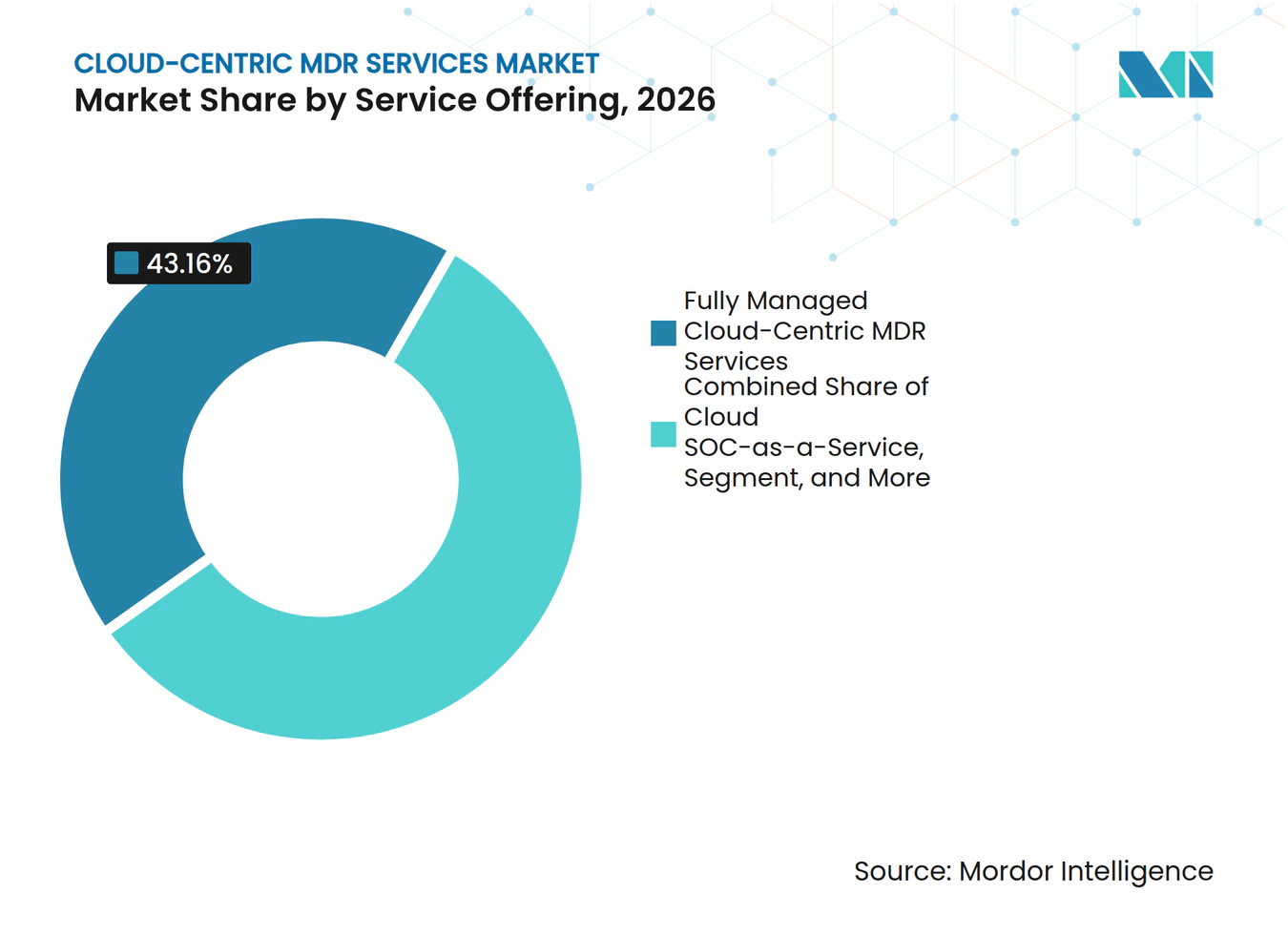
- By service offering, fully managed services held 43.16% of the cloud-centric MDR services market in 2026, while cloud-delivered managed extended detection and response is projected to expand at a 19.86% CAGR through 2032.
- By organization size, large enterprises accounted for 42.72% of revenue in 2026, while SMEs are projected to expand at a 19.44% CAGR through 2032.
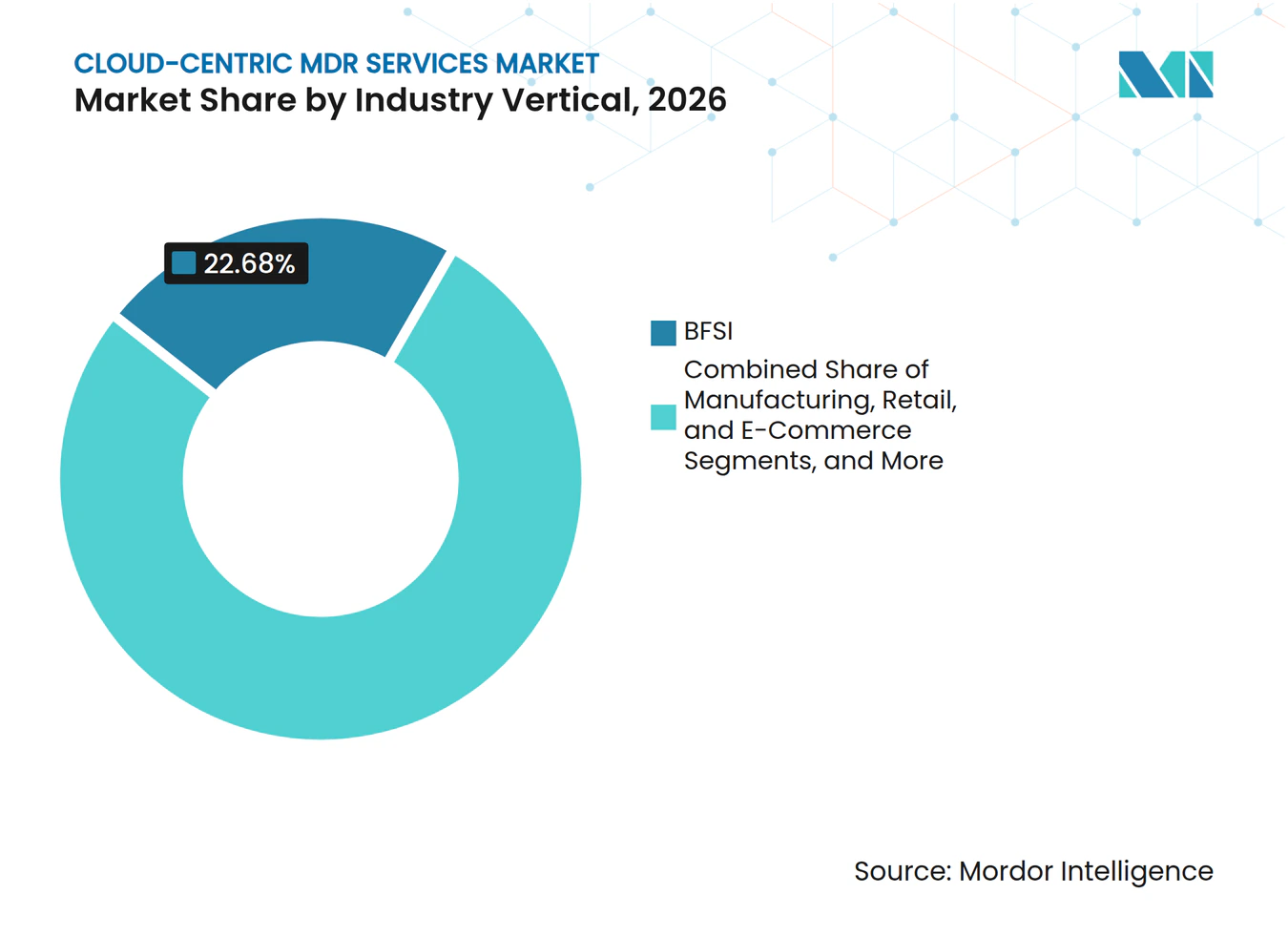
- By industry vertical, BFSI accounted for 22.68% of revenue in 2026, while information technology and telecommunications are projected to expand at a 20.42% CAGR through 2032.
- By geography, North America held 48.23% of revenue in 2026, while Asia-Pacific is projected to expand at a 20.04% CAGR through 2032.
Note: Market numbers in this report are based on Mordor Intelligence's proprietary estimation framework, which combines nine months of actuals with Q4 projections for base year 2026.
Global Cloud-Centric MDR Services Market Trends and Insights
Drivers Impact Analysis*
| Driver | (~) % Impact on CAGR Forecast | Geographic Relevance | Impact Timeline | Value |
|---|---|---|---|---|
| Increasing Complexity of Hybrid and Multi-Cloud Attack Surfaces | +4.2% | Global, the highest intensity in North America and the Asia-Pacific | Long term (≥ 4 years) | 43.16% |
| Cybersecurity Talent Shortages and the Cost of Building Internal SOCs | +3.8% | Global, acute pressure in North America, Europe, and emerging Asia-Pacific markets | Long term (≥ 4 years) | 19.86% |
| Rising Identity-Based Attacks Against Cloud Workloads | +3.2% | Global, initially concentrated in North America and Europe, is expanding to the Asia-Pacific. | Medium term (2-4 years) | 42.72% |
| Regulatory Requirements for Continuous Monitoring and Incident Reporting | +2.8% | EU, North America, and Asia-Pacific | Medium term (2-4 years) | 19.44% |
| Expansion of Cloud-Native Applications, Containers, and Serverless Computing | +2.2% | Global, the highest adoption velocity in North America and the Asia-Pacific core markets | Long term (≥ 4 years) | 22.68% |
| Adoption of AI-Assisted Detection, Investigation, and Automated Response | +1.8% | Global, with early adoption concentrated in North America and Europe | Short term (≤ 2 years) | 20.42% |
| Source: Mordor Intelligence | ||||
Increasing Complexity of Hybrid and Multi-Cloud Attack Surfaces
The cloud-centric MDR services market benefits as hybrid and multi-cloud architecture replace a single, definable security perimeter. IBM X-Force reported that cloud intrusions in 2025 often exploited hybrid identity misconfigurations, including weaknesses in Active Directory Connect, enabling movement from on-premises systems into cloud tenants. This makes the integration layer between identity providers and cloud control planes a significant point of exposure. Cloud-centric MDR services can correlate telemetry across these boundaries to identify lateral movement that endpoint-only tools may miss. Sysdig reported that more than 70% of organizations operate in multi-cloud environments, while the use of automated process-kill responses increased 140% year over year.[1] These conditions support demand for security operations capable of monitoring rapidly changing cloud estates.
Cybersecurity Talent Shortages and the Cost of Building Internal SOCs
Workforce constraints bolster demand in the cloud-centric MDR services market, as continuous internal security operations require scarce skills and sustained investment. SANS found that 60% of organizations identified skills gaps as their main workforce challenge in 2026, compared with a near-even split between skills and headcount concerns in 2025. The same research reported that 95% of organizations said regulatory directives affected hiring decisions in 2026. This places compliance needs alongside operational staffing pressure. Red Canary reported average annual cyber incident costs of USD 3.7 million per organization, while 75% of respondents reported skills shortages in intrusion detection. Managed services offer organizations a subscription-based alternative to recruiting and retaining a round-the-clock SOC team.
Rising Identity-Based Attacks Against Cloud Workloads
Identity-focused attacks are expanding the cloud-centric MDR services market beyond endpoint monitoring. Google Cloud found that identity issues were used for initial access in 83% of cloud and SaaS-related incidents it observed in the second half of 2025. EXPEL recorded identity-based incidents in 68.1% of its investigated cases in the second quarter of 2026, up from 58.7% in the first quarter. Microsoft reported that exposed cloud workloads were attacked in an average of 5.3 hours, and that 78% of attack techniques against critical infrastructure involved cloud identity abuse. SpyCloud found that 42% of affected organizations cited non-human identity misuse or compromise as their leading identity-based event type. Providers with behavior analytics for service accounts, OAuth activity, and cloud control planes are therefore better placed to address these attack paths.
Regulatory Requirements for Continuous Monitoring and Incident Reporting
Regulatory obligations are becoming a direct purchasing factor for the cloud-centric MDR services market. DORA has applied to EU financial entities since January 17, 2025, and includes requirements for ICT risk management, resilience testing, third-party oversight, and incident notification. The ACPR noted in January 2026 that reporting deadlines were rarely met, indicating ongoing operational gaps in incident classification and reporting. NIS2 also requires a 72-hour notification for relevant incidents among essential service operators. India notified the Digital Personal Data Protection Rules in November 2025, with enforcement expected by May 2027. These rules extend the demand for compliance-related monitoring beyond Europe to organizations that manage regulated data in the Asia-Pacific region.
Restraints Impact Analysis*
| Restraint | (~) % Impact on CAGR Forecast | Geographic Relevance | Impact Timeline |
|---|---|---|---|
| Data Sovereignty Restrictions on Cross-Border Security Telemetry | -1.5% | EU, Russia, China, Asia-Pacific national markets, and the Middle East | Long term (≥ 4 years) |
| Integration Complexity Across Heterogeneous Cloud Security Tools | -1.2% | Global, with the highest friction in large enterprises with legacy security tool estates | Medium term (2-4 years) |
| Limited Visibility Into Ephemeral Workloads and Short-Lived Cloud Resources | -0.9% | Global, acute in cloud-native organizations operating large container fleets | Medium term (2-4 years) |
| Customer Concerns About Alert Quality, False Positives, and Provider Lock-In | -0.7% | Global, concentrated in North America and Europe | Short term (≤ 2 years) |
| Source: Mordor Intelligence | |||
Data Sovereignty Restrictions on Cross-Border Security Telemetry
Data sovereignty rules constrain the cloud-centric MDR services market because many managed-service architectures centralize telemetry for analysis. GDPR transfer restrictions, China’s PIPL requirements, and localization rules in Gulf states can limit that approach. Bitdefender found that 77% of IT and security professionals considered data sovereignty increasingly important in purchasing decisions, while 76% would consider changing MDR vendors because of data-jurisdiction concerns. AWS launched its European Sovereign Cloud in January 2026, reinforcing expectations that cloud processing and supporting operations should sit within the relevant legal jurisdiction. Providers in the cloud-centric MDR services market may need isolated telemetry pipelines, SOC operations, and AI environments in each region. That duplication raises delivery costs and favors providers with the resources to establish sovereign service stacks.
Integration Complexity Across Heterogeneous Cloud Security Tools
Integration complexity can slow the adoption of cloud-centric MDR services when organizations operate across multiple clouds, endpoints, SIEM platforms, and cloud-native security products. SANS reported that only 25% of organizations regarded their detection and response budget as fully sufficient, while 66% had partly integrated automated response. Many organizations, therefore, retain hybrid manual workflows with duplicate alerts and incomplete telemetry. A high-severity endpoint signal may not share a common format with a cloud-trail anomaly, leaving analysts to correlate events across vendors. This can extend onboarding, weaken customer confidence, and increase the risk of service churn. Arctic Wolf’s more than 250 ecosystem integrations illustrate why pre-built connectors and normalization capabilities can reduce this friction.
*Our forecasts treat driver/restraint impacts as directional, not additive. The impact forecasts reflect baseline growth, mix effects, and variable interactions.
Segment Analysis
By Service Offering: Fully Managed Leads, but MXDR Reshapes the Field
Fully managed services held 43.16% of the cloud-centric MDR services market share in 2026. The segment addresses enterprises that want an outsourced SOC function covering detection, investigation, and containment in the cloud-centric MDR services market, without relying on internal operations staff. Its position reflects the challenge of sustaining tier-1 monitoring while attack volumes and skills gaps rise. Fully managed providers can control the detection engineering and response cycle, reducing dependence on a customer’s internal analysts. Co-managed services remain relevant for organizations that retain security teams but require specialist support. Cloud SOC-as-a-Service also provides a flexible route for buyers seeking cloud-delivered monitoring capabilities.
Cloud-delivered MXDR is projected to expand at a 19.86% CAGR through 2032, the highest rate among service offerings. The cloud-centric MDR services market size for this segment is supported by demand for a single service across identity, cloud infrastructure, SaaS, endpoints, and operational technology. Buyers are increasingly reluctant to manage separate contracts for narrow detection products. Agentic AI can also support faster triage, investigation, and containment across several telemetry sources. This allows MXDR providers to present broader coverage without increasing manual analyst effort at the same pace.



By Organization Size: SMEs Accelerate as Cyber-Insurance Economics Shift
Large enterprises accounted for 42.72% of revenue in 2026. Their multi-cloud estates, valuable data, and compliance obligations require continuous monitoring and incident response capabilities. These buyers often request custom detection playbooks, embedded threat intelligence, and dedicated service models. Such requirements support premium contract values above those of standard MSSP offerings. Rapid7 stated that its agentic AI workflows, launched in June 2025, saved more than 200 SOC analyst hours each week and achieved 99.93% accuracy in closing benign alerts.[2]This kind of automation addresses both staffing economics and audit requirements for large customers.
SMEs are projected to expand at a 19.44% CAGR through 2032. Cyber-insurance requirements, supply-chain clauses, and white-label delivery through managed service providers are widening access to 24/7 coverage in the cloud-centric MDR services market. CrowdStrike found that only 20% of SMBs use an external security provider or MSP, indicating that many potential buyers remain underserved. The cloud-centric MDR services industry can reach this group through packaged services that reduce deployment complexity and minimize contract barriers. Arctic Wolf, Huntress, and Blackpoint Cyber are positioned around the MSP channel, where providers can extend coverage across multiple smaller customers. This channel is important because it gives smaller organizations access to specialized operations without having to build them internally.
By Industry Vertical: BFSI Anchors Demand While IT and Telecom Lead Growth
BFSI held 22.68% market share in the cloud-centric MDR services market in 2026. DORA has made cloud-aware monitoring and incident reporting a compliance need for EU financial entities rather than a discretionary purchase. Financial organizations are particularly exposed to credential misuse, multi-factor authentication abuse, and OAuth token theft. IBM identified hybrid identity misconfigurations as a major cloud entry point, which reinforces the value of identity threat detection and response in this vertical. Healthcare and life sciences, government and public administration, and manufacturing form the next demand tier. These sectors are managing a combined IT, operational technology, and ransomware risk profile.
Information technology and telecommunications are projected to expand at a 20.42% CAGR through 2032. The sector builds and operates cloud infrastructure while also protecting APIs, software supply chains, and customer-data pipelines. Containers, serverless functions, and CI/CD pipelines can be difficult to protect using traditional MDR tooling in the cloud-centric MDR services market. Cloud-centric MDR services with Kubernetes audit log analysis and service account anomaly detection are becoming increasingly important for enterprise technology and SaaS providers. Retail and e-commerce are also increasing adoption as PCI DSS 4.0 requirements and cloud-hosted payment exposure become more significant. Manufacturing demand is supported by the convergence of IT and operational technology networks and the need to correlate telemetry across both environments.

Geography Analysis
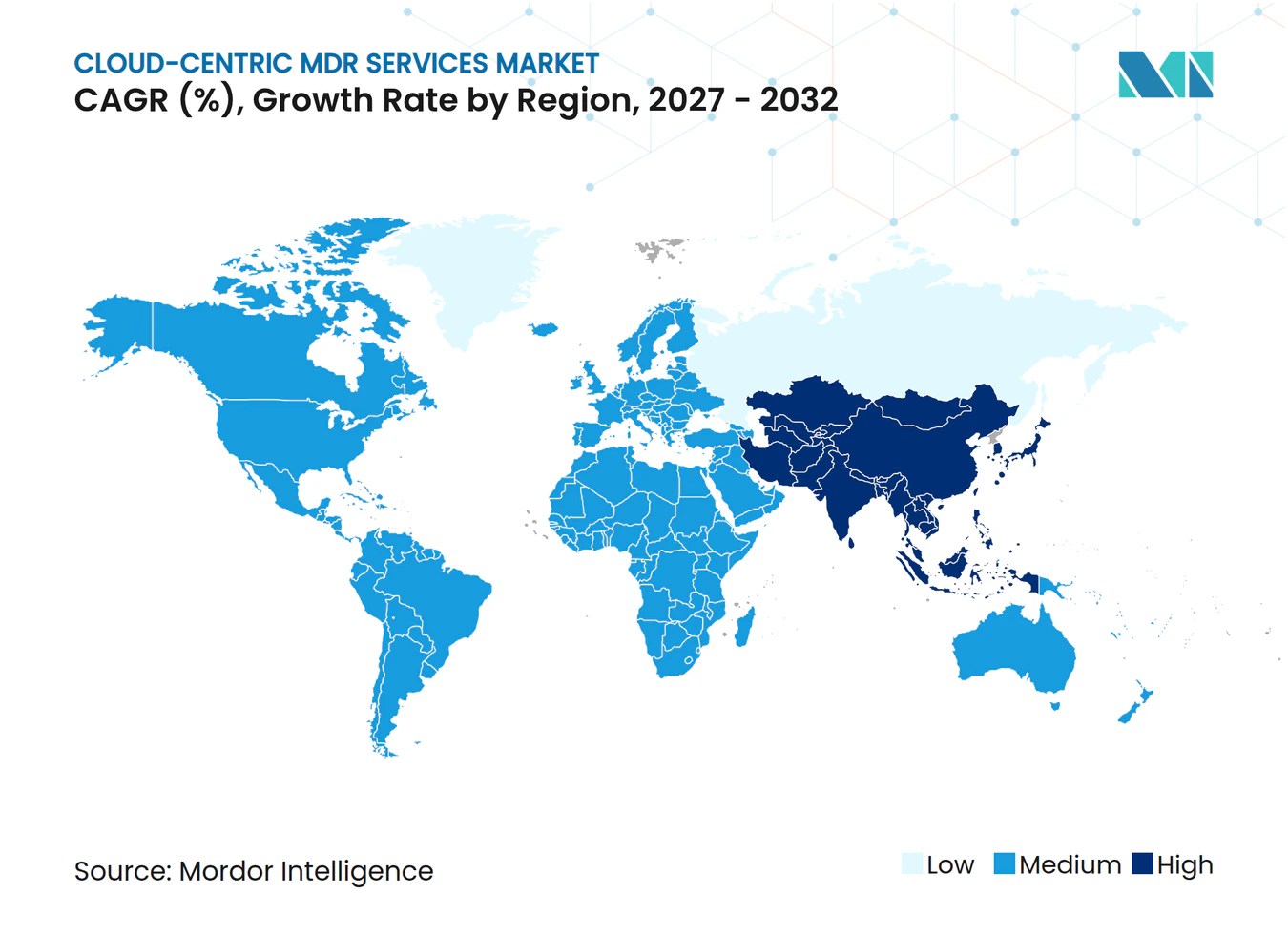
North America held 48.23% of revenue in 2026 and remains the largest regional contributor to the cloud-centric MDR services market. The region has a dense base of regulated enterprises and extensive use of security tools integrated with large cloud providers in the cloud-centric MDR services market. The United States leads regional demand through cybersecurity disclosure rules, monitoring needs in banking, and cyber-insurance conditions that encourage MDR adoption. Canada is a secondary growth area, particularly in financial services and critical infrastructure. Mexico is at an earlier stage and is commonly served by providers headquartered in the United States. South America is an emerging opportunity, with demand centered on Brazil’s financial sector and cloud-compliance investment associated with the Lei Geral de Proteção de Dados.
Europe faces strong compliance-related demand because NIS2 and DORA cover financial services, healthcare, energy, transport, and digital infrastructure. DORA has been applied in full since January 2025, and it requires structured ICT risk and incident management practices. The cloud-centric MDR services market size in the region is influenced by data sovereignty, as buyers increasingly expect telemetry processing, SOC activity, and AI training to remain within EU legal jurisdictions. Bitdefender launched a program in July 2026 for a fully EU-resident cybersecurity and MDR stack staffed by EU-based analysts.[3] The United Kingdom maintains separate demand under UK GDPR and Network and Information Systems Regulations. In the Middle East and Africa, Saudi Arabia, the UAE, and South Africa lead in demand, although sovereign cloud capacity can constrain cloud-centric service adoption.
Asia-Pacific is projected to expand at a 20.04% CAGR through 2032, the fastest regional rate. Japan’s alert management workload and use of endpoint detection tools have driven demand for SOC outsourcing. India’s Digital Personal Data Protection Rules create a compliance schedule that supports security spending in financial services, healthcare, and technology. India’s Computer Emergency Response Team also requires breach reporting within 6 hours for specified incidents. South Korea and Australia are comparatively mature cloud-MDR markets with rising investment in agentic SOC capabilities. Vietnam’s Personal Data Protection Law became effective on January 1, 2026, while Singapore’s expanding data-protection obligations add demand across Southeast Asia.
Competitive Landscape
Market Concentration
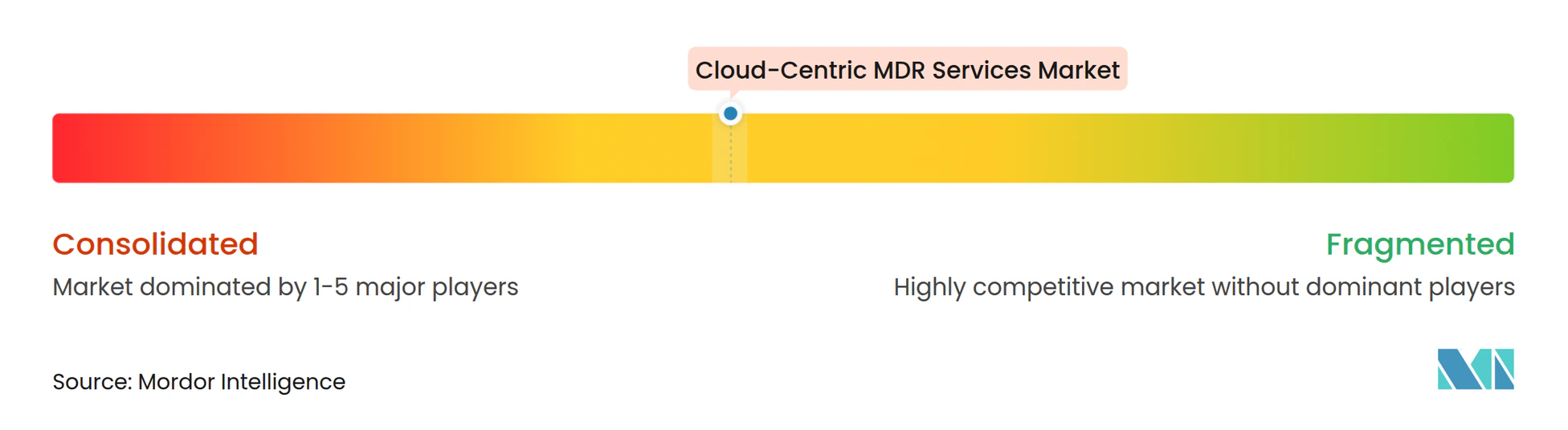
The cloud-centric MDR services market has moderate concentration among leading vendors and substantial fragmentation in the mid-market and MSP-focused tiers. Arctic Wolf Networks, CrowdStrike, eSentire, Rapid7, and ReliaQuest compete through cloud telemetry breadth, AI-based detection engineering, and containment speed. Sophos completed its acquisition of Secureworks in February 2025 for USD 859 million, combining the Sophos portfolio with Taegis XDR, the Counter Threat Unit, and identity threat detection and response capabilities. Zscaler’s acquisition of Red Canary also demonstrates interest from large network and identity security vendors in MDR capabilities.
Agentic AI is a central area of competition in the cloud-centric MDR services market, where providers seek more efficient investigative operations. CrowdStrike introduced Agentic MDR in March 2026 and expanded its collaboration with NVIDIA to use Nemotron models in investigative workflows.[4] The company stated that internal testing showed up to 5x faster investigations and more than 3x higher triage accuracy, while Nemotron Nano achieved 96% accuracy in generating investigation queries in Falcon LogScale. Arctic Wolf launched Aurora MDR Connect in September 2026 as an MSP-exclusive MDR tier supported by its Aurora Superintelligence Platform and Agentic SOC. SentinelOne acquired Prompt Security and announced the acquisition of Observo AI in September 2025, building AI-focused telemetry and runtime protection capabilities.
The MSP-delivered and SME-focused tier remains an important competitive opening. Organizations with 50 to 500 employees in regulated fields often need continuous monitoring but face budget and deployment constraints. Vendors that package services for MSPs can reduce those obstacles while extending their reach across many smaller customers. Sovereign service delivery is another differentiator, with data residency requirements influencing procurement. SentinelOne and Schwarz Digits announced a September 2025 partnership to provide AI-powered MDR on STACKIT sovereign cloud in Germany, addressing ISO 27001 and BSI C5 requirements. The cloud-centric MDR services industry, therefore, combines large-platform competition with regional and channel-led opportunities for specialist providers.
Cloud-Centric MDR Services Industry Leaders
-
CrowdStrike Holdings, Inc.
-
Arctic Wolf Networks, Inc.
-
eSentire Inc.
-
Expel, Inc.
-
Red Canary, Inc.
- *Disclaimer: Major Players sorted in no particular order
Recent Industry Developments
- September 2026: Arctic Wolf launched Aurora MDR Connect, an MSP-exclusive tier of Aurora Managed Detection and Response powered by the Aurora Superintelligence Platform and Agentic SOC. The offering enables MSPs to deploy 24/7 detection, investigation, and pre-authorized response across customer environments at scale, with investigations resolved in seconds through the AI Trust Engine, directly addressing the MSP cost model constraint of adding SOC analyst headcount to expand managed-security revenue.
- July 2026: Bitdefender launched its Sovereign Acceleration Program on July 9, 2026, enabling European organizations to migrate to a fully EU-resident cybersecurity and MDR stack delivered by EU-based analysts from an EU-domiciled SOC. The program includes a contract buyout offer to accelerate the displacement of non-EU cybersecurity vendors, directly targeting data-sovereignty-driven switching behavior in regulated European sectors.
- March 2026: Bitdefender launched its Sovereign Acceleration Program on July 9, 2026, enabling European organizations to migrate to a fully EU-resident cybersecurity and MDR stack delivered by EU-based analysts from an EU-domiciled SOC. The program includes a contract buyout offer to accelerate the displacement of non-EU cybersecurity vendors, directly targeting data-sovereignty-driven switching behavior in regulated European sectors.
- February 2026: Arctic Wolf acquired Sevco Security, adding cloud and IT asset intelligence to the Aurora platform to strengthen visibility across dynamic cloud inventories. Arctic Wolf was also selected as a preferred MDR provider by Chubb, deepening the strategic intersection between cyber insurance and managed security.
Global Cloud-Centric MDR Services Market Report Scope
The Cloud-Centric MDR Services Market refers to the market for managed cybersecurity services that provide continuous threat monitoring, detection, investigation, and response across cloud-based and hybrid IT environments. These services combine cloud security telemetry, threat intelligence, security analytics, and security operations expertise to identify and respond to threats targeting cloud infrastructure, workloads, identities, applications, and data. The market includes fully managed and co-managed detection and response services, cloud security operations center services, and cloud-delivered extended detection and response services.
The Cloud-Centric MDR Services Market is Segmented by Service Offering (Fully Managed Cloud-Centric MDR Services, Co-Managed Cloud-Centric MDR Services, Cloud SOC-as-a-Service, and Cloud-Delivered Managed Extended Detection and Response), by Organization Size (Small and Medium Enterprises, and Large Enterprises), by Industry Vertical (BFSI, Healthcare and Life Sciences, Government and Public Administration, Information Technology and Telecommunications, Manufacturing, Retail and E-Commerce, and Other Industry Verticals), and by Geography (North America, South America, Europe, Asia-Pacific, Middle East, and Africa). The Market Forecasts are Provided in Terms of Value (USD).
| Fully Managed Cloud-Centric MDR Services |
| Co-Managed Cloud-Centric MDR Services |
| Cloud SOC-as-a-Service |
| Cloud-Delivered Managed Extended Detection and Response |
| Small and Medium Enterprises |
| Large Enterprises |
| BFSI |
| Healthcare and Life Sciences |
| Government and Public Administration |
| Information Technology and Telecommunications |
| Manufacturing |
| Retail and E-Commerce |
| Other Industry Verticals |
| North America | United States |
| Canada | |
| Mexico | |
| South America | Brazil |
| Argentina | |
| Chile | |
| Rest of South America | |
| Europe | Germany |
| United Kingdom | |
| France | |
| Italy | |
| Spain | |
| Russia | |
| Rest of Europe | |
| Asia-Pacific | China |
| Japan | |
| India | |
| South Korea | |
| Australia | |
| Rest of Asia-Pacific | |
| Middle East | Saudi Arabia |
| United Arab Emirates | |
| Turkey | |
| Rest of Middle East | |
| Africa | South Africa |
| Nigeria | |
| Egypt | |
| Rest of Africa |
| By Service Offering | Fully Managed Cloud-Centric MDR Services | |
| Co-Managed Cloud-Centric MDR Services | ||
| Cloud SOC-as-a-Service | ||
| Cloud-Delivered Managed Extended Detection and Response | ||
| By Organization Size | Small and Medium Enterprises | |
| Large Enterprises | ||
| By Industry Vertical | BFSI | |
| Healthcare and Life Sciences | ||
| Government and Public Administration | ||
| Information Technology and Telecommunications | ||
| Manufacturing | ||
| Retail and E-Commerce | ||
| Other Industry Verticals | ||
| By Geography | North America | United States |
| Canada | ||
| Mexico | ||
| South America | Brazil | |
| Argentina | ||
| Chile | ||
| Rest of South America | ||
| Europe | Germany | |
| United Kingdom | ||
| France | ||
| Italy | ||
| Spain | ||
| Russia | ||
| Rest of Europe | ||
| Asia-Pacific | China | |
| Japan | ||
| India | ||
| South Korea | ||
| Australia | ||
| Rest of Asia-Pacific | ||
| Middle East | Saudi Arabia | |
| United Arab Emirates | ||
| Turkey | ||
| Rest of Middle East | ||
| Africa | South Africa | |
| Nigeria | ||
| Egypt | ||
| Rest of Africa | ||
Key Questions Answered in the Report
What is the size of the cloud-centric MDR services market?
The cloud-centric MDR services market size is USD 6.72 billion in 2026 and is projected to reach USD 19.28 billion by 2032, at a 19.06% CAGR from 2027 to 2032.
What is driving demand for cloud-centric MDR services?
Hybrid cloud complexity, cybersecurity skills gaps, identity-based attacks, and incident-reporting requirements are key drivers of demand.
Which cloud-centric MDR service offering has the largest share?
Fully managed services lead with a 43.16% share in 2026 because organizations seek a fully outsourced SOC function.
Which organization size is expanding fastest?
SMEs are projected to expand at a 19.44% CAGR through 2032, supported by cyber-insurance requirements and MSP-delivered services.
Which sector has the highest cloud-centric MDR services demand?
BFSI leads with a 22.68% share in 2026, while information technology and telecommunications are projected to expand at a 20.42% CAGR through 2032.
Which region is expanding fastest for cloud-centric MDR services?
Asia-Pacific is projected to expand at a 20.04% CAGR through 2032, supported by cloud adoption and evolving data-protection requirements.