
Climate Change Consulting Market Size and Share
Market Overview
| Study Period | 2020 - 2031 |
|---|---|
| Market Size (2026) | USD 16.17 Billion |
| Market Size (2031) | USD 25.04 Billion |
| Growth Rate (2026 - 2031) | 9.14 % |
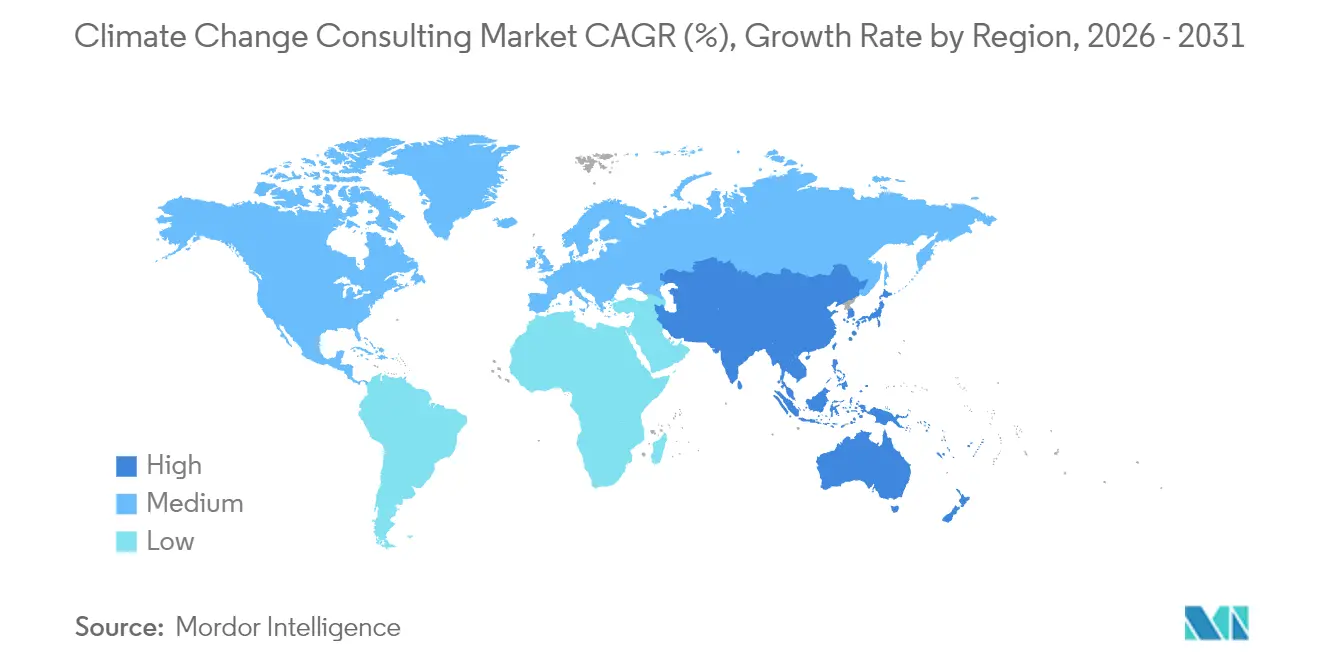
| Fastest Growing Market | Asia Pacific |
| Largest Market | North America |
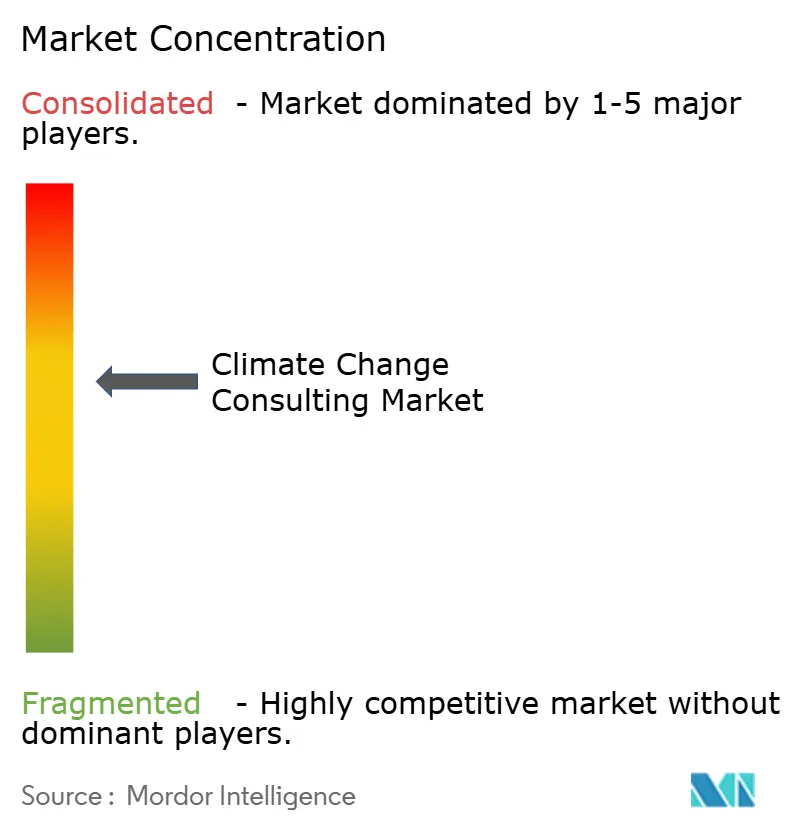
| Market Concentration | Medium |
Major Players *Disclaimer: Major Players sorted in no particular order Image © Mordor Intelligence. Reuse requires attribution under CC BY 4.0. | |
Climate Change Consulting Market Analysis by Mordor Intelligence
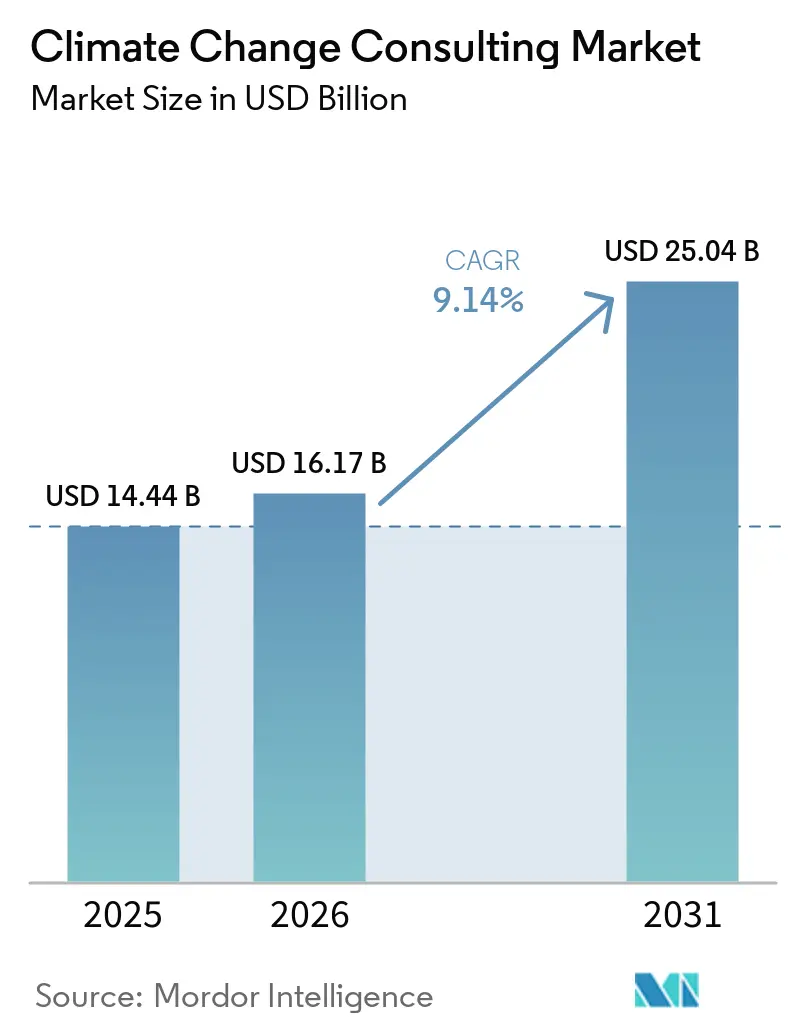
The climate change consulting market size was valued at USD 14.44 billion in 2025 and is estimated to grow from USD 16.17 billion in 2026 to reach USD 25.04 billion by 2031, at a CAGR of 9.14% during the forecast period (2026-2031). Mandatory disclosure rules in the United States and European Union have transformed advisory spending from optional to essential, while the rapid rise of sustainability-linked finance instruments has embedded independent verification into capital-raising processes. Large enterprises are driving near-term revenue as they race to meet accelerated reporting deadlines, yet small and medium enterprises are fast catching up because supply-chain scorecards now link contract renewals to verified decarbonization road maps. Consulting firms that fuse climate science, finance, and digital engineering skills are enjoying premium margins, and they are using AI-based scenario tools to compress project timelines and strengthen value propositions. Meanwhile, investors enforcing shadow carbon audits has created recurring demand for portfolio-level analytics, nudging the climate change consulting market toward double-digit expansion through mid-decade.
Key Report Takeaways
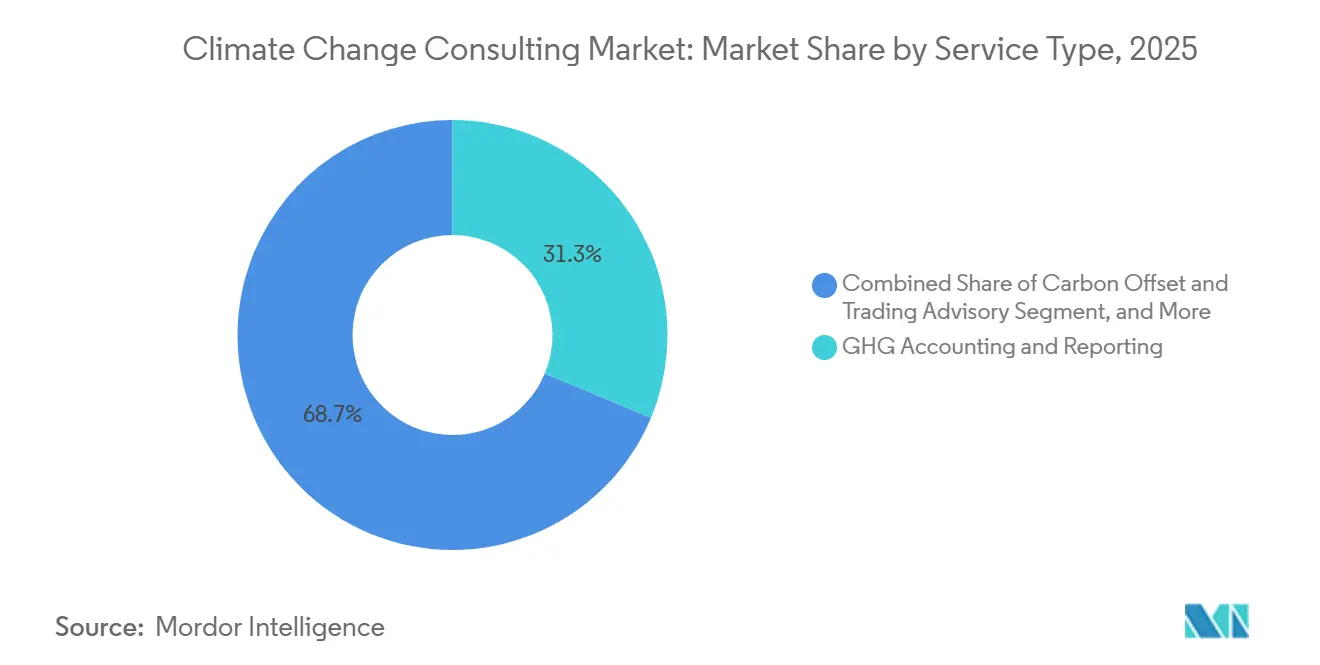
- By service type, GHG accounting and reporting led with 31.28% of revenue in 2025, while climate adaptation and resilience planning is projected to grow at an 11.40% CAGR through 2031.
- By end-user industry, energy and power captured 28.53% of 2025 spending, whereas mining and metals are forecast to advance at a 10.61% CAGR by 2031.
- By organization size, large enterprises accounted for 66.75% of market value in 2025, but small and medium enterprises are expected to expand at a 10.84% CAGR during 2026-2031.
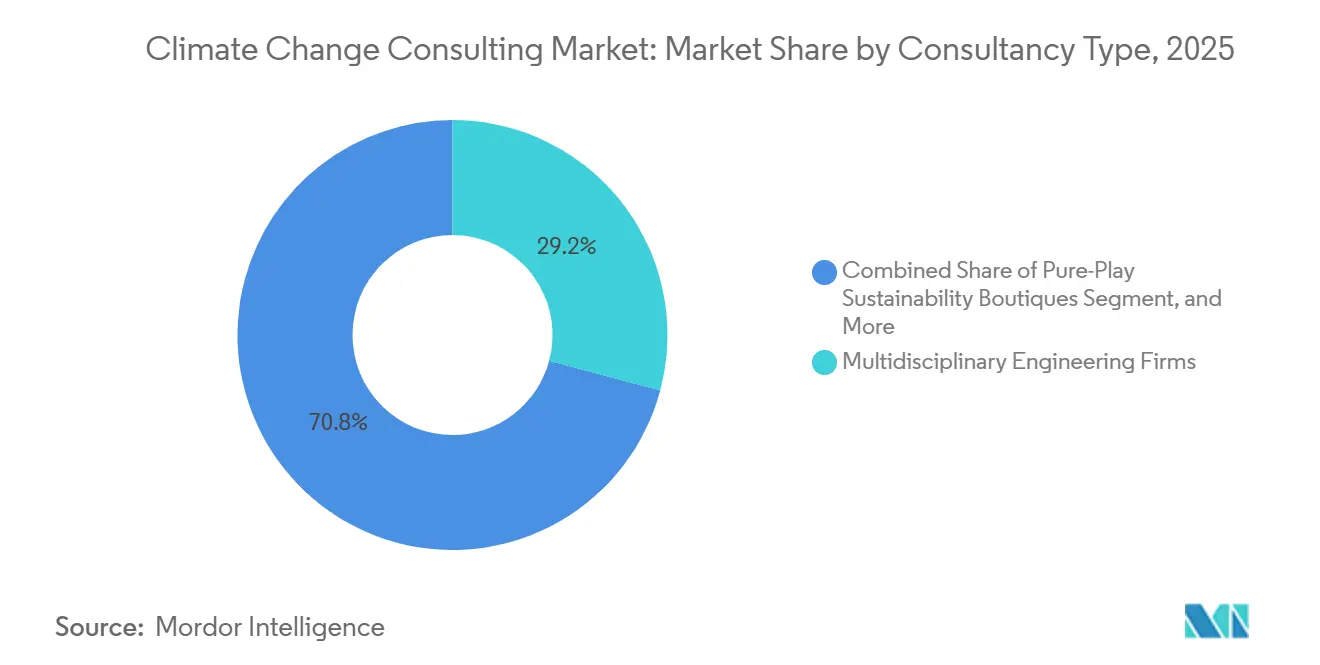
- By consultancy type, multidisciplinary engineering firms held a 29.16% share in 2025, while pure-play sustainability boutiques are set to record an 11.18% CAGR to 2031.
- By delivery mode, on-site advisory represented 52.74% of revenue in 2025, yet hybrid engagements are poised to increase at an 11.29% CAGR through 2031.
- By geography, North America commanded 37.33% of 2025 sales, and Asia-Pacific is anticipated to register an 11.07% CAGR over 2026-2031.
Note: Market size and forecast figures in this report are generated using Mordor Intelligence’s proprietary estimation framework, updated with the latest available data and insights as of 2026.
Market Trends and Insights
Drivers Impact Analysis of Climate Change Consulting Market*
| Driver | (~) % Impact on CAGR Forecast | Geographic Relevance | Impact Timeline |
|---|---|---|---|
| Mandatory ESG Disclosures Tightening Worldwide | +2.80% | Global, with early enforcement in North America and Europe | Short term (≤ 2 years) |
| Corporate Carbon-Shadow Audits Demanded by Investors | +1.90% | North America, Europe, Asia-Pacific financial hubs | Medium term (2-4 years) |
| Rapid Scaling of Sustainability-Linked Finance Instruments | +2.10% | Global, concentrated in OECD markets | Medium term (2-4 years) |
| Supply-Chain Decarbonization Pressures from OEMs | +1.60% | Global, strongest in automotive and electronics supply chains | Long term (≥ 4 years) |
| Breakthroughs in AI-Driven Climate-Risk Analytics | +1.40% | North America, Europe, select Asia-Pacific markets | Long term (≥ 4 years) |
| Growing Demand for Nature-Based Carbon Removal Advisory | +1.20% | Global, with pilot projects in South America and Africa | Long term (≥ 4 years) |
| Source: Mordor Intelligence | |||
Mandatory ESG Disclosures Tightening Worldwide
Rulemaking by the U.S. Securities and Exchange Commission in 2024 and the European Union’s Corporate Sustainability Reporting Directive in the same year triggered a wave of baseline emission assessments and internal-control upgrades.[1] The International Sustainability Standards Board harmonized reporting through IFRS S1 and S2, removing jurisdictional arbitrage and raising the rigor bar.[2] Consultants now design data architectures, run double-materiality analyses, and prepare audit-ready files that satisfy phased deadlines rolling from 2025 to 2028. Because disclosures require third-party assurance, advisory demand persists beyond first filings, creating multi-year revenue visibility for the climate change consulting market.
Corporate Carbon-Shadow Audits Demanded by Investors
Asset managers overseeing USD 130 trillion under the Net Zero Asset Managers initiative began ordering portfolio companies to publish financed-emission pathways in 2024. The Partnership for Carbon Accounting Financials standardized Scope 3 calculations, compelling banks and insurers to audit holdings and remediate laggards. Private-equity sponsors now embed climate covenants into management agreements that can adjust earn-outs. Consultants secure dual mandates, serving investors with portfolio screens and investees with deep dive decarbonization road maps, reinforcing recurring revenue for the climate change consulting market.
Rapid Scaling of Sustainability-Linked Finance Instruments
Cumulative issuance of sustainability-linked loans and bonds hit USD 1.2 trillion in 2025. Updated 2024 ICMA principles tightened ambition and verification thresholds, obligating borrowers to hire advisers for target setting and annual reporting.[3] Banks now insist on independent technical opinions before underwriting, expanding pre-issuance advisory layers. A shortage of ISO 14097-accredited verifiers has prompted engineering groups to acquire certification firms, aligning assurance and advisory and deepening the climate change consulting market penetration.
Supply-Chain Decarbonization Pressures from OEMs
Automotive leaders announced that supplier Scope 3 emissions would influence scorecards by 2026, putting non-compliant vendors at risk of delisting. CDP recorded 23,000 supplier disclosures in 2025, yet fewer than 20% had science-based targets.[4] Electronics brands applied similar demands, catalysing advisory uptake among Asia-Pacific SMEs that lack in-house expertise. Consultants navigate allocation-method disputes and run supplier workshops, locking in long-horizon engagements that buoy the climate change consulting market.
Restraints Impact Analysis of Climate Change Consulting Market*
| Restraint | (~) % Impact on CAGR Forecast | Geographic Relevance | Impact Timeline |
|---|---|---|---|
| Scarcity of Verifiable Scope 3 Emissions Data | -1.30% | Global, most acute in emerging markets and complex supply chains | Short term (≤ 2 years) |
| Inconsistent Regional Carbon-Pricing Mechanisms | -0.90% | Global, with divergence between EU ETS, California, and voluntary markets | Medium term (2-4 years) |
| Talent Shortage at the Climate Science–Finance Interface | -1.10% | North America, Europe, select Asia-Pacific hubs | Long term (≥ 4 years) |
| Green-Washing Litigation Risk Discouraging Advisory Uptake | -0.70% | North America, Europe | Short term (≤ 2 years) |
| Source: Mordor Intelligence | |||
Scarcity of Verifiable Scope 3 Emissions Data
Scope 3 often represents 70%-90% of a company’s footprint, yet supplier data remain fragmented, forcing reliance on spend-based proxies that can deviate by more than 50%. The International Sustainability Standards Board has only started consultations on better methodologies, delaying standardization until at least 2027. Automotive and electronics supply chains are particularly exposed, where multinationals source from over 50 countries. Persistent data gaps frustrate clients and postpone multi-year commitments, tempering expansion within the climate change consulting market.
Inconsistent Regional Carbon-Pricing Mechanisms
EU ETS allowances cost EUR 85 per metric ton (USD 96) in January 2026, while California’s cap-and-trade cleared at USD 38 and voluntary offsets traded at USD 12-25. China extended trading to steel and cement in 2025 but handed out free allowances that muted price signals. Variability complicates internal pricing models that consultants build for multinationals. Clients often split mandates by region, raising coordination costs and elongating decision cycles, thus shaving growth off the climate change consulting market.
*Our forecasts treat driver/restraint impacts as directional, not additive. The impact forecasts reflect baseline growth, mix effects, and variable interactions.
Climate Change Consulting Market Segment Analysis
By Service Type:
Reporting Dominance Yields to Adaptation PlanningThe climate change consulting market size for GHG accounting and reporting reached USD 1.90 billion in 2025, equal to 31.28% of total revenue. Companies prioritized baseline inventories to satisfy new disclosure laws, positioning this service as the entry point for most engagements. As physical risk becomes financially material, climate adaptation and resilience planning is projected to grow at an 11.40% CAGR, the fastest among service types. This shift reallocates spend toward flood modelling, heat stress mapping, and resilience investment road maps. The interplay of disclosure, risk quantification, and financing has created bundled offerings that integrate scenario analysis with adaptation capex planning, reinforcing cross-selling opportunities in the climate change consulting market.
Decarbonization strategy services have moved beyond marginal-abatement cost curves to evaluate hydrogen, carbon capture, and electrification options. Advisors increasingly integrate sustainable finance structuring, tying investment road maps to green bonds or sustainability-linked loans. Carbon offset and trading advisory remains modest because integrity reviews invalidated many forestry credits, but demand persists for high-quality nature-based removal projects, especially where clients pursue net-zero claims that require residual offsetting. Biodiversity and circular-economy consulting, presently niche, is expanding as forthcoming European due-diligence rules widen the definition of environmental impact, promising incremental revenue for specialized firms within the climate change consulting market.

By End-User Industry:
Mining and Metals Outpace Energy TransitionEnergy and power generated USD 1.73 billion in 2025, representing 28.53% of climate change consulting market revenue. Utilities faced immediate disclosure deadlines and cap-and-trade obligations, driving heavy spend on baseline audits and road maps. Mining and metals, while smaller, will expand at a 10.61% CAGR to 2031 as investors push for credible Scope 1 and 2 pathways that align with sector net-zero commitments. Consultants advise on electrified haul trucks, green hydrogen direct-reduced iron, and renewable power integration, fostering robust demand for techno-economic analysis.
Public-sector demand is rising because multilateral climate-finance channels require feasibility studies before disbursing funds. Manufacturing, spanning automotive to chemicals, is embedding decarbonization into capital-planning cycles, generating multi-disciplinary mandates that blend process engineering with climate finance guidance. Financial-services institutions need portfolio-level risk analytics to comply with central-bank stress tests. ICT and telecom operators hire advisers for data-center energy optimization and supply-chain footprint reductions. Agriculture, food, transportation, and logistics are broadening the base of the climate change consulting market, each with distinct service requirements from soil-carbon measurement to fleet electrification scenarios.
By Organization Size:
SMEs Accelerate Under Supply-Chain MandatesLarge enterprises commanded two-thirds of 2025 spending, but SME engagements are rising because OEM scorecards now link contract awards to verified science-based targets. The climate change consulting market size for SMEs is projected to reach USD 1.87 billion by 2031, expanding alongside platform-based advisory models that lower unit costs. Consultants serving SMEs often bundle carbon accounting with financing referrals to development-bank green-loan windows, accelerating uptake among capital-constrained suppliers.
Large-enterprise programs remain deeper and broader, featuring enterprise resource planning integrations and board-level scenario modelling. Premium pricing prevails in these bespoke mandates, but project durations are lengthening because clients navigate cross-border disclosure complexity. Advisory firms are segmenting their go-to-market strategies accordingly, either scaling standardized SME platforms or doubling down on relationship-driven enterprise practices, a trend that shapes competitive dynamics in the climate change consulting market.
By Consultancy Type:
Boutiques Gain Share Through SpecializationMultidisciplinary engineering firms held 29.16% of 2025 revenue. Their site experience in infrastructure and heavy industry underpins competitive strength in adaptation planning and facility-level decarbonization. Pure-play sustainability boutiques, though more fragmented, will post the highest growth at 11.18% CAGR. Their edge lies in specialized offerings such as nature-based carbon removal and science-based target validation, areas where clients value deep expertise over scale.
Big Four accounting firms dominate assurance-led engagements, leveraging audit relationships yet remaining constrained by independence rules. Management consultancies integrate climate with corporate strategy, bundling transformation road maps with cost savings and growth initiatives. Think tanks and NGOs occupy a hybrid niche, supplying credibility and mission alignment for public-sector and philanthropic clients. Acquisition activity is intensifying as larger platforms buy boutiques to shore up capability gaps, a dynamic that will continue to redefine the climate change consulting market landscape.
By Delivery Mode:
Hybrid Models Optimize Cost and ExpertiseOn-site advisory retained 52.74% of 2025 billings as facility audits, workshops, and board presentations benefit from physical presence. However, hybrid models mixing remote analytics with targeted site visits will expand at 11.29% CAGR, driven by 40%-60% travel cost savings and faster turnaround times. Remote-only advisory thrives for standardized reviews and training, yet satisfaction dips for complex strategy mandates.
Digital workspaces and AI-based scenario dashboards allow consultants to iterate with clients asynchronously, but engagement plans now spell out which milestones require on-site validation to secure project robustness. Regional preferences also shape delivery: Asia-Pacific clients lean toward in-person engagement, whereas North America and Europe increasingly accept hybrid and remote formats. This delivery diversification adds resilience to the climate change consulting market.
Geography Analysis
North America Climate Change Consulting Market
North America produced 37.33% of global revenue in 2025, anchored by the SEC disclosure rule and California’s cap-and-trade program that cover thousands of issuers and industrial plants. Canada’s carbon-pricing backstop, which rose to CAD 80 per metric ton (USD 59) in 2025, stimulated advisory demand in energy, mining, and manufacturing. Mexico’s pilot emissions-trading system, although narrow, sets the stage for future engagements. Regulatory litigation in the United States introduces execution risk, leading some firms to phase spending until legal clarity emerges, but the sheer depth of capital markets sustains baseline demand for financed-emission analytics, bolstering the climate change consulting market.
Europe Climate Change Consulting Market
Europe ranks second in revenue, propelled by the Corporate Sustainability Reporting Directive, EU Taxonomy Regulation, and Carbon Border Adjustment Mechanism that jointly constitute the world’s strictest disclosure and pricing framework. Germany’s EUR 30 billion (USD 34 billion) subsidy program for green hydrogen and electrification fuels feasibility studies, while the United Kingdom’s transition-plan rules require forward-looking scenario reports. France’s Article 29 obligations drive portfolio analytics, and Nordic corporates pursue nature-based removal projects for net-zero claims. These overlapping mandates generate high-value, multi-jurisdictional advisory work that reinforces the region’s influence on the climate change consulting market.
APAC Climate Change Consulting Market
Asia-Pacific is the fastest-growing region at an 11.07% CAGR. China expanded its national emissions trading system to eight sectors in 2025 and linked dual-carbon goals to provincial action plans, spawning city-level consulting contracts. India finalized its green taxonomy and tightened energy-efficiency standards, compelling hard-to-abate industries to seek advisory. Japan’s Green Transformation League is channelling USD 150 billion into low-carbon projects, while South Korea’s carbon-neutrality framework mandates sectoral road maps. Southeast Asian countries vie for climate-finance inflows, but local consulting capacity remains thin, creating entry opportunities for global players eager to enlarge their footprint in the climate change consulting market.
MEA and South America Climate Change Consulting Market
South America and Middle East and Africa are smaller but quickening. Brazil’s regulated carbon market, expected in 2027, already motivates pre-compliance audits. Sovereign wealth funds in the Middle East are allocating capital to renewables, and national oil companies need transition strategies aligned with UAE’s net-zero pledge. These developments are laying the groundwork for an increasingly diversified climate change consulting market across emerging regions.
Regulatory Landscape
Climate-related disclosure and taxonomy regimes are tightening, and they are shifting consulting spend toward audit-ready reporting, controls, and assurance coordination across jurisdictions. In the United States, U.S. Securities and Exchange Commission climate-disclosure rulemaking in 2024 and California initiatives such as SB 253 support structured Scope 1 and 2 reporting programs, while global convergence is reinforced by International Sustainability Standards Board standards (IFRS S1 and S2) that raise baseline rigor for multi-market issuers.
In Europe, the Corporate Sustainability Reporting Directive and the EU Taxonomy Regulation continue to shape double-materiality, data architecture, and verification work, though policy updates are still moving through implementation cycles. The European Commission prepared a draft Amended Climate Delegated Act aimed at simplifying technical screening criteria, with application scheduled for January 1, 2027. The United Kingdom advanced transition-plan and reporting architecture through proposed UK Sustainability Reporting Standards and related FCA proposals, including climate disclosures from January 1, 2027, and Scope 3 on a comply-or-explain basis from 2028. Alongside border and pricing tools such as CBAM-related verification rules, these changes add demand for emissions quantification and documentation that can withstand regulator and auditor scrutiny.
Competitive Landscape
The climate change consulting market remains moderately fragmented; the top five providers hold about 35% combined share. Big Four auditors leverage assurance expertise, engineering firms capitalize on technical depth, and pure-play boutiques win high-complexity mandates. Technology investment is the new battleground. Deloitte deployed an AI scenario platform that halves analysis time, WSP bought a geospatial analytics company to refine physical-risk models, and AECOM partnered with a cloud provider to run digital twins for industrial facilities.
Meanwhile, software-as-a-service start-ups that automate carbon accounting threaten to commoditize entry-level work, prompting incumbents to focus on transformation programs where strategic insight carries pricing power.
Regulatory independence rules cap audit-related cross-selling, giving boutiques room to flourish. South Pole’s 2025 acquisition by private equity underscores investor belief in voluntary carbon markets. Talent scarcity persists; senior consultant hiring cycles exceed 90 days, and compensation tops USD 200,000 in North America and Europe. Firms court specialists with equity stakes and mission branding. Consolidation is likely as large platforms acquire niche players to plug capability gaps, a trend that will elevate competitive pressure yet gradually raise market concentration within the climate change consulting market.
Climate Change Consulting Industry Leaders
-
Jacobs Solutions Inc.
-
AECOM
-
WSP Global Inc.
-
Stantec Inc.
-
Ramboll Group A/S
- *Disclaimer: Major Players sorted in no particular order
Climate Change Consulting Market Companies Covered in this Report
- Jacobs Solutions Inc.
- AECOM
- WSP Global Inc.
- Stantec Inc.
- Ramboll Group A/S
- Tetra Tech Inc.
- ERM International Group Ltd.
- Arup Group Ltd.
- GHD Group Pty Ltd.
- Sweco AB
- Deloitte Touche Tohmatsu Ltd.
- PricewaterhouseCoopers International Ltd.
- KPMG International Ltd.
- Ernst and Young Global Ltd.
- McKinsey and Company
- Boston Consulting Group Inc.
- ICF International Inc.
- South Pole Holding AG
- Carbon Trust Advisory Ltd.
- Sustainalytics
Market Opportunities and Future Outlook
Compliance is turning into scalable data products that reduce the friction of multi-jurisdiction reporting, particularly where Scope 3 data remains fragmented. Modular digital resources that map CSRD, IFRS S1/S2, and regional requirements into repeatable workflows give consultancies a way to package data architecture, control design, and audit support into platform-led offerings, which lowers unit costs for SMEs pulled in by OEM scorecards and supplier disclosure programs such as CDP supply chain reporting.
Technology-enabled adaptation and resilience also offers a near-term monetization route, as clients look for decision-grade analytics rather than narrative risk statements. The shift shows up in completed and ongoing work including Jacobs launching Flood IQ (an AI-enabled flood-risk solution for cities and utilities) and resilience efforts tied to the Port of San Francisco Waterfront Resilience Program, which supports advisory related to sea level rise adaptation and infrastructure modernization. Beyond engineering-led resilience, nature-based solutions and biodiversity monitoring are becoming more standardized in urban and infrastructure planning, including Hong Kong government guidelines supported by AECOM. That broadening creates room for consultancies that combine geospatial analytics, scenario tools, and permitting or funding support, including grant-application assistance for infrastructure programs.
Recent Industry Developments in Climate Change Consulting Market
- June 2026: Jacobs extended its role as program manager for the Port of San Francisco Waterfront Resilience Program, supporting sea level rise adaptation and infrastructure modernization. The expanded mandate reinforces large, multi-year resilience programs as a core demand center for climate consulting. It also strengthens Jacobs' ability to cross-sell risk analytics, design, and program delivery across coastal and municipal clients.
- December 2025: WSP Global secured a five-year, USD 85 million contract with the Asian Development Bank to deliver climate-adaptation planning across 12 Asia-Pacific countries. The award expands WSP's regional execution footprint and creates a pipeline of multi-country, donor-funded assignments that bundle policy, engineering, and implementation support. It also raises competitive pressure for firms seeking scale in public-sector adaptation frameworks.
- October 2024: AECOM partnered with a cloud-computing provider to roll out digital twins for industrial decarbonization across North America and Europe. The partnership embeds data and simulation capabilities into decarbonization road-mapping and capex planning engagements. It signals a shift toward productized, cloud-delivered consulting that can shorten delivery cycles for complex facilities.
Climate Change Consulting Market Report Scope and Research Methodology
Market Definition and Coverage
This market covers paid professional advisory services that help organizations measure, plan, and execute actions related to climate mitigation and adaptation. It includes consulting work that supports emissions baselining, transition planning, climate risk assessment, reporting readiness, and related program execution support across private and public sector buyers.
Scope exclusions: We exclude pure software subscription revenue, standalone product sales, and internal in-house consulting costs that are not billed as external climate advisory services.
Segments Covered in This Report
- By Service Type
- Risk Assessment and Scenario Analysis
- GHG Accounting and Reporting
- Decarbonisation Strategy and Road-Mapping
- Climate Adaptation and Resilience Planning
- Carbon Offset and Trading Advisory
- Sustainable Finance and ESG Integration
- Other Service Types
- By End-User Industry
- Energy and Power
- Mining and Metals
- Public Sector
- Manufacturing
- Financial Services
- ICT and Telecom
- Agriculture and Food
- Transportation and Logistics
- Other End-User Industry
- By Organisation Size
- Large Enterprises
- Small and Medium Enterprises
- By Consultancy Type
- Multidisciplinary Engineering Firms
- Pure-Play Sustainability Boutiques
- Big Four Accounting Firms
- Management Consulting Firms
- Think Tanks and NGOs
- By Delivery Mode
- On-Site Advisory
- Remote / Virtual Advisory
- Hybrid Engagements
- By Geography
- North America
- United States
- Canada
- Mexico
- Europe
- Germany
- United Kingdom
- France
- Spain
- Italy
- Rest of Europe
- Asia-Pacific
- China
- Japan
- India
- South Korea
- Rest of Asia-Pacific
- South America
- Brazil
- Argentina
- Rest of South America
- Middle East and Africa
- Middle East
- Israel
- Saudi Arabia
- United Arab Emirates
- Turkey
- Rest of Middle East
- Africa
- South Africa
- Egypt
- Rest of Africa
- Middle East
- North America
Data Sources, Market Sizing, and Validation
Desk Research
Desk research is used to build the starting shape of demand and to keep definitions consistent across geographies. We typically review public climate disclosure rules and guidance, such as materials from the SEC, the European Commission (CSRD), the IFRS Foundation (ISSB), and the GHG Protocol, because these drive what advisory work is expected and how often it repeats.
We also use sources such as government statistics portals, UNFCCC publications, World Bank climate risk datasets, and OECD policy trackers to sense where climate programs are being funded and prioritized. Company annual reports, investor presentations, and credible press help us map what types of climate services are being bundled and what delivery models are becoming common. For revenue anchors and deal signals, we may also refer to paid subscriptions that track company financials, patents, and global contracts and tenders, depending on data availability. These examples are not exhaustive, and many other sources are used for collection, cross-checking, and clarification.
Primary Interviews and Surveys
Primary work focuses on checking what actually gets sold, what gets renewed annually, and how pricing moves when rules change. We speak with a mix of consulting practitioners, climate assurance and reporting specialists, buyer-side sustainability leaders, and procurement or finance stakeholders across major regions so assumptions on project mix and fee ranges can be verified.
Through these conversations, inputs such as typical project duration, the split between recurring reporting support and one-time strategy work, and the pace of client onboarding are confirmed, and then used to adjust desk-based estimates before final sign-off.
Distribution of primary research fieldwork respondents
| Company type | Respondent position | Region |
|---|---|---|
| Top tier: 35% | CXOs: 18% | APAC: 50% |
| Mid tier: 47% | Functional/Unit leaders: 27% | EMEA: 30% |
| Smaller Players: 18% | Managers: 55% | Americas: 20% |
Market-Sizing & Forecasting
Sizing starts with a top-down build where the demand pool is reconstructed from climate disclosure coverage, the cadence of reporting cycles, and the typical consulting effort needed to reach compliance and investor-grade reporting. Once that envelope is formed, selective bottom-up checks are used, such as sampled fee benchmarks by service type, channel checks on project volumes, and revenue cross-checks from publicly discussed practice growth, which helps us avoid overstating spend in early-adoption countries.
Key inputs used in the model include the rollout timing of mandatory reporting rules, the share of large enterprises versus SMEs entering disclosure scope, the mix between emissions accounting support and transition planning, average project length by buyer type, and the share of work that renews annually. Where direct pricing is sparse, we handle gaps by using bounded fee ranges from interviews and then testing sensitivity by industry and organization size so results stay realistic.
For forecasting, scenario analysis is used to reflect different rule enforcement paths and budget cycles, and it is supported by simple trend techniques like exponential smoothing on stable service lines where renewals dominate. Assumptions are then refined using expert views on when advisory work shifts from initial setup to recurring updates and assurance-readiness work.
Data Validation & Update Cycle
We validate results by checking for logical consistency across regions, service mix, and buyer cohorts, and by running variance checks when a sub-market grows faster than its underlying policy or funding signals. Outliers are reviewed in analyst QA, and if a mismatch remains, follow-up questions are triggered with interviewees to confirm whether the change is structural or temporary.
Model outputs are also compared with independent indicators, such as the number of entities entering disclosure scope and public timelines for reporting deadlines, which helps keep the totals tied to a real demand base. Reports are refreshed annually, and interim updates are made when material events occur, such as major rule changes or large shifts in consulting utilization. Before delivery, a final analyst pass is completed so the client receives the most current view available.
Mordor Intelligence's Climate Change Consulting Market Size Compared Against Other Published Estimates
Published numbers for this market can vary because firms do not always use the same timing, scope, or pricing logic for similar advisory work. Differences often come from whether figures are anchored to a specific billing year, how multi-year transformation programs are recognized, and whether currency conversion is done using annual averages or a single point in time.
A refresh-led gap is also common in this space because reporting rules and assurance expectations move quickly, which changes the mix of recurring work versus one-time strategy. By updating fee ranges and service mix using recent disclosure deadlines and interview re-checks, and then applying consistent yearly FX timing for global rollups, Mordor Intelligence arrives at a 2026 value that may not match estimates that lean on older project rates or broader sustainability consulting inclusions.
Benchmark comparison
| Source | Market Size | Gaps in Research Methodology |
|---|---|---|
| Mordor Intelligence | USD 6.76 B (2026) | |
| Trade Journal A | USD 6.81 B (2024) | Uses a different base year and does not clarify how recurring reporting support is separated from one-time climate strategy projects, which can shift the implied run-rate when rules accelerate. |
| Industry Research Publisher B | USD 9.37 B (2031) | Presents a long-dated forecast that may assume steadier fee inflation and broader service bundling, and the pathway from policy timing to project volumes is not shown in a traceable way. |
Overall, the spread in figures is mainly explained by base-year timing, how advisory versus adjacent sustainability services are counted, and whether pricing is refreshed as disclosure cycles tighten. Keeping assumptions tied to observable deadlines, repeatable fee logic, and cross-checks from expert inputs helps the estimate stay practical to use in planning and budgeting.
Key Questions Answered in the Report
What is the projected value of the climate change consulting market by 2031?
The market is forecast to reach USD 25.04 billion by 2031.
Which service type will grow fastest through 2031?
Climate adaptation and resilience planning is poised to expand at an 11.40% CAGR.
Why are small and medium enterprises increasing their spending on consulting?
OEM supply-chain scorecards now link contract renewals to verified decarbonization road maps, pushing SMEs to hire advisers.
Which region is expected to record the highest CAGR?
Asia-Pacific is projected to grow at an 11.07% CAGR during 2026-2031.
How concentrated is the competitive landscape?
The top five firms hold about 35% share, indicating a moderately fragmented market.
What delivery model is gaining popularity?
Hybrid engagements combining remote analytics with selective on-site visits are growing at an 11.29% CAGR.