
Chlorinated Polyethylene Market Size and Share
Market Overview
| Study Period | 2021 - 2031 |
|---|---|
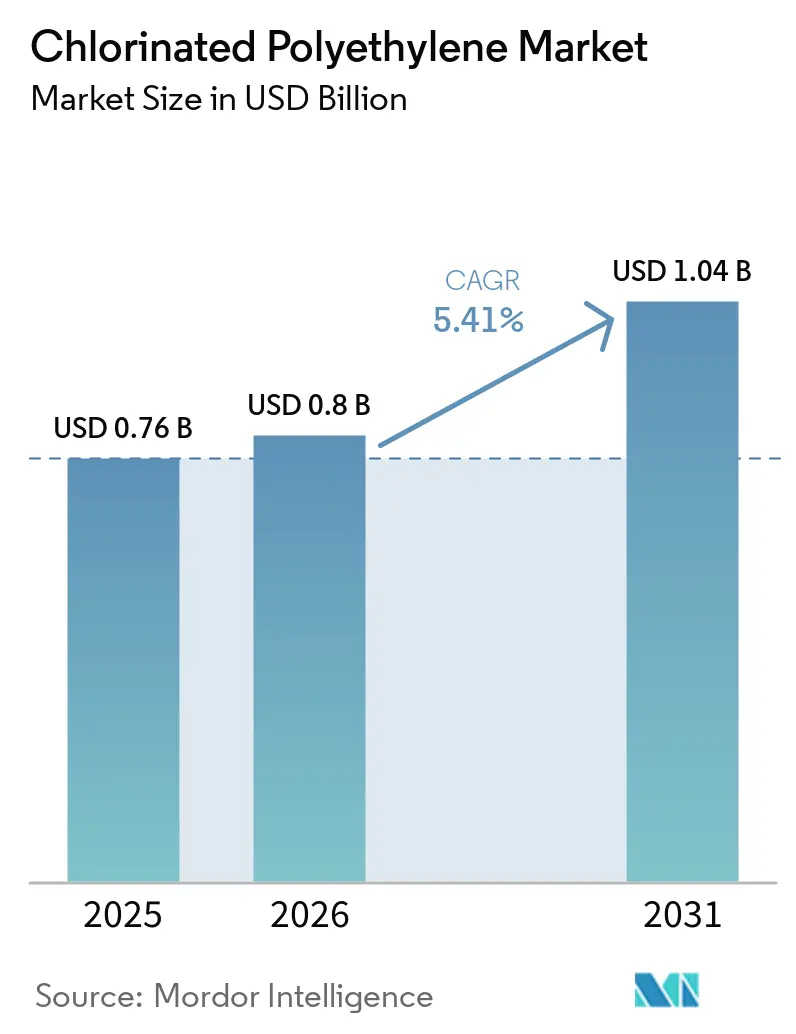
| Market Size (2026) | USD 0.8 Billion |
| Market Size (2031) | USD 1.04 Billion |
| Growth Rate (2026 - 2031) | 5.41 % |
| Fastest Growing Market | Asia Pacific |
| Largest Market | Asia Pacific |
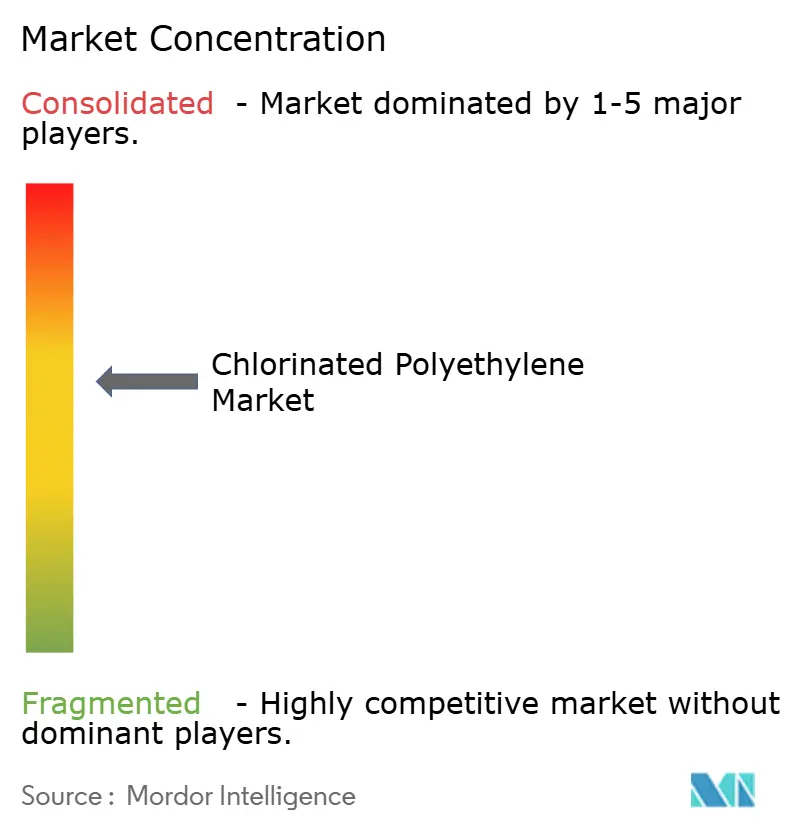
| Market Concentration | Medium |
Major Players *Disclaimer: Major Players sorted in no particular order Image © Mordor Intelligence. Reuse requires attribution under CC BY 4.0. | |
Chlorinated Polyethylene Market Analysis by Mordor Intelligence
The Chlorinated Polyethylene Market size is expected to increase from USD 0.76 billion in 2025 to USD 0.8 billion in 2026 and reach USD 1.04 billion by 2031, growing at a CAGR of 5.41% over 2026-2031. Momentum stems from the polymer’s entrenched use as a PVC impact modifier, its widening role in wire and cable jacketing, and its rising adoption in hose compounds and three-layer roofing membranes. High chlorine compatibility enables CPE to deliver cost-efficient oil resistance, flame performance, and weatherability, features that remain hard for thermoplastic polyolefins to match without expensive additives. Asia-Pacific’s dominance solidifies price leadership for the chlorinated polyethylene market: regional producers benefit from integrated chlor-alkali chains, low-cost coal or renewable electricity, and proximity to downstream PVC extrusion hubs. Halogen-free regulations in Europe and parts of North America do press formulators to partially replace CPE with TPV, SEBS, or EVA blends, yet CPE retains a defendable cost-performance niche wherever continuous oil exposure, high sunlight intensity, or tight bend radii prevail. Competitive intensity is moderate; the top five producers capture about 55–60% revenue but no firm unilaterally sets contract pricing or innovation pace.
Key Report Takeaways
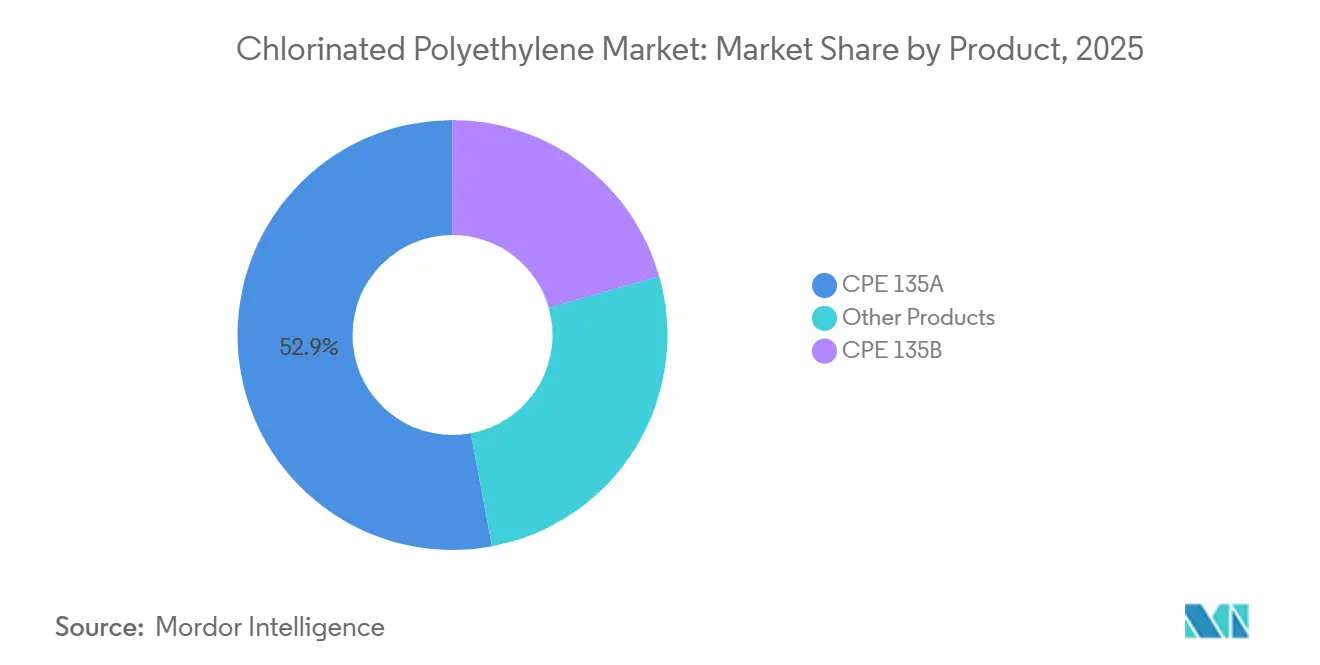
- By product grade, CPE 135A led with 52.94% revenue in 2025, while the higher-viscosity CPE 135B grade is projected to expand at a 5.51% CAGR through 2031.
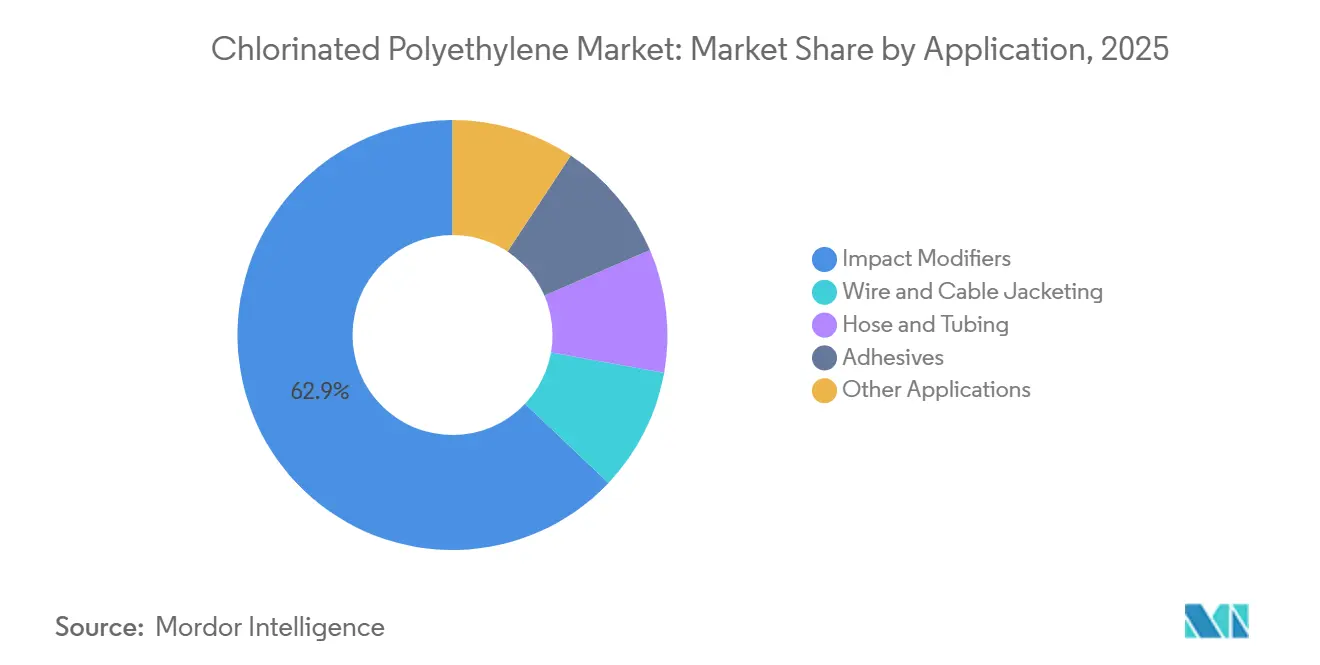
- By application, impact modifiers commanded 62.91% of the global chlorinated polyethylene market share in 2025, whereas hose and tubing is the fastest-growing end-use, advancing at 5.97% CAGR to 2031.
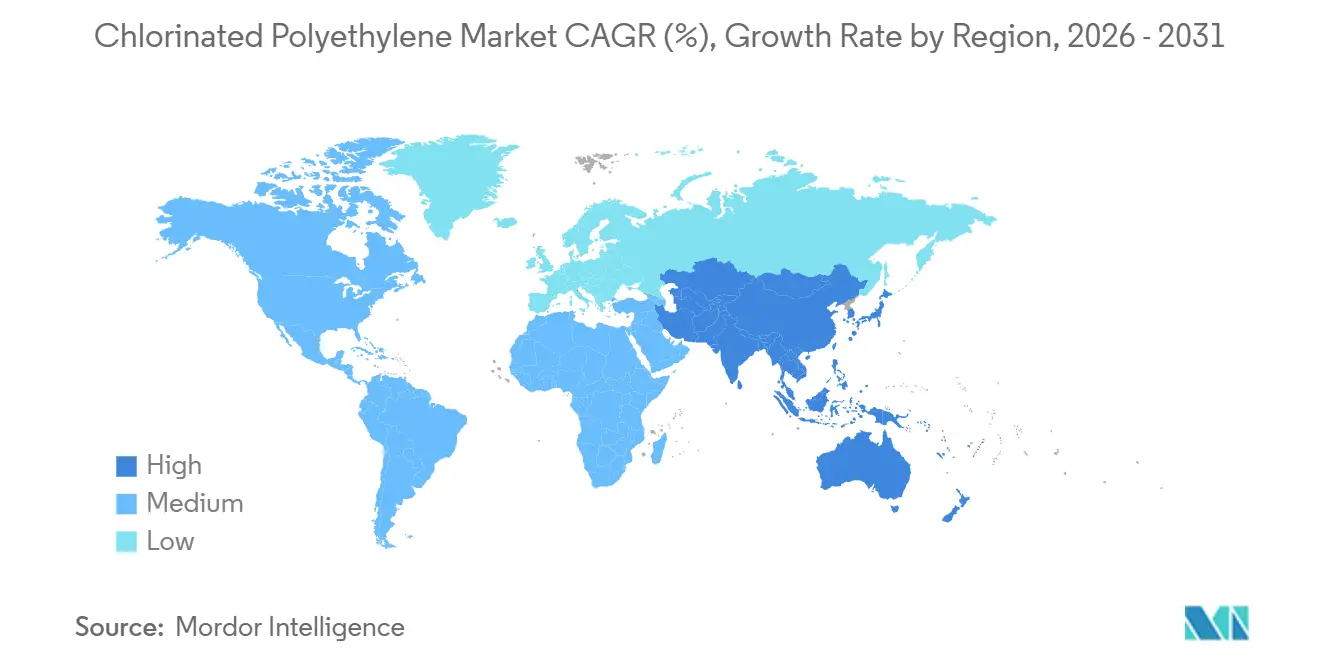
- By geography, Asia-Pacific accounted for 72.15% of worldwide consumption in 2025 and is set to register a 5.78% CAGR between 2026 and 2031, outpacing all other regions.
Note: Market size and forecast figures in this report are generated using Mordor Intelligence’s proprietary estimation framework, updated with the latest available data and insights as of 2026.
Market Trends and Insights
Drivers Impact Analysis of Chlorinated Polyethylene Market*
| Drivers | (~) % Impact on CAGR Forecast | Geographic Relevance | Impact Timeline |
|---|---|---|---|
| Shift toward halogen-free flame-retardant CPE hybrids | +0.8% | North America and EU, spill-over to APAC electronics hubs | Medium term (2–4 years) |
| Chinese supply-side expansion enhancing price competitiveness | +1.2% | Global, with strongest effect in APAC and Middle East | Short term (≤ 2 years) |
| Oil-resistant hoses for hydrogen refueling infrastructure | +0.6% | North America, EU, Japan, South Korea | Long term (≥ 4 years) |
| Growth of 3-layer smart roofing membranes in tropical regions | +0.5% | ASEAN, Middle East, Latin America (Brazil, Mexico) | Medium term (2–4 years) |
| On-site chlorination tech cutting Scope-3 emissions in Europe | +0.4% | EU core (Netherlands, Germany, France) | Long term (≥ 4 years) |
| Source: Mordor Intelligence | |||
Shift Toward Halogen-Free Flame-Retardant CPE Hybrids
Formulators are lowering total halogen content by blending CPE with phosphorus–nitrogen intumescent systems, reaching UL-94 V-0 ratings while meeting IEC 60754-2 thresholds. A 2025 study showed that adding micro-encapsulated red phosphorus and melamine cyanurate delivers limiting oxygen index values above 34% and smoke density below 80 Ds, allowing 40% less mineral hydroxide filler. North American and EU cable plants serving data centers and rail transit are early adopters because local codes mandate low-smoke performance without banning all halogens. Such “reduced-halogen” compounds lengthen the product life cycle for the chlorinated polyethylene market, though precise dispersion and moisture-resistant packaging raise formulation complexity and cost.
Chinese Supply-Side Expansion Enhancing Price Competitiveness
Integrated ethylene and chlor-alkali assets in Shandong province drove average CPE cash costs below USD 1,200 per tonne in 2025, undercutting Western producers by 20–30%[1]. Weifang Yaxing alone lifted capacity to 80,000 tpa yet saw margins narrow when export demand cooled, prompting a pivot toward greenhouse-film and specialty hose grades. Price softness benefits compounders across India, Vietnam, and Indonesia that feed cost-sensitive PVC and cable segments, although quality variability among smaller Shandong facilities stokes anti-dumping inquiries and undermines brand confidence.
Oil-Resistant Hoses for Hydrogen Refueling Infrastructure
Hydrogen hoses require outer jackets that resist mineral oil, abrasion, and sunlight. Southwire’s 2025 specifications for EV charging and oil-gas cables cite thermoset CPE jackets qualified to UL 44 and IEEE 1202 FT4 with 90 °C continuous rating[2]. While inner liners favor HNBR or FKM for permeation control, CPE captures 15–20% of the volume in external layers because polyolefins struggle to hit the same flame-oil balance without cost-intensive additives. Planned station rollouts in California, Germany, Japan, and South Korea underpin the long-term tailwind for the chlorinated polyethylene market.
Growth of 3-Layer Smart Roofing Membranes
CPE-based base sheets bonded to reflective mid-layers and UV-stabilized topcoats are gaining share in tropical climates. Their flexibility, ozone resistance, and compatibility with bitumen adhesives align with ASTM D4068 and mitigate seam failures common in thermoplastic polyolefin membranes. Embedded leak-detection sensors push initial system costs 25–35% higher but deliver lifecycle payback via lower cooling loads and rapid leak localization. Adoption is strongest in Singapore, Dubai, and metropolitan Brazil, advancing regional penetration for the chlorinated polyethylene market.
Restraints Impact Analysis of Chlorinated Polyethylene Market*
| Restraints | (~) % Impact on CAGR Forecast | Geographic Relevance | Impact Timeline |
|---|---|---|---|
| EU public-procurement bans on chlorinated plastics | -0.7% | EU member states, potential adoption in UK and Norway | Short term (≤ 2 years) |
| TPV and SEBS elastomer performance advances | -0.9% | Global, led by automotive OEMs in North America, EU, Japan | Medium term (2–4 years) |
| Emerging carbon-border tariffs on halogenated polymers | -0.6% | EU (CBAM), potential extensions to UK and Canada | Short term (≤ 2 years) |
| Source: Mordor Intelligence | |||
EU Public-Procurement Bans on Chlorinated Plastics
Germany, France, and the Netherlands now prioritize LSZH materials in publicly funded projects. Although REACH and CPR stop short of an outright ban, procurement guidelines cap halogen acid gas at ≤ 0.5% under IEC 60754-1. Cable and roofing suppliers must keep dual inventories, diverting CPE toward industrial markets while downtown fire codes tighten. The chlorinated polyethylene market therefore faces near-term European volume erosion and margin compression.
TPV and SEBS Elastomer Performance Advances
Dynamic vulcanizates of EPDM–PP and high-molecular SEBS systems now match CPE 135A for oil resistance and far exceed it for low-temperature flexibility, all without halogen content. Automotive wire harness and coolant hose buyers view halogen-free status as critical for recycling mandates under EU ELV directives. As TPV scaling lowers cost, the substitution pressure against the chlorinated polyethylene industry intensifies, particularly in automotive interiors.
*Our forecasts treat driver/restraint impacts as directional, not additive. The impact forecasts reflect baseline growth, mix effects, and variable interactions.
Chlorinated Polyethylene Market Segment Analysis
By Product:
Semi-Crystalline Grades Hold Sway, Specialty Formulations ScaleThe chlorinated polyethylene market size for CPE 135A accounted for 52.94% of revenue share in 2025. This semi-crystalline grade balances 35±2% chlorine with Mooney viscosity around 50, generating Shore A 60 hardness and elongation above 600%, metrics prized for rigid PVC impact modification and wire jackets. Higher-viscosity CPE 135B offers extra melt strength, unlocking blown-film and flame-retardant filler loading that underpins a forecast 5.51% CAGR through 2031. Specialty variants. high-chlorine (>40% Cl) for UL-94 V-0 cable compounds, modified molecular-weight grades for rubber magnets, and heat-stable versions for under-hood hoses, collectively broaden value pools beyond commodity resin.
Competition intensifies as producers migrate upstream: Dow, Resonac, and leading Shandong firms supply co-processed CPE-phosphorus masterbatches, enabling compounders to offer turnkey low-smoke solutions. This vertical move shields margin amid flat commodity pricing and embeds long-term customers within integrated supply contracts, reinforcing stickiness across the chlorinated polyethylene market.

By Application:
Impact Modifiers Dominate, Hose and Tubing AccelerateImpact modifiers absorbed 62.91% of 2025 demand, reflecting CPE’s ability to triple Izod impact strength of rigid PVC profiles at 5–10 phr loadings without impairing gloss or printability. The chlorinated polyethylene market share for impact-modifier use is forecast to decline modestly as TPV and ASA alloys nibble into window-frame and pipe specifications in Europe, yet absolute tonnage still rises with construction in India and ASEAN regions.
Hose and tubing will expand at a 5.97% CAGR, lifting the chlorinated polyethylene market size for this end-use toward USD 0.13 billion by 2031. Southwire’s SPEC 44122 sets jacket thickness between 3.7 mm and 8.3 mm, numbers difficult for polyolefins to hit under identical abrasion-oil-flame tests without premium ingredients. Growth stems from offshore oil hose refurbishment, hydrogen fueling lines, and high-flex mining cables in Latin America and Africa.
Geography Analysis
APAC Chlorinated Polyethylene Market
Asia-Pacific anchored 72.15% of 2025 global demand for the chlorinated polyethylene market and is projected to grow at a 5.78% CAGR through 2031. China harbors integrated ethylene (62 Mt y) and polyethylene (45 Mt y) assets that flow chlorine feedstock cheaply into CPE reactors. Shandong clusters deliver ex-works prices under USD 1,200 t, spurring compounders in India and Vietnam to capture share versus XLPE and TPO. Overcapacity, however, trims producer margins and invites periodic anti-dumping probes from Turkey and Brazil.
North America Chlorinated Polyethylene Market
North American market growth is buoyed by EV charging cables, data-center power cords, and oil-patch hoses. Federal codes allow CPE in industrial wiring; state procurements in California increasingly request LSZH for high-occupancy transit. Southwire’s 2025 EV charge-station spec (SPEC 45005) calls for thermoset CPE jackets to assure 90 °C continuous rating and FT4 flame compliance. Such documents validate CPE’s staying power despite halogen scrutiny.
Europe Chlorinated Polyethylene Market
European market faces dual headwinds: national procurement bans shrink building-wire tonnage, and CBAM may raise landed costs for high-carbon imports. Local producers, led by Nobian in the Netherlands, retrofit membrane electrolysers paired with renewable electricity to cut embedded carbon and sustain domestic CPE competitiveness.
The Americas and MEA Chlorinated Polyethylene Market
South America, the Middle East, and Africa are witnessing rising demand for chlorinated polyethylene. Brazil and Mexico deploy CPE-based three-layer roofing in tropical industrial zones; Saudi Arabia and the UAE specify CPE jackets in offshore drilling cables where 90°C oil immersion is routine. Lower regulatory pressure on halogens and heavy sunlight drive incremental uptake, supporting diversified growth across the chlorinated polyethylene market.
Value Chain Analysis
The chlorinated polyethylene (CPE) value chain depends on ethylene and chlorine availability, with chlorine typically sourced through integrated chlor-alkali operations that link caustic soda economics to chlorine costs. This integration helps explain Asia-Pacific price leadership and supports why Shandong-based clusters supply CPE at low cash costs. It also enables producers to run multi-product portfolios where CPE coexists with other chlorinated polymers and related intermediates. Upstream and primary manufacturing is concentrated in Shandong, including Weifang Yaxing (with chlor-alkali and CPE under one footprint) and Shandong Gaoxin Chemical (reported 60,000 tons/year capacity across chlorinated polymer materials including CPVC, HCPE, and CPE). Specialty-oriented players such as Sundow Polymers emphasize R&D and adjacent PVC-processing-auxiliary offerings.
Midstream value capture increasingly shifts from commodity resin sales into pre-compounded and application-tailored solutions, including CPE for impact-modifier masterbatches, wire and cable jacketing compounds, and specialty hose grades. Downstream, CPE is used by PVC compounders and converters for rigid PVC profiles, wire and cable plants, hose and tubing manufacturers, and roofing membrane producers. In these end uses, qualification to standards such as UL 44 and IEEE 1202 FT4 for cable jackets drives formulation support, consistent QA, and moisture-safe packaging. Distribution is handled through direct contracting with large compounders as well as regional distributors and export channels, and trade friction risks such as anti-dumping inquiries and carbon-related import scrutiny can affect route-to-market decisions and encourage suppliers to diversify grades and destination industries.
Competitive Landscape
The chlorinated polyethylene market is moderately consolidated. Cost-centric producers in Shandong maintain aggressive capacity ramp-ups. Weifang Yaxing’s 80 kiloton per annum plant illustrates scale economics but endures margin dilution when export pullbacks collide with domestic oversupply, leading management to channel output into film-grade CPE and specialty hose compounds.
Value-added players such as Dow and Resonac pivot toward specialty CPE. Resonac’s 2024 ELASLEN catalog lists low-chlorine grades for adhesive rubber alloys, mid-range for PVC modifiers, and high-chlorine for V-0 flame systems, bundled with formulation services to embed itself in semiconductor-equipment plates and EMI-shielding magnets. This shift lifts average selling prices and buffers against halogen-free substitution.
Emerging disruptors blend CPE with phosphorus–nitrogen synergists or pre-compound CPE-EPDM to address LSZH mandates. Their downstream integration captures margin and keeps entry barriers high. Competitive risk revolves around regulation: EU public-procurement bans and CBAM carbon factors fracture markets into compliance-premium and low-cost tiers, forcing multinationals to juggle split inventories and tailor certification pathways.
Chlorinated Polyethylene Industry Leaders
-
Weifang Yaxing Chemical Co. Ltd
-
Sundow Polymers Co. Ltd
-
Shandong Gaoxin Chemical Co. Ltd
-
Dow
-
Hangzhou Keli Chemical Co. Ltd
- *Disclaimer: Major Players sorted in no particular order
Chlorinated Polyethylene Market Companies Covered in this Report
- Aurora Material Solutions
- Bontecn Group China Co. Ltd
- Dow
- Dycon Chemicals
- Epigral Limited
- Hangzhou Keli Chemical Co. Ltd
- Jiangsu Tianteng Chemical Industry Co. Ltd
- Resonac Holdings Corporation
- Shandong Gaoxin Chemical Co. Ltd
- Shandong Ketian Chemical Co. Ltd
- Shandong Novista Chemical Ltd (Novista Group)
- Shandong Rike Chemical Co.,Ltd
- Shandong Xiangsheng New Materials Technology Co. Ltd
- Shandong Xuye New Materials Co. Ltd
- Sundow Polymers Co. Ltd
- Weifang Yaxing Chemical Co. Ltd
Market Opportunities and Future Outlook
Near-term opportunity is concentrated in higher-value grades and compound-ready formats that help cable, hose, and roofing customers balance flame, smoke, and oil-weather performance as material preferences tighten. Reduced-halogen CPE hybrid systems paired with phosphorus-nitrogen intumescent packages support UL-94 V-0 targets while meeting IEC 60754 thresholds, which keeps CPE present in applications where polyolefins struggle to replicate flame-oil-abrasion performance without costly additive loading. For CPE suppliers and compounders, this supports development of performance-certified, lower-smoke solutions for data-center power cabling, transit cabling, and industrial wiring segments that specify low-smoke behavior without fully excluding chlorinated materials.
On the supply side, producer moves toward specialty output reinforce opportunities for differentiated CPE and adjacent modifier systems. Weifang Yaxing started trial production in December 2025 for a 45,000 tons/year high-end new materials project, indicating incremental capacity and capability aimed at higher-end material segments overlapping with CPE value pools such as specialty film and hose-related formulations. Sundow Polymers also expanded its PVC modification offering with a high-performance powdered nitrile rubber (PNBR) series launched in January 2026, reflecting a commercial push toward elastomeric modifiers and blend strategies that PVC compounders can co-formulate with CPE when formulation and halogen targets align. Growth of three-layer roofing membranes in tropical regions and specifications-driven demand for oil-resistant, flame-rated hose and cable jackets, including hydrogen-related hose outer layers, remain practical entry points for CPE suppliers that can support consistent quality, certification documentation, and integrated additive packages.
Recent Industry Developments in Chlorinated Polyethylene Market
- January 2026: Sundow Polymers launched a new series of high-performance powder nitrile rubber (PNBR) products, branded as Sundow Wellan PNBR, aimed at modifying soft and semi-rigid PVC compounds. The move broadens its formulation toolkit for PVC customers that also purchase CPE impact modifiers and jacketing materials, supporting bundled selling across related elastomer-modifier systems.
- December 2025: Weifang Yaxing commenced trial production of a 45,000 tons/year high-end new materials project, alongside industrialization projects for 500 tons/year hexachlorocyclotriphosphazene and 500 tons/year benzalkonium chloride. This adds capability and supply optionality toward higher-end chemical and material outputs, shaping competitive dynamics for specialty-grade chlorinated polymer offerings in China.
- June 2025: Sundow Polymers announced development and production launch of high-performance antimony trioxide (ATO) substitutes, including partial (SD9000) and complete (99A-100) alternatives. The launch supports flame-retardant formulation continuity for chlorinated polymer and PVC compounders facing additive cost and supply constraints, and it aligns with the market shift toward alternative flame systems in wire and cable compounds.
Chlorinated Polyethylene Market Report Scope and Research Methodology
Market Definition and Coverage
For this study, the chlorinated polyethylene market includes revenues generated from selling chlorinated polyethylene resin used as an impact modifier and elastomeric compound across key industrial applications, counted at the first point of commercial sale.
Scope exclusions: It excludes downstream finished goods value such as completed cables, PVC pipes, roofing membranes, and fabricated rubber parts that only contain CPE as an ingredient.
Segments Covered in This Report
- By Product
- CPE 135A
- CPE 135B
- Other Products
- By Application
- Impact Modifiers
- Wire and Cable Jacketing
- Hose and Tubing
- Adhesives
- Other Applications
- By Geography
- Asia-Pacific
- China
- India
- Japan
- South Korea
- ASEAN
- Rest of Asia-Pacific
- North America
- United States
- Canada
- Mexico
- Europe
- Germany
- United Kingdom
- France
- Italy
- Russia
- Rest of Europe
- South America
- Brazil
- Argentina
- Rest of South America
- Middle-East and Africa
- Saudi Arabia
- South Africa
- Rest of Middle-East and Africa
- Asia-Pacific
Data Sources, Market Sizing, and Validation
Desk Research
We start by building a basic demand and supply picture using public information that can be checked and repeated. This includes chemical production and trade indicators from sources such as the US International Trade Commission (USITC) data, UN Comtrade, and national statistical offices, which help us understand where polymers and key feedstocks are moving by region.
To anchor end use signals, we also review sources such as the American Chemistry Council publications, EU regulatory pages on polymer and additive compliance, and peer reviewed polymer journals that discuss CPE usage in PVC impact modification and cable jacketing performance. Company annual reports, investor presentations, and reputable press coverage are then used to cross check capacity additions, plant utilization commentary, and pricing direction. Where helpful, we reference paid subscriptions for company financials and intelligence, patent databases, and shipment level import export records to fill gaps that are hard to confirm from public text alone. The sources listed here are illustrative only, and many other public and paid references were also used for data collection, validation, and clarification.
Primary Interviews and Surveys
Our team validates the desk findings through interviews and structured surveys with CPE producers, compounders, distributors, and large end users in wire and cable, plastics modification, and industrial rubber goods. Since this is a global market, we also make sure feedback is balanced across APAC, EMEA, and the Americas, and then differences in pricing, grades, and application mix are reconciled before finalizing the model.
Distribution of primary research fieldwork respondents
| Company type | Respondent position | Region |
|---|---|---|
| Top tier: 37% | CXOs: 17% | APAC: 48% |
| Mid tier: 43% | Functional/Unit leaders: 25% | EMEA: 30% |
| Smaller Players: 20% | Managers: 58% | Americas: 22% |
Market-Sizing & Forecasting
Sizing starts with a top-down build where polymer demand pools are reconstructed from end-use production activity and trade flows, and then translated into CPE consumption using application level penetration ranges. The main demand anchors we use include PVC processing volumes where impact modifiers are common, wire and cable output trends, and flexible compound demand in industrial rubber goods, which together help keep the totals realistic.
To sanity check the totals, selective bottom-up approximations are used, such as rolling up a sample of supplier revenues where disclosures exist, and testing average selling price bands against estimated volumes by region. Key inputs that are tracked in the model include CPE grade mix (for example 135A versus other grades), regional price spreads and currency timing, capacity additions and utilization direction, substitute modifier availability, and major end-use cycles in construction and electrical products. For forecasting, we rely on scenario analysis supported by simple regression style relationships between end-use indicators and CPE demand, and then the assumptions are stress tested with primary feedback on pricing and adoption changes. When bottom-up visibility is limited, gaps are handled through conservative coverage factors that are revisited during expert calls and adjusted only when supporting evidence is consistent.
Data Validation & Update Cycle
We run multiple checks before sign-off so one unusual input does not skew the outcome. Model outputs are compared with independent signals such as announced capacity changes, trade movements for relevant polymer categories, and pricing direction shared by market participants, and then any outliers are reviewed line by line.
A second analyst review is conducted to confirm that assumptions are applied consistently across regions and years, and follow-up calls are triggered when large variances show up versus earlier cycles or known market events. Reports are refreshed annually, with interim updates when material events occur, such as major shutdowns, new plants, or abrupt feedstock or energy cost swings. Before delivery, a final pass is completed so clients receive the latest updated view.
Mordor Intelligence's Chlorinated Polyethylene Market Size Measured Against Other Published Estimates
Published market values for chlorinated polyethylene can look far apart because each source uses its own mix of grades, applications, and timing for prices and currency conversion, and then forecasts are built on different end-use assumptions.
The biggest drivers usually come down to whether the count is kept at resin sales only or expanded into higher value compounded and converted products, and also whether demand is tied to PVC impact modifier usage and cable jacketing volumes or treated as a broader elastomer market. Some sources also start from a more aggressive price path, while others rely on older base years and do not revisit utilization and trade signals as frequently, which can shift the current-year number.
Benchmark comparison
| Source | Market Size | Gaps in Research Methodology |
|---|---|---|
| Mordor Intelligence | USD 0.76 B (2025) | |
| Trade Journal A | USD 0.89 B (2024) | Uses a press-style estimate that appears to bundle resins and elastomeric uses with broad end-use buckets, and it also reflects an earlier base year with a higher growth path that can lift the reported value. |
| Industry Bulletin B | USD 0.73 B (2025) | Focuses more narrowly on selected applications and tends to apply conservative price bands and limited cross-region validation, which can pull the total down versus a full grade and application mix roll-up. |
The spread in the table is mainly explained by what gets counted as market revenue and how current pricing and application mix are refreshed, and then those assumptions are carried into the forecast. Keeping the sizing tied to resin level sales and cross-checking with end-use indicators and trade signals helps keep the 2025 value traceable, a modeling choice applied by Mordor Intelligence.
Key Questions Answered in the Report
What is the current market size for the chlorinated polyethylene market?
The Chlorinated Polyethylene Market size is expected to increase from USD 0.76 billion in 2025 to USD 0.8 billion in 2026 and reach USD 1.04 billion by 2031, growing at a CAGR of 5.41% over 2026-2031.
Which product grade currently generates the highest revenue?
Semi-crystalline CPE 135A led with 52.94% of 2025 revenue because its 35% chlorine content optimizes PVC impact modification and wire jacketing.
Why does Asia-Pacific contribute the bulk of global demand?
Integrated chlor-alkali and PVC extrusion chains in China, India, and Southeast Asia deliver low-cost feedstock and proximity to cable and construction end-users, giving the region about 72% share in 2025.
How quickly will hose and tubing applications expand through 2031?
They are projected to post a 5.97% CAGR, propelled by hydrogen refueling, offshore hose replacement, and EV charging infrastructure.
What cost impact could the EU Carbon Border Adjustment Mechanism have on imports?
Certificates tied to embedded emissions could add EUR 50–100 per tonne for coal-powered Chinese grades once polymers enter the scheme after 2028.
How concentrated is the competitive landscape?
The top five producers control roughly 55–60% of global revenue, yielding a moderate concentration score of 6 / 10.