
Bio-Based Polyvinyl Chloride Market Size and Share
Market Overview
| Study Period | 2021 - 2031 |
|---|---|
| Market Size (2026) | USD 1.01 Billion |
| Market Size (2031) | USD 1.31 Billion |
| Growth Rate (2026 - 2031) | 5.37 % |
| Fastest Growing Market | Asia Pacific |
| Largest Market | Europe |
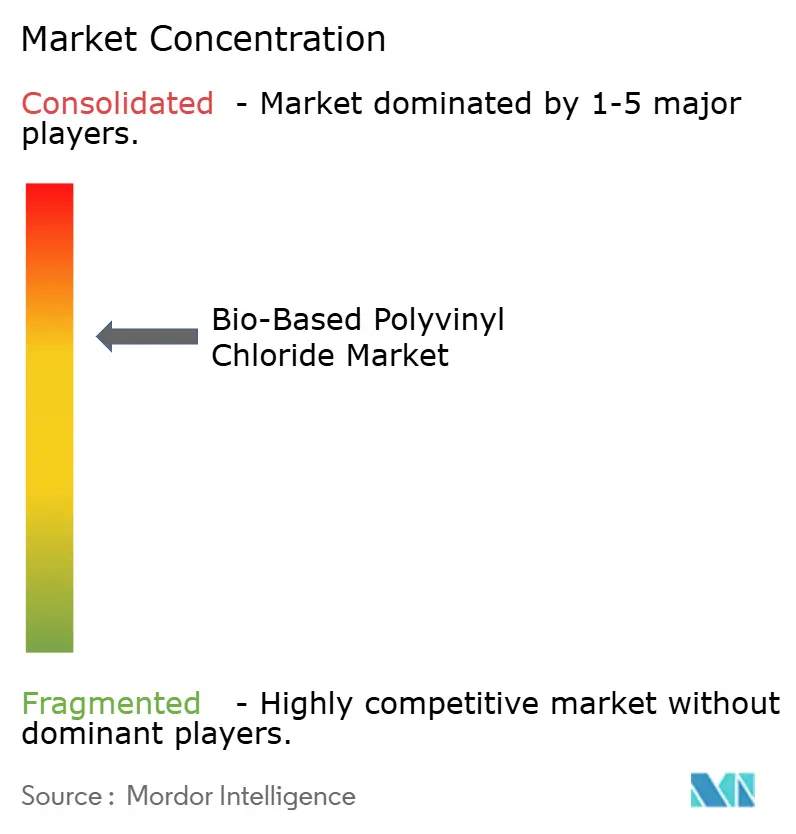
| Market Concentration | Medium |
Major Players *Disclaimer: Major Players sorted in no particular order Image © Mordor Intelligence. Reuse requires attribution under CC BY 4.0. | |
Bio-Based Polyvinyl Chloride Market Analysis by Mordor Intelligence
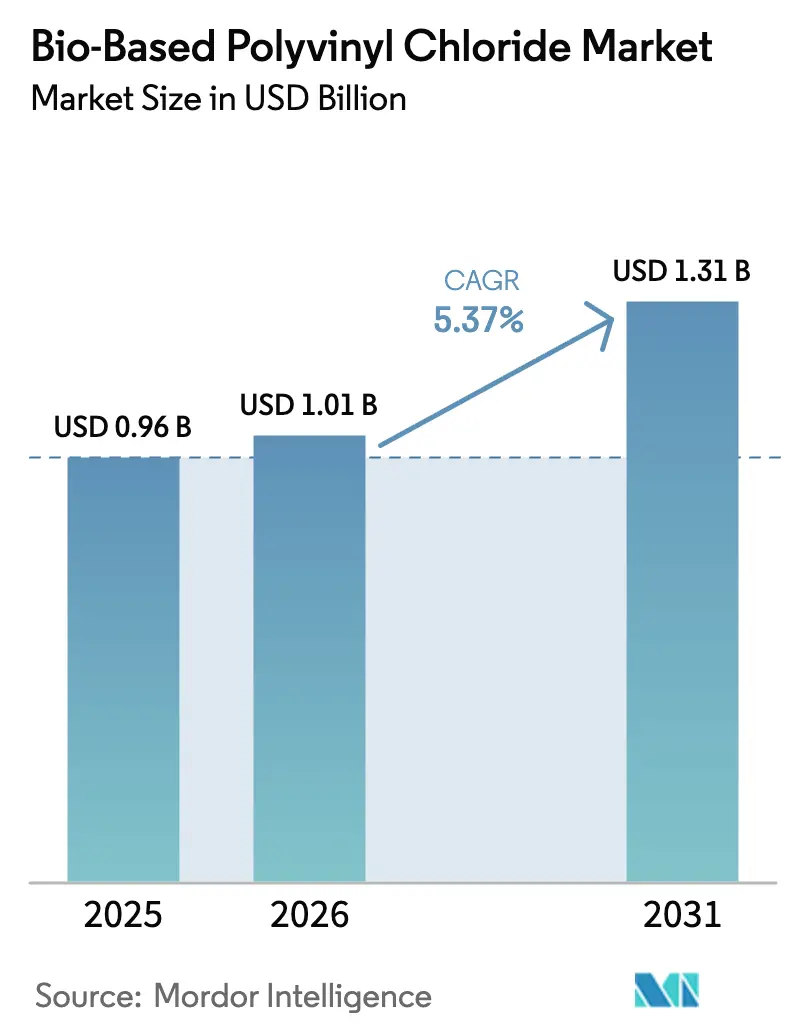
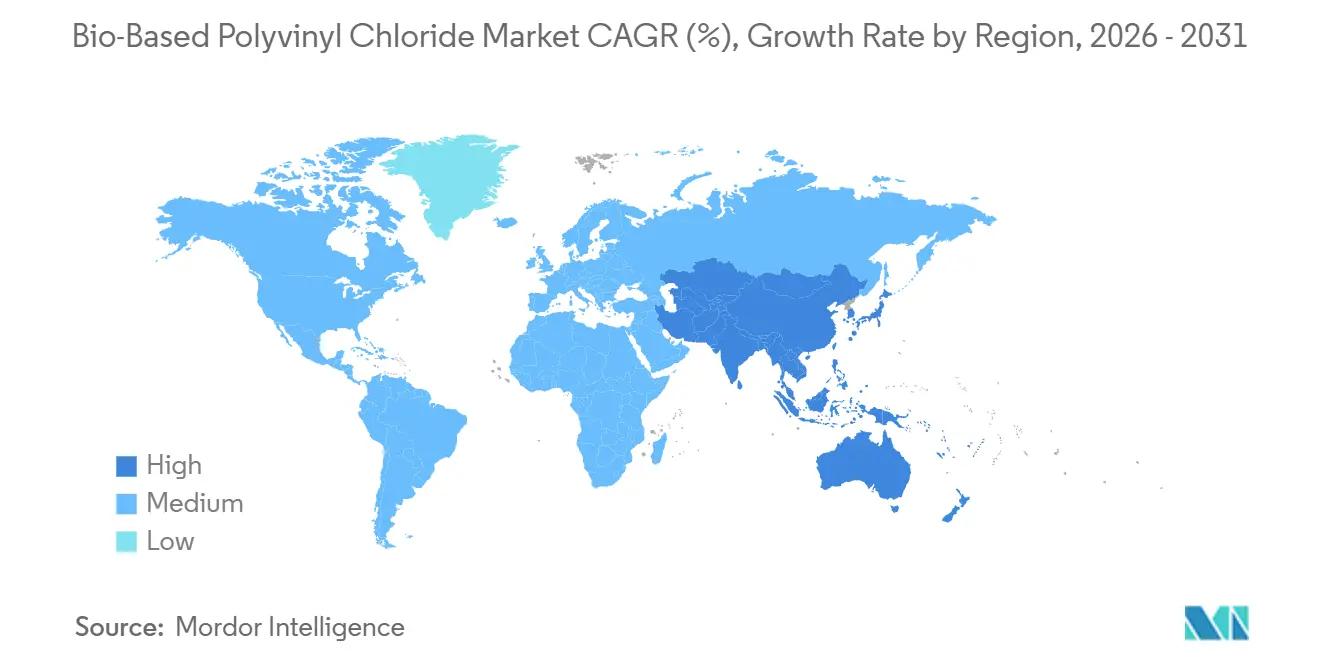
The Bio-Based Polyvinyl Chloride Market size is expected to grow from USD 0.96 billion in 2025 to USD 1.01 billion in 2026 and is forecast to reach USD 1.31 billion by 2031 at 5.37% CAGR over 2026-2031. Europe anchors 48.22% of 2025 revenue, helped by carbon-border rules that penalize coal-based PVC imports and reward certified low-carbon feedstocks. Asia-Pacific follows in absolute share yet leads growth at a 5.94% CAGR through 2031, spurred by China’s coal-to-bio-ethylene pilots and India’s sugarcane-ethanol surplus redirected from fuel blending. Rigid bio-PVC accounted for 62.48% of 2025 volume because potable-water pipe standards favor dimensional stability, while flexible grades are set for a 5.88% CAGR as automotive OEMs adopt bio-attributed compounds in interior panels to cut scope-3 emissions. Competitive intensity remains moderate; fewer producers run commercial-scale bio-ethylene-to-VCM chains, and most rely on mass-balance accounting that still faces traceability scrutiny in regulated markets.
Key Report Takeaways
- By product type, rigid variants led with a 62.48% bio-based polyvinyl chloride market share in 2025. Flexible grades are forecast to post the fastest 5.88% CAGR between 2026 and 2031.
- By application, pipes commanded 36.27% of the bio-based polyvinyl chloride market size in 2025. Wires and cables are advancing at a 5.93% CAGR through 2031.
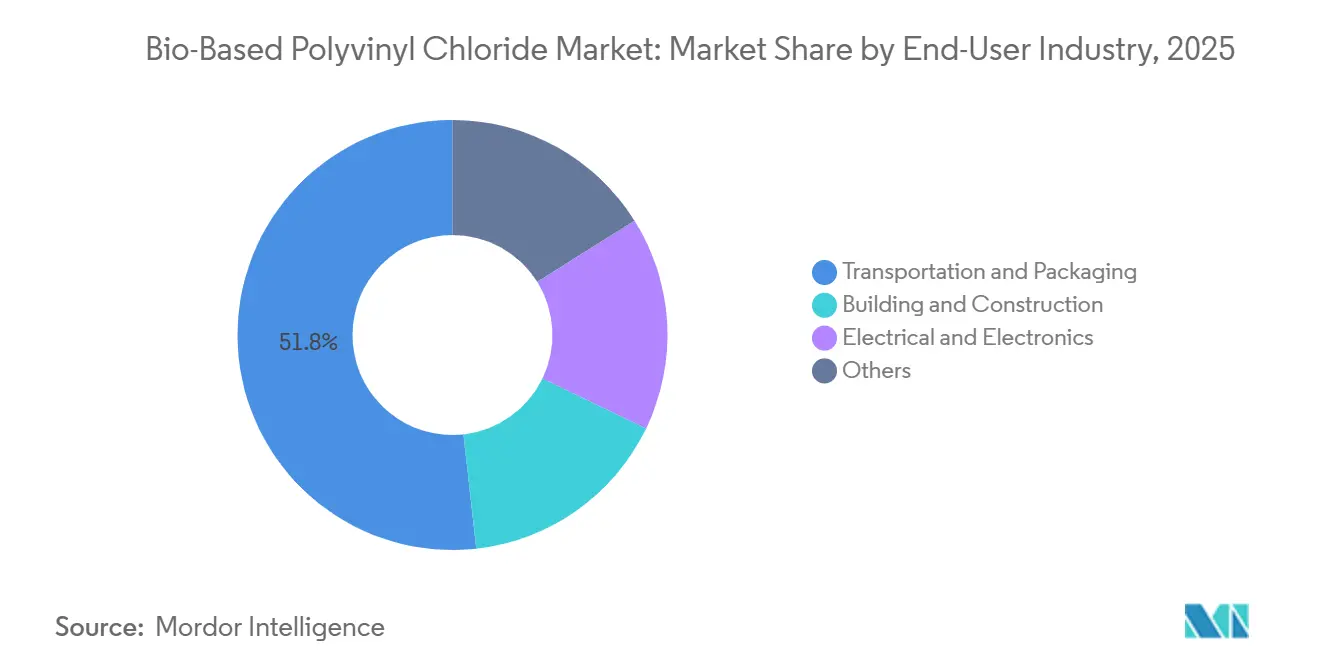
- By end-user, transportation and packaging captured a 51.77% share in 2025. The same segment is also the fastest growing, expanding at a 5.91% CAGR to 2031.
- By geography, Europe held 48.22% of the market in 2025; Asia-Pacific is predicted to grow at a 5.94% CAGR to 2031.
Note: Market size and forecast figures in this report are generated using Mordor Intelligence’s proprietary estimation framework, updated with the latest available data and insights as of January 2026.
Market Trends and Insights
Drivers Impact Analysis of Bio-Based Polyvinyl Chloride Market*
| Drivers | (~) % Impact on CAGR Forecast | Geographic Relevance | Impact Timeline |
|---|---|---|---|
| Stricter environmental regulations and ESG mandates | +1.8% | Europe, North America, APAC core markets | Medium term (2-4 years) |
| Corporate sustainability commitments and green-building standards | +1.2% | Global, with concentration in EU and North America | Medium term (2-4 years) |
| Cost-competitive bio-ethylene routes reaching commercial scale | +1.4% | South America (Brazil), Asia-Pacific (India, China) | Long term (≥ 4 years) |
| EU carbon-border adjustments accelerating low-carbon feedstock use | +0.9% | Europe, spill-over to exporters in ASEAN and Middle East | Short term (≤ 2 years) |
| Mass-balance flooring/pipe supply deals catalyzing downstream uptake | +0.6% | Europe, North America | Short term (≤ 2 years) |
| Source: Mordor Intelligence | |||
Stricter Environmental Regulations And ESG Mandates
The EU Carbon Border Adjustment Mechanism entered its transitional phase in late 2023 and will apply full embedded-carbon tariffs from 2026, making high-carbon PVC imports costlier by 2028 [1]. California’s SB 253 and SB 261 require scope-3 disclosures from 2024, pushing building and automotive buyers to audit polymer origins. Teknor Apex noted in 2025 a growth of European flooring customers demanding bio-attributed compounds verified for carbon footprint. These converging rules tilt procurement toward certified bio-PVC despite its price premium. Producers able to document chain-of-custody compliance earn preferred-supplier status in regulated tenders.
Corporate Sustainability Commitments And Green-Building Standards
LEED v5, fully rolling out in 2026, grants extra points for ISO 16620-verified bio-based content, putting bio-PVC on specification lists for projects targeting Gold or Platinum ratings [2]. The EPA’s 2025 update of Product Category Rules for resilient flooring mandates life-cycle assessments that reveal feedstock origin, effectively disadvantaging fossil resin in public procurement. Automaker scorecards reinforce the pull: Volkswagen assigns a portion of its supplier ratings to bio-based or recycled polymers. Meanwhile, Ford mandates the use of certified bio-PVC in its North American models by 2028. Such targets provide resin suppliers with the volume certainty essential for retrofitting crackers to process bio-feedstocks.
Cost-Competitive Bio-Ethylene Routes Reaching Commercial Scale
In 2025, Braskem's sugarcane-ethanol-to-ethylene facility in Brazil operated at high capacity, as oil prices stabilized, helping to narrow cost gaps. India's updated biofuel policy now permits surplus ethanol to transition from fuel applications to chemical uses. In late 2025, Praj inaugurated a demonstration plant in Gujarat. Cemvita Factory successfully reduced its CO₂-to-ethylene production costs, a significant drop from two years prior. This trajectory suggests the potential for grid parity by 2029, contingent on the continuation of the United States tax credits. With bio-ethylene nearing price parity, the feedstock premium that's been a barrier to the wider adoption of bio-PVC is poised to diminish.
EU Carbon-Border Adjustments Accelerating Low-Carbon Feedstock Use
China's carbide route for producing PVC releases significantly more CO₂ compared to certified bio-PVC. This difference allows importers to sidestep CBAM levies entirely. INEOS's NEOVYN bio-attributed resin not only meets compliance standards but also boasts a reduced carbon footprint. This advantage provides European converters with both cost savings and enhanced reputation. Responding to these shifts, Middle Eastern producers are taking note. For instance, SABIC has announced plans to incorporate bio-naphtha blends at its Jubail cracker by 2026. Such strategic moves underscore how the CBAM is driving changes in upstream feedstock sourcing, extending its influence well beyond the borders of the EU.
Restraints Impact Analysis of Bio-Based Polyvinyl Chloride Market*
| Restraints | (~) % Impact on CAGR Forecast | Geographic Relevance | Impact Timeline |
|---|---|---|---|
| High production-cost gap vs. fossil PVC | -1.1% | Global, most acute in price-sensitive ASEAN and MEA markets | Medium term (2-4 years) |
| Limited commercial-scale renewable-feedstock supply | -0.8% | Global, with bottlenecks in Europe and North America | Long term (≥ 4 years) |
| Traceability issues in mixed bio-attributed recycling streams | -0.4% | Europe, North America | Short term (≤ 2 years) |
| Source: Mordor Intelligence | |||
High Production-Cost Gap Versus Fossil PVC
Bio-ethanol commands a higher price than naphtha-based ethylene, resulting in a resin premium before accounting for capital charges related to cracker retrofits. In Brazil and India, fuel-blending mandates consume the majority of ethanol volumes, leaving limited surplus for chemical applications. Buyers in the price-sensitive packaging and construction sectors hesitate to pay the premium unless carbon penalties bridge the difference. In 2025, LyondellBasell reported that while bio-attributed polyolefins achieved a premium in Europe, they faced challenges in Southeast Asia, where fossil resins are priced lower.
Limited Commercial-Scale Renewable-Feedstock Supply
In 2025, global bio-ethylene production accounted for a small fraction of the total ethylene output, with a significant portion directed towards polyethylene rather than PVC. Dow's 2025 sustainability report highlighted the challenges of renewable-feedstock scarcity, pointing out that qualifying additional certified bio-naphtha could take a considerable amount of time. Establishing new fermentation plants demands substantial capital and competes for agricultural land, and there's a risk of catalyst fouling when co-processing bio-naphtha. This constrained supply hampers producers' ability to rapidly scale bio-PVC output, even as demand continues to surge.
*Our forecasts treat driver/restraint impacts as directional, not additive. The impact forecasts reflect baseline growth, mix effects, and variable interactions.
Bio-Based Polyvinyl Chloride Market Segment Analysis
By Product Type:
Rigid Grades Dominate While Flexibles AccelerateRigid variants controlled 62.48% of 2025 volume, reflecting the need for 50-year service lives in potable-water pipes and window profiles. This dominance underpins a substantial portion of the bio-based polyvinyl chloride market size, securing predictable offtake for resin suppliers. Flexible grades, forecast at a 5.88% CAGR, benefit from drop-in substitution in automotive interiors where scope-3 targets drive material choices.
Rigid compounds require minimal tooling changes when swapping fossil for bio-attributed resin, trimming adoption risk, and ensuring that the bio-based polyvinyl chloride market grows steadily within infrastructure projects. Flexible formulations depend on compatible plasticizers and careful migration testing; Teknor Apex launched a 40% bio-content flexible compound in 2025 to meet these performance demands. These advances show how formulation know-how, not polymer chemistry, sets the pace of segment uptake in the bio-based polyvinyl chloride industry.

By Application:
Pipe Infrastructure Leads While Cables SurgePipes captured 36.27% of the 2025 demand, giving the segment the largest share of the bio-based polyvinyl chloride market size. Municipal water utilities in Europe favor low-carbon materials to meet reporting mandates, anchoring predictable demand. Wires and cables, projected at a 5.93% CAGR, ride renewable-energy grid build-outs that specify certified low-carbon insulation.
Films and sheets face longer regulatory cycles because FDA food-contact reviews can stretch 12–18 months. Nevertheless, the segment gains when premium brands integrate bio content to enhance sustainability claims. Cable producers see strategic upside from avoiding future carbon levies, boosting their confidence to lock in bio-attributed resin offtake agreements. These patterns keep application growth aligned with broader infrastructure and consumer-brand timelines inside the bio-based polyvinyl chloride market.
By End-User Industry:
Transportation And Packaging Drive ScaleTransportation and packaging secured 51.77% of 2025 consumption and will grow at a 5.91% CAGR, establishing the segment as the principal revenue engine for the bio-based polyvinyl chloride market. Automakers can substitute bio-attributed PVC without retooling, directly lowering scope-3 footprints. Packaging converters deploy bio-films to meet brand owner scorecards that demand sustainable content by 2030.
Building and construction follow regulations such as LEED v5 and updated EPA rules, pushing flooring and profile makers toward certified content. Electrical and electronics gain momentum via data-center and EV-charging infrastructure, both of which specify low-carbon cabling. These usage patterns underline how compliance and brand visibility, rather than pure material performance, steer the bio-based polyvinyl chloride industry roadmap.

Geography Analysis
Europe and Russia Bio-Based Polyvinyl Chloride Market
Europe claimed a 48.22% bio-based polyvinyl chloride market share in 2025, lifted by CBAM’s transitional reporting and mass-balance supply deals between INEOS, Vynova, and downstream fabricators. Germany, France, and Italy lead demand, while Sweden and Denmark test bio-PVC in district-heating pipes. Russia remains sidelined due to sanctions and carbide-route dependence that lacks bio-feedstock infrastructure.
APAC Bio-Based Polyvinyl Chloride Market
Asia-Pacific is the fastest-growing region at a 5.94% CAGR through 2031. India diverts surplus sugarcane ethanol into chemical routes, and Praj’s Gujarat demo plant signals domestic feedstock readiness. China’s five-year plan opens pilot quotas for bio-ethanol co-processing, giving state-owned crackers a pathway to carbon-adjustment compliance. Japan and South Korea import certified bio-naphtha from Malaysia and Thailand for electronics and automotive customers.
The Americas and Middle East Bio-Based Polyvinyl Chloride Market
North America, while holding a smaller market share, reaps significant benefits from the United States tax credits, reducing CO₂-to-ethylene costs. Dow faces feedstock constraints, highlighting supplier qualification timelines over production bottlenecks. In North America, Mexico aligns its operations with the United States OEM scorecards, and Brazil's ethanol-to-ethylene plant bolsters South America's supply. The Middle East remains in its infancy; however, SABIC's scheduled trial of bio-naphtha hints at budding demand, with potential for substantial capacity expansion if the trial proves successful.
Regulatory Landscape
Regulation for bio-based PVC is increasingly shaped by carbon-accounting and product traceability requirements alongside traditional chemical and food-contact compliance. In Europe, the EU Carbon Border Adjustment Mechanism (CBAM) moved from transitional reporting (late 2023) to full embedded-carbon tariff application from 2026, which raises the compliance bar for high-carbon PVC imports and supports demand for verified low-carbon or bio-attributed feedstocks used in PVC.
Across end uses, market access depends on meeting jurisdiction-specific standards and recognized chain-of-custody schemes. In the United States, Clariant's U.S. FDA approval effective May 7, 2026 for its bio-based Licocare RBW wax additives for rigid PVC food-contact applications supports adoption in regulated packaging and consumer uses. Voluntary certification remains a key enabler for bio-attribution claims, with ISCC PLUS widely used to validate mass-balance, segregation, and controlled-blending approaches. Industry programs such as VinylPlus and guidelines such as Australia's Best Environmental Practice (BEP) PVC v2.0 also reinforce expectations on responsible manufacturing and sourcing documentation.
Value Chain Analysis
The bio-based PVC value chain mirrors conventional PVC production, with decarbonization concentrated on the ethylene side of the VCM route. Renewable feedstocks (bio-ethanol, bio-naphtha, or waste and residue derived inputs such as used cooking oil) are introduced upstream and allocated to PVC through mass-balance accounting, while chlorine and chlor-alkali inputs remain largely conventional. Commercial supply is currently led by producers offering certified bio-attributed or low-carbon PVC grades, including INEOS Inovyn (BIOVYN/NEOVYN), Vynova (VynoEcoSolutions), and Ercros (Etinox Renew), with chain-of-custody verification typically through ISCC PLUS and, in some cases, RSB.
Downstream, the drop-in nature of bio-attributed PVC allows converters to use existing extrusion, calendering, and molding assets in pipes, profiles, flooring, wires, and cables. This shifts differentiation toward formulation know-how and compliance support rather than new equipment. Additive suppliers and compounders influence outcomes for regulated applications, illustrated by Clariant's FDA-cleared bio-based Licocare RBW wax additives for rigid PVC food-contact use (effective May 7, 2026). Distribution generally runs through existing PVC channels, while key bottlenecks remain renewable-feedstock availability, certification and traceability audits, and securing documented LCA and chain-of-custody data needed for ESG reporting and procurement.
Competitive Landscape
The bio-based polyvinyl chloride market is moderately consolidated. Incumbents rely on ISCC PLUS or RSB certification to translate mass-balance volumes into marketable claims. Chain-of-custody software and catalyst patents dominate recent filings, signaling that process efficiency and traceability outweigh new polymer chemistries. Competitive positioning now hinges on demonstrating third-party verified carbon reductions significant enough to sidestep CBAM or qualify for LEED points, granting suppliers a pricing umbrella in regulated markets.
Bio-Based Polyvinyl Chloride Industry Leaders
-
INEOS
-
Vynova Group
-
Westlake Vinnolit GmbH & Co. KG
-
Solvay SA
-
LG Chem
- *Disclaimer: Major Players sorted in no particular order
Bio-Based Polyvinyl Chloride Market Companies Covered in this Report
- Avient Corporation
- Bio-Plastic Solutions LLC.
- Bio-Tec Environmental
- Braskem
- CLARIANT
- Dow
- ENSO Plastics
- Formosa Plastics Corporation, U.S.A.
- GEON Performance Solutions
- INEOS
- LG Chem
- LyondellBasell
- Metabolix, Inc.
- Nomaco
- Shin-Etsu Chemical Co., Ltd.
- Solvay SA
- Sylvin Technologies, Inc.
- Teknor Apex
- Vynova Group
- Westlake Vinnolit GmbH & Co. KG
Market Opportunities and Future Outlook
A near-term whitespace is emerging in regulated and traceability-sensitive applications where approvals and chain-of-custody documentation help unlock specifications beyond early-adopter construction and automotive uses. Clariant's U.S. FDA approval effective May 7, 2026 for bio-based Licocare RBW wax additives in rigid PVC food-contact applications expands the compliant additive toolkit for converters targeting food-contact packaging and other tightly regulated rigid PVC segments, reducing a practical barrier to switching to bio-attributed resins.
On the resin side, supplier roadmaps point to expanding portfolios that separate low-carbon, bio-attributed, and circular-attributed offerings under recognized certification frameworks. Ercros launched its Etinox Renew PVC resin family in May 2026 with ISCC PLUS certified mass-balance grades, combining renewable electricity and circular raw-material options to address different customer requirements. In parallel, academic work published in Polymer Testing (May 2026) described a higher-thermal-stability bio-based plasticizer concept for PVC, indicating ongoing formulation innovation that can support broader flexible bio-PVC adoption where migration and durability performance drive qualification timelines. Taken together, these moves create opportunities for compounders and converters to pair certified resin sourcing with compliant additive packages, EPD/LCA documentation, and downstream-ready product claims aligned to programs such as LEED v5 and EU digital product traceability initiatives.
Recent Industry Developments in Bio-Based Polyvinyl Chloride Market
- May 2026: Clariant received U.S. FDA approval for its bio-based Licocare RBW wax additives for use in rigid PVC food-contact applications (effective May 7, 2026). The clearance expands the compliant additive toolkit for converters targeting food-contact packaging and other tightly regulated rigid PVC segments.
- December 2025: Westlake Vinnolit published its 2024 Sustainability Report, confirming it achieved its 2030 target to cut Scope 1 and Scope 2 CO2e emissions per ton of production by 20% versus a 2016 baseline. The disclosure strengthens buyer confidence in supplier decarbonization claims that often accompany certified low-carbon or attributed PVC offerings.
- September 2024: INEOS Inovyn launched NEOVYN, a low-carbon PVC range positioned at 37% lower carbon footprint than the European industry average for suspension PVC. The introduction expanded the set of commercially available PVC options that align with customer Scope 3 reduction programs without changing processing behavior for converters.
Bio-Based Polyvinyl Chloride Market Report Scope and Research Methodology
Market Definition and Coverage
This market covers the value of bio-based PVC resin sold into downstream manufacturing, where renewable feedstocks are used to produce PVC that is processed into finished goods across key end uses and regions.
Scope exclusions: Recycled or mechanically recycled PVC, conventional fossil-based PVC, and finished-product retail margins are excluded from this sizing.
Segments Covered in This Report
- By Product Type
- Rigid Bio-PVC
- Flexible Bio-PVC
- By Application
- Pipes
- Wires
- Cables
- Films and Sheets
- Others
- By End-User Industry
- Building and Construction
- Transportation and Packaging
- Electrical and Electronics
- Others
- By Geography
- Asia-Pacific
- China
- India
- Japan
- South Korea
- ASEAN Countries
- Rest of Asia-Pacific
- North America
- United States
- Canada
- Mexico
- Europe
- Germany
- United Kingdom
- France
- Italy
- Russia
- NORDIC Countries
- Rest of Europe
- South America
- Brazil
- Argentina
- Rest of South America
- Middle-East and Africa
- Saudi-Arabia
- South Africa
- Rest of Middle-East and Africa
- Asia-Pacific
Data Sources, Market Sizing, and Validation
Desk Research
We start by building the background for PVC and bio-based polymers, then narrow it down to bio-based PVC-specific supply and demand indicators. Public sources such as the USGS (minerals and chlorine-related context), US Census Bureau trade statistics, UN Comtrade, the International Energy Agency for energy and feedstock direction, and European Chemicals Agency materials and regulatory references help us set realistic boundaries and check directional demand.
Next, we use company annual reports, investor presentations, sustainability disclosures, association websites, and reputable business press to understand product positioning (mass-balance vs segregated claims), typical end-use pull, and capacity announcements. In parallel, paid subscriptions for company financials and intelligence, patent databases, and an import-export shipment-level database are used selectively to cross-check timelines, identify active suppliers, and avoid missing smaller but visible flows. These sources are illustrative, and many other public and paid references are used during data collection, clarification, and validation.
Primary Interviews and Surveys
Our estimates are pressure-tested through expert interviews and structured surveys with resin suppliers, compounders, converters, and large end users, so pricing logic and adoption curves are not based only on published statements. Since this is a global market, inputs are validated across APAC, EMEA, and the Americas, with extra focus on regions where certification and green procurement rules shape demand assumptions.
Distribution of primary research fieldwork respondents
| Company type | Respondent position | Region |
|---|---|---|
| Top tier: 35% | CXOs: 14% | APAC: 51% |
| Mid tier: 44% | Functional/Unit leaders: 37% | EMEA: 31% |
| Smaller Players: 21% | Managers: 49% | Americas: 18% |
Market-Sizing & Forecasting
Sizing is built using a top-down approach where polymer demand pools are reconstructed from end-use consumption signals and then filtered by the share that can realistically be met with bio-based PVC, given certification availability and supply constraints. To keep the totals grounded, we also corroborate results with selective bottom-up approximations, such as sampled supplier revenue checks, channel conversations on volumes, and an ASP-by-application view multiplied by validated demand units.
Key inputs in the model include the split between rigid and flexible bio-based PVC, application pull from pipes and fittings, wires and cables, and films and sheets, the premium of bio-attributed resin versus conventional PVC, and the pace of mass-balance certification adoption by region. We also track signals such as construction activity trends tied to PVC use, announced capacity and debottlenecking, and trade movement visibility where it exists, which helps identify gaps when local production data is limited.
For forecasting, scenario analysis is used with a central case anchored on expected supply expansion, policy-driven demand in building materials, and realistic price normalization assumptions. When bottom-up data points are missing for smaller countries, we use proxy allocation based on PVC consumption patterns and regional adoption rates validated in interviews, and then adjust shares during review to avoid overstating early-stage markets.
Data Validation & Update Cycle
We triangulate the final market values by checking that the model aligns with multiple independent signals, including supplier capacity direction, pricing bands, and adoption rates reported by different respondent groups. Outliers are flagged early, then reworked through variance checks that compare implied volumes, implied ASPs, and regional mix against what is practical for a developing bio-based resin category.
Before sign-off, the work goes through multi-step analyst reviews, and follow-up calls are triggered when large deltas appear between desk indicators and primary feedback. Reports are refreshed annually, with interim updates when material events occur, such as major capacity starts, certification changes, or regulatory actions. Right before delivery, a fresh pass is completed so clients receive an updated view reflecting the latest public signals and interview feedback.
Mordor Intelligence's Bio Based Polyvinyl Chloride Market Size Compared Against Other Published Estimates
Published market sizes for bio-based PVC do not always line up, and the gap is usually caused by differences in what is counted as bio-based, how pricing is treated, and how fast adoption is assumed to scale across rigid versus flexible uses.
Capacity announcements, certification language in supplier disclosures, and regional adoption feedback from converters are the checks that keep Mordor Intelligence's estimate tied to the bio-attributed PVC demand pool, rather than broader sustainable PVC themes that can inflate totals. Differences also come from whether a source includes downstream product value, applies aggressive premium assumptions, or uses currency timing that does not match the stated year.
Benchmark comparison
| Source | Market Size | Gaps in Research Methodology |
|---|---|---|
| Mordor Intelligence | USD 1.01 B (2026) | |
| Industry Report Publisher A | USD 1.02 B (2026) | Uses a close value but appears to differ in year labeling and the way rigid versus flexible splits are carried into revenue, which can shift totals even if the CAGR stays similar. |
| Industry Report Publisher B | USD 0.96 B (2024) | Shows a faster growth path to 2030, which suggests broader inclusion of applications and a more aggressive adoption curve for bio-based feedstocks, plus a different base-year price level. |
Taken together, the spread is explained more by scope and adoption pacing than by arithmetic errors. By keeping the counted value at the resin market level and by linking shares to observable capacity, certification, and application demand signals, the resulting estimate stays traceable to clear inputs that can be revisited as the market evolves.
Key Questions Answered in the Report
What is the current global value of the bio-based polyvinyl chloride market?
The bio-based polyvinyl chloride market size was USD 1.01 billion in 2026 and is forecast to reach USD 1.31 billion by 2031.
Which region dominates demand for bio-based PVC?
Europe leads with 48.22% revenue share in 2025, supported by strict carbon-border rules and green-building standards.
Which segment grows the fastest through 2031?
Wires and cables are projected to expand at a 5.93% CAGR due to renewable-energy grid expansion.
Which certification schemes verify bio-attributed PVC claims?
ISCC PLUS and RSB are the leading chain-of-custody schemes accepted by regulators and major brand owners.