
Market Overview
| Study Period | 2020 - 2031 |
|---|---|
| Forecast Data Period | 2026 - 2031 |
| Base Year Market Size (2025) | USD 0.98 Billion |
| Market Size (2026) | USD 1.04 Billion |
| Market Size (2031) | USD 1.39 Billion |
| Growth Rate (2026 - 2031) | 6.02 % |
| Market Concentration | Medium |
Major Players *Disclaimer: Major Players sorted in no particular order Image © Mordor Intelligence. Reuse requires attribution under CC BY 4.0. | |
China Wound Care Management Devices Market Analysis by Mordor Intelligence
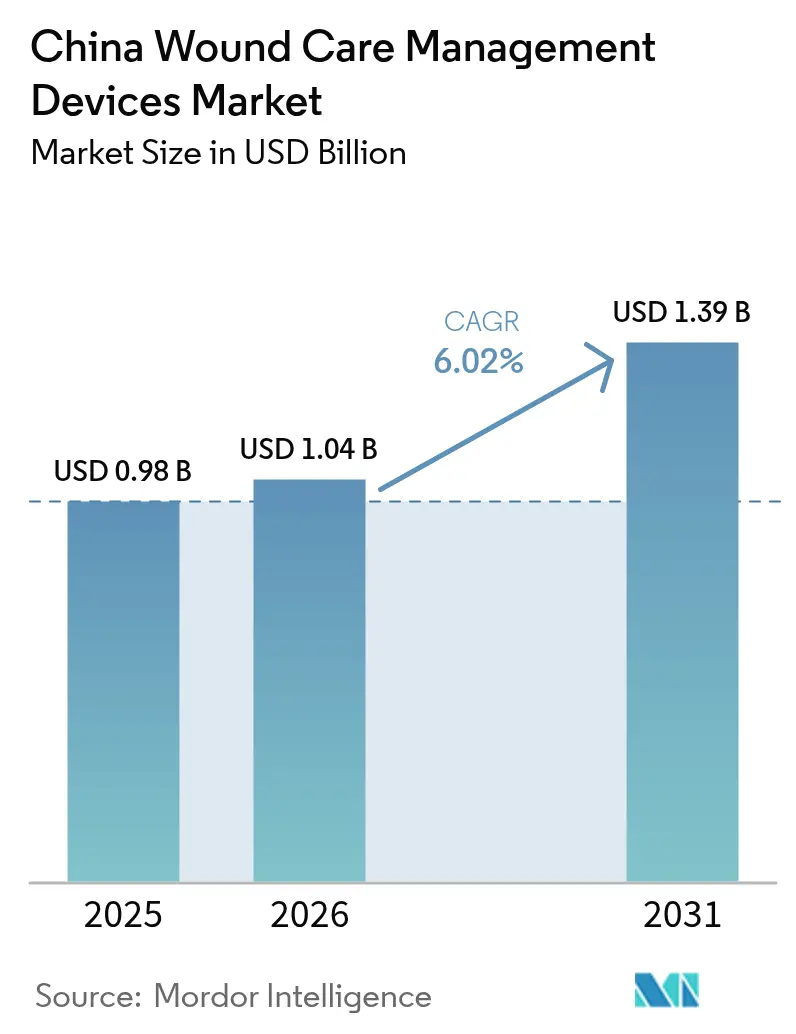
The China wound care management devices market size was valued at USD 0.98 billion in 2025 and estimated to grow from USD 1.04 billion in 2026 to reach USD 1.39 billion by 2031, at a CAGR of 6.02% during the forecast period (2026-2031). That trajectory reflects accelerating hospital capacity expansion, surging chronic disease prevalence, and government payment reforms that reward faster healing over procedure volume. China supports 233 million diabetes patients—15.88% of its adult population in 2023—and, without intervention, prevalence could rise to 29.1% by 2050 [1]. Wound-healing centers multiplied, signaling institutional readiness for advanced therapies. At the same time, Volume-Based Procurement (VBP) is cutting average prices for high-value consumables by roughly 70%, forcing suppliers to prove clear economic value. Digital health policies—66 enacted in 2023 alone—further stimulate demand for connected dressings and remote monitoring solutions.
Key Report Takeaways
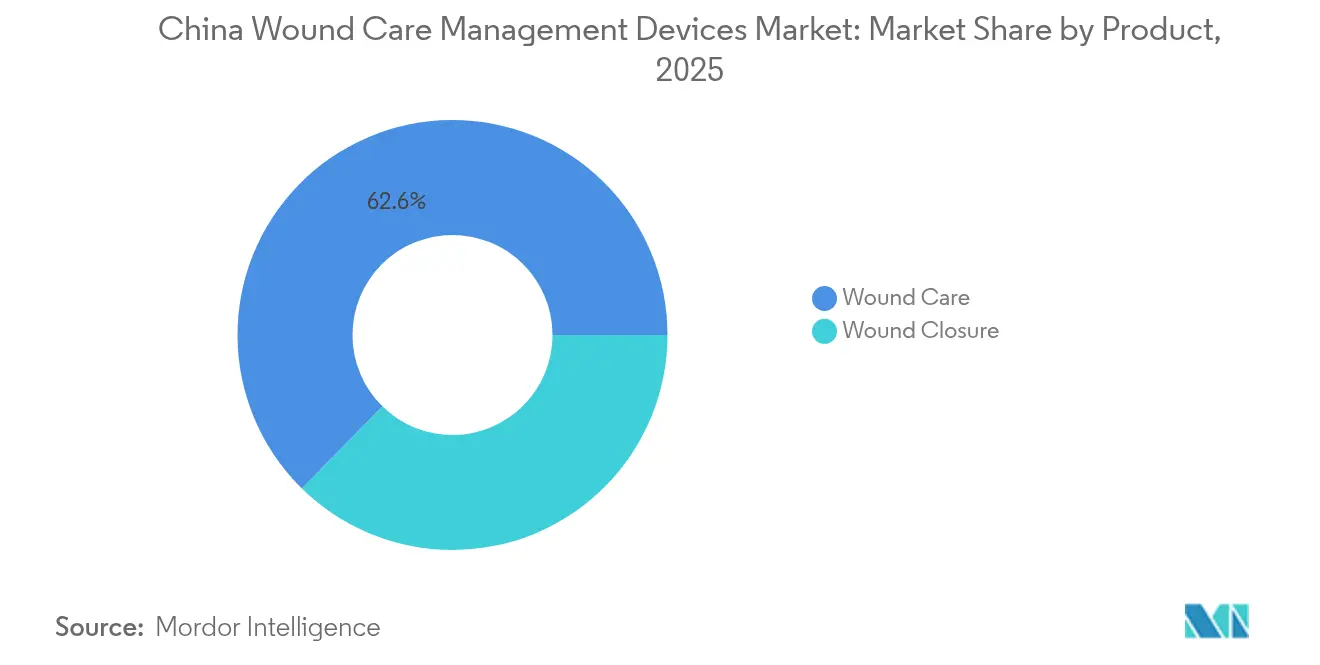
- By product category, advanced wound care captured 62.65% revenue share of the China wound care management devices market in 2025, while wound closure items are forecast to grow at a 6.75% CAGR through 2031.
- By wound type, chronic wounds commanded 58.74% of the market in 2025; acute wounds are expanding fastest at a 6.83% CAGR through 2031.
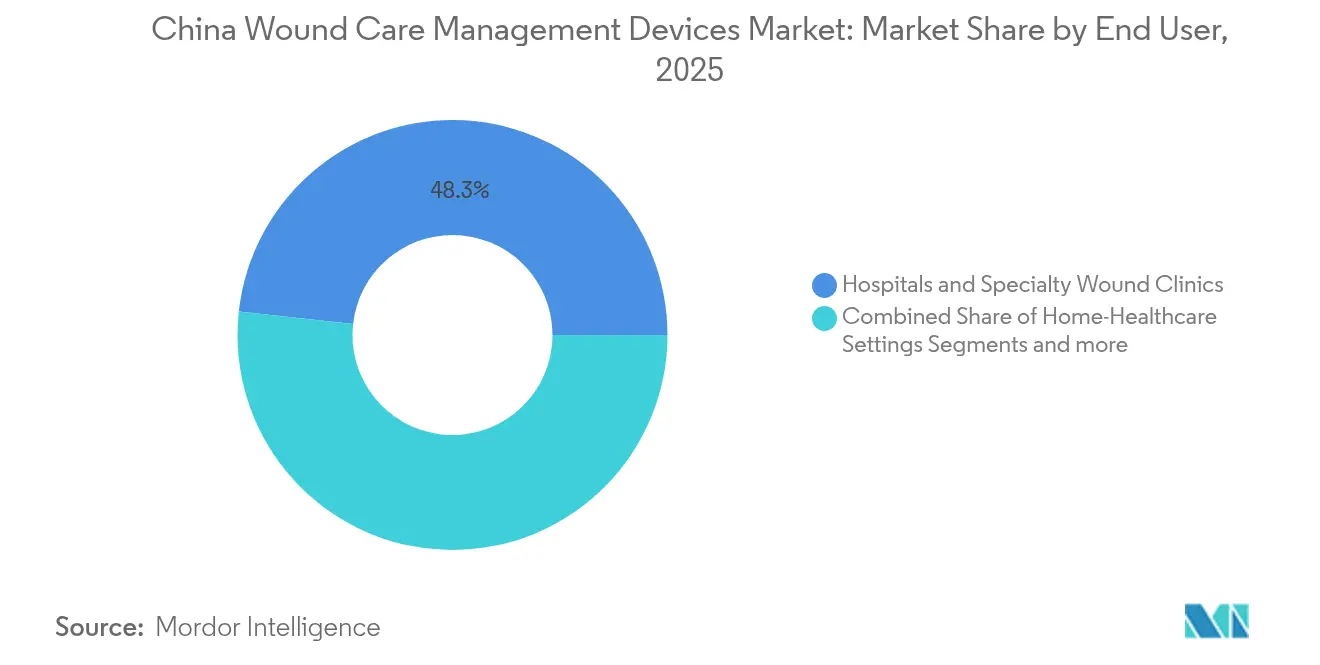
- By end-user, hospitals & specialty wound clinics accounted for 48.25% of the China wound care management devices market share in 2025, while home-healthcare settings are on track for a 6.99% CAGR to 2031.
- By mode of purchase, institutional procurement dominated with 59.88% market share in 2025; retail/OTC channels should climb at a 7.11% CAGR through 2031.
Note: Market size and forecast figures in this report are generated using Mordor Intelligence’s proprietary estimation framework, updated with the latest available data and insights as of 2026.
Market Trends and Insights
Drivers Impact Analysis of China Wound Care Management Devices Market*
| Driver | (~) % Impact on CAGR Forecast | Geographic Relevance | Impact Timeline |
|---|---|---|---|
| Rising incidence of diabetes & chronic wounds | +1.8% | National; concentrated in eastern urban centers | Long term (≥ 4 years) |
| Demand for faster recovery & reduced hospital stay | +1.2% | Tier-1 and Tier-2 cities; expanding to Tier-3 | Medium term (2-4 years) |
| Ageing population & higher elective surgeries | +1.5% | National; acute impact in eastern provinces | Long term (≥ 4 years) |
| Growing technological advancements in wound care devices | +0.9% | Urban centers; gradual rural penetration | Medium term (2-4 years) |
| Government DRG payment reform accelerating adoption of advanced dressings | +0.7% | National implementation; pilot regions leading | Short term (≤ 2 years) |
| Rising e-commerce penetration of wound supplies in tier-3/4 cities | +0.4% | Primarily tier-3 and tier-4 cities | Medium term (2-4 years) |
| Source: Mordor Intelligence | |||
Rising Incidence of Diabetes & Chronic Wounds
Diabetes prevalence increased from 7.53% in 2005 to 13.67% in 2023, inflating demand for the China wound care management devices market. Diabetic-foot treatment cost per patient jumped, while amputation rates almost tripled, prompting hospitals to shift toward preventive dressings and negative-pressure systems. Close to 100 million Chinese suffer chronic wounds every year, and diabetic ulcers have overtaken trauma as the primary cause. Evidence of superior healing in southern provinces drives region-specific adoption strategies. Collectively, these dynamics underpin sustained growth for the China wound care management devices market.
Demand for Faster Recovery & Reduced Hospital Stay
Complex-wound inpatients average 12 days of hospitalization versus seven for ordinary admissions, with median medical costs exceeding RMB 6,500. Hospitals therefore invest in technologies that shorten recovery. Modified negative-pressure therapy has trimmed healing time by almost three days and halved treatment expenses. Smart bandages such as the iCares system detect complications several days earlier than clinical observation. These solutions align with Diagnosis-Related Group (DRG) payment reforms that reward outcomes, helping expand the China wound care management devices market in metropolitan hubs.
Ageing Population & Higher Elective Surgeries
China’s 65+ cohort is swelling [2], driving both chronic wounds and surgical procedures. Class III Level A hospitals increased significantly, boosting surgical capacity. Preventive negative-pressure therapy cuts surgical-site infections by 74% among high-risk patients. Bioelectrical smart bandages achieve 99.75% closure by day 14, outperforming standard care. Aging-driven healthcare spending forecasts sustain long-run momentum for the China wound care management devices market.
Growing Technological Advancements in Wound Care Devices
Smart dressings now integrate pH, temperature, and drug-delivery functions [3]. Machine-learning models predict wound healing with over 98% accuracy, guiding personalized regimens. Self-growing hydrogel adhesives strengthen for 120 hours while inducing angiogenesis in diabetic wounds. Forty-eight AI medical devices earned Chinese approval in 2023, a 50% annual increase. Nanozyme dressings capable of modulating wound micro-environments mark the next innovation wave.
Restraints Impact Analysis of China Wound Care Management Devices Market*
| Restraint | (~) % Impact on CAGR Forecast | Geographic Relevance | Impact Timeline |
|---|---|---|---|
| Stringent registration (NMPA Class III) & reimbursement hurdles | -1.4% | National; affecting all market participants | Long term (≥ 4 years) |
| High price sensitivity in public tenders | -0.8% | National; concentrated in public hospital procurement | Medium term (2-4 years) |
| Emerging domestic OEMs triggering price wars in negative-pressure devices | -0.6% | National; acute impact in tier-1 and tier-2 cities | Short term (≤ 2 years) |
| Shortage of wound care specialists | -0.5% | National; severe impact in western and rural regions | Long term (≥ 4 years) |
| Source: Mordor Intelligence | |||
Stringent Registration (NMPA Class III) & Reimbursement Hurdles
Advanced dressings classified as Class III must undergo extensive trials, often extending approval by up to two years. New 2024 procurement rules require local patents and manufacturing, effectively sidelining many multinationals. Price negotiations led by the National Healthcare Security Administration resulted in average 63% cuts for novel therapies, squeezing margins. Commercial insurance covers just 7.7% of innovative-device costs, forcing patients to pay nearly half out-of-pocket. These hurdles temper growth, especially for premium imports within the China wound care management devices market.
High Price Sensitivity in Public Tenders
VBP rounds have slashed high-value consumable prices by about 70%. In winner-take-all tenders, the lowest bidders secure volumes, sidelining costlier advanced solutions. Public hospitals—holding 60.44% procurement share—now emphasize unit price over clinical evidence, curbing the adoption of innovative dressings. Smith+Nephew flagged VBP-driven China headwinds even as global advanced-wound revenue rose 3.8% in Q1 2025. Domestic firms reply with low-cost negative-pressure systems, triggering price wars that dent the China wound care management devices market’s value pool.
*Our forecasts treat driver/restraint impacts as directional, not additive. The impact forecasts reflect baseline growth, mix effects, and variable interactions.
China Wound Care Management Devices Market Segment Analysis
By Product:
Advanced Therapies Anchor GrowthAdvanced wound care retained a 62.65% share of the China wound care management devices market in 2025. Studies show negative-pressure therapy achieves 99.75% closure versus 94% for conventional methods, reinforcing clinical preference. Hospitals also favor antimicrobial hydrofibers such as Aquacel Ag+ for chronic ulcers, citing faster granulation. Advanced dressings’ higher upfront cost is offset by shorter length-of-stay incentives under DRG payment reform, supporting wider adoption in tertiary centers.
The wound-closure segment, though smaller, is forecast to rise at a 6.75% CAGR. Tissue adhesives and absorbable sealants gain traction for minimally invasive surgery, and automated staplers improve operating-room efficiency. Liquid-diode smart bandages that channel exudate one way while reading pH levels represent the next leap. Taken together, product innovation underpins enduring expansion of the China wound care management devices market.

By Wound Type:
Chronic Dominance, Acute MomentumChronic conditions accounted for 58.74% of the China wound care management devices market size in 2025, led by diabetic foot ulcers with an 8.1% annual incidence among diabetics. Specialized centers and city-level reimbursement pilots are scaling advanced dressings, although northern provinces still report slower healing. Pressure ulcers remain a costly inpatient problem, elevating demand for breathable silicone foams.
Acute wounds are projected to expand at 6.83% CAGR, reflecting increased elective surgery and improved emergency trauma care. Prophylactic negative-pressure systems reduce surgical-site infection by 74%, reinforcing hospital adoption. Dynamically phase-adaptive hydrogels that harden on impact but soften for remodeling shorten closure times in burn units. Such performance advantages sustain the acute segment’s outsized contribution to incremental growth within the China wound care management devices market.
By End User:
Decentralization Reshapes DemandHospitals and specialty wound clinics generated 48.25% of the China wound care management devices market share in 2025, capitalizing on multidisciplinary expertise and high-acuity case loads. Yet home-healthcare settings will post a 6.99% CAGR through 2031 as policymakers back integrated community care. Remote glucose monitoring cut HbA1c among diabetics, demonstrating telehealth’s role in wound prevention. Home-based negative-pressure systems face cost and training hurdles, but uptake is rising in affluent coastal cities.
Long-term-care facilities serve a growing geriatric cohort, where proactive dressings reduce pressure-ulcer incidence. Telemedicine platforms knit these settings together, though 27.69% of online consultations still end incomplete, indicating workflow refinements ahead. Advancements in user-friendly smart dressings promise smoother decentralization of the China wound care management devices market.
By Mode of Purchase:
E-Commerce Accelerates Retail GrowthInstitutional procurement retained 59.88% of the China wound care management devices market in 2025, but continued VBP rounds compress margins. Hospitals juggle the tension between lowest-price mandates and DRG savings, favoring products that prove total-cost advantages.
Retail and OTC channels should achieve a 7.11% CAGR as e-commerce platforms widen access in tier-3 and tier-4 cities. China’s healthcare IT industry surpassed RMB 800 billion in 2024, underpinning logistics for same-day wound-dressing delivery. Consumer-grade smart bandages with Bluetooth connectivity enable at-home monitoring, lowering clinic visits and reinforcing the decentralizing trend across the China wound care management devices market.
Geography Analysis
Regional inequality shapes adoption patterns across the China wound care management devices market. The eastern seaboard, housing most Class III Level A hospitals, captures the lion’s share of advanced-therapy sales, while western provinces lag in specialist density. Medical resource primacy averages 2.30, evidencing concentration in large metros.
Shanghai has narrowed equipment disparities but still clusters high-end wound-care devices in urban districts. Shenzhen’s community-hospital model raises suburban access and could be replicated for wound care. In Hainan’s rural counties, Health All-in-One kiosks boosted visits by 37.85% and revenue by 54.03%, hinting at scalable tele-wound-care solutions.
Digital channels mitigate some disparities: online pharmacies deliver negative-pressure kits to tier-4 locales within two days and offer video tutorials. Provincial policies vary- Jiangsu offers partial reimbursement for smart dressings, whereas Gansu does not- creating a patchwork of financing that suppliers must navigate. Despite gaps, accelerating infrastructure investment and telehealth adoption should gradually even out penetration, broadening the base of the China wound care management devices market.
Regulatory Landscape
China regulates wound care management devices under the National Medical Products Administration (NMPA) lifecycle framework, covering product classification, registration or filing, and quality management under the Regulations on the Supervision and Administration of Medical Devices. Oversight is tied to risk class (Class I filing, Class II and Class III registration), which is especially relevant for advanced dressings and higher-risk wound repair materials, where evidence and review requirements are more demanding.
Recent regulatory signals include an NMPA Center for Medical Device Evaluation (CMDE) release on January 27, 2026 (2026 No. 3) that issued an updated registration review guideline for polyurethane foam dressings, tightening technical and documentation expectations for an advanced-dressing subsegment. Separately, a revised Good Manufacturing Practice (GMP) for medical devices takes effect on November 1, 2026, increasing compliance urgency for both domestic manufacturers and multinationals running localized China production for supply.
Competitive Landscape
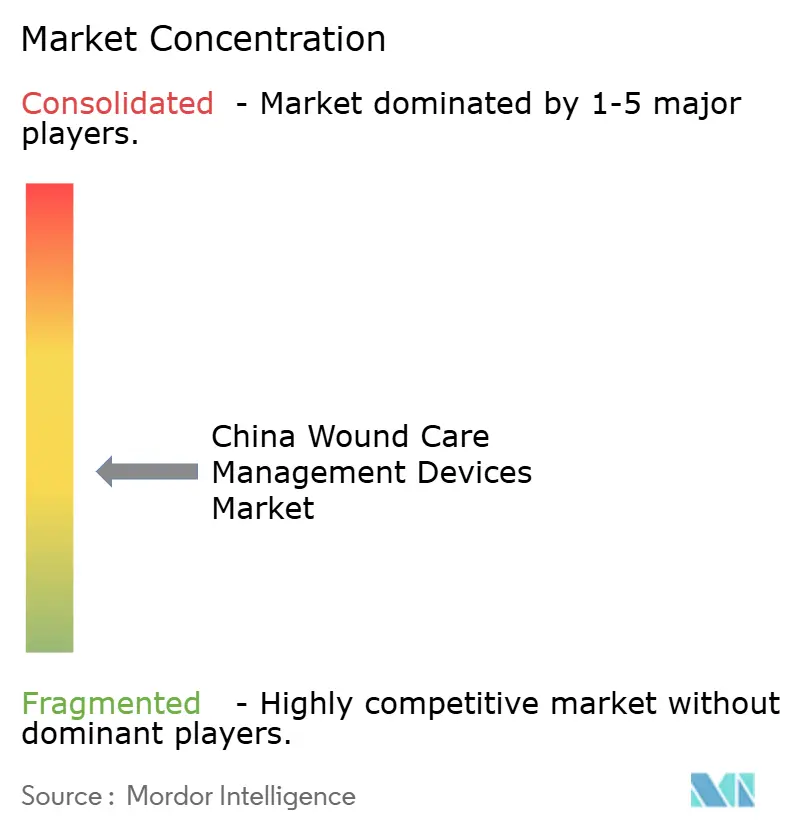
The China wound care management devices industry is moderately fragmented, with VBP compressing prices and awarding high volumes to a handful of lowest-bidding vendors. Multinationals such as Smith+Nephew cite China procurement headwinds, even while their global advanced wound division grew 3.8% in Q1 2025. Johnson & Johnson MedTech reported similar challenges as anti-corruption probes tightened hospital relationships.
Domestic firms leverage lower production costs and rapid regulatory pathways to outbid foreign rivals. Some local OEMs introduced negative-pressure systems priced 40% below imported equivalents, winning provincial tenders. Regulatory amendments now require local patents and plants, further tilting the field toward Chinese manufacturers.
Innovation remains a differentiator. Solventum’s V.A.C. Peel & Place dressing extends wear to seven days, easing application and trimming nurse time. Convatec posted 6.7% organic wound-care growth in H1 2024, fueled by Aquacel Ag+ and InnovaMatrix launches. University of Nottingham Ningbo’s battery-free Janus dressing exemplifies academia-industry collaboration that could spawn local commercialization paths. Over the next five years, suppliers that combine cost competitiveness with digital-health integration will secure durable positions in the China wound care management devices market.
China Wound Care Management Devices Industry Leaders
-
Medtronic PLC
-
Smith & Nephew PLC
-
Convatec Inc.
-
Coloplast
-
Solventum
- *Disclaimer: Major Players sorted in no particular order
China Wound Care Management Devices Market Companies Covered in this Report
- Johnson & Johnson
- Solventum
- Smiths Group
- Medtronic
- Coloplast
- Molnlycke Health Care
- Convatec
- Beiersdorf
- Winner Medical
- Zhende Medical
- Mindray (Negative-Pressure Therapy)
- SunMed Medical
- Acelity/KCI
- B. Braun
- Baxter
- DermaSci
- Kang Li Medical
- Lohmann & Rauscher
- Hartmann
- United-DS Medical
Read Analysis of China Wound Care Management Devices Companies
Market Opportunities and Future Outlook
Regulatory and standards work is creating visible whitespace around how suppliers build evidence and meet compliant localization requirements for advanced wound dressings and wound-repair materials. In April 2026, NMPA published its 2026 Medical Device Guidelines Revisions Plan, covering a large set of Class II and Class III devices with an emphasis on clinical evaluation and type testing for higher-risk products. At the same time, China continued to update classification and standards coverage for dressing categories, including updated catalogue specifications in January 2026 and standards workstreams that explicitly reference performance evaluation methods for contact wound dressings, which is pushing suppliers toward stronger local testing packages and quicker iteration cycles for products targeted at public-hospital access.
Go-to-market execution is also shifting toward local manufacturing and partnership models designed to operate within procurement constraints. In May 2026, Mobnlycke Health Care and Zhende Medical announced a majority-owned joint venture headquartered in Shanghai to integrate wound care portfolios, with operations scheduled to begin in Q3 2026. This follows Mobnlycke's China manufacturing build-out in Changshu, which supports shorter lead times and a China-based supply chain structure that better aligns with tender dynamics and technical registration expectations for advanced dressings and related consumables.
Recent Industry Developments in China Wound Care Management Devices Market
- July 2026: Mobnlycke Health Care completed construction of its first manufacturing facility in Changshu, China. The site strengthens local supply resilience for wound care consumables and supports a more China-centered cost and lead-time structure as institutional procurement continues to emphasize price and continuity of supply.
- May 2026: Mobnlycke Health Care and Zhende Medical announced a majority-owned joint venture, headquartered in Shanghai, to integrate and expand access to advanced wound care solutions in China. The partnership structure adds a direct route to broader local commercialization and portfolio scaling under China procurement and registration realities, with operations planned to begin in Q3 2026.
- November 2024: University of Nottingham Ningbo China unveiled a battery-free multifunctional microfluidic Janus wound dressing designed for real-time exudate management. The prototype highlights the direction of China-based innovation toward sensor-enabled and workflow-friendly dressings, aligning with hospitals and remote-care settings seeking earlier complication detection and fewer in-person visits.
China Wound Care Management Devices Market Report Scope and Research Methodology
Market Definition and Coverage
This market covers the value of wound care management devices sold in China, including dressings, wound therapy devices, and wound closure products used to treat acute and chronic wounds across care settings.
Scope exclusions: We exclude consumer first-aid strips, cosmetic skin patches, refurbished equipment, and improvised or home-made dressings.
Segments Covered in This Report
- By Product
- Wound Care
- Dressings
- Traditional Gauze & Tape Dressings
- Advanced Dressings
- Wound-Care Devices
- Negative Pressure Wound Therapy (NPWT)
- Oxygen & Hyperbaric Systems
- Electrical Stimulation Devices
- Other Wound Care Devices
- Other Wound Care Products
- Dressings
- Wound Closure
- Sutures
- Surgical Staplers
- Tissue Adhesives, Strips, Sealants & Glues
- Wound Care
- By Wound Type
- Chronic Wounds
- Diabetic Foot Ulcer
- Pressure Ulcer
- Venous Leg Ulcer
- Other Chronic Wounds
- Acute Wounds
- Surgical/Traumatic Wounds
- Burns
- Other Acute Wounds
- Chronic Wounds
- By End User
- Hospitals & Specialty Wound Clinics
- Long-term Care Facilities
- Home-Healthcare Settings
- By Mode of Purchase
- Institutional Procurement
- Retail / OTC Channel
Data Sources, Market Sizing, and Validation
Desk Research
Desk work starts by building the patient and procedure context that drives wound care use in China, and then linking it to device adoption and pricing. We typically use public sources such as the National Health Commission of China for health system indicators, the National Bureau of Statistics of China for demographics and macro trends, China Customs trade statistics for import and export signals, and peer-reviewed clinical journals to understand wound prevalence and care pathways.
To ground pricing and competitive positioning, we also review publicly available company filings, investor presentations, product brochures, tender announcements, and coverage from reputable press and association websites. Where available, we cross-check corporate revenue patterns and relevant patent activity using approved paid subscriptions for company financials and patent intelligence, which helps avoid over-counting adjacent categories. The desk sources listed here are illustrative only, and many other public references were also used for data collection, validation, and clarification.
Primary Interviews and Surveys
Primary work is used to pressure-test model assumptions that are hard to see in public sources, especially channel mix, usage intensity, and realistic ASP movement across hospital tiers. We spoke with hospital procurement teams, wound care clinicians, distributors, and manufacturing-side product managers, then used the input to confirm inclusion rules and resolve mismatches between shipment signals and consumption behavior.
Distribution of primary research fieldwork respondents
| Company type | Respondent position |
|---|---|
| Top tier: 25% | CXOs: 13% |
| Mid tier: 60% | Functional/Unit leaders: 36% |
| Smaller Players: 15% | Managers: 51% |
Market-Sizing & Forecasting
Sizing begins with a top-down build that ties China wound care demand to treated wound volumes and procedure counts, and then converts those totals into device consumption using adoption and utilization assumptions. To keep the totals realistic, we corroborate the outcome with selective bottom-up checks, such as sampled ASP multiplied by estimated unit volumes for key product groups, plus distributor channel checks where visibility was available.
The model inputs include treated chronic versus acute wound mix, inpatient and outpatient procedure activity, hospital purchasing patterns by tier, import and export movement for relevant device categories, and observed price corridors by product class. When a product area had thin public signals, we handle the gap through conservative penetration assumptions, then re-test through interviews until the implied volumes and spending fit care-setting realities.
For forecasting, scenario analysis is used around variables that move the market most, including diabetes burden trends, aging-linked wound incidence, protocol shift toward advanced dressings, and reimbursement or tender policy changes that can reset pricing. The final growth path is accepted only after it matches the direction shared by primary experts and remains consistent with historical demand indicators.
Data Validation & Update Cycle
Validation is done by triangulating outputs against independent signals, including trade flows, procedure activity direction, and the implied per-patient spend that clinicians and distributors consider plausible. Outliers are flagged and reviewed, and assumptions are revisited when the model produces jumps that cannot be explained by adoption, mix, or pricing changes.
Before sign-off, the work goes through multi-step analyst checks so calculations, scope rules, and conversions stay consistent across years. The report is refreshed annually, and interim updates are made when material events occur, such as policy changes or major pricing resets. Right before delivery, we run a final update pass so the market view reflects the latest available information.
Mordor Intelligence's China Wound Care Management Devices Market Size Compared Against Other Published Estimates
Published numbers for this market can look far apart because the underlying scope and counting rules differ, even when the titles sound similar. Differences usually come from what gets included as a device, the base year chosen, and whether pricing is modeled as tender-led price compression or as steady inflation.
The main gap comes from mixing the broader wound care product universe with the narrower device-only spend, where Mordor Intelligence counts wound care management devices as new product sales across dressings, therapy devices, and closure products, while leaving out consumer first-aid and cosmetic patches and excluding refurbished equipment.
Benchmark comparison
| Source | Market Size | Gaps in Research Methodology |
|---|---|---|
| Mordor Intelligence | USD 1.04 B (2026) | |
| Industry Publisher A | USD 1.27 B (2024) | Uses a different base year and may apply a wider inclusion set for wound care devices without clearly separating consumer first-aid items or non-device wound care products, which can lift the total. |
| Research Publisher B | USD 1.78 B (2024) | Covers the broader China wound care market rather than devices only, so spend can include additional product categories and a different pricing path, making the number less comparable to a device-defined scope. |
The spread in the table is mostly explained by scope width and year selection, and then amplified by how pricing is treated under tenders and procurement cycles. By keeping inclusion rules explicit and by tying volumes to treated demand signals that can be rechecked, the estimate stays easier to reproduce and update when new data points arrive.
Key Questions Answered in the Report
What is the current size of the China wound care management devices market?
The China wound care management devices market size is USD 1.04 billion in 2026 and is forecast to reach USD 1.39 billion by 2031.
Which product segment leads the market today?
Advanced wound care products hold 62.65% of 2025 revenue, underlining hospital preference for dressings and negative-pressure systems that accelerate healing.
Why are retail and OTC channels growing so quickly?
E-commerce platforms extend device access into tier-3 and tier-4 cities, driving a 7.11% CAGR for retail purchases through 2031 as consumers embrace home-based care.
How is Volume-Based Procurement affecting suppliers?
VBP rounds cut device prices by about 70%, forcing manufacturers to compete mainly on cost and to demonstrate clear total-cost savings to win hospital tenders.
Which geographic areas offer the most untapped potential?
Western and inland provinces lag in specialist density, making them attractive for tele-enabled wound solutions and lower-priced advanced dressings as infrastructure improves.
What technological trends will shape future market growth?
Smart dressings with embedded sensors, AI-guided wound assessment, and self-growing hydrogel adhesives are expected to drive adoption by shortening healing times and supporting remote monitoring.