
Market Overview
| Study Period | 2020 - 2031 |
|---|---|
| Forecast Data Period | 2026 - 2031 |
| Base Year Market Size (2025) | USD 4.65 Billion |
| Market Size (2026) | USD 4.88 Billion |
| Market Size (2031) | USD 6.23 Billion |
| Growth Rate (2026 - 2031) | 4.99 % |
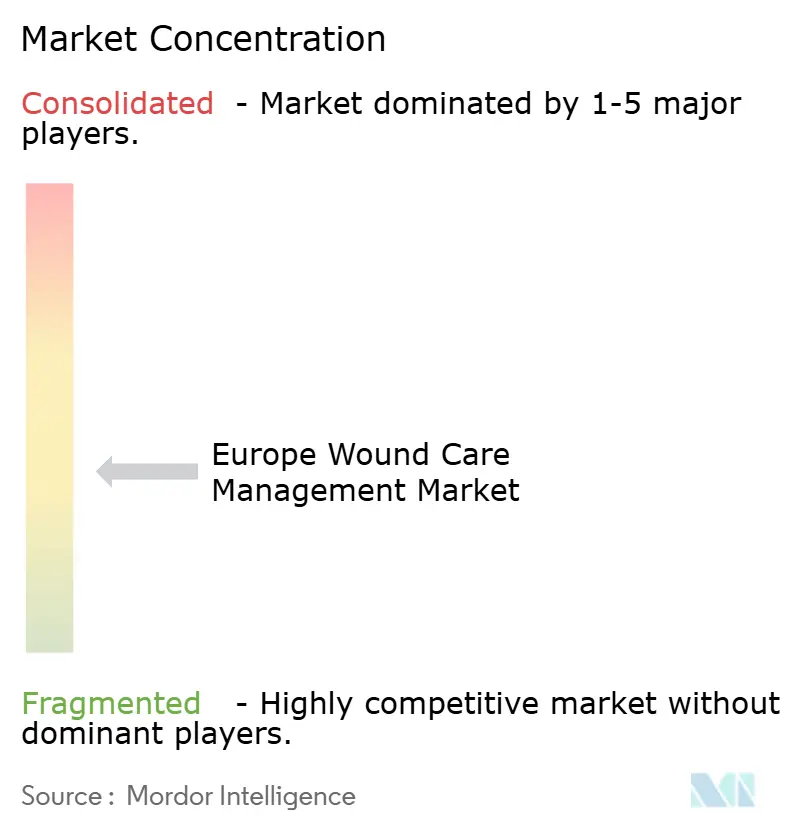
| Market Concentration | Medium |
Major Players *Disclaimer: Major Players sorted in no particular order Image © Mordor Intelligence. Reuse requires attribution under CC BY 4.0. | |
Europe Wound Care Management Market Analysis by Mordor Intelligence
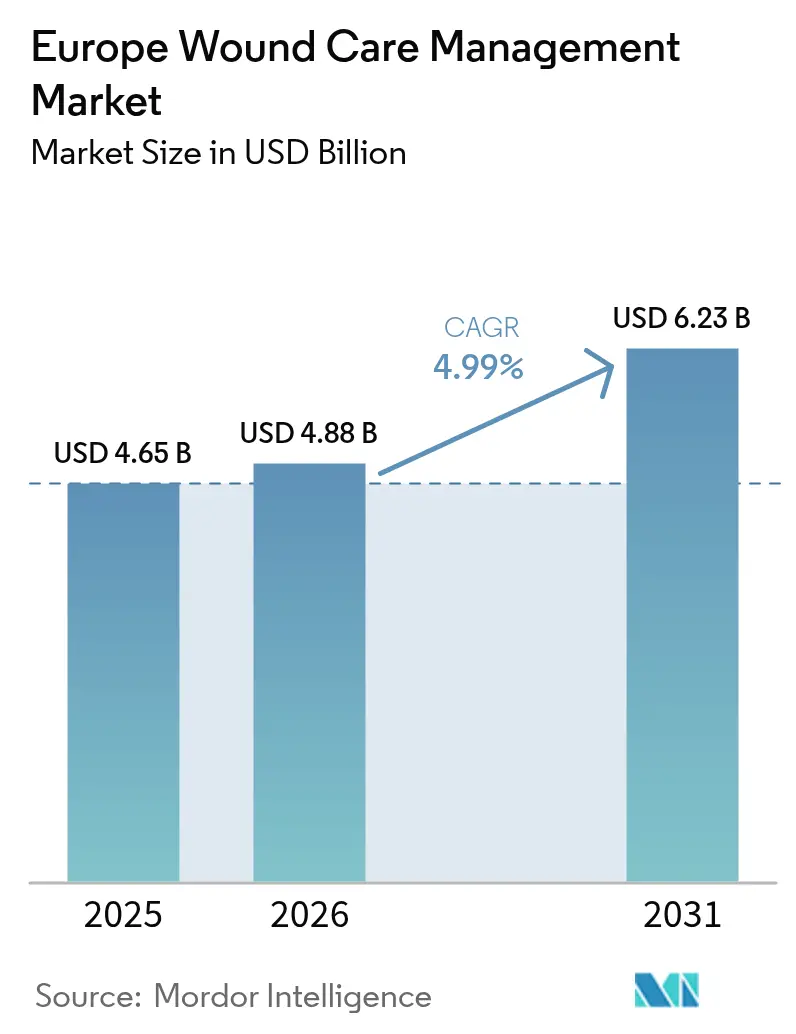
The European wound care management market size was valued at USD 4.65 billion in 2025 and estimated to grow from USD 4.88 billion in 2026 to reach USD 6.23 billion by 2031, at a CAGR of 4.99% during the forecast period (2026-2031). A confluence of rapid population ageing, the diabetes epidemic, and widespread adoption of AI-enabled imaging keeps the European wound care management market on a clear expansion path [1]. Growing surgical procedure volumes, tighter regulatory standards under the EU-MDR, and the shift from hospital to home care are reshaping procurement criteria and product design priorities across the European wound care management market. Leading vendors now bundle data-rich dressings with telehealth platforms, helping providers shorten length of stay and lower rehospitalisation rates. While Germany remains the revenue anchor, France outpaces all other countries, driven by favorable reimbursement pilots and strong digital health uptake.
Key Report Takeaways
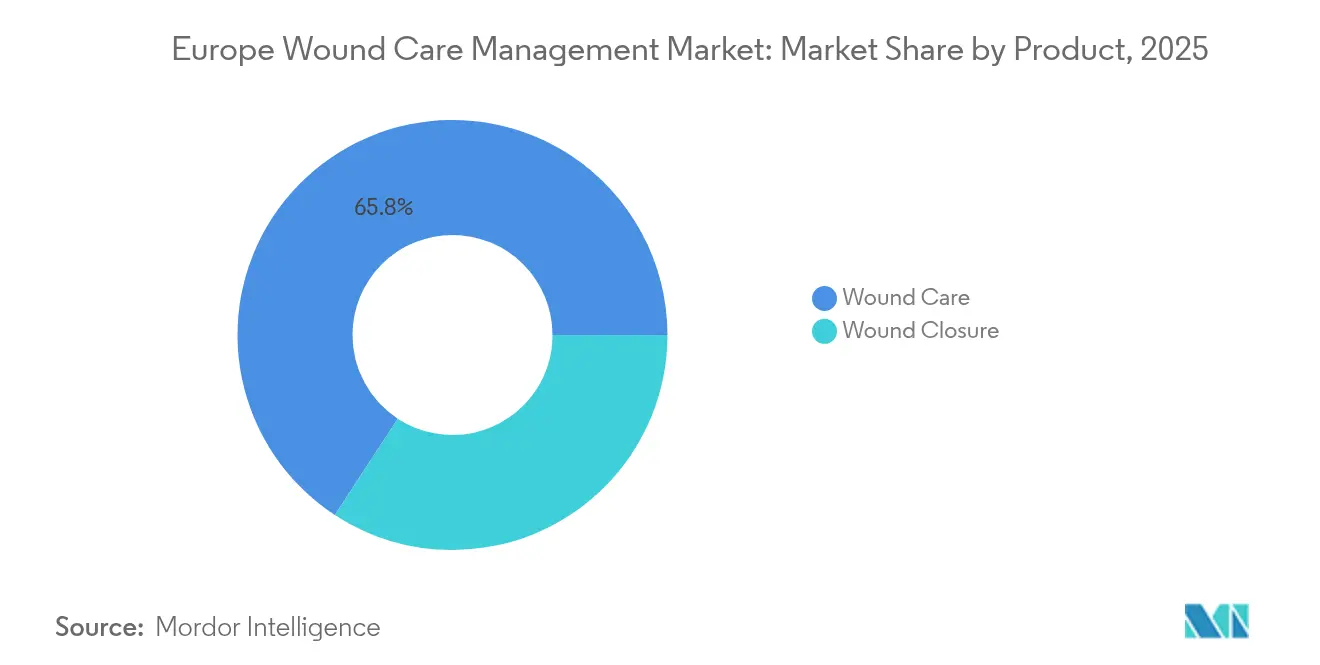
- By product category, wound care products held 65.78% of the European wound care management market share in 2025; wound closure solutions are projected to grow at a 5.72% CAGR through 2031.
- By wound type, chronic wounds accounted for 59.05% of the European wound care management market size in 2025, whereas acute wounds are projected to grow at a 5.63% CAGR through 2031.
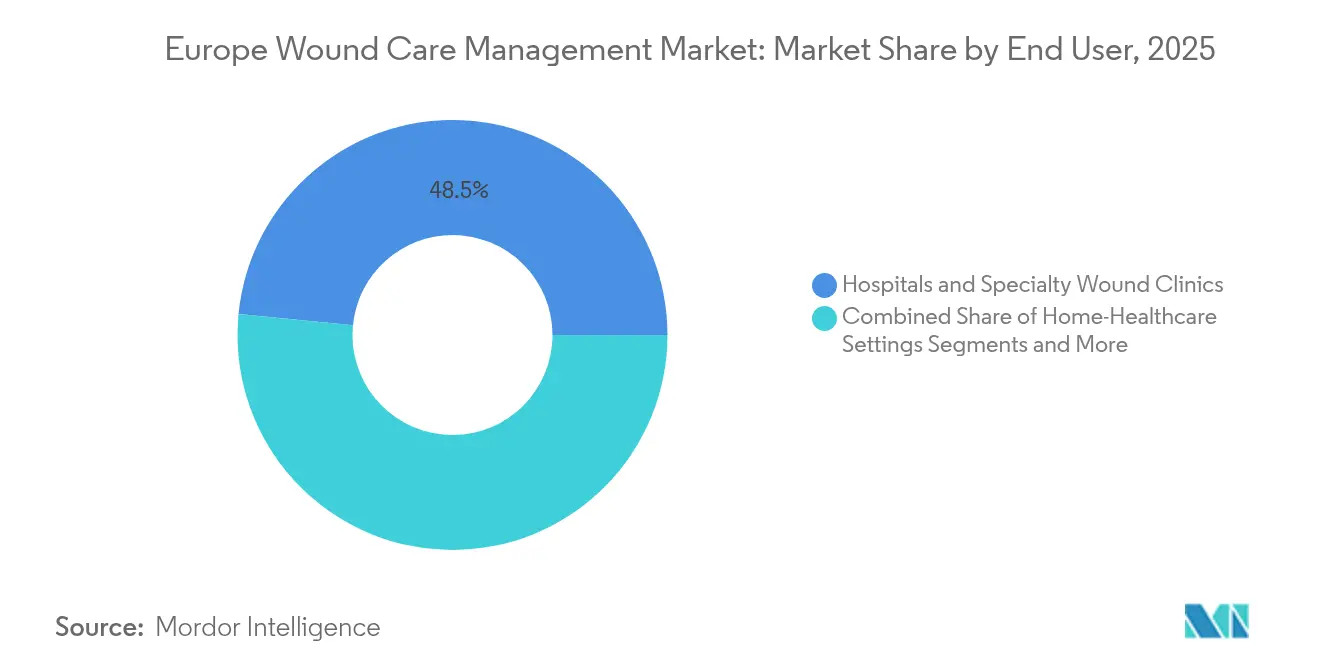
- By end user, hospitals and specialty wound clinics captured a 48.45% revenue share in 2025, while the home healthcare segment is forecast to post the fastest 5.74% CAGR to 2031.
- By mode of purchase, institutional channels dominated with 61.74% of 2025 sales; retail and over-the-counter outlets are expanding at a 5.7% CAGR.
- By geography, Germany accounted for 20.12% of the 2025 revenue; France is the fastest-growing country market, with a 5.17% CAGR through 2031.
Note: Market size and forecast figures in this report are generated using Mordor Intelligence’s proprietary estimation framework, updated with the latest available data and insights as of 2026.
Market Trends and Insights
Drivers Impact Analysis of Europe Wound Care Management Market*
| Driver | (~) % Impact on CAGR Forecast | Geographic Relevance | Impact Timeline |
|---|---|---|---|
| Increasing incidences of chronic wounds & diabetic ulcers | +1.2% | Pan-European, concentrated in Germany, UK, France | Long term (≥ 4 years) |
| Escalating volume of elective & trauma-related surgeries | +0.8% | Germany, France, Italy, Spain | Medium term (2-4 years) |
| Rapidly ageing European population base | +1.0% | Pan-European, acute in Germany, Italy | Long term (≥ 4 years) |
| Rising prevalence of diabetes & obesity | +0.9% | Eastern & Southern Europe, UK | Long term (≥ 4 years) |
| Adoption of AI-enabled digital wound imaging for precision treatment | +0.6% | Germany, UK, France, Nordic countries | Short term (≤ 2 years) |
| Hospital-to-home shift driving portable NPWT uptake | +0.5% | Germany, UK, France, Netherlands | Medium term (2-4 years) |
| Source: Mordor Intelligence | |||
Increasing incidences of chronic wounds & diabetic ulcers
Prevalence of diabetes mellitus in EU member states climbed from 7.01% in 2009 to 7.96% in 2019, translating into 61 million adults now living with the condition. Chronic wounds affect 2.21 per 1,000 citizens and carry an average treatment bill of EUR 15,000 (USD 17,476) per diabetic-foot-ulcer patient in Germany, encouraging hospitals to move rapidly toward bioactive dressings and portable NPWT platforms that help compress episode-of-care costs. Real-world data from the Barcelona metro area indicate wound treatment outlays of EUR 34.99 million (USD 40.77 million) over three years, suggesting EUR 1.76 billion (USD 2.05 billion) in national spending for Spain. Socioeconomic disparities exacerbate the burden, as lower educational levels and unemployment are associated with higher ulcer incidence, particularly in Eastern and Southern Europe [2].
Escalating volume of elective & trauma-related surgeries
Deferred procedures from the pandemic era have pushed surgical caseloads above pre-2020 baselines across top European centres. Robotic, image-guided, and day-surgery pathways shorten hospital stay but demand sophisticated post-operative dressings that can transition safely to home care [3]. Average reimbursements for complex tissue transfers range from EUR 5,933 (USD 6,912) for pedicled flaps to EUR 8,517 (USD 9,922) for free flaps across five major economies, underscoring high stakes for reliable closure technologies. Staple-compatible dressings and absorbable sealants are therefore gaining mindshare among theatre managers seeking to curtail operating-room turnover times.
Rapidly ageing European population base
The European Commission projects a sharp upswing in the over-65 cohort, resulting in parallel increases in comorbidities that slow the natural healing process. Health systems already face a shortage of 1.2 million professionals, intensifying reliance on automated wound assessment, tele-mentoring, and longer-wear dressings. WHO Europe reports that 1 in 6 residents still die before 70 from noncommunicable diseases, many needing recurring wound interventions along the care continuum.
Adoption of AI-enabled digital wound imaging for precision treatment
Swift Medical’s Skin & Wound platform surpassed 50 million clinical scans in 2024, confirming demand for objective measurement tools that directly integrate into electronic health record workflows. Devices such as Wound Viewer have lowered per-encounter costs by 35% while boosting healing performance, and the Healico mobile app already supports more than 3,800 clinicians in France and Germany by standardising remote consultations. Rapid uptake of these AI tools is elevating data analytics to a core competitive differentiator within the European wound care management market.
Restraints Impact Analysis of Europe Wound Care Management Market*
| Restraint | (~) % Impact on CAGR Forecast | Geographic Relevance | Impact Timeline |
|---|---|---|---|
| Reimbursement hurdles for advanced wound care across major EU economies | -0.7% | Germany, France, UK, Italy, Spain | Medium term (2-4 years) |
| High episode-of-care costs versus conventional dressings | -0.4% | Pan-European, acute in cost-sensitive markets | Short term (≤ 2 years) |
| EU-MDR compliance burden squeezing SME margins | -0.6% | Pan-European, disproportionate impact on SMEs | Long term (≥ 4 years) |
| Supply-chain volatility in collagen/alginate raw materials & growing AMR concerns | -0.3% | Pan-European, supply chain dependent regions | Medium term (2-4 years) |
| Source: Mordor Intelligence | |||
Reimbursement hurdles for advanced wound care across major EU economies
German statutory insurance data show that 76% of leg ulcer patients depend on older hydroactive or foam dressings, revealing a collision between clinician preference and budget caps. French surveys echo the concern: 89% of caregivers would rather opt for premium therapies, yet formularies limit their freedom of choice. Although economic models demonstrate that NPWT delivers superior long-term savings, high first-invoice prices and fragmented approval pathways hinder penetration, effectively diluting growth prospects for the European wound care management market in price-sensitive regions.
EU-MDR compliance burden squeezing SME margins
The average MDR certificate now takes 18 to 24 months to obtain. It can cost as much as EUR 100,000 (USD 116,505), a figure that is forcing 50% of surveyed manufacturers to shrink their portfolios and threatens the withdrawal of roughly one-third of devices. TEAM-NB reports a backlog of 10,000 unapproved products awaiting notified-body capacity, which extends the time-to-market and concentrates market share in the hands of well-capitalized multinationals. SMEs therefore face rising exit risk, adding consolidation pressure within the European wound care management market.
*Our forecasts treat driver/restraint impacts as directional, not additive. The impact forecasts reflect baseline growth, mix effects, and variable interactions.
Europe Wound Care Management Market Segment Analysis
By Product:
Closure momentum rises beside dominant dressingsWound care products accounted for 65.78% of the European wound care management market share in 2025, driven by hydrofiber, alginate, and antimicrobial dressings that reduce the frequency of changes and infection risk. Hospitals still purchase gauze for basic cases, yet advanced dressings are winning formularies where staff shortages and infection-control metrics drive procurement. Leading portfolios now pair dressings with cloud-connected imaging dashboards, reinforcing loyalty contracts with group purchasing organisations.
Wound closure solutions, although smaller, are set to record a 5.72% CAGR through 2031. Sutures remain theatre stalwarts, but staplers and topical adhesives are quickly gaining traction in minimally invasive segments. Smith+Nephew’s RENASYS pipeline and Solventum’s V.A.C. Peel & Place dressing, which allows seven-day wear, underscore the direction of innovation. Growth prospects hinge on the European wound care management market size for OR-compatible sealants, which could reach over USD 1.6 billion by 2031 under current adoption trends.

By Wound Type:
Chronic complexity still dominates spendChronic wounds accounted for 59.05% of applications in the European wound care management market in 2025, reflecting the high prevalence of diabetes and vascular diseases. Diabetic foot and venous leg ulcers attract intensive resource utilization, with German per-patient expenditures reaching EUR 15,000. Molecular profiling now links down-regulated FGF7 and elevated MMP10 to stalled healing, paving the way for precision topical therapies.
Acute wounds display the fastest 5.63% CAGR, aligned with surging surgical backlogs and trauma admissions. Burns, surgical incisions, and lacerations favour rapid-closure kits and absorbable barrier films, creating scope for hybrid dressings integrating silver or iodine reservoirs. The future addressable Europe wound care management market size for acute indications may reach approximately USD 2.08 billion by 2031 if theatre volumes maintain their 2025 trajectory.
By End User:
Home-care acceleration reshapes channel mixHospitals and specialty clinics retained 48.45% of sales in 2025; however, staffing gaps and bed-capacity strain encourage earlier discharge, routing complex cases to outpatient settings, where AI triage tools help sustain quality benchmarks. Academic medical centres operate as testbeds for sensor-enabled dressings that transmit moisture and temperature data to wound-care teams.
Home healthcare, expanding at a 5.74% CAGR, anchors the future of the European wound care management market. Portable NPWT units, such as Avance Solo and Avelle, demonstrate equal efficacy to inpatient pumps while reducing episode costs by up to USD 8,500. Tele-nursing platforms now coach family caregivers through routine dressing changes, and reimbursement pilots in France and the Netherlands validate payment models for remote monitoring subscriptions.
By Mode of Purchase:
Institutions lead as retail gains tractionInstitutional buyers secured 61.74% of the product flow in 2025, leveraging bulk tendering and total-cost-of-ownership scoring matrices. Deals increasingly cover multi-year service wraps that bundle clinician training, inventory analytics, and predictive maintenance for NPWT pumps.
Retail and OTC outlets are growing at a 5.7% CAGR, driven by diabetic self-care and the expansion of pharmacy-based clinical services across Germany and the UK. Consumer-grade advanced dressings with clear-window technology illustrate how vendors reposition hospital-proven materials for everyday buyers. If the European wound care management market size for retail channels continues to grow at its current pace, direct-to-consumer platforms could reach USD 965 million by 2031.
Geography Analysis
Germany Wound Care Management Market
Germany commanded 20.12% of revenue in 2025, underpinned by a mature reimbursement framework and a 30,000-strong certified wound-nurse workforce. Hydroactive dressings cover three-quarters of leg ulcer cases. At the same time, the adoption of portable NPWT is experiencing double-digit growth, reinforcing the nation’s status as the reference market for pan-European rollouts. Medical-device exports safeguard price elasticity, enabling German suppliers to cross-subsidise compliance costs and keep catalogue breadth intact.
France Wound Care Management Market
France is the breakout growth engine, expected to post a 5.17% CAGR through 2031, fuelled by telehealth penetration and progressive home-care reimbursement pilots for NPWT with instillation. Digital platform Healico’s widespread adoption sharpens data sharing between community nurses and hospital specialists, shortening referral windows and enhancing adherence. The regulatory climate supports ahead-of-curve deployment of AI imaging under sandbox guidelines, accelerating innovation within the European wound care management market.
Broader European Markets
The United Kingdom emphasizes cost-effectiveness through NICE guidance, triggering widespread formularies for antimicrobial foams and atraumatic silicone dressings. Italy’s regionalized healthcare service results in patchy adoption rates; northern provinces exhibit uptake comparable to Germany, whereas southern regions still rely heavily on traditional gauze. Spain bears a EUR 1.76 billion chronic-wound burden, prompting autonomous communities to pilot value-based procurement schemes. Nordic countries showcase the highest per-capita spend as e-health platforms link municipal caregivers with tertiary centers in near real-time, and Eastern Europe prioritizes lower-cost alginate dressings while upgrading supply-chain transparency to satisfy EU-MDR traceability clauses. Collectively, these dynamics indicate a European wound care management market that, although unified by regulation, remains heterogeneous in terms of adoption pace and care-delivery models.
Regulatory Landscape
Wound care dressings, NPWT systems, and wound-closure devices placed on the EU market are primarily governed by the EU Medical Device Regulation, Regulation (EU) 2017/745 (MDR), with implementation coordinated through national competent authorities and supported by the Medical Device Coordination Group (MDCG) via guidance documents. For wound-care portfolios that incorporate an ancillary medicinal substance, manufacturers also interact with the European Medicines Agency (EMA) interface framework for combination products, adding evidence and conformity-assessment complexity for certain advanced therapies.
A key operational change during the study period is the EUDAMED transition: after the functional launch of four EUDAMED modules on November 27, 2025, mandatory transparency obligations under the MDR and IVDR became applicable on May 28, 2026, increasing data-reporting and traceability requirements for manufacturers and authorized representatives. Separately, the European Commission introduced proposal COM(2025) 1023 on December 16, 2025, aimed at simplifying certification procedures and reducing administrative burden, reflecting continued policy focus on notified-body capacity constraints and time-to-certificate challenges for medical device suppliers.
Competitive Landscape
Competition is moderate. Smith+Nephew delivered 5.3% underlying revenue growth in 2024 and reported nearly 12.2% expansion in Advanced Wound Management during Q4, thanks to the PICO and RENASYS portfolios. HARTMANN booked EUR 608.9 million (USD 649.5 million) in wound-care revenue at 4.4% organic growth, leveraging entrenched distributor arrangements and clinician education modules. Mölnlycke extended its community-care footprint through the single-use Avance Solo NPWT system, bundling remote-monitoring APIs for district nurses.
Strategic acquisitions complement organic expansion. Merit Medical paid USD 120 million for Biolife’s haemostatic portfolio, granting exposure to high-margin surgical-bleed control niches. Healiva acquired cell-therapy assets from Smith+Nephew, signaling momentum toward personalized regenerative solutions. Smaller innovators capture white space: SolasCure secured FDA Fast Track designation for its Aurase enzymatic gel, while Kerecis’ fish-skin matrix demonstrated superior outcomes in Scandinavian trials for diabetic foot ulcers.
Supply-chain digitisation is now decisive. European device makers spend up to 20% of revenue on logistics, prompting a shift to predictive demand-planning and regional raw-material sourcing. Firms redirect 3-5% of annual revenue into supply-chain analytics to counter inflation and geopolitical risk, strengthening resilience across the Europe wound care management market. MDR hurdles are simultaneously thinning the long-tail of micro-vendors, nudging the sector toward higher concentration even as newcomers carve digital niches.
Europe Wound Care Management Industry Leaders
-
ConvaTec Group PLC
-
Smith & Nephew
-
Coloplast AS
-
Medtronic
-
Solventum
- *Disclaimer: Major Players sorted in no particular order
Europe Wound Care Management Market Companies Covered in this Report
- Solventum
- Smiths Group
- Molnlycke Health Care
- Coloplast
- Hartmann Group
- B. Braun
- Cardinal Health
- ConvaTec Group plc
- Medtronic
- Johnson & Johnson
- Essity AB (BSN medical)
- Lohmann & Rauscher GmbH
- Baxter
- Acelity LP Inc. (KCI)
- Medela
- Integra LifeSciences Corp.
- Organogenesis Holdings
- Urgo Medical
- Derma Sciences (Integra)
- Advanced Medical Solutions Group
Market Opportunities and Future Outlook
Procurement and reimbursement fragmentation across Europe creates commercial whitespace for suppliers that package advanced dressings and portable NPWT with documented outcomes and standardized workflows for home and community care. The reimbursement gap is being addressed by sector bodies, including the European Wound Management Association (EWMA), which published its Reimbursement Report 2026 (2nd edition) in March 2026 to improve transparency across selected markets (including Germany, Ireland, and Lithuania), and MedTech Europe, which has advocated integrating wound care into national health policies with stronger workforce training and structured technology adoption. Together, these efforts favor vendors that can pair products with clinical pathways, training, and health-economic evidence rather than competing on unit price alone.
Regulatory and evidence requirements under MDR continue to shape opportunity toward well-capitalized incumbents and specialized innovators that can maintain clinical documentation and post-market obligations, particularly for advanced and biologic-adjacent solutions. A concrete example is ConvaTec receiving EU regulatory approval for ConvaMatrix in September 2025, signaling active market-access momentum for skin-substitute technologies in hard-to-heal wounds. At the same time, the May 28, 2026 EUDAMED transparency obligations increase the value of digital-ready compliance, labeling, and UDI data management, giving manufacturers room to operationalize traceability while maintaining breadth across dressings, devices, and closure products for institutional and home-care channels.
Recent Industry Developments in Europe Wound Care Management Market
- July 2026: ConvaTec completed a GBP 24 million expansion at its Rhymney, South Wales facility to increase production capacity for Hydrofiber wound dressing material. The added regional manufacturing capacity supports continuity of supply for a core advanced-dressing input and strengthens delivery performance for European tenders and distributor channels.
- September 2025: ConvaTec received EU regulatory approval for ConvaMatrix, a porcine placenta-derived skin substitute intended for hard-to-heal wounds in the UK and Europe. The approval expands ConvaTec's advanced-therapy portfolio in a segment where MDR evidence thresholds are high, improving its ability to compete in specialized wound clinics and complex chronic-wound pathways.
- December 2024: Belluscura entered a joint venture with Separation Design Group and a major medical-device company to explore oxygen-based wound-care solutions. The partnership highlights ongoing product-development activity around adjunctive oxygen delivery, extending the competitive set beyond traditional dressings and NPWT into device-enabled therapy concepts.
Europe Wound Care Management Market Report Scope and Research Methodology
Market Definition and Coverage
This market covers the annual revenue generated from wound management products used to treat and close acute and chronic skin wounds across Europe, covering dressings and devices supplied through hospital and non-hospital care settings.
Scope exclusions: We exclude wound care services and labor costs (such as nursing time and bed-day costs) and purely pharmaceutical topical antibiotics.
Segments Covered in This Report
- By Product
- Wound Care
- Dressings
- Traditional Gauze & Tape Dressings
- Advanced Dressings
- Wound-Care Devices
- Negative Pressure Wound Therapy (NPWT)
- Oxygen & Hyperbaric Systems
- Electrical Stimulation Devices
- Other Wound Care Devices
- Topical Agents
- Other Wound Care Products
- Dressings
- Wound Closure
- Sutures
- Surgical Staplers
- Tissue Adhesives, Strips, Sealants & Glues
- Wound Care
- By Wound Type
- Chronic Wounds
- Diabetic Foot Ulcer
- Pressure Ulcer
- Venous Leg Ulcer
- Other Chronic Wounds
- Acute Wounds
- Surgical/Traumatic Wounds
- Burns
- Other Acute Wounds
- Chronic Wounds
- By End User
- Hospitals & Specialty Wound Clinics
- Long-term Care Facilities
- Home-Healthcare Settings
- By Mode of Purchase
- Institutional Procurement
- Retail / OTC Channel
- By Geography
- Germany
- United Kingdom
- France
- Italy
- Spain
- Rest of Europe
Data Sources, Market Sizing, and Validation
Desk Research
Desk research is used to set the medical and commercial context so the market model starts with realistic care pathways and purchase behavior. We rely on public health statistics and wound burden indicators from sources such as Eurostat, WHO Europe health datasets, and OECD health data, which help anchor the size of the patient pool that could require wound care.
Treatment practice and product usage patterns are clarified using sources such as NICE guidance, European Wound Management Association publications, peer reviewed clinical journals, and selected national health ministry portals for reimbursement or care delivery signals. To cross-check supplier footprint and geographic revenue mix, company annual reports, investor presentations, and reputable press coverage were also reviewed, and a paid subscription source for company financials and news was used selectively to confirm timelines and reported category splits. These desk sources are illustrative only, and other public sources were also referenced for data collection, validation, and clarification.
Primary Interviews and Surveys
Primary work is used to pressure-test assumptions that do not sit cleanly in public datasets, especially around product mix, channel pricing, and adoption speed for advanced dressings and therapy devices. We speak with a mix of manufacturers, distributors, hospital procurement contacts, clinicians in wound clinics, and home-care stakeholders across major European countries so the final assumptions reflect how products are bought and used in routine care.
Distribution of primary research fieldwork respondents
| Company type | Respondent position |
|---|---|
| Top tier: 39% | CXOs: 15% |
| Mid tier: 44% | Functional/Unit leaders: 39% |
| Smaller Players: 17% | Managers: 46% |
Market-Sizing & Forecasting
Sizing starts with a top-down build that reconstructs the addressable demand pool by country using wound incidence and prevalence signals, then converts that pool into product consumption using care setting splits and typical treatment intensity. Once that structure is in place, the value layer is built by applying realistic average selling prices by product group and adjusting for public tendering effects and mix shifts.
Key inputs that shape the model include chronic wound burden linked to diabetes and aging, surgical procedure volumes that drive acute wounds, hospital versus community care share, typical dressing change frequency for common wound types, penetration of negative pressure wound therapy, and the extent of reimbursement coverage that influences product choice. Results are corroborated with selective bottom-up approximations, including supplier revenue splits for Europe, sampled price points from tenders and distributor quotes, and channel checks on mix for advanced versus basic dressings. Where gaps show up, we adjust totals based on the direction indicated by these checks.
For forecasting, scenario analysis is used and kept practical, where a base case is derived from expected demographic trends, procedure outlook, and expert views on adoption of advanced therapies. The same variables are rolled forward, and price growth is handled separately from volume growth so inflation and mix do not get double counted.
Data Validation & Update Cycle
Validation is done through several passes so outliers are caught early and assumptions are not left unchecked. Model outputs are compared with independent signals such as country level healthcare spend direction, procedure trends, and observed shifts in care delivery toward home and outpatient settings, and then variances are reviewed before sign-off.
When a country result looks too high or too low versus the available demand indicators, the inputs are traced back to the driver (patient pool, utilization, or pricing), and the assumption is rechecked through follow-up outreach. Reports are refreshed annually, and interim updates are made when material events occur, such as reimbursement changes or sharp pricing moves in tenders. Before delivery, an analyst completes a fresh review pass so clients receive the latest updated view.
Mordor Intelligence's Europe Wound Management Market Sizing Compared With Other Published Estimates
Published market sizes for Europe wound management often differ because the scope line is drawn differently and the pricing logic is not always handled the same way across care settings. The year used for currency conversion and how quickly product mix is assumed to shift toward advanced therapies also creates spread, even when the end topic sounds identical.
A common gap driver is whether the estimate is limited to wound dressings and therapy devices, or whether it also folds in adjacent items like broader surgical closure tools and service-heavy care costs that sit outside product revenue. Another driver is how average selling prices are treated, where tender-driven hospital pricing can move differently from retail and home-care pricing, and the market total changes depending on which channel mix is assumed. In addition, refresh cadence matters because reimbursement updates and procurement cycles can move the price and mix picture within a year, which then changes the current-year starting point used for the forecast.
Benchmark comparison
| Source | Market Size | Gaps in Research Methodology |
|---|---|---|
| Mordor Intelligence | USD 4.65 B (2025) | |
| Industry Dataset A | USD 6.21 B (2025) | This figure is positioned around wound management devices and expands the device perimeter (such as compression therapy, HBOT, and smart imaging tools), which increases the counted revenue versus a product set focused on core wound management categories. |
| Global Consultancy B | USD 6.62 B (2025) | This estimate groups a wider wound care basket and can include additional product classes like biological skin substitutes and a broader surgical closure mix, and it also uses different channel and ASP progression assumptions that can lift the total. |
The table indicates that most of the spread is explained by what gets included in the product basket and how pricing is averaged across hospital tenders versus non-hospital channels, with currency timing adding a smaller difference. By keeping services out, separating product categories carefully, and checking pricing and mix with country-level channel inputs, the resulting 2025 value stays traceable to repeatable steps applied by Mordor Intelligence near the end of the model build, not added as an afterthought.
Key Questions Answered in the Report
What is the current size of the Europe wound care management market?
The market is valued at USD 4.88 billion in 2026 and is projected to reach USD 6.23 billion by 2031.
Which country leads revenue in Europe’s wound-care device space?
Germany holds the top spot with 20.12% of 2025 sales thanks to strong clinical infrastructure and early adoption of advanced therapies.
Which segment is growing fastest within the Europe wound care management market?
Wound closure solutions, driven by staplers and tissue adhesives, are projected to grow at a 5.72% CAGR through 2031.
Why is home healthcare important for wound-care growth?
Home-based care enables cost savings, addresses workforce shortages and supports patient comfort, pushing portable NPWT and tele-wound platforms to a 5.74% CAGR.
How does EU-MDR affect device makers?
Certification now takes up to 24 months and can cost EUR 100,000, prompting many SMEs to trim portfolios and causing a potential 33% device withdrawal.
What role does AI play in wound management?
AI-driven imaging platforms standardise measurements, cut assessment time and feed data into treatment algorithms, improving healing outcomes and lowering total care costs.