
Market Overview
| Study Period | 2021 - 2031 |
|---|---|
| Forecast Data Period | 2026 - 2031 |
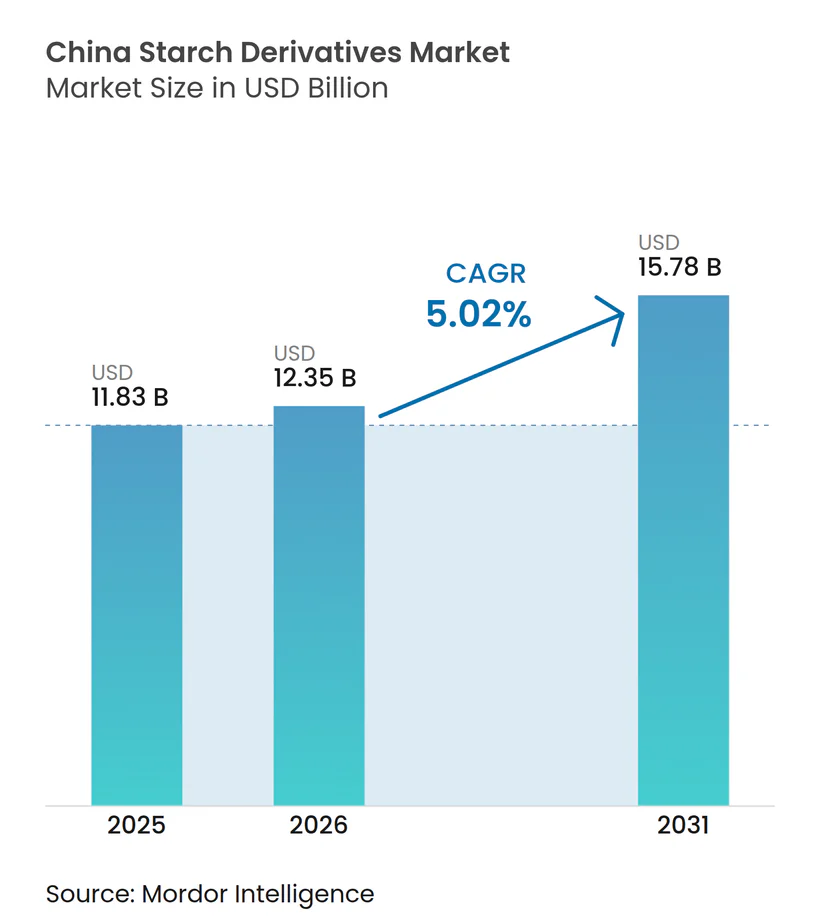
| Base Year Market Size (2025) | USD 11.83 Billion |
| Market Size (2026) | USD 12.35 Billion |
| Market Size (2031) | USD 15.78 Billion |
| Growth Rate (2026 - 2031) | 5.02 % |
| Market Concentration | Medium |
Major Players *Disclaimer: Major Players sorted in no particular order Image © Mordor Intelligence. Reuse requires attribution under CC BY 4.0. | |
China Starch Derivatives Market Analysis by Mordor Intelligence
The China starch derivatives market size is projected to be USD 12.35 billion in 2025, USD 12.97 billion in 2026, and reach USD 15.78 billion by 2031, growing at a CAGR of 5.02% from 2026 to 2031. The China starch derivatives market operates on a large domestic corn-processing base and serves food, beverage, pharmaceutical, and industrial users. Domestic processing capacity supports supply security, but excess capacity keeps pricing under pressure in several corn-producing regions. Demand is becoming more diverse as food manufacturers seek convenient formats, functional ingredients, and reliable texture control. Producers with integrated procurement, co-product sales, and specialty formulation capabilities can better manage commodity price pressure. Environmental investment and local production partnerships are also changing where producers place new capacity in the China starch derivatives market.
Key Report Takeaways
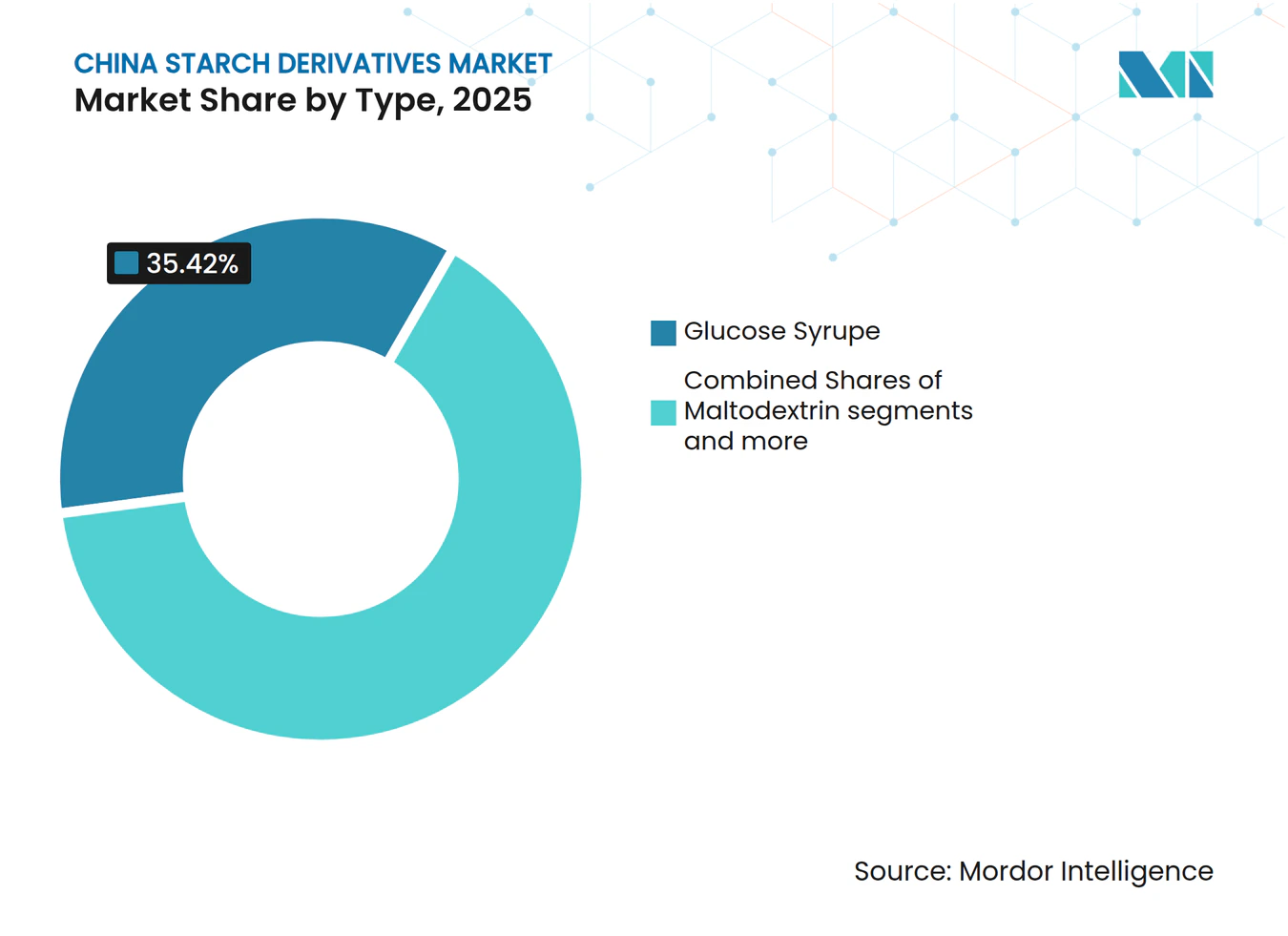
- By type, Glucose Syrups held 35.42% of the China starch derivatives market share in 2025, while High Fructose Corn Syrup is forecast to expand at a 6.75% CAGR through 2031.
- By source, Maize held 41.27% of revenue in 2025, while Tapioca is forecast to grow at a 6.36% CAGR through 2031.
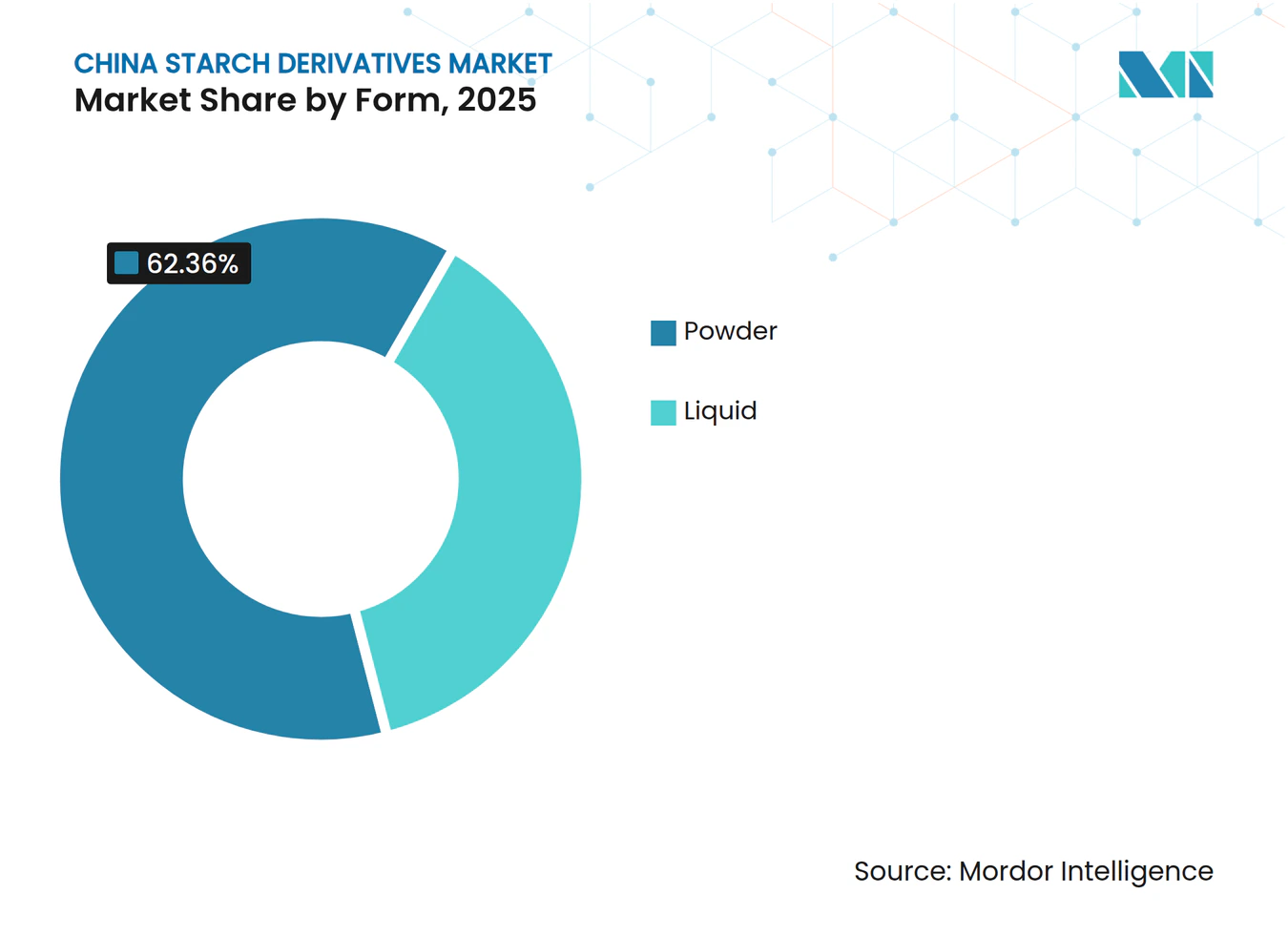
- By form, Powder accounted for 62.36% of revenue in 2025, while Liquid derivatives are forecast to grow at a 6.78% CAGR through 2031.
- By application, Food and Beverage held 34.57% of revenue in 2025, while Pharmaceuticals is forecast to grow at a 6.58% CAGR through 2031.
Note: Market size and forecast figures in this report are generated using Mordor Intelligence’s proprietary estimation framework, updated with the latest available data and insights as of 2026.
China Starch Derivatives Market Trends and Insights
Drivers Impact Analysis*
| Driver | (~) % Impact on CAGR Forecasts | Geographic Relevance | Impact Timeline |
|---|---|---|---|
| Growing demand for processed and convenience foods | +1.4% | East China, South China | Medium term (2-4 years) |
| Rising demand for glucose syrups in confectionery production | +0.9% | National, concentrated in East and South China | Short term (≤ 2 years) |
| Abundant domestic corn supply and established processing infrastructure | +0.8% | Northeast China, North China | Long term (≥ 4 years) |
| Technological advancements in starch processing | +0.7% | National, strongest in Shandong and Jiangsu | Medium term (2-4 years) |
| Increasing demand for functional and specialty ingredients | +0.6% | East China and national pharmaceutical hubs | Medium term (2-4 years) |
| Growing interest in bio-based and biodegradable materials | +0.5% | Southwest China and East China | Long term (≥ 4 years) |
| Source: Mordor Intelligence | |||
Growing Demand for Processed and Convenience Foods
China’s convenience food category exceeded CNY 673.6 billion in 2023 and was projected to exceed CNY 1 trillion by 2026. This demand supports wider use of starch-based thickeners, binders, texturizers, modified starches, and glucose syrups. Pre-cooked meals in East and South China require ingredients that preserve sauce texture and support shelf-life performance. Premium products need specialty starches that meet viscosity and freeze-thaw requirements. Value-oriented producers favor lower-cost syrup blends, which creates separate price tiers within the same food category. Frozen foods recorded positive retail sales growth in the second quarter of 2025 while the broader snack category weakened.
Rising Demand for Glucose Syrups in Confectionery Production
Glucose syrups are used as crystallization inhibitors and humectants in hard candy, soft candy, chocolate, and baked products. Their wide functionality supports their leading position in the China starch derivatives market. Sugar-free and functional confectionery can still require glucose syrup as a processing aid even when sucrose volume falls. Lower domestic corn prices can narrow the cost gap between starch-derived glucose syrups and alternative sweetening systems. This makes product performance and supply reliability important purchasing factors for confectionery producers. The China starch derivatives market therefore remains tied to both conventional confectionery production and newer functional product launches.
Abundant Domestic Corn Supply and Established Processing Infrastructure
China’s 2025/26 corn production was forecast at 321 million tonnes, 1% above the previous year[1]. The country’s corn-processing system supplies food, feed, starch, starch sugar, and other co-products. This breadth supports raw-material availability for the China starch derivatives market. It also increases the importance of operating discipline because major processors compete for the same corn supply. New investment in Taicang shows that supply infrastructure is moving closer to high-density demand centers in East China. Large integrated plants can also use corn oil, feed materials, and fermentation products to improve plant economics.
Increasing Demand for Functional and Specialty Ingredients
Resistant starch, prebiotic dextrins, and cyclodextrin systems are moving beyond narrow health-food applications. A 2025 study found that fiber fortification in common Chinese food products could increase the share of adults meeting daily fiber recommendations by 48% and children by 54%. This provides food formulators with a reason to use more functional ingredients. Starch-based excipients remain important in tablets, capsules, injectables, and drug-delivery systems[2]. Cyclodextrins can improve drug solubility and bioavailability, giving specialty producers access to higher-value uses. Interest in biodegradable packaging and bio-based materials also creates an additional outlet for modified starch technologies.
Restraints Impact Analysis*
| Restraint | (~) % Impact on CAGR Forecasts | Geographic Relevance | Impact Timeline |
|---|---|---|---|
| Intense price competition among domestic manufacturers | -0.5% | National, most acute in Northeast and North China | Short term (≤ 2 years) |
| Stringent environmental compliance requirements | -0.4% | Northeast China, Shandong, Hebei | Medium term (2-4 years) |
| Competition from alternative ingredients | -0.3% | National food and beverage manufacturing | Medium term (2-4 years) |
| Dependence on imported specialty raw materials and ingredients | -0.2% | South China and Shandong port clusters | Long term (≥ 4 years) |
| Source: Mordor Intelligence | |||
Intense Price Competition Among Domestic Manufacturers
Price competition remains a material restraint for the China starch derivatives market because standard products are easy for buyers to compare. Smaller producers have less ability to absorb changes in corn, energy, freight, and compliance costs. Commodity glucose syrups carry particular exposure when customers can switch among domestic suppliers with limited reformulation work. Integrated producers are better positioned because they can monetize co-products alongside starch streams. Alternative ingredients can increase buyer bargaining power in food and beverage applications. Imported specialty inputs also create exposure to international pricing and supply disruptions for companies that lack local alternatives.
Stringent Environmental Compliance Requirements
Environmental requirements raise capital and operating costs for older starch-processing facilities. Plants may need wastewater treatment, energy-efficiency equipment, and upgraded process controls to remain compliant. China Starch Holdings included wastewater treatment improvements and thermoelectric cogeneration in its Linqing investment program. Such investments favor operators with stronger balance sheets and established industrial sites. Requirements for new facilities to operate in designated industrial parks can also influence capacity location. The China starch derivatives market may become more concentrated if smaller plants cannot fund these upgrades.
*Our forecasts treat driver/restraint impacts as directional, not additive. The impact forecasts reflect baseline growth, mix effects, and variable interactions.
Segment Analysis
By Type: Glucose Syrups Anchor Revenue, HFCS and Specialty Types Propel Future Value
Glucose Syrups held 35.42% of the China starch derivatives market share in 2025, making them the largest type by revenue. Their role in confectionery, bakery, and beverages supports consistent demand across major food manufacturing clusters. Their functional uses include sweetness, moisture retention, texture control, and crystallization management. These characteristics make glucose syrups relevant to both established and new packaged-food products. High Fructose Corn Syrup is forecast to grow at a 6.75% CAGR from 2026 to 2031. The China starch derivatives market size for High Fructose Corn Syrup is supported by liquid food production systems that require consistent handling and dosing.
Maltodextrin serves food, pharmaceutical, and functional formulation needs where neutral taste and processing performance matter. Cyclodextrin occupies a more specialized position in pharmaceutical and encapsulation uses. Scientific literature identifies cyclodextrins as useful materials for improving solubility and bioavailability in drug-delivery applications. Dextrins and other specialty products serve adhesives, textile sizing, and bio-based polymer applications. These uses reduce reliance on commodity food volumes for producers with technical capabilities. Companies with enzyme modification and formulation expertise can compete through product performance rather than only price. The China starch derivatives market benefits when these specialty uses scale alongside core glucose syrup demand.



By Source: Maize Dominates, Tapioca’s Import Role Expands Supply Options
Maize held 41.27% of revenue in 2025, reflecting its central role in China’s corn-processing network. Corn supplies starch, starch sugar, feed products, fermentation inputs, and other co-products. This integrated system supports the China starch derivatives market through established procurement and production infrastructure. The USDA forecast of 321 million tonnes of corn production for 2025/26 indicates the scale of the domestic raw-material base. However, strong availability does not eliminate margin pressure when processing capacity is high. Larger processors can manage this risk through product mix, logistics, and co-product revenue.
Tapioca is forecast to grow at a 6.36% CAGR from 2026 to 2031. It offers processors an alternative feedstock for starch and selected sweetener applications. Tapioca sourcing can provide flexibility when corn prices rise, or regional supplies tighten. Wheat starch continues to serve more specialized uses, including noodles and selected confectionery formulations. Potato starch remains relevant for premium thickening and paper-grade applications. Other feedstocks, such as sorghum and barley, broaden the available raw-material mix. The China starch derivatives market can benefit from blended sourcing when it reduces input-price exposure and improves supply continuity.
By Form: Powder Retains Broad Utility While Liquids Gain Processing Relevance
Powder held 62.36% of revenue in 2025, supported by its ambient storage, shelf-life, and dry-blending compatibility. It is widely used in bakery, animal feed, and pharmaceutical excipient applications. The China starch derivatives market size for Powder reflects its role in production settings that need stable, easy-to-handle ingredients. Powder products can also move through established distribution channels without specialized liquid storage. These advantages support their continued use across a large customer base. Liquid derivatives are forecast to grow at a 6.78% CAGR from 2026 to 2031.
Liquid High Fructose Corn Syrup is suited to ready-to-drink tea, carbonated beverages, and liquid dairy production. Tank storage and pipeline transfer can reduce manual handling for automated plants. This can lower material losses and simplify continuous beverage blending. Liquid formats also help food manufacturers maintain uniform dosing in high-volume production. Enzyme-modified starches can extend these advantages into food and packaging applications. Producers that can supply consistent liquid quality may gain from automated manufacturing growth. Powder will remain important, but liquids address a distinct set of plant-efficiency needs in the China starch derivatives market.

By Application: Food and Beverage Leads, Pharmaceuticals Expand Higher-Value Demand
Food and Beverage held 34.57% of revenue in 2026 and remains the largest application. Confectionery supports demand for glucose syrups and dextrins, while beverages support demand for high-fructose corn syrup and maltodextrin. Bakery remains a stable use case because starch derivatives contribute texture, moisture, and product consistency. Ready-to-drink teas and functional beverages are important outlets for liquid forms. This segment creates a broad demand base for the China starch derivatives market. Convenience food growth further strengthens the connection between starch performance and packaged-food production.
Pharmaceuticals is forecast to grow at a 6.58% CAGR from 2026 to 2031. Starch-based excipients support tablets, capsules, granules, and injectable formulations. Cyclodextrin materials are especially relevant when formulations need better solubility or controlled delivery. Personal care and cosmetics provide a developing application for encapsulation and film-forming systems. Animal feed provides stable demand for energy and palatability applications. Bio-based polymers, adhesives, and textile sizing provide additional industrial uses. These applications give the China starch derivatives market multiple routes for value growth beyond core food demand.
Geography Analysis
North China is the principal price-setting area for corn starch derivatives, with Shandong, Hebei, and Inner Mongolia playing important roles in supply. Shandong-based processors benefit from proximity to ports, industrial customers, and corn-processing infrastructure. East China is the leading consumption center because it includes dense food and beverage manufacturing clusters. COFCO Biotechnology approved a 550,000-tonne annual starch-sugar project in Taicang, Jiangsu, with total investment of RMB 981 million, equivalent to USD 137 million. The project includes 300,000 tonnes of High Fructose Corn Syrup, 200,000 tonnes of maltose syrup, and 50,000 tonnes of specialty syrup. This investment shows why East China remains strategically important to the China starch derivatives market.
South China supports substantial beverage demand for liquid High Fructose Corn Syrup and glucose syrups. Guangdong’s food-processing base and Guangxi’s cassava resources support a regional tapioca supply chain. These conditions create a supply profile that differs from North China’s corn-centered structure. Demand from ready-to-drink tea and beverage producers gives liquid products a strong regional outlet. Port infrastructure also supports the movement of imported tapioca starch and related inputs. This regional mix helps diversify supply choices for the China starch derivatives market.
Northwest China added corn deep-processing capacity during 2025 in areas with corn availability and lower energy costs[3]. Provincial incentives and food-security priorities support processing diversification beyond the established coastal and Northeast locations. The China starch derivatives market share held by individual regions is shaped by feedstock access, logistics, customer proximity, and environmental requirements. Export growth can provide an outlet for domestic supply when local demand is insufficient. China’s corn deep-processing product exports grew 4.2% year-on-year in the first half of 2025. Regional strategies will continue to differ because each area has distinct raw-material, infrastructure, and demand conditions.
Competitive Landscape
Market Concentration
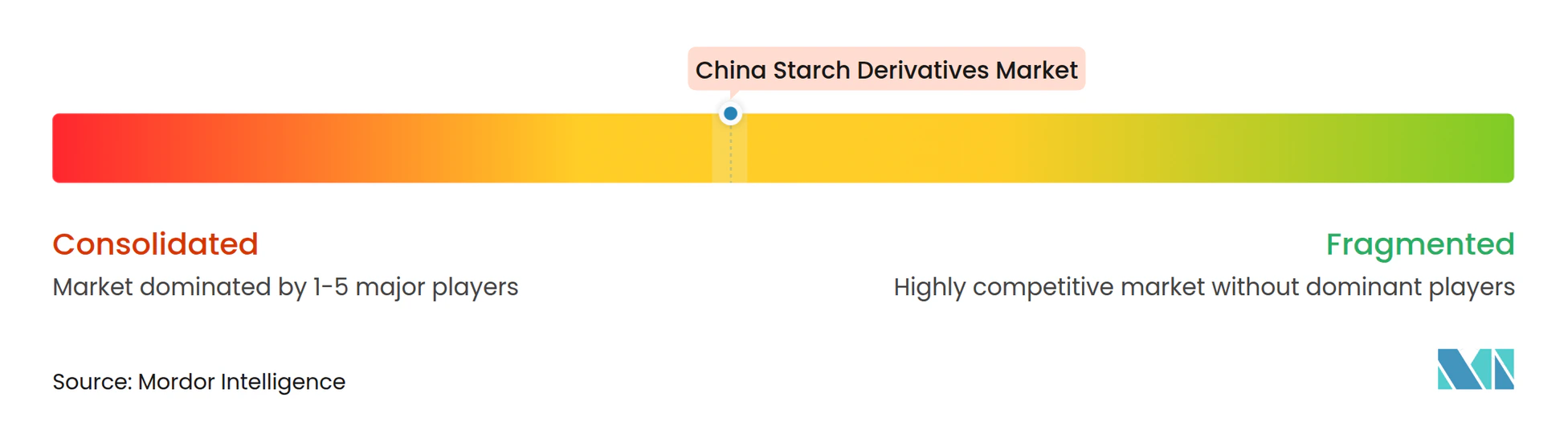
The China starch derivatives market has a consolidated structure, with national integrators competing alongside regional and specialty producers. Zhucheng Xingmao, COFCO Biochemical, Xiwang Sugar, and Baolingbao Biology have advantages in procurement, multi-product revenue, and capacity investment. Their scale supports investment in technology, logistics, and environmental upgrades. COFCO Biotechnology’s Taicang project is one example of a strategy focused on capacity near East China demand centers. China Starch Holdings’ Linqing program combines production investment with wastewater treatment and cogeneration. These moves show that capacity investment now includes operating-cost and compliance considerations.
Specialty-product development provides another route for competition in the China starch derivatives market. Pharmaceutical-grade cyclodextrins, prebiotic dextrins, and bio-based materials can offer differentiated value. The China Starch Industry Association’s 2025 World Starch Industry Congress highlighted the development of high-value derivatives and synthetic-biology-enabled products. Companies that meet quality and traceability requirements can compete in more demanding applications. Baolingbao demonstrated modified starch products for plant-based food texturizing and personal care at Vitafoods Europe 2025. This approach broadens the company’s portfolio beyond commodity starch products.
Multinational companies face a more difficult position in commodity products because domestic producers have local supply and cost advantages. Tate & Lyle reported a new partnership for locally produced food starches in China during its 2025 results. The company also cited greater starch-product costs from United States and China tariff uncertainty. ADM started phasing out domestic commodity trading through Toepfer Shanghai in April 2025, while retaining its starch derivatives, nutrition, and manufacturing activities. These actions indicate a greater emphasis on locally embedded supply and value-added positions. Competition will depend on both scale and the ability to meet specialized customer requirements.
China Starch Derivatives Industry Leaders
-
Cargill Incorporated
-
Ingredion Incorporated
-
Tate & Lyle PLC
-
Zhucheng Xingmao Corn Developing Co., Ltd.
-
COFCO Biochemical (Anhui) Co., Ltd.
- *Disclaimer: Major Players sorted in no particular order
Recent Industry Developments
- April 2026: COFCO Group commissioned China's first immobilized glucose isomerase production line. The enzyme converts glucose into fructose and is essential for manufacturing high fructose corn syrup. The development strengthens domestic supply of a critical processing input that had historically depended on foreign suppliers, supporting the stability of China's starch-based sweetener industry.
- March 2026: COFCO Biochemical completed an expansion project in Chengdu's Xinjin District in March 2026. The RMB 250 million project provides an annual production capacity of 150,000 tonnes of high-fructose syrup and 2,000 tonnes of flavored syrup.
- September 2025: COFCO Group introduced an enzymatically produced D-allulose ingredient for food industry customers. Developed jointly with the COFCO Nutrition and Health Research Institute using corn starch as the starting material, the product targets applications including beverages, dairy products, bakery products, freshly prepared tea drinks, and coffee.
China Starch Derivatives Market Report Scope
The China starch derivatives market is segmented by type, source, form, and application. By type, the market is categorized into glucose syrups, high fructose corn syrup (HFCS), maltodextrin, cyclodextrin, dextrins, and other starch derivatives. By source, the market is segmented into maize, wheat, potato, tapioca, and other sources. By form, the market is divided into powder and liquid. By application, the market includes food and beverage, pharmaceuticals, personal care and cosmetics, animal feed, and other applications. The food and beverage segment is further categorized into bakery, confectionery, beverages, and other food and beverage applications.
By Type
| Glucose Syrups |
| High Fructose Corn Syrup (HFCS) |
| Maltodextrin |
| Cyclodextrin |
| Dextrins |
| Others |
By Source
| Maize |
| Wheat |
| Potato |
| Tapioca |
| Others |
By Form
| Powder |
| Liquid |
By Application
| Food and Beverage | Bakery |
| Confectionery | |
| Beverage | |
| Other Food and Beverages | |
| Pharmaceuticals | |
| Personal Care and Cosmetics | |
| Animal Feed | |
| Other Applications |
| By Type | Glucose Syrups | |
| High Fructose Corn Syrup (HFCS) | ||
| Maltodextrin | ||
| Cyclodextrin | ||
| Dextrins | ||
| Others | ||
| By Source | Maize | |
| Wheat | ||
| Potato | ||
| Tapioca | ||
| Others | ||
| By Form | Powder | |
| Liquid | ||
| By Application | Food and Beverage | Bakery |
| Confectionery | ||
| Beverage | ||
| Other Food and Beverages | ||
| Pharmaceuticals | ||
| Personal Care and Cosmetics | ||
| Animal Feed | ||
| Other Applications | ||
Key Questions Answered in the Report
What is the projected size of China’s starch derivatives sector by 2031?
It is projected to reach USD 15.78 billion by 2031, from USD 12.35 billion in 2026, at a 5.02% CAGR.
Which product type leads China’s starch derivatives sector?
Glucose Syrups lead with 35.42% revenue share in 2025, supported by confectionery, bakery, and beverage uses.
What is the fastest-growing product type in China’s starch derivatives sector?
High Fructose Corn Syrup is forecast to grow at a 6.75% CAGR through 2031.
Which raw material has the leading role in China’s starch derivatives sector?
Maize leads with 41.27% revenue share in 2025, supported by China’s extensive corn-processing infrastructure.