
Market Overview
| Study Period | 2021 - 2031 |
|---|---|
| Forecast Data Period | 2026 - 2031 |
| Base Year Market Size (2025) | USD 31.26 Billion |
| Market Size (2026) | USD 32.84 Billion |
| Market Size (2031) | USD 42.05 Billion |
| Growth Rate (2026 - 2031) | 5.06 % |
| Market Concentration | Medium |
Major Players *Disclaimer: Major Players sorted in no particular order Image © Mordor Intelligence. Reuse requires attribution under CC BY 4.0. | |
China Processed Meat Market Analysis by Mordor Intelligence
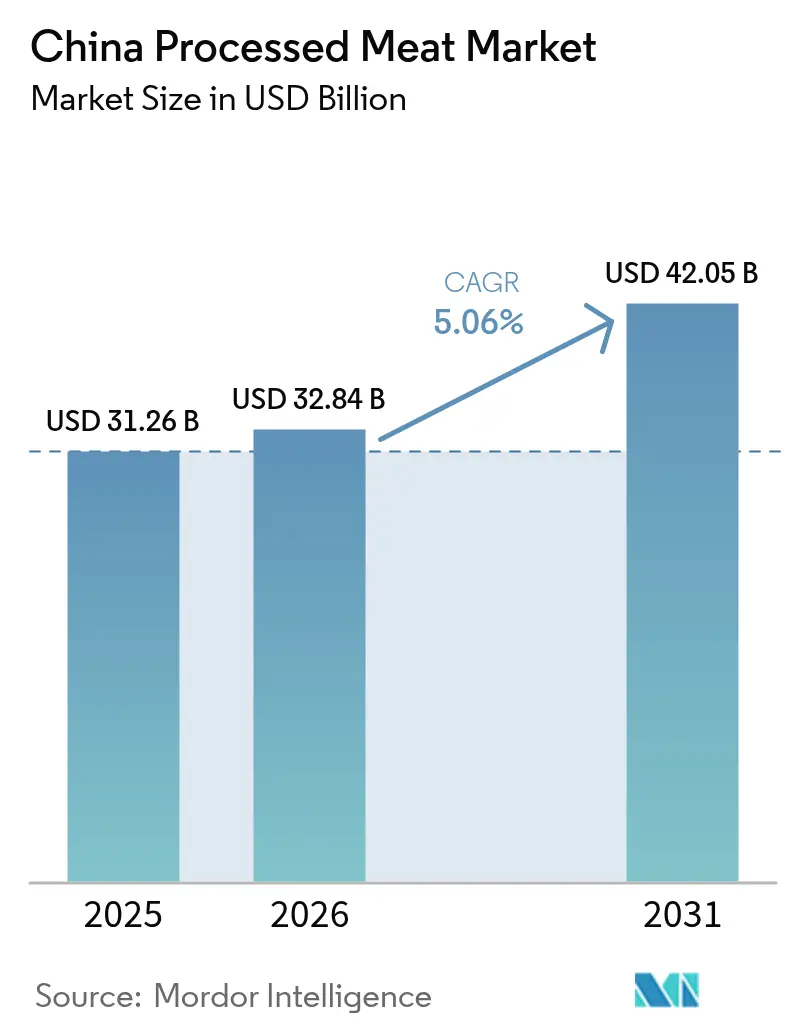
The China processed meat market size is projected to be USD 31.26 billion in 2025, USD 32.84 billion in 2026, and reach USD 42.04 billion by 2031, growing at a CAGR of 5.06% from 2026 to 2031. This steady trajectory reflects accelerating urbanization, rising disposable incomes, and greater cold-chain penetration, which make branded products accessible in lower-tier cities. Instant-delivery grocery platforms that compressed last-mile costs by 18-22% in 2024 further enhance availability, allowing the China processed meat market to convert demand traditionally served by wet markets. Poultry is gaining ground due to favorable price elasticity and rapid adoption in food service, while investments in AI-enabled slaughter lines boost yields and narrow the cost gap between regional and national brands. Simultaneously, tightening additive regulations and the 2060 carbon-neutral pledge encourage large processors to reformulate products at scale, driving premiumization and cleaner labels.
Key Report takeaways
- By meat type, pork-based products led with 56.42% of the China processed meat market share in 2025, while poultry processed items are advancing at a 7.56% CAGR through 2031.
- By end-user channel, retail and household consumption accounted for 55.10% of the China processed meat market size in 2025, yet HoReCa and food-service outlets record the highest projected CAGR at 6.60% through 2031.
Note: Market size and forecast figures in this report are generated using Mordor Intelligence’s proprietary estimation framework, updated with the latest available data and insights as of 2026.
China Processed Meat Market Trends and Insights
Drivers Impact Analysis*
| Driver | (~) % Impact on CAGR Forecast | Geographic Relevance | Impact Timeline |
|---|---|---|---|
| Rising Demand for Ready-to-Eat Protein Snacks Among Urban Millennials | +1.2% | Tier-1 and tier-2 cities, with spillover to tier-3 urban centers | Short term (≤ 2 years) |
| Government Push for Cold-Chain Infrastructure Expansion | +1.5% | National, with early gains in central and western provinces | Medium term (2-4 years) |
| Domestic Brand Premiumisation Targeting Lower-Tier Cities | +0.8% | Tier-3, tier-4, and county-level cities | Medium term (2-4 years) |
| E-commerce Fresh-Food Logistics Innovations Lowering Delivery Cost | +1.0% | National, concentrated in Yangtze River Delta and Pearl River Delta | Short term (≤ 2 years) |
| Food-Safety Scandals Driving Shift to Packaged Branded Meat | +0.9% | National, with heightened sensitivity in tier-1 cities | Short term (≤ 2 years) |
| Automation & AI in Slaughtering Boosting Yield, Lowering Cost | +0.7% | National, led by large-scale processors in Henan, Shandong, Sichuan | Long term (≥ 4 years) |
| Source: Mordor Intelligence | |||
Rising Demand for Ready-to-Eat Protein Snacks Among Urban Millennials
Urban millennials in China are reshaping protein consumption by prioritizing convenience and portion control, driving meat snacks to approximately 14% of the broader snack-food category in 2024. Single-serve jerky, chicken tenders, and luncheon-meat cups align with on-the-go lifestyles and smaller household sizes in tier-1 and tier-2 cities, where per-capita disposable income exceeded CNY 80,000 (USD 11,200) in 2025. E-commerce platforms report that ready-to-eat protein SKUs grew unit sales by 23% year-over-year in the first half of 2025, outpacing traditional refrigerated sausages by a factor of three, according to the USDA Foreign Agricultural Service[1]Source: USDA Foreign Agricultural Service, “China Retail Foods 2024,” fas.usda.gov. This channel shift is compressing the advantage of legacy cold-chain networks, as ambient-stable formats bypass the need for end-to-end refrigeration. Brands that invest in retort-pouch technology and nitrogen-flush packaging are capturing incremental share among consumers who previously relied on fresh wet-market purchases.
Government Push for Cold-Chain Infrastructure Expansion
The State Council's 14th Five-Year Plan for a Modern Logistics System earmarked CNY 100 billion (USD 14 billion) in preferential credit to construct 100 national cold-chain logistics bases by 2025, targeting provinces with underdeveloped refrigerated capacity such as Guizhou, Gansu, and Ningxia, according to the National Development and Reform Commission[2]Source: National Development and Reform Commission, “14th Five-Year Plan for a Modern Logistics System,” ndrc.gov.cn. These hubs integrate pre-cooling, blast-freezing, and temperature-monitored distribution, reducing spoilage rates from 15-18% to below 5% and extending the viable sales radius for processed meat by 300-500 kilometers. The Ministry of Transport mandated GPS-enabled cold-chain vehicles for inter-provincial meat shipments starting January 2025, closing a compliance gap that previously allowed unrefrigerated transport in rural corridors. This infrastructure build-out is democratizing access to branded processed meat in lower-tier cities, where modern retail penetration historically lagged coastal regions by a decade.
E-commerce Fresh-Food Logistics Innovations Lowering Delivery Cost
Instant-delivery platforms specializing in fresh food reached a USD 110 billion gross merchandise value in 2024, compressing last-mile delivery costs by 18-22% through algorithmic route optimization and micro-fulfillment centers located within 3 kilometers of residential clusters according to the USDA Foreign Agricultural Service. Major platforms deployed AI-driven demand forecasting that reduced inventory holding periods from 48 hours to under 12 hours, minimizing cold-storage fees and enabling price promotions on processed chicken and pork products. The General Administration of Customs streamlined import clearance for frozen meat through single-window digital filing in 2024, cutting border dwell time from 72 hours to 24 hours and lowering logistics friction for international brands. This convergence of domestic and cross-border efficiency is intensifying competition and eroding gross margins for processors that lack direct-to-consumer channels.
Automation & AI in Slaughtering Boosting Yield, Lowering Cost
Leading processors in Henan, Shandong, and Sichuan provinces adopted vision-guided robotic cutting systems in 2024-2025, raising carcass yield by 2-3 percentage points and reducing labor dependency by 15-20% in deboning and portioning operations. These systems employ machine learning to map bone structure in real time, optimizing blade paths and minimizing trim waste, which previously accounted for 8-10% of live-weight value, according to the China Meat Association[3]Source: China Meat Association, “Industry Technology Adoption Report 2024,” chinameat.org. WH Group's Shuanghui plants in Luohe integrated AI-driven quality grading that sorts cuts by marbling and color within milliseconds, enabling premium SKU differentiation and higher average selling prices. The Ministry of Industry and Information Technology's "Digital Manufacturing 2025" initiative offered tax rebates of up to 15% on capital expenditures for smart production lines, accelerating adoption among mid-tier processors that compete on cost. This technology diffusion is narrowing the competitive gap between large incumbents and regional players.
Restraints Impact Analysis*
| Restraint | (~) % Impact on CAGR Forecast | Geographic Relevance | Impact Timeline |
|---|---|---|---|
| ASF Recurrence Disrupting Pork Supply | -0.9% | Northeast provinces (Jilin, Heilongjiang), with spillover to Hebei | Short term (≤ 2 years) |
| Stricter Sodium & Nitrate Regulations | -0.5% | National, with enforcement prioritized in tier-1 cities | Medium term (2-4 years) |
| Consumer Health Shift Toward Plant-Based Proteins | -0.4% | Tier-1 cities and coastal urban centers | Long term (≥ 4 years) |
| Carbon-Neutral Targets Increasing Compliance Costs | -0.6% | National, concentrated in large-scale processors | Long term (≥ 4 years) |
| Source: Mordor Intelligence | |||
ASF Recurrence Disrupting Pork Supply
The World Organisation for Animal Health recorded 3 African Swine Fever outbreaks in China during 2024, concentrated in Jilin and Heilongjiang provinces, triggering localized culling of approximately 18,000 hogs and temporary transport bans that disrupted regional pork flows[4]Source: World Organisation for Animal Health, “African Swine Fever Situation Report 2024,” woah.org . Although national herd recovery reached 95% of pre-2018 levels by mid-2025, recurring ASF cases continue to sustain biosecurity costs and raise insurance premiums for integrated producers. Spot pork prices spiked 12-15% in affected provinces during the third quarter of 2024, compressing margins for processors locked into fixed-price contracts with retail chains. The Ministry of Agriculture and Rural Affairs expanded mandatory vaccination trials to 8 provinces in 2025, yet efficacy data remain inconclusive, leaving supply-chain planners hedging with higher poultry and beef inventories. This persistent tail risk is steering long-term capital allocation toward poultry processing capacity.
Stricter Sodium & Nitrate Regulations
The State Administration for Market Regulation amended GB 2760 food-additive standards in 2025, capping sodium nitrite at 150 milligrams per kilogram in cured meats, down from the previous 200 milligrams per kilogram threshold, and mandating front-of-pack sodium declarations for all processed meat products. Reformulation to meet these limits requires investment in alternative preservation technologies, such as high-pressure processing or natural antimicrobials, which would raise production costs by an estimated 8-12% for sausage and bacon lines. Smaller regional processors with limited R&D budgets face compliance deadlines in 2026, potentially triggering a wave of market exits or consolidation. Consumer awareness campaigns by the Chinese Nutrition Society highlighted links between high sodium intake and hypertension, amplifying scrutiny of processed meat categories and prompting retailers to expand shelf space for reduced-sodium SKUs. This regulatory tightening is accelerating premiumization as brands reposition lower-sodium products at higher price points.
*Our forecasts treat driver/restraint impacts as directional, not additive. The impact forecasts reflect baseline growth, mix effects, and variable interactions.
Segment Analysis
By Meat Type: Poultry Outpaces Legacy Pork Dominance
Poultry processed products are expanding at a 7.56% CAGR through 2031, the fastest rate among all meat types, while pork-based items held 56.42% of the market share in 2025. This divergence reflects poultry's lower input-cost volatility and rising acceptance of chicken nuggets, tenders, and deli meats in quick-service restaurant chains, which added 12,000 outlets across China in 2024, according to the Chain Store & Franchise Association[5]Source: China Chain Store & Franchise Association, “Annual Report 2024,” ccfa.org.cn. China consumed 14.5 million metric tons of poultry in 2024, with processed products accounting for an estimated 22% of total volume, up from 18% in 2020, according to the USDA Foreign Agricultural Service. Beef processed products, corned beef, jerky, sausages, and deli meats are gaining traction in tier-1 cities where per-capita income supports premium positioning, yet import dependency and tariff exposure limit volume growth. Mutton and goat segments remain niche, concentrated in northwestern provinces, with cultural preferences for smoked and cured lamb, while other meats, such as duck, rabbit, and turkey, serve specialty channels with minimal scale. The General Administration of Customs reported that frozen poultry imports rose 8% in 2024, driven by foodservice demand for standardized portioned cuts that reduce kitchen labor.
Pork's dominant share is underpinned by deep cultural affinity and the ubiquity of sausages, bacon, luncheon meat, and jerky across retail and HoReCa channels, yet African Swine Fever recurrence and regulatory pressure on sodium content are moderating growth. WH Group's Shuanghui brand commands an estimated 18-20% share of the pork processed segment, leveraging vertical integration and nationwide cold-chain reach. Automation in slaughtering and deboning is raising carcass yield by 2-3 percentage points, enabling processors to absorb input-cost inflation without proportional price increases. Beef and mutton processors face higher raw-material costs and fragmented supply chains, limiting their ability to compete on price with poultry and pork alternatives. The Ministry of Agriculture and Rural Affairs' livestock census indicated that beef cattle inventory grew 4% in 2024, yet domestic production remains insufficient to meet processed-meat demand, sustaining reliance on imports from Australia, Brazil, and Argentina.




By End-User: Retail Maturity Yields to HoReCa Innovation
HoReCa and food service segments are growing at a 6.60% CAGR through 2031, outpacing retail and household channels that held 55.10% of market share in 2025. This acceleration reflects dining-out frequency rebounding to pre-pandemic levels in tier-1 and tier-2 cities, where restaurant visits per capita reached 4.2 times per month in 2025, up from 3.1 times in 2022, according to the China Chain Store & Franchise Association. Institutional catering contracts in schools, corporate campuses, and hospitals are shifting toward pre-portioned, processed meats that reduce kitchen labor and ensure consistent compliance with SAMR's GB 31654 catering hygiene standards. Quick-service chains standardized on frozen chicken nuggets and beef patties to streamline menu execution, driving bulk procurement agreements with processors such as Sunner Development and Foshan Huanan Poultry. Food processing industry demand remains stable, anchored by manufacturers of ready meals, dumplings, and buns that incorporate processed pork and chicken as core ingredients.
Retail and household consumption benefit from e-commerce penetration. Supermarkets and hypermarkets retained the largest share within retail, yet convenience and neighborhood stores are expanding processed meat assortments to capture impulse purchases and top-up shopping trips. Online retail platforms deployed AI-driven personalization engines that increased basket attachment rates for processed meat by 14% in the first half of 2025, cross-selling jerky and sausages with beverage and snack bundles according to the USDA Foreign Agricultural Service. Specialty stores focusing on imported and premium processed meats serve affluent consumers in tier-1 cities, yet their aggregate share remains below 5%. The convergence of instant-delivery logistics and digital payment infrastructure is eroding the traditional wet-market channel, particularly among younger households that prioritize convenience and brand trust over price.

Geography Analysis
China's processed meat market exhibits pronounced regional heterogeneity, with eastern coastal provinces, Guangdong, Jiangsu, Zhejiang, and Shandong, driven by higher urbanization rates, denser retail infrastructure, and elevated per-capita incomes exceeding CNY 70,000 (USD 9,800). The Yangtze River Delta and Pearl River Delta regions benefit from mature cold-chain networks and proximity to major ports, enabling cost-efficient distribution of both domestic and imported processed meats. Central provinces such as Henan, Hubei, and Hunan are expanding at above-market rates as the National Development and Reform Commission's cold-chain logistics bases come online, reducing spoilage and extending shelf life for products shipped from coastal processing hubs.
Western provinces, Sichuan, Chongqing, and Shaanxi, demonstrate strong demand for spicy sausages and cured meats that align with local flavor profiles, yet fragmented retail landscapes and lower disposable incomes temper premium-product penetration. Northeastern provinces, historically China's pork production heartland, faced supply disruptions in 2024 due to 3 African Swine Fever outbreaks in Jilin and Heilongjiang, temporarily tightening processed pork availability and elevating spot prices by 12-15%. This volatility accelerated diversification into poultry and beef processing, with regional players investing in chicken deboning lines to hedge against ASF recurrence.
Southern provinces exhibit higher per-capita consumption of poultry processed products, reflecting cultural preferences and the dominance of Cantonese cuisine in foodservice menus. The General Administration of Customs reported that Guangdong and Shanghai accounted for 62% of frozen meat imports in 2024, underscoring their role as gateway markets for international brands. Tier-3 and tier-4 cities are witnessing premiumization as domestic brands such as Shuanghui, Jinluo, and Delisi launch mid-priced product lines targeting aspirational consumers, supported by e-commerce platforms that compress distribution costs and enable direct-to-consumer engagement.
Regulatory Landscape
China processed meat production is governed by national food safety standards administered by the National Health Commission (NHC), with enforcement alongside the State Administration for Market Regulation (SAMR). A key update is GB 31661-2025 (hygienic code for the production of prepared meat products), which took effect on March 16, 2026, tightening requirements around hygiene, processing controls, and whole-chain management for prepared meat manufacturing.
For cooked meat products, GB 19303-2023 (sanitary practices for the production of cooked meat products) was implemented on September 6, 2024, replacing the 2003 version and reinforcing plant expectations for sanitary controls. On the import side, the General Administration of Customs of China (GACC) continues to manage overseas establishment registration under Decree 280 implementation guidance, requiring official recommendation from the exporting country competent authority. This keeps market access and compliance documentation central for importers and international brands.
Value Chain Analysis
The China processed meat value chain starts with upstream livestock and poultry farming, then moves into midstream slaughtering and cutting, and finally into further processing into chilled, frozen, cured, and ready-to-eat formats. Large integrated operators and scaled processors increasingly combine slaughter, deboning, and further processing to stabilize input costs and standardize output, while food safety requirements (for example, GB 2726-2016 contaminant and microbiological limits for cooked meat products) drive investments in hygiene controls, testing, and plant-level quality management.
Downstream, products enter cold-chain logistics and modern trade and wholesale networks. Online and instant-delivery retail models are taking a growing share of demand, which elevates requirements for fast turnover, temperature control, and flexible packaging formats. Cross-border supply adds another compliance layer, since GACC registration rules for overseas meat facilities and documentation requirements influence how imported processed meat and ingredients flow into the chain, shaping sourcing strategies for premium and standardized foodservice SKUs.
Competitive Landscape
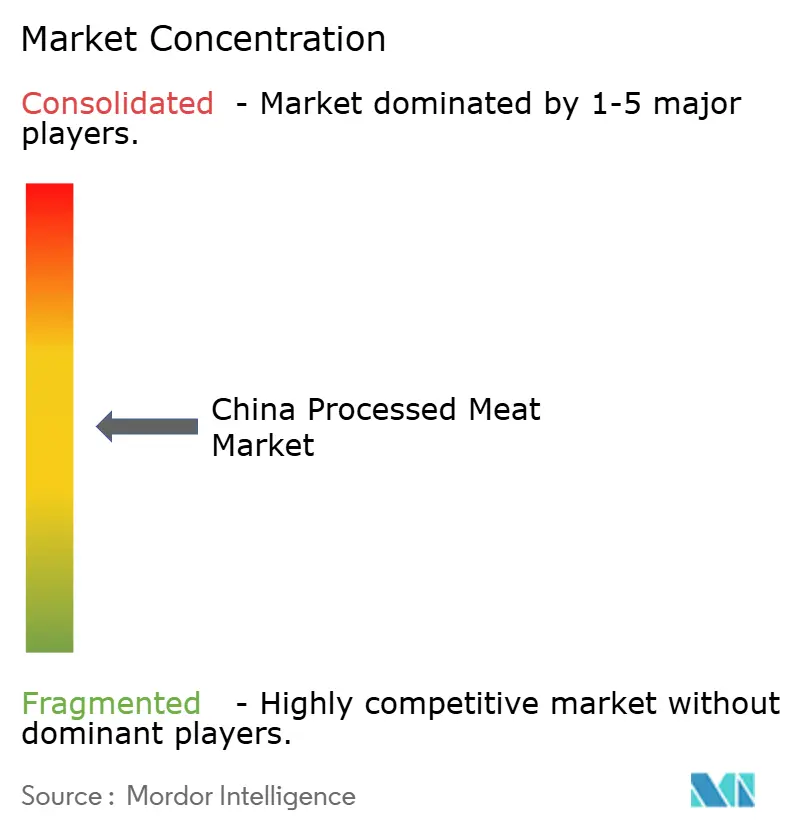
The China processed meat market demonstrates moderate concentration, with the top 5 players, WH Group, Tyson Foods, Jinluo Group, China Yurun Food Group, and COFCO Meat Holdings, capturing significant revenue share, leaving substantial fragmentation among regional processors and private-label manufacturers. WH Group's Shuanghui Development leverages vertical integration spanning hog farming, slaughtering, processing, and retail distribution, achieving economies of scale that smaller competitors cannot replicate. Tyson Foods and Hormel Foods maintain selective exposure through joint ventures and licensing agreements, focusing on premium imported products that command higher margins in tier-1 cities.
COFCO Meat Holdings, a state-owned enterprise, benefits from preferential access to government procurement contracts and institutional catering channels, yet its operational efficiency lags that of its private-sector peers. Strategic differentiation centers on cold-chain reach, brand equity, and compliance with evolving food-safety standards under SAMR's GB 2760 and GB 2762 frameworks. Mid-tier players such as Muyuan Foods and Wen's Food Group are integrating downstream into processed products to capture margin uplift from live-hog sales, deploying automation to offset labor-cost inflation. White-space opportunities persist in plant-based protein analogs, ambient-stable ready-to-eat formats, and halal-certified processed meats targeting Muslim-majority regions in Xinjiang and Ningxia.
Technology adoption is accelerating, with vision-guided robotic cutting systems raising carcass yield by 2-3 percentage points and AI-driven quality grading enabling premium SKU differentiation according to the China Meat Association. Smaller regional processors face margin compression from rising compliance costs tied to sodium reduction mandates and carbon-footprint reporting, creating consolidation pressure. E-commerce platforms are disintermediating traditional distributors, enabling direct-to-consumer models that reward brands with strong digital marketing capabilities and rapid SKU innovation cycles.
China Processed Meat Industry Leaders
Tyson Foods, Inc.
WH Group Limited
Jinluo Group
China Yurun Food Group
COFCO Meat Holdings
- *Disclaimer: Major Players sorted in no particular order

Market Opportunities and Future Outlook
Regulation-driven product and process upgrades are creating whitespace in compliant, shorter-shelf-life prepared foods and in cleaner-label processed meat. China notified a Draft National Food Safety Standard for Prepared Dishes in February 2026 (WTO SPS notification), which includes restrictions such as prohibiting food preservatives and limiting shelf life to no more than 12 months. These requirements push processors toward alternative preservation, tighter cold-chain management, and scalable reformulation for both retail and foodservice.
Smart manufacturing and digitalization remain an investment lane as processors add efficiency and traceability into operations. In June 2026, Jinzi Ham Company opened a 1-billion-yuan intelligent "Super Factory" in Jinhua, Zhejiang, integrating 5G and AI with an annual capacity of 1.5 million hams, which highlights the shift toward automated, high-throughput facilities. Alongside capacity additions, AI adoption is also being formalized through technology development contracts, as seen in a June 2026 AI-focused agreement involving COFCO Meat subsidiaries, supporting opportunities for equipment, software, and cold-chain solutions that can help processors meet tighter standards and brand-trust expectations.
Recent Industry Developments
- April 2026: Tyson Foods partnered with Dingdong Maicai to launch the Shanghai New Braised Meat series, introducing five poultry-based products. The range was produced on a new intelligent mid-style braised meat line at Tyson's Nantong facility, signaling deeper localization and closer alignment with instant-delivery retail demand.
- March 2026: WH Group disclosed that its packaged meat production capacity in China was about 2.07 million metric tons as of year-end 2025. The scale underscores the advantages of large incumbents in national distribution, procurement, and compliance investments as standards tighten across prepared and cooked meat categories.
- December 2024: BRF entered China by signing a binding agreement via BRF GmbH to acquire Henan Best Foods' processed food plant in Henan province for USD 43 million. The transaction provided BRF with an in-country manufacturing footprint and a faster route to serve local retail and foodservice channels with processed meat products.


Research Methodology Framework and Report Scope
Market Definition and Coverage
For this study, the China processed meat market covers meat products that are preserved or changed through methods like salting, curing, smoking, fermentation, or added preservatives, and then sold for consumption or further use. We size the market in value terms within China across major meat types and buying channels.
Scope exclusions: Fresh, unprocessed raw meat sales are excluded, and live animal value is not counted.
Segmentation Overview
- By Meat Type
- Poultry
- Chicken Nuggets and patties
- Deli Meats
- Tenders
- Sausages
- Others
- Pork
- Sausages
- Bacon
- Nuggets
- Luncheon Meat
- Jerkey
- Others
- Beef
- Corned Meat
- Jerkey
- Corned beef
- Sausages
- Deli Meats
- Luncheon Meat
- Cooked and Smoked Beef Cuts
- Others
- Mutton and Goat
- Smoked and cured lamb
- Jerkey
- Sausages
- Salami
- Luncheon Meats
- Others
- Other Meats (Duck, Pigeon, Rabbit, Turkey)
- Poultry
- By End-User
- Food Processing Industry
- HoReCa/ Food Service
- Hotels
- Restaurants
- Catering
- Retail/ House Hold
- Supermarkets & Hypermarkets
- Convenience & Neighborhood Stores
- Online Retail
- Specialty stores
- Others
Data Sources, Market Sizing, and Validation
Desk Research
Desk work starts with public statistics that explain the size of the meat supply and the direction of consumption in China. We typically use sources such as the National Bureau of Statistics of China, China Customs trade data, FAOSTAT, and relevant releases from the Ministry of Agriculture and Rural Affairs, since these help anchor production, import, and category trends.
To understand packaged and processed food demand, we also review association and standards material, plus company annual reports and investor presentations that describe product mix, capacity additions, and channel focus. Where needed, we refer to paid databases for company financials, patent filings, and shipment level import-export records to cross-check volumes and price signals. These are illustrative examples only, and many other sources were also used for data collection, validation, and clarification.
Primary Interviews and Surveys
Primary work was used to stress-test desk assumptions on what counts as processed meat, what share moves through retail versus food service, and how pricing is changing by format. We spoke with participants across processing, distribution, and buying roles, then used follow-up questions to resolve gaps on utilization rates, mix shifts across meat types, and regional consumption differences within China.
Distribution of primary research fieldwork respondents
| Company type | Respondent position |
|---|---|
| Top tier: 34% | CXOs: 15% |
| Mid tier: 49% | Functional/Unit leaders: 34% |
| Smaller Players: 17% | Managers: 51% |
Market-Sizing & Forecasting
Sizing is built mainly using a top-down and bottom-up combination, where national meat supply and trade series are reconstructed first, and then filtered into processed formats using processing intensity and channel split assumptions. After the first cut is created, we corroborate it with selective bottom-up checks, such as sampled price per kilogram by product format multiplied by estimated volumes, along with channel checks to adjust obvious over or under counts.
The model is shaped by a few practical inputs that can be tracked each year, including processed meat consumption trends, the mix shift across pork, poultry, beef, and other meats, the share sold through retail versus HoReCa, average selling price movement by format (such as sausages, bacon, deli meats, jerky, nuggets, and luncheon meat), and import dependence for certain categories. When data is not available at the exact sub-type level, gaps are handled through proxy ratios based on close categories and then validated with interview feedback.
For forecasting, we mainly use scenario analysis anchored to expected demand conditions and price direction, since processed meat spending is influenced by income growth, protein affordability, and substitution between meat types. The final trajectory is then checked against what industry participants expect for capacity expansion, channel expansion (including online retail), and changes in consumer preference toward convenient packaged proteins.
Data Validation & Update Cycle
Before finalizing, we run cross-checks between the value totals, implied volumes, and implied average prices to ensure the story is consistent and that no single assumption drives the result too heavily. Outliers are reviewed by an analyst who did not build the first model draft, and if a gap cannot be explained with desk evidence, the right interview group is re-contacted to confirm the assumption.
We also compare the output with independent signals such as production and trade movements, visible pricing changes in packaged meat, and reported shifts in channel demand. Reports are refreshed annually, and interim updates are done when material events occur that can change supply, pricing, or consumption patterns. Right before delivery, we perform a final check so clients receive the latest updated view.
Mordor Intelligence's China Processed Meat Market Size Measured Against Other Published Estimates
Published market sizes for processed meat in China can look far apart even when they appear to be talking about the same topic, because the included product forms and the counted selling channels vary in practice. Differences also come from how prices are averaged across formats, what currency timing is assumed, and whether food service demand is treated as a separate layer or folded into retail.
In our checks, the biggest drivers of gaps were whether estimates count only retail packaged processed meat versus including processed meat sold to the food processing industry and HoReCa, plus whether poultry and other meats are fully included alongside pork. Some studies also apply a single blended price curve across all processed formats, which can inflate value when premium deli meats and cheaper nuggets are mixed without volume weights. This mismatch is reduced through format-weighted pricing checks and channel splits maintained in Mordor Intelligence.
Benchmark comparison
| Source | Market Size | Gaps in Research Methodology |
|---|---|---|
| Mordor Intelligence | USD 31.26 B (2025) | |
| Trade Journal A | USD 27.90 B (2025) | Focuses mainly on retail packaged processed meat and omits a meaningful share sold via food service and industrial end users, which lowers the value total and dampens channel-driven growth. |
| Industry Association B | USD 35.80 B (2025) | Uses broader inclusion of adjacent prepared meat foods and applies generalized pricing assumptions across formats, which can lift the implied average price versus a format-weighted approach. |
Taken together, the spread is mostly explained by what is counted as processed meat and how each channel is valued, rather than by a completely different demand story. When scope is kept consistent across meat types and end users, and when prices are weighted by realistic format mix, the market total becomes easier to trace back to clear variables and repeatable steps.


Key Questions Answered in the Report
How large is the China processed meat market in 2026?
The China processed meat market size is valued at USD 32.84 billion in 2026.
Which meat type is growing fastest in China’s processed category?
Poultry processed products are advancing at a 7.56% CAGR through 2031, outpacing other meats.
What share do retail and household channels hold?
Retail and household purchases accounted for 55.10% of 2025 sales, remaining the largest channel.
How concentrated is competition among leading processors?
The top five companies collectively hold about 35-40% of revenue, reflecting moderate concentration.
What role does cold-chain expansion play in market growth?
Government-backed cold-chain investments reduce spoilage below 5% and extend distribution up to 500 kilometers, unlocking lower-tier city demand.
Page last updated on:


 Your data is secure and never sold or shared.


