
Cardiology Electrodes Market Size and Share
Market Overview
| Study Period | 2020 - 2031 |
|---|---|
| Market Size (2026) | USD 123.87 Million |
| Market Size (2031) | USD 160.19 Million |
| Growth Rate (2026 - 2031) | 5.27 % |
| Fastest Growing Market | Asia-Pacific |
| Largest Market | North America |
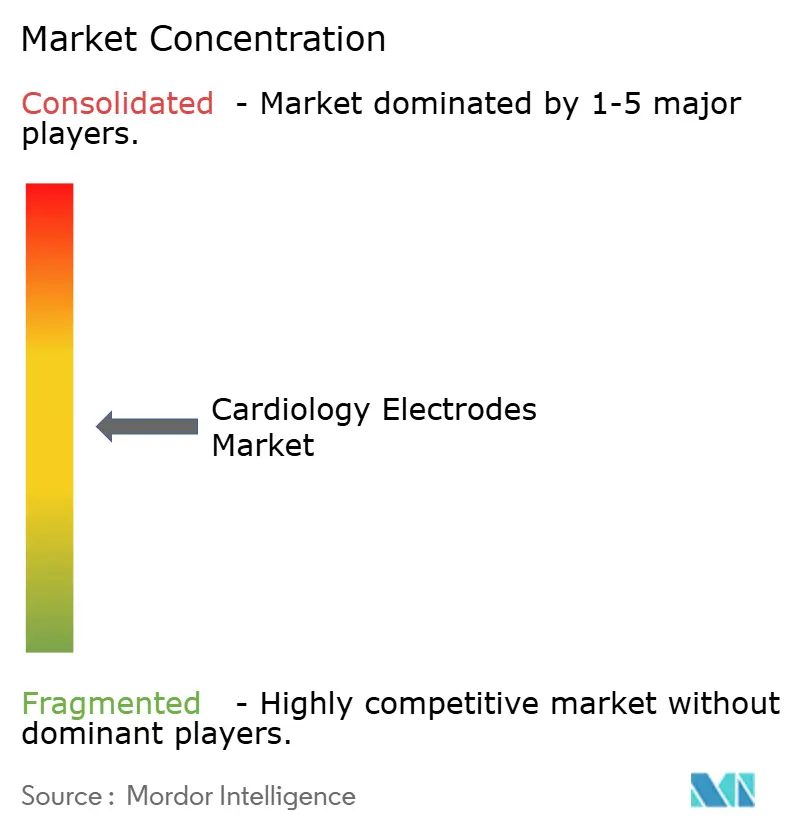
| Market Concentration | Medium |
Major Players *Disclaimer: Major Players sorted in no particular order Image © Mordor Intelligence. Reuse requires attribution under CC BY 4.0. | |
Cardiology Electrodes Market Analysis by Mordor Intelligence
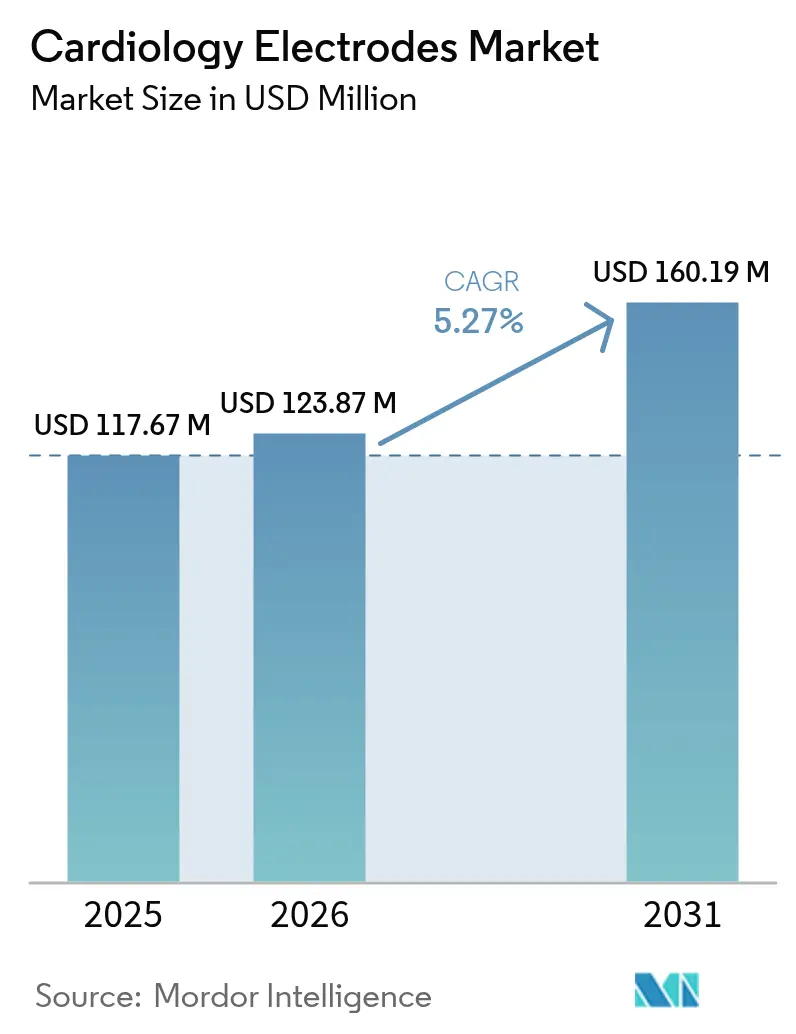
Cardiology Electrodes market size in 2026 is estimated at USD 123.87 million, growing from 2025 value of USD 117.67 million with 2031 projections showing USD 160.19 million, growing at 5.27% CAGR over 2026-2031.
Robust demand stems from the convergence of telehealth adoption, artificial-intelligence-enabled diagnostics, and hospitals’ cost-containment mandates. Manufacturers focusing on disposable electrodes benefit as infection-control protocols tighten, while suppliers of dry polymer designs gain momentum thanks to rising patient comfort requirements. Reimbursement expansions for home cardiac monitoring further widen addressable patient pools, and printed electronics continue to cut production costs, allowing broader geographic reach. Competitive intensity remains moderate because established brands rely on regulatory expertise and materials science know-how to defend positions, yet price pressure from low-cost Asian producers pushes incumbents toward product differentiation.
Key Report Takeaways
- By product, resting ECG electrodes led with 34.62% of cardiology electrodes market share in 2025, while long-term monitoring ECG electrodes are forecast to advance at an 11.02% CAGR through 2031.
- By usability, disposable medical electrodes captured 60.72% of the cardiology electrodes market size in 2025 and are projected to expand at a 12.35% CAGR to 2031.
- By adhesion type, traditional wet Ag/AgCl gel electrodes held 59.05% revenue share in 2025; dry polymer-based electrodes are poised to post the highest CAGR at 12.95% between 2026 and 2031.
- By end user, hospitals and cardiac centers accounted for 40.74% share of the cardiology electrodes market size in 2025, while ambulatory surgical centers are expected to record a 14.21% CAGR through 2031.
- By geography, North America commanded 39.02% of global revenue in 2025; Asia-Pacific is projected to be the fastest-growing region with a 11.67% CAGR over the same horizon.
Note: Market size and forecast figures in this report are generated using Mordor Intelligence’s proprietary estimation framework, updated with the latest available data and insights as of 2026.
Market Trends and Insights
Drivers Impact Analysis of Cardiology Electrodes Market*
| Driver | (~) % Impact on CAGR Forecast | Geographic Relevance | Impact Timeline |
|---|---|---|---|
| Rising burden of CVDs | +1.8% | Global, highest in North America and Europe | Long term (≥ 4 years) |
| Growing demand for single-use electrodes | +1.2% | Global, strong in APAC and North America | Medium term (2-4 years) |
| Home-based cardiac monitoring via telehealth | +0.9% | North America and EU, expanding to APAC | Short term (≤ 2 years) |
| Printed and flexible-electronics cost cuts | +0.7% | APAC core, global spill-over | Medium term (2-4 years) |
| Miniaturised dry-contact micro-arrays | +0.5% | Global, led by North America and Europe | Long term (≥ 4 years) |
| AI and machine-learning cardiac diagnostics | +0.3% | North America and EU, early urban APAC adoption | Short term (≤ 2 years) |
| Source: Mordor Intelligence | |||
Rising Burden of CVDs
Cardiovascular disease prevalence keeps electrode demand resilient. The American Heart Association projects hypertension rates to climb to 61.0% and diabetes to 26.8% by 2050, trends that elevate the need for long-term monitoring solutions.[1]American Heart Association, “Heart Disease and Stroke Statistics 2024 Update,” heart.org Productivity losses linked to cardiovascular conditions are also expected to swell, encouraging investment in early detection technologies that rely on high-performance ECG interfaces. Asia faces a sharper rise as lifestyle shifts interact with population aging, prompting global suppliers to localize production. Because cardiac monitoring is essential rather than discretionary, device orders remain stable even during economic slowdowns. Clinical guidelines that emphasize preventive cardiology reinforce continuous monitoring protocols, cementing electrodes as routine consumables.
Growing Demand for Single-Use Electrodes
Hospitals have institutionalized disposable electrodes after the COVID-19 pandemic highlighted infection-control gaps. Studies published in the British Journal of Nursing documented meaningful reductions in surgical-site infections when single-use ECG leads were employed.[2]British Journal of Nursing, “Single-Use ECG Leads Reduce Surgical Site Infections,” bjn.com Beyond infection mitigation, disposables cut sterilization labor and liability costs, often proving economical on a total-cost-of-ownership basis. Suppliers that can certify products in multiple jurisdictions enjoy scaling advantages, while newer biodegradable substrates such as nanocellulose ECG patches position vendors to satisfy sustainability mandates. The shift from reusable to disposable formats is most pronounced in North America and is rapidly taking hold in major Asian health-systems as capacity for high-volume manufacturing grows.
Home-Based Cardiac Monitoring Boom via Telehealth
Remote ECG monitoring soared during pandemic restrictions. A Journal of Arrhythmia study recorded patient satisfaction rates of 87% and trimmed average clinic time from 168.2 minutes to 13 minutes.[3]Journal of Arrhythmia, “Patient Satisfaction with Remote Monitoring During Pandemic,” j-arrhythmia.com This adoption sends electrode performance requirements in a new direction: patches must remain effective for several days, be simple for self-application, and avoid messy gels. Dry polymer and textile designs satisfy these needs, improving adherence and user comfort. Expanded reimbursement by Medicare and private insurers removes financial obstacles, and insurers are increasingly the core purchasing decision-makers. In parallel, digital health platforms integrate AI analytics that flag arrhythmias with sensitivities above 95%, boosting clinician trust in home data streams.
Printed & Flexible-Electronics Cost Reductions
Screen-printing and roll-to-roll processing have cut material and labor costs while maintaining signal integrity. Researchers demonstrated fully printed wet ECG electrodes with performance on par with conventional Ag/AgCl using significantly less silver. Flexographic lines also support mass-production volumes essential for emerging markets. APAC vendors, already advantaged by labor costs, capitalize on printed-electronics gains to undercut Western pricing without sacrificing quality. Integration of conductive polymers and nanofillers further refines impedance characteristics, letting manufacturers pitch value-based features such as lower motion artifacts. As cost hurdles fall, the cardiology electrodes market finds new customers in lower-tier hospitals and rural clinics.
Restraints Impact Analysis of Cardiology Electrodes Market*
| Restraint | (~) % Impact on CAGR Forecast | Geographic Relevance | Impact Timeline |
|---|---|---|---|
| Skin irritation and allergic dermatitis | -0.8% | Global, severe in sensitive populations | Medium term (2-4 years) |
| Price pressure from low-cost Asian OEMs | -0.6% | Global, most intense in cost-sensitive markets | Short term (≤ 2 years) |
| Environmental disposal rules on Ag/AgCl | -0.4% | Europe and North America, expanding to APAC | Long term (≥ 4 years) |
| Signal-quality drift in long-term wearables | -0.3% | Global, critical in ambulatory and home-care settings | Medium term (2-4 years) |
| Source: Mordor Intelligence | |||
Skin Irritation & Allergic-Contact Dermatitis
Case studies in the journal Contact Dermatitis highlight patients reacting to acrylic acid impurities and methacrylates in electrode hydrogels. Such reactions discourage extended monitoring, especially among older adults and neonates. Manufacturers respond by formulating hypoallergenic hydrogels, adopting textile substrates, or shifting toward dry micro-needle arrays. However, alternative designs may raise costs or complicate application, limiting rapid replacement of legacy products. Regulatory agencies now scrutinize labeling of potential allergens, increasing documentation burdens.
Price Pressure from Low-Cost Asian OEMs
Large-scale factories in China, Malaysia, and Vietnam leverage economies of scale and proximity to printed-electronics supply chains to offer electrodes at steep discounts. Hospital procurement teams facing budget caps often rank cost above brand loyalty, putting margin pressure on incumbents. Suppliers defend share through advanced material science, faster regulatory approvals, and integrated monitoring ecosystems that lock buyers into higher-level services. Over time, consolidation is likely, as smaller domestic players find it hard to meet quality and compliance thresholds while matching low prices.
*Our forecasts treat driver/restraint impacts as directional, not additive. The impact forecasts reflect baseline growth, mix effects, and variable interactions.
Cardiology Electrodes Market Segment Analysis
By Product:
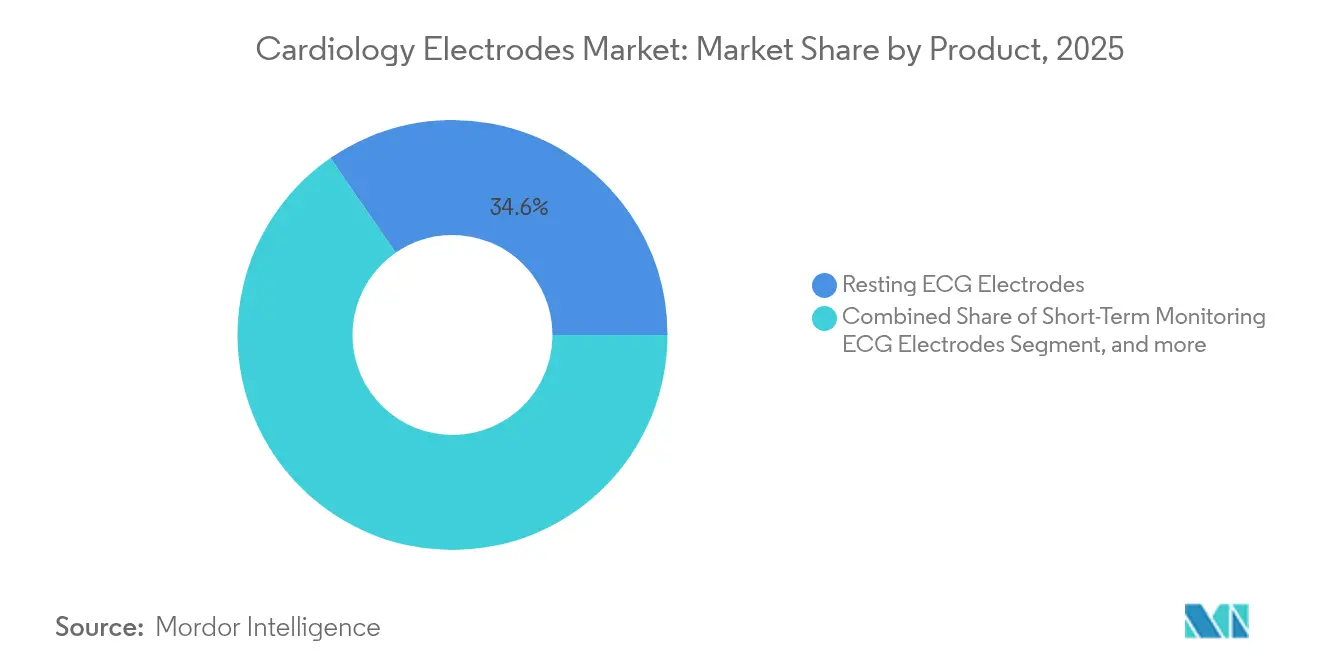
Long-Term Monitoring Drives InnovationLong-term monitoring ECG electrodes opened 2026 with a smaller base but are projected to post an 11.02% CAGR, well above the overall cardiology electrodes market. That trajectory reflects payer support for continuous surveillance programs intended to catch asymptomatic arrhythmias early. Premium revenues accrue to vendors offering breathable substrates and low-motion-artifact designs. Resting ECG electrodes still represent 34.62% of cardiology electrodes market share, owing to their ubiquity in emergency departments and routine checkups. Yet growth in that mature segment is modest because device replacement cycles are slow in developed nations.
Commercial deployment of multi-sensor Holter units illustrates the product transition. Recent studies in Sensors journal show that advanced Holters with Bluetooth Low Energy streamed high-resolution ECG and accelerometer data simultaneously, enhancing diagnostic yield. Motion-robust electrodes enable these devices to remain accurate during daily activities, unlocking higher reimbursements. Neonatal and pediatric electrodes form a niche requiring ultra-gentle adhesives and miniaturized snap connectors. Emerging biodegradable variants, currently in pilot trials, promise environmentally neutral disposal, a feature attracting European clinics prioritizing sustainability.



By Usability:
Disposables Dominate Growth TrajectoryDisposable electrodes accounted for 60.72% of cardiology electrodes market size in 2025 and will outpace reusable formats through 2031. Infection-prevention protocols drive procurement, especially in operating rooms and high-turnover wards. Cost analysis that factors cleaning labor, autoclave energy, and risk of cross-contamination often favors single-use options even when unit prices are higher. DuPont’s Liveo Soft Skin Conductive Tape exemplifies innovation, keeping impedance stable for seven days without hydrogel slippage. Such endurance expands disposables into ambulatory monitoring use-cases once dominated by reusable pads.
Reusable electrodes hold certain cost advantages in long-stay facilities and home environments, where the same patient wears the device for months. Caregivers appreciate lower waste volumes and the option to swap cables instead of full assemblies. Nevertheless, reimbursement policies increasingly bundle electrode costs into episode-of-care payments, encouraging providers to offload sterilization chores onto vendors through disposables.
By Adhesion Type:
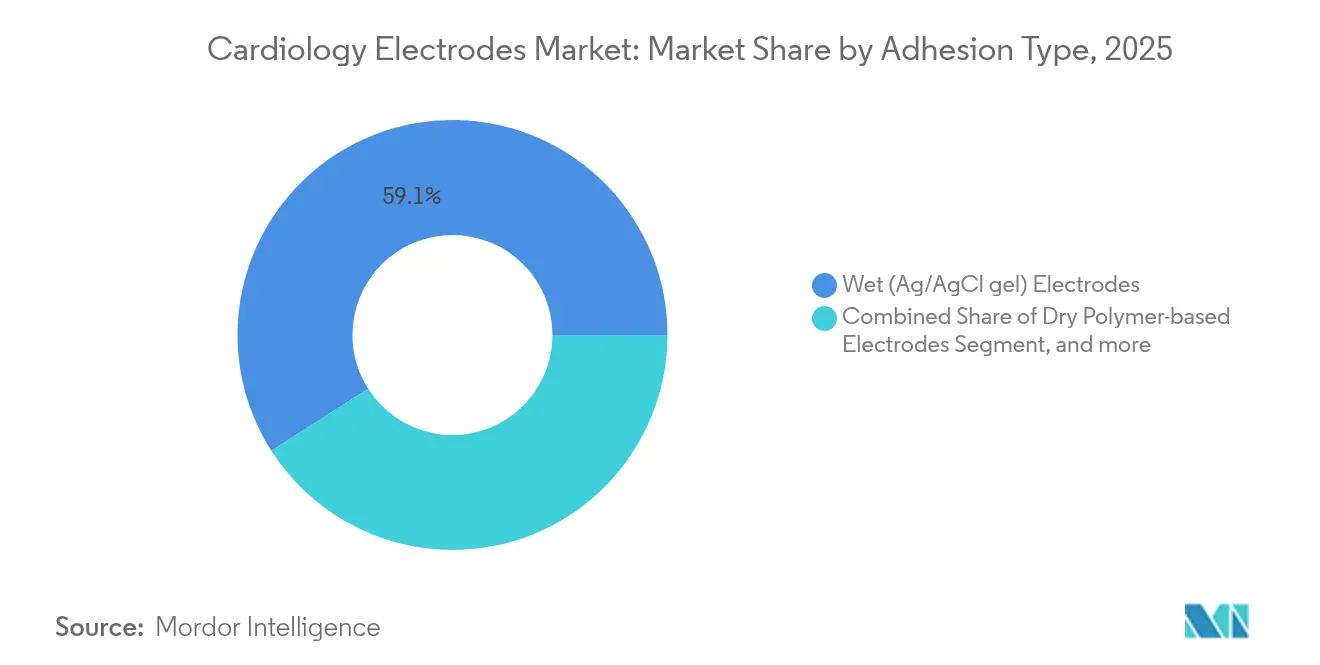
Dry Technologies Challenge Traditional DominanceWet Ag/AgCl gel pads delivered 59.05% of global revenue in 2025 because clinicians trust decades of signal-quality evidence. Yet patient feedback often cites discomfort, skin maceration, and residue cleanup. Dry polymer electrodes log a 12.95% CAGR by mitigating these complaints. Comparative tests published on ScienceDirect demonstrated that embroidered textile patches achieved nearly identical QRS amplitude yet boosted comfort ratings [SCiencedirect.com]. When combined with flexible electronics, dry platforms tolerate sweat and movement, ideal for sports cardiology.
Hydrogel-less micro-needle electrodes enter the scene with unprecedented low contact impedance achieved without skin prep. Current production costs limit volume adoption, but roll-to-roll micro-molding lines promise scalability. Capacitive coupling designs, meanwhile, flirt with the prospect of measuring ECG through clothing, a future that could redefine electrode semantics entirely. For now, procurement teams weigh the trade-off between proven gel reliability and emerging dry comfort gains.
By End User:
Ambulatory Centers Lead Growth AccelerationHospitals and cardiac centers comprised 40.74% of global revenue in 2025 because they remain the first point of advanced cardiac care. Their purchasing power secures bulk contracts and drives specification standards across a region. However, ambulatory surgical centers are set to grow at 14.21% CAGR as procedures migrate to outpatient settings for cost efficiency. These centers favor lightweight electrode kits that pair seamlessly with portable monitors, allowing quick patient turnover.
Home-care and remote-patient-monitoring providers represent the next frontier. Insurer reimbursement for RPM codes, alongside patient preference to avoid hospital visits, pushes volume to the consumer channel. Manufacturers respond with packaging tailored for self-application, complete with QR-code video instructions and recycling envelopes. Diagnostic laboratories hold modest but steady share, buying specialized electrodes for stress-test treadmills and imaging-triggered ECG gating.
Geography Analysis
North America Cardiology Electrodes Market
North America owned 39.02% of global revenue in 2025 thanks to insurance coverage that funds remote monitoring, a stringent FDA framework assuring device efficacy, and early consumer adoption of smartwatch-linked ECG. Integrated delivery networks commonly bundle electrodes into value-based care contracts, locking vendors into multi-year supply deals. Collaborations such as the Medtronic and Philips partnership demonstrate how platform integration strengthens competitive moats.
Europe Cardiology Electrodes Market
Europe maintains steady expansion, sustained by aging demographics and stringent Medical Device Regulation that rewards companies with proven quality systems. Germany commands high per-capita expenditure on cardiac care, while France and Italy increasingly emphasize environmentally benign disposables. United Kingdom hospitals under the NHS favor single-use electrodes to streamline infection-control compliance.
APAC Cardiology Electrodes Market
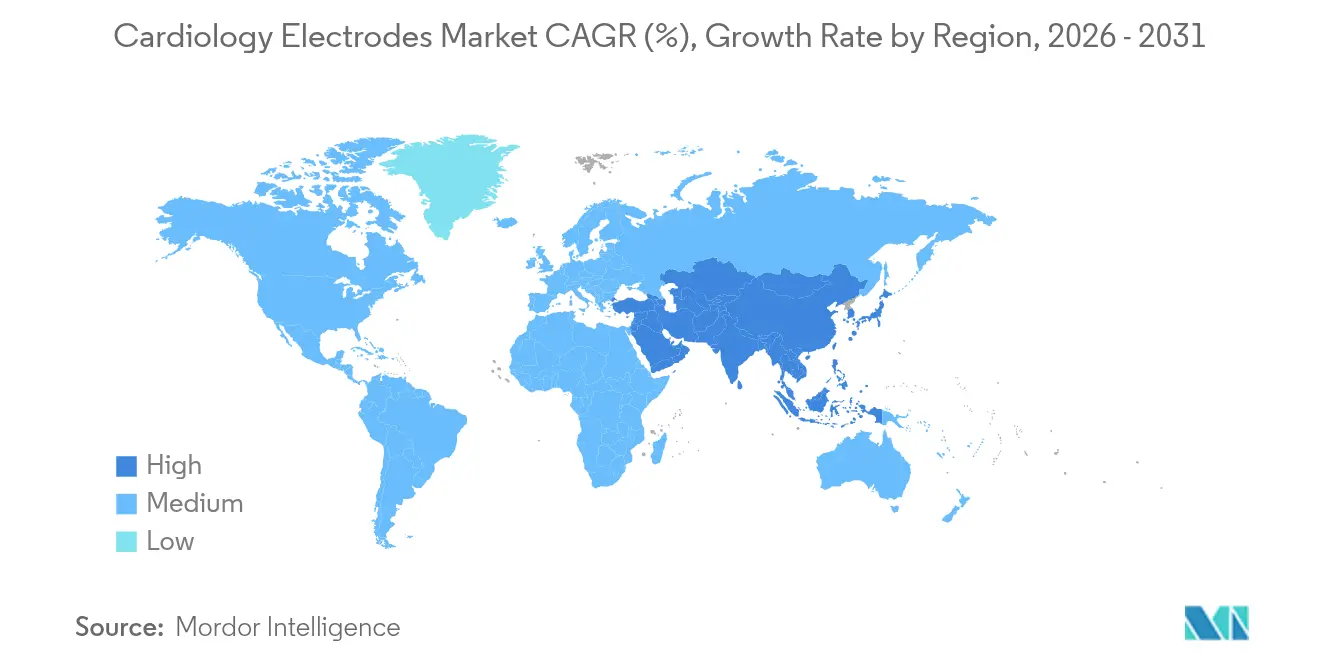
Asia-Pacific is the fastest riser at a 11.67% CAGR. China’s hospital modernization and telehealth pilot reimbursement stimulate demand volumes unmatched elsewhere. Japan, already proficient in remote monitoring, adopts premium dry-contact solutions driven by patient comfort preferences. India’s burgeoning middle class fuels double-digit growth in urban private hospitals, although cost sensitivity remains paramount in public facilities. Regional production clusters in Guangdong and Penang supply both domestic and export markets, shrinking lead times.
MEA and South America Cardiology Electrodes Market
Middle East and Africa along with South America are nascent but accelerating. Gulf Cooperation Council states allocate oil revenues toward cardiac centers outfitted with Western-brand electrodes, while Brazilian device regulators streamline approvals to reduce import costs. Vendors entering these zones often partner with local distributors to navigate diverse procurement policies.

Competitive Landscape
The cardiology electrodes market is moderately fragmented. Global leaders such as 3M Company, Cardinal Health, Koninklijke Philips, Ambu A/S, and Nihon Kohden command significant yet not dominant shares, each excelling in different subsegments. These incumbents invest heavily in R&D to differentiate through hydrogel chemistry, printed-electronics accuracy, and integrated data platforms. Regulatory acumen presents a key barrier; lengthy 510(k) pipelines deter smaller challengers.
Price competition intensifies for commodity resting ECG pads where Asian OEMs undercut Western brands. In response, incumbents pursue vertical integration, controlling silver-ink supply or adhesive formulation to lower costs without eroding quality. Several players focus on sustainability, developing biodegradable substrates to meet European waste directives.
Strategic collaboration characterizes the high-growth AI monitoring niche. Device makers sign exclusivity deals with software analytics startups to bundle electrodes with cloud interpretation services. Mergers and acquisitions also surface as firms seek scale economies amid cost pressures. Meanwhile, new entrants exploring capacitive and camera-based heart-rate sensors threaten long-term electrode demand but face hurdles in clinical validation.
Cardiology Electrodes Industry Leaders
Advin Health Care
CONMED
3M
Cardinal Health
Koninklijke Philips
- *Disclaimer: Major Players sorted in no particular order
Cardiology Electrodes Market Companies Covered in this Report
- 3M
- Ambu
- Cardinal Health
- Koninklijke Philips
- Nissha Co., Ltd. (Nissha Medical)
- Hill-Rom / Welch Allyn
- Conmed
- Nihon Kohden
- Medico Electrodes International
- BIO-Protech Inc.
- Leonhard Lang (SKINTACT)
- Rhythmlink International
- OSI Systems (Spacelabs Healthcare)
- ADInstruments Pty Ltd
- Nikomed USA
- FUKUDA Denshi Co.
- SOMNOmedics
- GE Healthcare
- VectraCor Inc.
- Advin Health Care

Market Opportunities and Future Outlook
A near-term whitespace is the interface layer between remote diagnostics workflows and consumable electrodes: longer-wear, easy self-application patches, and single-patient-use leadwire ecosystems that reduce cross-contamination and simplify clinical routines. Evidence of this direction includes Cardinal Health's Kendall DL Multi System (single-patient use, multi-parameter monitoring cable and lead wire system) launched in June 2025, along with continued expansion of 12-lead, AI-enabled remote cardiac diagnostics platforms such as AliveCor. AliveCor reported April 2026 regulatory milestones for Kardia 12L (Vietnam registration and CE Mark), and these announcements point to growing demand for electrodes that maintain signal quality over multi-day wear, tolerate motion, and minimize skin reactions.
Materials and manufacturing innovation also creates opportunities, especially for dry polymer, gel-free, and printed or flexible electrode architectures that reduce silver usage and improve comfort for extended monitoring. Academic work in 2025-2026 highlights stretchable and conformal designs (for example, kirigami-structured and hydrogel-based conductive arrays) that align with long-term monitoring needs and can be scaled via roll-to-roll and printing processes. In procedural cardiology, higher-density sensing elements used in electrophysiology mapping and therapy platforms reinforce the pull toward higher-fidelity electrical interfaces. Examples include the FDA 510(k) clearance of Stereotaxis MAGiC Sweep catheter in July 2025 with 20 electrodes, and the US FDA clearance in July 2026 of Johnson & Johnson's Dual Energy THERMOCOOL SMARTTOUCH SF platform, which together suggest space for electrode suppliers focused on tighter performance, biocompatibility, and consistency across both wearable monitoring and in-procedure applications.
Recent Industry Developments in Cardiology Electrodes Market
- April 2026: AliveCor announced regulatory milestones for its Kardia 12L system, including registration in Vietnam and CE Mark certification in Europe. The single-cable 12-lead design supports broader deployment of portable, clinician-grade ECG acquisition outside traditional hospital settings. This expansion raises emphasis on electrodes and accessories that support accurate acquisition across home, clinic, and mobile care workflows.
- June 2025: Cardinal Health launched the Kendall DL Multi System, a single-patient-use, multi-parameter monitoring cable and lead wire system for continuous monitoring of cardiac activity, blood oxygen, and temperature. The shift reinforces the move toward disposable, infection-control-oriented monitoring setups in acute care. It also pressures electrode and leadwire suppliers to differentiate on workflow integration, comfort, and reliable signal capture during longer monitoring periods.
- April 2024: BIOTRONIK introduced the BIOMONITOR IV insertable cardiac monitor with SmartECG technology at EHRA Congress 2024, citing a reduction in false positive detections while maintaining clinically relevant episodes. As insertable and remote monitoring programs scale, downstream demand rises for consistent external ECG acquisition in screening, follow-up, and corroboration use cases. This supports ongoing product development in long-wear and high-adhesion electrode formats designed for ambulatory pathways.


Cardiology Electrodes Market Report Scope and Research Methodology
Market Definition and Coverage
In this study, the cardiology electrodes market covers the revenue generated from electrodes used to capture and transmit cardiac electrical signals for resting ECG and patient monitoring in clinical and ambulatory settings, counted at the point of sale and reported in USD.
Scope exclusions: We exclude ECG machines, cables and lead wires, patient monitors, software, and electrodes used mainly for non-cardiology diagnostics (such as neurology).
Segments Covered in This Report
- By Product
- Resting ECG Electrodes
- Short-Term Monitoring ECG Electrodes
- Long-Term Monitoring ECG Electrodes
- Stress-Test / Exercise & Holter Electrodes
- Neonatal & Pediatric ECG Electrodes
- Other Products
- By Usability
- Disposable Medical Electrodes
- Reusable Medical Electrodes
- By Adhesion Type
- Wet (Ag/AgCl gel) Electrodes
- Dry Polymer-based Electrodes
- Hydrogel-less Micro-needle Electrodes
- Other Adhesion Types
- By End User
- Hospitals & Cardiac Centres
- Ambulatory Surgical Centres
- Home Care Settings
- Diagnostic Labs
- By Geography
- North America
- United States
- Canada
- Mexico
- Europe
- Germany
- United Kingdom
- France
- Italy
- Spain
- Rest of Europe
- Asia-Pacific
- China
- Japan
- India
- Australia
- South Korea
- Rest of Asia-Pacific
- Middle East & Africa
- GCC
- South Africa
- Rest of Middle East & Africa
- South America
- Brazil
- Argentina
- Rest of South America
- North America
Data Sources, Market Sizing, and Validation
Desk Research
Desk research was used to set the market boundary, build the country list, and collect measurable demand signals that can be checked year over year. We referred to public sources such as the US Centers for Disease Control and Prevention (CDC) for cardiovascular and monitoring related indicators, the World Health Organization (WHO) for disease burden context, and the US Food and Drug Administration (FDA) device databases for product clearances that confirm what is commercially active.
To keep the numbers realistic, we also used sources such as the International Trade Centre (ITC) Trade Map and national customs statistics to understand import trends for related medical consumables, and peer reviewed journals to sanity check usage patterns in resting ECG and ambulatory monitoring. Company annual reports, investor decks, and reputable healthcare press helped validate product positioning and channel mix. Paid databases were used selectively for company financials and patent lookups where public disclosures were thin. These are illustrative sources only, and many other public documents were reviewed to collect, cross-check, and clarify data points.
Primary Interviews and Surveys
Primary work centered on interviews and short surveys with electrode manufacturers, distributors, and hospital and clinic procurement stakeholders. Follow-on discussions with clinicians and biomedical staff helped clarify how brands are selected and how usage is handled in practice. Since this is a global market, we covered demand and pricing differences across major regions to validate assumptions on disposable versus reusable mixes, monitoring duration needs, and typical replacement rates that desk sources do not explain well.
Distribution of primary research fieldwork respondents
| Company type | Respondent position | Region |
|---|---|---|
| Top tier: 34% | CXOs: 20% | APAC: 46% |
| Mid tier: 45% | Functional/Unit leaders: 30% | EMEA: 32% |
| Smaller Players: 21% | Managers: 50% | Americas: 22% |
Market-Sizing & Forecasting
The core sizing starts with a top-down demand pool build that links cardiology electrode consumption to procedure and test volumes, and then translates that into value using region-level pricing. To keep the model practical, we built country and regional totals from indicators such as ECG test volumes, ambulatory monitoring adoption, disposable to reusable usage mix, average electrodes used per test episode, and average selling prices by adhesion type (wet, dry, and other).
Once totals were generated, they were corroborated through selective bottom-up checks, mainly by rolling up sampled supplier revenues, doing channel checks with distributors, and applying ASP times volume for a handful of high-visibility product lines. Where direct inputs were missing for smaller countries, we used proxy ratios (such as hospital utilization and per-capita diagnostic activity) and then tightened the results with interview feedback so the implied usage did not drift from real clinical practice.
For forecasting, we used scenario analysis anchored on healthcare utilization normalization, home and ambulatory monitoring expansion, and price movement assumptions that were discussed with industry participants. Growth rates were adjusted by region based on expected monitoring penetration, reimbursement and procurement tightening, and local manufacturing and import dependence, and then reconciled back to the global total for a consistent view.
Data Validation & Update Cycle
Validation was done in layers so that one weak input would not drive the full output. We compared modeled totals against independent signals such as device clearance activity, trade direction, and the implied electrode usage per monitoring episode, and then looked for unusual jumps at the country and segment level.
If a variance was outside the expected range, assumptions were re-checked and respondents were re-contacted to confirm whether the shift came from pricing, mix, or true demand change. Before sign-off, the work goes through multi-step analyst review so calculations, currency handling, and segment allocations are consistent. Reports are refreshed annually, with interim updates when material events occur, and a final pre-delivery review is done to reflect the latest available data.
Mordor Intelligence's Cardiology Electrodes Market Size Versus Other Published Estimates
Published market sizes for cardiology electrodes can look far apart because the product definition is not always the same, and the implied usage per test is rarely explained in detail. Differences also come from the year selected as the reference point, the way prices are averaged across hospital and distributor channels, and how quickly assumptions are refreshed when monitoring practices shift.
Some estimates fold in broader cardiac consumables or adjacent accessories like lead wires and monitoring cables, which expands the revenue pool quickly. In Mordor Intelligence's model, only cardiology electrode products used for resting ECG and short and long-term ECG monitoring are counted, and the totals are built from test volume, replacement behavior, and adhesion-type pricing checks that were re-validated through primary calls.
Benchmark comparison
| Source | Market Size | Gaps in Research Methodology |
|---|---|---|
| Mordor Intelligence | USD 123.87 M (2026) | |
| Industry Data Provider A | USD 132.72 M (2026) | Uses a wider electrode pool that can include additional disposable electrode types beyond ECG monitoring, and applies a higher blended price assumption with limited clarity on channel discounts. |
| Trade Publication B | USD 4.89 B (2025) | Defines the market as heart electrodes at a broad level, which likely combines cardiology electrodes with other cardiac electrode categories and related defibrillation components, creating a much larger total. |
Looking at the spread, the main driver is scope, followed by how usage and pricing are reconstructed from real-world care pathways. Our approach stays traceable because each step ties back to a simple set of variables, and then gets corrected using practitioner and channel feedback when the implied consumption does not match typical ECG and monitoring workflows.


Key Questions Answered in the Report
How large is the cardiology electrodes market in 2026?
The cardiology electrodes market size reached USD 123.87 million in 2026 and is forecast to grow steadily through 2031.
Which product segment is growing the fastest?
Long-term monitoring ECG electrodes are projected to expand at an 11.02% CAGR, the highest among product categories.
Why are disposable electrodes gaining share?
Hospitals prefer single-use electrodes to reduce infection risk and avoid sterilization costs, pushing disposables to 60.72% share in 2025.
Which region will see the highest growth to 2031?
Asia-Pacific is expected to record a 11.67% CAGR, propelled by healthcare infrastructure expansion and rising cardiovascular disease incidence.
How is AI affecting electrode demand?
AI-enabled cardiac diagnostics require reliable ECG inputs, driving demand for high-quality electrodes that can capture accurate signals even in home settings.
Who are the leading vendors?
Key players include 3M, Cardinal Health, Koninklijke Philips, Ambu A/S, and Nihon Kohden, each leveraging R&D and regulatory expertise to maintain competitiveness.
Page last updated on:


 Your data is secure and never sold or shared.


