
Carboxymethyl Cellulose (CMC) Market Size and Share
Market Overview
| Study Period | 2020 - 2031 |
|---|---|
| Market Size (2026) | USD 1.64 Billion |
| Market Size (2031) | USD 2.06 Billion |
| Growth Rate (2026 - 2031) | 4.58 % |
| Fastest Growing Market | Asia-Pacific |
| Largest Market | Asia-Pacific |
| Market Concentration | Medium |
Major Players *Disclaimer: Major Players sorted in no particular order Image © Mordor Intelligence. Reuse requires attribution under CC BY 4.0. | |
Carboxymethyl Cellulose (CMC) Market Analysis by Mordor Intelligence
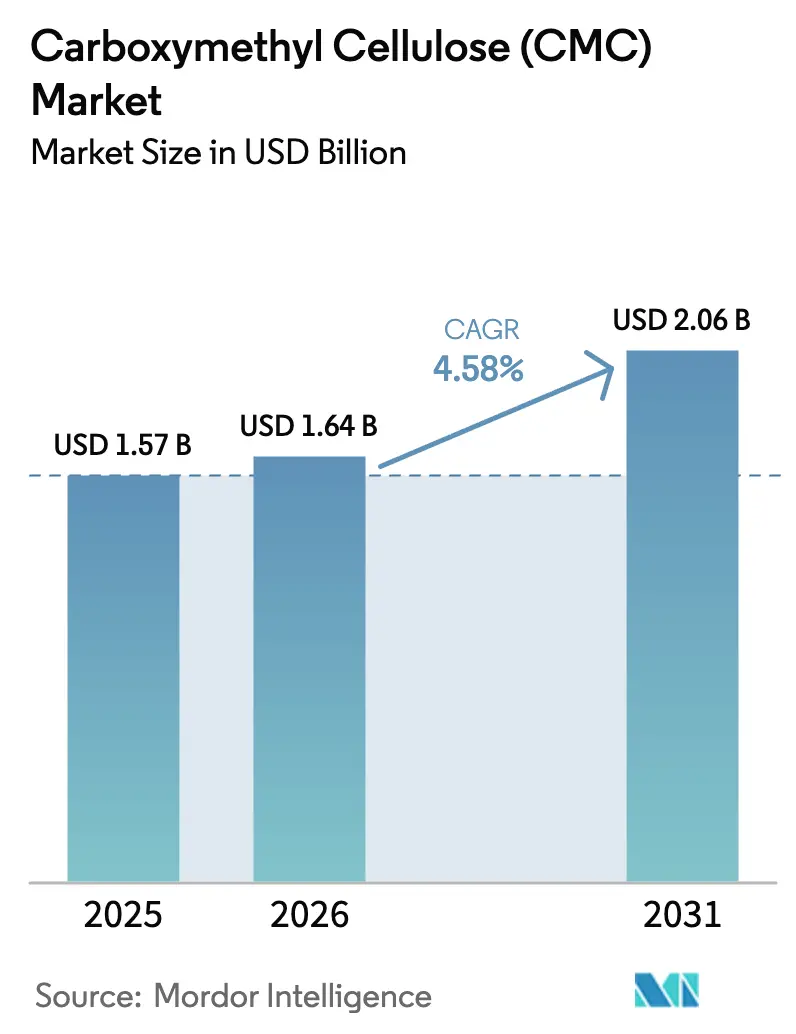
The Carboxymethyl Cellulose market size is expected to grow from USD 1.57 billion in 2025 to USD 1.64 billion in 2026 and is forecast to reach USD 2.06 billion by 2031 at 4.58% CAGR over 2026-2031. Rising demand spans clean-label food stabilizers, abuse-deterrent pharmaceutical coatings, high-salinity drilling fluids, and advanced lithium-ion battery binders. Manufacturers benefit from the polymer’s water solubility, salt and heat tolerance, and broad regulatory acceptance, enabling consistent performance across divergent processing environments. Scale advantages in Asia-Pacific, regulatory moves favoring patient-compliant excipients, and investments in battery-grade production reinforce growth even as competing hydrocolloids and feedstock volatility exert pressure. Vertical integration and continuous product innovation distinguish leading suppliers, while smaller regional players navigate tight margins and increasingly complex compliance requirements.
Key Report Takeaways
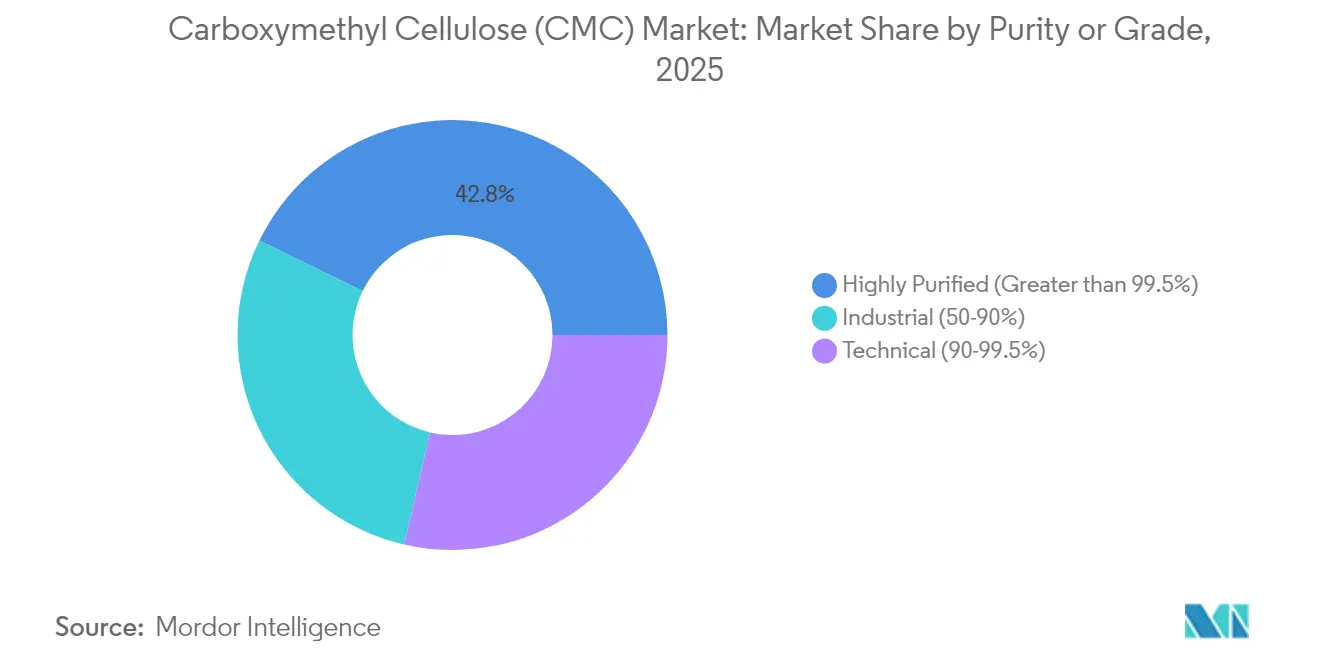
- By purity, Highly Purified grades captured 42.76% of the carboxymethyl cellulose market share in 2025 and are growing at a 5.36% CAGR through 2031.
- By application, Food and Beverages led with 35.52% revenue share in 2025, while Pharmaceuticals is projected to expand at a 6.55% CAGR through 2031.
- By geography, Asia-Pacific accounted for 41.78% of the carboxymethyl cellulose market size in 2025 and is advancing at a 4.96% CAGR to 2031.
Note: Market size and forecast figures in this report are generated using Mordor Intelligence’s proprietary estimation framework, updated with the latest available data and insights as of 2026.
Global Carboxymethyl Cellulose (CMC) Market Trends and Insights
Drivers Impact Analysis*
| Drivers | (~) % Impact on CAGR Forecast | Geographic Relevance | Impact Timeline |
|---|---|---|---|
| Surge in demand for clean-label, low-fat texturising solutions | +1.2% | Global, with concentration in North America and Europe | Medium term (2-4 years) |
| Expansion of high-salinity oil and gas drilling in Middle East deserts | +0.8% | Middle East and Africa, spillover to North America | Short term (≤ 2 years) |
| Pharma shift toward abuse-deterrent oral dosage coatings | +0.6% | North America and Europe, early adoption in APAC | Long term (≥ 4 years) |
| Electric-vehicle Li-ion anode binders adopting Carboxymethyl Cellulose | +0.5% | APAC core, spillover to North America and Europe | Medium term (2-4 years) |
| High demand from processed and convenient food | +0.3% | Global | Short term (≤ 2 years) |
| Source: Mordor Intelligence | |||
Surge in Demand for Clean-Label, Low-Fat Texturising Solutions
Food manufacturers reformulate products to shorten ingredient labels and reduce saturated fat while preserving mouthfeel. Highly purified grades of the polymer replace fat yet maintain viscosity, which supports low-calorie dressings, dairy alternatives, and plant-based meat. Research also shows CMC enabling smart antimicrobial food packaging films that signal spoilage, broadening functionality beyond simple thickening. Brands pay premium prices for grades produced with minimal chemical residues and full international approvals, strengthening revenue per kilogram. North American and European retailers reinforce momentum by tightening label audit requirements and promoting clean-label front-of-pack claims.
Expansion of High-Salinity Oil and Gas Drilling in the Middle East Deserts
Operators in Saudi Arabia, the United Arab Emirates, and Kuwait explore deep reservoirs with extreme salinity and temperature. CMC maintains fluid viscosity and filtration control where guar or native starches fail, safeguarding wellbore stability. Laboratory work at the University of Glasgow demonstrates the polymer’s capacity to disperse nanoparticulates that enhance thermal conductivity and lubricity[1]Ali Al-Araji, “Nanoparticle-Enhanced CMC Drilling Fluids,” University of Glasgow Research Archive, gla.ac.uk. Service companies qualify battery-grade CMC grades for drilling fluids to lower overall chemical loading, which cuts disposal costs. Rising rig counts in unconventional plays create immediate volume pull, while secondary demand flows to shale basins in Texas and New Mexico, facing similar salinity challenges.
Pharma Shift Toward Abuse-Deterrent Oral Dosage Coatings
Regulators in the United States and Europe reward tamper-resistant opioid formulations with favorable labeling. CMC forms insoluble, robust films that resist crushing and solvent extraction, thereby deterring misuse. International Society for Pharmaceutical Engineering guidance positions the polymer as a preferred matrix former because it balances mechanical strength with rapid gastric disintegration when ingested[2]International Society for Pharmaceutical Engineering, “Abuse-Deterrent Formulation Guidance,” ispe.org. Multinational drug makers convert existing extended-release therapies and new chemical entities to these films, while Asia-Pacific generic firms follow to retain export licenses. Higher specification excipient grades generate a durable margin lift for producers able to certify current Good Manufacturing Practice facilities.
Electric-Vehicle Li-ion Anode Binders Adopting Carboxymethyl Cellulose
Automakers target higher energy densities by replacing polyvinylidene fluoride binders with water-processable CMC systems. The switch lowers fluorinated solvent emissions, aligns with green battery directives, and boosts anode adhesion strength. Nippon Paper Industries commissioned a 24 kilotons per year CMC plant in Hungary in March 2025 to serve European battery lines and reduce logistics emissions. Chinese and Korean cell makers co-develop low-sodium CMC grades that extend cycle life beyond 1,200 charge-discharge cycles. As electric-vehicle penetration rises, these specialized grades outpace bulk industrial volumes, encouraging producers to carve out dedicated purification blocks.
Restraints Impact Analysis*
| Restraints | (~) % Impact on CAGR Forecast | Geographic Relevance | Impact Timeline |
|---|---|---|---|
| Rapid price swings in monochloroacetic acid feedstock | -0.7% | Global, particularly affecting Asia-Pacific producers | Short term (≤ 2 years) |
| Rise of enzymatically-modified guar and xanthan gum blends | -0.4% | Global, concentrated in food applications | Medium term (2-4 years) |
| Availability of substitutes in the market | -0.3% | Global, with higher impact in cost-sensitive applications | Long term (≥ 4 years) |
| Source: Mordor Intelligence | |||
Rapid Price Swings in Monochloroacetic Acid Feedstock
Monochloroacetic acid is classified as a high toxicological concern under REACH, which limits production flexibility and heightens compliance expenses. Spot prices have moved more than 30% within six months due to caustic soda shortages and port congestion in Europe, forcing CMC makers to accept volatile profit margins. Vertically integrated producers hedge by operating captive chloroacetic plants, whereas stand-alone Chinese facilities suspend production during price spikes, tightening global supply. Hedging strategies are limited because exchange-traded derivatives for the acid remain illiquid.
Rise of Enzymatically-Modified Guar and Xanthan Gum Blends
Advances in microbial fermentation enable tailored rheology profiles that mimic or exceed CMC performance at lower cost for specific food and personal-care formulations. Multinational ingredient suppliers market blends that improve freeze-thaw stability and tolerate high shear mixing, eroding CMC’s share in sauces and cosmetics. Oil-field service firms also test modified guar for high-salinity fracking fluids after enzyme treatment improves thermal stability. Switching costs are modest where label regulations already allow guar or xanthan, putting sustained pressure on CMC in cost-sensitive recipes.
*Our forecasts treat driver/restraint impacts as directional, not additive. The impact forecasts reflect baseline growth, mix effects, and variable interactions.
Segment Analysis
By Purity/Grade: Technical Grades Challenge Premium Positioning
Highly Purified grades held 42.76% carboxymethyl cellulose market share in 2025 and posted a 5.36% CAGR outlook. Regulatory bodies, including the US Food and Drug Administration, EU Pharmacopoeia, and China National Medical Products Administration, enforce tight purity specifications that smaller manufacturers struggle to match. As a result, top producers allocate capital to upgrade filtration, bleaching, and ion exchange systems. Pharmaceutical and specialty food contracts lock in multi-year volumes and support predictable capacity utilization. Wastewater treatment costs rise with each purity step, but the price premium offsets operating expenses and maintains segment margin leadership.



By Application: Pharmaceuticals Lead Innovation Despite Food Dominance
The carboxymethyl cellulose market size for Food and Beverages held 35.52% of the total revenue. CMC delivers thickening, moisture retention, and freeze-thaw control, which support global expansion of convenience foods. Frequent reformulation drives steady volume growth even as the price per kilogram remains tightly negotiated. The pharmaceutical segment is forecast to grow at 6.55% CAGR through 2031, the quickest among all uses, as regulators elevate abuse-deterrent standards and demand for controlled-release formulations climbs. This trajectory demonstrates how compliance requirements funnel value toward excipients with proven safety records and robust analytical dossiers.

Geography Analysis
Asia-Pacific accounted for 41.78% of global revenue in 2025 and is projected to advance at a 4.96% CAGR. China leads in capacity, but India’s processed food sector adds robust incremental consumption. Japan and South Korea invest in pharmaceutical and battery research and development, which elevates local demand for Highly Purified and battery-grade variants. Southeast Asian nations such as Vietnam and Indonesia import CMC for instant noodle, dairy, and textile applications, supported by favorable tariff regimes.
North America maintains a sizable carboxymethyl cellulose market driven by pharmaceutical excipients and shale oil drilling. Large integrated producers operate plants near caustic soda and monochloroacetic acid sources, which mitigates raw-material volatility. Europe emphasizes food safety and green chemistry, which sustains demand for sustainable grades. Regulation EC 1333/2008 prescribes additive purity and labeling, favoring incumbents with established dossiers.
South America, and Middle East and Africa offer untapped potential. Brazilian agribusiness requires CMC as a thickener in fruit-based beverages, but import tariffs and currency swings complicate procurement.
Value Chain Analysis
The CMC value chain starts with cellulose feedstock (wood pulp and cotton linters) and key reagents, mainly sodium hydroxide and monochloroacetic acid (MCA). Producers convert cellulose through alkalization and etherification, then move into purification (bleaching, filtration, ion exchange for high-purity and specialty grades), followed by drying, milling, blending, and packaging. For food, pharmaceutical, and battery grades, tighter specifications raise wastewater treatment needs and quality-control intensity versus industrial grades.
Distribution is commonly structured around direct contracts to large end users and regional chemical ingredient distributors for mid-sized buyers. In performance-led segments such as pharmaceutical excipients, detergents, and battery binders, customers typically require consistent viscosity and tighter impurity control, alongside regulatory documentation. Supply risk clusters around MCA cost and availability swings and logistics disruptions, with mitigation supported by vertical integration into key inputs and regional production footprints. Nippon Paper Industries commissioning a 24 kt/y battery-grade CMC plant in Hungary (March 2025) is an example of capacity placed closer to European battery supply chains to reduce lead time and contamination risk.
Competitive Landscape
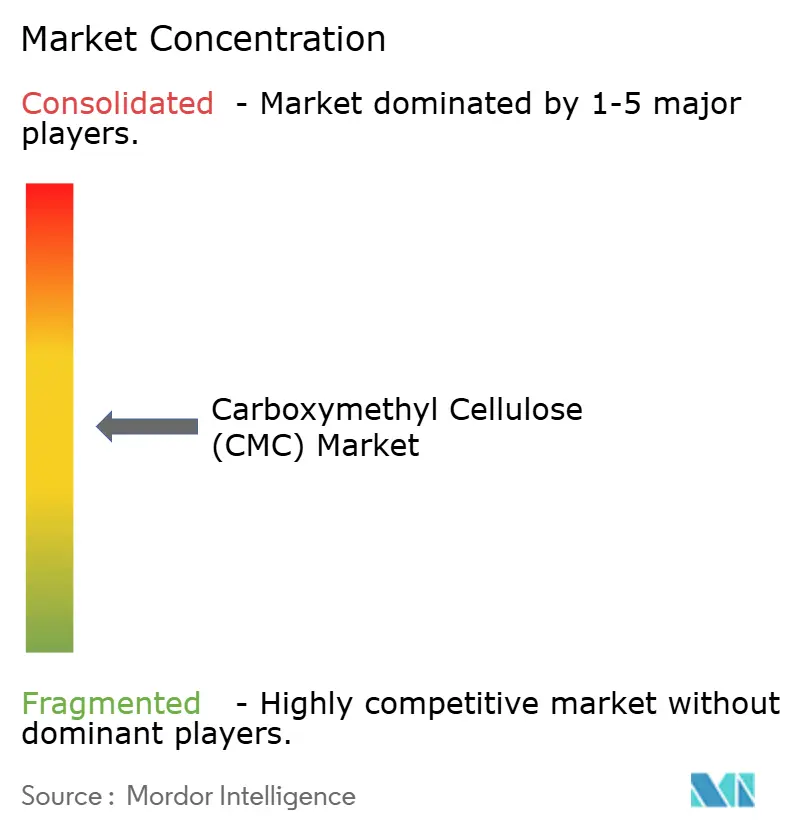
The carboxymethyl cellulose market shows moderate fragmentation. Technology differentiation revolves around molecular-weight control, degree of substitution, and tailored viscosity rather than volume alone. Nippon Paper Industries dedicates separate production blocks for battery-grade CMC to prevent metal contamination, winning supply agreements with European cathode makers.
Carboxymethyl Cellulose (CMC) Industry Leaders
Nouryon
Ashland
Tate & Lyle
Daicel Corporation
Dow
- *Disclaimer: Major Players sorted in no particular order

Market Opportunities and Future Outlook
White-space appears most visible where buyers require higher-assurance grades and more localized supply, rather than commoditized thickener volumes. Battery anode binders are pulling dedicated, low-contaminant CMC capacity into Europe, and the completion of a 24 kt/y battery-grade CMC plant in Hungary by Nippon Paper Industries (March 2025) supports supplier qualification while reducing cross-border logistics exposure for cell manufacturers.
In specialty ingredients, consolidation and portfolio expansion point to cross-selling opportunities for cellulose gum in clean-label and texture-led formulations. Tate & Lyle completing its acquisition of CP Kelco (November 2024) strengthens a combined platform across hydrocolloids and specialty ingredients, supporting broader solution selling into food and beverage and neighboring applications where CMC competes with other gums. On the supply side, barriers tied to purity systems and compliance documentation leave room for upgrades in filtration, bleaching, and ion-exchange capabilities, particularly for highly purified grades used in regulated end markets.
Recent Industry Developments
- June 2026: Ashland announced the groundbreaking of a new Life Sciences aquarius tablet coatings manufacturing facility in Ambernath, Maharashtra, India. The project expands local manufacturing access for coating systems used in oral solid dosage forms. It also aims to tighten lead times and supply continuity for regional pharmaceutical customers.
- February 2026: Nouryon launched FinnFix PB MAX, described as an industry-first 100% biobased and biodegradable carboxymethyl cellulose for laundry detergents. The release broadens CMC positioning in cleaning formulations where brand owners are scrutinizing renewable feedstocks and end-of-life impact. It also targets detergent applications that require performance with lower environmental footprint.
- November 2024: Tate & Lyle finalized its EUR 1.4 billion acquisition of CP Kelco. The combination expands the company’s specialty ingredients platform and strengthens formulation capabilities. It also increases scale in hydrocolloids where cellulose gum competes alongside other texturizers.


Research Methodology Framework and Report Scope
Market Definition and Coverage
This market covers revenues generated from selling carboxymethyl cellulose (CMC) used as a functional additive across end uses, counted at the manufacturer level and reported in USD across major regions.
Scope exclusions: We exclude captive, non-monetized internal transfers, and we do not treat upstream cellulose pulp or downstream finished consumer products as part of the CMC market value.
Segmentation Overview
- By Purity/Grade
- Highly Purified (Greater than 99.5%)
- Technical (90-99.5%)
- Industrial (50-90%)
- By Application
- Food and Beverages
- Oil and Gas
- Cosmetics and Personal Care
- Pharmaceuticals
- Detergents
- Paper Processing
- Other Applications (Mining, Construction and Ceramics, etc.)
- By Geography
- Asia-Pacific
- China
- India
- Japan
- South Korea
- Rest of Asia-Pacific
- North America
- United States
- Canada
- Mexico
- Europe
- Germany
- United Kingdom
- France
- Italy
- Rest of Europe
- South America
- Brazil
- Argentina
- Rest of South America
- Middle-East and Africa
- Saudi Arabia
- South Africa
- Rest of Middle-East and Africa
- Asia-Pacific
Data Sources, Market Sizing, and Validation
Desk Research
Desk work started by building a fact base on where CMC is consumed and how demand typically moves by end use. We referred to public sources such as the USGS, UN Comtrade, the US International Trade Commission data tools, the World Bank, and FDA and EFSA food additive information to understand trade flows, regulatory acceptance, and downstream activity signals.
Next, we reviewed manufacturer annual reports, investor decks, and press releases to map capacity additions, product positioning, and key application pushes that can change the supply and pricing balance. For select companies, we also used paid company financials and news-intelligence subscriptions, along with patent databases, to cross-check product pipelines and to avoid missing small but fast moving use cases. These sources are illustrative and many other public documents and databases were also used to collect, validate, and clarify data points.
Primary Interviews and Surveys
Primary work focused on validating how CMC demand splits across food, oil and gas fluids, detergents, paper, pharma, and personal care, and how pricing behaves by grade and contract type. We spoke with a mix of producers, distributors, and large end users across APAC, EMEA, and the Americas so the model could be anchored to real shipment patterns and procurement behaviors, and then adjusted where desk signals were not consistent.
Distribution of primary research fieldwork respondents
| Company type | Respondent position | Region |
|---|---|---|
| Top tier: 38% | CXOs: 13% | APAC: 41% |
| Mid tier: 46% | Functional/Unit leaders: 29% | EMEA: 35% |
| Smaller Players: 16% | Managers: 58% | Americas: 24% |
Market-Sizing & Forecasting
We sized the market using a top-down approach that starts from regional demand pools in key consuming industries and then reconstructs CMC consumption using penetration and use-rate assumptions by application, followed by an ASP build that reflects grade mix. To keep the totals realistic, the outputs were then checked with selective bottom-up approximations such as producer capacity and utilization signals, channel checks on typical contract pricing, and sampled volume-by-end-use estimates from interviews.
Inputs that mattered most included food and beverage processing activity and clean label formulation trends, drilling and completion activity in oil and gas, detergent and home care production trends, paper processing additives demand, and the split between highly purified and industrial grades because that mix changes average pricing. For forecasting, we used scenario analysis supported by short series smoothing on demand drivers, and assumptions were tuned using what interviewees expected on capacity additions, substitution pressures, and regional growth. Where direct volume indications were thin in smaller countries, we bridged gaps using trade proxies and a calibrated per-industry consumption intensity, which was rechecked during validation calls.
Data Validation & Update Cycle
After the first model run, our team checked the totals against independent signals such as import-export movements, known capacity expansions, and the implied price range by grade to catch outliers early. When results deviated from what respondents described, the assumptions were revisited and the most sensitive drivers were revalidated through follow-up outreach, before the numbers moved to internal review.
A second analyst then reviewed calculations, conversions, and the logic behind each driver so that the final market size is explainable step by step. Reports are refreshed annually, and interim updates are done when there are material events like major capacity starts, shutdowns, or sharp feedstock and energy swings. Before delivery, we run a final check pass so the dataset reflects the latest public releases and market signals.
Mordor Intelligence's Carboxymethyl Cellulose Cmc Market Size Versus Other Published Estimates
Published market sizes for CMC often do not line up because researchers draw the market boundary differently, and they also use different base years and pricing logic. Differences usually show up around whether sodium CMC only is counted, how much of the industrial grade is included, and whether the value is calculated at producer selling price or further down the chain.
Import-export movements by key CMC producing countries, combined with grade-mix discussions from producer and buyer interviews, are used as anchor checks that keep Mordor Intelligence's estimate aligned to manufacturer-level revenues rather than inflated downstream formulations. Other figures can drift when they apply aggressive ASP growth without matching it to contract reset cycles, or when they combine adjacent cellulose derivatives and label it as CMC in summary tables.
Benchmark comparison
| Source | Market Size | Gaps in Research Methodology |
|---|---|---|
| Mordor Intelligence | USD 1.64 B (2026) | |
| Industry Data Publisher A | USD 1.66 B (2024) | Uses an earlier base year and may apply broad grade definitions across many end uses, which can shift the implied 2026 value if ASP and mix are rolled forward with limited contract-cycle validation. |
| Global Consultancy B | USD 3.28 B (2025) | Likely captures a wider value chain or bundles adjacent cellulose derivatives and downstream formulated products under the CMC label, which lifts the number beyond manufacturer selling prices for CMC alone. |
The spread in the table is mainly explained by scope and value-point choices, not by a real demand disagreement. By tying the model to application demand signals, realistic grade mix, and price reset behavior, we end up with a market size that can be traced back to repeatable steps and practical checks.


Key Questions Answered in the Report
What is the current size of the carboxymethyl cellulose market?
The carboxymethyl cellulose market stands at USD 1.64 billion in 2026.
Which region leads the carboxymethyl cellulose market in 2025?
Asia-Pacific leads with 41.78% revenue share, supported by large-scale manufacturing and strong downstream demand.
Which application segment is growing fastest?
Pharmaceuticals is expanding at a 6.55% CAGR through 2031, driven by abuse-deterrent coatings and controlled-release formulations.
Why are battery manufacturers adopting CMC binders?
CMC offers water-based processing, improved adhesion, and environmental advantages over fluorinated binders, boosting energy density in lithium-ion anodes.
What restrains growth in the carboxymethyl cellulose market?
Volatile monochloroacetic acid prices and competition from modified guar and xanthan gum blends apply downward pressure on margins and share.
Page last updated on:


 Your data is secure and never sold or shared.


