
Market Overview
| Study Period | 2020 - 2031 |
|---|---|
| Forecast Data Period | 2026 - 2031 |
| Base Year Market Size (2025) | 3.40 Million tons |
| Market Volume (2026) | 3.52 Million tons |
| Market Volume (2031) | 4.16 Million tons |
| Growth Rate (2026 - 2031) | 3.42 % |
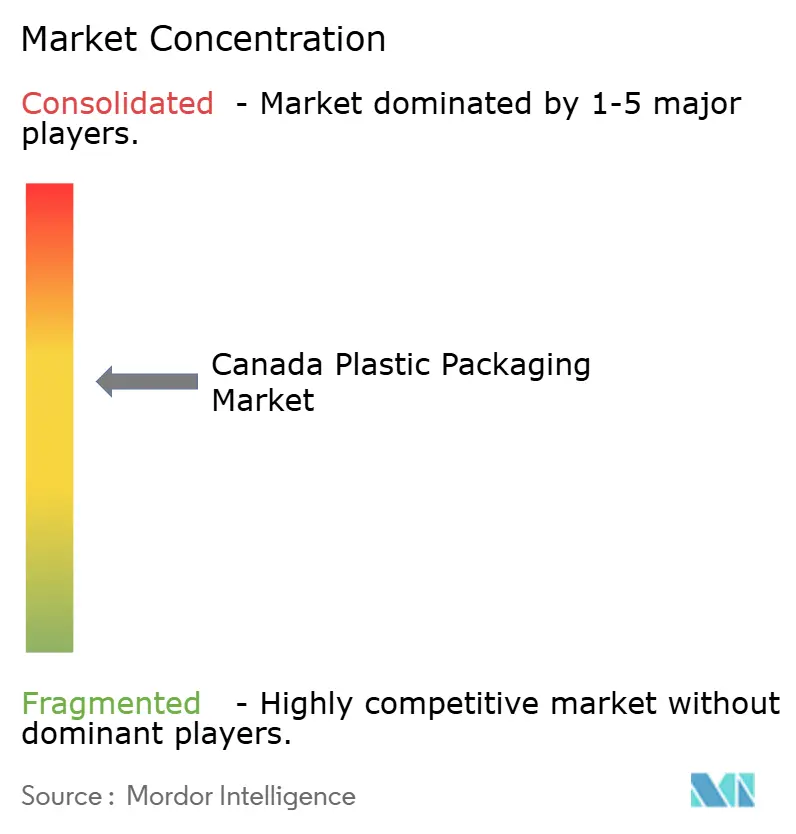
| Market Concentration | Medium |
Major Players *Disclaimer: Major Players sorted in no particular order Image © Mordor Intelligence. Reuse requires attribution under CC BY 4.0. | |
Canada Plastic Packaging Market Analysis by Mordor Intelligence
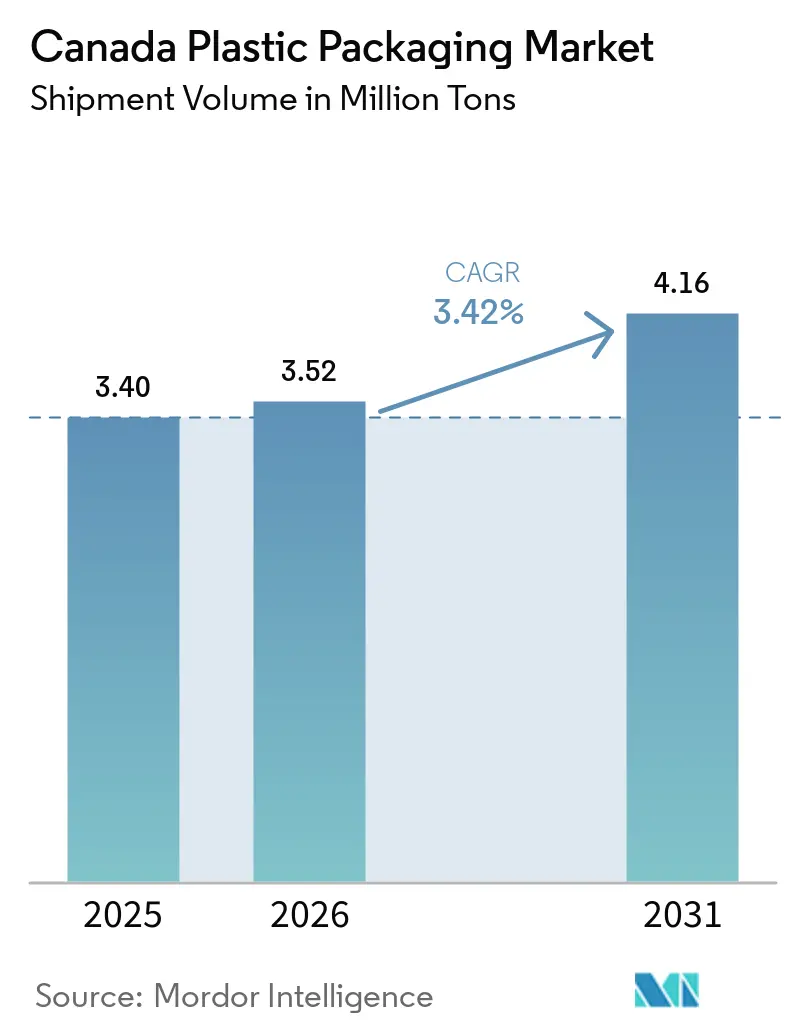
The Canada plastic packaging market size in 2026 is estimated at 3.52 million tons, growing from 2025 value of 3.40 million tons with 2031 projections showing 4.16 million tons, growing at 3.42% CAGR over 2026-2031. The rising demand for convenience foods, the rapid expansion of e-commerce, and regulatory moves favoring recyclable polymers collectively underpin this growth trajectory. Provincial EPR programs are accelerating investments in design for recycling, while smart packaging pilots in pharmaceuticals and perishables signal a growing interest in value-added formats. At the same time, large-scale M&A activity is reshaping supplier power, and volatility in petro-feedstock prices remains a headline risk that can squeeze converter margins.
Key Report Takeaways
- By material type, polyethylene led with 38.74% of Canada's plastic packaging market share in 2025, and polyethylene terephthalate is projected to expand at a 5.24% CAGR through 2031.
- By packaging type, flexible formats accounted for 57.31% of the Canada plastic packaging market size in 2025, rigid formats are forecast to grow at a 4.69% CAGR between 2026-2031.
- By product form, pouches and sachets held 34.88% share of the Canada plastic packaging market size in 2025, films and wraps are advancing at a 4.86% CAGR through 2031.
- By end-user industry, food applications represented 29.11% of Canada's plastic packaging market share in 2025, while cosmetics and personal care record the highest projected CAGR at 4.94% through 2031.
- By manufacturing process, extrusion captured 27.95% share of the Canada plastic packaging market size in 2025, whereas thermoforming rises at a 5.54% CAGR to 2031.
Note: Market size and forecast figures in this report are generated using Mordor Intelligence’s proprietary estimation framework, updated with the latest available data and insights as of 2026.
Market Trends and Insights
Drivers Impact Analysis of Canada Plastic Packaging Market*
| Driver | (~) % Impact on CAGR Forecast | Geographic Relevance | Impact Timeline |
|---|---|---|---|
| Demand from food and beverage industry for convenience packaging | +1.2% | National, concentrated in Ontario and Quebec processing centers | Medium term (2-4 years) |
| Rising e-commerce shipments requiring lightweight protective packaging | +0.8% | National, with early gains in Toronto, Montreal, Vancouver metropolitan areas | Short term (≤ 2 years) |
| Technological advancements in recyclable and bio-based plastics | +0.6% | Ontario innovation clusters, Quebec research centers, BC sustainability initiatives | Long term (≥ 4 years) |
| Provincial EPR harmonization prompting packaging redesign | +0.9% | Ontario, Quebec, Nova Scotia leading implementation | Medium term (2-4 years) |
| Growth of cannabis product packaging with strict compliance needs | +0.4% | National, with concentration in licensed production facilities | Short term (≤ 2 years) |
| Smart packaging adoption for pharma cold-chain monitoring | +0.3% | National pharmaceutical distribution networks | Long term (≥ 4 years) |
| Source: Mordor Intelligence | |||
Demand from Food and Beverage Industry for Convenience Packaging
Food processors continue shifting toward portion-controlled and ready-to-eat formats that rely on barrier plastic packaging films and pouches to extend shelf life and reduce waste. Statistics Canada reported that 30.4% of the nation’s plastic consumption in 2024 originated in food applications.[1]Producers in Quebec alone shipped CAD 7.8 billion (USD 6.0 billion) of plastic packaging during 2024, demonstrating the scale of this driver. Modified-atmosphere solutions adopted by protein processors in Ontario illustrate how performance requirements keep polyethylene in a leading position. These trends secure a stable demand base even as sustainability pressures mount, anchoring the Canada plastic packaging market.
Rising E-commerce Shipments Requiring Lightweight Protective Packaging
Online retail volumes remain elevated compared with pre-pandemic baselines, and parcel carriers favor lightweight materials that minimize dimensional weight charges. Flexible mailer pouches, padded films, and bubble wraps enable merchants to optimize freight costs across Canada’s long supply chains. Converters emphasize digital printing for brand differentiation during unboxing, an increasingly important marketing touchpoint. E-commerce therefore amplifies demand for materials that balance durability with minimal mass, supporting volume gains in films and wraps across the Canada plastic packaging market.
Technological Advancements in Recyclable and Bio-based Plastics
Universities and resin producers are accelerating R&D on mono-material films, advanced recycling, and bio-polymer blends. NOVA Chemicals opened its Centre of Excellence for Plastics Circularity in Calgary in June 2024, focusing on chemical recycling pathways for polyethylene. The University of Guelph’s seaweed-based resin program secured federal grants in February 2024, aiming at compost-ready food pouches. Continuous material innovation tightens the gap between sustainability mandates and functional performance, enabling converters to meet EPR targets without sacrificing barrier properties.
Provincial EPR Harmonization Prompting Packaging Redesign
Ontario’s Blue Box transition moved 130 communities to producer responsibility by March 2024, with Circular Materials forecasting national alignment by 2027. Quebec codified a broad EPR framework effective January 2025 that extends to industrial and institutional waste streams. Producers now face unified fee structures tied to recyclability and recycled content metrics. The new cost signals prompt lightweighting, color elimination, and mono-material redesign, accelerating sustainable innovation across the Canada plastic packaging market.
Restraints Impact Analysis of Canada Plastic Packaging Market*
| Restraint | (~) % Impact on CAGR Forecast | Geographic Relevance | Impact Timeline |
|---|---|---|---|
| Federal single-use plastics ban increasing regulatory uncertainty | -0.7% | National implementation with provincial variation in enforcement | Short term (≤ 2 years) |
| Volatility in petro-feedstock prices | -0.5% | National, with particular impact on Alberta petrochemical clusters | Medium term (2-4 years) |
| Limited domestic recycling capacity for rPET feedstock | -0.4% | National, concentrated in Ontario and Quebec processing centers | Medium term (2-4 years) |
| Retailer-led reusable packaging pilots reducing single-use demand | -0.3% | National retail chains, urban centers leading adoption | Long term (≥ 4 years) |
| Source: Mordor Intelligence | |||
Federal Single-use Plastics Ban Increasing Regulatory Uncertainty
The December 2023 federal court ruling that questioned plastic toxicity classifications introduced legal ambiguity, yet the Single-use Plastics Prohibition Regulations remain active pending appeal. Retailers and quick-service outlets are testing fiber and bio-resin substitutes while converters weigh capital allocation for new lines. Divergent provincial enforcement adds complexity for national brands. This policy backdrop tempers near-term demand for legacy checkout bags and cutlery, pressuring volumes in certain low-margin categories within the Canada plastic packaging market.
Volatility in Petro-feedstock Prices
Polyethylene and polypropylene resin prices tracked Brent crude swings and logistic bottlenecks through 2024-2025, squeezing converter spreads. Statistics Canada recorded 5.2% year-over-year inflation in packaging materials by January 2025. Alberta’s ethane-derived resin cluster faces added exposure to export tariffs introduced by the United States in March 2025, covering USD 14.9 billion of Canadian plastics exports. Margin compression can slow investment in new capacity, restricting supply responsiveness in the Canada plastic packaging market.
*Our forecasts treat driver/restraint impacts as directional, not additive. The impact forecasts reflect baseline growth, mix effects, and variable interactions.
Canada Plastic Packaging Market Segment Analysis
By Material Type:
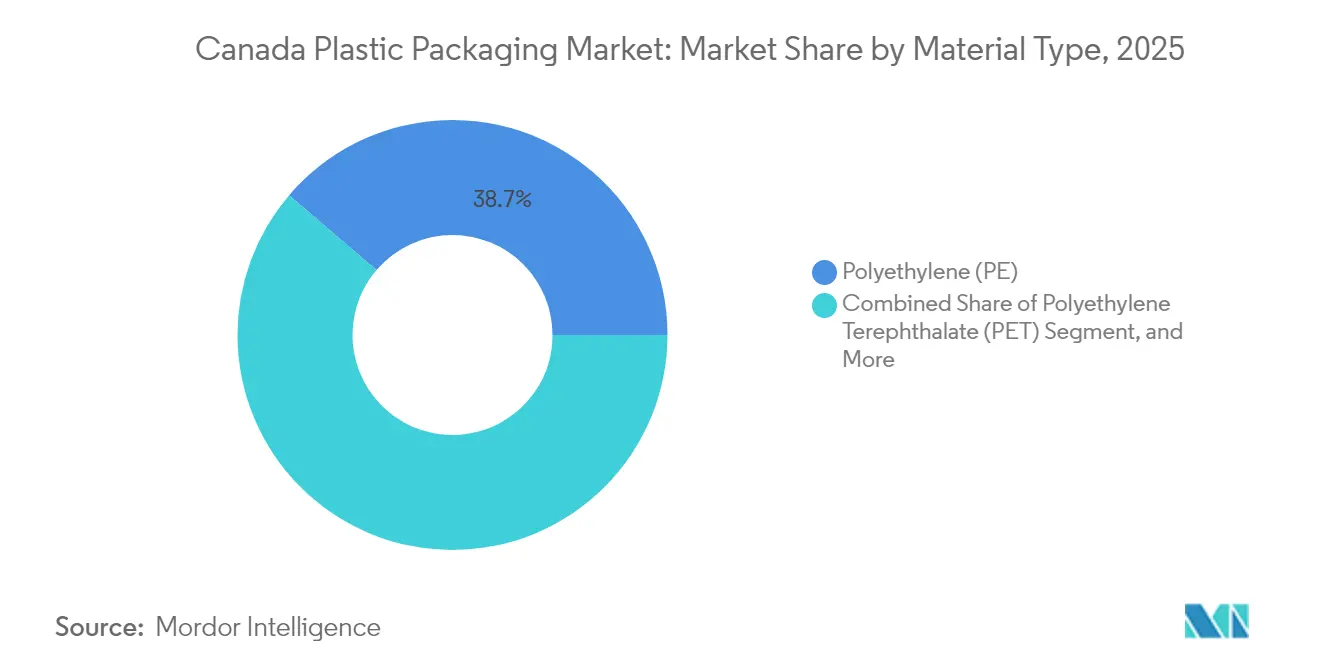
Polyethylene Retains Scale as PET AcceleratesPolyethylene held 38.74% of Canada plastic packaging market share in 2025, a position anchored in its versatility across films, bags, and rigid containers. Converter familiarity with PE, coupled with well-established mechanical recycling streams, sustains high volume usage. The segment also benefits from investment in chemical recycling pilot plants that target post-consumer PE waste, aligning with provincial EPR performance metrics. Meanwhile, polyethylene terephthalate expands at a 5.24% CAGR through 2031, underpinned by beverage bottlers’ shift to lighter PET preforms and bottle-to-bottle recycling initiatives that leverage growing rPET pellet capacity in Ontario and Quebec. The Canada plastic packaging market size tied to PET is therefore poised for above-average growth as deposit return expansions unlock clean feedstock streams. Polypropylene maintains relevance in closure and rigid tub applications, while polystyrene contracts under municipal bans targeting foam service ware. Bio-resin adoption remains nascent but earns attention for compost-ready coffee pod lids and produce containers, signaling future diversification in the Canada plastic packaging market.
The competitive landscape within materials is further shaped by resin price volatility and carbon accounting pressures. Converters source recycled PE and rPET to meet brand owner mandates for 30% post-consumer content in retail packaging by 2030. Such procurement dynamics can widen the cost gap between polymers, influencing substitution patterns. Resin suppliers are responding through mass-balance certified grades that carry lower scope 3 emissions, a factor increasingly weighted in retail tender processes.

By Packaging Type:
Flexible Solutions Dominate as Rigid Formats RepositionFlexible formats captured 57.31% of the Canada plastic packaging market size in 2025, reflecting advantageous product-to-package ratios that drive freight savings. Multi-layer films with EVOH or metallized barrier layers lengthen shelf life for meats, cheeses, and ready meals, thereby supporting retailer food waste reduction pledges. Brand owners also leverage stand-up pouches to differentiate in crowded center-store aisles, with resealable closures enhancing user convenience. Regulatory scrutiny of multi-material laminates, however, pushes converters toward polyolefin-only structures compatible with existing film recycling streams.
Rigid packaging maintains robust demand in segments where structural integrity is paramount, such as carbonated soft drinks, household cleaners, and OTC pharmaceuticals, supporting growth in the Canada rigid plastic packaging market. Light-weighting breakthroughs enable HDPE bottle weight cuts of 18% over legacy designs, mitigating resin cost inflation. Deposit return programs in British Columbia and Alberta lift PET bottle recovery rates above 80%, improving rPET availability and lowering lifecycle emissions. The Canada plastic packaging market therefore features a dynamic interplay where rigid suppliers innovate to preserve share while flexible formats continue to proliferate.
By Product Form:
Pouches Lead and Films Gain MomentumPouches and sachets secured 34.88% share of the Canada plastic packaging market size in 2025, buoyed by snack-food category expansion and consumer affinity for portable single-serve formats. High-definition flexographic printing enhances shelf impact, and degassing valves enable growth in specialty coffee applications. E-commerce further amplifies pouch use due to puncture resistance and minimal void space. Films and wraps experience the highest CAGR at 4.86% through 2031 as warehouse automation and pallet unitization protocols standardize the use of thinner high-stretch films that cut material usage by up to 22%. Supply chain stakeholders also favor recyclable collation shrink over paperboard for efficiency, reinforcing demand momentum in the Canada plastic packaging market.
Bottles and jars retain indispensability in beverages and personal care, especially where tactile cues and resealability affect brand perception. Tray and container volumes rise with ready-meal popularity, leveraging microwave-safe CPET structures. Bag and sack applications span produce, fertilizers, and industrial products, but face pressure from provincial levies on non-reusable grocery bags, prompting thicker multilayer options qualifying as reusable under regulation.
By End-User Industry:
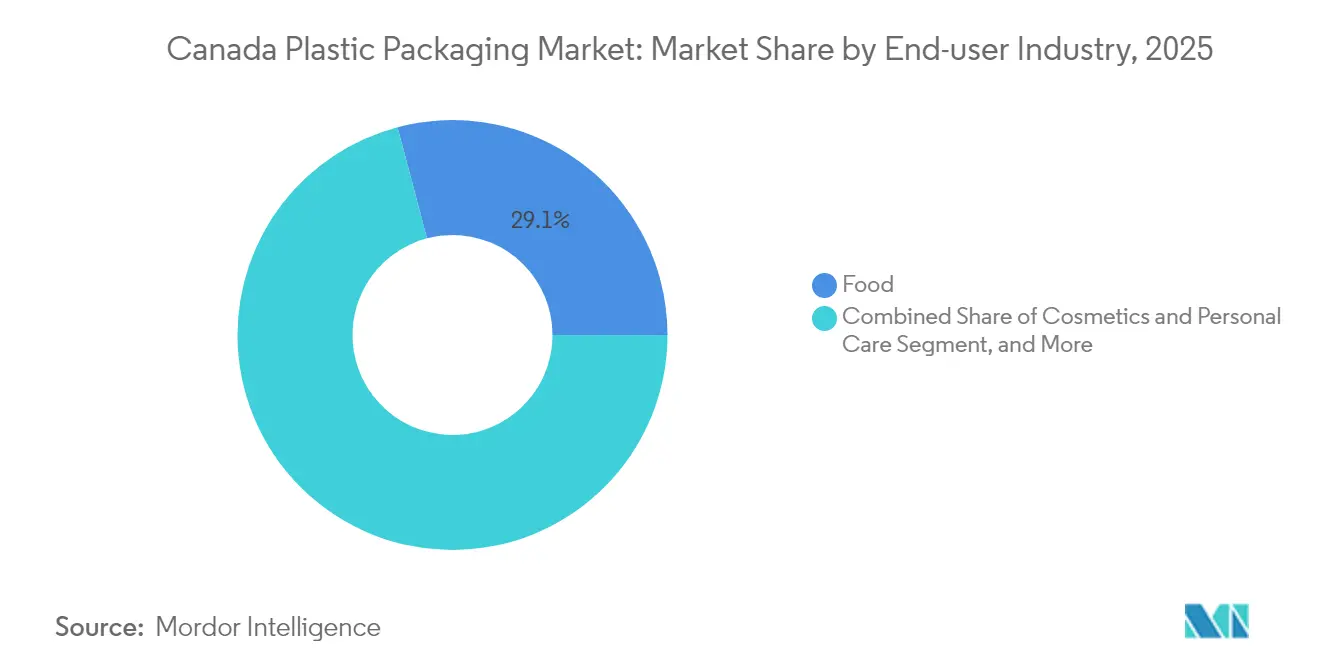
Food Dominates, Cosmetics AccelerateFood applications absorbed 29.11% of Canada plastic packaging market share in 2025, reflecting fundamental needs for product protection and compliance with CFIA labeling rules. Barrier film advances permit protein processors to extend chilled shelf life by up to eight days, reducing retailer shrink. Modified atmosphere technology adoption in fresh produce further cements plastics’ role in waste mitigation strategies. Beverage packaging remains a major sub-segment, with bottle redesign campaigns trimming PET gram weights and incorporating 100% rPET in premium water brands.
Cosmetics and personal care register a 4.94% CAGR to 2031, driven by demand for premium tactile finishes, airless pumps, and travel-size SKUs. Brand owners integrate ocean-bound recycled polymers to bolster ESG credentials, and refill-ready jar systems gain traction among boutique labels. Pharmaceutical demand for child-resistant closures, anti-counterfeit features, and cold-chain monitoring fosters incremental growth, while industrial markets consume heavy-duty sacks, IBC liners, and protective wrap, offering stable though lower-margin volumes inside the Canada plastic packaging market.
By Manufacturing Process:
Extrusion Holds Scale while Thermoforming OutpacesExtrusion accounted for 27.95% of Canada plastic packaging market share in 2025 through its efficiency in high-volume film, sheet, and profile production. Multi-layer co-extrusion enables oxygen barrier incorporation without adhesive tie layers, simplifying recycling. Process versatility allows converters to run recycled pellet blends up to 35% without compromising optical clarity, suiting EPR fee structures tied to recycled content.
Thermoforming posts a 5.54% CAGR, reflecting demand for lightweight rigid containers in dairy, bakery, and ready-meal categories. Thin-gauge PET and PP roll stock are thermoformed into clamshells and portion trays that align with deposit return streams. Injection molding retains a foothold in caps, closures, and personalized medicine dispensers, while blow molding remains synonymous with beverage and household chemical bottles. Process selection in the Canada plastic packaging market increasingly hinges on life-cycle assessments and the ability to accommodate recycled feedstock without mechanical property loss.
Geography Analysis
Ontario and Quebec together contribute roughly 75.68% of the Canada plastic packaging market, mirroring their population density, food processing clusters, and transportation links to U.S. customers. Ontario alone accounted for 62% of Canadian plastic waste exports in 2021, underscoring its role as both production hub and waste generator.Provincial policy such as the Blue Box overhaul is redirecting material flows toward domestic re-processing, a shift expected to boost local demand for recycled resin in the near term.
Quebec hosts more than 420 plastics establishments employing 21,000 workers, generating CAD 7.8 billion (USD 6.0 billion) in shipments during 2024. Its comprehensive EPR program, effective 2025, extends producer fees across commercial streams, incentivizing rapid packaging redesign. British Columbia’s Recycle BC model demonstrates how mandatory stewardship can achieve 95% local processing of collected residential plastics, though the province’s export share dipped to 5% by 2021, reflecting reduced manufacturing scale.
Alberta offers feedstock cost advantages due to ethane and propane availability, yet new U.S. tariffs on Canadian plastics heighten market uncertainty for its export-oriented output. Atlantic provinces remain small but exhibit above-average growth rates as seafood processors seek high-barrier vacuum pouches to safeguard product freshness during trans-Atlantic shipping. Overall, regional variations in policy, feedstock access, and end-market proximity determine growth pockets within the Canada plastic packaging market.
Regulatory Landscape
Plastic packaging in Canada is governed through a mix of federal requirements under the Canadian Environmental Protection Act, 1999 (CEPA) and province-led extended producer responsibility (EPR) programs. Environment and Climate Change Canada (ECCC) is implementing the Federal Plastics Registry (FPR), which makes annual reporting mandatory for plastics placed on the Canadian market. Phase 1 reporting, covering 2024 calendar-year data for plastic packaging and selected categories, is due by September 29, 2025, shifting compliance toward auditable mass-balance and product categorization across suppliers and brand owners.
Federal rules also shape product choices and end-of-life pathways. The Single-use Plastics Prohibition Regulations (SUPPR) remain in force following the January 30, 2026 Federal Court of Appeal decision upholding the CEPA Schedule 1 listing used to regulate plastic manufactured items, and a prohibition on exporting certain single-use plastic items took effect on December 20, 2025. In parallel, ECCC is developing recyclability and recycled-content labelling rules, including restrictions on the use of the chasing-arrows symbol unless an 80% threshold of Canadian recycling facilities accept the item and end markets exist. This pushes packaging producers toward verified recycle-ready structures and more conservative environmental claims.
Value Chain Analysis
Canada's plastic packaging value chain starts with upstream resin and additive suppliers, moves through processors and converters (film extrusion, thermoforming, injection/blow molding), then reaches brand owners and retailers before flowing into collection, sorting, and reprocessing. Regulatory data requirements are becoming a structural layer across this chain. Under the Federal Plastics Registry (FPR), producers (including manufacturers and importers placing packaging on the market) must report annually, with Phase 1 reporting beginning in September 2025 for 2024 data. This increases the need for traceability on resin types, packaging formats, and end-market pathways.
Industry collaboration platforms are also focusing on design and end-market bottlenecks, particularly for flexible packaging. The Canada Plastics Pact and the Circular Plastics Taskforce operate as conveners that bring together brand owners, packaging producers, recyclers, and municipalities to align packaging design with recycle-ready guidance and to advance collection and sorting models. Public support for circularity projects under Environment and Climate Change Canada programs further reinforces downstream capability building, including initiatives aimed at improving film sorting and supporting reuse-oriented solutions to reduce leakage and strengthen domestic feedstock availability.
Competitive Landscape
Industry consolidation intensified through 2024 as Amcor agreed to acquire Berry Global for USD 8.4 billion, creating a global powerhouse with expanded Canadian reach. Novolex closed its USD 6.7 billion purchase of Pactiv Evergreen in December 2024, backed by a USD 1 billion co-investment from Canada Pension Plan Investment Board. These moves elevate the combined market share of the top five suppliers toward 55%, tightening buyer options and accelerating technology diffusion.
Strategic focus areas include recycled content certification, mono-material laminate development, and smart sensor integration. ProAmpac’s March 2024 acquisition of Gelpac deepened its Canadian footprint in multiwall paper and woven poly sacks, underscoring interest in hybrid material portfolios. Cascades pursues a fiber-plastic blend strategy to hedge regulatory outcomes, while Winpak emphasizes proprietary co-extrusion for high-barrier lidding. Start-ups in Ontario’s innovation corridor target niche opportunities in cannabis compliance packaging and active freshness indicators. White-space persists in commercializing bio-polymer films at industrial scale, offering disruptor entry points into the Canada plastic packaging market.
Canada Plastic Packaging Industry Leaders
-
Amcor plc
-
Huhtamaki Oyj
-
Sealed Air Corporation
-
Winpak Ltd.
-
Silgan Holdings Inc.
- *Disclaimer: Major Players sorted in no particular order
Canada Plastic Packaging Market Companies Covered in this Report
- Amcor plc
- CCL Industries Inc.
- Sealed Air Corporation
- Winpak Ltd.
- Mondi plc
- Huhtamaki Oyj
- Sonoco Products Company
- Cascades Inc.
- Silgan Holdings Inc.
- Pactiv Evergreen Inc.
- Ball Corporation
- Graham Packaging Company L.P.
- AptarGroup, Inc.
- ProAmpac Holdings, Inc.
- Altium Packaging LLC
- Intertape Polymer Group Inc.
- Plastipak Packaging, Inc.
- Greif, Inc.
- Alpha Packaging, Inc.
Market Opportunities and Future Outlook
Compliance-driven traceability and verified claims are creating near-term whitespace for packaging producers and solution providers that can operationalize data capture and recyclability substantiation. The Federal Plastics Registry shifts reporting to a mandatory annual cadence, with Phase 1 reporting due September 29, 2025 for 2024 packaging data. This favors converters and brand owners that can map packaging SKUs to resin and format categories while supporting downstream verification. Proposed federal labelling constraints, including the 80% facility-acceptance threshold for the chasing-arrows symbol, also increase demand for packaging redesign, testing, and documentation that aligns on-pack claims with Canadian processing realities.
Recycle-ready flexible packaging and reuse models form a second opportunity set, supported by named initiatives. The Canada Plastics Pact published a five-year roadmap for flexible plastic packaging in March 2026, emphasizing standardized collection models and design guidance to improve recycling outcomes. The Reuse City Canada Project in Ottawa (with announced participation from Amcor) provides a city-scale venue to develop reusable packaging systems with measurable operational learnings. Supply-side consolidation and capacity upgrades are also reshaping which players can meet these requirements at scale, including the May 2026 merger of PolyExpert and Polykar into Invera Flexibles with announced capital commitments for Laval and Edmonton modernization, and FirmaPak's February 2026 acquisition of Easy Plastic Containers Corporation to broaden blow-molded packaging capabilities in Canada for end markets such as pharmaceuticals and personal care.
Recent Industry Developments in Canada Plastic Packaging Market
- May 2026: PolyExpert Inc. and Polykar Industries Inc. combined to form Invera Flexibles and announced up to USD 20 million in capital to expand and modernize production in Laval and Edmonton. The move creates a larger flexible packaging platform, supporting scale in converting and faster rollout of recycle-ready structures requested under provincial EPR fee signals.
- October 2025: The Government of Canada announced funding recipients under its Advancing a Circular Plastics Economy for Canada initiative to support projects spanning reuse and recycling solutions. The funding supports downstream capability improvements such as better sorting and reuse-oriented pilots, addressing constraints in domestic circular feedstock and end-market development.
- December 2024: Novolex completed its acquisition of Pactiv Evergreen in a USD 6.7 billion transaction supported by a USD 1 billion co-investment from Canada Pension Plan Investment Board. The deal increases consolidation across foodservice and food packaging portfolios and strengthens buyer-supplier leverage dynamics for Canadian packaging procurement.
Canada Plastic Packaging Market Report Scope and Research Methodology
Market Definition and Coverage
This market covers plastic packaging used in Canada across common formats such as rigid packs and flexible packs that protect, store, and transport products for end users.
Scope exclusions: Non-plastic packaging materials (paper, glass, and metal) and secondary services like logistics and retailing margins are excluded from the market sizing.
Segments Covered in This Report
- By Material Type
- Polyethylene (PE)
- Polypropylene (PP)
- Polyethylene Terephthalate (PET)
- Polystyrene and EPS
- Other Material Types
- By Packaging Type
- Flexible Plastic Packaging
- Rigid Plastic Packaging
- By Product Form
- Bottles and Jars
- Trays and Containers
- Pouches and Sachets
- Bags and Sacks
- Films and Wraps
- Other Product Forms
- By End-User Industry
- Food
- Beverage
- Pharmaceuticals and Healthcare
- Cosmetics and Personal Care
- Industrial
- Other End-user Industries
- By Manufacturing Process
- Extrusion
- Injection Molding
- Blow Molding
- Thermoforming
Data Sources, Market Sizing, and Validation
Desk Research
Desk work starts by setting the demand context for Canada packaging and then narrowing it to plastics by checking what is produced, imported, and consumed across key end-use categories. Public sources were used to ground inputs, such as Statistics Canada manufacturing and trade tables, Environment and Climate Change Canada publications on plastics and waste, Canada Border Services Agency and customs trade statistics, and provincial extended producer responsibility (EPR) program disclosures, along with standards and guidance from relevant packaging and recycling associations.
We also review company annual reports, investor presentations, and plant or capacity announcements to understand where production is expanding or shifting, which then informs realistic utilization and conversion assumptions. Patent databases and reputable press coverage are used to validate technology shifts like lightweighting and mono-material moves, since these can change resin mix over time. The sources named above are illustrative and not exhaustive, and other public references were also used for data collection, validation, and research clarification.
Primary Interviews and Surveys
Primary work was used to check what desk sources cannot fully explain, mainly the demand split by packaging format, the pace of down-gauging, and how recycled-content commitments are being applied in actual purchasing. We spoke with stakeholders across the value chain (resin suppliers, converters, brand owners, and recyclers), and coverage was balanced across major Canadian demand centers so assumptions could be challenged and adjusted before finalizing the model.
Distribution of primary research fieldwork respondents
| Company type | Respondent position |
|---|---|
| Top tier: 33% | CXOs: 14% |
| Mid tier: 52% | Functional/Unit leaders: 33% |
| Smaller Players: 15% | Managers: 53% |
Market-Sizing & Forecasting
Sizing is built using a top-down and bottom-up blend, where Canada packaging demand is reconstructed through end-use consumption indicators and polymer conversion patterns, and then translated into plastic packaging volumes for the country. The totals are corroborated with selective bottom-up approximations, such as sampled converter throughput checks, packaging format mix checks, and typical resin-to-pack conversion ratios, and the model is tuned where the two views do not align.
Key inputs that guide the model include packaged food and beverage output trends, e-commerce shipment intensity (which changes protective packaging needs), resin price direction as a sensitivity input, recycled content adoption timing by key applications, and lightweighting rates that reduce unit weight even when pack counts rise. For forecasting, scenario analysis is used so base, conservative, and faster-transition cases can be tested, then aligned to what industry experts see for regulation-led material shifts and capacity additions. When specific sub-application volume points are missing, gaps are filled using proxy relationships, such as linking film demand to packaged food volumes and linking rigid pack demand to household and personal care consumption patterns.
Data Validation & Update Cycle
Outputs are validated through several checks, including cross-verifying implied per-capita packaging usage against Canada consumption signals and trade movements, and reviewing year-to-year variances for unexpected jumps. If an assumption drives a large swing, it is re-tested through follow-up discussions and by rechecking the underlying public series.
Before sign-off, the model and conclusions pass through internal analyst reviews so calculation logic, units, and definitions stay consistent. The report is refreshed annually, and interim updates are made when material events occur, such as a major regulatory change, a large capacity expansion, or a sharp feedstock-driven pricing shift. Right before delivery, we run a last pass to ensure clients receive the most current view that can be supported by the available evidence.
Mordor Intelligence's Canada Plastic Packaging Market Size Compared With Other Published Estimates
Different published market sizes can look far apart even when they talk about the same country, because the unit of measurement, what is counted as packaging, and the timing of price and currency assumptions can vary. In Canada plastic packaging, the differences usually come from whether a source reports revenue dollars versus physical volume, and whether it mixes in adjacent items like packaging services.
The main gap comes from value-versus-volume reporting, where Mordor Intelligence treats Canada plastic packaging as a tonnage series (2025 to 2031) tied to conversion and consumption indicators, rather than a revenue series that can swing sharply with resin pricing and inflation timing.
Benchmark comparison
| Source | Market Size | Gaps in Research Methodology |
|---|---|---|
| Mordor Intelligence | USD 3.40 M (2025) | |
| Industry Research Publisher A | USD 10.63 B (2024) | Reported in revenue terms, so totals move with polymer price cycles and assumed packaging ASP progression, which is not directly comparable to a tonnage-only series without a stated conversion method. |
| Databook Publisher B | USD 9.10 B (2025) | Uses revenue with material and format splits, and results can shift based on how recycled-content premiums and bioplastics pricing are treated, plus the year used for inflation and currency normalization. |
The table suggests the biggest driver is measurement choice, where one set of numbers tracks dollars and another tracks physical output. When the same demand signals are expressed in consistent units and checked against trade and conversion patterns, the final sizing remains easier to reproduce and explain across years.
Key Questions Answered in the Report
How large is the Canada plastic packaging market in 2026?
The market totals 3.52 million tons in 2026 and is forecast to hit 4.16 million tons by 2031.
What is the current CAGR outlook for Canadian plastic packaging?
The compound annual growth rate stands at 3.42% for 2026-2031 based on prevailing demand and regulatory trends.
Which material leads packaging volumes across Canada?
Polyethylene remains the largest material, holding 38.74% share of total tonnage in 2025.
How are EPR regulations affecting packaging design?
Producer-funded collection fees tied to recyclability are pushing brands toward mono-material structures and higher recycled content.
What segment is growing fastest inside the market?
Polyethylene terephthalate shows the highest material CAGR at 5.24% through 2031, buoyed by beverage bottling and rPET adoption.
Which provinces dominate industry activity?
Ontario and Quebec together represent about 75.68% of the nation’s plastic packaging demand and production capacity.