
Market Overview
| Study Period | 2020 - 2031 |
|---|---|
| Forecast Data Period | 2026 - 2031 |
| Base Year Market Size (2025) | USD 6.51 Billion |
| Market Size (2026) | USD 6.94 Billion |
| Market Size (2031) | USD 9.58 Billion |
| Growth Rate (2026 - 2031) | 6.66 % |
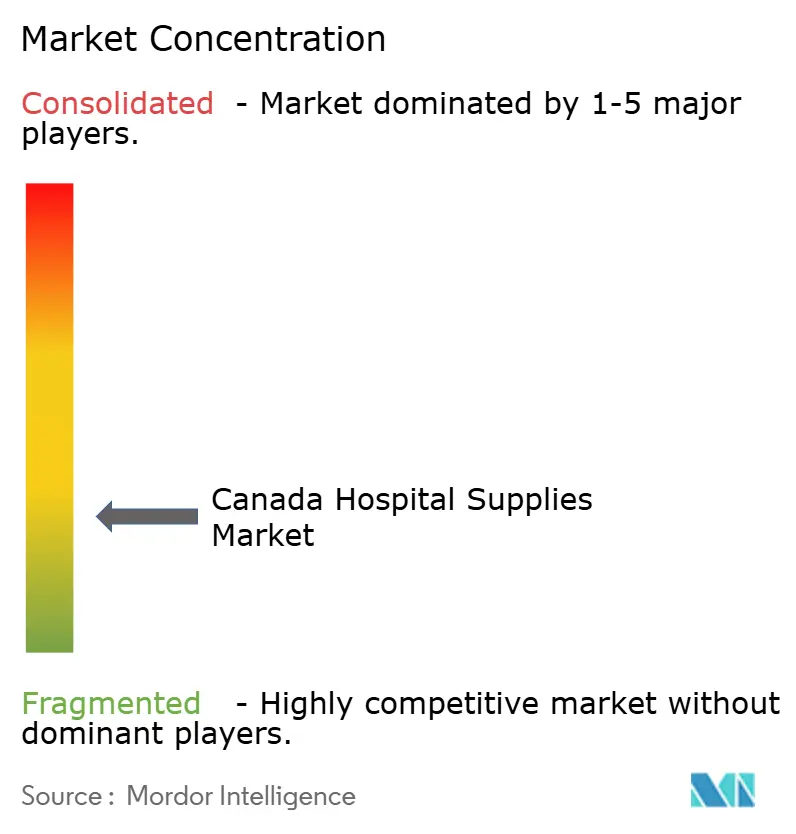
| Market Concentration | Low |
Major Players *Disclaimer: Major Players sorted in no particular order Image © Mordor Intelligence. Reuse requires attribution under CC BY 4.0. | |
Canada Hospital Supplies Market Analysis by Mordor Intelligence
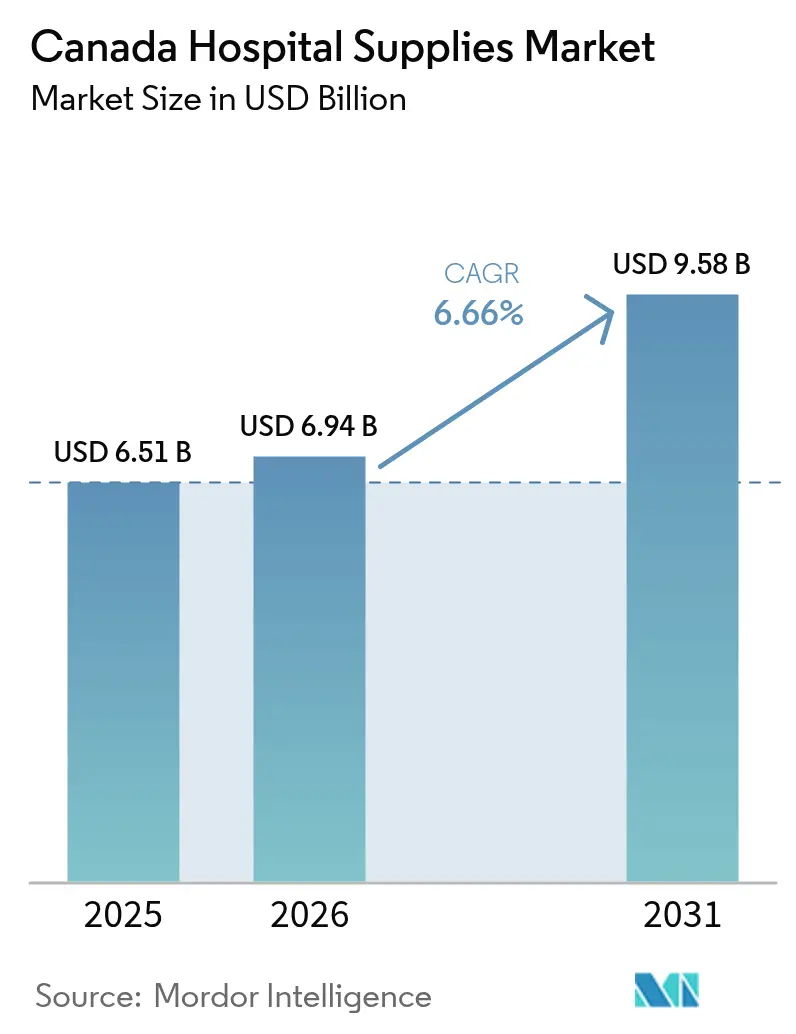
The Canada Hospital Supplies market size is expected to grow from USD 6.51 billion in 2025 to USD 6.94 billion in 2026 and is forecast to reach USD 9.58 billion by 2031 at 6.66% CAGR over 2026-2031.
The market size expansion is outpacing overall healthcare spending growth and is underpinned by strong government capital programs, rapid technological adoption, and rising surgical volumes. Provincial infrastructure projects worth more than CAD 80 (USD 58.3) billion are unlocking procurement opportunities, while demographic aging is reshaping product demand toward mobility aids, chronic-care disposables, and advanced patient monitoring. Technological breakthroughs—from low-temperature sterilization to connected operating-room equipment—are widening product ranges and lifting average selling prices. Meanwhile, multinational suppliers are deepening local partnerships to secure long-term contracts as hospitals sharpen sustainability goals and compliance requirements.
Key Report Takeaways
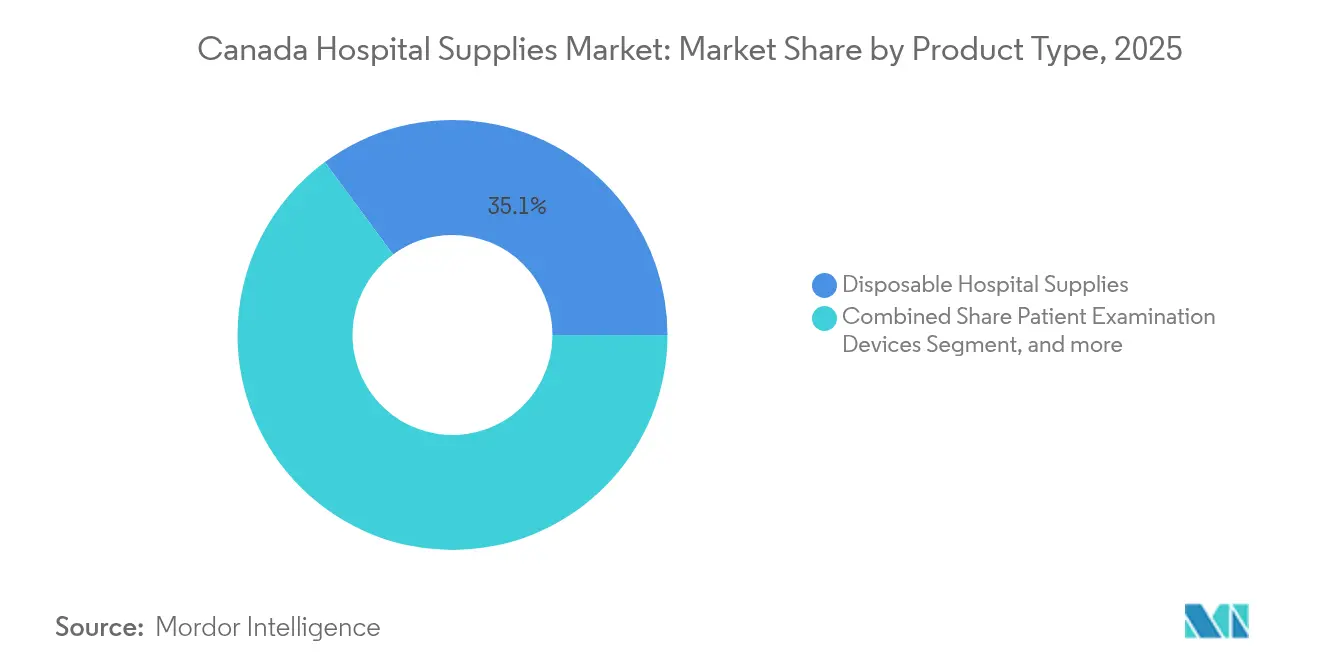
- By product type, disposable supplies led with 35.12% revenue share in 2025; sterilization equipment is projected to advance at an 8.5% CAGR through 2031.
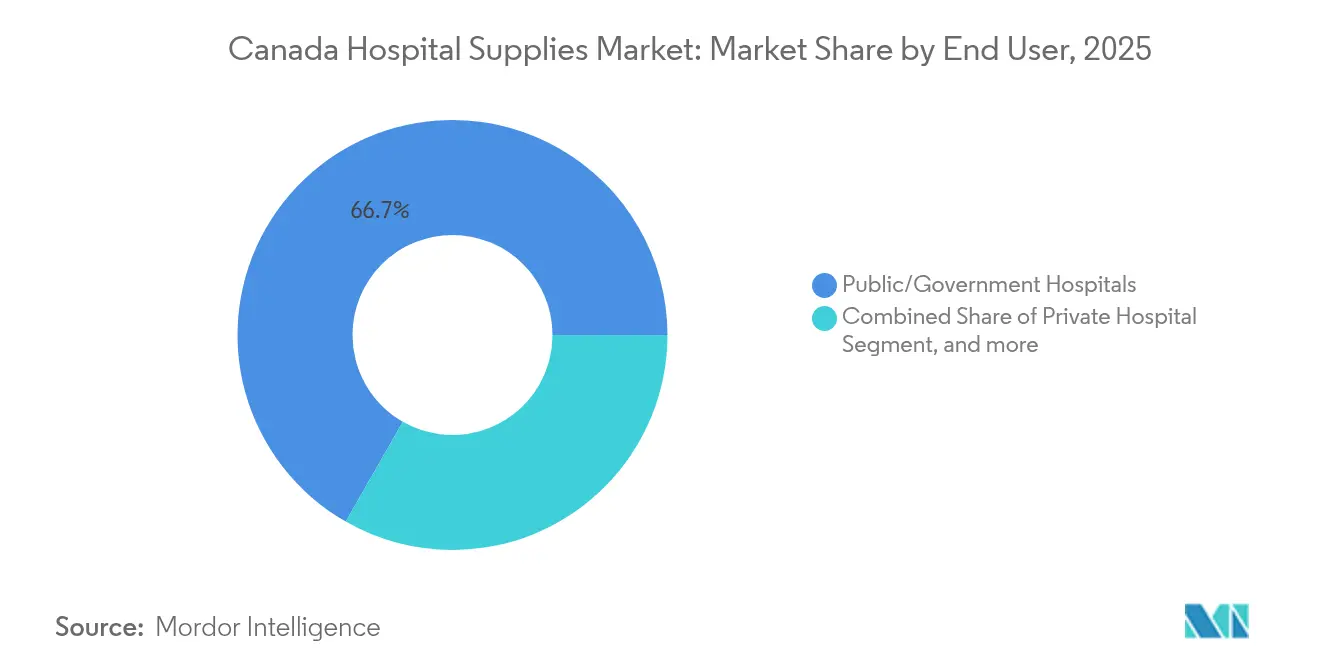
- By end user, public hospitals commanded 66.73% of the Canada hospital supplies market share in 2025, while specialty and ambulatory surgical centers are forecast to grow at 7.82% CAGR to 2031.
Note: Market size and forecast figures in this report are generated using Mordor Intelligence’s proprietary estimation framework, updated with the latest available data and insights as of 2026.
Canada Hospital Supplies Market Trends and Insights
Drivers Impact Analysis*
| Market Driver | (~) % Impact on CAGR Forecast | Geographic Relevance | Impact Timeline |
|---|---|---|---|
| Rapid expansion of hospital infrastructure pipeline | +1.8% | Ontario, Quebec, British Columbia, Saskatchewan | Medium term (2–4 years) |
| Increase in geriatric population and in-patient admissions | +1.5% | National urban centers | Long term (≥ 4 years) |
| Technological advancements in hospital supplies | +2.0% | National, early adoption in major urban hospitals | Medium term (2–4 years) |
| Rising surgical volume in region | +1.5% | Provinces with surgical backlogs | Short term (≤ 2 years) |
| Government healthcare spending & universal coverage | +0.9% | National | Short term (≤2 years) |
| Focus on infection control & sustainability | +1.0% | National, strong in tertiary hospitals | Short term (≤2 years) |
| Source: Mordor Intelligence | |||
Rapid Expansion of Hospital Infrastructure Pipeline
More than CAD 80 (USD 58.3) billion in provincial capital programs are either underway or approved, with Ontario allocating CAD 56 (USD 40.8) billion for new hospitals and 3,000 additional beds. British Columbia’s New St. Paul’s Hospital alone will add 548 beds by 2027. These builds lift baseline procurement for everything from surgical instruments to diagnostic imaging consoles as new departments come online. The project schedules are staggered, creating a rolling demand curve that suppliers can target for recurring contracts. Green-building mandates are also boosting sales of energy-efficient sterilizers and low-waste disposables as facilities pursue LEED standards and lower operating costs.[1]
Increase in Geriatric Population and In-patient Admissions in Hospitals
Seniors will rise 68% between 2017 and 2037, increasing from 6.2 million to 10.4 million people. Older Canadians already drive disproportionate utilization: 482.63 hospital admissions per 1,000 assisted-living residents compared with far lower rates among younger adults. Hospitals are therefore buying more fall-prevention mobility aids, pressure-relief mattresses, and chronic-wound dressings. Integrated patient-monitoring systems with larger screen displays and remote-alert features are also gaining traction as clinicians manage complex multimorbid cases.[2]
Technological Advancements in Hospital Supplies
The Canada hospital supplies market is rapidly absorbing AI-ready imaging carts, connected infusion pumps, and low-temperature hydrogen-peroxide sterilizers. STERIS’s AMSCO 600 system occupies 40% less floor space and delivers up to five times the throughput of prior steam units, a major draw for urban hospitals facing space constraints. Toronto General’s adoption of the da Vinci robotic platform has expanded ancillary demand for 3D visualization drapes, articulating laparoscopic instruments, and single-port access kits. These premium categories carry unit prices 2-3 times higher than conventional equivalents, magnifying revenue growth.[3]
Rising Surgical Volume in Region
Surgical throughput rebounded to 2.33 million procedures in 2023-2024, a 4.9% year-over-year jump as pandemic backlogs eased. Orthopedic interventions are forecast to climb 17.7% between 2020 and 2027, while ophthalmic cases may surge 27.7% in the same window. The volume resurgence is increasing consumption of single-use trocars, precision sutures, and antimicrobial drapes, and is accelerating turnover of high-wear items such as endoscopic blades and stapling cartridges.
Restraints Impact Analysis*
| Market Restraint | (~) % Impact on CAGR Forecast | Geographic Relevance | Impact Timeline |
|---|---|---|---|
| Emergence of home care services | -0.8% | Urban areas with robust home-care networks | Medium term (2–4 years) |
| Stringent regulatory framework | -0.2% | National | Long term (≥ 4 years) |
| Price sensitivity & budget constraints | -0.5% | National, pronounced in smaller hospitals | Short term (≤ 2 years) |
| Supply chain vulnerabilities | -0.4% | National, heightened in remote regions | Short to medium term (≤ 3 years) |
| Source: Mordor Intelligence | |||
Emergence of Home Care Services
The federal Aging with Dignity program is channeling CAD 5.4 (USD 3.9) billion into home-care capacity, giving chronic-disease patients viable alternatives to extended hospital stays. Remote patient monitoring kits, negative-pressure wound-therapy pumps, and portable oxygen concentrators are now stocked by home-health distributors. This shift siphons demand away from inpatient-only formats such as large-volume suction canisters and fixed-site telemetry stations. Suppliers that lack consumer-grade product lines risk losing share as purchasing decision-making decentralizes from hospital procurement offices to community agencies.
Stringent Regulatory Framework
Manufacturers must navigate Class I-IV clearances under Medical Devices Regulations (SOR/98-282) plus new recall-reporting rules effective January 2025. AI-enabled devices face additional ambiguity because Canada lacks an assessment framework comparable to the UK DTAC. Extended review cycles elevate working-capital requirements and can delay commercial launches by six to nine months. Smaller innovators may defer entry or partner with established license holders, slowing competitive churn and constraining supply diversity.
*Our forecasts treat driver/restraint impacts as directional, not additive. The impact forecasts reflect baseline growth, mix effects, and variable interactions.
Segment Analysis
By Product Type: Disposables Dominate as Sterilization Devices Accelerate
Disposable consumables delivered 35.12% of 2025 revenue, reflecting infection-control priorities that gained urgency during the pandemic. The Canada hospital supplies market size for disposables equaled USD 2.29 billion in 2025 and is tracking a 6.21% CAGR through 2031. Tightened provincial infection-control standards and the drive to cut reprocessing labor are steering buyers toward single-use procedure kits, cannulae, and barrier gowns. The federal award of CAD 42 (USD 30.6) million to build a new nitrile-glove plant in Ontario underscores policy support for domestic manufacturing capacity, which mitigates import-risk premiums during supply disruptions.
Sterilization and disinfectant equipment is the standout growth pocket, forecast to race ahead at 8.5% annually. Hospitals are retiring legacy steam units in favor of low-temperature plasma and vaporized-hydrogen-peroxide systems that safeguard heat-sensitive endoscopes and ophthalmic instruments. Capital budgets are also earmarked for autoclaves with IoT modules that integrate with electronic health records to automate cycle validation. As a result, the Canada hospital supplies market share for sterilization devices is expected to climb from 12.65% in 2025 to nearly 14.85% by 2031. Mid-tier product categories—patient-examination devices, operating-room tables, and mobility aids—continue respectable mid-single-digit growth, buoyed by rising outpatient volumes and geriatric demand.

By End User: Public Hospitals Lead, Specialty Centers Scale Fastest
Public institutions consumed 66.73% of sector revenue in 2025, translating into a Canada hospital supplies market size of USD 4.35 billion. Universal coverage and global budgets concentrate purchasing power within provincial supply-chain alliances, enabling bulk-buy contracts that prioritize quality certifications and vendor sustainability scores. High nursing overtime and agency staffing costs have nudged administrators to adopt single-patient-use items to reduce cross-contamination risk and shorten cleaning cycles.
Specialty and ambulatory surgical centers, though representing under 10% of 2025 outlays, are projected to post a 7.82% CAGR through 2031. Same-day orthopedic and ophthalmic centers contract directly with suppliers for bundled instrument packs and robotic-compatible disposables, often at higher margins than public tenders. Private hospitals remain a small but growing customer set with demand tied to employer-funded insurance for services outside the universal basket. Long-term-care and rehabilitation facilities secure stable procurement volumes in mobility and pressure-injury prevention products as the over-65 cohort expands.
Geography Analysis
Ontario anchors the Canada hospital supplies market with its dense population and a CAD 56 (USD 40.8) billion health-infrastructure pipeline. The Trillium Health Partners redevelopment alone will add 2,400 medical-surgical beds by 2029, lifting annual demand for monitors, IV sets, and wound-closure materials. Ontario’s integrated procurement network leans on multi-year vendor-of-record agreements, providing volume guarantees that attract global manufacturers.
British Columbia showcases the fastest CAGR, supported by USD 6.4 billion in new facilities slated for construction in 2025-2026. Projects such as the New St. Paul’s Hospital will feature smart-building HVAC systems that integrate sterile-processing and energy-management functions, driving procurement of sensor-embedded devices and eco-certified disposables.
The Prairie provinces collectively add momentum through rural-hospital upgrades. Atlantic Canada’s infrastructure surge highlighted by the USD 5.1 billion expansion of Halifax’s Queen Elizabeth II Health Sciences Centre broadens market coverage into historically underserved regions. Device requirements focus on tele-ICU carts and climate-resilient supply packaging suitable for coastal logistics.
Regulatory Landscape
Health Canada regulates hospital supplies sold as medical devices under the Medical Devices Regulations (SOR/98-282), with market entry tied to risk classification and licensing requirements. Class II, III, and IV products require a Medical Device Licence (MDL), and most importers and distributors must maintain a Medical Device Establishment Licence (MDEL), tightening documentation, quality-system discipline, and importer oversight in a market that depends heavily on imported supply.
Recent compliance changes add operational friction while tightening post-market controls. Guidance on Medical Device Establishment Licensing (GUI-0016) was updated effective December 14, 2024, and amendments introduced new recall-related obligations that took effect in January 2025. Health Canada also mandated digital submission workflows, requiring the Regulatory Enrolment Process (REP) and the Common Electronic Submission Gateway (CESG) for regulatory submissions from April 1, 2026. Further amendments to the regulations were published in the Canada Gazette on June 17, 2026, reinforcing the need for manufacturers and establishment licence holders to maintain robust change-control, traceability, and post-market surveillance processes.
Value Chain Analysis
The Canada hospital supplies value chain is anchored by global manufacturers (disposables, OR equipment, sterilization systems, patient monitoring and mobility aids), with Canadian subsidiaries and authorized importers feeding product into national and provincial distribution networks. Because Canada accounts for a small share of global medical device demand and imports most supplies, Canadian wholesalers, group purchasing organizations, and hospital supply-chain teams influence vendor qualification, inventory planning, and contract compliance, particularly for public hospitals that purchase through multi-year, system-wide agreements.
The downstream chain is increasingly shaped by data sharing and shortage management requirements. Health Canada requires certain manufacturers and importers (including for Class I devices) to report medical device shortages that may impact the Canadian market within two business days of becoming aware, which pushes distributors and providers to maintain better demand signals and substitution plans. On the procurement and contracting side, The Ottawa Hospital expanded its sourcing and contract-management support by leveraging Mohawk Medbuy services starting July 2024. Mohawk Medbuy also helped launch the Supply Chain Value Creation Council in January 2025 to improve coordination and mitigate shortage risk through shared priorities and information exchange.
Competitive Landscape
Global diversified players dominate the upper tier of the Canada hospital supplies market, with Johnson & Johnson, Medtronic, and Stryker leveraging broad catalogs to win system-wide contracts. Boston Scientific recorded 16.9% sales growth in Canada and Latin America in 2024, reflecting successful integration of its single-use endoscopy line and drug-eluting technologies into provincial formularies. Vertical integration insulates these suppliers from component shortages and gives hospitals confidence in lifecycle support.
Sustainability has emerged as a core differentiator. Zimmer Biomet, Boston Scientific, and Stryker have publicly committed to net-zero scopes 1 and 2 emissions by 2030, influencing purchasing committees that must meet provincial green-procurement mandates. Product take-back schemes for surgical-tool recycling are a notable competitive lever as hospitals pursue waste-diversion targets.
Strategic M&A remains active. DAS Health’s 2024 entry via acquisition of a Canadian health-IT integrator highlights cross-border interest in bundled device-and-software offerings. Supplier alliances with construction consortia on design-build projects, such as the Peter Gilgan Mississauga Hospital, further cement early equipment procurement commitments.
Canada Hospital Supplies Industry Leaders
-
Boston Scientific Corporation
-
McKesson Corporation
-
Baxter Canada
-
3M Canada
-
GE Healthcare Canada
- *Disclaimer: Major Players sorted in no particular order
Market Opportunities and Future Outlook
Near-term whitespace focuses on capacity additions and modernization tied to large hospital rebuilds and expansions already underway across provinces. These efforts translate construction milestones into tenders for sterilization and disinfectant equipment, operating-room equipment, patient monitoring, and high-consumption disposables. The confirmed pipeline of major projects, including Ontario and British Columbia programs and the Halifax Queen Elizabeth II Health Sciences Centre expansion, supports opportunities for suppliers that can bundle installation, training, and lifecycle service for new departments as they come online, while meeting hospital sustainability screens that are increasingly embedded in vendor-of-record evaluations.
Supply resilience and domestic capability building also create openings for local manufacturing, regionalized inventory, and higher-traceability distribution models. Health Canada shortage-reporting obligations and proposed traceability-oriented changes for establishment licence holders (published for consultation in late 2025) incentivize distributors and manufacturers to strengthen supplier documentation and continuity planning. Federal funding actions provide clearer signals of investment appetite for production and clinically adjacent hardware: in January 2026, FedDev Ontario announced support for Voltera Inc. to scale electronics-printing tools and for Blake Medical Group Inc. to advance a smart medical mattress line in Brantford, aligning with hospital demand for connected equipment, pressure-injury prevention, and more resilient domestic supply options for select product categories.
Recent Industry Developments
- June 2026: SteriMax Inc. acquired Andone Pharmaceuticals Inc., adding medical device and veterinary platforms to its portfolio. The transaction broadens SteriMax capabilities beyond pharmaceuticals and supports deeper participation in regulated hospital supply categories where supplier breadth and compliance infrastructure influence contracting outcomes.
- March 2025: McKesson Canada launched radioligand therapy treatment at its INVIVA infusion clinic in Toronto, with the clinic licensed by the Canadian Nuclear Safety Commission. Expanding specialized therapy delivery outside traditional hospital settings changes utilization patterns for associated consumables and reinforces the role of regulated, clinic-based channels alongside hospital procurement.
- July 2024: ED+PCL Healthcare Partners (EllisDon and PCL Construction joint venture) began site preparation for the Peter Gilgan Mississauga Hospital project in Ontario. Early construction mobilization advances long-lead planning for equipment and clinical supply packages, giving vendors a clearer window to align product specifications, service support, and sustainability requirements with a major new-build facility.
Research Methodology Framework and Report Scope
Market Definition and Coverage
For this report, the Canada hospital supplies market is defined as the value of products purchased and used by hospitals to deliver day to day patient care, run operating rooms, support examinations, and maintain hygiene and sterilization inside hospital settings.
Scope exclusions: We exclude non-hospital demand such as home care use, routine retail pharmacy sales, and long term care procurement that is not purchased under hospital budgets.
Segmentation Overview
- By Product Type
- Patient Examination Devices
- Operating Room Equipment
- Mobility Aids & Transportation Equipment
- Sterilization & Disinfectant Equipment
- Disposable Hospital Supplies
- Syringes & Needles
- Other Product Types
- By End User
- Public/Government Hospitals
- Private Hospitals
- Specialty & Ambulatory Surgical Centers
- Long-Term Care & Rehabilitation Hospitals
Data Sources, Market Sizing, and Validation
Desk Research
Desk research was used to set the base structure for the market and to lock down the right demand indicators for Canada. We leaned on public sources such as Statistics Canada tables, Health Canada guidance on medical devices and infection prevention, the Canadian Institute for Health Information (CIHI) for hospital activity signals, and the Public Health Agency of Canada for healthcare system context.
To keep inputs practical, we also reviewed hospital and provincial procurement portals, customs and trade releases where relevant, peer reviewed clinical publications on usage patterns for disposables and sterilization, and public company filings and investor presentations for category level revenue cues. In a few places, we used a paid subscription for company financials and a paid patent database to cross check innovation intensity and product mix shifts that affect pricing. The sources listed here are illustrative only, and many other public references were used for clarification, cross checks, and data validation.
Primary Interviews and Surveys
Primary work focused on validating what hospitals actually buy, how purchasing cycles work, and how mix changes show up in annual spend. We spoke with a blend of distributors, hospital procurement and clinical operations staff, and product specialists across major provinces, so gaps from desk research could be closed and assumptions could be stress tested against real procurement behavior.
To avoid over-counting, pricing and volume signals were rechecked with multiple respondent types, and the final view was adjusted only after the same direction was heard across supply and demand side conversations.
Distribution of primary research fieldwork respondents
| Company type | Respondent position |
|---|---|
| Top tier: 32% | CXOs: 13% |
| Mid tier: 51% | Functional/Unit leaders: 42% |
| Smaller Players: 17% | Managers: 45% |
Market-Sizing & Forecasting
Sizing started from a top-down build where the demand pool was reconstructed using hospital activity and capacity signals, and then mapped to supply categories that hospitals consistently procure. Once the demand pool was framed, selective bottom-up checks were run using sampled supplier revenue disclosures, distributor channel checks, and simple ASP times volume math for high-usage categories, which were then used to correct any drift.
The model used inputs that match how the market behaves in real life, such as inpatient and surgical procedure volumes, infection prevention intensity (for example, sterilization and disinfectant usage), capital refresh timing for operating room and examination equipment, mobility and transport needs linked to admissions, and price movement tied to product mix and inflation. Forecasts were produced using scenario analysis supported by short trend models, and the future path was aligned with what primary respondents expect for procedure growth, purchasing budgets, and supplier pricing over the next few years. When a bottom-up trail was incomplete for smaller categories, gaps were handled through proportional allocation based on hospital activity mix and confirmed with interview feedback before totals were finalized.
Data Validation & Update Cycle
Validation was done through multiple checks so single-source bias was reduced. Outputs were compared against independent signals such as hospital throughput trends, procurement cycle notes, and category level revenue disclosures, and then any large variance was reviewed again before internal sign-off.
If an assumption moved materially, such as a sharp pricing change in disposables or a policy shift that alters sterilization demand, respondents were re-contacted to confirm direction and magnitude. The report is refreshed annually, with interim updates when major events impact demand or pricing, and a final pre-delivery review is completed so the numbers reflect the latest available information.
Mordor Intelligence's Canada Hospital Supplies Market Size Compared With Other Published Estimates
Published estimates for Canada hospital supplies can look far apart even when they talk about similar product areas, because the underlying scope and counting rules are not the same. Differences usually come from what gets treated as hospital-only demand, what is counted as equipment versus general medical devices, and how prices are carried forward year to year.
Some external figures blend in broader healthcare equipment and general medical device spend across clinics or other care settings, and that tends to lift totals. In the Mordor Intelligence model, values are counted only when the purchase is tied to hospital use across defined supply categories like disposables, sterilization and disinfectant equipment, syringes and needles, mobility aids, and core operating room and examination needs, with non-hospital demand kept out of scope.
Benchmark comparison
| Source | Market Size | Gaps in Research Methodology |
|---|---|---|
| Mordor Intelligence | USD 6.94 B (2026) | |
| Market Analytics Firm A | USD 4.47 B (2023) | Uses an earlier base year and a narrower counted set in the disclosed snapshot, which can understate current value if recent procedure normalization and disposable usage growth are not fully captured. |
| Research Publisher B | USD 8.70 B (2026) | Appears to include a wider set of hospital-adjacent equipment and standards-based clinical products, which can push totals higher when categories used outside hospitals are not cleanly removed. |
The spread is mainly explained by scope width, base year timing, and how mixed-use products are treated. By keeping the count tied to hospital purchasing logic and then cross-checking totals with practical volume and pricing indicators, the final number stays easier to trace and repeat when the model is updated.
Key Questions Answered in the Report
What is the current size of the Canada hospital supplies market?
The market is valued at USD 6.94 billion in 2026 and is projected to reach USD 9.58 billion by 2031.
Which product category is growing the fastest?
Sterilization and disinfectant equipment is forecast to grow at an 8.5% CAGR, outperforming all other categories.
Why do public hospitals dominate purchasing?
Canada’s universal coverage model channels 66.73% of spending through publicly funded hospitals, concentrating procurement power in provincial supply alliances.
How is demographic aging influencing demand?
A 68% rise in the senior population by 2037 is increasing purchases of mobility aids, wound-care dressings, and geriatric-focused monitoring systems.
What regulatory changes should suppliers monitor?
January 2025 amendments to the Medical Devices Regulations broaden recall definitions and add reporting duties, raising compliance complexity for manufacturers.