
Market Overview
| Study Period | 2021 - 2031 |
|---|---|
| Forecast Data Period | 2026 - 2031 |
| Historical Data Period | 2021 - 2024 |
| Growth Rate | 3.07 % |
| Market Concentration | Medium |
Major Players *Disclaimer: Major Players sorted in no particular order Image © Mordor Intelligence. Reuse requires attribution under CC BY 4.0. | |
Canada Coal Market Analysis by Mordor Intelligence
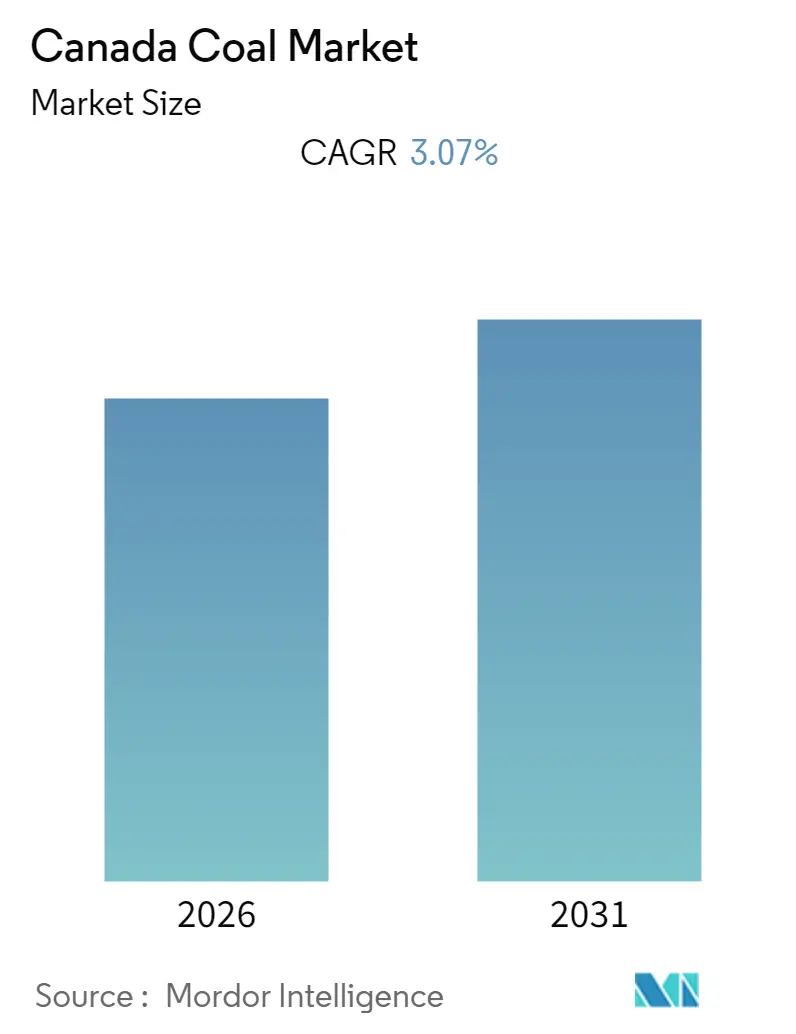
The Canada Coal Market size is expected to register a CAGR of 3.07% during the forecast period (2026-2031).
- With the decreasing share of coal in the country's electricity generation mix, the share of coal in the metallurgy industry is increasing and is expected to dominate the market during the forecast period.
- Canada exports the majority of its produced coal to countries like South Korea, Japan, India, China, etc. India and China produce significant electricity generation from coal, with China and Japan having plans to make more coal-fired power plants in the coming year, this is expected to create considerable opportunities in the near future.
- Rising environmental concerns over greenhouse gas emissions and global warming are expected to restrain the growth of the coal market in Canada during the forecast period.
Note: Market size and forecast figures in this report are generated using Mordor Intelligence’s proprietary estimation framework, updated with the latest available data and insights as of 2026.
Canada Coal Market Trends and Insights
Metallurgy Sector to Witness Significant Growth
- Around 70% of global steel production is dependent on coal. Metallurgical coal or coking coal is a vital ingredient in the steel making process. Pulverized Coal Injection (PCI) technology involves injecting coal directly into the blast furnace to provide the carbon for iron making.
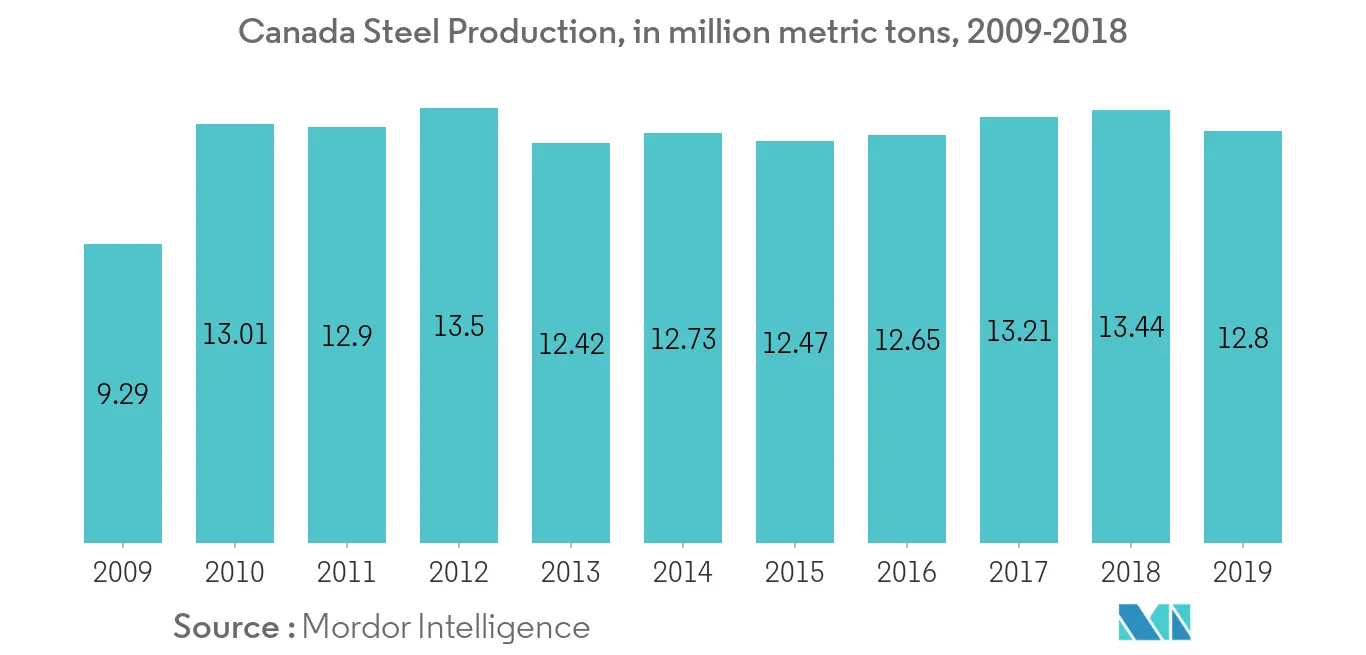
- In 2019, steel production in Canada decreased to 12.8 million metric tons in comparison to 13.4 million metric tons in 2018. Steel production is likely to drive coal consumption significantly.
- Canada's exports are primarily metallurgical coal. In 2018, Canada exported 34 million tonnes of coal around the world and imported 7.6 million tons of coal, mostly from the United States.
- In 2019, Canada exported over 3.1 million metric tons of steel to the United States, which is the biggest imported of Canadian steel. The United States accounts for over 89% of Canada's steel exports.
- The coal consumption is likely to decrease due to a decreasing share in power generation. Although post-COVID-19, with an increasing market of construction and infrastructure, steel production is expected to drive the coal demand.


Rising Environmental Concerns to Restrain the Market
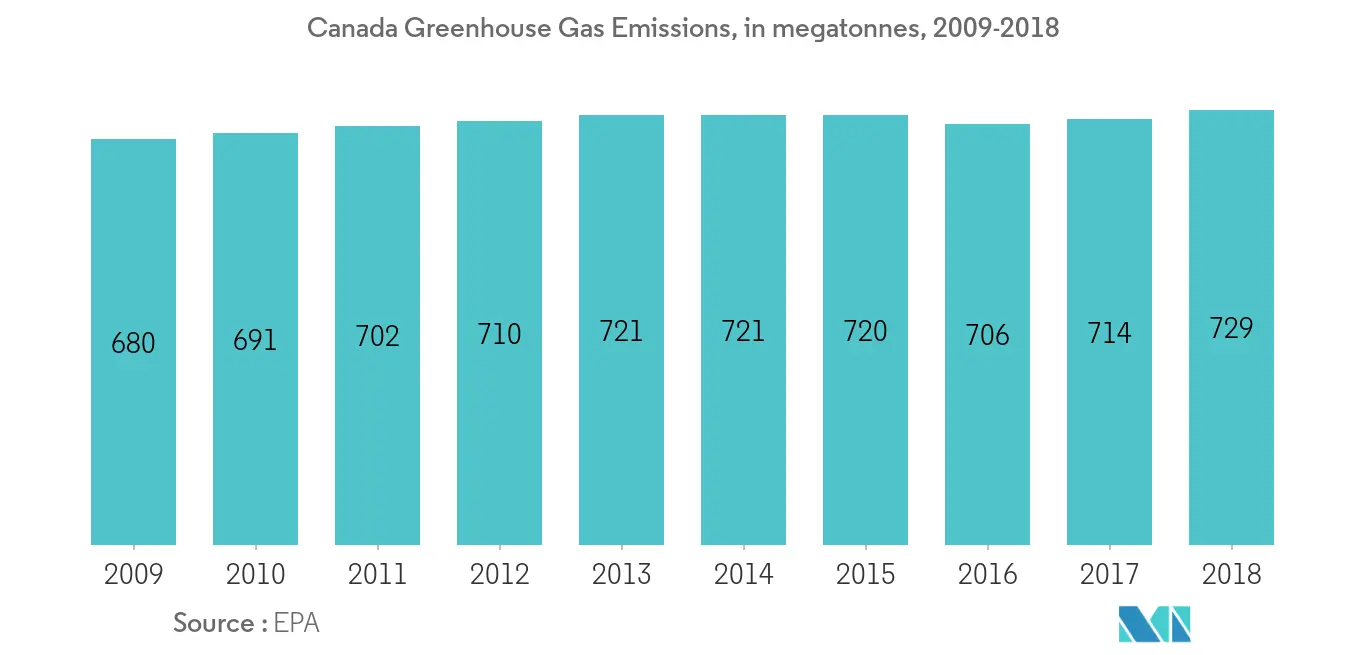
- Rising environmental concerns in Canada and the world over greenhouse gas emissions from the burning of coal and global warming are expected to restrain the coal market in the country.
- Due to climate change policies, the production of coal witnessed a downfall to 0.4 EJ in 2019, from a high of 1.51 EJ in 2013. The production is likely to decrease further by the end of 2020 due to market restrictions.
- The Canadian government has already phased out the usage of coal for electricity generation and the energy produced by coal will be eliminated by 2030.
- Although coal will still be used for metallurgical purposes in the country, the phasing out of coal for electricity generation will have a huge impact on the coal market in the country.
- The decrease of coal consumption due to environmental policies and increasing renewable share, the market for coal in Canada is expected to further decrease during the forecast period.
Regulatory Landscape
Canada regulates coal primarily through federal climate and environmental frameworks that tighten allowable emissions from power generation while raising the approval bar for new thermal coal supply. Environment and Climate Change Canada administers the Reduction of Carbon Dioxide Emissions from Coal-fired Generation of Electricity Regulations (SOR/2012-167) and, more recently, the Clean Electricity Regulations (SOR/2024-263), registered on December 13, 2024, which establish a performance-based regime targeting CO2 emissions from fossil fuel-based electricity generation.
Policy and intergovernmental implementation mechanisms shape operating conditions for remaining coal-fired units and associated thermal coal demand. An equivalency agreement between Canada and Saskatchewan came into force on January 1, 2025, suspending the application of the federal coal-fired electricity regulations in Saskatchewan during 2025-2026 while limiting provincial electricity sector emissions to 29.4 Mt CO2e for that period. Separately, the Minister of Environment and Climate Change has stated that new and expanded thermal coal mine projects are considered likely to cause unacceptable environmental effects under the Impact Assessment Act, which curtails pathways for greenfield and expansion approvals in thermal coal.
Value Chain Analysis
Canada's coal value chain is anchored in Western Canadian mining operations supplying predominantly metallurgical coal to export markets, supported by processing plants, Class I rail, and port terminals. In 2024, Canada produced 42.6 million tonnes of coal, comprising 67% metallurgical coal and 33% thermal coal; metallurgical coal exports totaled 36 million tonnes valued at CAD 8.9 billion, with China (33%), Japan (22%), and South Korea (21%) among key destinations. Producers and operators such as Teck Resources and Conuma, together with preparation and blending infrastructure, are central to meeting specification requirements for steelmaking customers.
Midstream logistics are a primary cost and capacity driver, with Canadian National Railway (CN) and Canadian Pacific Kansas City (CPKC) moving coal to West Coast export terminals, including Neptune Bulk Terminals, where throughput and scheduling affect realized export volumes and working capital. Downstream, domestic demand is increasingly concentrated in metallurgical applications as coal-fired power generation declines under phase-out and emissions-performance requirements, influencing mine planning and product mix. Recent capability additions illustrate this chain: Conuma commissioned a second module at the Quintette preparation plant in January 2025 (400 ROM tonnes per hour throughput), lifting site processing capacity and strengthening its ability to ship consistent-quality metallurgical products into the export logistics corridor.
Competitive Landscape
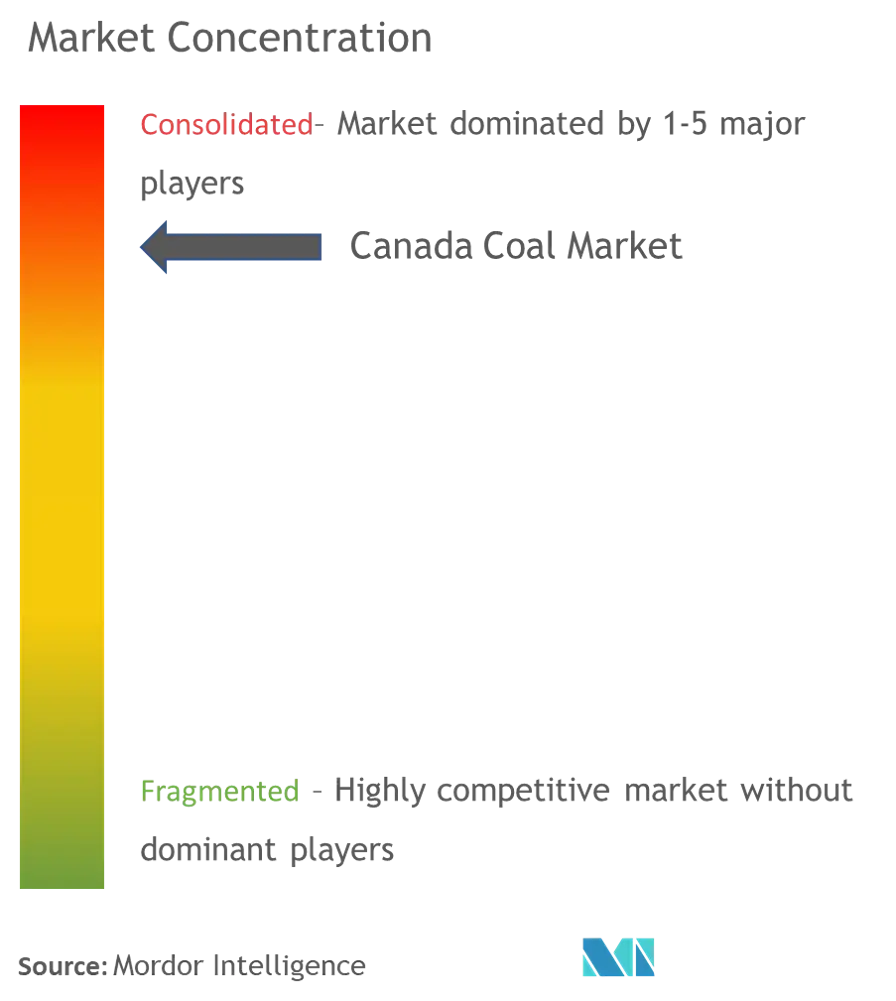
The Canada coal market is moderately consolidated. Some of the major companies include Peabody Energy Corp, Arch Coal Inc, Alliance Resources Partners, L.P., NACCO Industries, Inc., and Contura Energy Inc.
Canada Coal Industry Leaders
Peabody Energy Corp
Teck Resources Limited
Conuma Coal Resources Limited
Westmoreland Mining LLC
Dodd's Coal Mining Company Ltd.
- *Disclaimer: Major Players sorted in no particular order

Market Opportunities and Future Outlook
Near-term opportunities in Canada coal are concentrated in steelmaking coal supply reliability, processing efficiency, and export logistics performance, rather than in incremental domestic thermal demand. With coal accounting for 3.5% of total Canadian electricity generation in 2023 and coal-based generation declining by 30.9% in 2024 versus 2023, the market is shifting toward metallurgical coal and export-linked value capture. Canada produced 42.6 million tonnes of coal in 2024, with metallurgical coal forming the majority, and exported 36 million tonnes of metallurgical coal, pointing to port, rail, and preparation-plant debottlenecking as practical levers to protect shipment schedules and quality compliance for major Asia-Pacific buyers.
On the thermal side, federal policy and regulations constrain greenfield supply and reinforce the 2030 endpoint for conventional coal power, while provincial transition pathways create operational decision points for existing fleets. The January 2025 Canada-Saskatchewan equivalency agreement provides a defined compliance window through 2026, while public statements from SaskPower management in May 2026 highlighted the scale of refurbishment economics for 1,500 MW of coal-fired capacity (estimated at CAD 2.6 billion). In metallurgical coal, project and portfolio actions provide tangible opportunity signals, including Conuma's restart and processing upgrades at Quintette and the Crown Mountain coking coal project reaching a final joint provincial and federal environmental assessment stage, with a final revised application referenced for October 2026, supporting continued emphasis on high-quality steelmaking coal development and permitting readiness.
Recent Industry Developments
- January 2026: Conuma Resources received a final approved amendment to Mines Act Permit C-156 for the Quintette mine (permit amendment dated December 19, 2025). The permit update supports continued operations and infrastructure execution at a restarted metallurgical coal asset, improving the ability to align production and shipping plans with export demand.
- September 2025: Valory Resources (Summit Coal) secured final regulatory approvals from the Alberta Energy Regulator for the Mine 14 steelmaking coal project. The approval milestone advances a new supply option for metallurgical coal in Alberta and strengthens the pipeline of permitted projects targeting export-linked steel markets.
- July 2024: Glencore acquired a 77% stake in Elk Valley Resources, the steelmaking coal business previously associated with Teck. The transaction consolidated ownership of a major Canadian metallurgical coal platform, influencing marketing reach, capital allocation, and long-term operating strategy across key British Columbia coal assets.


Research Methodology Framework and Report Scope
Market Definition and Coverage
For this methodology, the market covers the value generated from coal supplied in Canada, including coal used for steelmaking and coal used for power and heat, with values expressed in USD for a consistent view.
Scope exclusions: We exclude downstream steel and electricity revenues, as well as equipment and services that support mining and logistics.
Segmentation Overview
- Application
- Metallurgy
- Power Generation
- Others
Data Sources, Market Sizing, and Validation
Desk Research
Desk research began with public production and trade series so we could anchor volumes before converting them into value. Key public sources used for this work included Natural Resources Canada (coal facts and annual context), Statistics Canada tables for coal production and exports, customs and trade statistics from the Government of Canada, and federal energy and environment publications that outline coal use and phase down timelines.
To keep assumptions realistic, we also reviewed public company filings and investor presentations, along with credible press coverage for shipment mix, operating changes, and contract commentary. Where helpful, a paid subscription covering company financials and another subscription covering shipment level trade flows were used for cross checks and for filling specific gaps in exporter mix and unit values. These examples are not exhaustive, and many other sources were referred to for data collection, validation, and research clarification.
Primary Interviews and Surveys
Primary work focused on validating what portion of Canadian coal flows is market relevant each year, and how pricing and contract structures differ between metallurgical and thermal use. We spoke with a mix of producers, traders, logistics participants, industrial end users, and industry specialists, and then used those inputs to confirm assumptions, close data gaps, and sanity check the final totals.
Distribution of primary research fieldwork respondents
| Company type | Respondent position |
|---|---|
| Top tier: 37% | CXOs: 13% |
| Mid tier: 43% | Functional/Unit leaders: 33% |
| Smaller Players: 20% | Managers: 54% |
Market-Sizing & Forecasting
Sizing was built using a top-down and bottom-up model logic where national production and export series (in tonnes) were converted into value using observed unit values, and then adjusted for domestic disposition based on validated share assumptions by end use. To avoid overcounting, imports and stock movements were treated as checks rather than as automatic additions, and the market was kept tied to physical coal flow that can be reconciled year to year.
A few variables were tracked closely because they move Canada coal value quickly, including metallurgical versus thermal mix, export tonnage direction, realized price per tonne, province level output shifts, and the pace of coal power retirement and substitution. When a public datapoint was missing or lagging, selective bottom-up approximations were used, such as sampled unit value times tonnage checks and supplier roll ups based on disclosed shipment guidance, which were then used to adjust the top line.
Forecasting used scenario analysis supported by expected paths for trade volumes and price bands discussed in interviews, followed by an analyst pass to align assumptions with likely policy and industrial demand outcomes. We kept a clear gap handling rule so that any filled datapoint was accepted only after it matched at least one independent signal (production, exports, or respondent validation).
Data Validation & Update Cycle
Outputs were checked against independent signals, such as the relationship between production and exports, the split between metallurgical and thermal coal in recent years, and the implied unit values that should align with observable price ranges. Any sharp year to year movements were flagged, re-tested for unit or currency errors, and then reviewed again after targeted re-contacts with interviewees.
Before sign-off, the model went through a multi step review so that assumptions, calculations, and results were consistent across the full time series. Reports refresh annually, and interim updates are made when material events occur, such as major mine disruptions, policy shifts affecting coal burn, or meaningful price resets. Right before delivery, an analyst performs a fresh pass so clients receive the latest updated view.
Mordor Intelligence's Canada Coal Market Estimate Compared With Other Published Estimates
It is normal to see different published numbers for Canada coal, because not everyone counts the same coal flows and not everyone applies the same price and currency timing. Differences also show up when one estimate leans on mining revenue, while another leans on trade value or on volumes converted using a simplified price.
In practice, the biggest gap drivers are scope (coal supplied in Canada versus coal mining industry revenue), treatment of exports versus domestic use, and whether metallurgical and thermal coal are priced separately or averaged into one unit value. The spread also comes from update cadence, since coal prices and export volumes can move within a year, and a model that does not re-check unit values and tonnage consistency will drift.
Benchmark comparison
| Source | Market Size | Gaps in Research Methodology |
|---|---|---|
| Mordor Intelligence | USD 10.30 B (2024) | |
| Industry Association A | USD 7.10 B (2024) | Often reflects export value only and can understate domestic coal use, and it may not fully normalize CAD to USD timing across the year. |
| Trade Journal B | USD 12.90 B (2024) | May extend scope into coal mining revenues and related preparation activities, which can inflate value versus a coal flow based market view. |
The table shows that the range is mostly explained by whether exports are treated as the whole market, or whether broader mining revenue is pulled in on top. By keeping totals tied to reconciled tonnage and applying separate unit values for metallurgical and thermal coal before converting into USD, the estimate stays traceable to public signals and interview checks, as modeled by Mordor Intelligence.


Key Questions Answered in the Report
What is the current Canada Coal Market size?
The Canada Coal Market is projected to register a CAGR of 3.07% during the forecast period (2026-2031)
Who are the key players in Canada Coal Market?
Peabody Energy Corp, Teck Resources Limited, Conuma Coal Resources Limited, Westmoreland Mining LLC and Dodd's Coal Mining Company Ltd. are the major companies operating in the Canada Coal Market.
What years does this Canada Coal Market cover?
The report covers the Canada Coal Market historical market size for years: 2020, 2021, 2022, 2023 and 2024. The report also forecasts the Canada Coal Market size for years: 2026, 2027, 2028, 2029, 2030 and 2031.
Page last updated on:


 Your data is secure and never sold or shared.


