
Market Overview
| Study Period | 2021 - 2031 |
|---|---|
| Forecast Data Period | 2026 - 2031 |
| Base Year Market Size (2025) | USD 142.0 Million |
| Market Size (2026) | USD 151.07 Million |
| Market Size (2031) | USD 205.81 Million |
| Growth Rate (2026 - 2031) | 6.39 % |
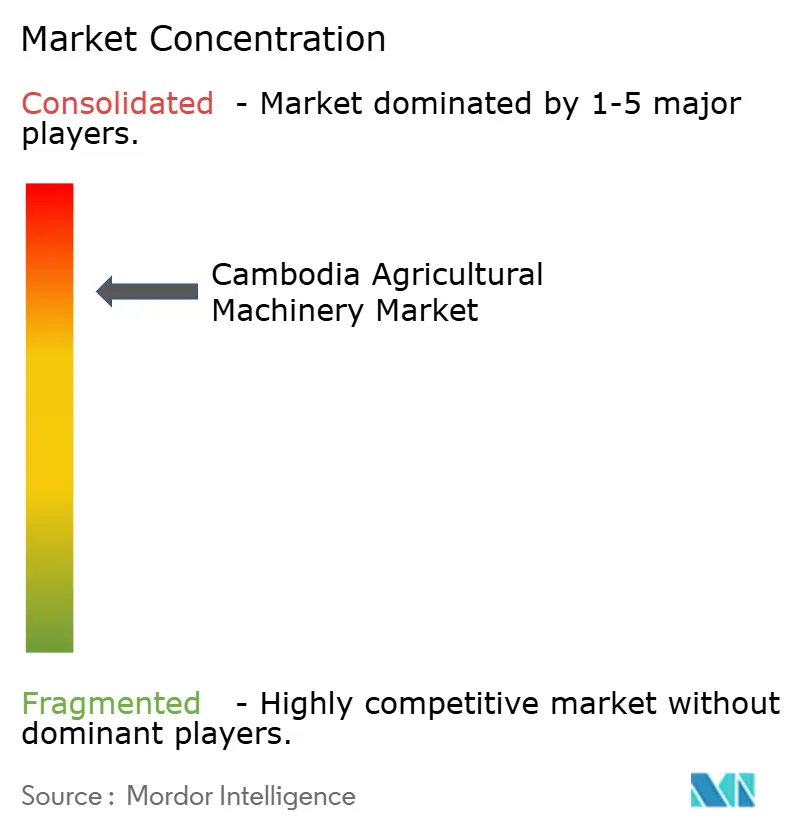
| Market Concentration | High |
Major Players *Disclaimer: Major Players sorted in no particular order Image © Mordor Intelligence. Reuse requires attribution under CC BY 4.0. | |
Cambodia Agricultural Machinery Market Analysis by Mordor Intelligence
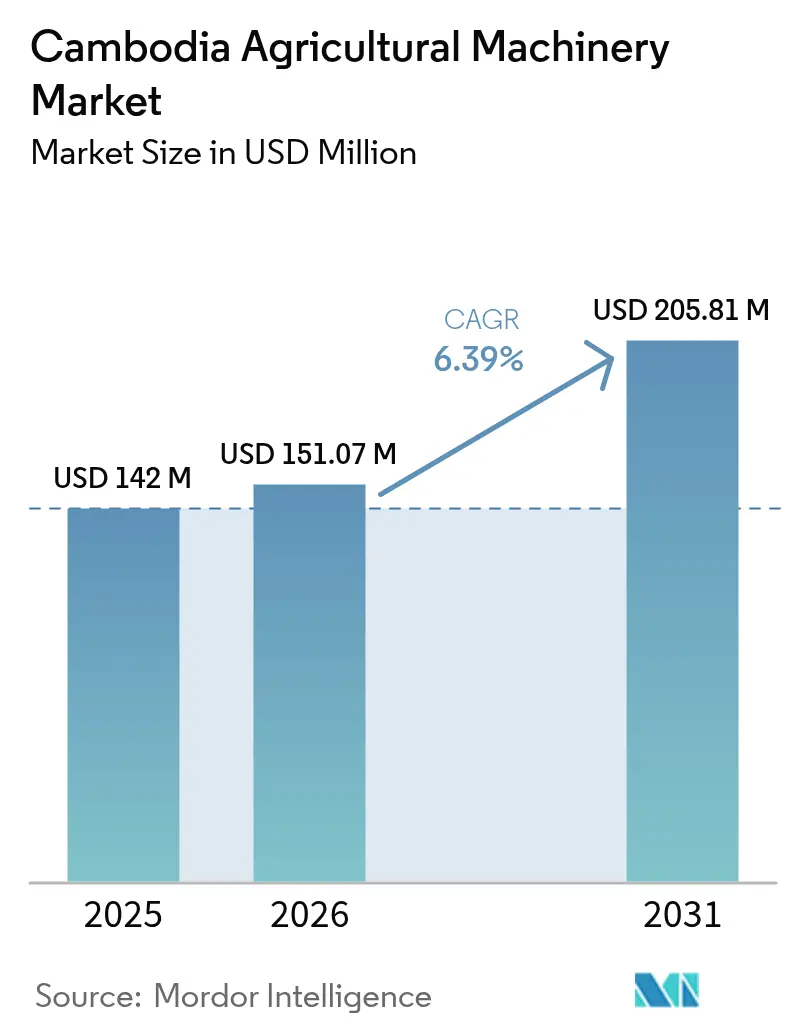
Cambodia agricultural machinery market size in 2026 is estimated at USD 151.07 million, growing from 2025 value of USD 142.0 million with 2031 projections showing USD 205.81 million, growing at 6.39% CAGR over 2026-2031. This growth trajectory reflects the country's strategic pivot toward agricultural modernization as it aims to become one of the world's top 10 agricultural producers by 2030. Rising rice export targets, pressure to curb post-harvest losses, and foreign investment in large plantations shape a market environment where tractors remain dominant, but precision technologies, such as laser land leveling and combine harvesters, gain ground. Custom-hire service models lower capital barriers for smallholders, while public-private partnerships accelerate rural access to equipment. The sector’s progress is tempered by patchy after-sales networks, high repair costs, and persistent reliance on draught animals in remote provinces.
Key Report Takeaways
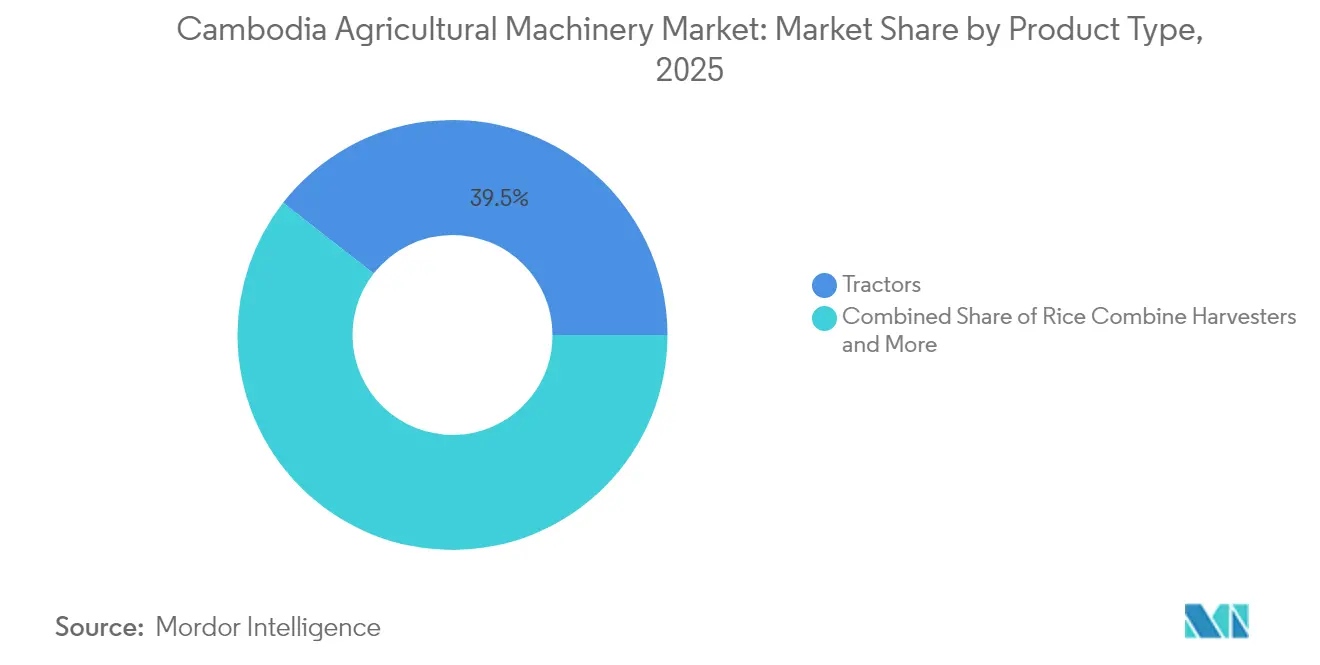
- By product type, the tractors segment held a 39.45% of the Cambodia agricultural machinery market share in 2025, while rice combine harvesters are advancing at a 9.41% CAGR through 2031.
Note: Market size and forecast figures in this report are generated using Mordor Intelligence’s proprietary estimation framework, updated with the latest available data and insights as of 2026.
Cambodia Agricultural Machinery Market Trends and Insights
Drivers Impact Analysis*
| Driver | (~) % Impact on CAGR Forecast | Geographic Relevance | Impact Timeline |
|---|---|---|---|
| Government subsidy scheme for two-wheel tractors | +1.2% | National, rice provinces | Medium term (2-4 years) |
| Increasing focus on sustainable agricultural mechanization | +0.9% | National, early adoption on plantations | Long term (≥ 4 years) |
| Rising public-private partnerships for custom-hire centers | +1.1% | Battambang, Siem Reap, Kampong Thom | Medium term (2-4 years) |
| Improved micro-finance access for machinery purchases | +0.8% | Rural smallholder zones | Short term (≤ 2 years) |
| Expansion of contract-farming by rice millers | +1.0% | Mekong Delta border areas | Medium term (2-4 years) |
| Adoption of laser land-leveling to conserve water | +0.7% | Irrigated, drought-prone provinces | Long term (≥ 4 years) |
| Source: Mordor Intelligence | |||
Government Subsidy Scheme for Two-Wheel Tractors
The national subsidy program allocates a portion of the USD 100 million modernization fund to small two-wheel tractors that match the average farm size of 1.2 hectares prevalent among Cambodia’s 2.1 million smallholder households. Implemented through provincial agriculture departments, the scheme lowers upfront costs by pairing tax incentives with microloans, encouraging local dealers to stock parts and provide basic servicing. Differentiating from neighboring Vietnam’s preference for larger four-wheel units, Cambodia is cultivating a unique compact-tractor niche that fits narrow field layouts and minimizes soil compaction.
Increasing Focus on Sustainable Agricultural Mechanization
Laser land-leveling delivers twin benefits of 24% higher paddy yields and up to 47% lower irrigation water use, which aligns with Cambodia’s Paris Agreement commitments and unlocks eligibility for climate finance facilities.[1] Commercial estates have begun bundling the technology with alternate wetting and drying irrigation promoted in regional demonstration plots by Kubota Corporation, pointing toward a future where precision farming becomes integral to greenhouse-gas mitigation strategies.
Improved Micro-Finance Access for Machinery Purchases
Eighty-one licensed microfinance institutions now offer equipment loans averaging USD 4,200, a size that suits two-wheel tractors and low-horsepower power tillers. Bundling credit with contract-farming agreements reduces default risk and helps prevent distress land sales that were previously linked to collateralized loans. The state-owned Agriculture and Rural Development Bank steers concessional lines to lenders that meet rural outreach targets.
Expansion of Contract Farming by Rice Millers
Amru Rice Co., Ltd., producer and exporter of Cambodian rice, has expanded its contract farming network from 3,600 growers in 2022 to over 15,000 by 2025, reflecting a strategic push toward inclusive and sustainable rice production in Cambodia. The company ensures guaranteed paddy off-take and delivers technical guidance to farmers, including mechanization standards aligned with Sustainable Rice Platform (SRP) certification. This approach not only improves productivity and environmental compliance but also strengthens farmer resilience on agricultural machinery. These investments enhance grain quality, promote machinery upgrades across farming clusters, and support market growth.
Restraints Impact Analysis*
| Restraint | (~) % Impact on CAGR Forecast | Geographic Relevance | Impact Timeline |
|---|---|---|---|
| Heavy reliance on conventional farming practices | -1.4% | Remote traditional areas | Long term (≥ 4 years) |
| Higher repair and maintenance costs of farm machinery | -1.1% | Provinces with poor service access | Medium term (2-4 years) |
| Shortage of skilled machinery operators | -0.9% | National, especially new mechanization zones | Short term (≤ 2 years) |
| Fragmented after-sales service network | -0.8% | Outside major commercial centers | Medium term (2-4 years) |
| Source: Mordor Intelligence | |||
Heavy Reliance on Conventional Farming Practices
Fuel cost spikes that doubled diesel prices to a high rate in 2024 prompted many smallholders to revert to draught animals, illustrating how economic shocks can derail machinery adoption. Cultural preference for familiar ox-based methods persists in isolated villages, where generational knowledge transfer underpins risk-averse attitudes toward new technology. Integration programs that pair mechanical weeders with the System of Rice Intensification demonstrate a hybrid path that respects tradition while introducing labor-saving devices.
Shortage of Skilled Machinery Operators
Vocational curricula lag behind the complexity of modern combine harvesters and precision implements. Research indicates limited availability of operators trained in GPS guidance and digital farm management, particularly in newly mechanized provinces. Short-duration courses offered through the UN Economic and Social Commission for Asia-Pacific help fill some gaps, yet coverage remains limited relative to the growing number of machine populations.[2]
*Our forecasts treat driver/restraint impacts as directional, not additive. The impact forecasts reflect baseline growth, mix effects, and variable interactions.
Segment Analysis
By Product Type: Compact Tractors Dominate While Harvesters Accelerate
Tractors held a 39.45% market share of the Cambodian agricultural machinery market in 2025, with the sub-40-horsepower category reflecting the widespread use of one-hectare farm sizes. The Cambodia agricultural machinery market size allocated to tractors is projected to grow steadily as government subsidies favor compact, fuel-efficient models suited to narrow paddies. Combine harvesters, although accounting for a smaller revenue base, are expanding at a 9.41% CAGR because they reduce 15-20% of post-harvest losses associated with manual cutting and beating. Power tillers and diesel engines with a power output of below 10 horsepower remain staples for land preparation and irrigation pumping, respectively, providing smallholders with modular mechanization pathways.
Kubota Corporation’s GPS-ready mini tractors and Yanmar Holdings Co., Ltd.’s ergonomic SM series exemplify how precision features trickle down to lower-horsepower classes. While tractors with engines exceeding 100 horsepower see limited adoption due to land fragmentation, plantation investments indicate a higher demand for larger engines in rubber, cassava, and industrial rice estates. Forward-looking vendors are positioning mid-range 70-90 horsepower units that can double as haulage tractors, anticipating gradual farm consolidation.

Geography Analysis
Rice powerhouse provinces in the Mekong corridor, Battambang, Kampong Cham, and Prey Veng, generate roughly 60% of Cambodia agricultural machinery market demand, combining broad paddies with better road access that favors large machine transport. Border provinces benefit from their proximity to established machinery markets in Thailand and Vietnam, enabling farmers to access equipment and services across national boundaries. However, regulatory compliance and warranty considerations can complicate cross-border transactions.
Central plains such as Kampong Thom benefit from ongoing irrigation reconstruction projects, including the USD 31 million Damnak Chheukrom mega system that improves field accessibility for tractors and harvesters. Northern frontier provinces Ratanakiri, Mondulkiri, and Kratie present high potential yet face sparse dealer coverage and weaker logistics. A special investment promotion program running from 2025 to 2028 offers tax holidays and infrastructure grants to entice agro-processing and mechanization firms to the region.
Rubber and cassava estates backed by Vietnamese investors are early adopters of mid-range tractors and self-propelled sprayers, anchoring future sales channels. Coastal zones around Kampot and Preah Sihanouk show modest uptake focused on salt and pepper cultivation that requires niche implements, while Phnom Penh serves as the hub for equipment warehousing, parts importation, and high-end service facilities.
Regulatory Landscape
Cambodia's agricultural machinery market is shaped by sector oversight from the Ministry of Agriculture, Forestry and Fisheries (MAFF), while the General Department of Customs and Excise (GDCE) handles border and tax enforcement. Importers typically work through MAFF-facing compliance for businesses and products, then clear shipments through GDCE using the Single Administrative Document (SAD) processed via the ASYCUDA World platform, making documentation readiness a key part of go-to-market execution.
On the trade and policy side, agricultural equipment is generally exempt from import customs duties, while imports remain subject to a 10% value-added tax (VAT), which affects pricing and financing structures for tractors, harvesters, and power tillers. The National Rural Development Policy 2025-2035, enacted December 2, 2025, and the Agricultural Development Policy 2025-2035 reinforce government direction toward modernization and infrastructure improvements, supporting demand pull for mechanization as well as related irrigation and post-harvest equipment in priority provinces.
Competitive Landscape
Market leadership is held by five global manufacturers. Kubota Corporation, Yanmar Holdings Co., Ltd., Mahindra and Mahindra Ltd., Tractors and Farm Equipment Limited, and Deere & Company shared the majority of share of 2024 revenue. Kubota Corporation’s crawler combine harvesters tailored for paddy fields and Yanmar Holdings Co., Ltd.’s compact diesel engines strengthen their positions.
Local affiliates focus on product localization, modifying tire widths, and adding canopy frames to suit Cambodia’s high humidity and intense UV exposure. Mahindra and Mahindra Ltd. accelerates entry by partnering with Phnom Penh-based distributors that bundle spare parts financing. Custom-hire businesses create indirect competition by pooling branded fleets, allowing growers to experience machines from multiple manufacturers before purchase. Technology is an emerging battlefield where GPS steering, yield monitors, and remote diagnostics differentiate higher-margin units.
Yanmar Holdings Co., Ltd. is piloting battery-powered diesel hybrids, while Kubota Corporation is testing methane-reducing paddy management systems that may be bundled with its tractors. Regulatory compliance capability is now a competitive resource because import approval hinges on meeting the Institute of Standards of Cambodia requirements for emissions and safety. Looking ahead, vendor success hinges on scaling rural service footprints and forging finance partnerships that bring mid-range equipment within reach of consolidating farm enterprises.
Cambodia Agricultural Machinery Industry Leaders
-
Kubota Corporation
-
Yanmar Holdings Co., Ltd.
-
Mahindra and Mahindra Ltd
-
Tractors and Farm Equipment Limited
-
Deere & Company
- *Disclaimer: Major Players sorted in no particular order
Market Opportunities and Future Outlook
Program-backed investment and cooperative-based distribution create a practical opening for suppliers and service providers to combine equipment with finance, training, and maintenance. In January 2026, MAFF signed a USD 13 million capital support agreement for rice farmers, including investments linked to machinery categories such as harvesters, tractors, and water pumps. This points to continued public funding channels that can be served through dealer networks, custom-hire fleets, and cooperative procurement.
A second opportunity cluster centers on climate-smart and digital enablement that can lift machinery utilization and returns in rice systems. In January 2026, MAFF and the Ministry of Water Resources and Meteorology launched the Cambodia Agrometeorological Service (CAS) digital advisory platform for smallholders in four northern provinces, and in April 2026, the Mekong Institute and NIGT launched the SMART-RICE project to pilot AI and satellite-based monitoring for low-emission rice cultivation in Takeo Province. These programs create pull for compatible implements and services such as precision land preparation and mechanized harvesting aligned to water management calendars, and they support the business case for solar-powered pumping and irrigation-adjacent equipment where UNDP-supported solar water pumping deployments include operator training and local distribution points.
Recent Industry Developments
- June 2026: Kubota Leasing (Cambodia) Plc highlighted its ongoing leasing operations in Cambodia to improve farmer access to agricultural machinery such as tractors and combine harvesters. The continued presence of a brand-tied financing channel supports purchase conversion in a market where upfront affordability and repayment alignment to harvest cycles influence equipment adoption.
- February 2025: THACO Group announced a USD 1 billion investment program in Cambodia's agriculture sector with a focus that includes mechanization, infrastructure development, and agro-processing. The scale of capital earmarked for farm operations and processing raises demand for tractors, harvesters, and specialized machinery across plantation-style crops and larger commercial farming clusters.
- September 2024: RMA Cambodia launched two Deere & Company tractor models, the 6195M (195 hp) and the 8RT370 (370 hp tracked). Introducing higher-horsepower options expands the addressable segment for estates and larger operators, and it increases the importance of after-sales capability and parts availability for complex machines.
Research Methodology Framework and Report Scope
Market Definition and Coverage
This market covers agricultural machinery sold for on-farm crop activities in Cambodia, from land preparation through harvesting and basic field care, measured in value terms (USD) and supported with unit trends.
Scope exclusions: It excludes tractors and related equipment when they are primarily used for industrial or construction work rather than farm operations.
Segmentation Overview
- By Product Type
- Tractors
- Below 40 HP
- 40 to 100 HP
- Above 100 HP
- Rice Combine Harvesters
- Power Tillers
- Below 10 HP
- 10 to 15 HP
- Diesel Engine Units
- Below 10 HP
- 10 to 15 HP
- Tractors
Data Sources, Market Sizing, and Validation
Desk Research
Desk research was used to set the factual base for Cambodia mechanization and to keep assumptions realistic. We relied on public sources such as the Ministry of Agriculture, Forestry and Fisheries publications, National Institute of Statistics releases, FAOSTAT crop area and yield series, World Bank and IMF macro indicators, and UN Comtrade trade flows for relevant machinery categories.
To translate context into sizing inputs, we also reviewed importer and distributor announcements, company websites and investor materials where available, and trusted press coverage of farm mechanization programs and seasonal labor constraints. In a few places, paid subscriptions for company financials and news intelligence, import or export shipment-level data, and patent databases were used to cross-check activity signals and product focus. These examples are not exhaustive, and many other public and paid sources were referred to for data collection, validation, and research clarification.
Primary Interviews and Surveys
In Cambodia, we conduct expert interviews and surveys with importers, distributors, farm service providers, growers, and public agriculture specialists. Their responses validate customs demand, clarify owned versus rented use, fill category gaps, and test prices, replacement timing, and crop-cycle assumptions against desk findings. We triangulate these responses before final analysis.
Distribution of primary research fieldwork respondents
| Company type | Respondent position |
|---|---|
| Top tier: 28% | CXOs: 18% |
| Mid tier: 47% | Functional/Unit leaders: 32% |
| Smaller Players: 25% | Managers: 50% |
Market-Sizing & Forecasting
The core model uses a top-down build that reconstructs Cambodia demand from farm activity signals and equipment needs, and then ties that demand to price bands that buyers actually pay. To keep it grounded, totals were corroborated with selective bottom-up approximations, such as sampled dealer sell-out checks, importer volume narratives, and simple ASP times volume math for priority equipment types.
Key inputs used in the model include crop area under cultivation and harvesting intensity, seasonal labor availability, machine replacement and utilization cycles, imported machinery flow signals, and observed price movement for tractors, power tillers, rice combine harvesters, and diesel engine units. When a data series was thin, we used conservative ranges and narrowed them through follow-up questions with channel participants, and then applied the refined ranges consistently across years.
For forecasting, scenario analysis was applied around mechanization adoption pace and affordability, and the year-by-year path was shaped using macro indicators and crop outlook cues that respondents agreed were most relevant. Where short-term shocks appeared, assumptions were adjusted transparently so the forecast stays repeatable rather than overly reactive.
Data Validation & Update Cycle
Outputs are checked against independent signals, including trade flows, crop season patterns, and plausible unit economics, before numbers are finalized. We run variance checks across equipment types and years, and any outliers trigger a second look at the exact driver that created the jump.
A multi-step internal review is followed, and re-contacts are done when interview feedback conflicts with desk signals or when price and volume assumptions drift apart. The report is refreshed annually, and interim updates are made when major policy moves, import changes, or sharp currency shifts could materially affect the market. Before delivery, a fresh validation pass is completed so clients receive the latest updated view.
Mordor Intelligence's Cambodia Agricultural Machinery Market Size Measured Against Other Published Estimates
Published market sizes for Cambodia agricultural machinery can vary a lot, even when they sound like they measure the same thing. The differences usually come from what equipment is counted, whether values are modeled from demand signals or mainly from shipments, and how pricing and currency timing are handled.
By tracking unit demand proxies and refresh timing for price and FX, Mordor Intelligence keeps the estimate anchored to agriculture-use tractors, rice combine harvesters, power tillers, and diesel engine units, which reduces inflation from adjacent equipment and non-farm usage that sometimes gets blended in.
Benchmark comparison
| Source | Market Size | Gaps in Research Methodology |
|---|---|---|
| Mordor Intelligence | USD 151.07 M (2026) | |
| Industry Publisher A | USD 10.84 M (2025) | The published value is far smaller, which typically points to a narrower scope that may count only a limited set of machinery transactions or a subset of categories, with fewer cross-checks on unit volumes and channel pricing. |
| Global Publisher B | USD 158.62 M (2026) | The estimate appears to include a wider equipment basket that can extend into irrigation and post-harvest tools, and it also runs to a longer forecast horizon, which can shift the assumed adoption curve and price progression versus a tighter category definition. |
Taken together, the spread mainly traces back to category boundaries and how volumes and prices are translated into USD for the base year. Our approach stays traceable because each major equipment group is linked to clear demand drivers, then checked against channel feedback and consistency tests before the totals are finalized.
Key Questions Answered in the Report
What is the current value of the Cambodia agricultural machinery market?
It is valued at USD 151.07 million in 2026 with a projected rise to USD 205.81 million by 2031.
Which product category leads sales in Cambodia?
Tractors hold the largest share at 39.45% of 2025 revenue, driven by demand for sub-40 horsepower units.
What restrains faster mechanization uptake?
High repair costs, limited service networks, operator skill shortages, and cultural preference for draught animals slow adoption.
How important are combine harvesters to the rice sector?
Combine harvesters grow at a 9.41% CAGR because they cut 15-20% post-harvest losses and address labor shortages.