
Butylated Triphenyl Phosphate Market Size and Share
Market Overview
| Study Period | 2020 - 2031 |
|---|---|
| Market Size (2026) | USD 29.61 Million |
| Market Size (2031) | USD 35.15 Million |
| Growth Rate (2026 - 2031) | 3.49 % |
| Fastest Growing Market | Asia Pacific |
| Largest Market | Asia Pacific |
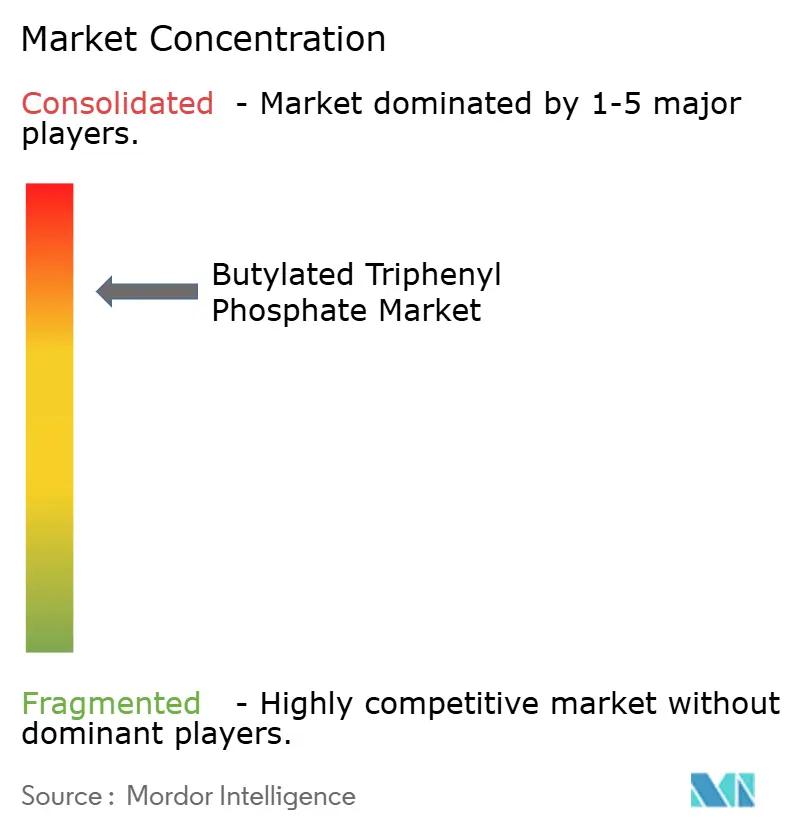
| Market Concentration | High |
Major Players *Disclaimer: Major Players sorted in no particular order Image © Mordor Intelligence. Reuse requires attribution under CC BY 4.0. | |
Butylated Triphenyl Phosphate Market Analysis by Mordor Intelligence
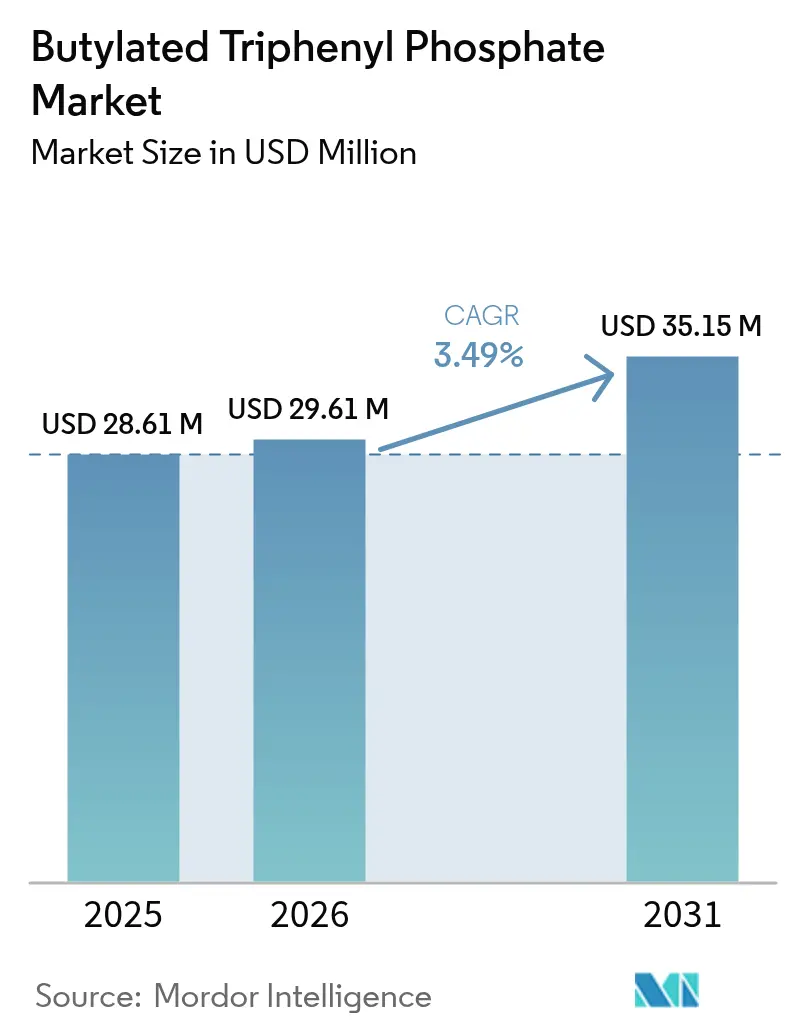
The Butylated Triphenyl Phosphate market size is expected to grow from USD 28.61 million in 2025 to USD 29.61 million in 2026 and is forecast to reach USD 35.15 million by 2031 at 3.49% CAGR over 2026-2031. Demand is rising because regulators in North America and Europe are phasing out halogenated flame retardants, while industrial users look for safer additives that still deliver high thermal stability. Raw-material price swings in phenol and phosphorus oxychloride continue to squeeze margins, yet manufacturers are investing in process efficiency and backward integration to protect profitability. Asia-Pacific retains a leading supply position thanks to an integrated feedstock base, and producers in Japan and South Korea are scaling capacity to serve premium aerospace and electronics lines. Intensifying interest in safe lithium-ion battery chemistries has opened a fast-growing niche that rewards suppliers able to meet both safety and electrochemical performance targets. Consolidation, such as LANXESS’s purchase of Chemtura, shows that the Butylated Triphenyl Phosphate market is moving toward scale-driven competition even as start-ups explore bio-based routes.
Key Report Takeaways
- By function, flame retardants led with 51.78% revenue share in 2025, while lubricant and hydraulic additives are forecast to post the fastest 4.84% CAGR through 2031.
- By application, PVC compounds and resins accounted for 39.10% of the Butylated Triphenyl Phosphate market share in 2025; photovoltaics and energy storage are projected to grow at a 5.23% CAGR to 2031.
- By end-user industry, electrical and electronics dominated at 36.20% share in 2025, whereas aerospace and defense are set to record the highest 5.42% CAGR to 2031.
- By geography, Asia-Pacific held 38.10% of the Butylated Triphenyl Phosphate market size in 2025, and the region is poised to expand at a 4.10% CAGR between 2026 and 2031.
Note: Market size and forecast figures in this report are generated using Mordor Intelligence’s proprietary estimation framework, updated with the latest available data and insights as of 2026.
Market Trends and Insights
Drivers Impact Analysis of Butylated Triphenyl Phosphate Market*
| Drivers | (~) % Impact on CAGR Forecast | Geographic Relevance | Impact Timeline |
|---|---|---|---|
| Regulatory phase-out of halogenated flame retardants | +1.2% | Global, with early adoption in North America and EU | Medium term (2-4 years) |
| Surging demand for fire-resistant lubricants and hydraulic fluids | +0.8% | APAC core, spill-over to North America | Long term (≥ 4 years) |
| Rapid growth of flexible PVC in construction and wire-cable | +0.6% | Asia-Pacific, Middle East emerging markets | Medium term (2-4 years) |
| Safety-driven uptake in automotive and aerospace interiors | +0.5% | Global, with a concentration in automotive hubs | Short term (≤ 2 years) |
| Adoption in high-voltage Li-ion battery electrolytes | +0.4% | APAC manufacturing centers, North America | Long term (≥ 4 years) |
| Source: Mordor Intelligence | |||
Regulatory Phase-Out of Halogenated Flame Retardants
Comprehensive bans now enforce tight compliance deadlines in several jurisdictions. New York’s restriction on flame retardants in furniture and electronic displays took effect in December 2024, while the United States EPA updated its Persistent, Bioaccumulative and Toxic Chemicals rule in November 2024 to curb decabromodiphenyl ether and allied compounds[1]. Canada added further substances to its Schedule 1 toxic list in February 2025, intensifying reformulation pressure. As manufacturers re-engineer product lines simultaneously across regions, short-term demand spikes emerge for compliant organophosphorus alternatives. Electronics and furniture suppliers face the most urgent deadlines, whereas industrial users still enjoy longer transition windows that spread procurement over several years. Companies able to guarantee consistent quality and documentation earn preferred-supplier status.
Surging Demand for Fire-Resistant Lubricants and Hydraulic Fluids
High-temperature machinery in metalworking, mining, and offshore platforms increasingly specifies flame-retardant lubricants to lower insurance costs and meet stricter safety audits. Perimeter Solutions’ 2024 SEC filing underscored the role of phosphorus pentasulfide in anti-wear additives that raise lubricant flash points. Asian steel mills and shipyards are major adopters because confined spaces magnify fire risk. Although premium prices slow uptake in cost-sensitive segments, buyers cite lower downtime and regulatory compliance as compelling benefits. Suppliers who provide in-house testing data and rapid technical support shorten customer qualification cycles. Long-term growth is expected to align with the build-out of renewable power plants, which run at elevated operating temperatures.
Rapid Growth of Flexible PVC in Construction and Wire-Cable
Urban infrastructure investment across China, India, and Southeast Asia fuels robust consumption of flame-retarded PVC sheet, conduit, and cable. Studies show that optimized butylated triphenyl phosphate loadings push the limiting oxygen index of PVC above 50%, doubling fire resistance without sacrificing tensile strength. Green-building certifications now favor halogen-free materials, prompting compounders to refine formulations that balance cost against new safety targets. Wire-and-cable remains the fastest sub-segment as smart buildings and renewable installations call for tight flame and smoke standards. Yet formulation complexity adds research and development cost and lengthens product rollouts, prompting end-users to lock in multi-year supply contracts once validation is complete.
Safety-Driven Uptake in Automotive and Aerospace Interiors
Vehicle interiors, especially in electric models, present new thermal profiles that raise concern over cabin fires. Consumer NGOs highlight that many cars still contain carcinogenic flame retardants, encouraging automakers to pivot toward lower-toxicity phosphate esters. In aerospace, the FAA mandates stringent burn-through resistance for insulation and panels[2]. Combined with ongoing fleet renewal, demand for certified additives has climbed. Certification processes remain lengthy, but once qualified, materials lock in for a platform’s entire life cycle. This creates stable, high-margin streams for suppliers able to navigate aviation audit protocols.
Restraints Impact Analysis of Butylated Triphenyl Phosphate Market*
| Restraints | (~) % Impact on CAGR Forecast | Geographic Relevance | Impact Timeline |
|---|---|---|---|
| Toxicological and eco-tox concerns driving stricter regulations | -0.9% | Global, with stricter enforcement in developed markets | Medium term (2-4 years) |
| Volatile prices of phenol and phosphorus oxychloride feedstocks | -0.7% | Global supply chains, concentrated in Asia-Pacific | Short term (≤ 2 years) |
| Equipment corrosion and hydrolysis maintenance costs in lubricant circuits | -0.4% | Industrial applications globally, concentrated in marine and offshore | Long term (≥ 4 years) |
| Source: Mordor Intelligence | |||
Toxicological and Eco-Tox Concerns Driving Stricter Regulations
Peer-reviewed work in 2025 confirmed that organophosphate flame retardants can disrupt endocrine, hepatic, and neurological functions. Washington State enacted rules in 2025 that presume intentional addition if organophosphate flame retardants appear above specific thresholds. Regulators indicate that organophosphates could follow the same tightening path as halogenated products, injecting uncertainty into long-term planning. Brands are therefore funding trials of bio-based or polymeric substitutes that cannot migrate out of end products. While this trend caps growth for legacy chemistries, it creates headroom for innovation among suppliers that can demonstrate reduced toxicity without compromising performance.
Volatile Prices of Phenol and Phosphorus Oxychloride Feedstocks
Energy cost swings and geopolitical friction drive sharp changes in benzene and chlorine derivatives, pushing phenol and phosphorus oxychloride quotations higher and widening spreads between contract and spot markets. Asian producers dominate these intermediates, so freight rates and currency shifts amplify volatility. Sudden cost spikes compress margins because downstream buyers resist instant pass-throughs. To mitigate risk, leading producers negotiate index-linked formulas, hedge raw-material exposure and invest in captive phenol capacity. Long-term offtake agreements with consumer-electronics majors also stabilize production planning despite short-term price shocks.
*Our forecasts treat driver/restraint impacts as directional, not additive. The impact forecasts reflect baseline growth, mix effects, and variable interactions.
Butylated Triphenyl Phosphate Market Segment Analysis
By Function:
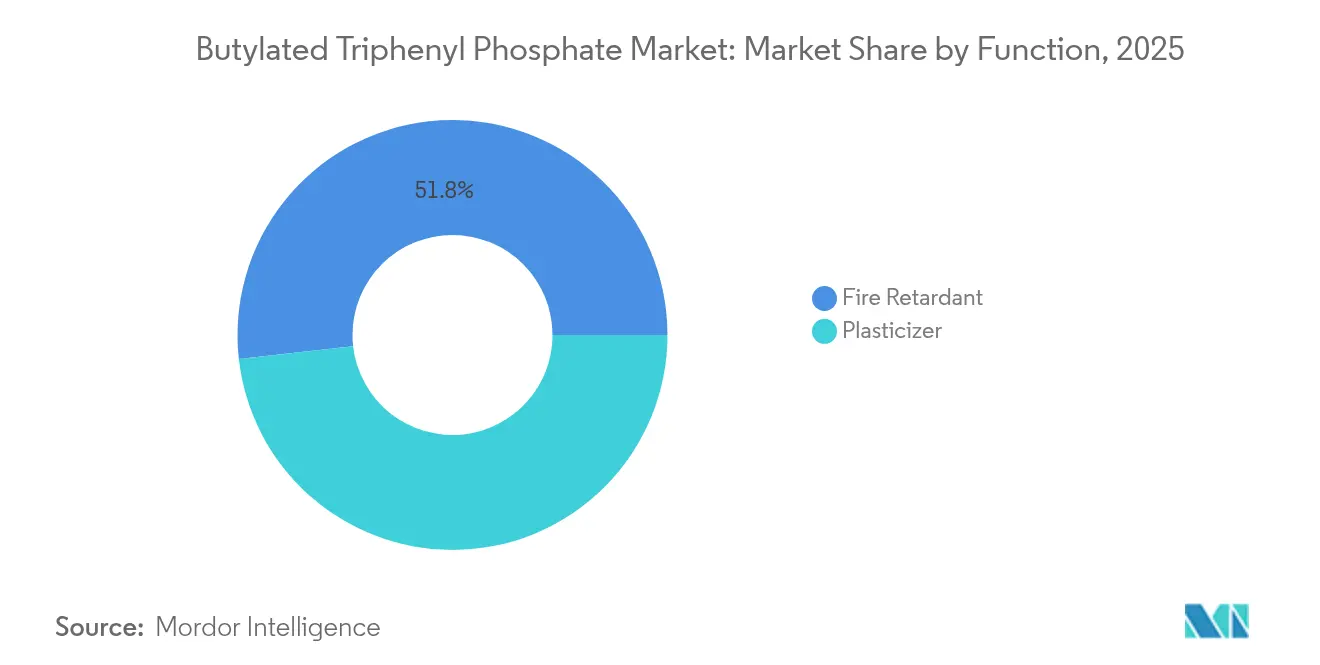
Lubricant Applications Drive Growth Despite Flame Retardant DominanceThe flame-retardant function captured 51.78% of the Butylated Triphenyl Phosphate market share in 2025, a position cemented by mandatory fire-safety codes in furniture, electronics, and construction. Growth, however, shifts toward lubricant and hydraulic additive roles, which are forecast to expand at 4.84% through 2031 as factories modernize and safety audits intensify. The Butylated Triphenyl Phosphate market size tied to lubricant uses is poised to widen because high-temperature equipment and offshore platforms insist on fluid that self-extinguishes quickly. Leading suppliers tailor phosphorus content and viscosity modifiers to meet OEM equipment standards, and they bundle technical guidance that shortens plant trials from months to weeks.

By Application:
Energy Storage Emerges as High-Growth SegmentPVC compounds and resins accounted for 39.10% of the Butylated Triphenyl Phosphate market size in 2025 as builders across Asia-Pacific sought cables, conduits, and flooring that pass updated flame-spread tests. Photovoltaics and energy-storage systems are projected to post a 5.23% CAGR to 2031, the fastest among all applications, because BIPV panels and lithium-ion batteries must meet rigorous fire codes. Experiments show that only 3 wt% of triphenyl phosphate in electrolytes can arrest flame propagation without hurting cell capacity. Module makers, therefore, secure multi-year supply pacts to ensure chemistry consistency through certification cycles.
By End-User Industry:
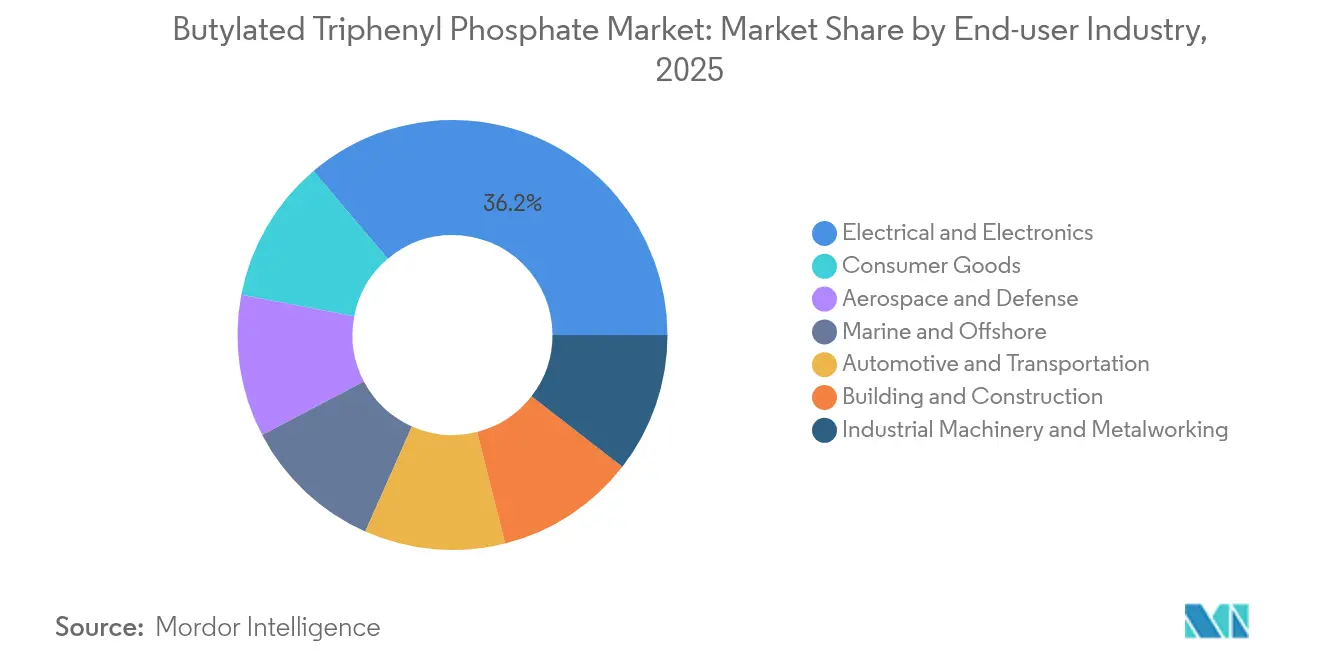
Aerospace Growth Outpaces Electronics LeadershipElectronics retained 36.20% of the Butylated Triphenyl Phosphate market in 2025, with every household device from televisions to routers requiring flame-retarded plastics. Still, aerospace and defense display the quickest 5.42% CAGR through 2031 as airline fleets modernize with composite-rich cabins that necessitate high-performance flame retardants. New insulation standards mandate additives that survive burn-through at 1100 °C for four minutes, thresholds met by organophosphorus esters but seldom by halogenated systems.
Automotive interiors form another sizeable user group, especially as electric models call for revised thermal management strategies. While some jurisdictions lack updated flammability statutes, automakers adopt safer chemistries voluntarily to pre-empt reputational risk. Construction maintains a steady baseline driven by urbanization, though green-building labels prefer halogen-free solutions that can boost formulation cost. Industrial machinery rounds out demand by embracing flame-retardant hydraulic fluids, yet volume upside is tempered by the slow replacement cycle of heavy equipment. Consumer goods remain the smallest slice but operate under the strictest scrutiny, as recreational foams now face additive bans in several US states.
Geography Analysis
APAC Butylated Triphenyl Phosphate Market
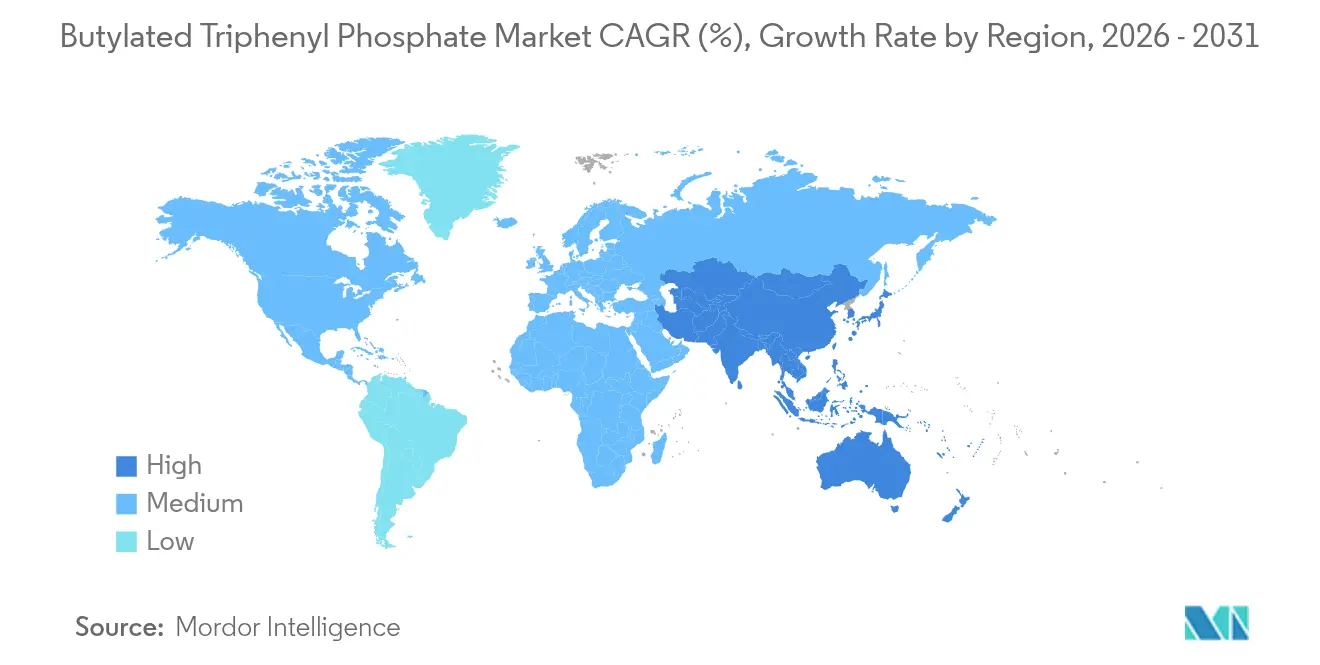
Asia-Pacific controlled 38.10% of the Butylated Triphenyl Phosphate market in 2025 and is projected to grow at a 4.10% CAGR through 2031. China anchors regional demand with its electronics manufacturing base and ongoing urban construction that absorbs flame-retarded PVC. Japan and South Korea prioritize aerospace-grade materials, relying on established chemical clusters for phenol and phosphorus intermediates.
North America and Europe Butylated Triphenyl Phosphate Market
North America is buoyed by early regulatory moves that accelerate substitution. New York’s product ban that began in December 2024 set a high bar, while Canada’s February 2025 toxic-substances listing reinforced momentum toward organophosphates. Europe traces a flatter trajectory because the region already enforces the world’s strictest chemical rules. Producers pivot to bio-based and polymeric options, illustrated by ALTANA AG’s equity stake in Finnish innovator NORDTREAT.
MEA and South America Butylated Triphenyl Phosphate Market
South America and the Middle-East, and Africa remain emerging pockets, where infrastructure build-outs create fresh demand, yet regulatory enforcement remains nascent. Multinationals usually serve these territories via imports to avoid over-investment until policy clarity improves.
Regulatory Landscape
Regulatory oversight for butylated triphenyl phosphate (BTPP) continues to tighten as authorities act on organophosphate flame retardants. In the European Union, TPHP (CAS 115-86-6) was added to the REACH Candidate List of Substances of Very High Concern in November 2024, raising downstream article communication obligations and documentation demands for polymer and electronics value chains at the 0.1% w/w SVHC threshold.
North America is also tightening its compliance pathways. Environment and Climate Change Canada held a public consultation that concluded on January 21, 2026 regarding the proposed addition of TPHP to Schedule 1 of the Canadian Environmental Protection Act (CEPA), signaling potential future risk-management measures. In the United States, the EPA continues TSCA program activity for phosphorus-based chemicals through ongoing risk-evaluation work, adding compliance monitoring pressure for users and importers even before any substance-specific restrictions are finalized.
Value Chain Analysis
The BTPP value chain starts with upstream inputs such as p-tert-butylphenol and phosphorus oxychloride, with mixed tert-butylated triphenyl phosphate esters (BPDP or Phosflex 71B type mixtures) produced and sold to additive-package suppliers and formulators. Midstream participants include specialty phosphate-ester manufacturers and blenders, while downstream conversion spans PVC compounders, engineering thermoplastics compounders (PC/ABS, PPO alloys), and functional-fluid formulators where BTPP is used as a flame-retardant plasticizer and as an anti-wear/extreme-pressure additive.
Supply is concentrated in Asia, with multiple China-based specialty manufacturers exporting to global plastics and lubricant customers. REACH registration and hazard labeling influence storage, transport, and import documentation into the EU, increasing the importance of capable distributors and raising traceability requirements for TPHP-containing mixtures. Buyer qualification cycles in electronics, wire and cable, and safety-critical applications favor suppliers that can deliver stable specifications, impurity control, and robust regulatory dossiers.
Competitive Landscape
The Butylated Triphenyl Phosphate market features consolidation. Innovation tilts toward PFAS-free and bio-derived molecules. Suppliers also experiment with reactive or polymeric grades that lock into plastic matrices, curbing leaching and environmental exposure. Raw-material volatility spurs backward-integration moves, with some players investing in captive phenol units or long-term phosphorus ore contracts to hedge cost swings. Customer stickiness remains high because qualification in safety-critical markets can exceed 18 months, raising switching barriers and fostering long contracts.
Butylated Triphenyl Phosphate Industry Leaders
-
LANXESS
-
ICL
-
PCC Group
-
Radco Industries, Inc.
-
Tina Organics ( P ) Ltd.
- *Disclaimer: Major Players sorted in no particular order
Butylated Triphenyl Phosphate Market Companies Covered in this Report
- ADEKA Corporation
- China Zhang Jia Gang YaRui Chemical Co., Ltd
- ICL
- LANXESS
- PCC Group
- Radco Industries, Inc.
- Shandong Ruixing Flame Retardant Technology Co. LTD.
- Tina Organics ( P ) Ltd.
- Zhangjiagang Fortune Chemical Co., Ltd.
- ZhangJiaGang YaRui Chemical Co. Ltd.
- Zhejiang Wansheng Co., Ltd.
Market Opportunities and Future Outlook
A near-term opportunity is reformulation and compliance support as regulators move toward enforceable restrictions and article-level obligations. The EU SVHC listing of TPHP has increased demand for supply-chain transparency, consistent compositional control in mixed aryl-phosphate esters, and documentation that supports downstream communication duties. At the same time, tightening EU electronics-related restrictions is pushing OEMs and EMS/assembly supply chains to re-validate halogen-free solutions and to secure qualified additive sources.
Product development whitespace is opening around lower-migration and lower-exposure solutions within phosphate ester families, including reactive or polymeric approaches that reduce additive leaching and align with sustainability programs. ECHA activity indicates broader category-level oversight, with a July 2026 draft amendment proposing notification requirements (0.1% w/w threshold) for 12 categories of organophosphorus flame retardants, and an expected application date in 2027. This highlights the value of suppliers that can support customers across multiple jurisdictions and article types.
Recent Industry Developments in Butylated Triphenyl Phosphate Market
- July 2026: ECHA published a draft amendment ECHA/RAC/2026/11 proposing notification requirements for 12 categories of organophosphorus flame retardants at a 0.1% w/w threshold, with an application date of January 2027. The change increases compliance workload for suppliers of phosphate-ester additives and for downstream polymer and electronics value chains that need consistent substance identification and reporting processes.
- May 2026: European Commission published an amendment to REACH Annex XVII restricting specific flame retardants including TCEP, TCPP, and Deca-BDE in industrial electronics. OEMs and EMS/assembly supply chains are tightening their validation of halogen-free solutions and ensuring qualified additive sources.
- April 2024: The European Union imposed anti-dumping duties on certain alkyl phosphate esters, including BTPP, imported from China. The measure reshaped landed-cost calculations for EU buyers and increased the appeal of alternative sourcing strategies, including inventory planning and diversification of supply routes.
Butylated Triphenyl Phosphate Market Report Scope and Research Methodology
Market Definition and Coverage
This market covers revenues generated from selling butylated triphenyl phosphate used mainly as a fire-retardant additive and plasticizer across industrial applications and end-use industries, reported in USD and aggregated at the global level.
Scope exclusions: We exclude internal transfers within vertically integrated sites, and we do not count unrelated phosphate esters that are not butylated triphenyl phosphate.
Segments Covered in This Report
- By Function
- Fire Retardant
- Plasticizer
- By Application
- Lubricants
- Polyvinyl Compounds and Resins
- Other Applications (Engineering Plastics, Coatings and Adhesives, etc.)
- By End-user Industry
- Automotive and Transportation
- Aerospace and Defense
- Electrical and Electronics
- Building and Construction
- Industrial Machinery and Metalworking
- Marine and Offshore
- Consumer Goods
- By Geography
- Asia-Pacific
- China
- India
- Japan
- South Korea
- Rest of Asia-Pacific
- North America
- United States
- Canada
- Mexico
- Europe
- Germany
- United Kingdom
- France
- Italy
- Rest of Europe
- South America
- Brazil
- Argentina
- Rest of South America
- Middle-East and Africa
- Saudi Arabia
- South Africa
- Rest of Middle-East and Africa
- Asia-Pacific
Data Sources, Market Sizing, and Validation
Desk Research
Desk research was used to frame the demand pool and to set realistic guardrails before we spoke with the market. We relied on public references such as UN Comtrade trade statistics, USITC tariff schedules, U.S. International Trade Administration materials, European Chemicals Agency dossiers, and OECD chemicals information, which helped clarify product identity, trade visibility, and regulatory direction.
We also reviewed importer disclosures, company annual reports, investor presentations, technical datasheets, and association publications linked to plastics additives and flame retardants. For cross-checking, we selectively used paid subscriptions for company financials and intelligence, plus patent databases to see where formulation work and substitution efforts were trending. The desk sources listed here are illustrative only, and we used other documents to validate and clarify data points during the study.
Primary Interviews and Surveys
Primary work focused on validating how BTTP is purchased and specified across lubricants, PVC compounds, and other uses, since these decisions affect both price realization and volume. We spoke with a mix of producers, distributors, formulators, and downstream users, and the interviews covered APAC, EMEA, and the Americas so regional pricing and supply tightness could be compared on a consistent basis.
Distribution of primary research fieldwork respondents
| Company type | Respondent position | Region |
|---|---|---|
| Top tier: 28% | CXOs: 13% | APAC: 45% |
| Mid tier: 55% | Functional/Unit leaders: 40% | EMEA: 34% |
| Smaller Players: 17% | Managers: 47% | Americas: 21% |
Market-Sizing & Forecasting
Our sizing starts with a top-down rebuild of demand, where end-use activity and chemical additives intensity are used to translate lubricants output, PVC compounding volumes, and selected industrial production indicators into BTTP consumption. Once the demand pool is formed, it is converted to value using region-specific average selling prices that reflect contract structure, grade mix, and typical shipment sizes.
To keep the totals realistic, we corroborate the output with selective bottom-up checks, including supplier capacity signals, channel feedback on utilization, and sampled price quotes multiplied by estimated volumes for a few high-visibility application pockets. Where disclosure is thin, we handle gaps by using proxy ratios from similar phosphate ester additives, then adjusting those ratios based on interview feedback on substitution, regulation-driven reformulations, and procurement shifts.
For forecasting, scenario analysis is used so the model can separately reflect regulatory replacement pace for halogenated flame retardants, raw-material cost pass-through, and the speed of growth in key consuming sectors. The forward view is then tightened using expert inputs on expected PVC formulation trends, lubricant additive loading changes, and regional capacity additions or debottlenecks.
Data Validation & Update Cycle
Estimates are validated through triangulation across demand indicators, pricing checks, and supply-side signals, then variance flags are reviewed before figures are finalized. When a number looks inconsistent, we recheck unit conversions, revisit key assumptions, and, if needed, re-contact respondents to confirm whether the change is real or timing-related.
Each report is refreshed annually, and interim updates are made when material events occur such as a major regulatory move, a capacity change, or a sustained pricing shock. Before delivery, an analyst performs a fresh pass across the model inputs and the narrative so clients receive the latest updated view.
Mordor Intelligence's Butylated Triphenyl Phosphate Market Size Versus Other Published Estimates
Published market sizes for BTTP often do not match because sources use different product scope, price assumptions, and timing for currency conversion, and then those choices flow through the full model. Differences also show up when one estimate leans on trade visibility, but another leans on application demand signals and expert correction factors.
A common gap driver is scope, since some publications group BTTP together with broader organophosphate flame retardants or mixed phosphate esters, which can inflate the total. Another driver is pricing logic, where a single global ASP can miss the spread between contract pricing in Asia and specialty shipments in North America and Europe, and then the totals drift away from actual buying patterns. Some estimates fold in adjacent phosphate ester plasticizers, and Mordor Intelligence counts only BTTP sold into the stated functions and applications, with region-level ASPs checked back through interviews.
Benchmark comparison
| Source | Market Size | Gaps in Research Methodology |
|---|---|---|
| Mordor Intelligence | USD 29.61 M (2026) | |
| Trade Publisher A | USD 19.70 M (2024) | Uses an earlier base year and appears to rely heavily on reported shipments and trade-linked visibility, which can undercount domestic consumption and small-lot specialty demand that is not cleanly captured in trade proxies. |
| Industry Portal B | USD 53.50 M (2025) | The scope likely blends BTTP with adjacent phosphate ester additives, and it may apply aggressive adoption assumptions and a uniform ASP progression across regions. |
The spread across the three figures is mainly explained by how narrowly the product is defined and how prices are localized by region and use case. When scope stays specific to BTTP and inputs are cross-checked with application demand and realistic price bands, the resulting size is easier to trace and repeat year after year.
Key Questions Answered in the Report
What is the current size of the Butylated Triphenyl Phosphate market?
The Butylated Triphenyl Phosphate market size is USD 29.61 million in 2026 and is forecast to rise to USD 35.15 million by 2031 at a 3.49% CAGR.
Which region leads demand for Butylated Triphenyl Phosphate?
Asia-Pacific holds 38.10% of global demand and is projected to grow at a 4.10% CAGR through 2031, driven by electronics manufacturing and construction activity.
Which application segment is expected to grow the fastest?
Photovoltaics and energy storage applications show the highest projected 5.23% CAGR because building-integrated PV and lithium-ion batteries require stricter fire-safety additives.
Why are lubricants an emerging opportunity in this market?
Industrial equipment and offshore platforms specify fire-resistant fluids to meet evolving safety codes, pushing lubricant and hydraulic additive demand to a 4.84% CAGR.
How are regulations shaping the competitive landscape?
Bans on halogenated flame retardants and tighter scrutiny of organophosphates force suppliers to invest in safer, often bio-based chemistries, favoring companies with strong regulatory and research and development capabilities.