
Market Overview
| Study Period | 2020 - 2032 |
|---|---|
| Forecast Data Period | 2027 - 2032 |
| Base Year Market Size (2026) | USD 0.11 Billion |
| Market Size (2027) | USD 0.12 Billion |
| Market Size (2032) | USD 0.16 Billion |
| Growth Rate (2027 - 2032) | 7.78 % |
| Market Concentration | Medium |
Major Players *Disclaimer: Major Players sorted in no particular order Image © Mordor Intelligence. Reuse requires attribution under CC BY 4.0. | |
Brazil Electrically Powered Hydraulic Steering Market Analysis by Mordor Intelligence
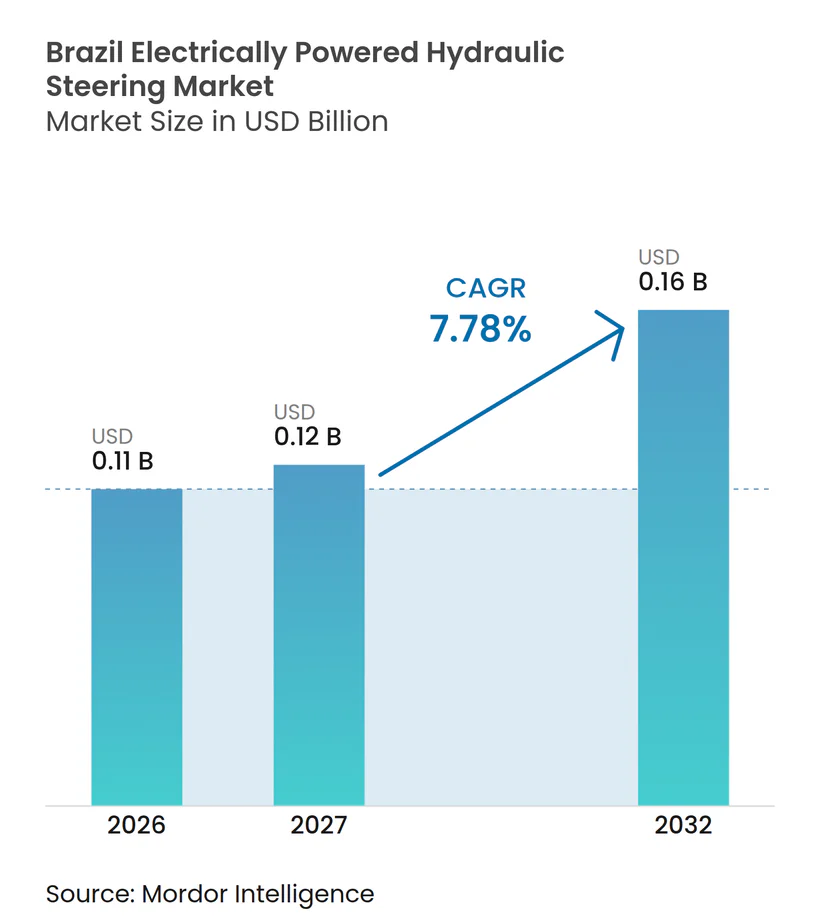
The Brazil electrically powered hydraulic steering market size was valued at USD 0.11 billion in 2026 and is expected to grow from USD 0.12 billion to USD 0.16 billion by 2032, growing at a CAGR of 7.78% from 2027 to 2032. The Brazil electrically powered hydraulic steering market is supported by road freight, agricultural machinery, mining equipment, and construction fleets that need high hydraulic steering assist under demanding loads. Heavy trucks, articulated loaders, haul units, and combines remain practical applications because their operating conditions require hydraulic torque that lighter steering systems cannot reliably provide. The Brazil electrically powered hydraulic steering market also benefits from MOVER incentives and vehicle efficiency rules that encourage electronic control systems and local engineering investment. Passenger-car platforms continue to move toward electric power steering, while hybrid, commercial, and off-road platforms retain a transition period for electrically powered hydraulic steering. Suppliers are responding by localizing, integrating systems, and optimizing aftermarket logistics, particularly where imported electronics and pump assemblies create procurement exposure.
Key Report Takeaways
- By component type, Electric Motor-Pump Units held 35.18% of the Brazil electrically powered hydraulic steering market in 2026, while Sensors are forecast to grow at a 10.24% CAGR through 2032.
- By vehicle type, On-Road Vehicles held 65.14% of the Brazil electrically powered hydraulic steering market in 2026, while Off-Road Vehicles are forecast to grow at an 8.51% CAGR through 2032.
- By steering mechanism, Rack and Pinion held 45.33% of the Brazil electrically powered hydraulic steering market in 2026, while Hydraulic Cylinder and Articulated Steering are forecast to grow at a 9.68% CAGR through 2032.
- By propulsion, Internal Combustion Engine vehicles held 84.07% of the Brazil electrically powered hydraulic steering market in 2026, while Battery Electric vehicles are forecast to grow at a 15.33% CAGR through 2032.
- By sales channel, OEM accounted for 82.36% of the Brazilian electrically powered hydraulic steering market in 2026 and is forecast to grow at an 8.12% CAGR through 2032.
- By geography, Southeast accounted for 55.24% of Brazil's electrically powered hydraulic steering market in 2026, while Central-West is forecast to grow at a 9.06% CAGR through 2032.
Note: Market numbers in this report are based on Mordor Intelligence's proprietary estimation framework, which combines nine months of actuals with Q4 projections for base year 2026.
Brazil Electrically Powered Hydraulic Steering Market Trends and Insights
Drivers Impact Analysis*
| Driver | (~) % Impact on CAGR Forecast | Geographic Relevance | Impact Timeline |
|---|---|---|---|
| Agribusiness, Construction and Mining Equipment | +2.0% | South and Central-West for agribusiness, Southeast and North for mining and construction | Medium term (2-4 years) |
| PROCONVE P8 and MAR-I Compliance | +1.6% | National, with highest OEM compliance concentration in São Paulo and Paraná | Short term (≤ 2 years) |
| MOVER Incentives and Automotive Investment | +1.3% | National, with early gains in São Paulo, ABC region, and Camaçari | Medium term (2-4 years) |
| EHPS for Brazil's Mixed Cycles | +1.0% | National, strongest in Southeast and North mixed on-road and rural conditions | Short term (≤ 2 years) |
| Flex-Fuel and Hybrid Diversification | +0.7% | National, led by Southeast and Northeast vehicle hubs | Medium term (2-4 years) |
| Assembly Response to Import Costs | +0.6% | Southeast production centers | Short term (≤ 2 years) |
| Source: Mordor Intelligence | |||
Agribusiness, Construction and Mining Equipment Demand
Brazil's agribusiness and extractive activities provide a deep demand base for off-highway steering systems. The country harvested 350.2 million tonnes of grains across 81.7 million hectares in the 2024/25 season, supporting the use of high-horsepower tractors, harvesters, and self-propelled sprayers. These machines depend on hydraulic steering to support long work shifts and difficult terrain. Construction equipment sales and mineral extraction also support demand for articulated vehicles and haul equipment that require hydraulic-cylinder steering at high payloads. Equipment purchases can move with soybean, coffee, and corn prices, which creates more variation than conventional vehicle program cycles. The Brazil electrically powered hydraulic steering market therefore depends on suppliers that can serve agricultural customers through both equipment renewal periods and weaker commodity cycles. Suppliers also need product ranges suited to tractors, sprayers, harvesters, loaders, and haul units rather than a single vehicle category. Demand is strongest when equipment owners value uptime, driver comfort, and dependable low-speed maneuvering during intensive operating periods.
PROCONVE P8 and MAR-I Compliance-Driven Efficiency Upgrades
PROCONVE P8 applies Euro VI-equivalent requirements to new heavy trucks and buses, thereby increasing the importance of electronically controlled auxiliary systems. A demand-responsive electric pump avoids the continuous load of a belt-driven hydraulic pump during low-assist operation. This design supports the efficiency goals of modern engine management systems. Electronic stability control requirements also increase the value of shared ECU and sensor architecture across steering and vehicle safety functions. SAE Brasil has documented a phased MAR-II pathway for agricultural, construction, and industrial machinery above 75 kW [1]. The Brazil electrically powered hydraulic steering industry can benefit where compliance upgrades require more sensors and control capacity in equipment that remains unsuitable for light electric steering systems. Compliance work can bring steering specifications into wider discussions of engine controls, stability systems, and vehicle electronics. This allows established system suppliers to offer integrated packages instead of individual mechanical parts.
MOVER Incentives and Automotive Technology Investment
Brazil enacted the MOVER program in June 2024 and formalized regulations in 2025 to support vehicle efficiency, research, and local production. The program provides financial credits through 2028, linked to qualifying investments and technology outcomes. U.S. government reporting identifies announced automotive investments exceeding USD 26 billion under the wider incentive environment [2]. New hybrid and electric platforms create steering design decisions before production begins. The program's local-content orientation encourages suppliers to build engineering and production capability near Brazilian assemblers. This makes the Brazil electrically powered hydraulic steering market more dependent on early platform design work than on later replacement sales. Suppliers that engage before vehicle specifications are fixed can help OEMs match efficiency targets with the required steering performance. Their ability to meet local-content and technical requirements can shape whether they remain on the approved supplier list.
EHPS Suitability for Brazil's Mixed Duty Cycles
Freight and agricultural vehicles in Brazil often move between unpaved access roads, regional highways, and long-distance routes during the same operating cycle. A significant share of paved roads requires maintenance or rehabilitation, with nearly one-fifth classified as being in poor or critical condition. These conditions increase the need for strong low-speed steering assistance in loaded vehicles. Electrically driven hydraulic pumps activate when steering demand increases, while maintaining hydraulic force under high-load conditions. Infineon describes significant fuel savings and carbon dioxide reductions for relevant commercial-vehicle duty cycles [3]. The Brazil electric-powered hydraulic steering market can therefore retain a role on routes where conventional hydraulic systems waste energy and full-electric systems lack adequate assist. Operators can evaluate the system based on fuel consumption, maintenance needs, steering response, and suitability for variable road conditions. This broad operating comparison helps explain why the architecture remains relevant in heavy commercial and agricultural use.
Restraints Impact Analysis*
| Restraint | (~) % Impact on CAGR Forecast | Geographic Relevance | Impact Timeline |
|---|---|---|---|
| EPS Substitution in Passenger Cars | -1.6% | National, most severe in Southeast passenger-car hubs | Short term (≤ 2 years) |
| Import Dependence and Tariff Uncertainty | -0.9% | National | Short term (≤ 2 years) |
| Volatility in Imported Electronics and Pump | -0.6% | National | Short term (≤ 2 years) |
| Service and Calibration Outside Southeast | -0.4% | Northeast, North, and Central-West | Medium term (2-4 years) |
| Source: Mordor Intelligence | |||
EPS Substitution in Passenger Cars
Electric power steering has displaced electrically powered hydraulic steering in most new passenger-car programs. The shift reflects lower mass, lower parasitic energy use, and software-led steering calibration. Passenger-car producers increasingly choose column or rack electric systems as a default architecture. This reduces the volume base that previously supported wider use of hydraulic steering components. MOVER efficiency incentives reinforce interest in lighter vehicle configurations and fewer mechanical losses. The Brazilian electrically powered hydraulic steering market is consequently more exposed to commercial vehicles, buses, and off-road machinery, where axle loads and operating conditions drive hydraulic requirements. The decline in passenger-car fitment makes accurate assessment of heavy-duty applications more important for suppliers. It also reduces the scale benefit that passenger-car volumes once provided to hydraulic component makers.
Import Dependence and Tariff Uncertainty
Precision sensors, ECUs, and motor-pump cores can expose local assemblers to import costs and exchange-rate movements. This exposure is important because these parts carry significant technical value within the system. Import changes can also affect the economics of aftermarket repair kits, especially where distributors hold slow-moving inventory. Suppliers outside the Southeast face a further challenge because calibration capacity and service access are less developed. Local-content investment may reduce some dependence over time, but it does not remove short-term procurement risk. The Brazil electrically powered hydraulic steering market must therefore balance localization plans with reliable access to imported electronic components. Regional service gaps can make a technically sound product harder to support after installation. Suppliers need trained technicians and diagnostic capability where equipment operates outside the main manufacturing corridor.
*Our forecasts treat driver/restraint impacts as directional, not additive. The impact forecasts reflect baseline growth, mix effects, and variable interactions.
Segment Analysis
By Component Type: Electric Motor-Pump Units Anchor Revenue, Sensors Lead Growth
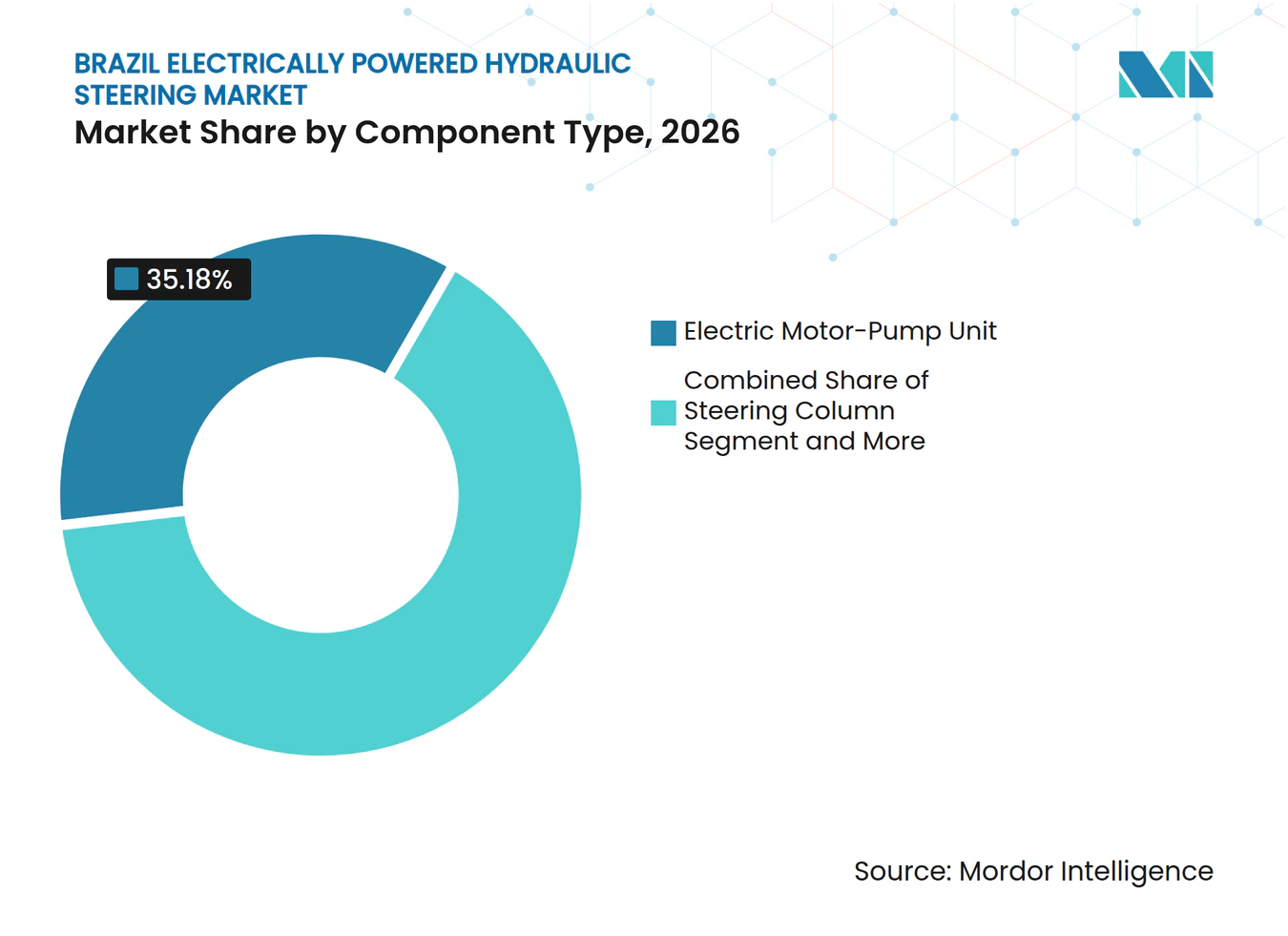
Electric Motor-Pump Units accounted for 35.18% of the Brazilian electrically powered hydraulic steering market share in 2026. The unit combines the brushless motor, pump, and ECU interface that determine core system output. Its technical role makes it the highest-value component assembly in an electrically powered hydraulic steering installation. Sensors are projected to grow at a 10.24% CAGR through 2032. Greater torque, position, wheel-speed, and yaw feedback support higher control precision in commercial vehicles. Electronic Control Units also benefit from regulations that increase the need for integrated safety and efficiency functions. Steering columns, hydraulic racks, gears, and cylinders maintain stable demand as essential mechanical components. Hoses, lines, fittings, and reservoirs remain accessible areas for Brazilian rubber and polymer suppliers.
The value concentration in the motor-pump unit gives suppliers with proprietary motor and pump integration a stronger commercial position. Bosch presents its Servotwin system as a commercial-vehicle steering solution that combines hydraulic assistance with electronic functions [4]. These functions can include support for lane guidance, wind compensation, and congestion driving. The added functions make sensor and ECU content useful beyond basic steering control. ISO 26262-related functional-safety expectations can also raise the development threshold for electronic steering components. The Brazil electrically powered hydraulic steering industry retains opportunities for local suppliers in lower-complexity parts, while advanced electronic assemblies remain more concentrated. Local firms can use proximity to vehicle plants to supply molded hoses, fittings, reservoirs, and other parts that require shorter delivery cycles. Their position is less secure in sensors, control software, and integrated motor-pump modules, where validation and intellectual property remain important.



By Vehicle Type: On-Road Volumes Dominate but Off-Road Growth Leads
On-Road Vehicles accounted for 65.14% of the Brazilian electrically powered hydraulic steering market share in 2026. Medium and heavy trucks, buses, and coaches support this position because they require dependable steering assistance in freight and passenger operations. Passenger cars are a smaller source of demand as electric steering becomes more common. Light commercial vehicles and bus classes continue to use hydraulic assist where vehicle weight exceeds practical electric torque limits. Off-Road Vehicles are forecast to grow at an 8.51% CAGR through 2032. Precision agriculture, mineral extraction, and infrastructure work support this faster growth. Material handling equipment also benefits from investment in warehouses, ports, and bulk exports. The Brazil electrically powered hydraulic steering market is consequently more tied to productive equipment than to passenger-car production.
Imports of agricultural machinery also introduce compatibility needs for suppliers that can adapt firmware to different CAN-bus protocols. Large row-crop operations are expected to remain reliant on internal-combustion equipment during the forecast period. Battery-powered tractors are suited to lighter applications because their operating autonomy remains limited. This keeps a substantial operating role for hydraulic steering in larger agricultural machinery. Suppliers that can support imported equipment standards may gain access to a growing part of the off-road fleet. Equipment owners need service parts that fit the machine and communicate with its existing controls.
By Steering Mechanism: Rack and Pinion Leads, Articulated Steering Gains Ground
Rack-and-pinion mechanisms accounted for 45.33% of the Brazilian electrically powered hydraulic steering market in 2026. They are common in on-road vehicles where compact packaging and directional precision are important. The mechanism supports light commercial vehicles and mid-sized trucks with manageable front-axle loads. Recirculating Ball systems continue to serve heavy trucks and intercity buses that need greater mechanical advantage. Hydraulic Cylinder and Articulated Steering is forecast to grow at a 9.68% CAGR through 2032. Articulated loaders, graders, mine-service vehicles, and dump trucks drive this category. Their frames articulate rather than turn through a conventional wheel-knuckle arrangement. Hydraulic cylinder actuation remains the feasible steering architecture for those applications.
Orbital steering units are used in agricultural and construction equipment to connect operator input with hydraulic cylinder movement. These units connect operator input with hydraulic cylinder movement in mobile equipment. Schaeffler's work in commercial-vehicle steering components points to broader competition for precision steering mechanisms. Suppliers must build reliable electronic control around the hydraulic actuation layer as articulated equipment becomes more connected. The Brazil electrically powered hydraulic steering market can gain from this shift because the fastest-growing mechanism still requires hydraulic force. Digital controls do not remove the need for a robust cylinder, hose, pump, and valve arrangement in large articulated machines. Suppliers need to ensure system reliability when machinery operates in dusty, hot, vibration-prone environments and on uneven terrain.
By Propulsion: ICE Dominates, Battery Electric Charts a Divergent Trajectory
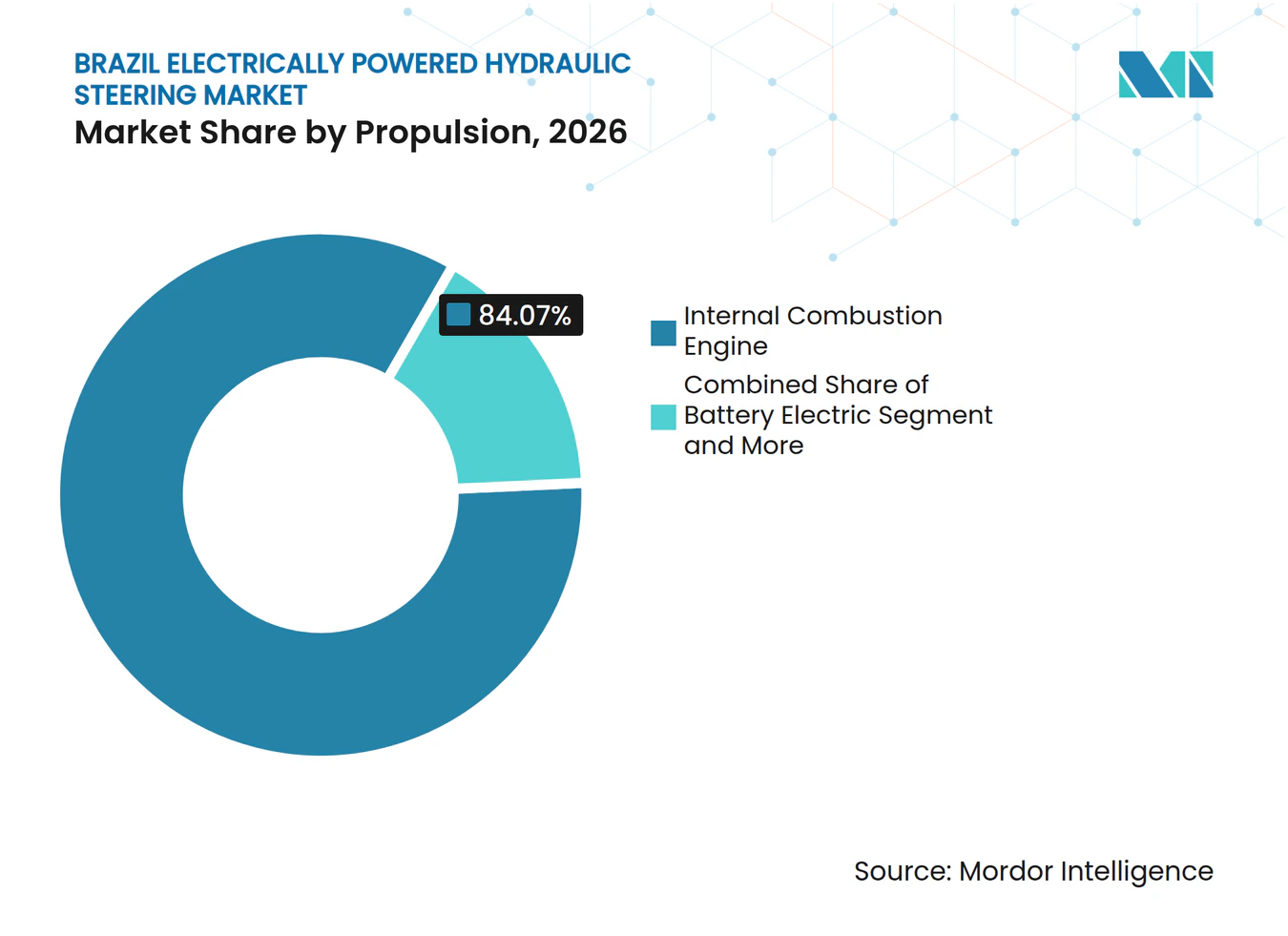
Internal Combustion Engine vehicles accounted for 84.07% of Brazil's electrically powered hydraulic steering market in 2026. This position reflects Brazil's current commercial and off-road fleet composition. Diesel trucks and buses remained the dominant registered vehicles in the relevant classes during 2025. Hybrid vehicles create an intermediate steering application because they retain combustion systems while adding more electronic control. MOVER targets for lower energy consumption support efficiency upgrades in light commercial vehicle programs. These vehicles can preserve the hydraulic infrastructure required for electrically powered hydraulic steering. This creates a transition period between traditional combustion vehicles and fully electric platforms. The Brazilian electrically powered hydraulic steering industry benefits when hybrid designs meet high-load operating requirements.
Battery Electric vehicles are forecast to grow at a 15.33% CAGR through 2032. Many urban buses can use electric power steering because their axle loads are within its practical range. Heavy mining equipment presents a different case. Zero-emission haul trucks in Pará and Minas Gerais still need steering systems capable of handling very high payloads. Hydraulic steering or hydraulic cylinder actuation remains the applicable option in these machines. Battery-electric growth, therefore, has different implications for urban transport and off-highway equipment. The Brazil electric-powered hydraulic steering market remains relevant where electrification does not reduce heavy-duty steering loads. The choice of propulsion does not by itself determine the steering architecture of a machine. Urban transport can favor lighter steering systems, while off-highway vehicles can maintain hydraulic actuation. Suppliers must therefore assess battery-electric programs by application rather than treating them as one demand category.

By Sales Channel: OEM Consolidates Both Share and Growth, Aftermarket Serves the Installed Base
OEM held 82.36% of the category in 2026 and is forecast to grow at an 8.12% CAGR through 2032. Truck, bus, and equipment assemblers specify steering systems as complete packages with controlled connectors and ECU calibrations. Those specifications constrain substitution after the vehicle is sold. MOVER local-content requirements also favor longer supply agreements with suppliers that have Brazilian production and engineering capability. Steering is a safety-adjacent system, which makes original-equipment qualification especially important. The OEM channel therefore combines high current volume with strong control over future design wins. This structure is central to the Brazil electrically powered hydraulic steering market because most demand is established before vehicle assembly.
The aftermarket remains tied to Brazil's aging commercial-vehicle fleet. P7-class trucks represented a significant share of registered heavy vehicles in 2025, creating a continuing repair and replacement base. This installed base requires parts long after the associated new-vehicle program has ended. Schaeffler inaugurated its South America Central Logistics Center in Porto Feliz in April 2025 to improve regional distribution. Faster parts availability can support bearing and electronic-component replacement needs. Independent distributors have a stronger role in the Northeast and Central-West, where dealer coverage is thinner. The Brazil electric-powered hydraulic steering market therefore includes a smaller but durable replacement channel alongside its OEM-led core. Replacement customers value availability because a disabled truck or agricultural machine can disrupt freight or fieldwork.
Geography Analysis
Southeast held 55.24% of Brazil's electrically powered hydraulic steering market size in 2026. São Paulo is home to automotive assemblers, Tier-1 steering suppliers, and Tier-2 component makers. São José dos Pinhais, Limeira, Indaiatuba, and São Bernardo do Campo offer engineering, homologation, and proximity to OEMs. These capabilities are difficult for smaller regional clusters to reproduce quickly. The South provides a secondary base through Paraná's automotive activity and demand for agricultural equipment. The cluster gives OEMs shorter access to engineering teams, testing resources, and established supplier relationships. It also allows Tier-1 companies to coordinate electronic steering content with related braking and safety systems. The South complements this position through its proximity to vehicle production and agricultural equipment demand.
Central-West is forecast to grow at a 9.06% CAGR through 2032. Mato Grosso and Goiás operate large fleets of sprayers, row-crop tractors, and harvesters for soybean, corn, and cotton production. These machines require sustained steering support over long working hours. The distance from Southeast OEM centers makes local service networks and parts distribution important. The region's large farms require equipment that can operate over long distances and varied surface conditions. Service coverage is therefore a commercial issue as well as a technical one. Suppliers that place inventory closer to farm operators can shorten downtime during planting and harvest windows. This can improve the attractiveness of both original equipment supply and replacement parts.
The Northeast is becoming more relevant as a manufacturing location. Automotive production in Bahia creates design-in opportunities for suppliers capable of providing local technical support. The North remains tied mainly to mining operations in Pará and Amazonas. Iron ore, bauxite, nickel, and related extraction activities require haul trucks and loaders with hydraulic steering. These operations are less affected by passenger-car adoption of electric power steering. Geography within the Brazil electrically powered hydraulic steering market therefore reflects a production-led Southeast, an agricultural Central-West, an emerging Northeast, and a mining-oriented North. Each region has a different demand pattern, which limits the value of a uniform route-to-market strategy. National suppliers need to align distribution, technical support, and customer relationships with the operating conditions in each region.
Competitive Landscape
Market Concentration
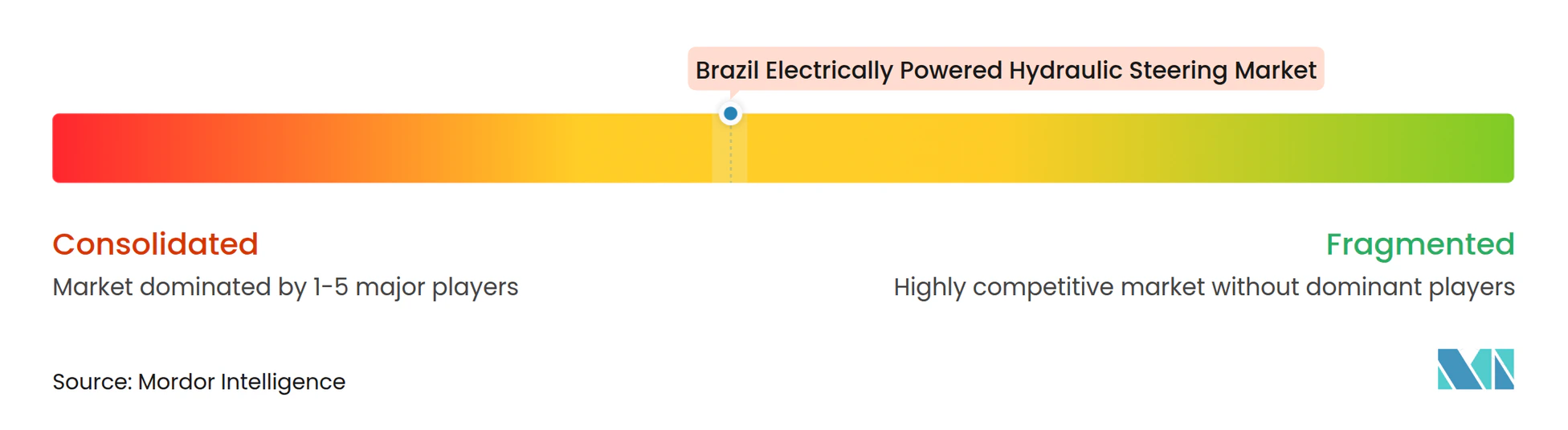
The Brazil electrically powered hydraulic steering market is moderately concentrated at the complete-system level. ZF Friedrichshafen, JTEKT, Nexteer Automotive, and Bosch compete through long-standing engineering relationships with OEMs. Their position rests on system validation, safety requirements, electronic controls, and vehicle-platform integration. Competition is more fragmented for sensors, hoses, fittings, and hydraulic castings. Brazilian and regional suppliers can compete in those parts through cost and proximity. ZF localized its commercial-vehicle brake ECU at Limeira in 2025 and obtained UN/ECE E1 homologation. This move illustrates how localization can strengthen an OEM supplier’s technical position. Local production can shorten communication with assemblers and reduce exposure to delays in imported parts. Smaller suppliers face a higher barrier when they lack comparable validation resources and customer access.
Steer-by-wire development signals the direction of future global steering platform requirements. ZF, Bosch, JTEKT, and Schaeffler also maintain steering technology programs. These developments influence the requirements that OEMs may use in future platform decisions. Schaeffler expanded its Brazilian aftermarket electronics portfolio during 2025 and 2026. A broader parts range allows a company to serve repairs even when it does not hold the original vehicle contract. Logistical capacity can make that strategy more effective over long distances and for dispersed customers. Aftermarket expansion also reduces reliance on a small number of future vehicle-platform awards. The approach is particularly relevant where older commercial fleets need continued parts availability.
Potential openings remain in service kits for older P7 trucks in the Northeast and North. Suppliers can also address the needs of electronically controlled steering in precision agriculture equipment operating in the Central-West. Imported Chinese tractors and construction machines create another need for compatible CAN-bus calibration and support. The Brazilian electrically powered hydraulic steering market favors companies that can combine local support with validated expertise in electronic and hydraulic systems. Companies also need to manage the different needs of OEM programs, large equipment operators, dealers, and independent repair businesses. These buyers place different value on engineering integration, delivery speed, price, and technical service. A balanced presence across those channels can reduce exposure to demand changes in one application.
Brazil Electrically Powered Hydraulic Steering Industry Leaders
-
ZF Friedrichshafen AG
-
JTEKT Corporation
-
Nexteer Automotive Group Limited
-
Robert Bosch GmbH
-
Bucher Industries AG
- *Disclaimer: Major Players sorted in no particular order
Recent Industry Developments
- May 2026: JTEKT India announced the commencement of steering gear exports to Stellantis in Brazil, targeting 70,000 units in FY2027 ending March and scaling to 150,000 units in FY2028, with a long-term trajectory of up to 500,000 units per annum. The program establishes India-based JTEKT production as a low-cost source for the Brazilian OEM market, complicating the economics of localization for in-country EHPS manufacturing.
- March 2026: The PROCONVE MAR-II regulation for off-road equipment progressed from CIPAM approval to public consultation at CONAMA. The regulation will impose emission limits equivalent to the United States EPA Final Tier 4 standards on agricultural, construction, and industrial engines above 75 kW. This regulatory milestone has accelerated the timeline for ECU and sensor upgrades in EHPS-compatible off-highway equipment.
Brazil Electrically Powered Hydraulic Steering Market Report Scope
The scope includes segmentation by component type (steering column, electric motor-pump unit, sensors, electronic control unit, hydraulic rack, gear, and cylinder, hoses, lines, fittings, and reservoir, and other components), vehicle type (on-road vehicles [passenger cars, light commercial vehicles, medium- and heavy-duty commercial vehicles, and buses and coaches], and and off-road vehicles [agricultural equipment, construction equipment, mining equipment, material handling equipment, and other off-road vehicles]), steering mechanism (rack and pinion, recirculating ball, and hydraulic cylinder/articulated steering), propulsion type (internal combustion engine, hybrid electric, battery electric, and other propulsion systems), and sales channel (OEM and aftermarket). The analysis also covers regional-level segmentation, including Southeast, South, Northeast, North, and Central-West. Market size and growth forecasts are presented by value in USD and volume in Units.
By Component Type
| Steering Column |
| Electric Motor-Pump Unit |
| Sensors |
| Electronic Control Unit |
| Hydraulic Rack, Gear and Cylinder |
| Hoses, Lines, Fittings and Reservoir |
| Other Components |
By Vehicle Type
| On-Road Vehicles | Passenger Cars |
| Light Commercial Vehicles | |
| Medium and Heavy Commercial Vehicles | |
| Buses and Coaches | |
| Off-Road Vehicles | Agricultural Equipment |
| Construction Equipment | |
| Mining Equipment | |
| Material Handling Equipment | |
| Other Off-Road Vehicles |
By Steering Mechanism
| Rack and Pinion |
| Recirculating Ball |
| Hydraulic Cylinder / Articulated Steering |
By Propulsion
| Internal Combustion Engine |
| Hybrid Electric |
| Battery Electric |
| Other Propulsion Systems |
By Sales Channel
| Original Equipment Manufacturer (OEM) |
| Aftermarket |
By Geography
| Southeast |
| South |
| Northeast |
| North |
| Central-West |
Cross-Segmentation Analysis
| Component Type by Sales Channel |
| By Component Type | Steering Column | |
| Electric Motor-Pump Unit | ||
| Sensors | ||
| Electronic Control Unit | ||
| Hydraulic Rack, Gear and Cylinder | ||
| Hoses, Lines, Fittings and Reservoir | ||
| Other Components | ||
| By Vehicle Type | On-Road Vehicles | Passenger Cars |
| Light Commercial Vehicles | ||
| Medium and Heavy Commercial Vehicles | ||
| Buses and Coaches | ||
| Off-Road Vehicles | Agricultural Equipment | |
| Construction Equipment | ||
| Mining Equipment | ||
| Material Handling Equipment | ||
| Other Off-Road Vehicles | ||
| By Steering Mechanism | Rack and Pinion | |
| Recirculating Ball | ||
| Hydraulic Cylinder / Articulated Steering | ||
| By Propulsion | Internal Combustion Engine | |
| Hybrid Electric | ||
| Battery Electric | ||
| Other Propulsion Systems | ||
| By Sales Channel | Original Equipment Manufacturer (OEM) | |
| Aftermarket | ||
| By Geography | Southeast | |
| South | ||
| Northeast | ||
| North | ||
| Central-West | ||
| Cross-Segmentation Analysis | Component Type by Sales Channel | |
Key Questions Answered in the Report
What is the projected value of electrically powered hydraulic steering in Brazil by 2032?
The Brazil electrically powered hydraulic steering market is projected to reach USD 0.16 billion by 2032, expanding at a 7.78% CAGR from 2027 to 2032.
Which vehicle category is growing fastest in Brazil?
Off-Road Vehicles are forecast to grow at an 8.51% CAGR through 2032, supported by agricultural, mining, and construction equipment demand. These uses require high steering force and reliable operation over uneven terrain and during long working cycles.
Which component holds the largest share of the Brazil electrically powered hydraulic steering market in 2026?
Electric Motor-Pump Units account for 35.18% of the market value in 2026, as they integrate the system’s motor, pump, and control interface. By generating and managing steering assistance, these units represent the highest-value assembly within the system.
What is the role of the MOVER program in vehicle steering demand?
MOVER links incentives to efficiency, research, and local production, thereby encouraging the adoption of electronically controlled steering systems. It also creates a reason for suppliers and automakers to consider local engineering and production commitments.