
Brazil Digital Transformation Market Size and Share
Market Overview
| Study Period | 2021 - 2031 |
|---|---|
| Forecast Data Period | 2026 - 2031 |
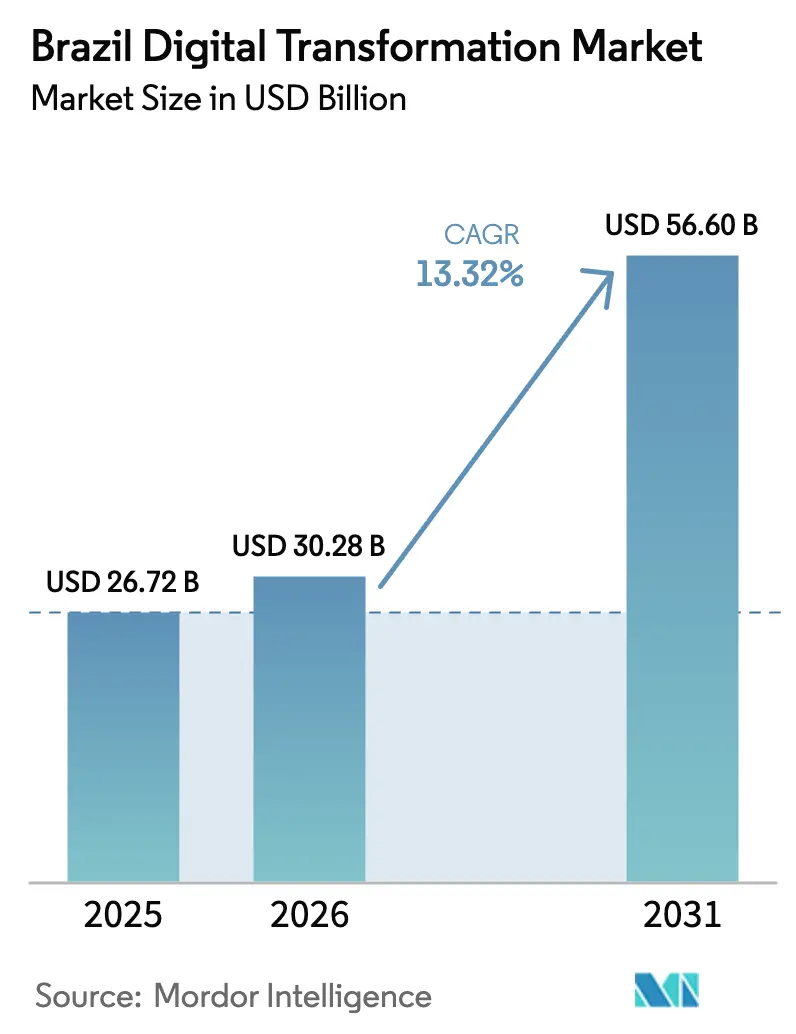
| Base Year Market Size (2025) | USD 26.72 Billion |
| Market Size (2026) | USD 30.28 Billion |
| Market Size (2031) | USD 56.60 Billion |
| Growth Rate (2026 - 2031) | 13.32 % |
| Market Concentration | Medium |
Major Players
*Disclaimer: Major Players sorted in no particular order Image © Mordor Intelligence. Reuse requires attribution under CC BY 4.0. |
|
Brazil Digital Transformation Market Analysis by Mordor Intelligence
The Brazil digital transformation market size was valued at USD 26.72 billion in 2025 and estimated to grow from USD 30.28 billion in 2026 to reach USD 56.6 billion by 2031, at a CAGR of 13.32% during the forecast period (2026-2031). Robust cloud investment by hyperscalers, the PIX payment boom, and rapid expansion of the Government of Brazil's services ecosystem are creating durable demand engines. Aggressive tax incentives under Lei do Bem are catalysing Industry 4.0 upgrades, while 5G coverage now reaching 64% of the population accelerates IoT and edge use cases. At the same time, hybrid cloud architectures and open-banking regulation are reshaping competitive strategy, spurring alliances among global and local providers. Compliance cost tied to the LGPD and legacy integration gaps inside state-owned enterprises temper the growth outlook, yet have not derailed investment momentum.
Key Report Takeaways
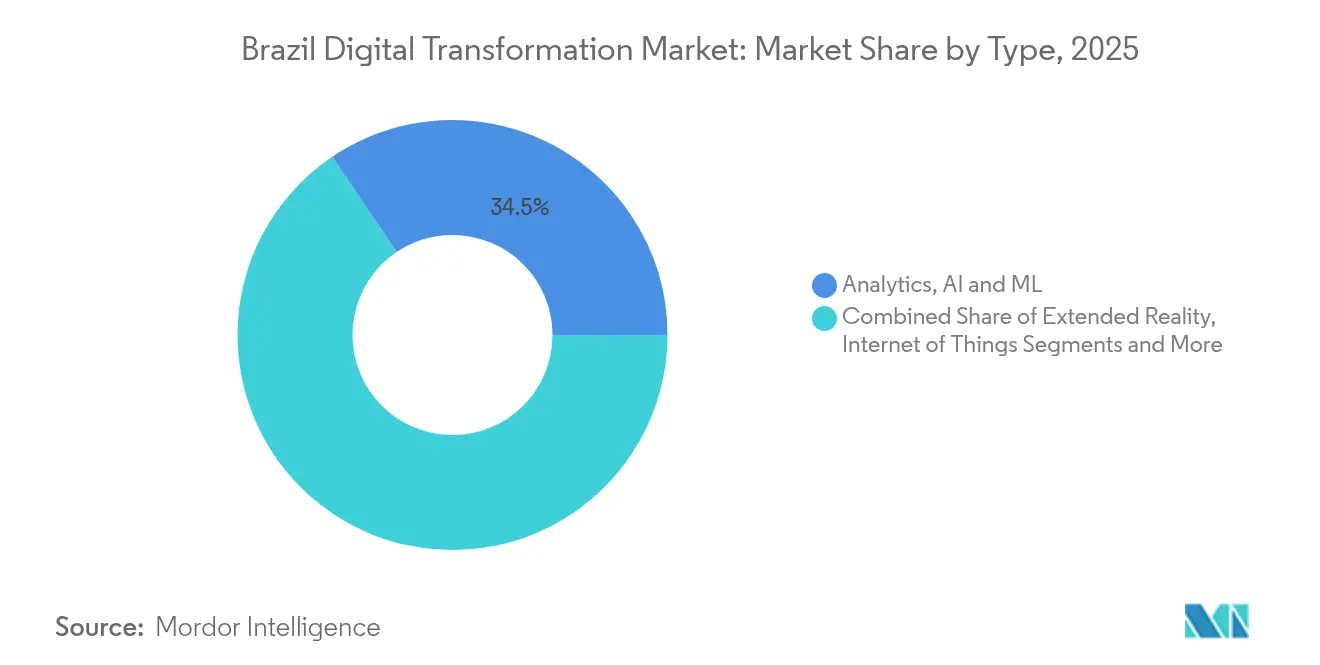
- By type, Analytics, AI & ML led with 34.45% of Brazil digital transformation market share in 2025; Extended Reality is projected to expand at a 15.05% CAGR to 2031.
- By region, the South-East commanded 53.30% of the Brazil digital transformation market size in 2025; the North is forecast to advance at a 15.52% CAGR between 2026-2031.
- By industry, BFSI accounted for 21.60% share of the Brazil digital transformation market size in 2025 and processed 42 billion PIX transactions, while Healthcare is accelerating at a 13.75% CAGR.
- By deployment mode, cloud captured 61.20% Brazil digital transformation market share in 2025; hybrid solutions are growing at a 13.45% CAGR through 2031.
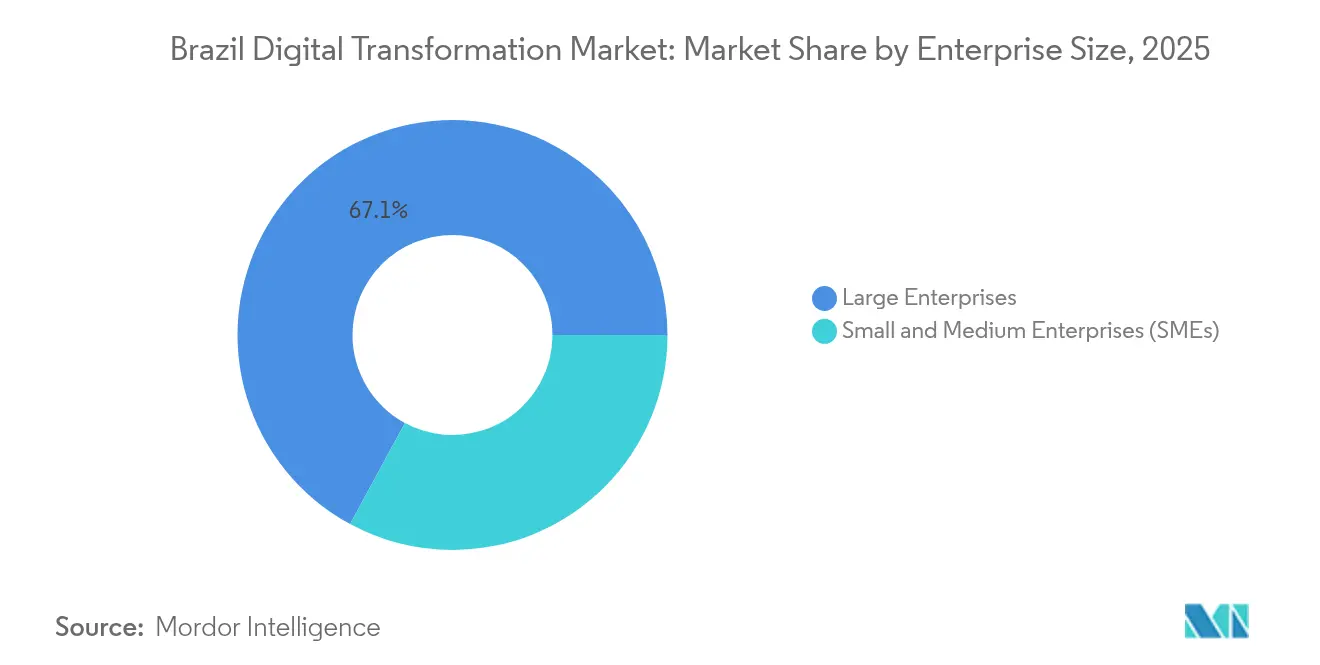
- By enterprise size, large companies held 67.10% of the Brazil digital transformation market size in 2025, but SMEs are projected to record a 15.45% CAGR to 2031.
- By service line, Integration & Implementation contributed 39.20% revenue in 2025; Managed Services are set to rise at a 13.95% CAGR.
Note: Market size and forecast figures in this report are generated using Mordor Intelligence’s proprietary estimation framework, updated with the latest available data and insights as of 2026.
No country-level or regional dataset alone defines global value; it is assembled from all contributing countries and geographies, including Brazil. Our global digital transformation (dx) market size reflects this full aggregation.
Brazil Digital Transformation Market Trends and Insights
Drivers Impact Analysis*
| Driver | (~) % Impact on CAGR Forecast | Geographic Relevance | Impact Timeline |
|---|---|---|---|
| Federal "GovTech" & gov.br digital-service expansion | +3.5% | National, with concentration in urban centers | Medium term (2-4 years) |
| Open-Banking & PIX regulation accelerating BFSI digitalisation | +3.2% | National, with higher adoption in South-East and South regions | Short term (≤ 2 years) |
| Hyperscaler data-centre build-out (AWS, Microsoft, Google, Oracle) | +2.8% | South-East (São Paulo), with expanding presence in South | Medium term (2-4 years) |
| Lei do Bem tax incentives for Industry 4.0 investments | +2.5% | National, with higher impact in industrial centers | Long term (≥ 4 years) |
| 5G roll-out enabling low-latency IoT & edge use-cases | +2.1% | National, with priority in major metropolitan areas | Medium term (2-4 years) |
| Rapid consumer shift to mobile super-apps (e.g., MercadoPago, iFood) | +1.8% | National, with higher penetration in urban areas | Short term (≤ 2 years) |
| Source: Mordor Intelligence | |||
Federal “GovTech” & Gov.br Digital-Service Expansion
Gov.br now offers 4,200 online services to 156 million users, creating a unified citizen gateway that trims bureaucratic friction.[1] dco.org The USD 150 million PRODIGITAL loan from the IDB, with USD 30 million from BNDES, extends digitalisation to states and municipalities.[2]Inter-American Development Bank, "IDB and BNDES Accelerate Digital Transformation in Brazilian States and Municipalities", IDB, iadb.orgService unification has raised Brazil’s GovTech maturity score to 0.975, a regional high. As online adoption grows, private firms gain a larger digital-ready customer base, prompting further investment. Municipal projects sized USD 2-40 million are queued for co-financing, signalling steady demand for systems integrators.
Open-Banking & PIX Regulation Accelerating BFSI Digitalisation
Brazil hosts the world’s largest open-finance data-sharing framework, with 74 million active consents from 43 million clients. PIX processed 42 billion transactions in 2023 and reached 153 million Brazilians plus 15 million firms.[3]Carlos Eduardo Brandt, "Pix: The Latest Updates on Brazil's Leading Instant Payment Scheme European Payments Council", europeanpaymentscouncil.eu Upcoming Automatic PIX and PIX by Proximity will lower checkout friction and support embedded-finance models. The Central Bank’s Drex pilot adds programmable money layers, potentially creating new business lines for fintechs. These regulatory tailwinds compress onboarding costs and widen credit availability, positioning BFSI as the anchor tenant of Brazil's digital transformation market.
Hyperscaler Data-Centre Build-Out (AWS, Microsoft, Google, Oracle)
Brazil attracted 40% of Latin American data-centre investment in 2023. AWS plans USD 1.8 billion, while Microsoft allocates USD 2.7 billion to AI-ready cloud zones. Oracle’s multicloud links with AWS, Google Cloud, and Microsoft Azure remove data-transfer charges and stack-lock-in hurdles. São Paulo hosts 670 MW operational and 770 MW planned colocation capacity, equivalent to 95% of regional supply. Hyperscaler expansion adds local low-latency zones, improves data-residency compliance, and fuels adjacent managed-service demand.
Lei do Bem Tax Incentives for Industry 4.0 Investments
Lei do Bem allows up to 200% R&D deduction and now covers qualified researcher hiring and equipment exemptions. A carry-over clause enables unused credits in future fiscal years, smoothing investment cycles. Industrial innovation rate stood at 64.6% in 2023, led by chemicals (88.7%) and machinery (88%).[4]Instituto Brasileiro de Geografia e Estatística, "Innovation Rate of Industry Drops for the Second Year in a Row", IBGE, agenciadenoticias.ibge.gov.brManufacturing R&D spend reached BRL 38.3 billion (USD 7.5 billion) in the same year. The MOVER programme raises green-mobility R&D credits to BRL 4.1 billion by 2028. These fiscal levers keep capex buoyant even amid macro volatility, sustaining the Brazil digital transformation market.
Restraints Impact Analysis*
| Restraint | (~) % Impact on CAGR Forecast | Geographic Relevance | Impact Timeline |
|---|---|---|---|
| Legacy systems within SOEs hindering integration | -1.8% | National, with concentration in federal and state-level entities | Medium term (2-4 years) |
| Shortage of senior cloud & cyber-security talent | -1.5% | National, with acute impact in South-East and South regions | Short term (≤ 2 years) |
| Import tariffs on advanced hardware (XR headsets, robots) | -1.2% | National, affecting all regions equally | Long term (≥ 4 years) |
| LGPD data-localisation compliance cost for multinationals | -1.0% | National, with higher impact on international companies | Short term (≤ 2 years) |
| Source: Mordor Intelligence | |||
Legacy Systems Within SOEs Hindering Integration
State-owned enterprises still run siloed mainframes that limit API connectivity and delay the rollout of AI or cybersecurity upgrades. Brazil ranks 49th in the UN e-Government Survey, underscoring the integration gap. PRODIGITAL’s USD 180 million allocation seeks to modernise state platforms. Nevertheless, fragmented oversight and the absence of an omnibus cybersecurity statute slow procurement and inflate project risk. Integration vendors with strong legacy-modernisation toolkits retain pricing power in this context.
LGPD Data-Localisation Compliance Cost for Multinationals
Since 2020, LGPD mandates strict data-handling rules that often require in-country storage and dual legal review with GDPR and US CLOUD Act binaries. New 2024 guidelines on breach notification sharpen reporting timelines, while ANPD’s recent autonomy signals tougher audits. Litigation is rising, with 1,789 LGPD-related cases recorded in a 12-month window. Multinationals incur incremental capex for local data-centres or encrypted multi-region designs, marginally clipping Brazil's digital transformation market growth in the near term.
*Our forecasts treat driver/restraint impacts as directional, not additive. The impact forecasts reflect baseline growth, mix effects, and variable interactions.
Segment Analysis
By Type: Analytics & AI Cement Decision Intelligence
Analytics, AI & ML generated 34.45% of Brazil digital transformation market revenue in 2025, underpinning enterprise need for predictive insight. Demand stems from credit-risk scoring, fraud detection, and public-health resource targeting. Extended Reality, projected to grow 15.05% annually, is penetrating surgical training, mental-health therapy, and immersive retail displays. These use cases bridge physical-digital divides and amplify customer experience. The Internet of Things phenomenon is next in line, supported by 27.1 billion projected connected devices by 2025 as 5G gains reach.
A rising wave of blockchain pilots in trade-finance and agribusiness traceability, coupled with robotics adoption in automotive and electronics, extends the technology palette. Cybersecurity spend, forecast at USD 5.46 billion by 2029, anchors risk-mitigation agendas. Cloud & edge computing expenditure is scaling beyond USD 4.5 billion with 41% growth, reinforcing the compute layer. Providers that package AI accelerators with secure cloud and edge nodes are best positioned to lead the Brazil digital transformation market size growth curve.



By End-User Industry: BFSI Leads Digital Revolution
The BFSI vertical owned 21.60% revenue in 2025 and remains the digital lodestar by virtue of PIX ubiquity and open-finance rulemaking. Brazil digital transformation market size for BFSI is primed to expand further as Drex and Automatic PIX unlock new monetisation pathways. Healthcare, heading for a 13.75% CAGR, is propelled by USD 200 million earmarked for digitising the public SUS network. Telemedicine, AI-assisted diagnostics, and electronic health records are the immediate beneficiaries.
Manufacturing is redoubling Industry 4.0 installations, leveraging Lei do Bem rebates to automate shop floors. Retail & e-commerce deploy AI-driven personalisation, supported by IFC’s USD 130 million infusion into Magalu’s marketplace expansion. Public-sector programmes like PRODIGITAL raise digital inclusion, while telecom operators monetise 5G through private-network offerings. The diversified opportunity canvas sustains long-run growth for the Brazil digital transformation industry segment portfolio.
By Deployment Mode: Cloud Dominance Reshapes Infrastructure
Cloud deployment controlled 61.20% of Brazil digital transformation market share in 2025, a lead built on hyperscaler capex and regulatory push for scalability. São Paulo’s data-centre boom ensures low latency and LGPD alignment. Oracle-AWS-Google multicloud interconnects are dismantling proprietary walls, giving enterprises architectural freedom. Hybrid deployment is slated for 13.45% CAGR as firms split workloads between public and private substrates to meet data-residency norms.
On-premise remains material in defence and regulated utilities, yet its share is edging lower. Architects are moving toward zero-trust frameworks anchored in cloud security posture management. Vendors that combine hybrid orchestration tools with compliance dashboards differentiate in the Brazil digital transformation market.
By Enterprise Size: SMEs Accelerate Digital Adoption
Large enterprises secured 67.10% of 2025 spend, tapping deeper capex pools to trial AI copilots, digital twins, and advanced analytics. Many also claim Lei do Bem benefits, maximising R&D offsets. SMEs, however, record a 15.45% growth clip as cloud subscriptions and low-code platforms slash entry barriers. Programmes from SEBRAE and the BRICS SME Working Group provide digital-skills vouchers and AI toolkits that level the playing field.
A youthful founder cohort leverages embedded-finance APIs and social-commerce integrations to disrupt incumbents. Service providers offering tiered managed-service bundles and outcome-based contracts will succeed in converting SME intent into Brazil digital transformation market revenue.
By Service: Integration Expertise Drives Implementation Success
Integration & Implementation accounted for 39.20% of 2025 billings, mirroring the complexity of linking legacy ERP with cloud microservices. High-touch projects in BFSI and public administration demand seasoned system integrators familiar with local regulations. PRODIGITAL’s funding stream amplifies public-sector engagement, while industry-specific data models heighten differentiation.
Managed services, projecting a 13.95% CAGR, address acute cyber-talent shortages that exceed an 800,000 professional deficit. Vendors bundle SOC-as-a-Service, cloud optimisation, and FinOps to convert capex to predictable opex. Consulting and Training streams round out portfolios, ensuring change-management success and anchoring long-term client relationships in the Brazil digital transformation market.
Geography Analysis
The South-East region held 53.30% of 2025 revenue due to São Paulo’s 670 MW live colocation capacity and 770 MW in pipeline. The concentration of financial headquarters, universities, and venture capital fuels a virtuous innovation flywheel. Start-ups here captured 81% of national tech investment inflows. High 5G coverage and fibre penetration make the region an ideal testbed for edge AI workloads. South-East is expected to retain leadership but will face competitive pressure as connectivity equalises nationwide.
The North is the fastest climber with a 15.52% CAGR, assisted by Norte Conectado fibre corridors threading the Amazon belt. Internet Exchange Points rolled out by CGI.br reduce latency and lower transit cost cgi.br. Digital inclusion translates into new e-commerce and tele-education markets, and renewable energy sites provide green power for edge data-centres. Environmental safeguards shape project design, blending conservation with economic uplift.
The South, North-East, and Centre-West display heterogenous adoption patterns. The South leverages research universities in Florianópolis and Porto Alegre to specialise in industrial IoT. The North-East channels public-private funds into telecom backbones aimed at narrowing socio-economic gaps. The Centre-West, anchored by Brasília, pilots e-government templates later replicated nationwide. National internet usage has climbed to 84% in 2024, with daily access at 96%, yet rural broadband still lags urban averages by 24 percentage points. Policies that subsidise last-mile fibre and satellite links remain critical to balanced Brazil digital transformation market growth.
The digital transformation (dx) market is assessed by Mordor Intelligence through a multi-layered geographic lens, covering other regions such as North America, Africa, and Middle East, along with detailed country-level analysis for Canada, Mexico, Nigeria, Israel, China, and United Arab Emirates.
Competitive Landscape
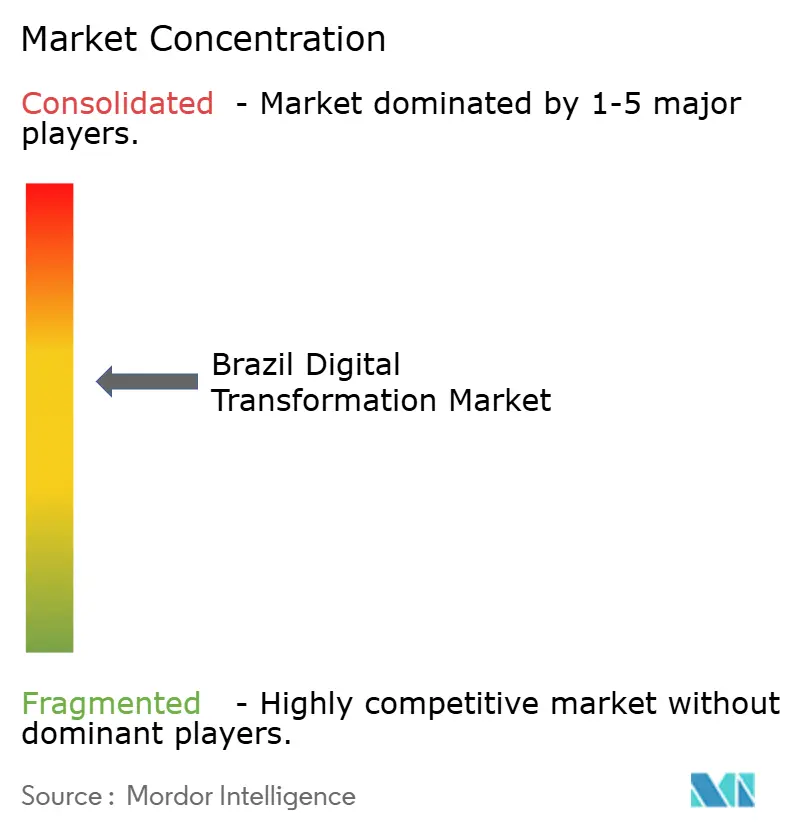
Brazil digital transformation market features moderate fragmentation: global consultancies (Accenture, IBM), hyperscalers (AWS, Microsoft), and SaaS giants jostle with local stalwarts such as TOTVS, CI&T, and Stefanini. Global firms leverage scale, while domestic players monetise regulatory fluency and cultural affinity. CI&T’s acquisition of Dextra extended agile delivery capacity and deepened sector domain credibility. Accenture invests in near-shore delivery hubs to cut project latency and talent churn.
Emerging challengers exploit white spaces. Take Blip focuses on conversational commerce; BIX Technology and Tempest Security Intelligence ride the cybersecurity swell towards USD 5.46 billion by 2029. Oracle’s multicloud alliances with Google Cloud and Microsoft Azure illustrate coopetition, enabling clients to deploy high-performance databases without egress fees. Hyperscaler regional zones generate partner ecosystems of MSPs and ISVs that localise vertical solutions.
Consolidation is likely as vendors seek scale to meet enterprise demand for end-to-end digital stacks. Data-sovereignty compliant cloud offerings and industry-specific AI accelerators remain key differentiation levers. Firms coupling technology advantage with robust compliance advisory are poised to capture a rising share of the Brazil digital transformation market.
Brazil Digital Transformation Industry Leaders
-
Luby Software LLC
-
BIX Technology
-
Siena Company
-
CI&T, Inc.
-
Stefanini Group
- *Disclaimer: Major Players sorted in no particular order

Recent Industry Developments
- May 2025: Oracle and Google Cloud linked OCI with Google Cloud to deliver zero-egress multicloud in 11 regions including Brazil East, supporting AI-heavy workloads
- April 2025: IFC committed USD 130 million to Magalu’s infrastructure upgrade, targeting e-waste recycling and SME onboarding
- April 2025: Central Bank announced PIX instalment functionality for launch in September 2025, expanding payment versatility
- March 2025: Microsoft and Oracle enlarged their multicloud pact by 24 regions, boosting resilience for Brazilian enterprises


Brazil Digital Transformation Market Report Scope
Digital transformation is the process of incorporating digital technologies such as analytics, artificial intelligence, and machine learning, extended reality (XR), Iot, industrial robotics, blockchain, additive manufacturing/3D printing, cybersecurity, cloud and edge computing, and others (digital Twin, mobility, and connectivity) in various end-user industries across the country.
Brazil digital transformation market is segmented by type (analytics, artificial intelligence, and machine learning, extended reality (XR), iot, industrial robotics, blockchain, additive manufacturing/3d printing, cybersecurity, cloud and edge computing, and others [digital twin, mobility, and connectivity]), end-user industry (manufacturing, oil, gas and utilities, retail & e-commerce, transportation and logistics, healthcare, bfsi, telecom and it, government and public sector, and others). The market sizes and forecasts are provided in terms of value (USD) for the segments.
| Analytics, AI and ML |
| Extended Reality (XR) |
| Internet of Things (IoT) |
| Industrial Robotics |
| Blockchain |
| Additive Manufacturing / 3-D Printing |
| Cyber-security |
| Cloud and Edge Computing |
| Others (Quantum, RPA, etc.) |
| Manufacturing |
| Oil, Gas and Utilities |
| Retail and E-commerce |
| Transportation and Logistics |
| Healthcare |
| BFSI |
| Telecom and IT |
| Government and Public Sector |
| Others (Education, Media, etc.) |
| On-premise |
| Cloud |
| Hybrid |
| Large Enterprises |
| Small and Medium Enterprises (SMEs) |
| Consulting |
| Integration and Implementation |
| Managed Services |
| Training and Support |
| By Type | Analytics, AI and ML |
| Extended Reality (XR) | |
| Internet of Things (IoT) | |
| Industrial Robotics | |
| Blockchain | |
| Additive Manufacturing / 3-D Printing | |
| Cyber-security | |
| Cloud and Edge Computing | |
| Others (Quantum, RPA, etc.) | |
| By End-User Industry | Manufacturing |
| Oil, Gas and Utilities | |
| Retail and E-commerce | |
| Transportation and Logistics | |
| Healthcare | |
| BFSI | |
| Telecom and IT | |
| Government and Public Sector | |
| Others (Education, Media, etc.) | |
| By Deployment Mode | On-premise |
| Cloud | |
| Hybrid | |
| By Enterprise Size | Large Enterprises |
| Small and Medium Enterprises (SMEs) | |
| By Service | Consulting |
| Integration and Implementation | |
| Managed Services | |
| Training and Support |


Key Questions Answered in the Report
What is the current value of the Brazil digital transformation market?
The market stands at USD 30.28 billion in 2026 and is projected to reach USD 56.6 billion by 2031 at a 13.32% CAGR during 2026-2031.
Which segment holds the largest Brazil digital transformation market share?
Analytics, AI & ML leads with 34.45% share, reflecting strong demand for data-driven decision tools.
How fast is cloud adoption growing in Brazil?
Cloud deployment already commands 61.20% share and hybrid models are expanding at a 13.45% CAGR as firms balance flexibility with data-sovereignty.
Why is BFSI a priority industry for digital investment?
Regulatory innovations such as PIX and open-finance APIs have shortened onboarding times and scaled instant payments to 153 million users, driving sustained tech spend.
What challenges could slow Brazil digital transformation market growth?
Integration of legacy systems in state-owned enterprises and rising LGPD compliance costs for multinationals impose near-term friction but are being mitigated by targeted policy programmes.
Which regions present the fastest growth opportunities?
The North region, supported by the Norte Conectado fibre project, is projected to grow at 15.52% CAGR between 2026-2031, creating new demand for connectivity and digital services.
Page last updated on:


 Your data is secure and never sold or shared.


