
Netherlands Digital Transformation Market Size and Share
Market Overview
| Study Period | 2020 - 2031 |
|---|---|
| Forecast Data Period | 2026 - 2031 |
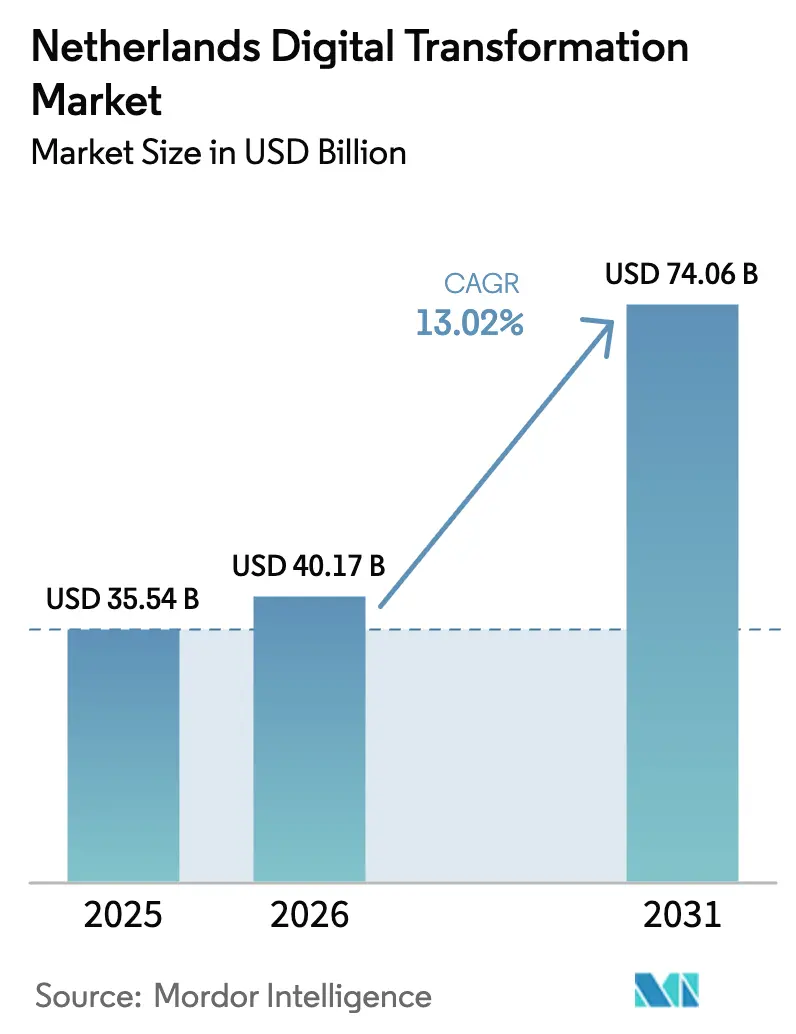
| Base Year Market Size (2025) | USD 35.54 Billion |
| Market Size (2026) | USD 40.17 Billion |
| Market Size (2031) | USD 74.06 Billion |
| Growth Rate (2026 - 2031) | 13.02 % |
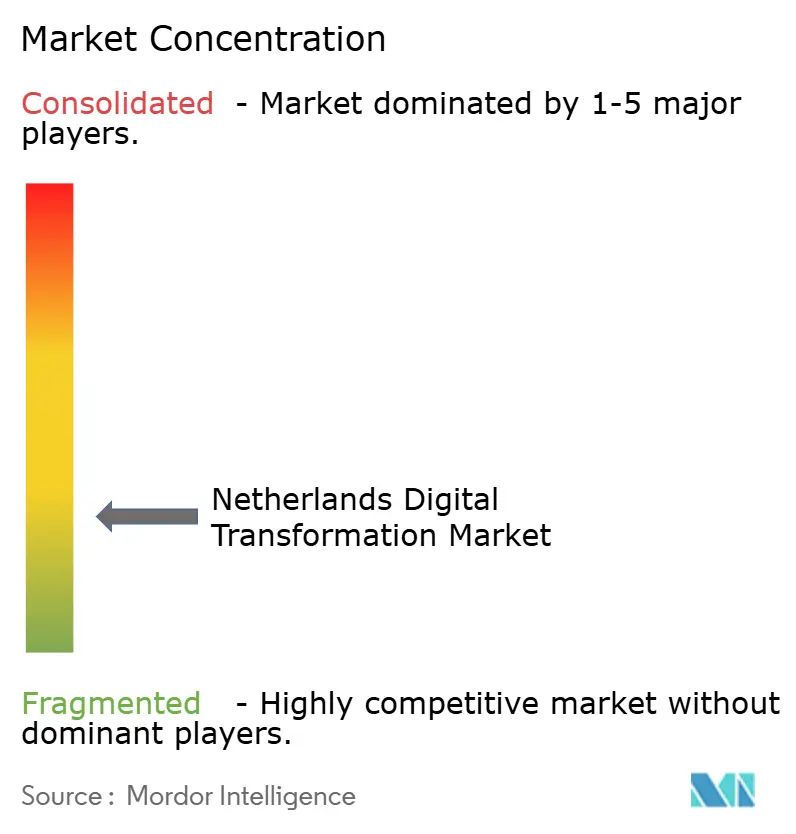
| Market Concentration | Low |
Major Players *Disclaimer: Major Players sorted in no particular order Image © Mordor Intelligence. Reuse requires attribution under CC BY 4.0. | |
Netherlands Digital Transformation Market Analysis by Mordor Intelligence
The Netherlands Digital Transformation Market size is expected to grow from USD 35.54 billion in 2025 to USD 40.17 billion in 2026 and is forecast to reach USD 74.06 billion by 2031 at 13.02% CAGR over 2026-2031. Mandatory e-invoicing, aggressive 5G roll-outs, and EUR 1.7 billion in Digital Europe funding underpin the current expansion. The combination of near-universal gigabit broadband, 95% organizational AI adoption, and a sustained venture-capital influx has positioned the country as a regional testbed for cloud-native and quantum-ready solutions. Energy-efficient datacenter innovation, hybrid cloud models, and AI-powered automation are opening new revenue pools for suppliers that can address data-sovereignty demands alongside scalability requirements. Yet the Netherlands digital transformation market must also navigate grid congestion, GDPR compliance costs, and an acute talent shortfall that slows deployment timelines while raising project risk.
Key Report Takeaways
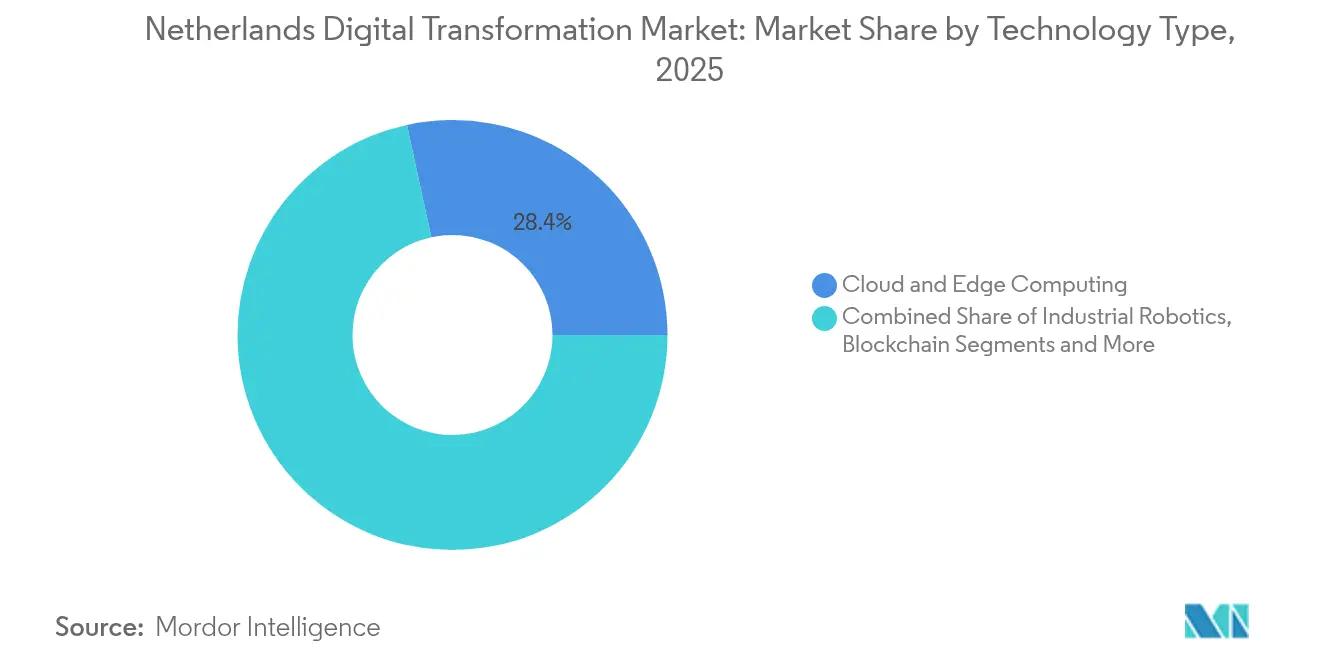
- By technology type, Cloud & Edge Computing led with a 28.40% revenue share in 2025, while Digital Twin & Edge-AI is forecast to advance at a 21.95% CAGR through 2031.
- By end-user industry, Banking, Financial Services and Insurance held 19.75% of the Netherlands digital transformation market share in 2025, whereas Transportation & Logistics is projected to expand at an 18.05% CAGR to 2031.
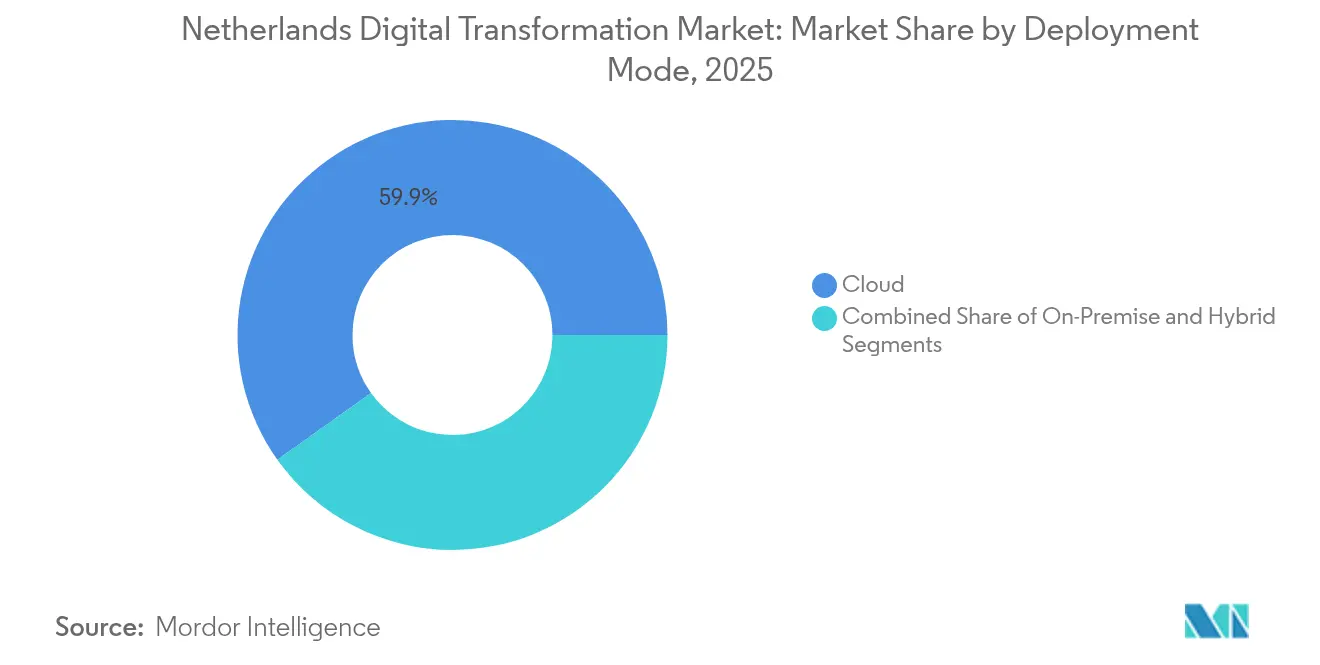
- By deployment mode, cloud models commanded 59.85% of the Netherlands digital transformation market size in 2025, while hybrid architectures are growing fastest at 17.15% CAGR during the forecast period.
- By enterprise size, large enterprises accounted for 50.35% share of the Netherlands digital transformation market size in 2025; small and mid-sized enterprises are set to increase at a 15.85% CAGR to 2031.
- By business function, operations contributed 26.20% of 2025 revenue, with supply-chain & procurement activities advancing at the highest 16.3% CAGR toward 2031.
Note: Market size and forecast figures in this report are generated using Mordor Intelligence’s proprietary estimation framework, updated with the latest available data and insights as of 2026.
The contribution of Netherlands may read different when placed against the full pool of global outputs. The worldwide digital transformation (dx) market shares by Mordor Intelligence reflect that proportional balance.
Netherlands Digital Transformation Market Trends and Insights
Drivers Impact Analysis*
| Driver | (~) % Impact on CAGR Forecast | Geographic Relevance | Impact Timeline |
|---|---|---|---|
| Explosive adoption of big-data, AI & ML across Dutch enterprises | +2.8% | National (Randstad, Eindhoven) | Medium term (2-4 years) |
| Government “Digital Agenda 2030” & broadband coverage | +2.1% | National (rural gaps remain) | Long term (≥ 4 years) |
| Rapid proliferation of 5G-enabled apps & services | +1.9% | Urban centers expanding outward | Short term (≤ 2 years) |
| Surge in cloud-native start-ups & hyperscale datacenters | +1.7% | Amsterdam and Rotterdam-The Hague corridors | Medium term (2-4 years) |
| Mandatory B2G/B2B e-invoicing | +1.4% | Nationwide | Short term (≤ 2 years) |
| Net-zero targets driving digital-twin roll-outs | +1.6% | Port cities and industrial corridors | Long term (≥ 4 years) |
| Source: Mordor Intelligence | |||
IT and Telecom to witness Significant Growth Opportunities
Nationwide gigabit connectivity enables frictionless cloud migration and feeds demand for data-intensive use cases. The Ministry of Economic Affairs reports 98% coverage at 100 Mbps and targets universal 1 Gbps by 2030, European Commission.[1]European Commission, “Digital Connectivity in the Netherlands,” digital-strategy.ec.europa.eu SMEs receive EUR 1.7 billion in grant backing to close capability gaps, and the planned Rijkscloud is expected to keep sensitive workloads on Dutch soil. Superior project execution has allowed the country to capture 11.7% of EU Digital Europe funds, well above its population share, signalling policymaker effectiveness.
Explosive Adoption of Big-Data, AI & ML Across Dutch Enterprises
With 95% of organizations already piloting or deploying AI, the Netherlands leads Europe in enterprise-scale implementation.[2]Computer Weekly, “Dutch workforce faces radical transformation as AI adoption accelerates,” computerweekly.com Public investment in the EUR 204.5 million AINEd program and the national GTP-NL language model lowers entry barriers for SMEs, while regional AI factories in Groningen and Amsterdam drive knowledge clustering. Banks project that 43% of jobs will feel AI impact, yet union frameworks ensure orderly reskilling, sustaining technology demand without social backlash.
Rapid Proliferation of 5G-Enabled Mobile Apps & Services
Nationwide network upgrades led by KPN, VodafoneZiggo, and Odido deliver average urban download speeds of 189 Mbps and unlock industrial IoT deployment in sectors such as logistics and manufacturing. Collision-avoidance trials linking KPN and TNO validate ultra-low-latency performance for autonomous vehicles. The Port of Rotterdam leverages 5G to cut CO2 emissions through optimized vessel routing.[3]Port of Rotterdam, “Improving logistics processes,” portofrotterdam.com
Surge in Cloud-Native Start-Ups & Hyperscale Datacenter Investments
Dutch start-ups attracted EUR 3.1 billion in 2024 funding, 35% of it targeting deep-tech domains. However, grid congestion in Noord-Holland forces datacenters onto waiting lists, spurring interest in energy-efficient architectures and edge nodes that limit central-site power draw.[4]TenneT, “No extra space on electricity grid,” tennet.eu 4 Government cloud ODC-Noord demonstrates 30% cost savings through OpenStack and Ceph, showcasing a viable model for sovereign cloud at scale.
Restraints Impact Analysis*
| Restraint | (~) % Impact on CAGR Forecast | Geographic Relevance | Impact Timeline |
|---|---|---|---|
| Intensifying GDPR-linked data-privacy compliance burden | -1.8% | EU-wide, affecting multinational operations | Medium term (2-4 years) |
| Acute shortage of advanced digital talent despite high ICT wages | -2.1% | National, concentrated in tech hubs | Long term (≥ 4 years) |
| High upfront capex for SMEs modernising legacy core systems | -1.4% | National, affecting 99.9% of Dutch businesses | Short term (≤ 2 years) |
| Energy-price volatility undermining new datacentre expansion | -1.2% | Regional, affecting Noord-Holland and major urban areas | Medium term (2-4 years) |
| Source: Mordor Intelligence | |||
Intensifying GDPR-Linked Data-Privacy Compliance Burden
Enhanced enforcement and higher fine ceilings raise the cost of cross-border data handling. Multinationals spend additional budget on privacy-by-design audits, while SMEs struggle with legal complexity and documentation needs. Cloud providers react with region-locked instances and encryption-as-a-service offerings, creating fragmentation risk for the Netherlands' digital transformation market. The Court of Audit found two-thirds of government workloads lacked mandatory assessments, highlighting systemic gaps that inflate remediation expenses.
Acute Shortage of Advanced Digital Talent Despite High ICT Wages
Sector wages outpace EU peers, yet vacancy rates remain elevated. ICT services growth slowed to 1.4% in 2025 from 5% in 2022 because labour supply lagged demand. The EUR 204.5 million AINEd program will only yield skilled graduates from 2027 onward, leaving a near-term execution gap. Firms import specialists, but housing shortages in Amsterdam and Eindhoven limit relocation flexibility, raising project costs and elongating go-live schedules.
*Our forecasts treat driver/restraint impacts as directional, not additive. The impact forecasts reflect baseline growth, mix effects, and variable interactions.
Segment Analysis
By Technology Type: Cloud Retains Scale While AI Leads Momentum
Cloud & Edge Computing contributed the largest 28.40% slice of the Netherlands digital transformation market in 2025. Government adoption of open-source stacks at ODC-Noord signals long-term commitment to sovereign hosting. Digital Twin & Edge-AI is projected to expand by 21.95% CAGR to 2031, accelerated by industrial twins in maritime, manufacturing, and urban mobility. Analytics, AI & ML ranks second in revenue as enterprises integrate classical pipelines with emerging quantum workflows at Amsterdam Science Park.
Industrial robotics use cases are converging with additive manufacturing to offset labour expenses and shorten prototype cycles, especially in the automotive supply chain. Cybersecurity investment is rising fast following Eye Security’s EUR 36 million Series B and the impending NIS2 directive. Blockchain remains exploratory yet shows promise in energy-sector emissions tracing and peer-to-peer power trading via the European Blockchain Sandbox. This technological mosaic is creating an integrated innovation stack that powers the Netherlands' digital transformation market through the decade.



By End-User Industry: BFSI Sets Pace, Logistics Surges Ahead
BFSI captured 19.75% of 2025 revenue in the Netherlands digital transformation market, reflecting large-scale platform revamps such as ING’s EUR 800 million Think Forward program and ABN AMRO’s Nuxeo migration. Transportation & Logistics is moving fastest, heading for an 18.05% CAGR as ports deploy IoT sensors, AI twins, and blockchain for paperless corridors.
Manufacturing momentum is driven by the Smart Industry initiative, which has engaged over 800 companies in pilots spanning predictive maintenance and cobot deployment. Healthcare gains ground through AI-enabled imaging and triage, with clinicians positioning machine learning as a modern equivalent of the sewerage revolution in public health. Utilities and energy operators confront grid congestion by digitizing asset management and deploying BESS orchestration software, generating fresh demand for edge analytics and resilient SCADA upgrades.
By Deployment Mode: Hybrid Balances Sovereignty and Scale
Cloud instances represented 59.85% of the Netherlands digital transformation market size in 2025, boosted by government cloud adoption and robust hyperscaler presence. Hybrid frameworks are gaining ground at 17.15% CAGR through 2031, as public agencies and heavily regulated industries combine private stacks with burst-to-cloud flexibility to satisfy data-residency mandates. On-premise solutions persist in critical banking workflows and industrial control systems where latency and security demands remain stringent.
The ACM study flagged potential price and innovation risks from concentrated hyperscaler supply, reinforcing hybrid-first procurement strategies. Edge nodes attached to wind farms and factory floors further diversify deployment, alleviating power-draw constraints in congested grid zones while ensuring compliance with evolving cloud risk guidelines from the Court of Audit.
By Enterprise Size: SMEs Accelerate Under Policy Tailwinds
Large enterprises still produce the majority 50.35% revenue share, but SMEs are propelling growth via a 15.85% CAGR. The Digital Europe program puts EUR 16.2 million toward co-financing SME projects and aims for 95% basic digitalization by 2030. Banking collaborations such as ABN AMRO’s facility with the European Investment Bank deliver favourable lending terms for intangible transformation assets.
EnableNow’s EUR 650,000 funding illustrates fintech traction in compliance-as-a-service models that ease PSD2 burdens for smaller firms. Yet SMEs often defer AI and cyber-security deployments due to skills scarcity, forcing public-private coalitions like MKB Digiwerkplaats to step in with training and template frameworks.
By Business Function: Operations Dominate, Supply Chain Transforms
Operations accounted for 26.20% of spending in 2025, driven by plant-floor IoT, predictive analytics, and robotics integration across high-tech manufacturing clusters. Supply-chain & procurement activities are forecast to climb 16.3% CAGR as firms seek real-time material visibility to counter volatile commodity pricing.
Finance & accounting digitization gains momentum from embedded-finance offerings that weave credit and payments into non-financial platforms, as charted by De Nederlandsche Bank. AI-driven marketing tools studied by ShoppingTomorrow improve conversion rates by tailoring content to individual customer journeys. HR teams prioritise reskilling against the backdrop of 43% AI-impacted roles, extending demand for learning-management platforms integrated with national upskilling initiatives.
Geography Analysis
The West Netherlands cluster—Amsterdam, Rotterdam, The Hague, and Utrecht—anchors the Netherlands digital transformation market through a dense mix of multinationals, start-ups, the AMS-IX exchange, and the newly designated EU quantum computer site. The region’s 8.1 million inhabitants generate EUR 367 billion in gross regional product, accounting for more than half of national output. Energy-grid bottlenecks in Noord-Holland and Zuid-Holland have triggered EUR 195 billion in planned upgrades, along with experimental energy hubs that open doors for smart-grid technology vendors.
South Netherlands, centred on the Brainport Eindhoven and Rotterdam-The Hague corridor, excels in industrial digitalization. The Autonomous Factory project drives adoption of AI-enhanced cobots and additive manufacturing, while the Port of Rotterdam’s 4D twin underscores logistics leadership. Regional universities supply a steady pipeline of engineers, helping the area capture 75% of Dutch R&D activities.
East and North Netherlands rely on targeted public investment to balance national growth. Groningen’s EUR 200 million AI factory, backed by cabinet, regional, and EU funds, provides supercomputer access for local firms, particularly in agri-tech and energy transition applications. Rural connectivity upgrades extend broadband to remote farmland, enabling sensor-driven crop management and renewable-energy micro-grids that link back to national markets through hybrid cloud-edge architectures.
The digital transformation (dx) market is analyzed by Mordor Intelligence across multiple other geographies, with in-depth regional assessments available for Europe, North America, and Africa. This is complemented by country-specific insights for France, Italy, United States, Nigeria, Brazil, and Colombia, reflecting various localized market behavior and policy environments' coverage.
Competitive Landscape
Global vendors such as Microsoft, IBM, and SAP compete with Dutch specialists like Eye Security and Fortaegis, leaving the Netherlands digital transformation market moderately fragmented. Venture capital grew 47% in 2024 despite wider European declines, indicating sustained appetite for disruptive plays. AI-centred capabilities have become the primary differentiator, with firms pitching pre-trained models that speed deployment while safeguarding EU data-sovereignty requirements.
Government funding of EUR 1.7 billion through Digital Europe and parliamentary backing for a Rijkscloud unlock grants that offset R&D risk, enticing both incumbents and start-ups into co-innovation consortia. The Port of Rotterdam offers a live sandbox for AI, edge-compute, and 5G service providers, further intensifying competition among system integrators who can demonstrate operational outcomes.
White-space opportunities include hybrid cloud-edge orchestration engines, quantum-classical bridges, and BESS-ready energy-management platforms. TenneT’s forecast of up to 12.7 GW battery capacity by 2030 highlights market headroom for software that balances storage fleets against volatile renewables. Success will hinge on domain depth, regulatory fluency, and an ability to recruit or train scarce AI and cyber-security talent at speed.
Netherlands Digital Transformation Industry Leaders
Accenture PLC
Google LLC (Alphabet Inc.)
IBM Corporation
Microsoft Corporation
Oracle Corporation
- *Disclaimer: Major Players sorted in no particular order

Recent Industry Developments
- June 2025: Dutch cabinet and Groningen region finalised EUR 200 million investment for a regional AI factory.
- May 2025: ING reported EUR 1.455 billion Q1 2025 net result and launched OneApp to unify retail and business banking.
- April 2025: Government allotted EUR 1.7 billion Digital Europe funds for 2025–2027, including EUR 16.2 million to co-finance SME projects.
- March 2025: Dutch Parliament approved the national Rijkscloud motion.


Netherlands Digital Transformation Market Report Scope
Digital transformation involves integrating technologies like analytics, artificial intelligence, machine learning, extended reality (XR), IoT, industrial robotics, blockchain, additive manufacturing/3D printing, cybersecurity, cloud and edge computing, among others, across various end-user industry verticals.
The Netherlands digital transformation market is segmented by type (analytics, artificial intelligence and machine learning, extended reality (XR), IoT, industrial robotics, blockchain, additive manufacturing/3D printing, cybersecurity, cloud and edge computing, and others (digital twin, mobility, and connectivity)), end-user industry (manufacturing, oil, gas and utilities, retail & e-commerce, transportation and logistics, healthcare, BFSI, telecom and IT, government and public sector, and others (education, media & entertainment, environment, etc. )).
The market sizes and forecasts are provided in terms of value in USD for all the above segments.
| Analytics, AI and ML |
| Industrial Robotics |
| Blockchain |
| Additive Manufacturing / 3-D Printing |
| Cloud and Edge Computing |
| Digital Twin and Edge-AI |
| Others (Digital Twin, Mobility, Connectivity) |
| Manufacturing |
| Oil, Gas and Utilities |
| Retail and e-Commerce |
| Transportation and Logistics |
| Healthcare |
| BFSI |
| Telecom and IT |
| Government and Public Sector |
| Others (Education, Media and Entertainment, Environment) |
| On-premise |
| Cloud |
| Hybrid |
| Large Enterprises |
| Small and Mid-sized Enterprises |
| Operations |
| Finance and Accounting |
| Sales and Marketing |
| Human Resources |
| Supply-Chain / Procurement |
| By Technology Type | Analytics, AI and ML |
| Industrial Robotics | |
| Blockchain | |
| Additive Manufacturing / 3-D Printing | |
| Cloud and Edge Computing | |
| Digital Twin and Edge-AI | |
| Others (Digital Twin, Mobility, Connectivity) | |
| By End-User Industry | Manufacturing |
| Oil, Gas and Utilities | |
| Retail and e-Commerce | |
| Transportation and Logistics | |
| Healthcare | |
| BFSI | |
| Telecom and IT | |
| Government and Public Sector | |
| Others (Education, Media and Entertainment, Environment) | |
| By Deployment Mode | On-premise |
| Cloud | |
| Hybrid | |
| By Enterprise Size | Large Enterprises |
| Small and Mid-sized Enterprises | |
| By Business Function | Operations |
| Finance and Accounting | |
| Sales and Marketing | |
| Human Resources | |
| Supply-Chain / Procurement |


Key Questions Answered in the Report
How big is the Netherlands Digital Transformation Market?
The Netherlands Digital Transformation Market size is expected to reach USD 40.17 billion in 2026 and grow at a CAGR of 13.02% to reach USD 74.06 billion by 2031.
What is the current Netherlands Digital Transformation Market size?
In 2026, the Netherlands Digital Transformation Market size is expected to reach USD 40.17 billion.
Who are the key players in Netherlands Digital Transformation Market?
Accenture PLC, Google LLC (Alphabet Inc.), IBM Corporation, Microsoft Corporation and Oracle Corporation are the major companies operating in the Netherlands Digital Transformation Market.
What years does this Netherlands Digital Transformation Market cover, and what was the market size in 2025?
In 2025, the Netherlands Digital Transformation Market size was estimated at USD 40.17 billion. The report covers the Netherlands Digital Transformation Market historical market size for years: 2019, 2020, 2021, 2022, 2023 and 2024. The report also forecasts the Netherlands Digital Transformation Market size for years: 2026, 2027, 2028, 2029, 2030 and 2031.
Page last updated on:


 Your data is secure and never sold or shared.


