
Market Overview
| Study Period | 2021 - 2031 |
|---|---|
| Forecast Data Period | 2026 - 2031 |
| Base Year Market Size (2025) | USD 7.93 Billion |
| Market Size (2026) | USD 8.42 Billion |
| Market Size (2031) | USD 11.38 Billion |
| Growth Rate (2026 - 2031) | 6.22 % |
| Market Concentration | Medium |
Major Players *Disclaimer: Major Players sorted in no particular order Image © Mordor Intelligence. Reuse requires attribution under CC BY 4.0. | |
Brazil Agricultural Machinery Market Analysis by Mordor Intelligence
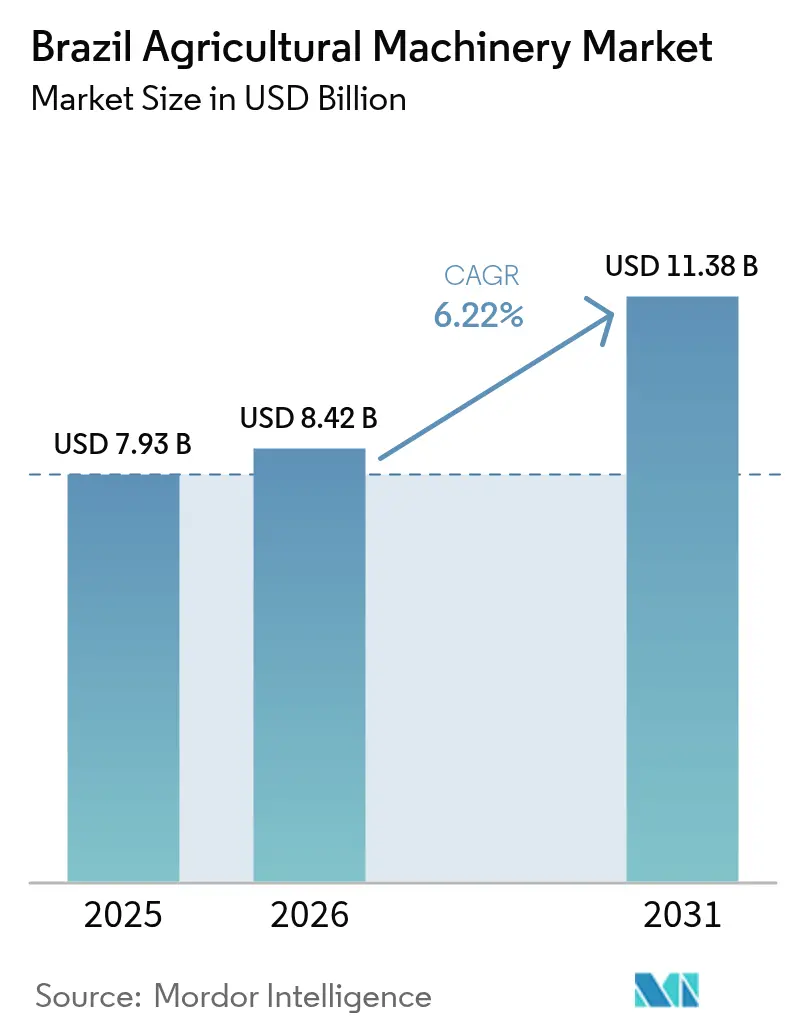
The Brazil agricultural machinery market size is expected to grow from USD 7.93 billion in 2025 to USD 8.42 billion in 2026 and is forecast to reach USD 11.38 billion by 2031 at 6.22% CAGR over 2026-2031. Continued expansion of large-scale soybean, corn, and sugarcane farms, wider access to subsidized credit, and rapid diffusion of precision farming tools are the core engines propelling the Brazil agricultural machinery market. Demand remains resilient even in a high-interest-rate environment because government programs channel low-cost funds toward machinery upgrades, and OEM (Original Equipment Manufacturer) service bundles cut operating costs through predictive maintenance. Farm consolidation in the Center-West supports steady replacement cycles for tractors and harvesters, while frontier regions such as Matopiba (a region formed by parts of Tocantins, Maranhao, Piaui, and Bahia states) fuel first-time purchases of irrigation and spraying systems. At the same time, carbon-credit incentives and sustainability mandates expand the addressable base for fuel-efficient models that lower emissions and capture additional income streams for growers.
Key Report Takeaways
- By machinery type, tractors commanded 45.32% of Brazil agricultural machinery market share in 2025, while hay and forage machinery is projected to expand at a 5.82% CAGR through 2031.
Note: Market size and forecast figures in this report are generated using Mordor Intelligence’s proprietary estimation framework, updated with the latest available data and insights as of 2026.
Brazil Agricultural Machinery Market Trends and Insights
Drivers Impact Analysis*
| Driver | (~) % Impact on CAGR Forecast | Geographic Relevance | Impact Timeline |
|---|---|---|---|
| Soaring Mechanized-Harvest Mandates | +1.2% | São Paulo, Minas Gerais, Goiás | Medium term (2-4 years) |
| Digital-ag Credit from Government Policies | +0.9% | National, Center-West focus | Short term (≤2 years) |
| Expansion of Center-Pivot Financing via Banks | +0.8% | Mato Grosso, Goiás, Bahia | Medium term (2-4 years) |
| OEM Telematics-as-a-Service Bundles | +0.7% | National, large farms early | Long term (≥4 years) |
| Carbon-Credit Premiums for Tractors | +0.5% | Amazon basin, Cerrado fringe | Long term (≥4 years) |
| Satellite-Enabled Ag-IoT Expansion in Frontier Ecosystems | +0.6% | MATOPIBA, North | Medium term (2-4 years) |
| Source: Mordor Intelligence | |||
Digital-ag Credit from Government Policies
Plano Safra 2025/26 released BRL 516.2 billion (USD 93.9 billion) in rural credit, with lines priced at 2.5% for machinery up to BRL 100,000 (USD 18,200) and 5% up to BRL 250,000 (USD 45,500). Embedded fintech processes accelerate loan approval, enabling mid-sized growers to transition from cash purchases to structured financing. BNDES (The Brazilian Economic and Social Development Bank) added BRL 70 billion (USD 12.8 billion) solely for tech-enabled equipment bundles, linking funding to precision-ag Key Performance Indicators.[1] Newly issued digital grain receipts (CPRs) are now accepted as collateral, broadening credit access for tenant farmers.
Expansion of Center-Pivot Financing via Banks
Center-pivot counts in Mato Grosso leapt 226% in one year as lenders lengthened amortization to eight harvest cycles. Lindsay Corporation’s Smart Pivot trials confirmed 15% yield lifts and 27% water savings, validating the returns that underpin those loan products.[2] Insurers now bundle rainfall-index coverage with irrigation loans, trimming default risk tied to drought. Equipment dealers respond by stocking modular spans that can be expanded when growers refinance.
OEM Telematics-as-a-Service Bundles
Deere & Company’s SpaceX satellite link lets machines stream diagnostics from frontier fields, and AGCO’s PTx Trimble stack pushes remote software updates. Subscription pricing converts capital outlays into predictable opex, cushioning growers against commodity swings. Predictive maintenance has cut unplanned downtime by 18% on early adopter fleets, validating the pay-as-you-go model. Deere & Company recently added agronomic prescription services to the same package, turning telematics into a full decision-support platform.
Carbon-Credit Premiums for Tractors
Law 15.042 lets farms monetize fuel-efficient tractor upgrades, and Petrobras pledged BRL 450 million (USD 81.8 million) for forest-linked offsets. Tier 4-final engines documented through onboard telematics qualify for saleable credits that average USD 7 per metric ton. The National Green Mobility Program stacks purchase rebates on top, shrinking payback to under four seasons. Large cereal growers now factor projected carbon revenue into machine TCO (Total Cost of Ownership) calculations.
Restraints Impact Analysis*
| Restraint | (~) % Impact on CAGR Forecast | Geographic Relevance | Impact Timeline |
|---|---|---|---|
| High Financing Costs amid Selic Volatility | -1.8% | National, sharpest in Northeast and South | Short term (≤2 years) |
| Grain-Price Downturn Dampening CAPEX | -1.1% | Center-West, Rio Grande do Sul | Medium term (2-4 years) |
| Data-Sovereignty Litigation on Farm Analytics | -0.4% | National, large enterprises | Long term (≥4 years) |
| Sub-Scale Farms’ Limited ROI on Automation | -0.7% | Northeast, family farms | Long term (≥4 years) |
| Source: Mordor Intelligence | |||
High Financing Costs Amid Selic Volatility
The Selic climbed from 10.5% to 13.25% in early 2025, driving commercial equipment loans above 20%. Bank data show a 30% drop in non-subsidized applications, with mid-size growers delaying combine replacements. Currency swings inflate imported parts costs, further eroding purchasing power. Some OEMs now offer factory-backed rate buy-downs to keep volumes moving.
Data-Sovereignty Litigation on Farm Analytics
Court challenges over cross-border data flows raise compliance costs for cloud telematics. OEMs must invest in local servers and legal audits, adding up to 8% to subscription fees. Large growers hesitate to share operational data with foreign platforms until rules stabilize.[3] Industry groups now lobby for a sector-specific data framework to unlock adoption.
*Our forecasts treat driver/restraint impacts as directional, not additive. The impact forecasts reflect baseline growth, mix effects, and variable interactions.
Segment Analysis
By Machinery Type: Dominance of Tractors and Upswing in Forage Equipment
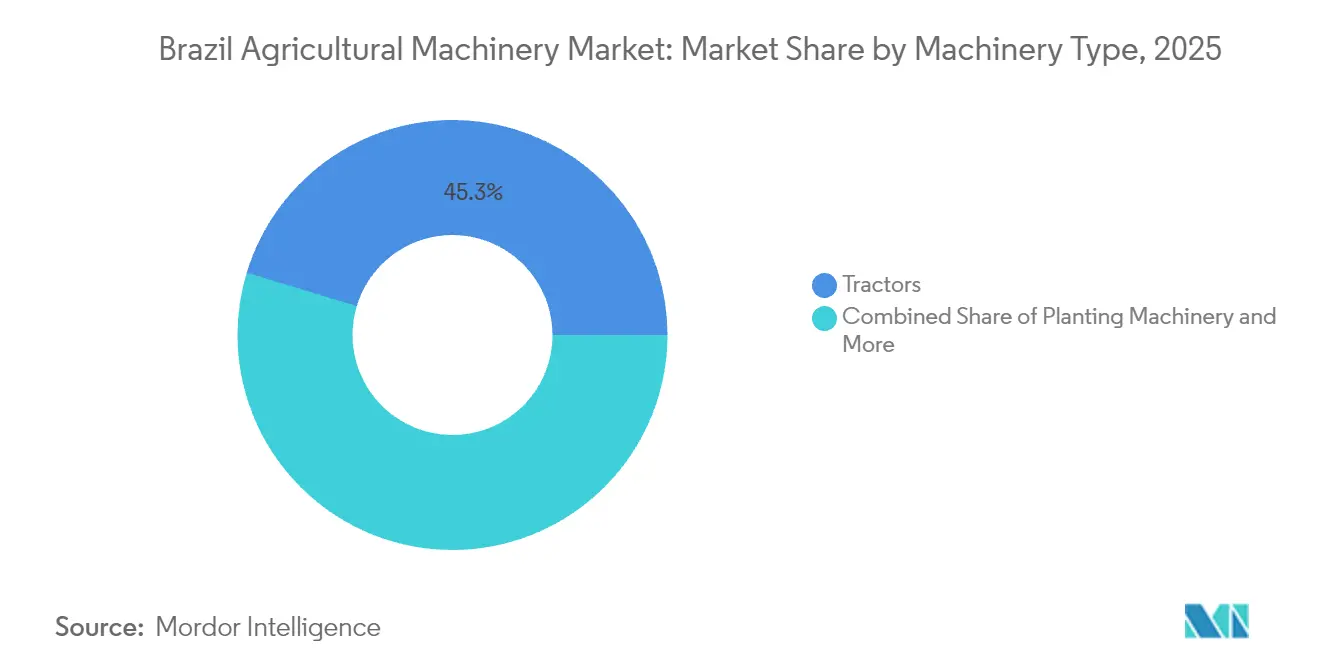
Tractors accounted for 45.32% of Brazil agricultural machinery market share in 2025, underscoring their position as the primary power source across grain, sugarcane, and mixed-farming operations. Their broad utility makes them the anchor of fleet-renewal cycles, and steady replacement demand in the Center-West keeps this segment the largest contributor to Brazil agricultural machinery market size. Harvesting and spraying equipment follow in value as growers pair combines and self-propelled sprayers with precision guidance to protect yield and curb input waste. Irrigation systems post double-digit value gains in frontier regions, yet their absolute share remains smaller because high upfront costs limit initial adoption outside Mato Grosso and Goiás.
Hay and forage machinery is the fastest-growing category, advancing at a 5.82% CAGR through 2031 as integrated crop-livestock systems widen across the Cerrado and South. Growth in planting and cultivation equipment stays linked to conservation tillage practices that require lighter, residue-friendly implements rather than deep inversion tools. Demand for planting, harvesting, and spraying machinery also benefits from bundled telematics that convert capital purchases into data-driven productivity gains. Together, these trends reinforce a balanced expansion pattern in which tractors retain scale leadership while hay and forage equipment captures the momentum edge within the Brazil agricultural machinery market.

Geography Analysis
Equipment demand clusters in the Center-West, where Mato Grosso alone accounts for more than one-third of Brazil agricultural machinery market value. Mega-farms averaging 3,400 hectares generate ample cash flow for successive upgrades to high-horsepower tractors, GPS combines, and variable-rate pivots. Logistics corridors to export ports have improved, helping dealers manage parts inventories and field service over vast distances. Financing penetration is deepest here because balance sheets accommodate structured debt, reinforcing a virtuous cycle of technology adoption.
The South ranks second in value, yet differs in structure. Average holdings of around 62 hectares rely on cooperatives to negotiate discounts and share high-ticket equipment. Tractor demand tilts toward sub-130 HP models that suit mixed cropping and livestock. Rice farms in Rio Grande do Sul use crawler tractors and specialized threshers, reflecting agro-climatic needs distinct from Cerrado grain belts. Cooperative financing and group maintenance arrangements stabilize sales volumes, maintaining the South’s reliable share within Brazil agricultural machinery market.
The Southeast specializes in sugarcane and specialty crops, making it the epicenter for cane harvesters and self-propelled sprayers with narrow wheel tracks. São Paulo’s mechanization mandate keeps harvester replacement rates brisk, while Minas Gerais coffee estates invest in drip irrigation and small-frame sprayers. Further Matopiba (a region formed by parts of Tocantins, Maranhão, Piauí, and Bahia states) and parts of Pará emerge as frontier zones where irrigation and land clearing equipment comprise the bulk of first-cycle orders. Growth rates here exceed national averages, but infrastructure gaps and credit access still cap absolute volumes.
Regulatory Landscape
Brazil agricultural machinery regulation spans registration, road-use rules, labor safety, and emissions compliance, which affects both product design and go-to-market planning. Decree No. 11.014/2022 created RENAGRO (MAPA) as the national register for tractors intended for agricultural work, while CONTRAN Resolution No. 1.017/2024 set criteria for registration and circulation of agricultural tractors and autonomous apparatus on public roads. The resolution also clarifies when state traffic authority registration applies versus MAPA/RENAGRO registration.
On the safety side, NR-12 (Annex XI) establishes mandatory requirements for the design, manufacture, import, and commercialization of agricultural machinery, including protective structures and safeguarding devices. Environmental compliance is handled through PROCONVE, with IBAMA issuing the LCVM (License for Use of Vehicle or Engine Configuration) for new machines and engines. Technical standardization is coordinated through ABNT/CB-203, aligned with ISO/TC 23, and 2026 policy actions tied to modernization (Promaq) and federal credit initiatives (Move Agricultura) reinforce a regulatory environment that links compliance obligations with subsidized pathways for machinery upgrades.
Competitive Landscape
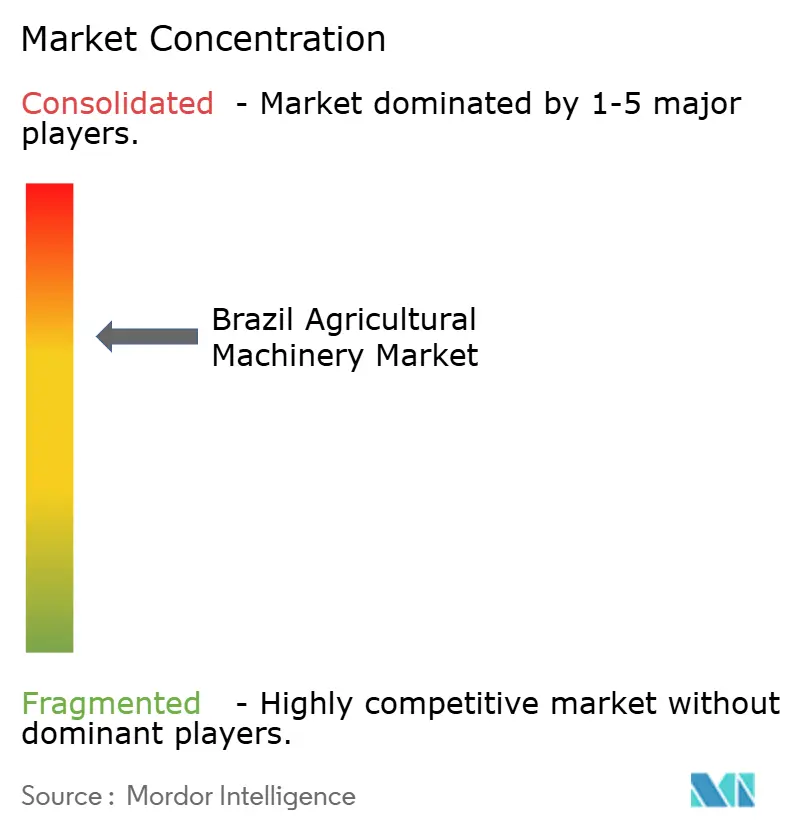
The Brazil agricultural machinery market remains moderately concentrated. Deere & Company leads, leveraging the country’s most extensive dealer network, a captive finance arm, and satellite-enabled Operations Center software that unifies fleet data. CNH Industrial N.V. follows, combining Case IH and New Holland Agriculture product ranges and a Sorocaba combine plant that supplies the entire Southern Cone. AGCO Corporation gains a technology edge through its PTx Trimble joint venture. Kubota Corporation and Mahindra & Mahindra Ltd round out the top group, focusing on mid-horsepower tractors and expanding parts logistics in the South.
Localization strategies dominate. Deere & Company, AGCO Corporation, and CNH Industrial N.V. all operate foundries and transmission lines inside Brazil, insulating cost structures from exchange-rate swings and qualifying for domestic-content credit incentives. Technology partnerships intensify AGCO Corporation and Trimble Inc.’s precision stack, complement Deere & Company’s in-house systems, while CNH Industrial N.V. integrates Raven Applied Technology guidance across Case IH and New Holland Agriculture brands.
Financing solutions differentiate competitors as much as horsepower or boom width. Deere Financial, CNH Industrial Capital, and AGCO Finance tailor seasonal lines tied to crop calendars, absorbing some rate risk away from growers during volatile Selic cycles. This captive approach stabilizes unit sales even in bearish commodity years. Consequently, the competitive arena hinges on who couples machinery, data services, and funding into the most farmer-friendly bundle, a dynamic that will define Brazil agricultural machinery market evolution over the next decade.
Brazil Agricultural Machinery Industry Leaders
-
Deere & Company
-
CNH Industrial N.V.
-
AGCO Corporation
-
Kubota Corporation
-
Mahindra & Mahindra Ltd
- *Disclaimer: Major Players sorted in no particular order
Market Opportunities and Future Outlook
Policy-backed financing and OEM localization are creating room for upgraded fleets, automation-ready platforms, and smaller-ticket mechanization. In April 2026, the federal government launched MOVE Brasil with BRL 10 billion in credit targeted at modernizing machines and implements, building on subsidized lines under Plano Safra that keep machinery upgrades viable even when interest rates are volatile. This supports opportunities for manufacturers and dealers to pair equipment sales with approved financing and service subscriptions, particularly for mid-sized growers moving from cash purchases to structured credit.
Investment and development-bank backed R&D are also expanding the local base for precision and automation. In April 2026, BNDES approved BRL 129 million for CNH Industrial to support eight research and innovation projects, including autonomy, sensors, and electronics architectures, alongside upgrades in Piracicaba (SP). The program widens the addressable market for connected tractors and harvesters that integrate telematics and decision-support services. Capacity and localization investments further open segment-specific opportunities: CNH Industrial announced a BRL 100 million investment in Curitiba (PR) for harvester platform production, and Yanmar began construction of a new plant in Indaiatuba (SP) after a reported BRL 280 million investment focused on compact tractors, supporting demand from smaller and diversified farms as well as large-scale grain and sugarcane operations.
Recent Industry Developments
- April 2026: CNH Industrial announced BRL 100 million in investment at its Curitiba (PR) plant to localize production of Draper FD2 by MacDon cutting platforms for New Holland. The move shortens lead times and reduces exposure to import costs for a high-value harvesting component, strengthening local supply depth for combine-related purchases.
- February 2025: AGCO announced expansions in Jundiai (SP) focused on sustainability and workforce development. The site investment supports localization and throughput improvements across AGCO brands in Brazil, helping stabilize parts availability and manufacturing capability in a market sensitive to FX-driven cost swings.
- August 2024: Deere & Company and Banco Bradesco established a 50:50 joint venture to expand financing services in Brazil for equipment, parts, and subscription-based solutions. By combining captive-style equipment expertise with bank scale, the partnership broadens credit access and supports bundled offers that tie machinery upgrades to digital services.
Research Methodology Framework and Report Scope
Market Definition and Coverage
This market covers the value of farm machinery sold and used across Brazil for core field and post-field activities, including soil preparation, planting, crop care, irrigation support, harvesting, and handling after harvest.
Scope exclusions: It does not count inputs or services such as seeds, fertilizers, pesticides, financing, fuel, repairs, and general farm labor.
Segmentation Overview
- By Machinery Type
- Tractors
- Below 80 HP
- 81 to 130 HP
- Above 130 HP
- Plowing and Cultivating Machinery
- Plows
- Harrows
- Cultivators and Tillers
- Other Plowing and Cultivating Machinery (Subsoilers, Ridgers, etc.)
- Planting Machinery
- Seed Drills
- Planters
- Spreaders
- Other Planting Machinery (Transplanters, Precision Seeders, etc.)
- Harvesting Machinery
- Combine Harvesters
- Sugarcane Harvesters
- Forage Harvesters
- Other Harvesting Machinery (Beet Harvesters, Potato Harvesters, etc.)
- Hay and Forage Machinery
- Mowers
- Balers
- Other Haying and Forage Machinery (Rakes, Tedders, etc.)
- Irrigation Machinery
- Center-Pivot Irrigation
- Sprinkler Irrigation
- Drip Irrigation
- Other Irrigation Machinery (Micro-Sprinklers, Flood/Furrow Systems, etc.)
- Spraying Machinery
- Self-Propelled Sprayers
- Tractor-Mounted Sprayers
- Aerial Drone Sprayers
- Tractors
Data Sources, Market Sizing, and Validation
Desk Research
Desk research sets the scope and the fact base so the model stays tied to real machinery demand in Brazil. We rely on public and official references such as IBGE agricultural and industrial statistics, CONAB crop outlooks and supply-demand bulletins, MAPA program updates that influence farm investment, and SECEX foreign trade data that helps validate machinery inflows and outflows.
To connect activity to value, we also review customs and tariff classifications where relevant, peer-reviewed agronomy and mechanization literature, and public rural credit program disclosures that signal purchasing capacity. Company filings and investor presentations are used for pricing language and Brazil exposure context, and then cross-checked with association websites and reputed press coverage.
A paid subscription for company financials and intelligence supports revenue split checks, and a paid import and export shipment-level database is used selectively to sanity-check unit patterns for traded machinery categories. The sources listed above are not exhaustive, and many other references were also used for data collection, validation, and research clarification.
Primary Interviews and Surveys
Primary inputs are used to confirm desk findings and close gaps around pricing, replacement timing, and what gets treated as machinery value in-year. We covered OEM-side and component-side experts, dealers and distributors, large farm operators, and service partners across Brazil so assumptions on volumes, mix, and utilization could be verified.
These discussions helped validate practical variables such as average selling price movement by equipment class, seasonality around planting and harvesting windows, and how financing availability shifts purchase timing.
Distribution of primary research fieldwork respondents
| Company type | Respondent position |
|---|---|
| Top tier: 38% | CXOs: 16% |
| Mid tier: 46% | Functional/Unit leaders: 27% |
| Smaller Players: 16% | Managers: 57% |
Market-Sizing & Forecasting
Sizing starts with a top-down build that uses Brazil equipment demand signals to reconstruct spending, and then it is checked with selective bottom-up approximations to keep the totals realistic. On the top-down side, we map the demand pool using planted area and crop mix, mechanization intensity by major cropping systems, replacement cycles for key equipment, and rural credit conditions that influence purchase timing.
Those drivers are converted into value by applying segment-level unit assumptions and simple ASP logic that reflects horsepower mix for tractors, import parity effects where relevant, and mix shifts between new buys and replacement buys. Bottom-up checks are then run using sampled dealer channel checks, public financial exposure splits, and trade flow indicators where imported machinery has a visible role. When a sub-segment has thin public data, gaps are handled with conservative penetration ranges that are re-tested through interviews before being rolled into the total.
For forecasting, scenario analysis is used so the outlook can reflect different paths for farm income, financing availability, and equipment pricing. The final curve is then aligned to what primary respondents see for near-term ordering and delivery lead times.
Data Validation & Update Cycle
Outputs are validated by triangulating independent signals, and then variance checks are run to flag jumps that do not match crop cycles, credit conditions, or trade movements. A second analyst review confirms that definitions, currency handling, and rollups are applied consistently, followed by targeted re-contacts when a price move, policy change, or sharp FX shift could materially change the result.
Reports are refreshed annually, and interim updates are triggered when major events materially affect demand or pricing. Before delivery, a fresh pass is done so charts, assumptions, and market values reflect the latest available information.
Mordor Intelligence's Brazil Agricultural Machinery Market Size Compared With Other Published Estimates
Published market sizes for Brazil agricultural machinery can differ even when the topic name looks the same, because each source sets its own timing, currency conversion date, and what is counted as machinery revenue. Differences also show up when one estimate leans more on production and trade indicators, while another leans more on broad equipment groupings or on simplified price inflation paths.
In this market, the gap is often driven by refresh cadence and how equipment-class ASP progression is handled across tractors, harvesters, and crop-care machines, followed by whether post-harvest handling and certain irrigation-related machines are included in the spending total. The refresh-led step is to lock FX timing and price checkpoints close to the base year, and then re-confirm outliers through dealer and farm-side call-backs, which is how Mordor Intelligence limits drift in fast-moving price years.
Benchmark comparison
| Source | Market Size | Gaps in Research Methodology |
|---|---|---|
| Mordor Intelligence | USD 7.93 B (2025) | |
| Industry Research Publisher A | USD 6.23 B (2024) | Uses a 2024 base year and a narrower machinery basket that can undercount post-harvest handling equipment, and it may apply smoother ASP changes that reduce the visible impact of horsepower and feature mix shifts. |
| Industry Association B | USD 7.06 B (2023) | Anchors the series to an earlier base year and applies a decade-long CAGR, which can miss timing shifts from rural credit cycles and replacement buying, and it may use higher-level currency conversion that does not adjust by equipment class. |
Overall, the table suggests that timing, scope inclusions, and price handling explain most of the spread. Using the same demand signals but aligning year definitions and validating price steps by equipment class typically brings published values closer together and makes the final number easier to reproduce.
Key Questions Answered in the Report
How large is the Brazil agricultural machinery market in 2026?
The Brazil agricultural machinery market size is USD 8.42 billion in 2026 and is projected to reach USD 11.38 billion by 2031.
What is the projected growth rate for Brazilian farm equipment through 2031?
The market is forecast to expand at a 6.22% CAGR between 2026 and 2031.
Which machinery type leads sales today?
Tractors hold 45.32% of Brazil agricultural machinery market share, making them the dominant category.
Which segment is growing the fastest?
Hay and forage equipment posts the highest 5.82% CAGR through 2031 due to livestock intensification.