
Braze Alloys Market Size and Share
Market Overview
| Study Period | 2021 - 2031 |
|---|---|
| Market Size (2026) | USD 2.58 Billion |
| Market Size (2031) | USD 3.16 Billion |
| Growth Rate (2026 - 2031) | 4.12 % |
| Fastest Growing Market | Asia-Pacific |
| Largest Market | Asia-Pacific |
| Market Concentration | Medium |
Major Players *Disclaimer: Major Players sorted in no particular order Image © Mordor Intelligence. Reuse requires attribution under CC BY 4.0. | |

Braze Alloys Market Analysis by Mordor Intelligence
The Braze Alloys Market size is estimated at USD 2.58 billion in 2026, and is expected to reach USD 3.16 billion by 2031, at a CAGR of 4.12% during the forecast period (2026-2031). This measured trajectory reflects the transition from legacy joining techniques toward high-performance brazing solutions that tolerate higher service temperatures, tighter leak-rate limits, and multi-metal assemblies. Electric-vehicle battery cold plates, aerospace turbine-blade repairs, and compact HVAC-R heat exchangers are dictating new material specifications and production-line automation, reshaping procurement priorities for both OEMs and Tier-1 suppliers. Copper-based fillers retain cost leadership, yet nickel-cobalt blends are moving quickly into power electronics and extreme-temperature duties. At the same time, automation-friendly filler geometries such as rings and preforms are displacing manual rod and wire feeding, cutting cycle time, and scrap in lights-out manufacturing cells. Regionally, Asia-Pacific dominates value creation on the back of China’s EV supply chain and India’s heat-exchanger export boom, while Europe faces compliance pressures from stricter toxic-metal exposure limits.
Key Report Takeaways
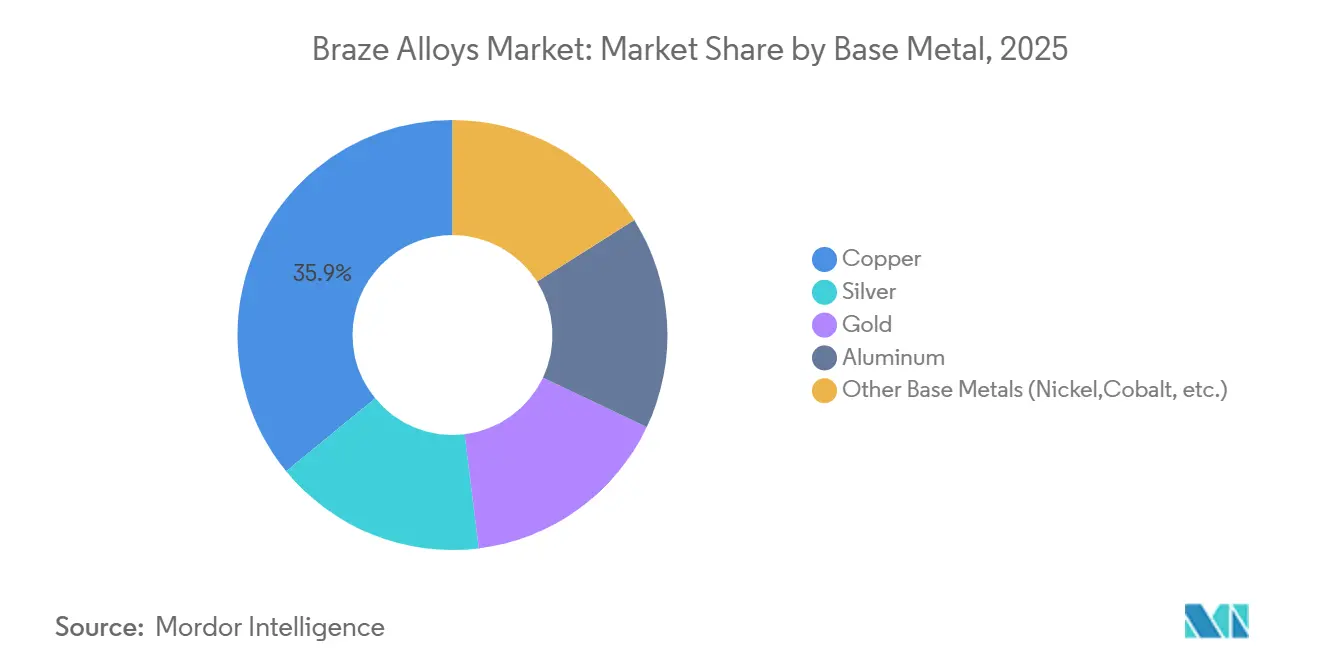
- By base metal, copper captured 35.92% of the braze alloys market share in 2025, whereas the other base metal segment is forecast to expand at a 4.82% CAGR through 2031.
- By filler form, rod and wire formats held 40.04% of 2025 revenue, while rings and preforms are set to post the fastest 5.04% CAGR over the same outlook.
- By temperature range, medium-temperature fillers commanded 50.65% of demand in 2025; high-temperature fillers will register the quickest 4.59% CAGR to 2031.
- By end-user industry, automotive applications accounted for 30.57% of 2025 consumption, but medical, energy, and other diversified uses are rising at a 4.93% CAGR.
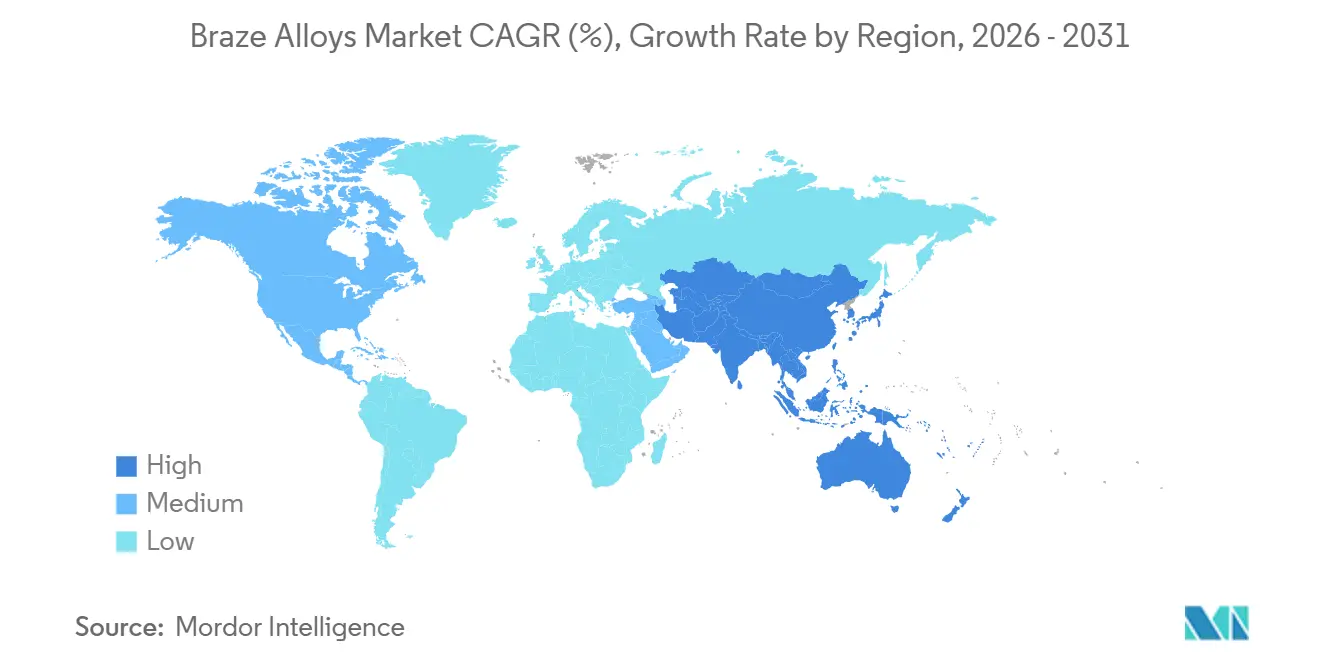
- By geography, Asia-Pacific secured 46.38% of the 2025 value and is projected to advance at a 5.16% CAGR during 2026-2031.
Note: Market size and forecast figures in this report are generated using Mordor Intelligence’s proprietary estimation framework, updated with the latest available data and insights as of January 2026.
Market Trends and Insights
Drivers Impact Analysis of Braze Alloys Market*
| Drivers | (~) % Impact on CAGR Forecast | Geographic Relevance | Impact Timeline |
|---|---|---|---|
| Adoption of brazing over welding and soldering | +1.2% | Global, concentrated in North America and EU vehicle clusters | Medium term (2-4 years) |
| Surging demand for aluminum-based brazes in automotive heat exchangers | +1.0% | China, India, Thailand, spill-over to North America | Short term (≤ 2 years) |
| EV power-electronics uptake of nickel-based induction pastes | +0.9% | China, South Korea, United States, Germany | Medium term (2-4 years) |
| Growth of the HVAC-R industry raising braze consumption | +0.7% | India, Southeast Asia, Middle East, global export hubs | Long term (≥ 4 years) |
| Emergence of high-entropy braze alloys for extreme environments | +0.4% | U.S. and EU aerospace hubs, select APAC defense contractors | Long term (≥ 4 years) |
| Source: Mordor Intelligence | |||
Adoption of Brazing Over Welding and Soldering
Manufacturers are pivoting toward brazing because it secures joint strengths approaching 90% of parent-metal yield while avoiding heat-affected-zone cracking that often follows fusion welding. Controlled-atmosphere furnaces now dominate aluminum radiator production, cutting scrap from 8% to under 2% and saving up to USD 1.8 million per assembly line annually. Soldering cannot meet 150 °C under-hood duty cycles, so OEMs increasingly specify brazed busbars and cooling plates for electric-drive platforms. Equipment suppliers confirm that 60% of all new brazing furnace orders booked in 2025 were for automotive Tier-1 plants in China and Mexico, regions that previously relied on spot welding.
Surging Demand for Aluminum-Based Brazes in Automotive Heat Exchangers
Al-Si brazes in the 7–12 % silicon range remain the backbone of heat-exchanger cores, and battery electric vehicles multiply surface-area requirements two to three times versus internal-combustion layouts. A typical EV pack now houses up to six liquid-cooling circuits, each demanding leak-rate guarantees below 1 g/year over a 150,000 km service life[1]Society of Automotive Engineers, “Thermal Management in Electric Vehicles,” sae.org. India’s component exports grew 18% in fiscal 2025 as global OEMs diversified their supply chains. Alloy tweaks that add manganese and copper are extending fatigue life by 25% in accelerated thermal-shock tests, helping suppliers meet warranty targets.
EV Power-Electronics Uptake of Nickel-Based Induction Pastes
Silicon-carbide inverters run above 175 °C, forcing die-attach materials to endure up to 100,000 thermal cycles. Nickel-phosphorus brazes, heated by induction in under 60 s, cut intermetallic growth by 40% compared with silver-copper eutectics, extending module warranties to 12 years[2]IEEE Power Electronics Society, “Reliability of Nickel Brazes in SiC Modules,” ieee.org. Chinese module makers shipped more than 15 million SiC units in 2025, a 35% jump within one year, accelerating nickel-braze consumption.
Growth of the HVAC-R Industry Raising Braze Consumption
India’s HVAC market is forecast to exceed USD 10 billion by 2028, prompting domestic firms to add automated torch-brazing cells capable of sub-45-second joint cycles.
Restraints Impact Analysis of Braze Alloys Market*
| Restraints | (~) % Impact on CAGR Forecast | Geographic Relevance | Impact Timeline |
|---|---|---|---|
| Base-metal price volatility | -0.8% | Global, pronounced in silver-intensive segments | Short term (≤ 2 years) |
| Toxic-metal (Cd, Pb) regulatory bans | -0.5% | EU and North America, extending to export-oriented APAC plants | Medium term (2-4 years) |
| Shortage of furnace-qualified labour | -0.4% | Global | Medium term (2-4 years) |
| Source: Mordor Intelligence | |||
Base-Metal Price Volatility
Silver prices swung between USD 22 and USD 32 per troy ounce during 2024-2025. Every 10% uptick pushes finished alloy cost by up to 6%, yet annual contracts delay pass-through for nine months, pressuring margins. Copper prices likewise fluctuated from USD 8,200 to USD 10,500 per metric ton, hitting HVAC-R filler economics. Smaller suppliers lacking hedging programs defer research and development spending, slowing new alloy development.
Toxic-Metal (Cd, Pb) Regulatory Bans
EU Directive 2024/869 caps occupational lead exposure at 0.03 mg/m³ by 2029, compelling aerospace MRO shops to overhaul ventilation or shift to lead-free formulations. Cadmium-bearing brazes already face RoHS restrictions, yet replacing Cd with Zn or Sn changes wetting behavior, triggering 18-24 month requalification cycles for each of 40-plus legacy filler codes in a single engine platform. Compliance costs weigh heaviest on European alloy houses working under shorter enforcement deadlines.
*Our forecasts treat driver/restraint impacts as directional, not additive. The impact forecasts reflect baseline growth, mix effects, and variable interactions.
Braze Alloys Market Segment Analysis
By Base Metal:
Copper Dominates While Nickel-Cobalt AcceleratesCopper-based fillers captured 35.92% of the braze alloys market share in 2025, reflecting their low unit cost in HVAC-R coils and power-distribution busbars. The other base metals segment, including Nickel and cobalt systems, is forecast for a 4.82% CAGR, riding on aerospace turbine-blade refurbishment and SiC power module adoption. Gold and silver fillers occupy high-reliability niches where biocompatibility or thermal stability warrants premium pricing. Aluminum-silicon alloys underpin vehicle heat exchangers, with controlled-atmosphere brazing enabling thin-wall geometries and corrosion resistance.
Processability and temperature ceilings explain adoption curves. Copper-phosphorus compositions melt at 700–850 °C, balancing throughput and joint strength for refrigerant circuits. Nickel-chromium-boron blends withstand 1,000 °C and oxidative exhaust gases, suiting turbine repairs. These distinctions underpin the braze alloys market as manufacturers match performance envelopes to new duty cycles.



By Filler Form:
Preforms Rise in Automated CellsRod and wire formats remained top-selling at 40.04% of the 2025 value, favored in manual torch operations and batch furnaces. However, rings and preforms are growing at 5.04% CAGR thanks to induction-brazing robotics in EV inverter assembly lines. Pre-shaped aluminum-silicon rings allow simultaneous joining of up to 16 cold-plate ports per furnace run, trimming takt time by 35% and lifting first-pass yield.
Powder and paste fillers dominate electronics and small-joint work, where screen-printing and dispensing heads deposit 0.05-gram charges with ±0.01-gram accuracy. Foil and ribbon variants address aerospace honeycomb structures, delivering uniform melt layers that avoid starved joints. The outcome is a diverse form-factor portfolio that keeps the braze alloys market responsive to automation trends.
By Temperature Range:
Medium-Temperature Leads, High-Temperature GainsMedium-temperature fillers (450–800 °C) generated 50.65% of 2025 demand, mirroring automotive radiator and HVAC-R coil volumes. Low-temperature alloys under 450 °C stay in niche electronics uses due to limited mechanical strength. High-temperature fillers, now expanding at 4.59% CAGR, support turbine-blade overhaul intervals extended to 30,000 flight hours and gas-turbine service life boosts to 32,000 operating hours.
NASA evidence of 400 MPa shear strength in high-entropy brazes speeds migration from legacy nickel-boron blends, opening headroom for future 1,200 °C engine cores. This shift secures long-run momentum for the braze alloys market size in repair and refurbishment workflows where component replacement costs surpass USD 5,000.
By End-User Industry:
Automotive Anchors, Diversified Uses ExpandAutomotive held 30.57% of 2025 consumption, anchored by aluminum heat-exchanger production for both internal-combustion and electric drivetrains. Diversified other end-user industries segment, which mainly includes medical instruments, concentrated solar receivers, and industrial heat transfer, is advancing at a 4.93% CAGR, insulating suppliers from vehicle-cycle volatility.
Medical devices rely on biocompatible gold or silver fillers that survive repeated steam sterilization, while solar tower receivers exploit nickel-based brazes for 650 °C service. Industrial plate-fin exchangers in chemical plants achieve 40% higher heat-flux density after vacuum brazing. This mix broadens the braze alloys industry revenue base and stabilizes demand.

Geography Analysis
APAC Braze Alloys Market
Asia-Pacific commanded 46.38% of 2025 revenue and is projected to grow 5.16% annually through 2031, driven by China’s 9 million BEV output and India’s double-digit heat-exchanger export growth. Japan supplies precision nickel-based brazing for turbine components, whereas South Korea’s battery-pack lines demand tight-leak aluminum cold-plate joints. Southeast Asia captures production relocating from higher-cost Chinese provinces, with Vietnam scaling electronics contract manufacturing.
North America Braze Alloys Market
North America's braze alloys demand is led by aerospace MRO activity requiring high-temperature nickel fillers. Mexico exported USD 8 billion in thermal-management modules, leveraging trade agreements and near-shoring trends. The United States benefits from the Inflation Reduction Act, which funds domestic inverter and battery assembly, thereby enlarging local filler-powder demand.
EMEA and South America Braze Alloys Market
Europe accounted for a considerable market share in 2025 but faces compliance costs tied to toxic-metal bans. Germany’s automotive sector drives copper and aluminum filler use, whereas France leans on nickel fillers for jet-engine parts. Nordic countries invest in vacuum-brazed marine heat exchangers. South America and the Middle East and Africa each supplied under 5% of value yet register steady growth tied to Brazilian vehicle output and Gulf HVAC construction.

Regulatory Landscape
Braze-alloy formulation and placement in key markets are shaped by toxic-metal composition restrictions and end-use equipment compliance requirements. In the European Union, REACH restrictions limit cadmium in brazing fillers (with specific derogations for certain safety-critical uses), which is accelerating substitution toward cadmium-free silver and copper-based filler systems and increasing the importance of documented traceability from alloy producers through distribution.
Hardware-focused rules also influence alloy choices in electronics and appliances. The EU RoHS Directive 2011/65/EU restricts lead content in electrical and electronic equipment while managing lead-related exemptions for alloying in certain metals. In September 2025, Commission Delegated Directive (EU) 2025/2364 amended RoHS exemptions for lead as an alloying element, with multiple expiry points in 2026-2027, which is prompting OEMs and tier suppliers to requalify lead-reduced or lead-free filler alternatives under recognized filler-metal standards such as AWS A5.8 and EN ISO 17672.
Value Chain Analysis
The value chain spans primary metal supply (copper, silver, nickel, chromium and other alloying inputs), alloy formulation and melting, and conversion into saleable forms, including rod and wire, powders, pastes, foils, rings and preforms. From there, technical distribution and application-engineering support flow into end users such as automotive thermal management, HVAC-R, aerospace MRO, and power electronics. Producers compete on metallurgical control and repeatability, while form conversion and packaging support automation in customer brazing lines, including rings and preforms aligned to robotic induction or controlled-atmosphere furnace workflows.
Channel structure varies by application criticality. High-integrity accounts (aerospace and certain power-electronics and medical device assemblies) commonly involve direct engagement for qualification support, documentation, and change-control, while broad industrial and HVAC-R consumption relies more on inventory-based regional distribution. Constraints also concentrate upstream and at conversion, where base-metal price swings, notably silver and copper, affect contract pricing and hedging practices. In parallel, specialized furnace and process knowledge tightens the supply of qualified manufacturing and field-support labor needed to qualify new cadmium- and lead-free filler systems.
Competitive Landscape
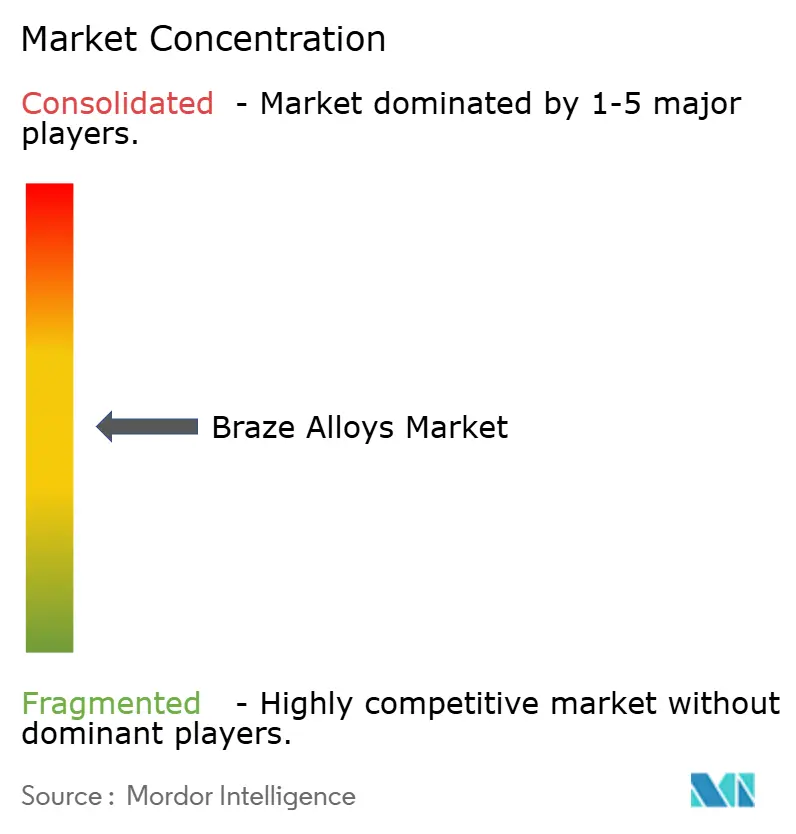
The braze alloys market is moderately consolidated, with the top five players collectively accounting for a significant market share of global capacity, signaling moderate concentration. Regional specialists such as Nihon Superior and Saru Silver Alloy maintain agile lead times and custom alloy menus, winning local contracts. Competition hinges on alloy customization, form-factor innovation, and process engineering support. Materion’s 2024 patent filing for a silver-copper-indium filler illustrates ongoing research and development to improve titanium wetting for medical implants.
Braze Alloys Industry Leaders
Lucas-Milhaupt Inc.
Umicore
The Lincoln Electric Company (Harris Products Group)
Prince & Izant Company
Johnson Matthey
- *Disclaimer: Major Players sorted in no particular order
Braze Alloys Market Companies Covered in this Report
- Aimtek, Inc.
- Bellman-Melcor, LLC
- Cupro Alloys Corporation
- Fusion, Inc.
- Indian Solder and Braze Alloys Pvt. Ltd.
- Johnson Matthey
- Lucas-Milhaupt Inc.
- Materion Corporation
- Morgan Advanced Materials plc
- Nihon Superior Co., Ltd.
- OC Oerlikon Management AG
- Prince & Izant Company
- Saru Silver Alloy Private Limited
- Sulzer Ltd
- The Lincoln Electric Company
- Umicore
- VBC Group
- Wall Colmonoy
- Wieland Group

Market Opportunities and Future Outlook
Opportunities cluster in filler systems and form factors that reduce precious-metal intensity while maintaining wetting and joint integrity under tighter leak-rate and reliability requirements. Product-development focus is visible in silver-optimization approaches for HVAC-R and industrial joining, alongside nickel-based brazes and pastes used in higher-temperature electronics duties, for example SiC power electronics operating above 175 C, where fast induction cycles and thermal-cycling performance are prioritized.
A second opportunity area is automation-ready supply, including rings, preforms, and precision powders and pastes, aligned with controlled-atmosphere furnace and induction-brazing cells being deployed in EV thermal management and inverter assembly lines. Market activity also points to European portfolio and capacity reshaping in silver brazing alloys and fluxes through acquisitions, which supports the shift away from restricted substances. This is enabling broader offering breadth for OEM requalification programs tied to tightening EU compliance timelines, including RoHS exemption changes published in 2025 and expiring across 2026-2027.
Recent Industry Developments in Braze Alloys Market
- July 2026: Lucas-Milhaupt announced participation at the Farnborough International Airshow (FIA 2026) in the United Kingdom (July 20-24, 2026), highlighting brazing solutions positioned for aerospace programs with AS9100 alignment and ITAR and DFAR compliance. The outreach reinforces the strategic weight of certified, documentation-heavy applications where alloy suppliers compete on qualification support and regulated supply-chain readiness.
- January 2025: Lucas-Milhaupt introduced Silvaloy 560, a cadmium-free silver filler meeting AWS A5.8 parameters. The launch expands options for customers shifting away from restricted substances while maintaining performance in brazed assemblies that must pass established filler-metal specifications.
- October 2024: Materion invested USD 12 million to expand eutectic powder output in Ohio, increasing silver-copper capacity by 40% for EV inverter and aerospace demand. Added powder availability supports higher-throughput, automation-friendly joining formats used in electronics and high-reliability manufacturing lines.


Braze Alloys Market Report Scope and Research Methodology
Market Definition and Coverage
For this methodology, the braze alloys market is the value of metal filler materials sold for brazing, where joining is done above 450 C but below the melting point of the base metals. We treat the market as finished braze alloy products supplied in common forms used by manufacturers.
Scope exclusions: We exclude solder alloys used below 450 C, flux-only products, and revenues from contract brazing services.
Segments Covered in This Report
- By Base Metal
- Copper
- Silver
- Gold
- Aluminum
- Other Base Metals (Nickel,Cobalt, etc.)
- By Filler Form
- Powder
- Paste
- Foil / Ribbon
- Rod / Wire
- Rings and Preforms
- By Temperature Range
- Low-Temperature (Less than 450 °C)
- Medium-Temperature (450-800 °C)
- High-Temperature (Greater than 800 °C)
- By End-User Industry
- Automotive
- Aerospace and Defense
- Electrical and Electronics
- Construction
- Other End-User Industries(Medical Devices, Energy and Power, etc.)
- By Geography
- Asia-Pacific
- China
- Japan
- India
- South Korea
- ASEAN Countries
- Rest of Asia-Pacific
- North America
- United States
- Canada
- Mexico
- Europe
- Germany
- United Kingdom
- France
- Italy
- Spain
- NORDIC Countries
- Rest of Europe
- South America
- Brazil
- Argentina
- Rest of South America
- Middle East and Africa
- Saudi Arabia
- South Africa
- Rest of Middle East and Africa
- Asia-Pacific
Data Sources, Market Sizing, and Validation
Desk Research
Desk research was used to build the fact base on where braze alloys are consumed and what drives volumes, which were then converted into values. We reviewed public trade and production indicators, end use output trends, and metal pricing signals that influence alloy demand and average selling prices over time.
Sources we used include public materials and manufacturing datasets such as USGS mineral and metals statistics, UN Comtrade trade flows, OECD and World Bank industrial indicators, International Copper Study Group updates, and standards and technical references such as AWS brazing specifications. We also used company filings and investor presentations, association websites, and reputed press for capacity changes and application trends, and we referenced paid subscriptions for company financials and patent databases to sanity check player exposure and innovation intensity. The sources listed here are illustrative only, and many other public references were also used for data collection, validation, and clarification.
Primary Interviews and Surveys
Primary work focused on validating demand drivers and the pricing logic behind different braze alloy families, since published list prices do not always match realized prices. We spoke with a mix of producers, distributors, and industrial users across major manufacturing regions so assumptions on application mix, substitution, and pass through of metal costs could be checked and adjusted.
Distribution of primary research fieldwork respondents
| Company type | Respondent position | Region |
|---|---|---|
| Top tier: 30% | CXOs: 14% | APAC: 45% |
| Mid tier: 55% | Functional/Unit leaders: 33% | EMEA: 32% |
| Smaller Players: 15% | Managers: 53% | Americas: 23% |
Market-Sizing & Forecasting
Sizing starts with a top-down demand pool build that reconstructs consumption from manufacturing output and trade signals in braze-heavy end uses, followed by alloy-intensity assumptions for key joining applications. Once the demand pool was formed, values were computed by applying application-weighted net average selling prices, which were linked back to underlying metal inputs and the typical premium for alloying and form factors.
In practice, the model was anchored using a small set of fingerprints that can be checked year to year, including industrial production levels in HVAC and refrigeration and general manufacturing, brazing-intensive equipment output, import and export movement for related metal products, metal price trends for silver, copper, and nickel, and observed shifts in product forms used by fabricators. To avoid a purely theoretical build, selective bottom-up approximations were also run, such as sampled supplier revenue exposure and volume times ASP checks by alloy family, and gaps were handled by using conservative penetration assumptions until interviews confirmed a more realistic range.
For forecasting, we relied on scenario analysis supported by short-cycle indicators, since demand can swing with industrial cycles and metal prices. The outlook was tied to expected manufacturing activity, end use build rates, and an ASP path that reflects metal price expectations and negotiated pricing behavior that participants shared with us.
Data Validation & Update Cycle
Outputs were cross-checked against independent signals, including metals pricing moves, trade direction, and end use production trends, and then reviewed for unusual jumps that did not match known market events. When a variance was too large to explain, assumptions were revisited and, where needed, respondents were re-contacted to confirm whether the change was volume-led or price-led.
A multi-step analyst review is followed so that definitions, conversions, and currency treatments are consistent across years and geographies. Reports are refreshed annually, with interim updates when major events materially shift demand or pricing, and a final pre-delivery review is completed so the latest available indicators are reflected.
Mordor Intelligence's Braze Alloys Market Estimate Compared With Other Published Estimates
Different published market sizes for braze alloys are common because the product boundary and the pricing basis are not always treated the same way, and timing choices can also move the number. We keep the logic simple, but it is built to be repeatable, so readers can trace the result back to clear demand and pricing steps.
The largest gaps usually come from what gets counted as braze alloys, for example, whether fluxes or solder materials are included, and from how ASP is constructed when metal prices move quickly. Year labeling also matters because some estimates use an average FX rate across the year while others use a point-in-time conversion, and refresh timing can lag key price changes. In this area, currency timing and validation checks are handled through the annual refresh cadence used in Mordor Intelligence.
Benchmark comparison
| Source | Market Size | Gaps in Research Methodology |
|---|---|---|
| Mordor Intelligence | USD 2.58 B (2026) | |
| Global Data Publisher A | USD 5.15 B (2024) | Uses a broader, manufacturer-led definition by type and application, and the higher value can reflect inclusion of adjacent filler and joining materials plus less transparent net ASP adjustments for precious-metal-heavy mixes. |
| Industry Advisory B | USD 3.22 B (2025) | Builds from a different base year and coverage set, and the estimate can shift if FX conversion timing and metal price pass-through assumptions are applied at a less granular application level. |
The spread in the table is mainly explained by scope boundaries and by how pricing and currency are timed in the model, especially when silver and copper costs change within a year. By keeping the demand pool tied to brazing-above-450 C use cases and applying application-weighted net ASP logic with recurring validation against trade and production signals, the outcome stays balanced and easier to reproduce.


Key Questions Answered in the Report
What is the 2026 value of the braze alloys market?
The braze alloys market size is estimated at USD 2.58 billion in 2026.
How fast will demand for high-temperature braze fillers grow?
High-temperature fillers are projected to register a 4.59% CAGR between 2026 and 2031.
Which region leads global consumption?
Asia-Pacific held 46.38% of 2025 demand and is the fastest-growing region at a 5.16% CAGR.
Why are nickel-based brazes gaining share?
Nickel-phosphorus pastes support SiC power modules operating above 175 °C, extending component warranties to 12 years.
What regulatory change is influencing alloy reformulation in Europe?
EU Directive 2024/869 imposes stricter lead-exposure limits effective 2029, forcing a switch to cadmium- and lead-free fillers.
Page last updated on:


 Your data is secure and never sold or shared.


