
Nickel Alloys Market Size and Share
Market Overview
| Study Period | 2021 - 2031 |
|---|---|
| Market Volume (2026) | 500.07 kilotons |
| Market Volume (2031) | 646.51 kilotons |
| Growth Rate (2026 - 2031) | 5.27 % |
| Fastest Growing Market | Asia-Pacific |
| Largest Market | Asia-Pacific |
| Market Concentration | Medium |
Major Players *Disclaimer: Major Players sorted in no particular order Image © Mordor Intelligence. Reuse requires attribution under CC BY 4.0. | |
Nickel Alloys Market Analysis by Mordor Intelligence
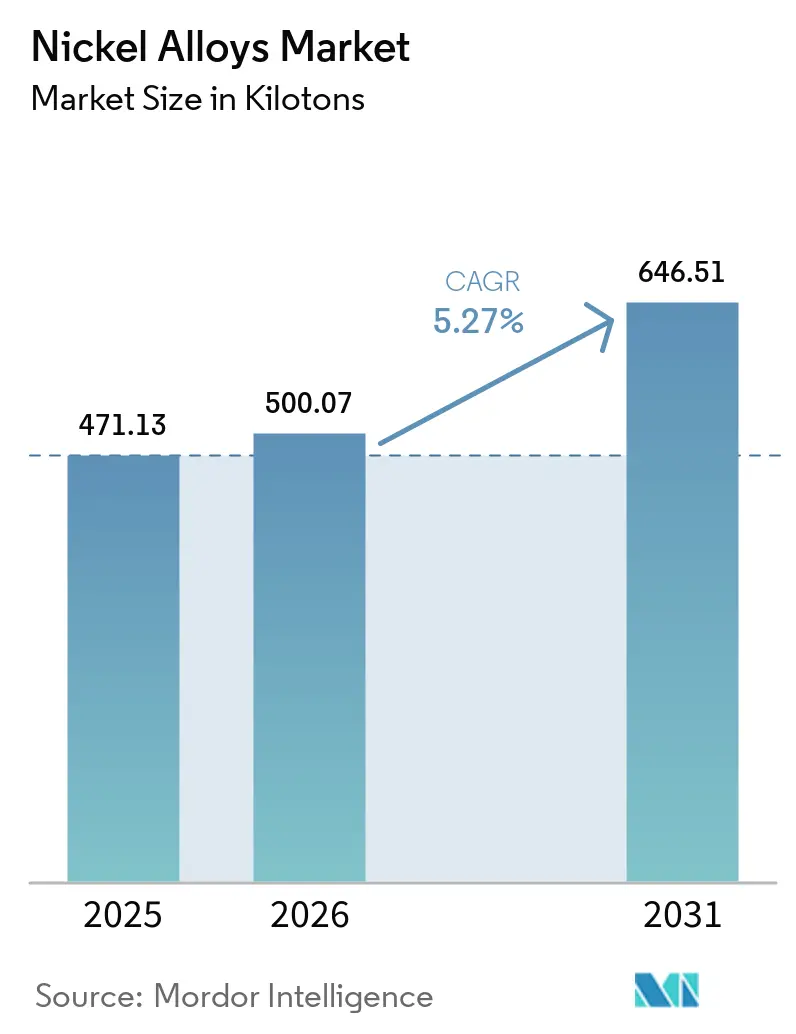
The Nickel Alloys Market size is expected to increase from 471.13 kilotons in 2025 to 500.07 kilotons in 2026 and reach 646.51 kilotons by 2031, growing at a CAGR of 5.27% over 2026-2031. Growth is being propelled by super-alloy consumption in next-generation aircraft engines, rising volumes of battery-grade Class 1 nickel for high-nickel EV cathodes, and expanding orders for corrosion-resistant alloys in small-modular nuclear reactors and hydrogen turbines. Defense hypersonics programs and space-launch systems add another structural demand layer, while additive manufacturing is shortening prototype cycles and amplifying alloy uptake across multiple end-use sectors. Volatility in London Metal Exchange pricing remains a constraint, yet producers with low-carbon footprints and certified aerospace pedigrees continue to secure premium contracts.
Key Report Takeaways
- By alloy type, Heat-Resistant Nickel Alloys (includes superalloys) led with 47.76% nickel alloys market share in 2025, and are forecast to grow at an 6.26% CAGR through 2031.
- By nickel chemistry, Other Types held 46.80% of 2025 nickel alloys market size revenue; Nickel-Chromium-Iron Alloys are projected to expand 6.52% annually to 2031.
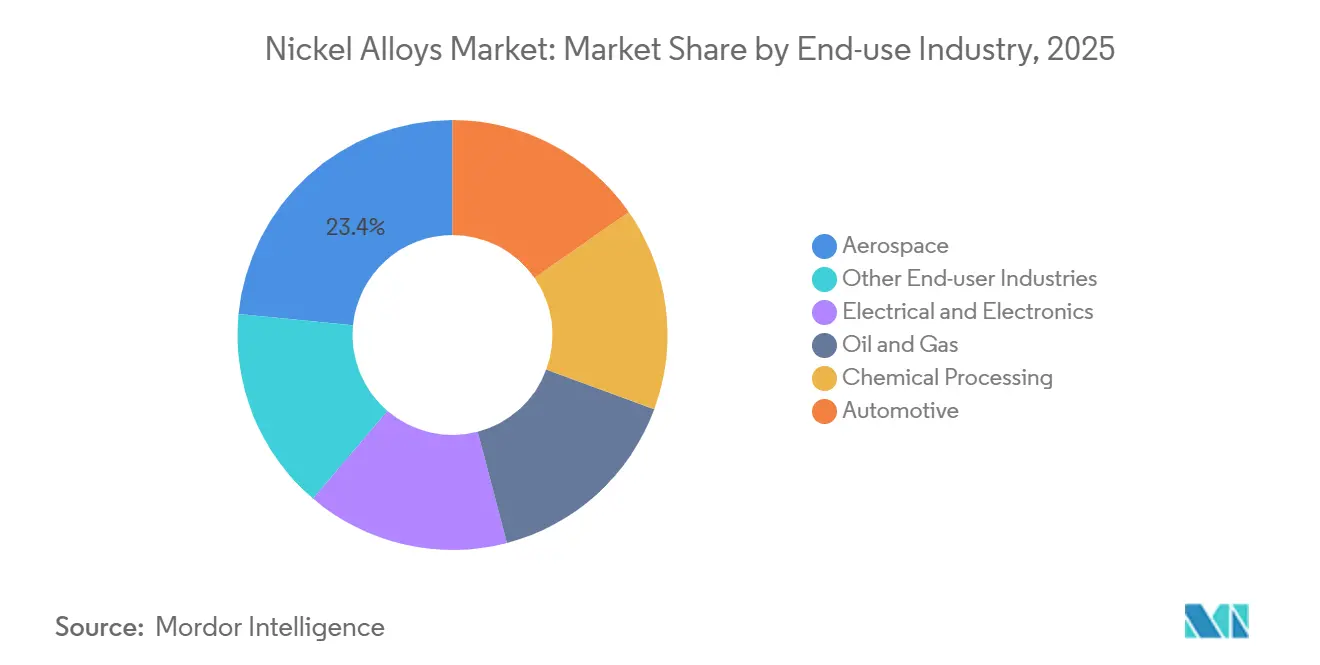
- By end-use, aerospace captured 23.44% revenue in 2025, and is expected to grow at a 7.23% CAGR through 2031.
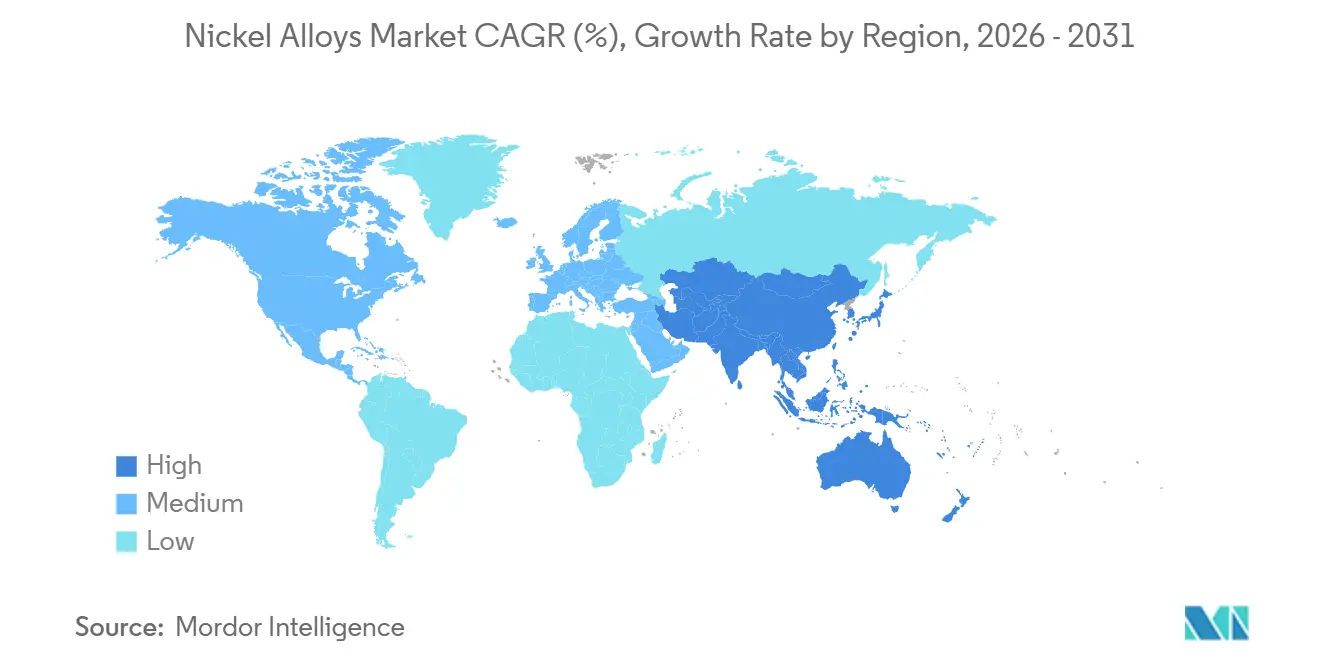
- By geography, Asia-Pacific accounted for 49.62% of 2025 revenue and is forecast to advance 7.56% annually to 2031.
Note: Market size and forecast figures in this report are generated using Mordor Intelligence’s proprietary estimation framework, updated with the latest available data and insights as of January 2026.
Market Trends and Insights
Drivers Impact Analysis of Nickel Alloys Market*
| Drivers | (~) % Impact on CAGR Forecast | Geographic Relevance | Impact Timeline |
|---|---|---|---|
| Aerospace super-alloys demand surge | +2.1% | North America, Europe | Long term (≥ 4 years) |
| Battery-grade nickel shift in EV cathodes | +1.8% | Asia-Pacific, North America, EU | Medium term (2-4 years) |
| Small-modular nuclear reactors build-out | +1.3% | North America, Europe, Middle East | Long term (≥ 4 years) |
| Hydrogen turbine retrofits | +1.0% | Europe, Asia-Pacific, Middle East | Medium term (2-4 years) |
| Defense hypersonics and space vehicles | +1.5% | United States, China, India | Long term (≥ 4 years) |
| Source: Mordor Intelligence | |||
Aerospace Super-Alloys Demand Surge
Commercial backlogs exceeded 14,000 aircraft in 2024, translating to an estimated 280,000 metric tons of nickel-based super-alloy demand over the next decade. Engine makers are adopting higher-pressure-ratio architectures that operate beyond 1,650 °C, a regime that mandates single-crystal René and Inconel castings with exceptionally tight chemistry windows. Defense programs such as the U.S. Air Force Next Generation Air Dominance fighter require alloys that cycle between −55 °C and 1,200 °C within milliseconds. Additive manufacturing is reducing weight by up to 25% on turbine components although powder feedstock remains three to four times costlier than wrought bar. These aerospace dynamics ensure sustained, high-value pull on the nickel alloys market for at least another decade.
Battery-Grade Nickel Shift in EV Cathodes
High-nickel NMC 811 and NMC 9-5-5 chemistries now deliver energy densities above 250 Wh kg-1, displacing earlier 532 formulations. Automakers outside China are signing multi-year offtake contracts to secure low-carbon Class 1 supply; General Motors committed to 75,000 metric tons from 2026-2030, subject to carbon thresholds below 10 tons CO₂ per ton nickel. The European Union Battery Regulation will impose mandatory carbon-footprint ceilings from 2030, reinforcing demand for responsibly sourced feedstock. While China’s LFP surge diluted nickel intensity in 2025, global battery-grade nickel tonnage still rose on aggregate, locking in a pivotal growth vector for the nickel alloys market.
Small-Modular Nuclear Reactors Build-Out
Factory-fabricated SMRs reduce site construction cycles from ten to under three years and incorporate 150 metric tons of nickel alloys per 300 MWe module[1]United States Department of Energy, “Battery Materials Supply Chain Review 2026,” energy.gov. NuScale received final NRC design approval and is partnering with Romania to deploy six modules by 2030. TerraPower’s Natrium demonstrator specifies Hastelloy X heat exchangers capable of 560 °C service for 60 years. ASME Section III traceability requirements limit eligible suppliers, cementing an attractive, high-barrier avenue for established producers within the nickel alloys market.
Hydrogen Turbine Retrofits
Siemens Energy validated 100% hydrogen combustion on an SGT-400 turbine using Hastelloy X combustor liners in 2024[2]Siemens Energy AG, “Hydrogen-Capable Turbine Validation,” siemens-energy.com . Mitsubishi Power’s JAC class employs single-crystal nickel super-alloys with ≥3 % rhenium to prevent creep rupture at 1,650 °C firing temperatures. Saudi Arabia’s 4 GW NEOM electrolyzer project will need hydrogen-ready turbines for backup power. Higher mass flow raises mechanical stress by 15%, pushing alloy tonnage per megawatt upward and supporting incremental nickel alloys market growth into the 2030s.
Restraints Impact Analysis of Nickel Alloys Market*
| Restraints | (~) % Impact on CAGR Forecast | Geographic Relevance | Impact Timeline |
|---|---|---|---|
| Nickel supply-chain geopolitical risk | −1.2% | North America, Europe | Short term (≤ 2 years) |
| Volatile LME pricing and hedging costs | −0.9% | Global | Short term (≤ 2 years) |
| High lifecycle CO₂ footprint vs. green-steel options | −1.0% | Europe, North America | Long term (≥ 4 years) |
| Source: Mordor Intelligence | |||
Nickel Supply-Chain Geopolitical Risk
Indonesia’s ore-export ban and downstream mandates have routed 68% of incoming FDI to Chinese-controlled joint ventures, centralizing supply but elevating Western security concerns. The United States invoked the Defense Production Act to fast-track the Tamarack project, yet permitting challenges persist. Jakarta’s WTO appeal against an unfavorable November 2024 ruling prolongs uncertainty, compelling aerospace primes to requalify alternative feedstocks, a process costing up to USD 5 million per grade. This uncertainty tempers near-term volume expansion in the nickel alloys market.
Volatile LME Pricing and Hedging Costs
Post-2022 volatility lifted implied options premiums above 35%, adding USD 800–1,200 t-1 to hedged procurement costs, according to LME settlement data. Smaller alloy mills lack the balance-sheet capacity for multi-year hedges, exposing them to margin erosion when long-term aerospace contracts collide with spot-price weakness. The absence of a deep forward curve beyond 27 months further complicates capital allocation for smelter projects that require five-plus years from study to production. These financial headwinds shave roughly 0.9 percentage points from the projected nickel alloys market CAGR.
*Our forecasts treat driver/restraint impacts as directional, not additive. The impact forecasts reflect baseline growth, mix effects, and variable interactions.
Nickel Alloys Market Segment Analysis
By Alloy Type:
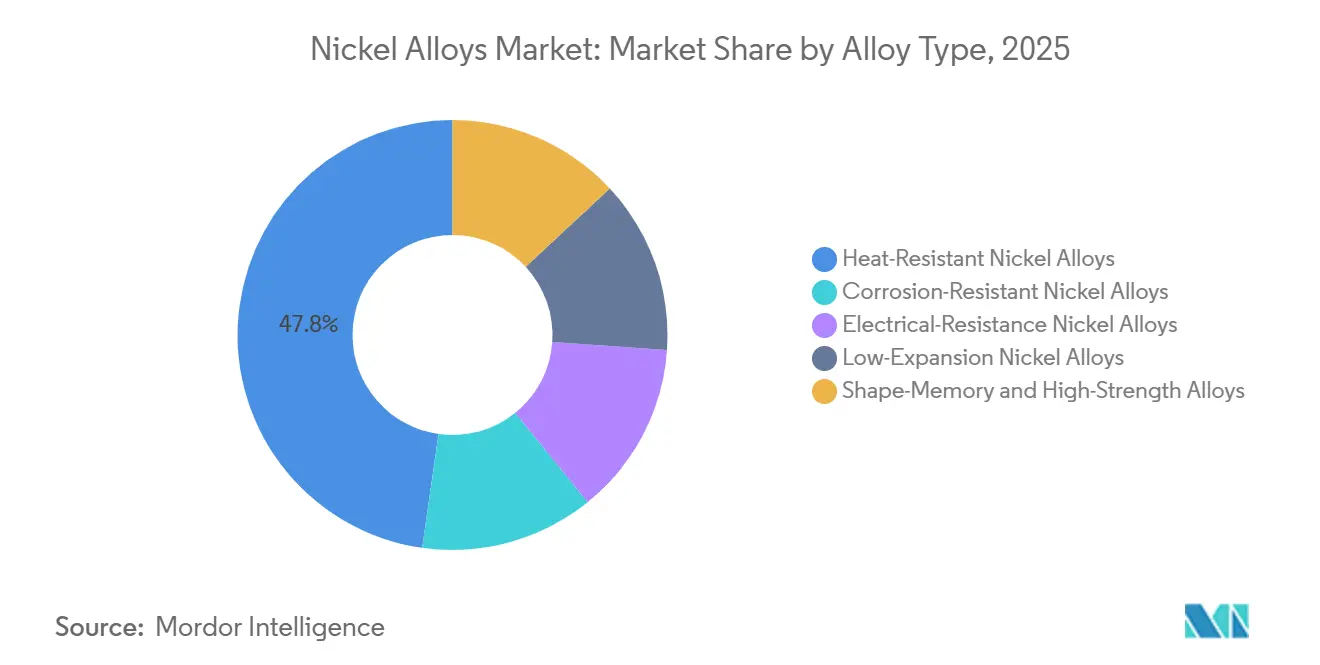
Heat-Resistant Nickel Alloys Dominate the MarketIn 2025, Heat-Resistant Nickel Alloys, including superalloys, dominated the nickel alloys market with a 47.76% share. Their leadership stems from their indispensable role in high-temperature, high-stress environments. Advanced precipitation-hardened superalloys and directionally solidified variants are preferred for critical applications such as aero-engine hot sections, industrial gas turbines, and hydrogen-fueled power plants operating above 1,000 °C. The expansion of commercial aviation fleets, increasing maintenance cycles, and the development of LNG and hydrogen infrastructures drive consistent demand for forged disks, turbine blades, and combustors. Additionally, retrofitting power generation systems for improved thermal efficiency is boosting the use of higher-creep-strength alloys, supporting long-term consumption.
Heat-Resistant Nickel Alloys (including superalloys) is also the fastest-growing segment, with a projected 6.26% CAGR from 2026 to 2031, driven by additive manufacturing and next-generation propulsion programs. Laser and electron-beam powder-bed fusion enable intricate cooling channels and lighter components, increasing superalloy powder demand and improving material utilization across aerospace supply chains. Thermal-barrier-coated superalloys are gaining traction in small modular reactors and concentrated solar power receivers, while advanced coatings extend service intervals in heavy-duty turbines. Although design optimizations are improving material efficiency per engine, rising engine production, overhaul cycles, and demand for high-temperature industrial equipment offset these gains. As electrification shifts metal demand from traditional alloys, heat-resistant nickel superalloys remain structurally essential, ensuring stable, performance-driven growth in the nickel alloys market.



By Nickel Type:
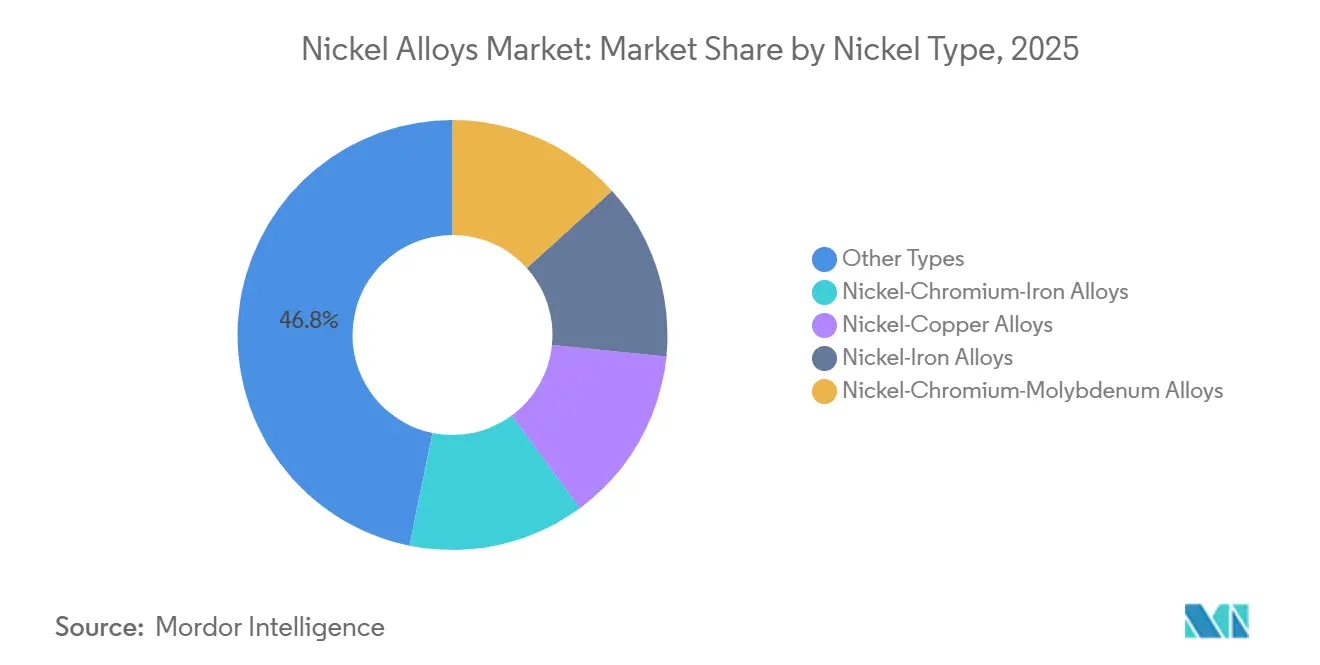
Ni-Cr-Fe is the Fastest Growing SegmentNickel-Chromium-Iron (Ni-Cr-Fe) Alloys are projected to grow at a 6.52% CAGR from 2026 to 2031, driven by their ability to withstand carburizing and oxidizing atmospheres. The Inconel 600/601/690 family is preferred for ultra-supercritical boilers, hydrogen reformers, and waste-to-energy plants, where higher firing temperatures challenge stainless steels. Coal-to-chemicals projects in Asia-Pacific and refinery heater retrofits in the Middle East are boosting demand for superheater tubing and furnace hardware. Electrification and hydrogen blending are raising operating temperatures, further driving the adoption of Ni-Cr-Fe alloys for their durability and cost efficiency. These alloys are steadily replacing high-alloy stainless steels in heat-treating equipment, sustaining strong growth.
Other Types held the largest market share at 46.80%, including nickel-based superalloys, multi-element compositions, Ni-Cr electrical-resistance alloys, and Ni-Ti shape-memory materials. Superalloys dominate turbine disks, blades, and aerospace fasteners, while multi-element variants support power-generation and space propulsion. Ni-Cr alloys are used in industrial heating elements, and Ni-Ti alloys are expanding in medical devices and smart actuators. Additive manufacturing and powder metallurgy are enabling proprietary compositions for extreme environments, supporting premium pricing and long-term contracts. Despite Ni-Cr-Fe alloys' rapid growth, Other Types retain the largest revenue share due to their diverse applications and material continuity.
By End-Use Industry:
Aerospace Leads the MarketIn 2025, aerospace accounted for 23.44% of the nickel alloys market and is projected to grow at a 7.23% CAGR from 2026 to 2031, driven by rising global aircraft production and engine replacements. Expanding narrow-body backlogs, next-gen wide-body programs, and increased defense spending are boosting demand for superalloy turbine disks, single-crystal blades, combustors, and high-temp fasteners. Engines with higher bypass ratios and geared turbofans, operating at elevated core temperatures, require more creep-resistant nickel alloys to meet fuel efficiency and emissions standards. Additionally, extended fleet service lives are driving MRO activities, sustaining aftermarket demand for forgings, castings, and repair powders.
Additive manufacturing strengthens aerospace's position by enabling weight-optimized designs and internal cooling channels beyond conventional machining. OEMs certifying printed brackets, heat exchangers, and fuel nozzles for mass production are driving powder demand for laser and electron-beam fusion, improving qualification cycles and buy-to-fly ratios. Space launch vehicles and reusable rocket engines further increase the need for high-strength, oxidation-resistant grades capable of repeated thermal cycles. While sectors like energy transition and chemical processing diversify demand, aerospace remains the cornerstone and growth driver of the nickel alloys market due to its unmatched requirements for extreme temperature resilience, fatigue life, and certification-driven material consistency.
Geography Analysis
APAC Nickel Alloys Market
Asia-Pacific commanded 49.62% of 2025 revenue and is forecast to advance 7.56% annually to 2031, the fastest among all regions. Indonesia produced 1.8 million tons of nickel ore in 2024 and operates 23 HPAL and RKEF facilities that feed both battery-grade matte and stainless pig iron. China remains the largest stainless producer at 33 million tons in 2024, consuming roughly 1.5 million tons of nickel though the shift toward 200-series grades is lowering intensity per ton. India’s defense build-out lifted domestic orders for Inconel forgings awarded by Hindustan Aeronautics in 2024.
North America and Europe Nickel Alloys Market
North America benefits from the Inflation Reduction Act’s 30% tax credits for battery components and the CHIPS Act’s USD 52 billion outlay for semiconductor fabs that rely on ultra-low-expansion alloys. ATI’s USD 140 million Pennsylvania expansion targets aerospace super-alloy demand and advanced electrical steels. Europe faces embedded-carbon tariffs under the Carbon Border Adjustment Mechanism that could exceed EUR 2,000 per ton for Indonesian nickel, redirecting buyers to Canadian or Finnish suppliers with lower footprints.
MEA and South America Nickel Alloys Market
South America remains niche, driven by Brazilian offshore pre-salt fields requiring corrosion-resistant subsea hardware rated to 200 MPa at 2,000 m depths. The Middle East and Africa show project-driven demand, epitomized by Saudi Arabia’s USD 7 billion NEOM industrial cluster and South Africa’s platinum processing upgrades that specify nickel-based alloys for sulfuric-acid leaching circuits. Collectively, these geographic vectors give the nickel alloys market a balanced demand base and mitigate over-reliance on any single consuming region.

Value Chain Analysis
The nickel alloys value chain begins with nickel ore mining and primary refining into Class 1 nickel units and intermediates, alongside alloying inputs such as chromium, molybdenum, iron, and cobalt. Demand and product suitability are shaped by supply routes, including matte and MHP/HPAL intermediates and refined nickel, which in turn affect which materials can be used for superalloys, corrosion-resistant grades, and powder feedstocks.
Midstream processing typically includes melting and remelt (VIM/VAR/ESR), casting, forging and rolling, wire drawing, and powder atomization for additive manufacturing. Downstream conversion then runs through certification-heavy qualification pathways into aerospace, energy, nuclear, chemical, and electronics components via OEM and tier supply chains. Qualification cycles of 12-24 months for safety-critical applications can slow switching and favor established producers and approved service centers, while periodic Indonesian RKAB quota constraints, including mine curtailments when quotas are exhausted, can create short-term physical risk to feedstock availability and procurement planning.
Competitive Landscape
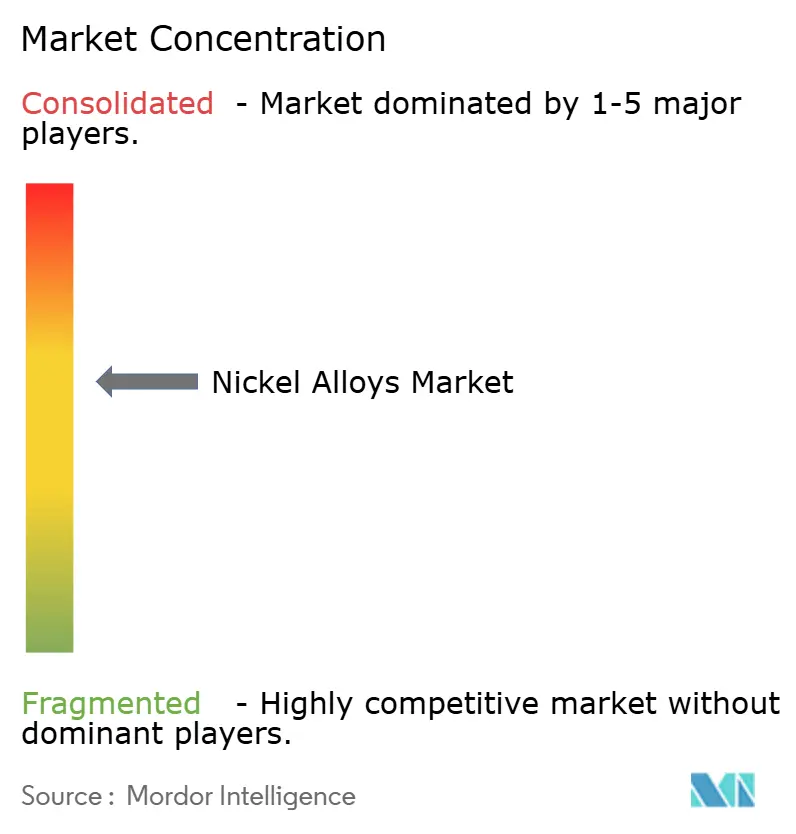
The global nickel alloys market is moderately consolidated, with the top five players holding a significant market share. Competitive advantage hinges on AS9100 and ASME Section III accreditation, additive-manufacturing prowess, and demonstrably low carbon footprints. Sandvik’s Osprey unit supplies gas-atomized Inconel and Hastelloy powders that allow engine OEMs to qualify topology-optimized parts without investing in atomizers. Smaller players in the market leverage rapid-turnaround service centers and digital inventories to capture spot opportunities when integrated mills quote 12-16-week lead times. Barriers to entry remain high; nuclear qualification demands a decade of creep-rupture data, and aerospace primes enforce exhaustive supplier audits. High-entropy alloys, now under a NASA patent, signal potential technology disruption yet remain at lab-scale. Overall, capital intensity and certification hurdles anchor a durable competitive moat for incumbents across the nickel alloys market.
Nickel Alloys Industry Leaders
ATI
Haynes International
VDM Metals
CRS Holdings, LLC.
thyssenkrupp Materials NA, Inc.
- *Disclaimer: Major Players sorted in no particular order
Nickel Alloys Market Companies Covered in this Report
- ATI
- Haynes International
- VDM Metals
- thyssenkrupp Materials NA, Inc.
- CRS Holdings, LLC.
- Precision Castparts Corp.
- NeoNickel
- Sandvik AB
- voestalpine Specialty Metals
- SANYO SPECIAL STEEL Co., Ltd.
- Nippon Yakin Kogyo
- JLC Electromet Pvt. Ltd.
- Berkshire Hathaway Inc.
- Kennametal Inc.
- Proterial, Ltd.
- Alloys International, Inc.
- Eramet
- Arconic
- Outokumpu
- GLENCORE

Market Opportunities and Future Outlook
Near-term whitespace is concentrated in premium, certified capacity and conversion steps that shorten lead times for aerospace and energy-transition applications, particularly VIM/remelt, precision forging, and gas-atomized powder supply for additive manufacturing. In April 2026, ATI announced a nickel superalloy capacity expansion at its Monroe, North Carolina (Bakers South) facility, centered on a new vacuum induction melting furnace, which points to continued investment in high-end melt capability for tight chemistry windows and qualification requirements.
A second opportunity area involves low-carbon and traceable nickel and alloy products as procurement criteria tighten across aerospace, batteries, and energy infrastructure. In July 2026, Canada Nickel partnered with RWE Supply and Trading to commercialize low-carbon intermediate stainless and alloy steel products via its Net Zero Metals platform using feedstock from the Crawford project, which reflects structured commercialization channels for lower-footprint metal units. On the technology side, the 2026 use of AI and IoT-driven metallurgical modeling has been applied to shorten specialty Ni-Cr-Fe alloy development cycles, supporting faster iteration in grades targeted for hydrogen turbines, SMR components, and other high-temperature industrial equipment.
Recent Industry Developments in Nickel Alloys Market
- June 2026: Haynes International confirmed commissioning activity for a fully integrated hydraulic radial forging line (SMX 800/25 MN) supplied by SMS group, with completion targeted in 2027 to raise nickel- and cobalt-based alloy production capability. The investment is designed to increase forging throughput for aerospace and other high-performance applications where conversion capacity and tight process control are as important as melt supply.
- August 2025: Haynes International announced HASTELLOY WR-66, adding a new corrosion-resistant alloy option to its portfolio. New grade introductions can support requalification cycles and give end users an additional specification choice when feedstock volatility or supply-chain constraints affect established chemistries.
- November 2024: Acerinox completed its acquisition of Haynes International for about USD 970 million and formed the Acerinox High-Performance Alloys (HPA) Division. The combination broadened the high-performance alloys platform alongside existing capabilities, with implications for more integrated product development and supply coverage across nickel alloy forms.


Nickel Alloys Market Report Scope and Research Methodology
Market Definition and Coverage
This market covers finished nickel alloy materials sold in commercial form, where nickel is the main base metal and the alloy is bought for corrosion resistance, heat strength, or toughness in demanding environments.
Scope exclusions: Excludes pure nickel metal, nickel ore and intermediate chemicals, and finished equipment where alloys are only a minor bill of materials item.
Segments Covered in This Report
- By Alloy Type
- Heat-Resistant Nickel Alloys
- Corrosion-Resistant Nickel Alloys
- Electrical-Resistance Nickel Alloys
- Low-Expansion Nickel Alloys
- Shape-Memory and High-Strength Alloys
- By Nickel Type
- Nickel-Chromium-Iron Alloys
- Nickel-Copper Alloys
- Nickel-Iron Alloys
- Nickel-Chromium-Molybdenum Alloys
- Other Types
- By End-use Industry
- Aerospace
- Electrical and Electronics
- Oil and Gas
- Chemical Processing
- Automotive
- Other End-user Industries
- By Geography
- Asia-Pacific
- China
- Japan
- India
- South Korea
- ASEAN Countries
- Rest of Asia-Pacific
- North America
- United States
- Canada
- Mexico
- Europe
- Germany
- United Kingdom
- France
- Italy
- Russia
- Rest of Europe
- South America
- Brazil
- Argentina
- Rest of South America
- Middle East and Africa
- Saudi Arabia
- South Africa
- Rest of Middle-East and Africa
- Asia-Pacific
Data Sources, Market Sizing, and Validation
Desk Research
Desk research starts by building the nickel alloy supply and demand context, then narrowing it to the alloy forms that are actually traded and consumed. We reference public sources such as USGS mineral and metals statistics, UN Comtrade customs trade tables, the International Trade Administration country notes, and energy and industry statistics from agencies such as the IEA and the US EIA, which help anchor metal use, industrial output, and trade direction.
After that, model inputs are cross-checked using company annual reports and investor presentations, audited filings where available, and technical publications such as ASM International handbooks and peer reviewed metallurgy journals to confirm typical alloy families, end uses, and substitution behavior. Limited paid database access is used only to speed up company financial screening, patent lookups, and shipment level import export checks when public series are incomplete. The desk sources listed here are illustrative, and other public documents and datasets were also reviewed for data collection and clarification.
Primary Interviews and Surveys
Primary work is used to confirm what is being counted as nickel alloy volume versus adjacent stainless and specialty steel products, and to pressure test the price and mix assumptions. Interviews with material producers, distributors, service centers, and procurement and engineering stakeholders from key end use industries across APAC, EMEA, and the Americas helped align regional demand signals and trade flows with what appears in secondary datasets.
Distribution of primary research fieldwork respondents
| Company type | Respondent position | Region |
|---|---|---|
| Top tier: 28% | CXOs: 17% | APAC: 52% |
| Mid tier: 53% | Functional/Unit leaders: 33% | EMEA: 30% |
| Smaller Players: 19% | Managers: 50% | Americas: 18% |
Market-Sizing & Forecasting
Sizing is built mainly through a top-down reconstruction that starts from nickel alloy production and trade signals, and then applies form and end use allocation factors to arrive at an addressable demand pool by region. To keep totals grounded, the outputs are corroborated with selective bottom-up approximations such as sampled supplier and distributor volumes, channel checks on typical order patterns, and an ASP times volume sense-check for a few common alloy families before final adjustments are made.
Key inputs that steer the model include aerospace build and maintenance activity, oil and gas capex and refinery throughput, chemical processing capacity additions, power generation and industrial heat equipment demand, and observed nickel and alloy surcharge movement that influences buyer timing. Where data gaps appear in smaller geographies, proxy indicators like industrial production and import dependence are used, and then corrected through interview feedback. For forecasting, scenario analysis is applied around macro cycles and nickel price swings, and the final trajectory is picked after aligning the drivers with what industry participants expect for lead times, substitution, and inventory behavior.
Data Validation & Update Cycle
Validation is handled through multiple checks so the final numbers do not rely on one dataset or one assumption. We compare outputs with independent signals such as trade balance direction, downstream industrial production trends, and capacity announcements, and then investigate outliers before sign-off through peer review.
The dataset is refreshed annually, and interim updates are triggered when material events occur, such as sharp nickel price changes, major capacity closures, or policy moves affecting trade. Before delivery, a final analyst pass is completed so the model reflects the latest public releases and any new primary feedback.
Mordor Intelligence's Nickel Alloys Market Size Compared Against Other Published Estimates
Published market sizes for nickel alloys can vary even when the topic sounds the same, because firms do not always count the same products, units, and pricing mechanics. Differences also come from the chosen base year, how regional trade is netted out, and whether the estimate is updated when metal prices and surcharges move quickly.
The main gap comes from mixing value and volume in ways that can accidentally double count alloy surcharge inflation, where Mordor Intelligence keeps the core market sizing in volume terms (kilotons) and uses pricing only as a cross-check instead of letting nickel price swings drive the total.
Benchmark comparison
| Source | Market Size | Gaps in Research Methodology |
|---|---|---|
| Mordor Intelligence | USD 500.07 M (2026) | |
| Industry Research Publisher A | USD 15.79 B (2024) | Reports the market in value terms for a different base year, and the total can move mainly with nickel price and surcharge assumptions rather than with shipped alloy tonnage. |
| Industry Research Publisher B | USD 14.70 B (2024) | Uses a value based definition and forecast window that can fold in a broader set of high performance alloy revenues, which may not be filtered to traded nickel alloy material forms only. |
The spread in the table is mostly explained by unit choice and what is treated as in scope, since a volume anchored view will not expand or shrink just because metal pricing changes. By tying the size to measurable demand drivers and then validating with channel feedback, the estimate stays easier to reconcile with production and trade signals across regions.


Key Questions Answered in the Report
How large is the global nickel alloys market in 2026?
The market stands at 500.07 Kilotons in 2026 and is forecast to reach 646.51 Kilotons by 2031.
What is the expected growth rate for nickel alloys through 2031?
Market volume is projected to rise at an 5.27% CAGR over 2026-2031, driven by aerospace, EV batteries, SMRs, and hydrogen turbines.
Which alloy segment holds the largest share?
Heat-Resistant Nickel Alloys (includes superalloys) led with 47.76% share in 2025, thanks to their indispensable role in high-temperature and high-stress environments.
Which end-use industry is growing fastest?
Aerospace demand is set to expand at a 7.23% CAGR, driven by rising global aircraft production and engine replacements.
What region will drive most of the new demand?
Asia-Pacific is projected to advance at 7.56% annually to 2031, underpinned by Indonesian processing capacity and Chinese stainless production.
Page last updated on:


 Your data is secure and never sold or shared.


