
Bovine-based Collagen For Biomedical Applications Market Size and Share
Market Overview
| Study Period | 2020 - 2031 |
|---|---|
| Market Size (2026) | USD 1.42 Billion |
| Market Size (2031) | USD 2.28 Billion |
| Growth Rate (2026 - 2031) | 9.97 % |
| Fastest Growing Market | Asia Pacific |
| Largest Market | North America |
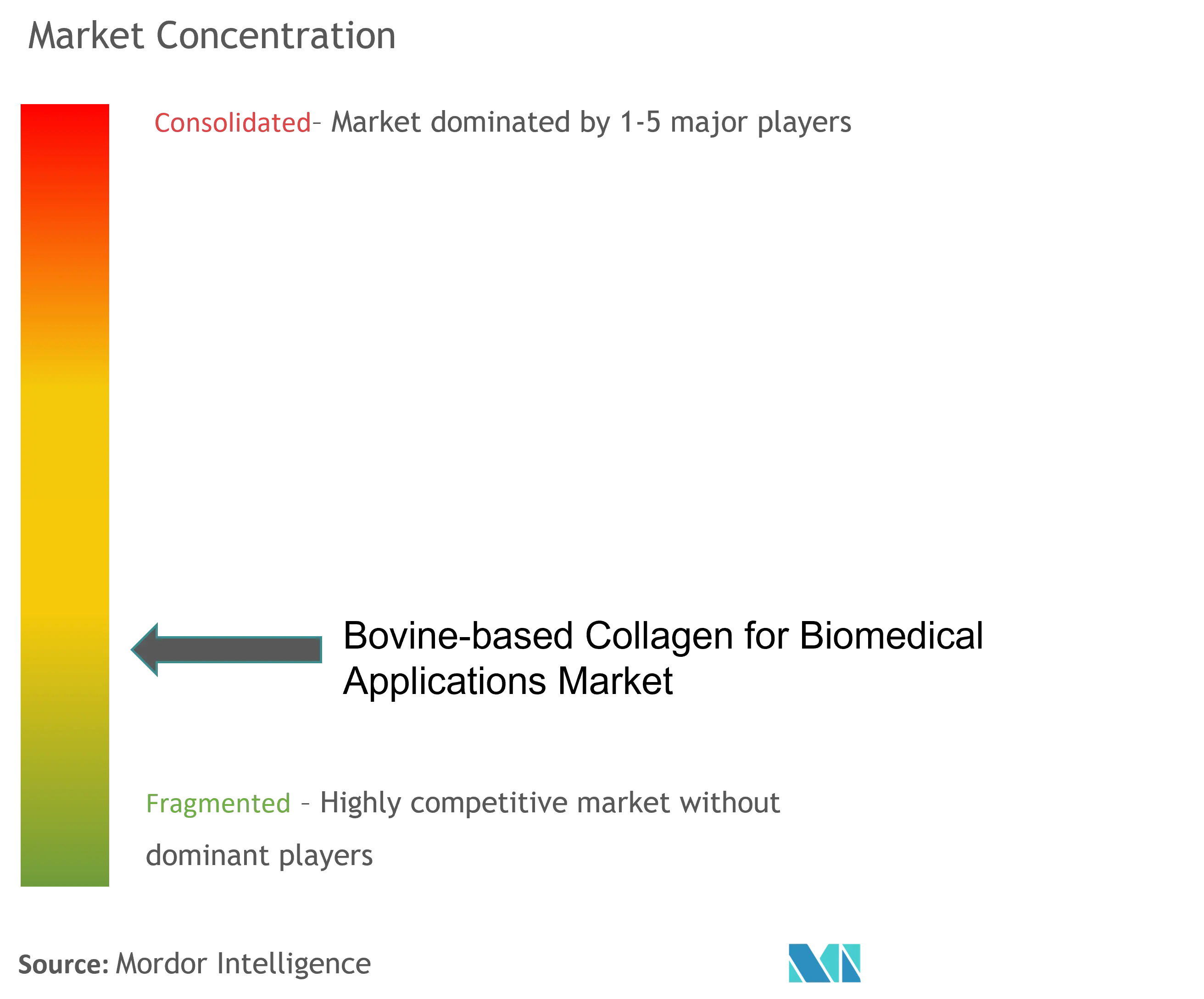
| Market Concentration | Low |
Major Players *Disclaimer: Major Players sorted in no particular order Image © Mordor Intelligence. Reuse requires attribution under CC BY 4.0. | |
Bovine-based Collagen For Biomedical Applications Market Analysis by Mordor Intelligence
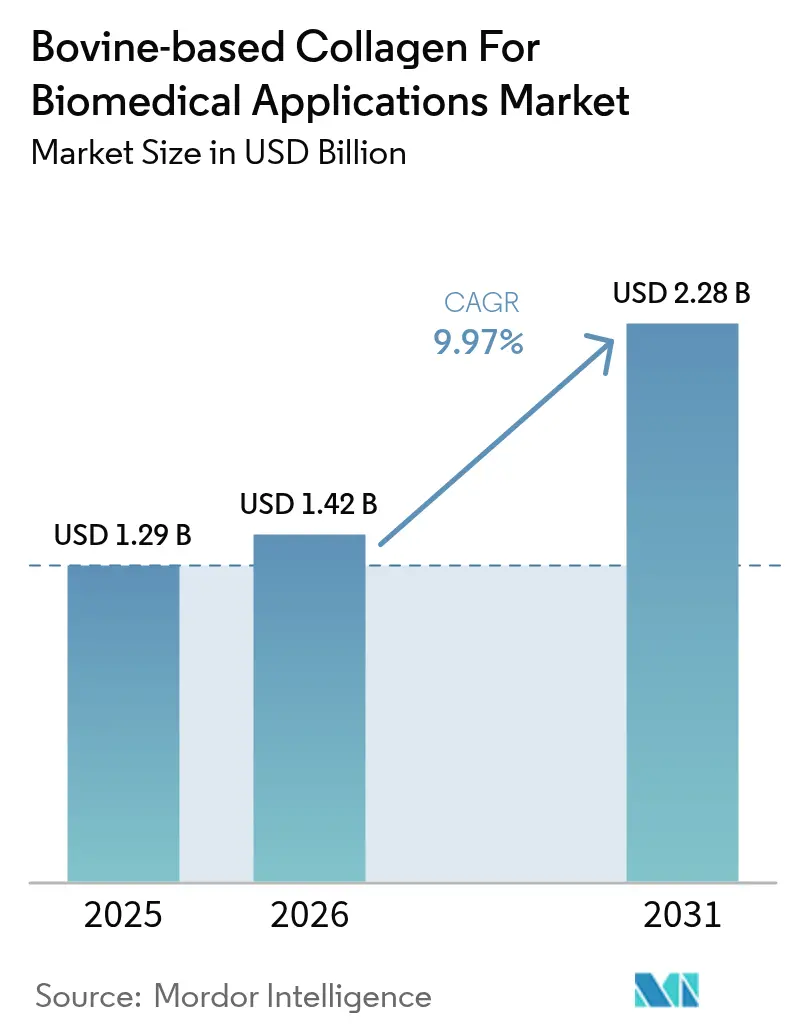
The Bovine-based Collagen For Biomedical Applications Market size was valued at USD 1.29 billion in 2025 and estimated to grow from USD 1.42 billion in 2026 to reach USD 2.28 billion by 2031, at a CAGR of 9.97% during the forecast period (2026-2031).
The bovine-based collagen for biomedical applications market continues to evolve rapidly, driven by increasing awareness of collagen's versatile applications in biomedical sciences and healthcare. The sector has witnessed significant technological advancements in extraction and processing methods, leading to improved product quality and expanded applications across various medical fields. Industry stakeholders are increasingly focusing on sustainable sourcing practices and implementing advanced purification techniques to ensure product safety and efficacy. This shift towards sustainable practices has become particularly important as environmental consciousness grows among both manufacturers and consumers.
The integration of bovine collagen in advanced biomaterial applications has gained substantial momentum, particularly in tissue engineering and regenerative medicine. Recent developments in biomaterial science have expanded the potential applications of bovine collagen in areas such as arthroplasty, cochlear implants, heart valve design, and tissue engineering. According to recent healthcare statistics, approximately 23.7% of US adults (58.5 million people) have been diagnosed with arthritis, with projections indicating this number could reach 78.4 million by 2040. This growing patient population has spurred increased research into collagen-based therapeutic solutions.
The industry has witnessed significant strategic collaborations between key players to enhance research and development capabilities. A notable example is the long-term research and development agreement between L'Oréal and the Symatese Group, focusing on developing advanced biomaterials designed for human tissue physiology, particularly for regeneration purposes. Such partnerships are instrumental in driving innovation and expanding the application scope of bovine-based collagen products. The market has also seen increased investment in manufacturing infrastructure to meet the growing demand for high-quality collagen products.
Global health statistics indicate a significant prevalence of conditions that could benefit from collagen-based treatments, with osteoporosis affecting approximately 23.1% of women and 11.7% of men worldwide. This has led to increased focus on developing specialized collagen-based solutions for bone and joint health. The industry is witnessing a shift towards more sophisticated product formulations, with manufacturers investing in advanced processing technologies to enhance the bioavailability and efficacy of their products. Additionally, there is growing emphasis on developing combination products that leverage the synergistic benefits of bovine collagen with other bioactive compounds.
Note: Market size and forecast figures in this report are generated using Mordor Intelligence’s proprietary estimation framework, updated with the latest available data and insights as of 2026.
Global Bovine-based Collagen For Biomedical Applications Market Trends and Insights
Growing Demand for Bovine-based Collagen to Treat Various Diseases
The rising prevalence of various diseases and disorders that can be treated with bovine-based collagen for biomedical applications market products is driving significant market growth. According to research published in the International Journal of Environmental Research and Public Health in March 2022, postmenopausal women showed high prevalence rates of osteoporosis (30.50%) and osteopenia (44.20%), with factors such as higher systolic blood pressure, triglyceride levels, and poor sleep hygiene independently influencing the risk. These conditions require effective treatment options, and bovine collagen has shown promising results in improving bone density and supporting tissue regeneration.
The application of bovine-based collagen for biomedical applications market extends beyond bone health to various other therapeutic areas, including skin regeneration, wound healing, dental therapy, and gastroesophageal reflux treatment. The versatility of bovine collagen is particularly evident in its low immunogenic properties and high biocompatibility, making it an ideal choice for various medical applications. Recent studies have demonstrated that collagen extracted from bovine sources has been extensively utilized for vascular graft enrichment, primarily as a coating for the luminal surface of vascular grafts and as a medication delivery system for the release of pro-endothelialization agents.
Increasing Demand for Dental and Orthopedic Surgeries
The growing prevalence of dental and orthopedic conditions is significantly driving the demand for bovine-based collagen products in surgical procedures. According to Statistics Canada's August 2022 update, there is a substantial population affected by arthritis across different age groups, with 657,900 people aged 35 to 49 years, 2,042,100 people aged 50 to 64 years, and 3,138,500 people aged 65 and above having arthritis in 2021. This high prevalence of orthopedic conditions necessitates surgical interventions where bovine-based collagen products play a crucial role in healing and recovery.
The demand is further amplified by the increasing incidence of dental procedures and the growing recognition of bovine collagen's effectiveness in dental applications. Bovine-based collagen has shown particular promise in periodontal treatment, general dental procedures, and orthodontic treatments. The material's natural properties make it an excellent choice for tissue scaffolds and matrix formation in dental procedures, providing better healing outcomes and reduced recovery times. The rising adoption of bovine-based collagen in dental procedures is also attributed to its ability to promote natural development and aid in the debridement of contaminated tissues.
Ongoing R&D to Develop Wound Healing and Regenerative Medicines
Research and development initiatives in wound healing and regenerative medicine are creating new opportunities for bovine-based collagen applications. According to Mission Regional Medical Center's 2022 update, approximately 6.7 million people currently live with chronic wounds, and this number is expected to grow by more than 2% in the next decade. This significant patient population has driven extensive research into more effective wound remedies, with a focus on reducing hospital costs, providing long-term comfort, and promoting good scar healing. Bovine collagen's role in these applications is particularly important as it serves as a primary matrix material in many wound healing products.
The advancement in regenerative medicine research has led to innovative applications of bovine-based collagen, particularly in the development of injectable hydrogel-based scaffolds for cartilage regeneration. Recent research has focused on improving therapeutic efficacy and ease of administration through advanced design and manufacturing processes. Additionally, there are ongoing efforts to utilize waste valorization opportunities, where unusable hide off-cuttings, shavings, and trimmings from industrial processing of bovine hides into leather are being transformed into high-value collagen products. This sustainable approach not only addresses environmental concerns but also helps meet the growing demand for collagen in medical applications.
Segment Analysis
Bone Graft Substitutes Segment in Bovine-based Collagen for Biomedical Applications Market
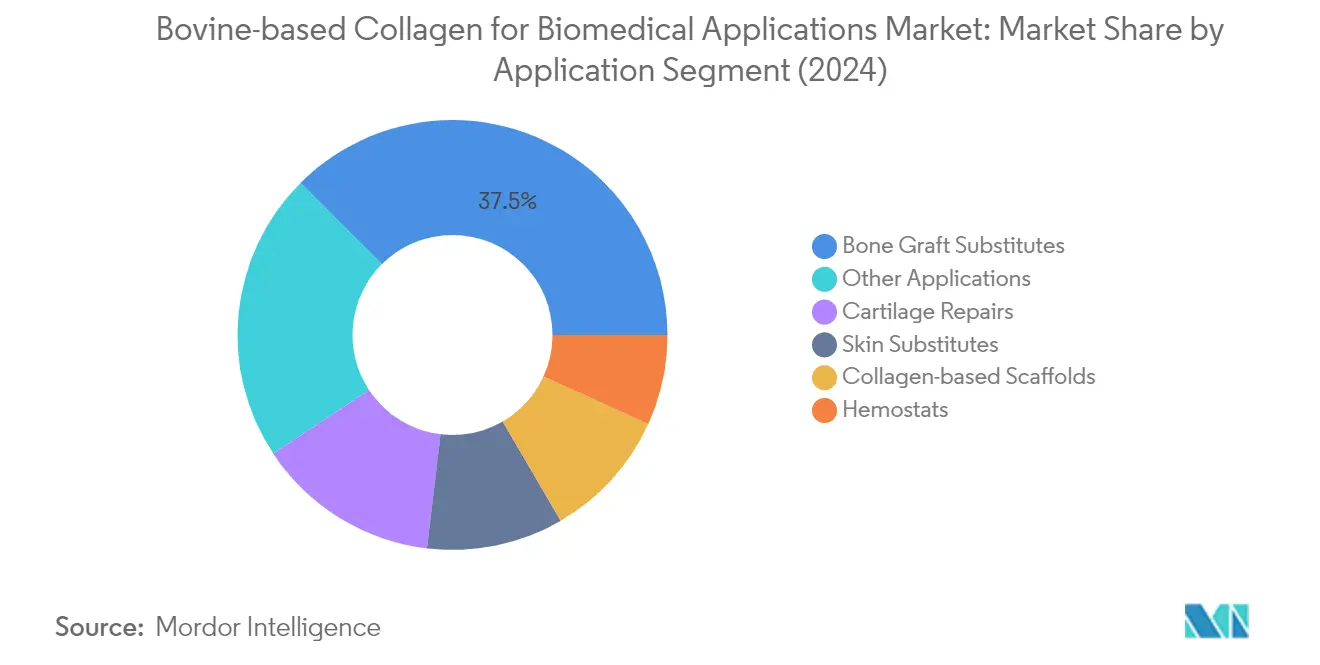
The Bone Graft Substitutes segment dominates the global bovine-based collagen for biomedical applications market, accounting for approximately 37.32% of the total market share in 2025. This segment's leadership position is driven by the increasing prevalence of bone and joint disorders worldwide, particularly osteoporosis and orthopedic injuries requiring surgical intervention. The widespread adoption of bovine-based bone graft substitutes can be attributed to their superior stability, low immunogenicity, and excellent biocompatibility properties. These products are extensively used in maxillary sinus lifting procedures, implant surgeries, and various orthopedic applications. The segment's growth is further supported by technological advancements in bone grafting techniques and the rising geriatric population globally who are more susceptible to bone-related conditions requiring surgical interventions.
Remaining Segments in Bovine-based Collagen for Biomedical Applications Market
The market's remaining segments include Collagen-based Scaffolds, Hemostats, Skin Substitutes, Cartilage Repairs, and Other Applications, each serving distinct medical purposes. Collagen-based Scaffolds are crucial in tissue engineering applications, particularly in cartilage, bone, and tendon regeneration. The Hemostats segment plays a vital role in surgical procedures by providing effective bleeding control and improved surgical outcomes. Skin Substitutes are essential in wound healing and tissue regeneration applications, particularly in treating chronic wounds and burns. The Cartilage Repairs segment addresses the growing need for joint repair and regeneration solutions, while Other Applications encompass various uses such as dental applications, cardiovascular procedures, and general surgery applications. Each of these segments contributes significantly to the overall market growth through continuous innovation and expanding applications in various medical procedures.
Geography Analysis
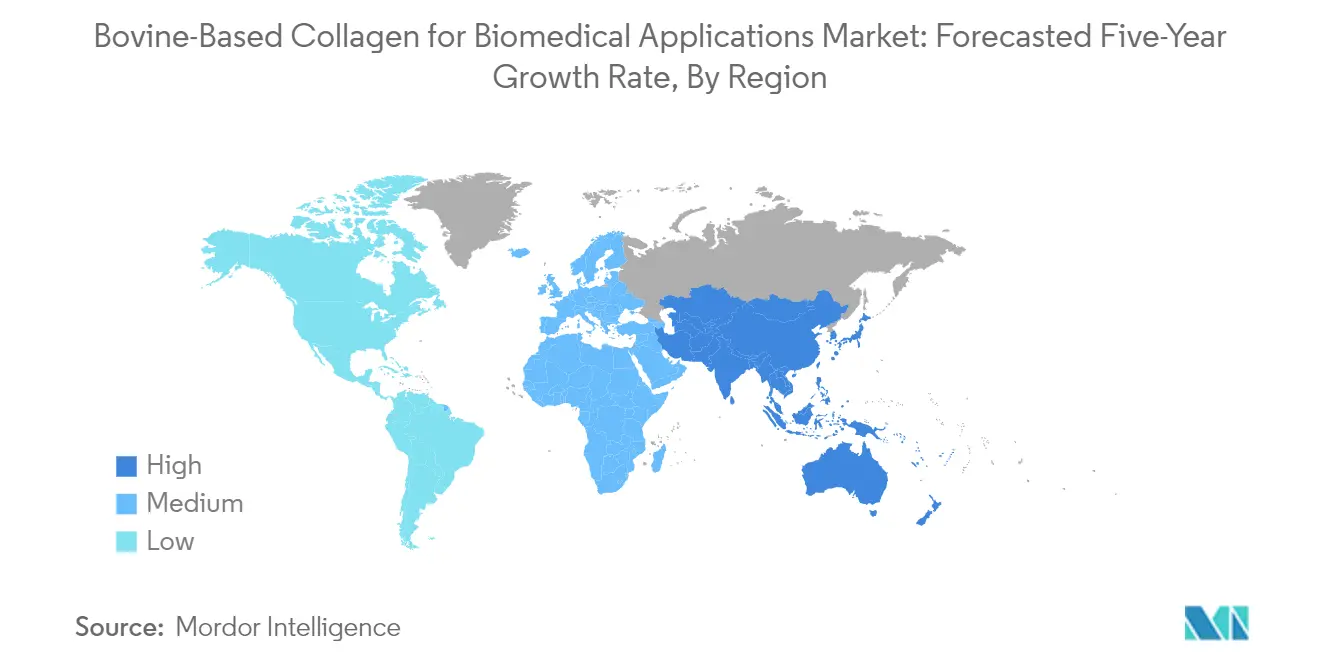
North America represents a dominant force in the global bovine-based collagen for biomedical applications market, driven by advanced healthcare infrastructure and increasing adoption of innovative medical technologies. The region's market is characterized by high investment in research and development, particularly in regenerative medicine and tissue engineering applications. The United States, Canada, and Mexico collectively contribute to the region's prominence, with factors such as growing demand for dental and orthopedic surgeries, a rising geriatric population, and an increasing prevalence of chronic wounds driving market growth.
The United States maintains its position as the largest market in North America, commanding approximately 86.45% of the regional market share. The country's market leadership is supported by extensive research activities, the presence of major market players, and advanced healthcare facilities. The robust healthcare system, coupled with the increasing prevalence of orthopedic disorders and rising adoption of regenerative medicine, continues to drive market growth. The presence of well-established regulatory frameworks and reimbursement policies further strengthens the market position of bovine-based collagen for biomedical applications market products in the United States.
The United States is projected to maintain the highest growth trajectory in North America, with an expected CAGR of approximately 8.88% during 2026-2031. This growth is primarily attributed to increasing investments in research and development of advanced collagen-based products, rising demand for minimally invasive surgical procedures, and growing applications in wound healing and tissue regeneration. The country's focus on innovative medical technologies and increasing healthcare expenditure continues to create favorable conditions for market expansion.
Europe represents a significant market for bovine-based collagen for biomedical applications market, characterized by strong research capabilities and increasing adoption of advanced biomaterials. The region benefits from well-established healthcare infrastructure and growing awareness about regenerative medicine applications. Countries including Germany, the United Kingdom, France, Italy, and Spain contribute significantly to the market growth, with each nation showing distinct patterns of adoption and development in collagen-based medical applications.
Germany leads the European market, holding approximately 22.76% of the regional market share. The country's dominance is attributed to its advanced healthcare system, strong presence of medical device manufacturers, and significant investments in research and development. The German market benefits from high healthcare spending, an increasing geriatric population, and growing demand for advanced wound care and orthopedic applications.
France emerges as the fastest-growing market in Europe, with an anticipated CAGR of approximately 9.84% during 2026-2031. The country's impressive growth is driven by increasing adoption of innovative medical technologies, rising demand for cosmetic and reconstructive surgeries, and growing applications in dental and orthopedic procedures. The French market also benefits from supportive healthcare policies and increasing research activities in regenerative medicine.
The Asia-Pacific region demonstrates significant potential in the bovine-based collagen for biomedical applications market, driven by improving healthcare infrastructure, increasing healthcare expenditure, and growing awareness about advanced medical treatments. The region encompasses diverse markets including China, Japan, India, Australia, and South Korea, each contributing uniquely to the overall market landscape. The increasing adoption of Western medical practices, a rising geriatric population, and growing demand for advanced wound care solutions are key factors influencing market growth.
China maintains its position as the largest market in the Asia-Pacific region, driven by its extensive healthcare reforms, large patient population, and increasing investments in healthcare infrastructure. The country's market is characterized by growing adoption of advanced medical technologies, increasing prevalence of chronic diseases, and rising demand for regenerative medicine applications. The presence of domestic manufacturers and increasing research activities further strengthen China's market position.
India emerges as the fastest-growing market in the Asia-Pacific region, driven by improving healthcare infrastructure, increasing medical tourism, and growing awareness about advanced medical treatments. The country's market is witnessing rapid expansion due to rising investments in healthcare facilities, growing demand for advanced wound care solutions, and increasing adoption of regenerative medicine applications. The presence of a large patient pool and increasing healthcare expenditure further contribute to market growth.
The Rest of World region, encompassing the Middle East, Africa, and Latin America, represents an emerging market for bovine-based collagen applications. The market in these regions is driven by improving healthcare infrastructure, increasing healthcare awareness, and growing adoption of advanced medical technologies. The region shows promising growth potential due to rising investments in healthcare facilities, increasing medical tourism, and growing demand for advanced wound care solutions. Brazil emerges as the largest market in this region, while Saudi Arabia shows the fastest growth potential, driven by significant healthcare investments and improving medical infrastructure.
Competitive Landscape
Top Companies in Bovine-based Collagen for Biomedical Applications Market
The bovine-based collagen for biomedical applications market features established players like Darling Ingredients, Medtronic, Collagen Matrix, and Botiss Biomaterials leading innovation in biomedical applications. Companies are increasingly focusing on developing specialized collagen formulations for specific medical procedures, particularly in orthopedics and dental applications. Strategic partnerships with healthcare providers and research institutions have become crucial for product development and market penetration. Manufacturing capabilities are being enhanced through facility expansions and technological upgrades to meet growing demand. Geographic expansion, particularly in emerging markets, remains a key priority with companies establishing local production and distribution networks. The industry has also witnessed increased investment in research and development to create novel applications and improve existing product efficacy.
Market Structure Shows Dynamic Competitive Environment
The competitive landscape is characterized by a mix of large medical device conglomerates and specialized collagen manufacturers, creating a diverse market environment. Global players leverage their extensive distribution networks and research capabilities to maintain market leadership, while regional specialists focus on niche applications and local market requirements. The market shows moderate consolidation with larger companies actively pursuing acquisitions of smaller, innovative firms to expand their product portfolios and technological capabilities. Companies with integrated supply chains, from raw material sourcing to end-product manufacturing, have demonstrated stronger market positions and better operational control.
Market dynamics are influenced by increasing collaboration between manufacturers and healthcare institutions, driving product innovation and adoption. The industry has witnessed strategic partnerships aimed at developing application-specific solutions and expanding geographical reach. Mergers and acquisitions have been primarily focused on acquiring specialized technologies and entering new regional markets. Companies with strong research and development capabilities have maintained competitive advantages through continuous product innovation and improved manufacturing processes. The market also sees active participation from local players who leverage their understanding of regional healthcare systems and regulatory requirements.
Innovation and Adaptability Drive Future Success
Success in the market increasingly depends on companies' ability to develop specialized products meeting specific medical requirements while maintaining cost-effectiveness. Manufacturers must focus on establishing strong relationships with healthcare providers and research institutions to understand evolving clinical needs and develop appropriate solutions. Quality control and regulatory compliance have become crucial differentiators as healthcare providers prioritize product safety and reliability. Companies need to invest in advanced manufacturing technologies and maintain robust supply chains to ensure consistent product quality and timely delivery. The ability to adapt to changing healthcare practices and emerging medical applications will determine long-term success in the market.
Market entrants need to focus on developing unique value propositions through specialized applications or improved manufacturing processes. Building strong distribution networks and establishing relationships with key healthcare providers is essential for market penetration. Companies must also consider the impact of alternative materials and changing regulatory requirements on their market positions. Success factors include maintaining cost competitiveness while ensuring product quality and regulatory compliance. The ability to demonstrate clinical efficacy and cost-effectiveness through research and clinical trials will become increasingly important for market success. Companies need to balance innovation with practical considerations of manufacturing scalability and market acceptance.
Bovine-based Collagen For Biomedical Applications Industry Leaders
Rousselot
Botiss biomaterials GmbH
BBI Solutions
FOODMATE CO., LTD.
Symatese
- *Disclaimer: Major Players sorted in no particular order


Market Opportunities and Future Outlook
The opportunity is in raising the analytical and documentation bar for bovine type I collagen used in tissue-engineered products as standardization efforts tighten quality expectations across regions. ISO 6631:2025 introduces a method for quantifying bovine type I collagen marker peptides using LC-MS/MS, which can support more consistent quality control for collagen-based scaffolds, wound dressings, and other implant-adjacent products where batch-to-batch characterization and traceability matter for procurement and regulatory submissions.
Regulatory clearances and national technical requirements also create room for differentiated wound-care formats and matrix products that depend on well characterized bovine collagen inputs. In the United States, FDA 510(k) activity for bovine collagen wound dressings and dermal matrices (including Collagen Matrix Inc. and Ovigenex) shows an active pathway for new collagen-based wound management formats, while GB/T 45992-2025 for collagen and its hydrolysate (entering implementation in 2026) adds another compliance anchor for suppliers selling into, or sourcing for, Asia. Across applications such as hemostats, skin substitutes, and tissue engineering scaffolds, manufacturers that can provide highly purified, application-specific collagen (with controlled degradation profiles and validated analytical methods) have room to differentiate beyond commodity collagen inputs.
Recent Industry Developments
- June 2026: Rousselot (Darling Ingredients) received a U.S. patent for its Nextida GC collagen peptide composition targeting blood glucose regulation. While positioned for non-pharmaceutical use, the IP signals continued formulation and processing innovation around collagen peptides that can spill over into higher-value biomedical-grade characterization and product development.
- April 2025: botiss biomaterials GmbH expanded its biomaterials portfolio at IDS 2025, including the launch of maxgraft+Hya, combining its regenerative materials offering with hyaluronic acid-based handling and performance features. This highlights continued product-format innovation in dental regeneration, a major demand center for bovine-derived collagen and related biomaterials used in grafting and soft-tissue support workflows.
- November 2024: Rousselot and IamFluidics launched a dissolvable microcarrier for scalable cell culturing that incorporates denatured collagen. This adds a collagen-enabled tool for bioprocessing and cell culture workflows, broadening collagen use cases beyond implants and wound care into enabling technologies for regenerative medicine manufacturing.


Research Methodology Framework and Report Scope
Market Definition and Coverage
This market covers bovine-derived collagen materials sold for biomedical use, where the product is designed to interact with the body in procedures or clinical-grade care, and revenue is counted at the point of sale to medical and life science channels.
Scope exclusions: We exclude collagen used mainly for food, supplements, cosmetics, and general industrial gelatin uses, even when the input source is bovine.
Segmentation Overview
- By Application
- Bone Graft Substitutes
- Collagen-based Scaffolds
- Hemostats
- Skin Substitutes
- Cartilage Repairs
- Others
- Geography
- North America
- United States
- Canada
- Mexico
- Europe
- Germany
- United Kingdom
- France
- Italy
- Spain
- Rest of Europe
- Asia-Pacific
- China
- Japan
- India
- Australia
- South Korea
- Rest of Asia-Pacific
- Rest of the World
- North America
Data Sources, Market Sizing, and Validation
Desk Research
Desk work starts by mapping where bovine collagen is actually used in healthcare and how it is regulated and purchased, so the market does not get mixed with consumer collagen categories. We reference public sources such as FDA device databases and guidance notes, European Commission medical device framework pages, World Bank and OECD health expenditure series, and selected peer reviewed papers on collagen biomaterials and implantable scaffolds.
To convert the demand picture into values, we use a mix of open and structured sources such as company annual reports and investor decks, press releases from hospitals and research institutes, customs or trade statistics when collagen material movements are visible, and pricing indicators published in reputable journals. A paid subscription is also used for company financials and patent databases, which helps confirm where product pipelines and capacity investments are moving. These examples are not exhaustive, and many other public and internal-reference sources were reviewed to collect, validate, and clarify data points.
Primary Interviews and Surveys
Primary work is used to confirm what portion of bovine collagen revenue is truly biomedical grade and to understand how volumes and prices shift by use case and region. We speak with a mix of raw material suppliers, medical device manufacturers, contract manufacturers, and procurement or clinical users, and we balance inputs across APAC, EMEA, and the Americas to avoid a single-region bias.
Distribution of primary research fieldwork respondents
| Company type | Respondent position | Region |
|---|---|---|
| Top tier: 29% | CXOs: 14% | APAC: 47% |
| Mid tier: 51% | Functional/Unit leaders: 42% | EMEA: 32% |
| Smaller Players: 20% | Managers: 44% | Americas: 21% |
Market-Sizing & Forecasting
We size the market mainly with a top-down approach where procedure and treatment activity is translated into collagen demand pools, then converted into value using realistic adoption rates and average selling prices by application. We then cross-check totals using selective bottom-up approximations, such as supplier revenue roll-ups, sampled ASP x volume checks from channel conversations, and sanity checks against known device category growth.
Key inputs used in the model include the number of orthopedic and wound care procedures where collagen is commonly specified, the mix shift toward scaffolds, skin substitutes, and hemostats, the share of bovine collagen versus other collagen sources used in regulated products, and price movement by grade (including sterilization and traceability requirements). We also track regional approvals and reimbursement signals because they affect how quickly collagen-based products get adopted, which feeds into volume growth.
Forecasts are built using scenario analysis supported by simple trend models, where base growth is linked to procedure volumes and gradual penetration changes, and then adjusted using interview consensus on pricing, substitution risk, and supply constraints. When bottom-up inputs are missing for smaller channels, we handle gaps by using conservative penetration ranges and reconciling them back to the top-down demand pool, so the final number remains explainable.
Data Validation & Update Cycle
Outputs are checked against independent signals such as procedure growth, medical device category revenue trends, and reported changes in collagen raw material availability and pricing. If a region or application shows an unusual jump, we review the drivers, revisit assumptions, and trigger follow-up calls with relevant participants before sign-off.
Each report is refreshed annually, and interim updates are made when a material event happens, such as a regulatory change, a major supply disruption, or a pricing swing that shifts near-term market value. Before delivery, a final review pass is completed so clients receive the most current view available at that time.
Mordor Intelligence's Bovine Based Collagen for Biomedical Applications Market Size Compared Against Other Published Estimates
Published market numbers for bovine-based collagen in biomedical use can differ a lot, even when the topic name sounds the same. In practice, the spread usually comes from what gets counted as biomedical grade, what years are used for currency and pricing, and how aggressively penetration is assumed to rise across high-growth applications.
The main gap comes from product-scope overlap, where Mordor Intelligence treats the market as bovine-derived collagen used in biomedical applications and keeps food, supplements, and cosmetic collagen value out of the totals, even if the upstream collagen source is the same.
Benchmark comparison
| Source | Market Size | Gaps in Research Methodology |
|---|---|---|
| Mordor Intelligence | USD 1.42 B (2026) | |
| Industry Publisher A | USD 0.89 B (2025) | Uses an earlier base year and typically leans on a narrower captured revenue pool, which can undercount newer uses like advanced scaffolds and higher-spec hemostats that carry higher pricing. |
| Industry Research Portal B | USD 2.80 B (2024) | Broader definitions appear to include adjacent collagen and gelatin-like categories and wider end-use interpretations, which can pull in non-biomedical demand and inflate the value when prices are averaged. |
The table indicates that most variance is explained by what is included as biomedical revenue and by the year used to anchor prices and currency. By keeping the demand pool tied to biomedical applications and then checking the result against procedure activity and realistic ASP logic, the estimate stays traceable and repeatable for planning.


Key Questions Answered in the Report
How big is the Global Bovine-based Collagen for Biomedical Applications Market?
The Global Bovine-based Collagen for Biomedical Applications Market size is expected to reach USD 1.42 billion in 2026 and grow at a CAGR of 9.97% to reach USD 2.28 billion by 2031.
What is the current Global Bovine-based Collagen for Biomedical Applications Market size?
In 2026, the Global Bovine-based Collagen for Biomedical Applications Market size is expected to reach USD 1.42 billion.
Who are the key players in Global Bovine-based Collagen for Biomedical Applications Market?
Rousselot, Botiss biomaterials GmbH, BBI Solutions, FOODMATE CO., LTD. and Symatese are the major companies operating in the Global Bovine-based Collagen for Biomedical Applications Market.
Which is the fastest growing region in Global Bovine-based Collagen for Biomedical Applications Market?
Asia Pacific is estimated to grow at the highest CAGR over the forecast period (2025-2030).
Which region has the biggest share in Global Bovine-based Collagen for Biomedical Applications Market?
In 2025, the North America accounts for the largest market share in Global Bovine-based Collagen for Biomedical Applications Market.
What years does this Global Bovine-based Collagen for Biomedical Applications Market cover, and what was the market size in 2025?
In 2025, the Global Bovine-based Collagen for Biomedical Applications Market size was estimated at USD 1.42 billion. The report covers the Global Bovine-based Collagen for Biomedical Applications Market historical market size for years: 2019, 2020, 2021, 2022, 2023 and 2024. The report also forecasts the Global Bovine-based Collagen for Biomedical Applications Market size for years: 2026, 2027, 2028, 2029, 2030 and 2031.
Page last updated on:


 Your data is secure and never sold or shared.


