
Biomedical Textile Market Size and Share
Market Overview
| Study Period | 2020 - 2031 |
|---|---|
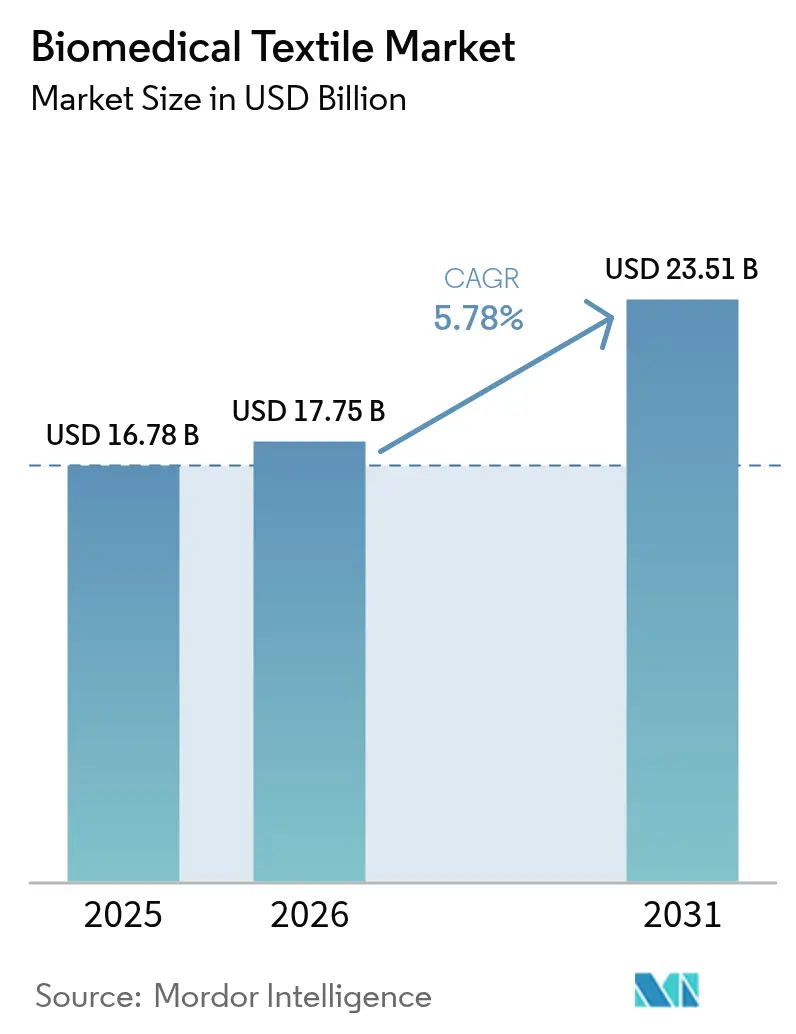
| Market Size (2026) | USD 17.75 Billion |
| Market Size (2031) | USD 23.51 Billion |
| Growth Rate (2026 - 2031) | 5.78 % |
| Fastest Growing Market | Asia Pacific |
| Largest Market | North America |
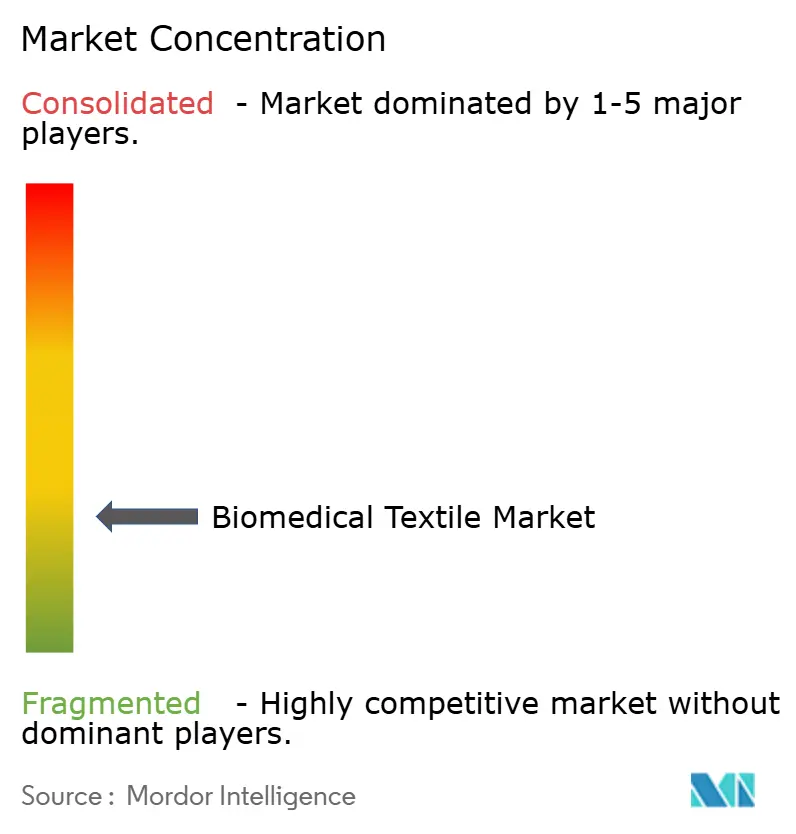
| Market Concentration | Low |
Major Players *Disclaimer: Major Players sorted in no particular order Image © Mordor Intelligence. Reuse requires attribution under CC BY 4.0. | |
Biomedical Textile Market Analysis by Mordor Intelligence
The Biomedical Textile Market size was valued at USD 16.78 billion in 2025 and estimated to grow from USD 17.75 billion in 2026 to reach USD 23.51 billion by 2031, at a CAGR of 5.78% during the forecast period (2026-2031). This growth rests on the expanding surgical workload created by older populations, the commercialization of minimally-invasive implantable fabrics, and steady public-sector funding that migrates defense textile research into civilian care. Demand also rises as care settings shift toward home health and ambulatory clinics that rely on portable, sensor-ready dressings. Sustained regulatory clarity from the FDA on biocompatibility testing shortens approval cycles, while Europe’s single-use plastics rules accelerate the switch to compostable fibers and bioresorbable scaffolds. Mergers such as Freudenberg’s acquisition of Heytex concentrate know-how in nonwovens, strengthening supply resilience and shortening innovation timelines. Simultaneously, retail channels now stock electro-spun nanofiber dressings, signaling mainstream acceptance of advanced wound products and opening recurring revenue streams for consumer-facing variants of clinical lines.
Key Report Takeaways
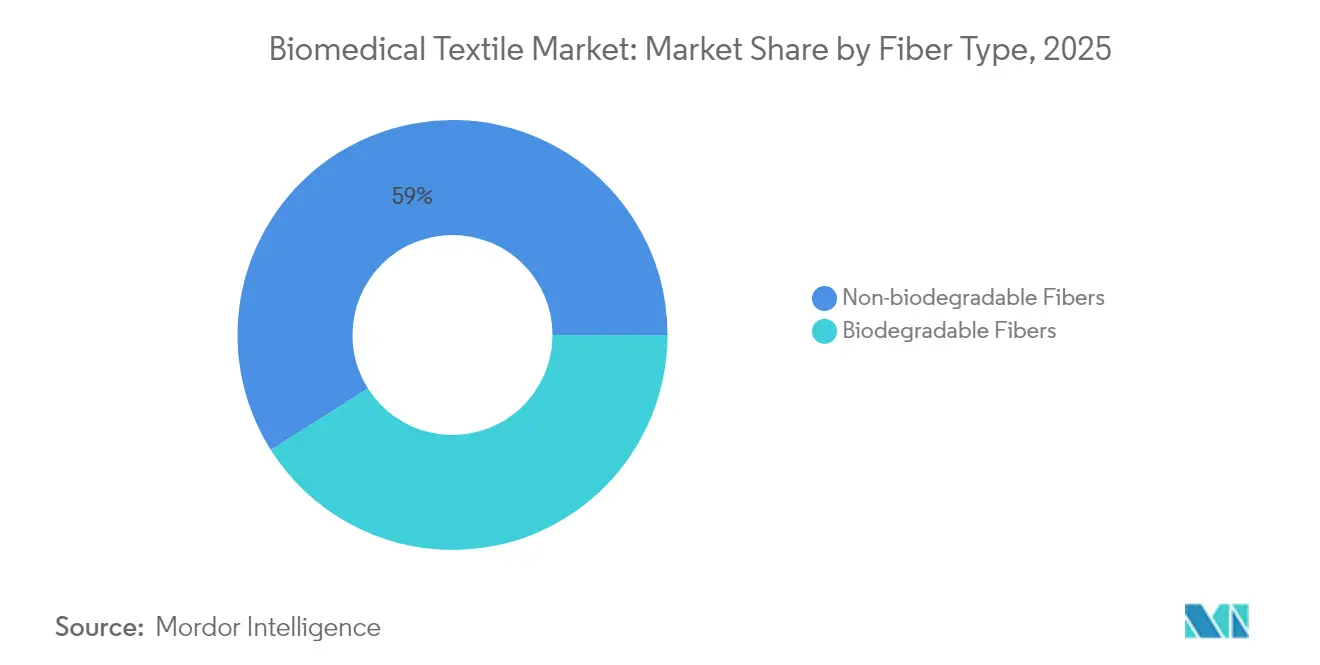
- By fiber type, non-biodegradable fibers held 58.98% of the biomedical textile market share in 2025, while biodegradable fibers are projected to expand at an 7.68% CAGR through 2031.
- By fabric form, non-woven textiles captured 61.85% revenue share in 2025; the segment is forecast to grow 8.14% annually to 2031.
- By application, non-implantable products accounted for 53.92% of the biomedical textile market size in 2025, whereas implantables are set to advance at a 6.79% CAGR between 2026-2031.
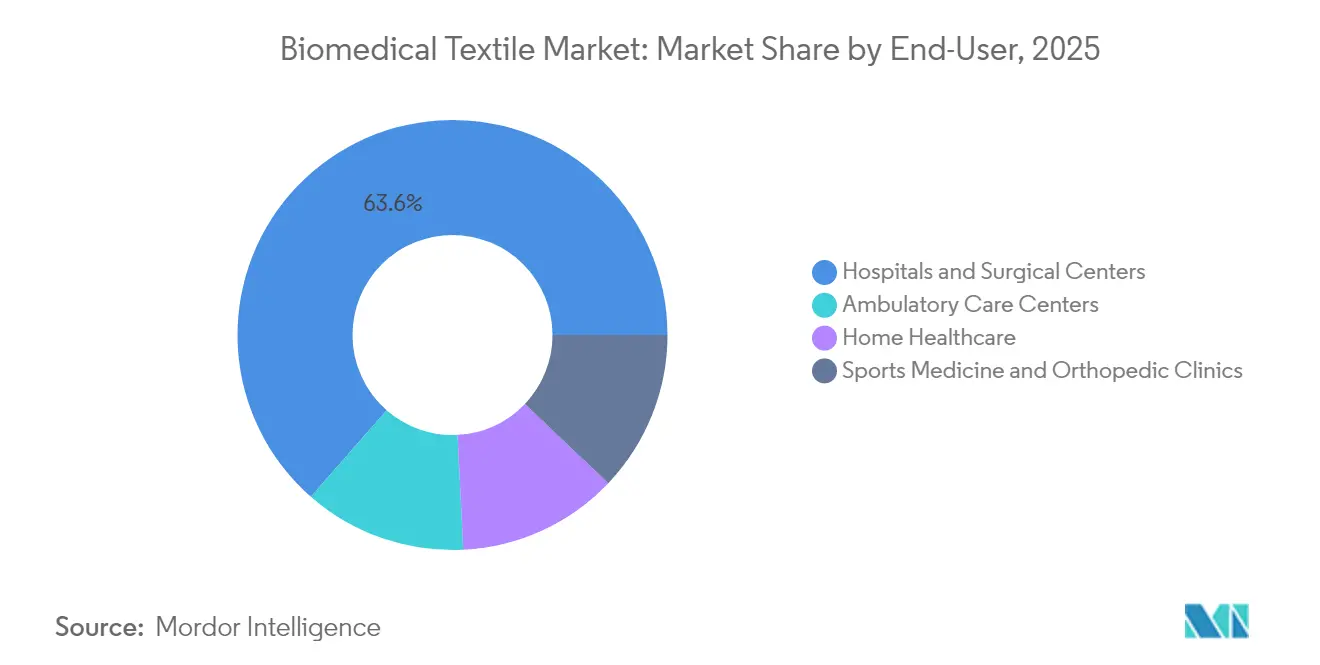
- By end-user, hospitals and surgical centers commanded 63.55% share of the biomedical textile market in 2025 and are growing at a 7.35% CAGR to 2031.
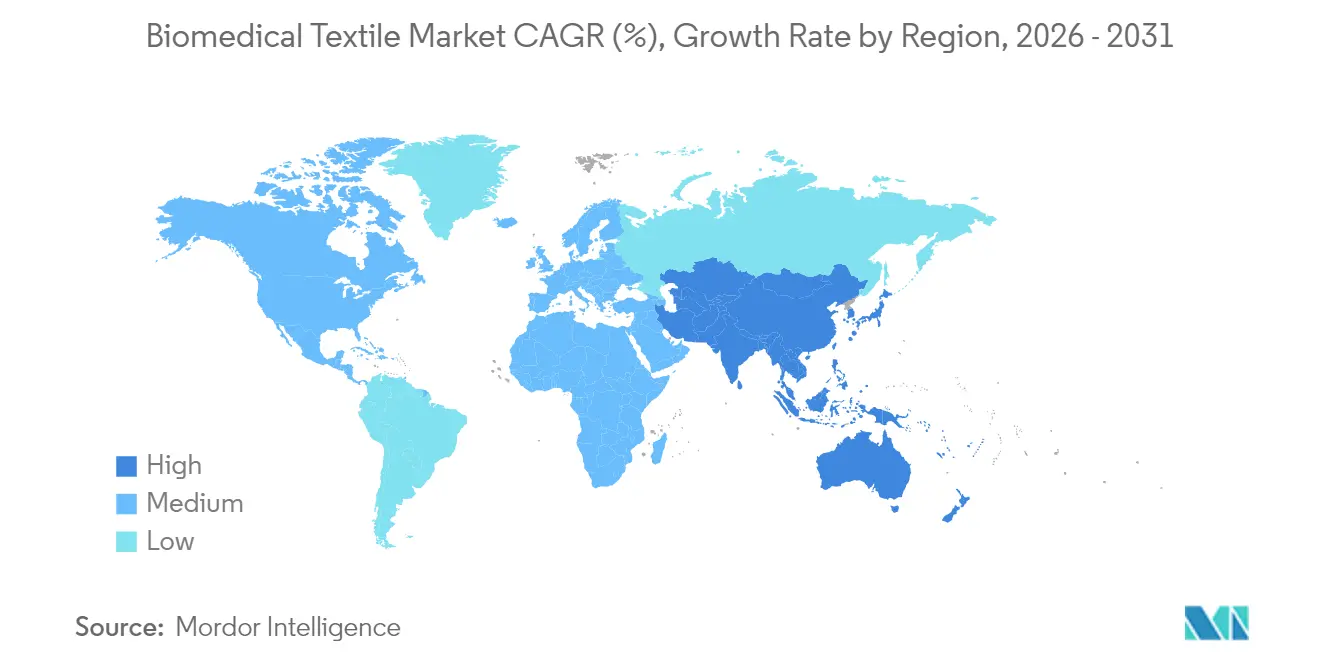
- By geography, North America led with 37.72% of the biomedical textile market share in 2025; Asia-Pacific registers the fastest regional CAGR at 7.06% through 2031.
Note: Market size and forecast figures in this report are generated using Mordor Intelligence’s proprietary estimation framework, updated with the latest available data and insights as of 2026.
Global Biomedical Textile Market Trends and Insights
Drivers Impact Analysis*
| Driver | (~) % Impact on CAGR Forecast | Geographic Relevance | Impact Timeline |
|---|---|---|---|
| Rising number of surgeries | +1.80% | North America, Europe, Asia-Pacific | Medium term (2-4 years) |
| Growing need for high-quality wound‐care textiles | +1.50% | Asia-Pacific emerging markets, global hospital systems | Short term (≤ 2 years) |
| Rapid ageing population in key economies | +1.20% | North America, Europe, Japan | Long term (≥ 4 years) |
| Advances in minimally-invasive implantable textiles | +0.90% | North America, EU, spillover to Asia-Pacific | Medium term (2-4 years) |
| Bioresorbable electro-spun nanofiber dressings entering retail channels | +0.60% | Developed markets | Short term (≤ 2 years) |
| Defense-funded sensor fabrics accelerating med-smart textile crossover | +0.40% | North America with global diffusion | Long term (≥ 4 years) |
| Source: Mordor Intelligence | |||
Rising Number of Surgeries
Global surgical procedures continue to climb as median ages rise and elective interventions become more accessible. The U.S. Department of Defense’s nanofabric programs, originally aimed at battlefield care, generate antimicrobial yarns and lightweight vascular grafts that transfer into civilian operating rooms[1]U.S. Department of Defense, “Advanced Functional Fabrics of America Award,” defense.gov . Hospitals integrate programmable fibers that record temperature and pH at incision sites, letting surgeons detect infection risk without removing dressings. Asia-Pacific hospitals accelerate adoption because improved insurance coverage brings larger middle-class cohorts into surgical theaters, amplifying textile consumption per case.
Growing Need for High-Quality Wound Care Textiles
Advanced dressings shorten recovery, lower readmissions, and reduce nursing time. Electro-spun nanofiber products, such as Spincare, achieved 46.6% epithelialization without rehospitalization versus conventional gauze in clinical trials. Chinese factories boost output for export while also meeting domestic demand for multifunctional silver-ion mats that limit bacterial growth. Wearable biosensors now embed graphene traces into spun-bond substrates, allowing home-care nurses to remotely read wound moisture on mobile dashboards[2]Nature Research, “Self-Powered Biosensors for Wound Monitoring,” nature.com . These capabilities align with payer pressure to shift chronic-wound treatment from inpatient wards to outpatient and home settings.
Rapid Aging Population
Life expectancy improvements in Japan, Germany, and the United States enlarge cohorts that need orthopedic repairs, vascular grafts, and decubitus ulcer dressings. Biomimetic scaffolds woven from collagen-coated polylactic acid replicate extracellular matrices and accelerate granulation in elderly skin. Long-term care facilities deploy smart bedding that tracks shear forces, warning staff before pressure injuries form. These developments lock in durable demand for patient-specific textile interventions.
Advances in Minimally-Invasive Implantable Textiles
Surgeons favor micro-braided stents and small-diameter knitted grafts that pass through 6-F catheters yet expand to full luminal size once in place. Electrospinning marries polyurethane elasticity with polyglycolic acid resorption, yielding graft walls that support endothelialization and then vanish within 12 months. The FDA’s latest 2025 guidance clarifies cytotoxicity and hemocompatibility test thresholds, accelerating 510(k) clearances for textile implants. Adding fiber-optic filaments permits post-implant strain monitoring, enabling earlier intervention if dilatation occurs.
Restraints Impact Analysis*
| Restraint | (~) % Impact on CAGR Forecast | Geographic Relevance | Impact Timeline |
|---|---|---|---|
| High cost of vascular grafts & artificial skin | -0.80% | Emerging markets, global price-sensitive payers | Medium term (2-4 years) |
| Electronic-textile integration complexity | -0.60% | Developed markets | Short term (≤ 2 years) |
| Absent shelf-life standards for antimicrobial biotextiles | -0.40% | Global | Long term (≥ 4 years) |
| Regulatory backlash on single-use medical nonwovens waste | -0.30% | Europe, North America | Medium term (2-4 years) |
| Source: Mordor Intelligence | |||
High Cost of Vascular Grafts & Artificial Skin
Tissue-engineered grafts require sterile cleanrooms, multi-week cell seeding, and precision weaving, driving prices beyond reimbursement caps in many health systems. Insurance guidelines in the United States still classify numerous bioengineered dressings as investigational, limiting coverage and slowing scale economies. Without volume, unit costs remain high, deterring procurement by hospitals in Latin America and parts of Southeast Asia.
Electronic-Textile Integration Complexity
Clinical laundry exposes e-textiles to detergents and 80 °C sterilization that corrode silver and copper coatings. Tests at Ghent University showed resistance in silver-plated yarns more than doubled after 25 wash cycles, compromising signal fidelity. Certification bodies lack harmonized protocols, which forces device makers to self-define reliability metrics, prolonging market adoption. Encapsulation films and thermoplastic coatings extend life but increase weight and inhibit breathability, forcing trade-offs that slow specification in critical-care garments.
*Our forecasts treat driver/restraint impacts as directional, not additive. The impact forecasts reflect baseline growth, mix effects, and variable interactions.
Segment Analysis
By Fiber Type: Biodegradable Innovation Drives Future Growth
Biodegradable threads account for 41.02% of 2025 revenue, yet are pacing the biomedical textile market at an 7.68% CAGR through 2031. FDA recognition of poly-lactic acid and poly-caprolactone resorption profiles opens regulatory doors, and surgeons value scaffolds that dissolve, eliminating follow-up retrieval. Start-ups now coat polylactic acid microfibers with honey-derived antimicrobials to meet infection control goals without systemic antibiotics.
Non-biodegradable fibers such as polyethylene terephthalate retain dominance where permanent load-bearing is vital, including ligament repairs and hernia meshes. They hold 58.98% of the biomedical textile market share, supported by decades of clinical data. Producers invest in low-shedding yarn treatments that reduce particle release during long implants. Together, these dual fiber classes widen supplier portfolios and let procurement teams match materials to procedure complexity, reinforcing the resilience of the biomedical textile market.



By Fabric Form: Non-woven Dominance Across Metrics
Non-woven lines posted 61.85% 2025 revenue and deliver the sector’s highest 8.14% CAGR due to melt-blown versatility and inline lamination that embeds hydrogel layers for moisture balance. Production scale allows Freudenberg to recycle 7 million PET bottles daily into single-use drapes that meet ISO 13432 compostability thresholds. Hospitals favor these drapes for reduced lint and rapid barrier deployment.
Woven and knitted formats serve niche implantables that demand precise tensile strength and controlled porosity. Engineers now weave 3D bifurcated tubes that mimic natural blood-vessel branches, expanding indications for textile-based endovascular grafts. Hybrid constructions that laminate a melt-blown antimicrobial core between warp-knit covers converge benefits of both worlds, a trend that helps sustain broad-based growth in the biomedical textile market.
By Application: Implantable Growth Outpaces Non-implantable Volume
Non-implantables, covering surgical masks, gowns, and wound pads, secured 53.92% of 2025 revenue. Volume surged during pandemic-driven inventory overhauls, and institutional stock policies keep baseline demand high. However, implantables expand 6.79% annually as scaffolded tissue engineering shifts from experimental to reimbursable therapy. Knitted polyester-urethane heart patches seeded with autologous cells now show 12-month retention with no calcification in early clinical cohorts.
Extracorporeal textiles, while smaller, post steady orders for dialysis and oxygenation membranes. Smart sensors embedded in implantable meshes transmit real-time strain data to surgeons, allowing remote monitoring and proactive revision. This digital layer raises implant value, reinforcing premium pricing and bolstering revenue diversity within the biomedical textile market size figures for 2026-2031.
By End-user: Hospital Centricity Sustains Share and Growth
Hospitals and surgical centers consumed 63.55% of biomedical textiles in 2025 and are growing fastest at 7.35% because sterile protocols and high case volumes require continuous replenishment. Many facilities upgrade to antimicrobial curtains and bedding that cut pathogens by 95% within 15 minutes of contact, aligning with infection-control mandates. Operating-room managers also specify RFID-tagged drapes to automate inventory counts, streamlining cost coding.
Ambulatory surgery centers and home-health providers adopt lightweight wraps with integrated biosensors for wound moisture and temperature, fueling emerging demand. Sports clinics request elastic compression socks that house accelerometers to track rehabilitation kinetics. Such diversification embeds biomedical textile market products along an extended care continuum, supporting resilience against procedure-mix shifts.
Geography Analysis
North America commands 37.72% 2025 revenue, driven by broad insurance coverage and rapid translation of federally funded textile research into commercial supply chains. The Department of Defense’s USD 75 million smart-fabric program delivered sensor yarns now appearing in civilian negative-pressure wound dressings. FDA biocompatibility guidance released in 2025 streamlines approvals, letting local firms secure early-mover contracts. Capital investment from device majors such as Smith & Nephew anchors regional manufacturing clusters in Massachusetts and Minnesota.
Asia-Pacific posts a 7.06% CAGR to 2031 as governments expand universal health insurance and stimulate domestic medtech output. China aggressively scales nanofiber lines to meet both export orders and home demand, while Japan funds geriatric remote-care pilots that rely on sensor-integrated gauze. Regulatory harmonization through ASEAN Medical Device Directives gradually lowers entry barriers, supporting multinational and regional vendors alike.
Europe blends advanced regulation with sustainability imperatives. The EU Single-Use Plastics Directive bans certain fossil-based disposables, prompting hospitals to trial Lenzing’s cellulosic stent covers and bio-based nonwoven pads. Freudenberg leverages the Heytex acquisition to supply polyurethane-coated substrates for negative-pressure therapy devices. Nonetheless, waste-reduction rules raise compliance costs; suppliers succeed by certifying compostability and closed-loop recycling audits.
South America and the Middle East & Africa trail on value but show accelerating unit growth as tertiary hospitals open and governments subsidize trauma networks. Cost-optimized spun-bond wound pads made from locally recycled PET balance price sensitives with adequate barrier function. International NGOs aid procurement training, helping clinicians choose evidence-backed textile solutions and broadening the biomedical textile market footprint.

Regulatory Landscape
Biomedical textiles sit at the intersection of medical device controls and material safety standards, with biocompatibility and manufacturing quality systems driving most compliance work for implantable and skin-contact products. In the United States, the FDA Quality Management System Regulation (QMSR) became effective in February 2026, shifting device manufacturers toward a more harmonized quality framework aligned with ISO-based practices, which affects textile converters and OEM partners supplying sterile wound-care materials and implantable fabrics.
Biological evaluation requirements continue to tighten around updated consensus standards. In May 2026, the FDA recognized ISO 10993-1 (6th edition, 2025) as a consensus standard and maintained a transition runway for the earlier edition until July 1, 2029, forcing updates to Biological Evaluation Plans and supplier test packages for fibers, coatings, and finished textile constructs. In Europe, the European Commission published Implementing Decisions (EU) 2026/1231 (MDR) and 2026/1313 (IVDR) in June 2026 to update harmonized standards lists (including EN ISO 10993-1:2025 and EN ISO 15223-1 updates), reinforcing documentation and labeling discipline for biomedical textile products entering EU healthcare systems.
Value Chain Analysis
The biomedical textile value chain starts with polymer and additive supply (PET, polypropylene, polyurethane, UHMWPE, and bioresorbable resins such as PLA/PCL), then moves through fiber extrusion and functionalization (antimicrobial agents, coatings), textile formation (nonwovens, weaving, knitting, braiding), and downstream conversion into medical-grade components (cut-and-sew, lamination, coating) before sterilization, packaging, and distribution to hospitals, surgical centers, and home-care channels. Quality gates (ISO 13485-aligned systems, ISO 10993 biocompatibility evidence, traceability, and particulate control) shape supplier selection and push manufacturers to qualify multiple sources for critical yarns and coating chemistries.
CDMOs and OEM-partner models increasingly sit in the middle of this chain to reduce development cycles and improve regulatory readiness for textile-based devices. Corza Medical opened a Biomedical Textiles Innovation Lab in Taunton, United Kingdom (August 2025) to provide prototyping and testing support for OEM partners, reflecting demand for faster iteration on implantables and advanced wound-care substrates. Material and hygiene differentiation is also being pushed upstream through partnerships, such as Parx Materials five-year cooperation with Shanghai Textile Raw Materials Co., Ltd. (Orient International Group subsidiary) announced in January 2026 to integrate zinc-based antibacterial technology for the China market, and Woolchemy with BCNonwovens (May 2026) to scale wool-based hygiene nonwovens, expanding sustainable feedstock options for wipes and incontinence-related medical textiles.
Competitive Landscape
The biomedical textile market remains fragmented. B. Braun SE, Cardinal Health, dsm-firmenich, Freudenberg Performance Materials, and Medline Industries LP collectively hold roughly 30% share, anchoring a field of more than 200 specialist weavers and converters. Scale players deepen defensible niches through M&A: Freudenberg’s EUR 100 million Heytex deal adds coated technical fabrics that complement its wound-care nonwovens, while Lenzing’s stake in TreeToTextile secures access to low-carbon cellulosic feedstock.
Smaller innovators target white-space in sensor integration and biodegradable elastomers. U.S. start-up SynTiss integrates micro-LEDs into braided sutures for intraoperative illumination, and India-based BioWeave optimizes banana-fiber vascular patches for price-sensitive markets. Continuous capital inflow from strategic venture arms accelerates pilot-to-clinic timelines. Competitive intensity centers on intellectual property around electrospinning nozzles, antimicrobial coatings, and wash-durable circuitry.
Regulatory expertise is a key differentiator. Firms with ISO 13485 plants and in-house toxicology labs navigate faster toward FDA and EU MDR approvals, shortening customer lead times. Environmental audits further filter vendors, as hospitals increasingly demand verified recycling or composting pathways for disposable gowns. Those able to pair clinical efficacy with eco-credentials secure multi-year supply contracts, reinforcing margins despite commodity polymer volatility.
Biomedical Textile Industry Leaders
B. Braun SE
Cardinal Health
dsm-firmenich
Freudenberg Performance Materials
Medline Industries LP
- *Disclaimer: Major Players sorted in no particular order

Market Opportunities and Future Outlook
Near-term whitespace is concentrated where regulatory clarity and care-setting shifts intersect: sensor-ready dressings for home health and ambulatory care, and minimally invasive implantable textiles that combine mechanical performance with controlled resorption. The report context already shows sensor-enabled wound monitoring and defense-funded smart-fabric spillover into civilian care, while the FDA biocompatibility pathway continues to be refined through updated ISO 10993 recognition, enabling suppliers that can package validated test data with textile design support to win OEM programs.
Sustainability and differentiated polymers create additional commercial openings across disposables and next-generation implantables. EU waste and single-use rules are pushing trials of compostable or bio-based nonwovens and cellulosic alternatives, making certified compostability and auditable recycling pathways a tangible procurement lever for hospital systems. On the materials side, Covation Biomaterials introduced Sorona elasterell-p fiber in July 2026 as a partially plant-based stretch fiber, supporting development of elastic medical textiles such as compression and orthopedic supports where comfort and recovery performance matter. At the same time, tightening analytical requirements for high-purity polymers used in implantable components increase the value of vertically integrated supply chains that can manage extractables and biocompatibility evidence alongside textile conversion, reducing iteration loops between material suppliers, converters, and device OEMs.
Recent Industry Developments
- March 2026: The OEM division has been renamed to B. Braun Pharma & MedTech Partner to underscore its collaboration-first model with medical device customers. This realignment clarifies manufacturing and development interfaces for device makers sourcing biomedical-grade materials and components, including textile-adjacent elements used in surgical and wound-care supply chains. The move reinforces B. Braun's strategy to accelerate collaboration across suppliers and customers in biomedical textiles.
- April 2025: dsm-firmenich Biomedical and Peijia Medical announced a strategic innovation partnership to develop polymer materials for heart valve applications, focusing on UHMWPE and thermoplastic polyurethane. The collaboration signals continued upstream material innovation feeding downstream device platforms where textile-like constructs, coatings, and polymer processing disciplines converge.
- August 2024: dsm-firmenich announced it successfully defended U.S. Patent No. 10,280,532 covering colored multi-filament yarn used in medical devices such as UHMWPE sutures. Protecting IP around medical-grade yarn design supports differentiation in high-performance fibers used across implantable and non-implantable biomedical textile applications.


Research Methodology Framework and Report Scope
Market Definition and Coverage
This market is measured as revenue generated from textiles engineered for medical use where biocompatibility, sterility, or therapeutic performance is required, including materials used in wound care, surgical settings, and implant related applications.
Scope exclusions: We exclude general apparel and regular industrial technical textiles that are not designed or marketed for healthcare or clinical use.
Segmentation Overview
- By Fiber Type
- Non-biodegradable Fibers
- Biodegradable Fibers
- By Fabric Form
- Non-woven
- Woven
- Other Fabric Types (Knitted, Braided)
- By Application
- Non-implantable
- Implantable
- Other Implantable (Extracorporeal, etc.)
- By End-user
- Hospitals and Surgical Centers
- Ambulatory Care Centers
- Home Healthcare
- Sports Medicine and Orthopedic Clinics
- By Geography
- Asia-Pacific
- China
- India
- Japan
- South Korea
- Rest of Asia-Pacific
- North America
- United States
- Canada
- Mexico
- Europe
- Germany
- France
- United Kingdom
- Italy
- Rest of Europe
- South America
- Brazil
- Argentina
- Rest of South America
- Middle East and Africa
- Saudi Arabia
- South Africa
- Rest of Middle East and Africa
- Asia-Pacific
Data Sources, Market Sizing, and Validation
Desk Research
Desk work starts with public baselines that help us understand demand signals and compliance boundaries for biomedical textiles. We typically refer to sources such as US FDA materials and biocompatibility guidance, CDC infection prevention references, OECD health statistics, and World Bank population and health expenditure indicators to set the demand context.
To keep the model grounded, we also review supporting evidence such as UN Comtrade trade flows for relevant textile and medical categories, patents databases to gauge innovation intensity, and peer reviewed papers on nonwoven wound dressings and implantable fiber behavior. Company annual reports, investor presentations, and credible association sites are used to understand product positioning and how pricing is moving. Paid subscriptions that cover company financials and intelligence, patent records, and shipment level trade data are also used selectively where they can confirm or challenge a key assumption. These examples are illustrative, and many other public and paid sources were also used for collection, cross checks, and clarification.
Primary Interviews and Surveys
Primary discussions were used to pressure test unit pricing, adoption timing, and mix shifts between non implantable and implantable textile uses. We spoke with a balanced set of stakeholders across raw material suppliers, converters, device linked users, and healthcare procurement roles, and we compared inputs across APAC, EMEA, and the Americas so regional patterns were not averaged out.
Distribution of primary research fieldwork respondents
| Company type | Respondent position | Region |
|---|---|---|
| Top tier: 26% | CXOs: 16% | APAC: 45% |
| Mid tier: 57% | Functional/Unit leaders: 41% | EMEA: 31% |
| Smaller Players: 17% | Managers: 43% | Americas: 24% |
Market-Sizing & Forecasting
Our sizing uses a top-down build that reconstructs the addressable demand pool using healthcare activity and usage intensity, and then converts it into revenue using region specific price points. To avoid over counting, assumptions are set around what portion of wound care consumption uses advanced textile dressings, what share of procedures rely on textile based implants, and how much nonwoven use is driven by infection control protocols.
Selective bottom-up checks are then used to corroborate totals, where we approximate supplier revenue roll ups and cross check sampled ASP multiplied by estimated volumes for key product groups. Inputs that matter most include surgical procedure volumes, chronic wound prevalence and treated cases, hospital and ambulatory spend patterns, penetration of nonwoven disposables in clinical settings, and average selling price progression by fabric form (woven versus nonwoven) and by application. Forecasts are produced using multivariate regression with scenario checks. The main drivers are projected using public health and spending outlooks, and then tuned with what interviewees expect for adoption pace and price movement. When a sub segment lacks clean volume data, we fill the gap with ratio based splits anchored to clinical activity proxies and then revalidate through follow up calls.
Data Validation & Update Cycle
Validation is done through multiple passes where model outputs are compared with independent signals such as trade direction, healthcare utilization trends, and announced capacity or investment moves. If a region shows an unusual jump, the underlying assumptions are reopened, and the team rechecks unit prices, penetration rates, and currency conversions before sign off.
Reports are refreshed annually, and interim updates are made when material events shift demand, pricing, or supply availability. Before delivery, we do a final review pass so the client receives the most current view aligned to the latest data cuts and confirmed expert inputs.
Mordor Intelligence's Biomedical Textile Market Size Measured Against Other Published Estimates
Published market sizes for biomedical textiles can look far apart because the scope line is drawn differently, and because pricing and currency handling are not always aligned to the same timing. Differences also come from what is counted as biomedical use, especially when hygiene nonwovens, hospital disposables, and implant related textiles get mixed together in different ways.
In our refresh-led workflow, the spread is heavily influenced by when ASP updates are applied and when exchange rates are locked, which is why the model is rechecked against procedure and wound care demand indicators close to publication before finalizing the number, a step that is handled in Mordor Intelligence.
Benchmark comparison
| Source | Market Size | Gaps in Research Methodology |
|---|---|---|
| Mordor Intelligence | USD 17.75 B (2026) | |
| Global Consultancy A | USD 18.20 B (2024) | Uses an earlier base year and a different forecast window, and the public summary does not clarify if hospital hygiene nonwovens and broader healthcare fabrics are included, which can lift the total versus a tighter biomedical use boundary. |
| Industry Publisher B | USD 19.92 B (2025) | Appears to include a wider set of hygiene and incontinence related textile products under biomedical textiles, and the pricing and currency timing assumptions are not clearly disclosed, which can shift the value upward in nominal USD terms. |
Looking across the three figures, most of the variance can be traced back to category coverage and to the timing of price and currency assumptions rather than a disagreement on demand direction. By keeping the inputs tied to healthcare activity indicators and by documenting the inclusion rules, we aim to provide a number that can be repeated and stress tested when assumptions change.


Key Questions Answered in the Report
What is the biomedical textile market size in 2026?
The biomedical textile market size stands at USD 17.75 billion in 2026.
Which fabric form leads the biomedical textile market?
Non-woven textiles lead, holding 61.85% of 2025 revenue and expanding at an 8.14% CAGR to 2031.
Which region is growing fastest in the biomedical textile market?
Asia-Pacific is the fastest-growing region, projected to rise at a 7.06% CAGR through 2031.
Why are biodegradable fibers gaining popularity in the biomedical textile industry?
They eliminate secondary removal surgeries, address sustainability mandates, and now follow clearer FDA biocompatibility guidance.
How does electronic-textile integration affect market growth?
Integration challenges around wash durability and reliability currently subtract 0.6 percentage points from forecast CAGR, but breakthroughs in encapsulation are narrowing this gap.
What share of the biomedical textile market do hospitals hold?
Hospitals and surgical centers account for 63.55% of 2025 revenue and are expanding at 7.35% annually.
Page last updated on:





