
Market Overview
| Study Period | 2020 - 2031 |
|---|---|
| Market Volume (2026) | 124.07 Billion liters |
| Market Volume (2031) | 158.93 Billion liters |
| Growth Rate (2026 - 2031) | 5.08 % |
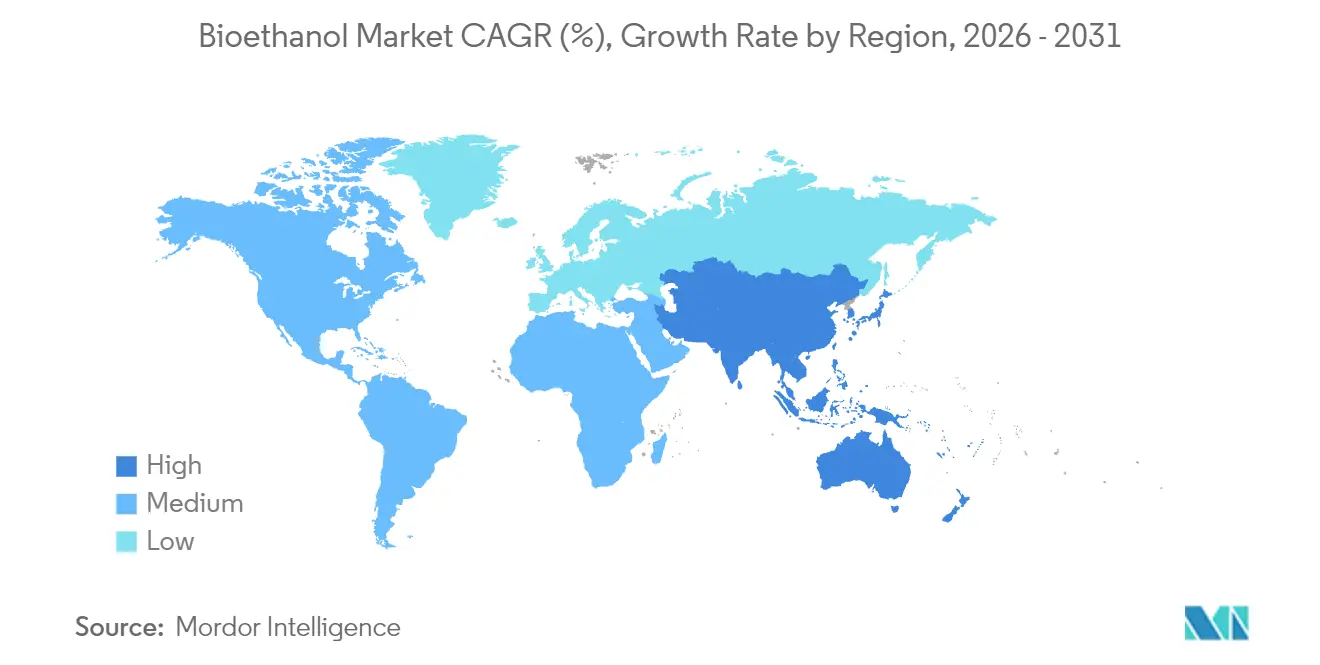
| Fastest Growing Market | Asia-Pacific |
| Largest Market | North America |
| Market Concentration | Medium |
Major Players *Disclaimer: Major Players sorted in no particular order Image © Mordor Intelligence. Reuse requires attribution under CC BY 4.0. | |
Bioethanol Market Analysis by Mordor Intelligence
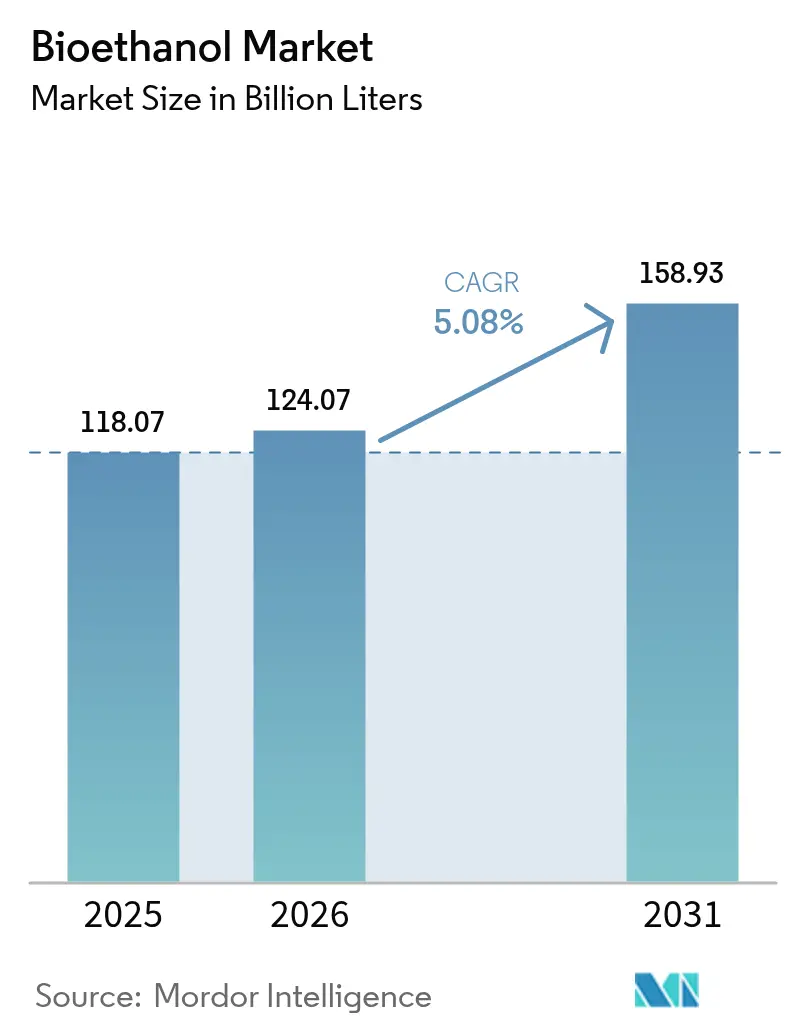
The Bioethanol Market size was valued at 118.07 billion litres in 2025 and estimated to grow from 124.07 billion litres in 2026 to reach 158.93 billion litres by 2031, at a CAGR of 5.08% during the forecast period (2026-2031). Continued policy backing for E10–E20 blends, growing interest in ethanol-to-jet fuel, and cost-advantaged feedstock supply underpin this trajectory even as light-duty vehicle electrification advances. North American corn-based capacity, Brazilian sugarcane flexibility, and fresh capital inflows from Middle Eastern investors reinforce supply security. Meanwhile, Asia-Pacific governments fast-track aggressive blending targets that deepen regional demand pools, and refiners pursue low-carbon ethanol to satisfy tightening ESG metrics. Together, these factors sustain the bioethanol market’s resilience against competing transport decarbonization pathways.
Key Report Takeaways
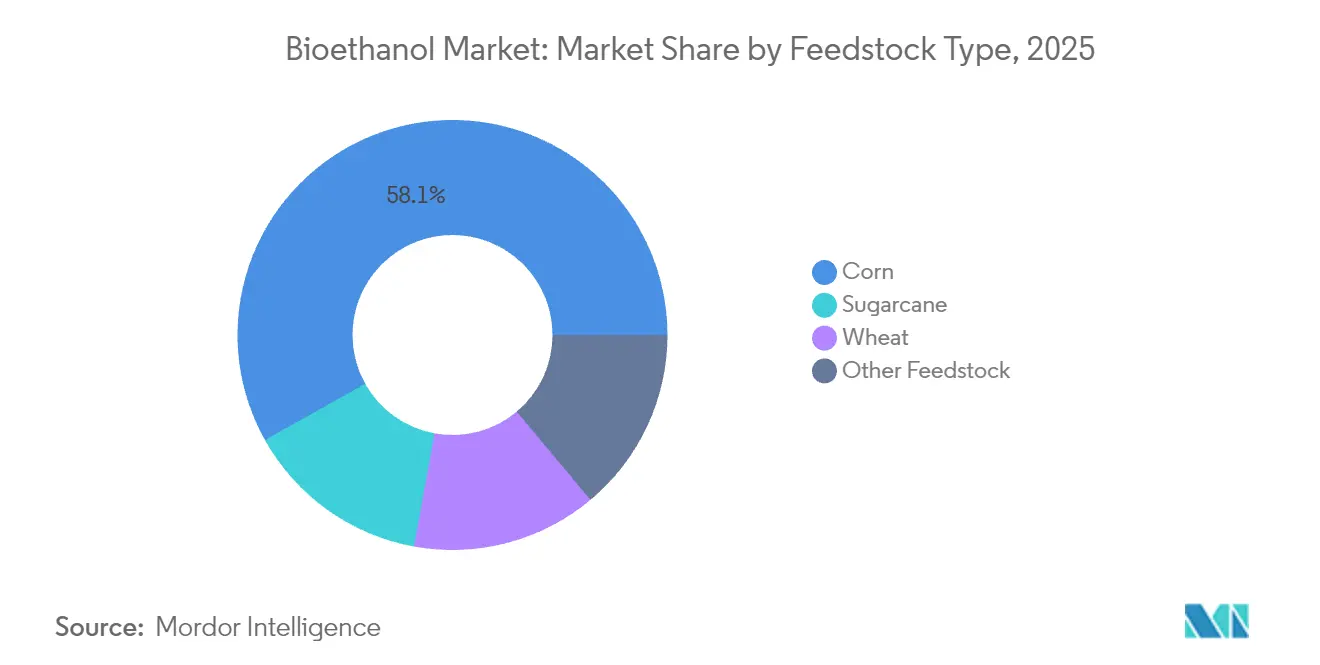
- By feedstock type, corn held 58.12% of the bioethanol market share in 2025, while wheat-based production is projected to expand at a 5.45% CAGR to 2031.
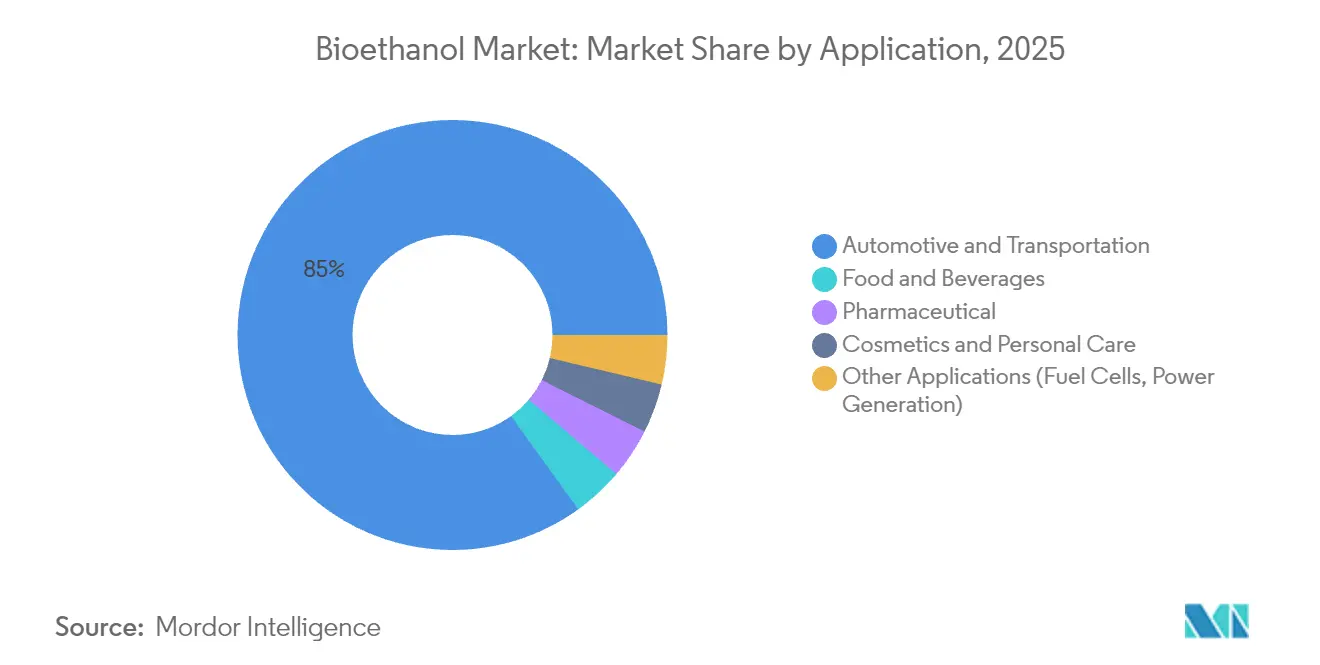
- By application, automotive and transportation dominated with 84.95% of the bioethanol market size in 2025, whereas food and beverages are forecast to grow at a 5.44% CAGR through 2031.
- By geography, North America captured 55.10% revenue share of the bioethanol market in 2025, while the Asia-Pacific region records the highest projected CAGR at 5.74% to 2031.
Note: Market size and forecast figures in this report are generated using Mordor Intelligence’s proprietary estimation framework, updated with the latest available data and insights as of 2026.
Market Trends and Insights
Drivers Impact Analysis of Bioethanol Market*
| Driver | (~) % Impact on CAGR Forecast | Geographic Relevance | Impact Timeline |
|---|---|---|---|
| Favourable global E10–E20 blending mandates | +1.8% | Global; early gains in Brazil, India, Japan | Medium term (2-4 years) |
| Carbon-reduction and ESG pressure on refiners | +1.2% | North America and EU; spill-over to APAC | Long term (≥ 4 years) |
| Feedstock cost advantage in U.S. corn and Brazil sugarcane | +0.9% | North America and South America core | Short term (≤ 2 years) |
| Octane demand spurring ethanol as aromatic substitute | +0.7% | Global; concentrated in developed markets | Medium term (2-4 years) |
| Airline demand for ethanol-to-jet SAF pathways | +0.4% | North America and EU; emerging in APAC | Long term (≥ 4 years) |
| Source: Mordor Intelligence | |||


Favourable Global E10–E20 Blending Mandates
Strengthened blending requirements are creating predictable baseload demand that insulates the bioethanol market from crude price swings while locking in capacity expansion. Japan’s nationwide E10 roll-out and pilot E20 zones, Brazil’s 27% ceiling flexibility, and India’s accelerated 30% target together lift annual offtake volumes and encourage new plant investment[1]International Energy Agency, “Ordinance No 75/2015 on Ethanol Blending Mandate,” iea.org . Regulatory agencies back compliance through fuel-quality standards, domestic content rules, and import controls, ensuring blend targets translate into physical deliveries rather than paper credits. These policies turn the bioethanol market into a structural element of national energy security strategies even as electrification gains momentum.
Carbon-Reduction and ESG Pressure on Refiners
Refiners facing investor scrutiny and stringent carbon standards now view low-intensity bioethanol as a strategic differentiator instead of a mere compliance component. California’s 2024 Low Carbon Fuel Standard update tightened carbon benchmarks, rewarding supplies certified under schemes such as ISCC. The EU’s revised Renewable Energy Directive likewise privileges traceable, sustainably sourced ethanol. In response, companies like BP vertically integrated upstream via the USD 1.4 billion acquisition of Bunge Bioenergia, securing feedstock and lifecycle emission control in one step. Premium demand emerges in markets where renewable-content uptake exceeds mandate floors, sustaining price spreads favorable to lower-carbon producers.
Feedstock Cost Advantage in U.S. Corn and Brazil Sugarcane
Record U.S. corn yields, efficient dry-grind plants, and coproduct optimization grant American producers a cost buffer that shields margins when corn prices spike. Parallel advantages in Brazil arise from year-round sugarcane harvesting, cogeneration of power from bagasse, and growing corn-ethanol capacity that smooths seasonal supply gaps. USDA projects a 5% rise in planted corn acres for 2025, reinforcing feedstock availability. These dynamics position both regions as the bioethanol market’s swing suppliers, capable of expanding exports when other regions experience feedstock shortages.
Octane Demand Spurring Ethanol as Aromatic Substitute
Tighter air-quality rules phase down benzene, toluene, and xylene content in gasoline, prompting refiners to seek clean octane replacements. Ethanol’s 113 research octane number fills this gap while lowering toxic emissions, stimulating incremental demand unrelated to renewable-fuel quotas. High-performance vehicles in urban centers attract premium ethanol blends, and engine designs optimized for higher ethanol content bolster this pull. Consequently, octane-driven off-take offers the bioethanol market an additional hedge against declining gasoline volumes in mature economies.
Restraints Impact Analysis of Bioethanol Market*
| Restraint | (~) % Impact on CAGR Forecast | Geographic Relevance | Impact Timeline |
|---|---|---|---|
| Rapid electrification of light-duty vehicles | -1.4% | North America and EU; expanding to APAC | Medium term (2-4 years) |
| Food-vs-fuel and land-use controversy | -0.8% | Global; acute in food-importing regions | Short term (≤ 2 years) |
| Stricter ILUC-based carbon-intensity scoring | -0.6% | EU and California; spreading elsewhere | Long term (≥ 4 years) |
| Source: Mordor Intelligence | |||
Rapid Electrification of Light-Duty Vehicles
Soaring EV adoption trims gasoline demand ceilings in core markets. Norway hit 94% EV penetration for 2024 new car sales, China surpassed 35%, and the IEA forecasts a 30% global light-vehicle share by 2030. As a result, refiners face shrinking blend pools, compelling bioethanol producers to pivot toward aviation, heavy-duty transport, and export-led strategies. Regional demand divergence persists because emerging economies lag in vehicle electrification, creating opportunities for geographic diversification within the bioethanol market.
Food-vs-Fuel and Land-Use Controversy
India’s push to 30% blending flipped it from a corn exporter to an importer in 2024, inflating feed costs for poultry producers and intensifying scrutiny of first-generation biofuels. IFPRI warns that diverting food crops to fuel during tight grain supply cycles can exacerbate insecurity, spurring policymakers to recalibrate mandates. This narrative pressures governments to favor feedstock diversification toward residues and non-food crops, complicating investment decisions for conventional producers and tempering the bioethanol market’s growth in politically sensitive regions.
*Our forecasts treat driver/restraint impacts as directional, not additive. The impact forecasts reflect baseline growth, mix effects, and variable interactions.
Bioethanol Market Segment Analysis
By Feedstock Type:
Corn Dominance Faces Wheat InnovationCorn-based output contributed 58.12% of the bioethanol market size in 2025, anchored by the U.S. Midwest, Brazil’s Mato Grosso expansion, and well-established rail and barge logistics. Producers leverage enzyme advances and co-product valorization, notably distillers' grains for livestock feed and captured CO2 for beverages, to compress unit costs and improve carbon scores. Continuing investments in carbon capture and underground storage clusters across the Midcontinent further enhance lifecycle performance credentials.
Wheat ethanol is projected to record a 5.45% CAGR through 2031, the fastest growth among mainstream feedstocks. European players harness policy incentives for domestic grain diversification, while Australia’s bumper wheat cycles offer export opportunities. Rising protein premiums make wheat distillers' grains attractive to livestock feeders, offsetting higher starch costs. Technology breakthroughs enabling high-gravity fermentation and fractional distillation improve plant utilization rates, strengthening wheat’s competitiveness within the bioethanol market.
Other feedstocks, such as sugarcane, cassava, and emerging lignocellulosic sources, supply niche but strategic volumes that hedge against weather-induced crop swings. Brazilian sugarcane retains a structural cost edge via bagasse-fired cogeneration, while Indonesia’s nipa palm and Mexico’s agave pilots aim to unlock marginal-land production. Such diversification dampens price volatility and aligns with policymakers' pressure to minimize food-crop displacement.


By Application:
Automotive Dominance with Food Sector GrowthAutomotive and transportation end-uses absorbed 84.95% of total volume in 2025, cementing their status as the bioethanol market’s revenue spine. Mandated blend walls in the United States, Brazil, and the EU guarantee baseline demand even when oil prices fall. Refiners prize ethanol’s octane contribution, letting them comply with aromatic caps without costly refinery upgrades.
Food and beverages represent the fastest-expanding application, expected to grow at a 5.44% CAGR to 2031. Growth hinges on rising demand for premium spirits, natural flavor extracts, and fermentation substrates that require high-purity ethanol. Distillers benefit from flexible pricing linked to beverage-grade quality premiums, insulating them from fuel-ethanol price cycles. Pharmaceutical, cosmetics, and sanitizer uses add steady offtake backed by rigorous ISO and pharmacopeia standards that command stable margins inside the broader bioethanol market.
The nascent ethanol-to-jet fuel pathway opens an additional premium outlet. Airlines preferring drop-in solutions over radical aircraft redesigns underpin offtake agreements that finance new conversion plants. While still small in absolute liters, SAF potential reshapes producer economics by offering multiples of road-fuel prices for qualifying feedstocks, underscoring the application diversification underway.
Geography Analysis
North America Bioethanol Market
North America maintained 55.10% of global volume in 2025 thanks to entrenched corn infrastructure, stable Renewable Fuel Standard targets, and supportive state-level Low Carbon Fuel initiatives. Producers integrate carbon capture, direct air capture, and pipeline networks that compress the carbon intensity of corn ethanol, qualifying it for high-value credit markets. Canada leverages wheat and corn feedstock clusters, whereas Mexico’s demand uptick absorbs U.S. exports, reinforcing continental trade flows that stabilize regional balance.
APAC Bioethanol Market
Asia-Pacific records the highest forecast CAGR at 5.74% through 2031 as India’s 30% blend target and China’s import appetite amplify consumption. Regional governments frame bioethanol expansion as rural income support and foreign-exchange savings, encouraging local investment in multi-feedstock biorefineries. Thailand, the Philippines, and Vietnam advance blend mandates aligned with agricultural modernization plans, while Indonesia pilots nipa-to-ethanol routes to sidestep food-crop constraints.
EMEA and South America Bioethanol Market
Europe emphasizes sustainability certification and favors residue-based ethanol that fulfills stringent greenhouse-gas savings thresholds. Quota systems in Germany and France anchor demand, and the United Kingdom’s Renewable Transport Fuel Obligation prioritizes SAF, indirectly boosting ethanol-to-jet pathways. South America, dominated by Brazil, attracts foreign capital, notably the UAE’s USD 13.5 billion commitment, to expand integrated assets that marry sugarcane, corn, and cogeneration. Middle East and Africa remain niche but rising, catalyzed by FAO programs for clean cooking solutions that position ethanol as a household energy alternative.

Value Chain Analysis
The bioethanol value chain starts with feedstock origination and aggregation (corn, sugarcane, wheat, and other biomass), followed by milling and conversion at biorefineries (fermentation, distillation, dehydration). It then covers coproduct handling (DDGS, corn oil, and recovered CO2) and outbound logistics to blenders, fuel retailers, and industrial users. North America anchors upstream scale and processing density, supported by roughly 200 biorefineries and 31.9 billion gallons of fuel ethanol production in 2025, while Brazil combines sugarcane milling with a growing corn-ethanol base that helps smooth seasonal supply and supports exports.
Midstream and downstream steps are increasingly shaped by low-carbon qualification requirements and blend infrastructure. In April 2026, the US EPA set 2026-2027 Renewable Fuel Standard volumes, reinforcing compliance-driven pull from obligated parties to certified ethanol suppliers. New collaboration models also address bottlenecks in emerging import and distribution systems: in March 2026, the U.S. Grains and BioProducts Council and Pertamina New and Renewable Energy signed an MoU focused on technical and commercial supply chain development to support Indonesia’s E10 transition and future E20 readiness. In July 2026, VIVESCIA, Roquette, and Siplec E.Leclerc formed a three-year partnership in France covering regenerative agriculture, low-carbon ethanol production, and fuel distribution, reflecting the shift toward traceability and integrated offtake channels as programs such as the US 45Z Clean Fuel Production Credit (effective 2025) influence investment decisions.
Competitive Landscape
The bioethanol industry is moderately fragmented. Gevo’s purchase of Red Trail Energy enlarged its North Dakota footprint and added onsite carbon sequestration expertise, illustrating the rising value of embedded CCS. Technology differentiation centers on enzyme cocktails that lift fermentation yield, advanced control systems using artificial intelligence for real-time energy optimization, and in-house carbon accounting platforms certified to ISO 14067. Producers racing toward ethanol-to-jet deployment secure offtake letters from airlines to underpin financing, with LanzaJet’s Georgia plant and Gevo’s Net-Zero 1 in South Dakota serving as early blueprints.
Bioethanol Industry Leaders
POET LLC
ADM
Valero
Raizen
Green Plains Inc.
- *Disclaimer: Major Players sorted in no particular order

Bioethanol Market Companies Covered in this Report
- Abengoa
- ADM
- Alto Ingredients Inc.
- Blue Biofuels Inc.
- BP p.l.c.
- Cenovus Energy
- Cristalco
- CropEnergies AG
- Ethanol Technologies
- GranBio Investimentos SA
- Green Plains Inc.
- Henan Tianguan Group Co. Ltd
- Jilin Fuel Ethanol Co. Ltd
- KWST
- Lantmannen
- POET LLC
- Raizen
- SEKAB
- SUNCOR Energy Inc.
- Tereos
- Valero
- VERBIO Vereinigte Bioenergie AG

Market Opportunities and Future Outlook
One near-term whitespace is the build-out of higher-blend availability and compatible retail infrastructure that turns mandates and incentives into physical offtake, particularly where policy attention is on E15 and higher blends. In the United States, the April 2026 EPA final Renewable Fuel Standard volumes for 2026 and 2027 (including 15 billion gallons of conventional biofuel) keep compliance demand central to procurement decisions, and supply-side projects are expanding to meet blend and low-carbon requirements. Capacity additions and debottlenecking are also underway at large producers: POET initiated a major Shelbyville, Indiana expansion to 193 million gallons per year from 98 million (project announced January 2026 and later moved into execution), and Gevo announced plans in March 2026 to add a second 75 million gallons per year unit at Richardton, North Dakota, reinforcing investment around scale and operational flexibility.
A second opportunity area is low-carbon ethanol differentiation supported by carbon accounting, process energy optimization, and certification, which can support premium placement in credit-driven markets and improve access to emerging end uses such as ethanol-to-jet. Corporate and national actions also expand addressable demand pools beyond mature gasoline markets: India’s formal approval of E100 fuel standards in June 2026 supports flex-fuel and high-ethanol use cases, while Brazil’s CNPE mandated an increase in the gasoline blend to E32 effective August 1, 2026, creating an immediate step-up in domestic blending demand. In South America, corn ethanol investments also strengthen export-ready supply: CerradinhoBio began operating an expanded Chapadao do Ceu plant in Goias in June 2026, and FS started construction of a new 580 million liter per year facility in Querencia, Mato Grosso in June 2026, widening the pipeline of incremental production connected to DDGS and corn oil coproduct markets.
Recent Industry Developments in Bioethanol Market
- June 2026: POET broke ground on an expansion at its Shelbyville, Indiana bioprocessing facility to raise bioethanol capacity from 98 million to 193 million gallons per year. The project adds large-scale incremental output in a core US production corridor and improves POET’s ability to serve higher-blend and low-carbon demand programs.
- November 2025: ADM and Tallgrass started operations at a carbon capture and storage project at ADM’s Columbus, Nebraska Corn Processing Complex, described by the companies as the world’s largest bioethanol CCS facility. By connecting to Tallgrass’ Trailblazer CO2 pipeline network, the project supports lower-carbon ethanol supply and improves access to credit-sensitive fuel markets.
- June 2024: Raizen opened its Piracicaba second-generation ethanol plant, converting bagasse into about 42 million liters of cellulosic ethanol per year. The start-up expands commercial-scale 2G capacity in Brazil and supports feedstock diversification away from food crops while leveraging existing sugarcane milling logistics.


Bioethanol Market Report Scope and Research Methodology
Market Definition and Coverage
This market covers bioethanol produced from biomass based feedstocks and supplied for end use across fuel blending and non-fuel uses. The sizing tracks total demand and supply balance in volume terms, aligned to commercial bioethanol that reaches end users through formal channels.
Scope exclusions: We exclude fossil based ethanol, captive on-site trial volumes not released to the market, and double counting between intermediate transfers and final consumption.
Segments Covered in This Report
- By Feedstock Type
- Sugarcane
- Corn
- Wheat
- Other Feedstock
- By Application
- Automotive and Transportation
- Food and Beverages
- Pharmaceutical
- Cosmetics and Personal Care
- Other Applications (Fuel Cells, Power Generation)
- By Geography
- Asia-Pacific
- China
- India
- Japan
- South Korea
- Rest of Asia-Pacific
- North America
- United States
- Canada
- Mexico
- Europe
- Germany
- United Kingdom
- France
- Italy
- Rest of Europe
- South America
- Brazil
- Argentina
- Rest of South America
- Middle-East and Africa
- Saudi Arabia
- South Africa
- Rest of Middle-East and Africa
- Asia-Pacific
Data Sources, Market Sizing, and Validation
Desk Research
Desk work starts by building a clean fact base for production, blending demand, and trade flows, since these are the anchors for a volume market like bioethanol. We mainly refer to public sources such as national energy agencies and fuel mandate notifications, customs and trade statistics portals, agriculture ministries and crop balance sheets, and international datasets from organizations such as FAO, IEA, and the US EIA.
To make the model usable across regions, we also compile supporting signals from company annual reports, investor presentations, association websites, and reputable press coverage on capacity additions, plant utilization, and blending policy changes. Where needed, we cross-check select company financials, patent activity, and shipment level trade indicators using paid database subscriptions that help fill gaps and reduce manual errors. These sources are illustrative only, and many other references were used to collect, validate, and clarify data points through the work.
Primary Interviews and Surveys
Primary work is used to confirm what the desk data cannot fully explain, especially real utilization ranges, typical yield assumptions, and how blending targets translate into actual offtake. We speak with a mix of producers, distributors, feedstock stakeholders, and downstream buyers across APAC, EMEA, and the Americas, then use their inputs to adjust conversion factors, trade leakage, and near term demand sensitivity.
Distribution of primary research fieldwork respondents
| Company type | Respondent position | Region |
|---|---|---|
| Top tier: 38% | CXOs: 14% | APAC: 43% |
| Mid tier: 47% | Functional/Unit leaders: 36% | EMEA: 37% |
| Smaller Players: 15% | Managers: 50% | Americas: 20% |
Market-Sizing & Forecasting
The core sizing uses a top-down build where production, trade, and mandated blending programs are reconstructed into a country level demand pool, then rolled up to regional and global totals. To keep totals realistic, we corroborate results with selective bottom-up approximations such as sampled plant capacity times utilization checks, distributor channel checks, and spot checks of average realized volumes in key end uses.
In bioethanol, a few inputs drive the outcome most: installed capacity by country, typical operating rates, feedstock availability and yield ranges, gasoline consumption and blend rate adherence, and net import or export balances. When the story changes, it usually appears first in policy moves (E10 or E15 adoption, mandate enforcement) and in the spread between feedstock costs and fuel prices, so we treat these as early warning indicators.
For forecasting, we mainly apply scenario analysis supported by regression-style sensitivity checks, since demand shifts are strongly linked to blending mandates, fuel demand, and capacity ramp ups. Where a bottom-up proxy is thin for a smaller country, we handle the gap by using peer country intensity ratios, then revisiting the assumption during primary follow ups before the forecast is locked.
Data Validation & Update Cycle
Validation is done by comparing outputs against independent signals such as reported national blending volumes, trade statistics consistency, and known capacity changes, and then checking whether movements look reasonable year over year. If a country shows an unusual jump, we trace the driver back to one of the levers in the model, and we either correct the assumption or justify it with supporting evidence.
Before sign off, the work goes through multi step analyst reviews where key tables are rechecked and calculations are replicated. Reports are refreshed annually, and interim updates are triggered when there are material events like mandate revisions, major plant shutdowns, or large capacity additions. Right before delivery, we do a final pass so the numbers reflect the latest available public releases and verified market feedback.
Mordor Intelligence's Bio Ethanol Market Size Compared Against Other Published Estimates
Published market sizes for bioethanol often do not line up because the underlying unit of measurement, included end uses, and the way policy driven volumes are treated can differ. Differences also come from the year selected for the starting point, currency conversion timing, and whether production, consumption, or sales revenue is being represented.
The benchmark table shows a clear split between volume based reporting and revenue based reporting, and in Mordor Intelligence's model the market is expressed in billion liters tied to supply and blending fundamentals rather than a single global average price conversion. Another common gap is that some estimates lean heavily on assumed ASP increases and broad application mixes, while others reflect conservative policy compliance or exclude informal trade, which changes final totals even when the same countries are covered.
Benchmark comparison
| Source | Market Size | Gaps in Research Methodology |
|---|---|---|
| Mordor Intelligence | USD 124.07 B (2026) | |
| Global Consultancy A | USD 84.02 B (2025) | Reported in USD value terms, which can shift materially based on assumed average prices and currency timing, and it may mix fuel and non-fuel applications under a broader revenue scope. |
| Industry Publisher B | USD 67.71 B (2024) | Uses a different base year and a revenue lens that can understate or overstate volumes when blending compliance, trade balances, and utilization shifts are simplified into a single growth curve. |
Reading the three figures together, the spread is mostly explained by unit choice, starting year, and how blending policy is translated into real offtake. Our approach stays traceable because key totals are built from capacity, utilization, trade, and blend rates, and then checked back to independent public signals before the forecast path is finalized.


Key Questions Answered in the Report
What is the forecast volumetric growth for global bioethanol through 2031?
Global volume is projected to rise from 124.07 billion liters in 2026 to 158.93 billion liters by 2031, reflecting a 5.08% CAGR.
Which region will add the most incremental liters of demand?
Asia-Pacific, driven by India’s 30 % blending target and sustained Chinese import demand, posts the highest CAGR at 5.74% through 2031.
How dominant is corn in current bioethanol output?
Corn accounts for 58.12 % of 2025 supply, making it the single largest feedstock within the global mix.
What segment beyond fuel offers the fastest revenue growth?
Food and beverages lead non-fuel applications, expanding at a 5.44 % CAGR on rising demand for beverage-grade and food-processing ethanol.
How are producers addressing carbon-intensity pressures?
Investments in carbon capture, sustainable feedstock certification, and ethanol-to-jet pathways allow producers to lower lifecycle emissions and access premium markets.
What forces could restrain future demand growth?
Accelerating electric-vehicle adoption in developed markets and mounting food-versus-fuel concerns may dampen gasoline-blend demand and policy backing.
Page last updated on:


 Your data is secure and never sold or shared.


