
Market Overview
| Study Period | 2021 - 2031 |
|---|---|
| Forecast Data Period | 2026 - 2031 |
| Base Year Market Size (2025) | USD 4.63 Billion |
| Market Size (2026) | USD 4.85 Billion |
| Market Size (2031) | USD 6.12 Billion |
| Growth Rate (2026 - 2031) | 4.76 % |
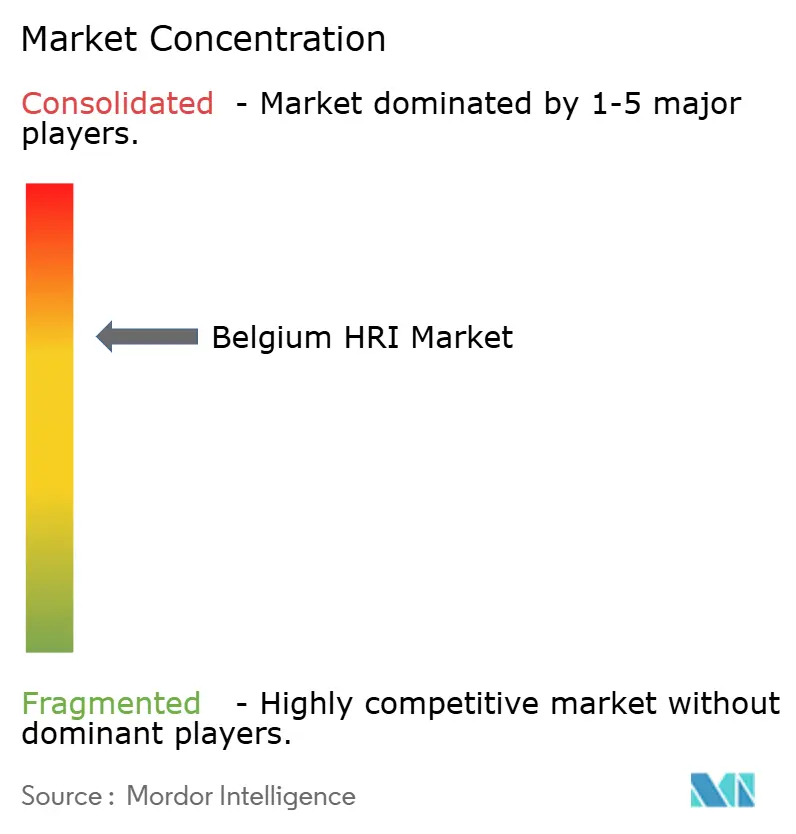
| Market Concentration | Medium |
Major Players
*Disclaimer: Major Players sorted in no particular order Image © Mordor Intelligence. Reuse requires attribution under CC BY 4.0. |
|
Belgium HRI Market Analysis by Mordor Intelligence
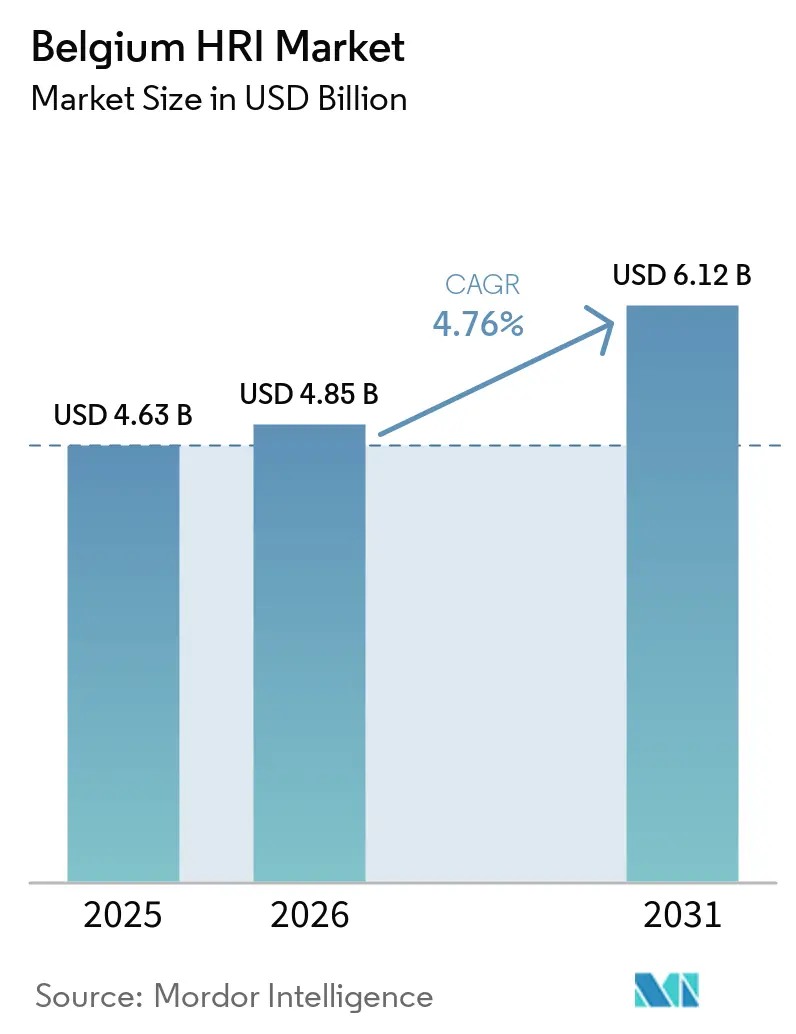
The Belgium HRI Market size is expected to grow from USD 4.63 billion in 2025 to USD 4.85 billion in 2026 and is forecast to reach USD 6.12 billion by 2031 at 4.76% CAGR over 2026-2031. Brussels, hosting a high concentration of international meetings, enjoys year-round occupancy. This is further bolstered by record inbound air traffic, fueling restaurant patronage. Even during off-peak tourist seasons, institutional meal programs sustain demand. Meanwhile, digital ordering has rebounded, stabilizing at levels surpassing pre-pandemic figures. On the supply side, momentum is evident through multi-million-euro hotel refurbishments and a wave of consolidation among contract caterers. Chain operators are also making significant automation investments, a strategic move to counterbalance Belgium's elevated labor costs. Notably, operators emphasizing certified sustainable sourcing are reaping the rewards, capturing premium spending without sacrificing volume. This positions sustainability not just as a trend, but as a dual lever for revenue and efficiency in Belgium's HRI landscape.
Key Report Takeaways
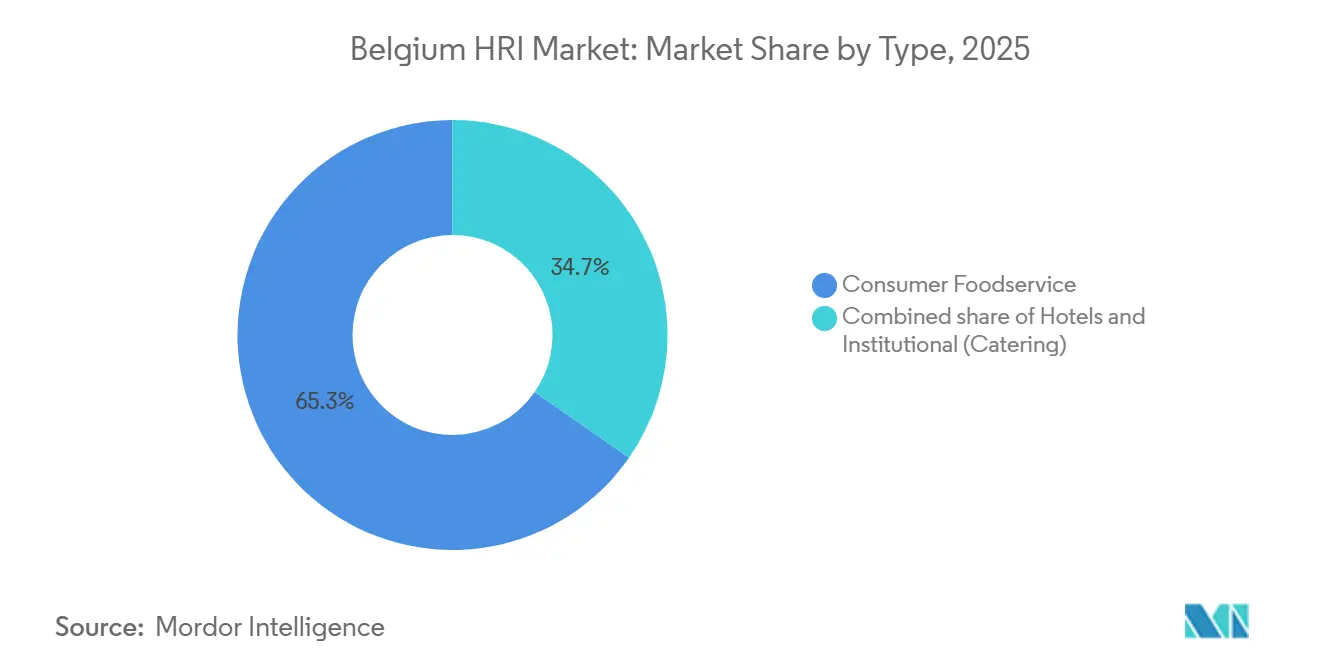
- By type, consumer foodservice held 65.34% Belgium HRI market share in 2025, while hotels are forecast to grow at a 5.53% CAGR through 2031.
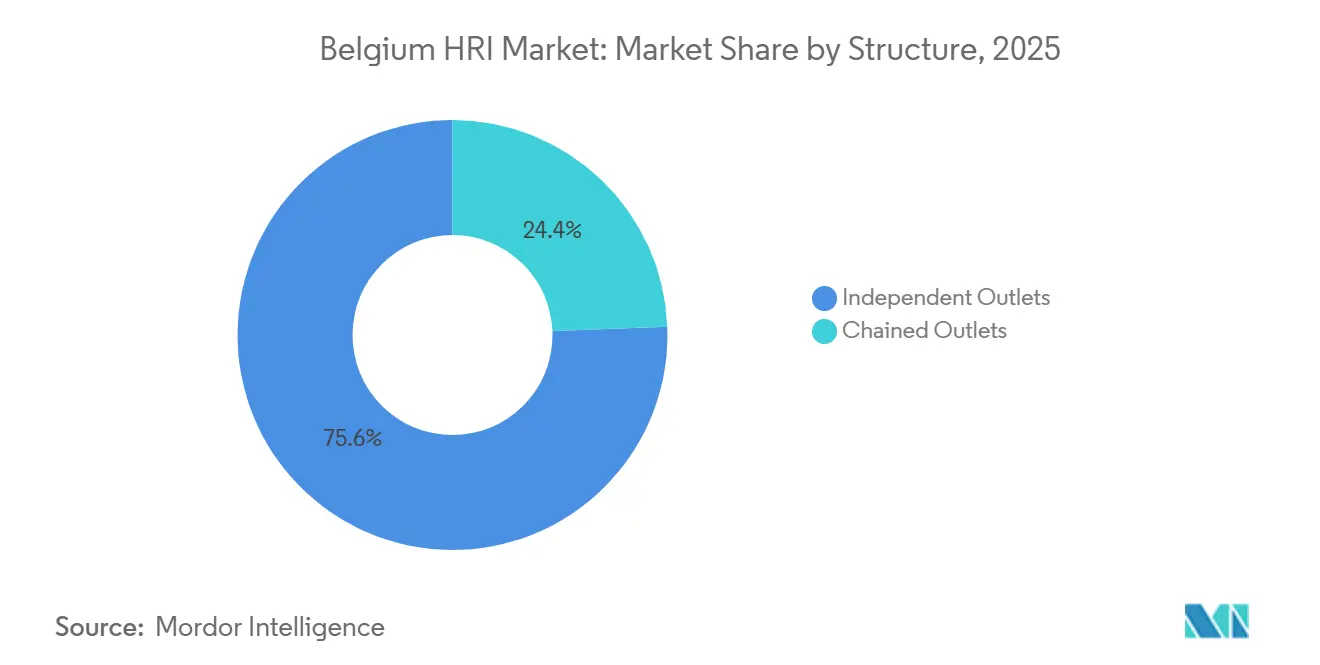
- By structure, independent outlets commanded 75.62% of the Belgium HRI market size in 2025, whereas chained outlets are set to expand at a 6.31% CAGR to 2031.
Note: Market size and forecast figures in this report are generated using Mordor Intelligence’s proprietary estimation framework, updated with the latest available data and insights as of January 2026.
Belgium HRI Market Trends and Insights
Drivers Impact Analysis*
| Drivers | (~) % Impact on CAGR Forecast | Geographic Relevance | Impact Timeline |
|---|---|---|---|
| Tourism and business travel driving demand for hotels, restaurants, and event catering in Brussels, Antwerp, and Bruges | +1.2% | National, with concentration in Brussels, Antwerp, Bruges | Medium term (2-4 years) |
| Institutional catering growth meeting demand for fresh meals in workplaces and public institutions | +0.8% | National, with emphasis on Brussels-Capital Region and Flanders | Long term (≥ 4 years) |
| Urban lifestyles boosting takeaway, delivery, and fast-casual dining formats | +1.0% | National, concentrated in Brussels, Antwerp, Ghent, Leuven | Short term (≤ 2 years) |
| Online delivery platforms driving restaurant delivery and cloud-kitchen growth | +0.9% | National, with highest penetration in Brussels and Antwerp | Short term (≤ 2 years) |
| Experiential venues like concept restaurants and pop-ups offering unique dining experiences | +0.4% | Brussels, Antwerp | Medium term (2-4 years) |
| Sustainable sourcing and energy-efficient operations aligning with consumer expectations | +0.5% | National, led by Brussels-Capital Region Good Food initiative | Long term (≥ 4 years) |
| Source: Mordor Intelligence | |||
Tourism and Business Travel Driving Demand for Hotels, Restaurants, and Event Catering
Belgium's small size and multilingual workforce make Brussels, Antwerp, and Bruges popular destinations for international conferences and leisure tourism. Brussels ranked first in the Union of International Associations' list for international meetings. In 2024, Antwerp saw 15.8 million day tourists, a 10.6% increase from the previous year, and 2.7 million overnight stays, which rose by 6%. Bruges attracted about 8 million visitors, maintaining strong occupancy rates in its boutique hotels. The Corinthia Brussels reopened in December 2024 after a EUR 150 million (USD 161.3 million) renovation, adding 126 luxury rooms designed for corporate clients and association delegates. Brussels Airport handled 23.6 million passengers in 2024, reflecting the recovery of business travel, which accounted for 52% of hotel demand in Brussels, compared to 48% for leisure in 2025. Event catering has also benefited, as large conferences often result in multi-day meal contracts for institutional caterers. Compass Group Belgium, operating under the Eurest brand, is one such caterer and holds ISO 9001 and ISO 14001 certifications.
Institutional Catering Growth Meeting Demand for Fresh Meals in Workplaces and Public Institutions
Public-sector mandates provide consistent, long-term revenue streams for on-site meal services in schools, hospitals, and government offices. In March 2024, Compass Group Belgium earned the Brussels-Capital Region's "Good Food" label, which requires at least 30% of ingredients to be organic or locally sourced, raising standards for contract renewals. The company has strengthened its position by acquiring J&M Catering, Fruy Catering, and Gourmet Invent, consolidating smaller regional operators and achieving cost efficiencies in purchasing. Sodexo Belgium has committed to achieving Net Zero emissions by 2040 and has upgraded client sites with energy-efficient kitchen equipment, aligning with public-sector sustainability requirements. Workplace catering is also benefiting from hybrid work models; as employees return to offices 2 to 3 days a week, they prefer fresh and diverse menu options over packed lunches, supporting steady per-capita meal spending. The segment's long-term growth is driven by demographic trends. Belgium's aging population is increasing the need for hospital and care-home catering, while school-meal programs are expanding to meet nutritional standards set by regional education authorities.
Urban Lifestyles Boosting Takeaway, Delivery, and Fast-Casual Dining Formats
High population density in cities like Brussels, Antwerp, Ghent, and Leuven drives the popularity of quick-service and fast-casual dining, which focus on speed and convenience. McDonald's Belgium operates 113 restaurants, serving over 70,000 meals daily by utilizing drive-through lanes and mobile-order technology to minimize wait times. Belchicken, a halal quick-service chain, plans to expand to 300 locations across Europe, directly competing with KFC in Belgium. Meanwhile, KFC has reduced its expansion target in the country from 40 branches to 17. Takeaway demand, which surged during the pandemic, has now stabilized at higher levels. Chez Léon, a full-service restaurant in Brussels, serves about 1,400 meals on peak Saturdays, with takeaway orders making up a growing share. Urban consumers prioritize fast service, digital ordering, and clear nutritional information. To meet these demands, operators are investing in self-service kiosks and loyalty apps to encourage repeat customers.
Online Delivery Platforms Driving Restaurant Delivery and Cloud-Kitchen Growth
Deliveroo, Just Eat Takeaway.com, and Uber Eats collectively handle millions of orders annually in Belgium, charging restaurants commission fees of 25% to 30% per transaction. This cost structure benefits cloud kitchens, which avoid front-of-house expenses and maximize kitchen efficiency. In March 2024, Casper, a dark-kitchen operator based in Brussels, raised EUR 5 million (USD 5.4 million) in funding. The company operates six facilities, each producing about 150 meals daily across 10 virtual brands. Compass Group Belgium introduced its DARKK ghost-kitchen brand in September 2023, focusing on corporate lunch deliveries and utilizing its existing institutional catering infrastructure. Foodiz, a corporate-catering platform, processes approximately 200 orders daily for 305 corporate clients and reported a 50% increase in turnover in 2021 compared to 2020. However, a 2024 qualitative study revealed that cultural preferences for in-person dining in Flanders limit the growth potential of dark kitchens. This suggests that hybrid models, which combine dine-in and delivery services, may be more sustainable. Additionally, restaurants relying on platforms face risks from algorithm changes and higher fees. To address this, some operators are developing their own delivery fleets or direct-order apps.
Restraints Impact Analysis*
| Restraint | (~) % Impact on CAGR Forecast | Geographic Relevance | Impact Timeline |
|---|---|---|---|
| Raw material price fluctuations disrupting profitability | -0.6% | National | Short term (≤ 2 years) |
| Food safety and hygiene rules burdening smaller operators | -0.5% | National, enforced by AFSCA | Medium term (2-4 years) |
| Labor laws and rising social contributions increasing compliance costs | -0.7% | National | Long term (≥ 4 years) |
| Competition limiting pricing power and innovation | -0.4% | National, concentrated in Brussels and Antwerp | Medium term (2-4 years) |
| Source: Mordor Intelligence | |||
Food Safety and Hygiene Rules Burdening Smaller Operators
The Belgian Federal Agency for the Safety of the Food Chain (AFSCA) requires businesses to follow Hazard Analysis and Critical Control Points protocols. These protocols involve maintaining records such as temperature logs, supplier certifications, and cleaning schedules. Non-compliance can lead to penalties, temporary closures, or license revocation. Smaller independent restaurants often struggle with compliance as they lack dedicated staff and rely on owner-operators to handle paperwork alongside daily operations. In contrast, larger chains like McDonald's Belgium use regional food-safety managers and automated monitoring systems, enabling them to achieve better compliance at a lower cost per unit. Recent regulatory changes now require digital traceability for meat and seafood, which involves integrating supplier databases. This creates a significant financial burden for smaller operators. Additionally, AFSCA enforces allergen-labeling rules under EU Regulation 1169/2011, requiring restaurants to update menus and train staff. While these regulations improve public health, they also increase the fixed costs of entering the market. This explains why Independent Outlets are projected to hold a 75.62% market share in 2025, while Chained Outlets are expected to grow at a faster CAGR of 6.31%, as they can spread compliance costs across a larger number of locations.
Labor Laws and Rising Social Contributions Increasing Compliance Costs
In 2024, Belgium's minimum wage reached EUR 2,070.48 (USD 2,228) per month, one of the highest in the EU[1]Source: Wage Indicator Foundation, "Minimum Wage Increased in Belgium from 01 May 2024 - July 22, 2024", wageindicator.org. Employers pay about 45% of gross wages toward social security, covering pensions, healthcare, and unemployment insurance. Hospitality wages have grown faster than productivity, squeezing margins. In the Horeca sector, annual wage indexation tied to inflation prevents pay freezes during downturns. Labor shortages worsen the issue, with over 10,000 hospitality vacancies despite a 5.5% national unemployment rate, due to unsociable hours and limited career growth. Operators are adopting automation, such as self-service kiosks, robotic dishwashers, and AI scheduling, to cut staff. McDonald's Belgium installed kiosks in all 113 outlets, reducing front-counter staff by 20% while maintaining service speed. However, full-service restaurants cannot automate table service without harming the guest experience, leaving them at a disadvantage. Unlike France, which reduced VAT for on-premise dining, Belgium has not provided targeted relief for hospitality labor costs, increasing pressure on operators.
*Our forecasts treat driver/restraint impacts as directional, not additive. The impact forecasts reflect baseline growth, mix effects, and variable interactions.
Segment Analysis
By Type: Consumer Foodservice Anchors Market Share
In 2025, Consumer Foodservice dominated 65.34% of Belgium's HRI Market, driven by quick-service restaurants, full-service establishments, cafés, bars, and a growing cloud-kitchen segment. McDonald's Belgium, with 113 outlets, serves over 70,000 meals daily using drive-throughs, mobile ordering, and self-service kiosks to improve efficiency and reduce labor costs. Quick-service restaurants maintain gross margins of 60%-65% by ensuring high table turnover and minimizing food waste with standardized menus. Full-service restaurants, like Chez Léon, which serves 1,400 meals on peak Saturdays and processes a tonne of mussels daily, generate higher average checks but face higher labor costs. Cafés and bars, mainly in Brussels's Grand Place and Antwerp's Grote Markt, earn 40%-50% of their gross profit from alcohol sales. Cloud kitchens, a rapidly growing segment, include Casper, which raised EUR 5 million (USD 5.4 million) in March 2024 and operates 6 dark kitchens producing 150 meals daily per location across 10 virtual brands, cutting front-of-house costs and maximizing kitchen efficiency.
Hotels are expected to grow at a 5.53% CAGR through 2031, supported by refurbishments and capacity expansions targeting business travelers and conferences. Corinthia Brussels reopened in December 2024 after a EUR 150 million (USD 161.3 million) renovation, adding 126 luxury rooms for corporate clients. Pandox invested EUR 35 million (USD 37.7 million) to expand DoubleTree Brussels City to 505 rooms, making it Belgium's largest hotel and meeting demand from Brussels's convention center. A&O Hostels spent EUR 7 million (USD 7.5 million) to open properties in Brussels (December 2024) and Antwerp (October 2024), targeting budget travelers and student groups. Brussels Airport's master plan through 2032 includes a 300-plus-room four-star hotel near the terminal for transit passengers and airline crews. In 2025, Brussels hotels recorded a 72.7% occupancy rate and an average daily rate of EUR 149.8 (USD 161.2), with potential for further rate increases as new supply is absorbed. Institutional catering, though smaller in value, provides stable revenue through contracts with schools, hospitals, and government offices, supported by sustainability mandates like Brussels-Capital Region's Good Food label.



By Structure: Chained Outlets Gain Share Through Scale
Chained Outlets are expected to grow at a 6.31% CAGR through 2031, outpacing the market's 4.76% growth rate. Their success is driven by advantages in procurement, technology, and brand recognition, which help offset higher occupancy costs. McDonald's Belgium operates 113 restaurants with 23 franchisees, employing over 7,500 staff and serving 70,000+ meals daily, reducing per-unit food costs by 15% compared to independents. Belchicken plans to expand to 300 European locations, using standardized kitchens and centralized menus. Starbucks Belgium leverages mobile-order-ahead and loyalty apps to boost repeat business and reduce wait times. Domino's Pizza achieves higher delivery margins through proprietary logistics and digital ordering, outperforming restaurants relying on third-party aggregators. Compass Group Belgium, under Eurest and Medirest brands, expanded by acquiring J&M Catering, Fruy Catering, and Gourmet Invent, consolidating regional operators.
In 2025, Independent Outlets accounted for 75.62% of the Belgian HRI Market, reflecting the country's culinary diversity and preference for local establishments. Chez Léon, a Brussels-based restaurant, serves 1,400 meals on peak Saturdays, preparing 1 tonne of mussels daily, showcasing the potential of well-located independents. Entropy Restaurant, a plant-based fine-dining venue, earned a Gault & Millau score of 14.5 and operates a zero-waste kitchen, attracting eco-conscious diners. The Tram Experience, a vintage-tram dining service in Brussels, charges EUR 250 to 300 (USD 269 to 323) for two guests, highlighting the pricing power of unique concepts. However, independents face challenges like higher procurement costs, limited capital for technology, and stricter compliance under AFSCA protocols. Quick Restaurants, a legacy Belgian burger chain, closed underperforming locations and shifted to franchising to compete with McDonald's and Burger King. Many independents now combine dine-in, delivery, and catering to diversify revenue and reduce fixed costs. Despite slower growth, their large market share highlights the enduring appeal of local cuisine and personalized service in Belgian dining culture.
Geography Analysis
The Brussels-Capital Region leads Belgium's HRI Market, driven by its role as the EU's de facto capital and the top city for international association meetings (Union of International Associations). In 2024, the city recorded 9.8 million overnight stays, a 4% increase from 2023. By 2025, hotel occupancy averaged 72.7%, with a daily rate of EUR 149.8 (USD 161.2). Business travel dominates hotel demand due to the presence of EU institutions, NATO, and multinational offices, which generate steady conference and event revenue. Brussels Airport handled 23.6 million passengers in 2024, up 6.4% year-on-year, supporting both hotel and independent restaurants[2]Source: Brussels Airport Company NV/SA, "23.6 million passengers at Brussels Airport in 2024, up 6,4% on 2023", brusselsairport.be. The region's "Good Food" label, requiring 30% organic or local ingredients in public catering, is driving sustainability among caterers like Compass Group Belgium and Sodexo Belgium.
Antwerp, Belgium's second-largest city and Europe's second-busiest port, saw 15.8 million day tourists in 2024, a 10.6% rise, and 2.7 million overnight stays, up 6%. Cultural attractions, shopping, and diamond trade business travel fuel this growth. Hotel development is active, with Hilton Antwerp planning expansion, Staybridge Suites Antwerp opening a 99-room property by 2026, and A&O Hostels investing EUR 7 million (USD 7.5 million) in budget properties in Antwerp and Brussels. In February 2025, Restaurant Samenloop, a social-catering initiative employing marginalized individuals, opened in Antwerp, showcasing the city's support for inclusive businesses. Bruges attracts 8 million visitors annually, maintaining high boutique hotel occupancy and thriving Flemish cuisine restaurants, though its smaller population limits institutional catering opportunities.
Flanders, home to most of Belgium's population, has the highest density of quick-service chains, including McDonald's 113 locations and Belchicken's planned 300 European outlets. Wallonia, Belgium's French-speaking region, has fewer restaurants but benefits from cross-border tourism with France and Luxembourg. Liège, Wallonia's largest city, supports institutional catering through hospitals and universities, with Casper operating a dark kitchen to meet corporate lunch demand. A 2024 study found Flanders' preference for in-person dining limits dark kitchen growth, unlike Brussels, where dense populations and long commutes favor delivery models. National wage-setting minimizes labor cost differences, but Brussels' sustainability mandates and higher incomes drive demand for premium dining experiences like the Tram Experience and Bistro Martin's Le Petit Chef. The interplay of Brussels' global role, Antwerp's commercial strength, and Flanders' suburban density will shape investments and innovations through 2031.
Competitive Landscape
The Belgium HRI market is moderately consolidated, with a mix of large hospitality groups, international restaurant chains, and strong regional operators accounting for a meaningful share of total foodservice activity. Organized players benefit from established brands, standardized operations, and broad geographic coverage, particularly in quick-service restaurants, cafés, and hotel chains. The key players engaged in Belgium's HRI market are Yum! Brands, Inc., McDonald's Corporation, Domino's Pizza, Inc., Starbucks Corporation, Restaurant Brands International Inc., Doctor's Associates Inc., and others. Their scale enables consistent service quality and efficient sourcing, supporting stable market positions across major urban centers and tourist hubs.
At the same time, independent restaurants, cafés, and family-owned establishments remain an integral part of Belgium’s foodservice landscape. These operators are especially prominent in full-service dining, traditional Belgian cuisine, and neighborhood cafés, where local identity and culinary heritage play a strong role in consumer choice. The continued relevance of independent outlets limits overall market concentration and sustains competitive diversity within the HRI sector.
Competition in the Belgium HRI market is increasingly shaped by menu innovation, sustainability practices, and service efficiency rather than expansion alone. Leading players are investing in digital ordering, delivery partnerships, and energy-efficient operations to improve margins and customer experience. While selective consolidation through franchising and acquisitions is occurring, the coexistence of organized chains and a large base of independent operators maintains the market’s moderately consolidated structure.
Belgium HRI Industry Leaders
-
McDonald's Corporation
-
Yum! Brands, Inc.
-
Doctor's Associates Inc.
-
Domino's Pizza, Inc.
-
Restaurant Brands International Inc.
- *Disclaimer: Major Players sorted in no particular order

Recent Industry Developments
- June 2025: Danish foodtech company Noahs enters the Belux region through a partnership with Q8 — launching their multi-brand concept to 75 service stations across Belgium and Luxembourg.
- February 2024: Costa Coffee has opened its first Belgian location, at Liège-Guillemins train station. The international coffee brand aims to have at least ten Belgian outlets in the near future.
- March 2023: BigChefs launched its first branch in Belgium in Antwerp. According to the brand, the all-day dining brasserie is located in a beautiful building on the F. Rooseveltplaats and can seat more than 200 people.


Belgium HRI Market Report Scope
The HRI (Hotel, Restaurant, and Institution) food service industry is responsible for offering meals to customers. The HRI industry depends on disposable income, leisure time, and complete customer satisfaction.
The scope of the Belgium HRI market includes segmentation on the basis of Type and Structure. By type, the market is segmented into Consumer Foodservice, Hotels, and Institutional (Catering). The consumer food service is further segmented under Cafes and Bars, Full-service Restaurants, Fast Food, Pizza Consumer Foodservice, Self-service Cafeterias, 100% Home Delivery/Takeaway, and Street Stalls/Kiosks. Furthermore, the market is segmented on the basis of structure into Independent Outlets and Chained Outlets.
The market sizing has been done in value terms in USD for all the abovementioned segments.
Type
| Consumer Foodservice | Cafes and Bars |
| Full-Service Restaurants | |
| Quick-Service Restaurants | |
| Cloud Kitchen | |
| Hotels | |
| Institutional (Catering) |
Structure
| Independent Outlets |
| Chained Outlets |
| Type | Consumer Foodservice | Cafes and Bars |
| Full-Service Restaurants | ||
| Quick-Service Restaurants | ||
| Cloud Kitchen | ||
| Hotels | ||
| Institutional (Catering) | ||
| Structure | Independent Outlets | |
| Chained Outlets |


Key Questions Answered in the Report
How large is the Belgium HRI market in 2026?
The Belgium HRI market size is USD 4.85 billion in 2026 and is projected to reach USD 6.12 billion by 2031.
Which segment grows fastest through 2031?
Hotels lead growth with a 5.53% CAGR, outpacing other type categories.
What drives chained outlet expansion?
Scale benefits in procurement, technology rollout, and brand recognition fuel a 6.31% CAGR for chains.
Which cities offer the strongest demand fundamentals?
Brussels anchors business travel and conferences, Antwerp captures high day-tour volumes, and Ghent benefits from dense student populations.
Page last updated on:





