
Beijing Data Center Market Size and Share
| Study Period | 2019 - 2030 |
| Forecast Data Period | 2025 - 2030 |
| Historical Data Period | 2019 - 2023 |
| Market Volume (2025) | 237.18 megawatt |
| Market Volume (2030) | 365.77 megawatt |
| CAGR (2025 - 2030) | 9.05% |
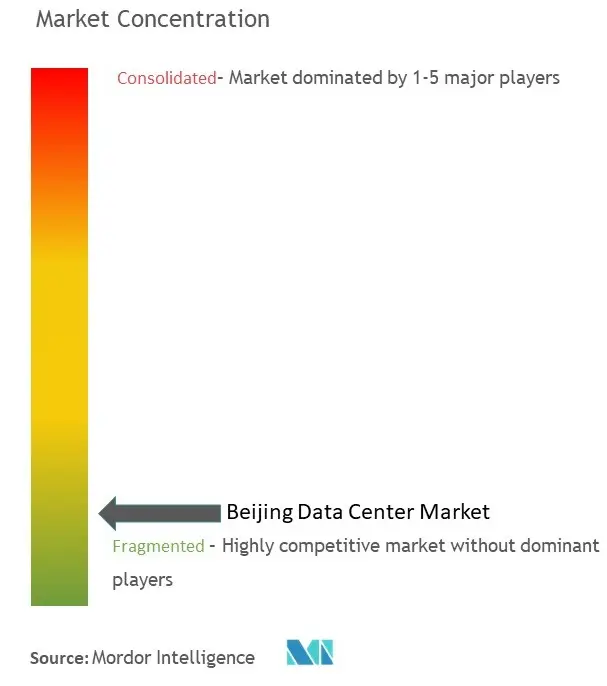
| Market Concentration | Medium |
Major Players *Disclaimer: Major Players sorted in no particular order |
Beijing Data Center Market Analysis by Mordor Intelligence
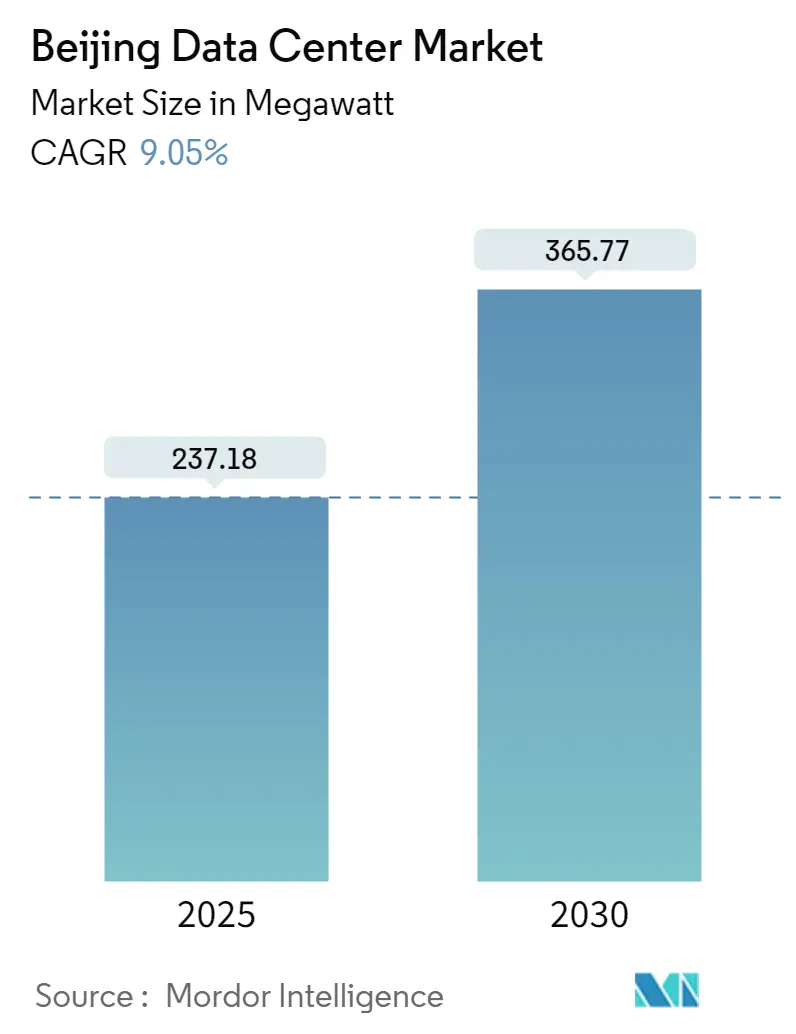
The Beijing Data Center Market size is estimated at 237.18 megawatt in 2025, and is expected to reach 365.77 megawatt by 2030, at a CAGR of 9.05% during the forecast period (2025-2030).
- A data center is a physical room, building, or facility that holds IT infrastructure used to construct, run, and provide applications and services and store and manage the data connected with them.
- Beijing, the financial capital of China, witnessed an increase in data consumption due to factors such as financial transactions, online gaming, streaming content, the adoption of smart home automation, and emerging artificial intelligence industries, which triggered the growth of data centers in the region.
- Owing to growing carbon footprint emissions, Beijing has been at the forefront of regulations in the country since 2014. It has already prohibited the building and expanding data centers in central urban areas while diverting activity to surrounding Tianjin and Hebei. The city's local government released a draft plan to mandate that data centers completed in 2021 and after must include renewable energy in their power sources and incrementally increase the share of renewables by 10% each year to 100% by 2030. Higher power tariffs will hit existing data centers that do not meet efficiency standards. The government is also planning to phase out older facilities with PUE levels of over 2.0.
- Mega data centers are the most preferred type in Beijing. Their capacity is expected to increase consistently in the region. Being industrial and highly populated, Beijing has a growing demand for massive and mega data centers. On the other hand, small, medium, and large data centers are expected to witness stagnant growth over the years.
Beijing Data Center Market Trends and Insights
Large data centers are anticipated to grow in the region during the forecast period.
- The country had 25 large data center facilities with a combined IT load capacity of 140.5 MW as of 2022. In addition, new large-scale data center facilities are under construction in the Tianjin and Hebei regions, with a projected capacity of 350 MW by 2029. However, the mega-data centers in the region still dominate the current market.
- Data centers are predominantly concentrated in the Beijing region, with a market share of 24%, following the dominance of the Shanghai region over the data center facilities.
- China Telecom Corporation held the largest market share of 40% in 2022 regarding large data centers in the country. Around 40% of the company's facilities are located, with Beijing coming in second. The company is expected to expand its large-scale data center facility portfolio with upcoming projects in the Hebei and Tianjin regions in the coming years.


BFSI segment to grow at a noteworthy pace.
- The digital revolution has most influenced the BFSI (banking and financial services) segment in industries allowing cost-effective earnings. The augmented penetration of cell phones and fast internet across the region has stimulated people to choose digital banking, which has also led toward incorporating powerful CRM and cloud tools to store and examine data, which is anticipated to augment market growth.
- The digital ecosystem surrounding a bank is blowing up at a quick pace. With the constant change in consumer demands, banks have been forced to customize their product offerings according to their demands. Secondly, as consumers embrace a mobile lifestyle and socialize on digital platforms, they expect banks to connect with them on the same platforms.
- Furthermore, Beijing fintech companies are trying to improve financial activities, such as paying, insuring, or lending to businesses and customers, using technology.
- Banks are seeking to transform their product offerings, channels, and customer services to reflect the changing demands of consumers. Banks must integrate business processes with advanced analytical capabilities, continuously refining processes, services, and products in real time. Thus, banks increasingly rely on the cloud's power to achieve their objectives and manage the current market challenges.
- The hybrid cloud is expected to command significant demand due to the sensitive nature of the data handled by BFSI enterprises.

Competitive Landscape
Chindata Group Holdings Ltd. led the segment in 2022 with nine massive-sized data centers concentrated in Hebei and Beijing. The company is expected to launch four new facilities: two in Beijing and one in Shanxi and Hebei.
Chindata Group Holdings Ltd. currently has fifteen operational data centers in Hebei, Shanxi, Beijing, and Zheijiang, with an installed capacity of 421 MW. In 2022, the company's capacity was 85612 racks with a raised floor capacity of 15,07,180 sq ft.
Beijing Data Center Industry Leaders
China Telecom Corporation Ltd
Princeton Digital Group
KDDI Telehouse
GDS
Chindata Group Holdings Ltd.
- *Disclaimer: Major Players sorted in no particular order

Recent Industry Developments
- February 2023: CapitaLand Investment Limited (CLI) announced the establishment of a Chinese data center development fund called CapitaLand China Data Centre Partners (CDCP). The fund is anticipated to aid the growth of data centers in Beijing and other regions.
- July 2022: Kappel announced its data center development plans in Beijing. The data center development decision was made after the company acquired Huailai Data Centre, and it expects to develop the site in the Beijing region with Heying jointly.


Beijing Data Center Market Report Scope
A data center is a physical room, building, or facility that holds IT infrastructure used to construct, run, and provide applications and services, as well as store and manage the data connected with those applications and services.
The Beijing data center market is segmented by DC size (small, medium, large, massive, mega), by tier type (tier 1 and 2, Tier 3, Tier 4), by absorption (utilized, colocation type [retail, wholescale, hyperscale], end user [cloud & IT, telecom, media & entertainment, government, BFSI, manufacturing, e-commerce], and non-utilized). The market sizes and forecasts are provided in terms of value (MW) for all the above segments.
| Small |
| Medium |
| Large |
| Massive |
| Mega |
| Tier 1 & 2 |
| Tier 3 |
| Tier 4 |
| Utilized | Colocation Type | Retail |
| Wholesale | ||
| Hyperscale | ||
| End-User | Cloud & IT | |
| Telecom | ||
| Media & Entertainment | ||
| Government | ||
| BFSI | ||
| Manufacturing | ||
| E-Commerce | ||
| Other End-User | ||
| Non-Utilized | ||
| DC Size | Small | ||
| Medium | |||
| Large | |||
| Massive | |||
| Mega | |||
| Tier Type | Tier 1 & 2 | ||
| Tier 3 | |||
| Tier 4 | |||
| Absorption | Utilized | Colocation Type | Retail |
| Wholesale | |||
| Hyperscale | |||
| End-User | Cloud & IT | ||
| Telecom | |||
| Media & Entertainment | |||
| Government | |||
| BFSI | |||
| Manufacturing | |||
| E-Commerce | |||
| Other End-User | |||
| Non-Utilized | |||


Key Questions Answered in the Report
How big is the Beijing Data Center Market?
The Beijing Data Center Market size is expected to reach 237.18 megawatt in 2025 and grow at a CAGR of 9.05% to reach 365.77 megawatt by 2030.
What is the current Beijing Data Center Market size?
In 2025, the Beijing Data Center Market size is expected to reach 237.18 megawatt.
Who are the key players in Beijing Data Center Market?
China Telecom Corporation Ltd, Princeton Digital Group, KDDI Telehouse, GDS and Chindata Group Holdings Ltd. are the major companies operating in the Beijing Data Center Market.
What years does this Beijing Data Center Market cover, and what was the market size in 2024?
In 2024, the Beijing Data Center Market size was estimated at 215.72 megawatt. The report covers the Beijing Data Center Market historical market size for years: 2019, 2020, 2021, 2022, 2023 and 2024. The report also forecasts the Beijing Data Center Market size for years: 2025, 2026, 2027, 2028, 2029 and 2030.
Page last updated on:
Beijing Data Center Market Report
Statistics for the 2025 Beijing Data Center market share, size and revenue growth rate, created by Mordor Intelligence™ Industry Reports. Beijing Data Center analysis includes a market forecast outlook for 2025 to 2030 and historical overview. Get a sample of this industry analysis as a free report PDF download.
- Data Center Power Market Power systems across all regions, split by component, tier and facility size.
- Artificial Intelligence (AI) Data Center Market AI facilities across all regions, split by facility type, component and tier.
- Data Center Construction Market Global construction demand, split by tier, facility size and facility type.
- Hong Kong Data Center Physical Security Market Physical security demand across Hong Kong, covering solution type and service type.
- Indonesia Data Center Power Market Power systems in Indonesia, split by component, facility type and facility size.
- Philippines Data Center Power Market Power systems demand across the Philippines, covering component, facility type and facility size.
- South Korea Data Center Processor Market South Korea processors, split by processor type, application and architecture.
- United Arab Emirates Hyperscale Data Center Market Hyperscale sites in the UAE, split by facility type, component and tier.
- Austria Data Center Power Market Power systems demand across Austria, covering component, facility type and facility size.
- Malaysia Hyperscale Data Center Market Hyperscale sites in Malaysia, split by facility type, component and tier.
- China Data Center Construction Market Construction in China, split by facility size and tier.
- Asia-Pacific Data Center Physical Security Market Physical security demand across Asia-Pacific, covering solution type and service type.
- China Data Center GPU Market GPUs demand across China, covering deployment type, gpu type and interconnect.


 Your data is secure and never sold or shared.


