
Market Overview
| Study Period | 2020 - 2031 |
|---|---|
| Forecast Data Period | 2026 - 2031 |
| Base Year Market Size (2025) | USD 491.40 Million |
| Market Size (2026) | USD 511.16 Million |
| Market Size (2031) | USD 622.84 Million |
| Growth Rate (2026 - 2031) | 4.02 % |
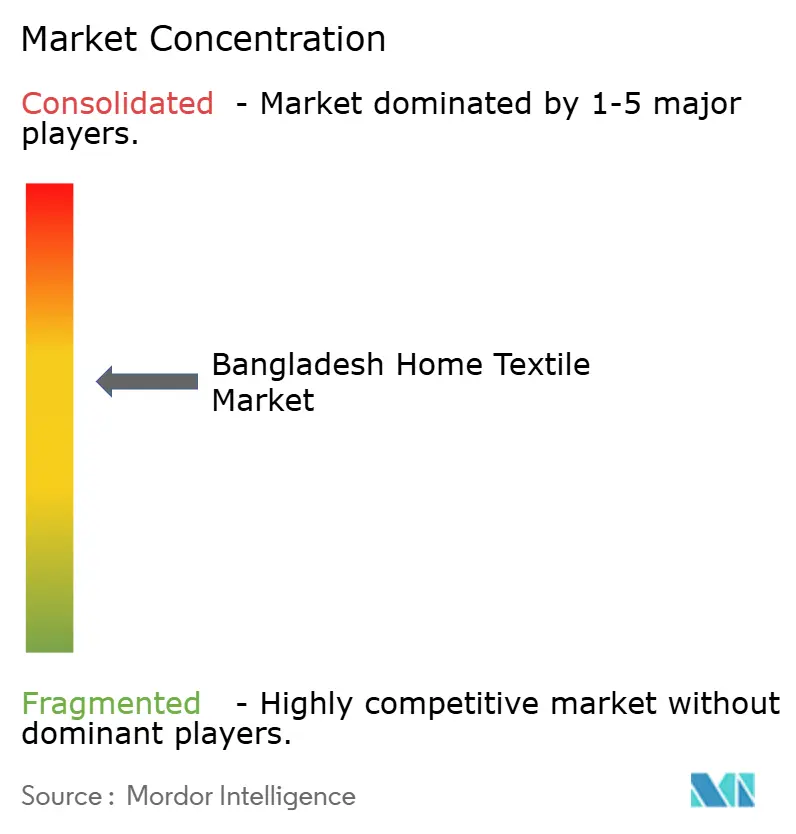
| Market Concentration | Medium |
Major Players *Disclaimer: Major Players sorted in no particular order Image © Mordor Intelligence. Reuse requires attribution under CC BY 4.0. | |
Bangladesh Home Textile Market Analysis by Mordor Intelligence
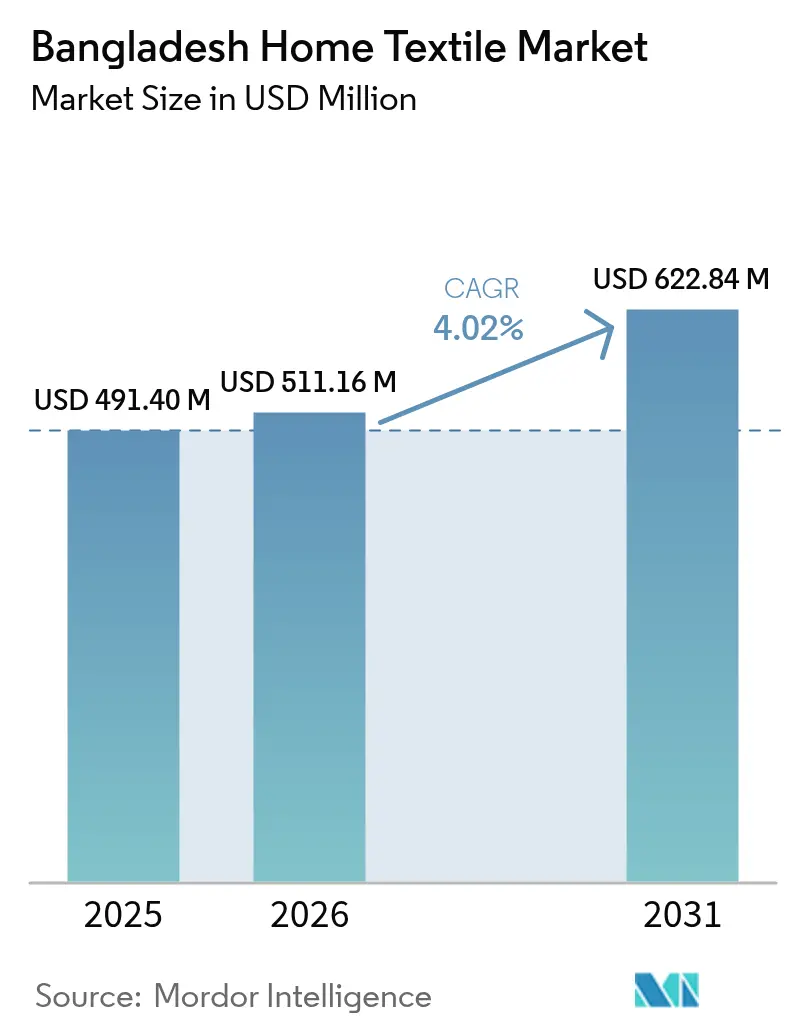
The Bangladesh home textiles market size was valued at USD 491.40 million in 2025 and estimated to grow from USD 511.16 million in 2026 to reach USD 622.84 million by 2031, at a CAGR of 4.02% during the forecast period (2026-2031). Robust export linkages, low-cost manufacturing, and duty-free access to the EU, Canada, and Japan sustain a steady order pipeline for bedding, towels, curtains, and rugs, while rising domestic disposable income deepens urban demand for branded décor products. Greater adoption of African cotton, eco-preferred fibers, and digital design tools boosts product quality and value addition for international buyers. Meanwhile, e-commerce acceleration widens direct-to-consumer channels, allowing producers to bypass traditional intermediaries and capture healthier margins. These tailwinds are tempered by chronic gas outages, wage inflation, and the looming loss of LDC-linked tariff preferences, which collectively squeeze margins and complicate forward capacity planning.
Key Report Takeaways
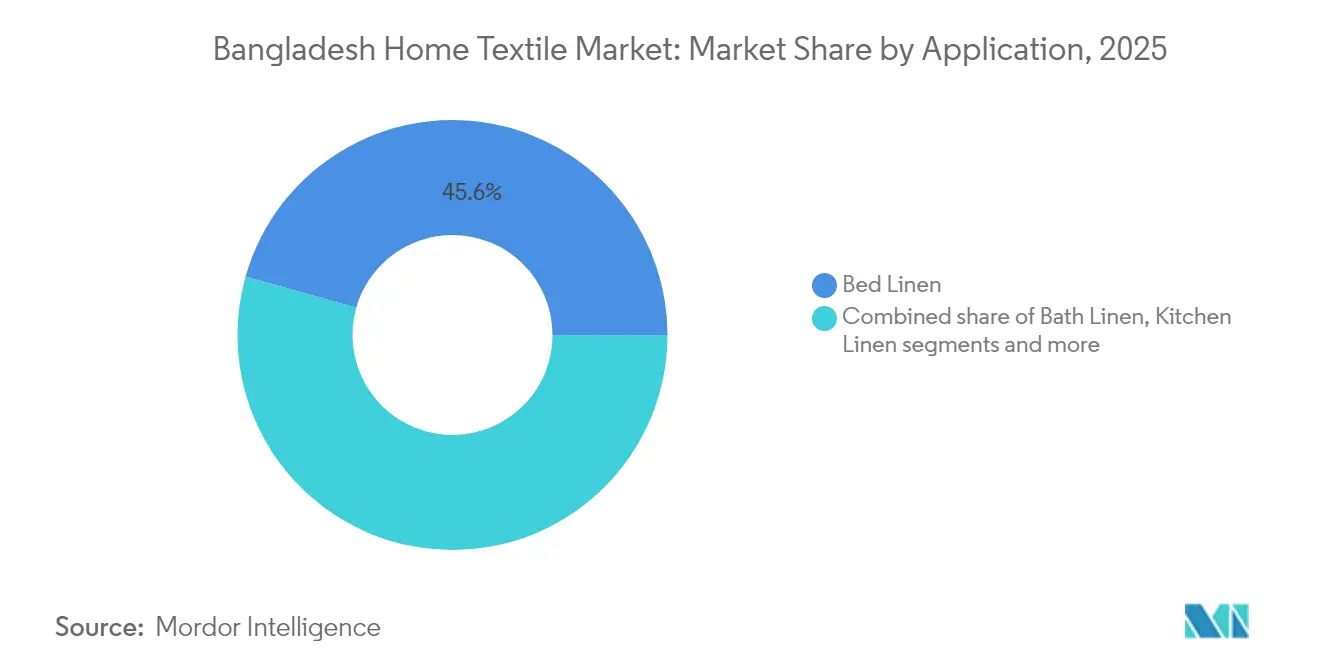
- By application, bed linen led with 45.62% of the Bangladesh home textiles market share in 2025. carpets & area rugs are forecast to expand at a 4.63% CAGR through 2031, the fastest among all applications.
- By material, cotton captured a 67.75% share of the Bangladesh home textiles market size in 2025. Synthetic Fibres are projected to register the highest 4.86% CAGR between 2026-2031.
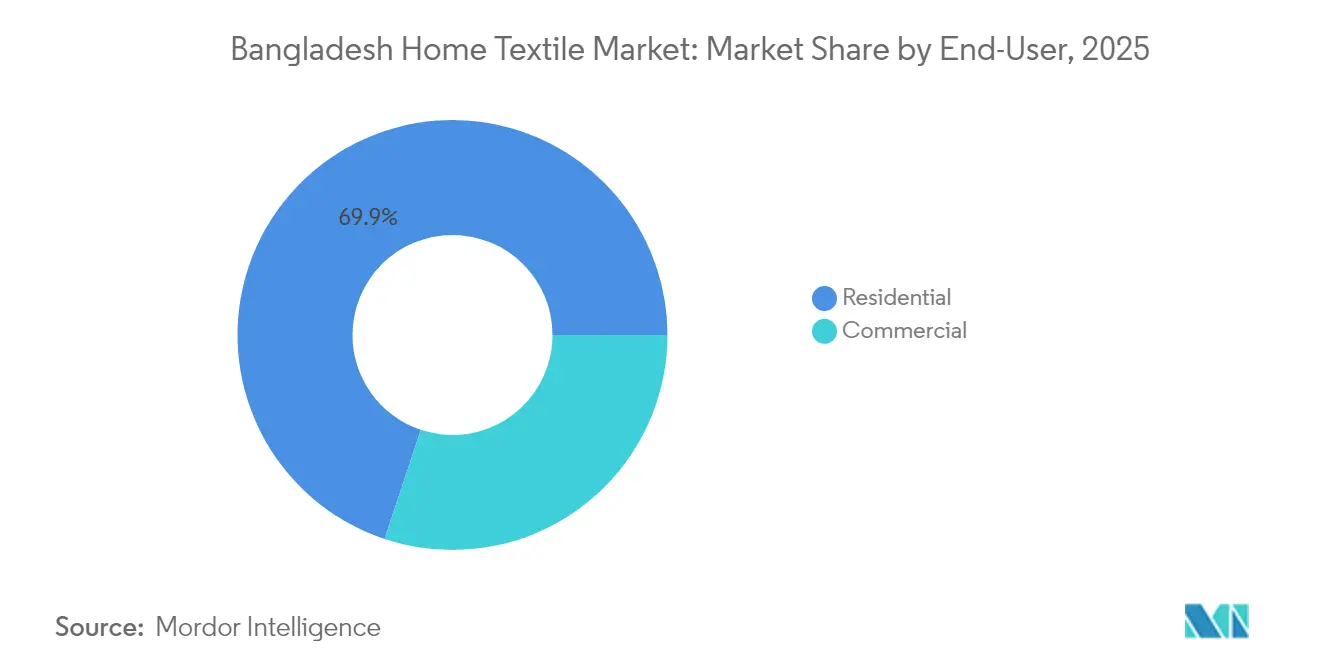
- By end-user, the residential segment accounted for 69.88% of the Bangladesh home textiles market size in 2025. Commercial applications are advancing at a 4.41% CAGR to 2031.
- By distribution channel, B2C/retail commanded 82.05% revenue share in 2025 and was advancing at a 4.74% CAGR to 2031.
- Geographically, the Dhaka division held 36.35% of the Bangladesh home textiles market share in 2025; the Sylhet Division is set to post a 4.97% CAGR through 2031.
Note: Market size and forecast figures in this report are generated using Mordor Intelligence’s proprietary estimation framework, updated with the latest available data and insights as of 2026.
Bangladesh Home Textile Market Trends and Insights
Drivers Impact Analysis*
| Driver | (~) % Impact on CAGR Forecast | Geographic Relevance | Impact Timeline |
|---|---|---|---|
| Rising disposable incomes | +0.8% | Dhaka, Chattogram, Sylhet; spillover nationwide | Medium term (2-4 years) |
| Duty-free EU/Canada/Japan access | +1.2% | Major EU destinations, Canada, Japan | Long term (≥4 years) |
| E-commerce boom | +0.6% | Domestic Bangladesh, regional export hubs | Short term (≤2 years) |
| Shift to higher-grade African cotton | +0.4% | Global quality-sensitive buyers | Medium term (2-4 years) |
| Adoption of eco-friendly fibers | +0.5% | EU and North America sustainability-focused markets | Long term (≥4 years) |
| “China-plus-one” sourcing diversion | +1.1% | The United States and EU buyer networks | Medium term (2-4 years) |
| Source: Mordor Intelligence | |||
Rising Disposable Incomes Spurring Spending on Branded Home Décor
An expanding middle class of nearly 30 million consumers is moving beyond utilitarian linens toward branded aesthetics, lifting domestic value per purchase, especially in premium bed sheets and decorative pillow covers. Urban GDP growth of 3.8-4.5% in 2025 underpins this trend, strengthening discretionary budgets in Dhaka and Chattogram. Retailers note that brand recognition increasingly outweighs price as a deciding factor in household textile purchases, prompting manufacturers to invest in distinctive designs and stronger packaging. Bangladesh Standards and Testing Institution reinforces this shift by enforcing labeling and colorfastness norms that align with global requirements. Collectively, these factors lift the perceived quality ceiling and encourage local producers to target higher price points in the Bangladesh home textiles market.
Duty-Free EU/Canada/Japan Access Sustaining Export Demand
Preferential schemes such as the EU’s Everything but Arms program grant quota- and duty-free entry for Bangladeshi linens, towels, and curtains, securing roughly 60% of annual shipments to Europe. Exports under EBA currently amount to about USD 25 billion and shield producers from 9-12% ad-valorem tariffs levied on rivals[1]. Although Least Developed Country graduation in 2026 threatens this edge, the United Kingdom’s decision to extend GSP access through 2027 offers a near-term buffer. Producers are therefore accelerating capacity expansion and line certifications to lock in contracts ahead of tariff changes. Simultaneously, government negotiators are pursuing bilateral agreements to cushion the Bangladesh home textiles market against a sudden duty shock.
E-Commerce Boom Enabling Direct-to-Consumer Home-Textile Brands
Domestic platforms such as Fabric Lagbe and global-facing start-ups like Sourcewiz enable small and mid-sized factories to publish live catalogs, generate automated quotations, and transact with overseas buyers, reportedly boosting revenue by three-tenths in the first operational year[2]. Lower digital onboarding costs let producers sell batches as small as 300 units, democratizing export participation. Local shoppers also gravitate toward mobile marketplaces integrated with same-day delivery within Dhaka, widening consumer reach for novelty bedsheets and embroidered cushion covers. As a result, inventory cycles shorten, data analytics refine style assortments, and dependence on brick-and-mortar wholesalers declines. The channel, therefore, underwrites incremental volume and pricing power across the Bangladesh home textiles market.
Shift to Higher-Grade African Cotton Ensuring Better Yarn Quality
Large spinning mills are diversifying raw-cotton procurement towards premium West African grades that deliver higher strength-to-nep ratios, reducing fabric rejections and dye variability. While import costs edge up, mills recapture value through lower waste and stronger buyer quality scores. International retailers have responded by grading Bangladeshi bedding at par with Vietnamese and Turkish suppliers, opening avenues for higher-margin orders. The Cotton Development Board’s support for cultivar trials further signals long-run improvements in domestic agronomy. Elevated yarn consistency ultimately positions the Bangladesh home textiles market to climb the price ladder instead of competing solely on labor arbitrage.
Restraints Impact Analysis*
| Restraint | (~) % Impact on CAGR Forecast | Geographic Relevance | Impact Timeline |
|---|---|---|---|
| Chronic gas & power outages | -1.4% | Nationwide, acute in industrial hubs | Short term (≤2 years) |
| Rising wage & compliance costs | -0.8% | Labor-intensive clusters | Medium term (2-4 years) |
| Loss of GSP benefits post-LDC graduation | -1.2% | EU, Canada, Japan export corridors | Long term (≥4 years) |
| High tariffs on specialty MMF fabrics | -0.6% | Synthetic fiber subsectors | Medium term (2-4 years) |
| Source: Mordor Intelligence | |||
Chronic Gas & Power Outages Cutting Mill Utilization
Daily load-shedding of 7-9 hours forces roughly 19% of mills to run at just 40-50% capacity, while captive generators lie idle because pipeline pressure covers only 67% of national demand[3]. Industrial gas prices have jumped from BDT 30 to BDT 42 per m³ since 2023, eroding contribution margins on energy-intensive bleaching and finishing processes. Exporters risk shipping delays and chargebacks when production stops mid-cycle, and some small operators have temporarily shut down weaving sheds in Narayanganj and Gazipur. Emergency allocations by the Power Division prioritize fertilizer plants over textiles, leaving little short-term relief. Consequently, buyer confidence wavers, and the Bangladesh home textiles market confronts systemic supply volatility.
Margin Squeeze from Rising Wage & Compliance Costs
Minimum wage revisions, fire-safety retrofits, and heightened social-audit frequency add cumulative pressure of 5-7% on FOB pricing, narrowing the competitiveness advantage Bangladesh once held over Pakistan and India. Factories aiming for BetterWork or SLCP conformity must allocate capital to worker well-being programs, cafeteria upgrades, and digitized payroll systems. Buyers rarely absorb these cost increments, compelling producers to search for efficiency in changeover times and material yields. The resultant capex outlays deter smaller mills from upgrading, potentially accelerating consolidation. This dynamic slows reinvestment cycles and affects volume growth for the Bangladesh home textiles market.
*Our forecasts treat driver/restraint impacts as directional, not additive. The impact forecasts reflect baseline growth, mix effects, and variable interactions.
Segment Analysis
By Application: Bed Linen Dominance Drives Volume Growth
Bed Linen anchors the Bangladesh home textiles market size, accounting for 45.62% of value in 2025. Vertically integrated leaders such as Zaber & Zubair run looms capable of weaving 400,000 meters of sheeting per day, guaranteeing large-lot consistency for European big-box retailers. Premium thread-count products shipped under OEKO-TEX labels command healthy unit economics even after energy surcharges. In contrast, the Bath and Kitchen Linen segments benefit from sustained hospitality procurement as global hotel chains refurbish room inventories post-pandemic. Upholstery textiles for sofas and drapery gain moderate traction from property development in Dhaka and Chattogram, although order volumes remain lower than bedding.
Carpets & Area Rugs constitute the fastest-expanding application, projected at a 4.63% CAGR. Heritage crafts like Nakshi Kantha stitchery and fine Jamdani motifs give Bangladeshi jute rugs a distinct artisanal appeal recognized by UNESCO. Export incentives of 8% on handicrafts help offset raw-material price volatility, yet weaver attrition and financing gaps limit scale. Government support under the National Handicraft Policy adds training and marketing grants, positioning artisan clusters in Tangail and Cumilla for higher foreign exchange earnings. Collectively, these forces elevate the rugs segment’s profile within the Bangladesh home textiles market.

By Material: Cotton Leadership Faces Synthetic Competition
Cotton contributes 67.75% of the Bangladesh home textiles market share in 2025, reflecting mills’ long-standing competency in carding, ring spinning, and finishing of staple-length fibers. Annual cotton imports run 8.5 million bales, equivalent to USD 8.67 billion, exposing mills to global price swings and shipping-route disruptions. The Cotton Development Board aims to raise local cultivation to 200,000 hectares by 2041, a move that could supply a fifth of demand and mitigate forex risk. Bangladesh home textiles market size for cotton products should therefore remain resilient, provided ginning infrastructure and Bt-cotton approvals materialize on schedule.
Synthetic Fibres, though smaller today, deliver the highest 4.86% forecast CAGR. Buyers value moisture-wicking, wrinkle-resistant, and quick-dry properties in polyester-rich bedsheets and microfiber comforters. High tariff walls on specialty MMF inputs currently dampen cost competitiveness, yet large groups are piloting recycled-ready PET yarn lines and exploring fabric recycling. Linen, jute, bamboo, and silk remain niche but command premium placements in eco-focused collections. Envoy Textiles’ waste-fabric recycling venture is a notable step toward circularity, aligning with EU requirements for traceability and low carbon intensity. Together, diversification beyond cotton broadens the Bangladesh home textiles market’s product mix.
By End-User: Commercial Segment Drives Premium Growth
The Residential segment captured 69.88% of the Bangladesh home textiles market share in 2025, driven by urban condominium growth and a preference for coordinated bed-and-bath ensembles. Retailers bundle bedsheets with cushion covers, pushing average ticket size higher. Traditional handloom goods such as Nakshi Kantha bedcovers still feature in gift purchases, but production constraints and skill shortages limit scale.
Commercial buyers, hotels, hospitals, and corporate guest houses register the stronger 4.41% CAGR through 2031. Hospitality chains stipulate chlorine-fast whites for institutional laundering and durability over 150 wash cycles, enabling factories to fetch a higher margin per yard. Sustainability certifications like GOTS and OEKO-TEX have become prerequisites for long-term supply. Compliance with fire-retardant specifications under U.S. NFPA 701 further distinguishes certified mills. Consequently, commercial sub-segments propel both value expansion and reputational lift for the Bangladesh home textiles market size.
By Distribution Channel: B2C Retail Transformation
B2C/Retail networks control 82.05% of the Bangladesh home textiles market size in 2025. Supermarkets such as Shwapno and Agora allocate dedicated shelf space to linens, while branded showrooms of ACS Textiles and Classical HomeTex flourish in high-income neighborhoods. Organized retail remains under-penetrated versus regional peers, implying headroom for floor-space growth.
Online channels enjoy double-digit expansion as mobile penetration hits 66% nationwide. Flash-sale events around Eid and Pahela Baishakh push spikes in bedsheet sales, and social commerce influencers increasingly endorse local brands. Mass Merchandisers capitalize on private-label programs to boost margins, whereas Mom-and-Pop stores retain relevance in rural districts by selling low-count cotton pillowcases. B2B/direct supply to institutional importers holds steady but cedes growth momentum to consumer outlets. This retail evolution deepens product assortment and price visibility throughout the Bangladesh home textiles market.
Geography Analysis
Dhaka Division commanded 36.35% of the Bangladesh home textiles market share in 2025, leveraging dense industrial estates, skilled labor pools, and seamless connectivity along the Dhaka-Chattogram corridor. Anchor projects such as the Beximco Industrial Park house spinning, weaving, dyeing, and finishing units within integrated campuses, streamlining lead times. Financial clusters in Motijheel and Uttara facilitate working-capital access, while Hazrat Shahjalal International Airport aids urgent sample dispatches. However, road congestion and gas rationing pose persistent logistical costs, prompting firms to explore satellite campuses in Gazipur and Manikganj.
Chattogram Division serves as the principal export gateway. The seaport handles over 90% of the country’s container trade, making its vessel berth queuing time a critical determinant of FOB competitiveness. Port-centric manufacturing enjoys customs-bond advantages, yet limited inland container depot capacity constrains off-dock efficiency. Planned Payra deep-sea port could alleviate some congestion, but until operational, exporters factor extra buffer days into shipment schedules. Proximity to the port nevertheless lowers internal freight for towel and bathrobe consignments compared with Dhaka-based suppliers.
Sylhet Division is forecast to post the fastest 4.97% CAGR through 2031. Government grants under the Bangladesh Economic Zones Authority are catalyzing light-manufacturing estates near the newly upgraded Sylhet airport. Diaspora remittances fuel retail spending on home upgrades, lifting local demand for premium bedding. Clusters in Rajshahi, Rangpur, Barishal, Khulna, and Mymensingh remain smaller but offer specialization opportunities in jute wall hangings and block-printed table linen. Infrastructure gaps, particularly gas pipelines and four-lane highways, must be closed to unlock production scalability across these secondary divisions. Together, regional diversification mitigates concentration risk for the Bangladesh home textiles market.
Regulatory Landscape
Bangladesh home textile producers work under a standards and compliance regime led by the Bangladesh Standards and Testing Institution (BSTI), established under the Bangladesh Standards and Testing Institution Act, 2018. BSTI covers standardization, testing, quality control, and certification marking, and for designated product categories it runs a Compulsory Certification Marks (CM) scheme that requires a conformity certificate before marketing. The institution also governs textile-related standard setting and test-methods through sectional committees, including JT/SC 5 for textile test methods and JT/SC 10 for handloom products. Alongside BSTI, the Department of Textiles under the Ministry of Textiles and Jute supports sector development, skills, and industry programs.
Trade policy shapes export competitiveness for home textiles shipped under preferential access in key destinations. The report context points to the 2026 LDC graduation timeline as a policy milestone for tariff preference continuity, while producers respond by tightening certifications and compliance readiness aligned with international buyer requirements, including OEKO-TEX and other sustainability-linked criteria cited in procurement.
Value Chain Analysis
The Bangladesh home textile value chain starts with imported raw materials, especially cotton and specialty man-made fibers, then progresses through spinning, weaving/knitting, processing (bleaching, dyeing, printing, finishing), and conversion into finished home textile articles for export and domestic retail. Large, vertically integrated groups, including Zaber & Zubair (Noman Group) and other integrated mills referenced in the competitive landscape, manage multiple stages in-house to control quality and lead times. Smaller units tend to participate as subcontractors for specific operations such as weaving, stitching, or value-added embellishment.
On the downstream side, exports often pass through buying houses and intermediaries that coordinate product development, compliance documentation, and logistics between overseas retailers and local factories. Domestically, the channel mix is led by B2C retail, including organized retail and online platforms, which is shortening replenishment cycles for branded linens and decor. Utility reliability and input economics are persistent friction points, with gas and power disruptions constraining wet-processing and finishing throughput, while tariffs on certain specialty MMF inputs limit cost-effective diversification for synthetic-rich home textile lines.
Competitive Landscape
The Bangladesh home textiles market exhibits moderate concentration anchored by vertically integrated groups such as Zaber & Zubair Fabrics, ACS Textiles, Apex Weaving & Finishing, and Mom Tex. Zaber & Zubair has invested more than USD 600 million in compaction, digital printing, and automated cutting lines, enabling daily output of 400,000 meters of fabric and 100,000 finished pieces destined mainly for Europe. ACS Textiles employs 5,000-plus staff across weaving, dyeing, and finishing, and exports OEKO-TEX-certified goods to Australia, North America, and the EU.
Strategic positioning revolves around cost leadership, compliance breadth, and buyer intimacy. Leading mills allocate up to 3% of revenue for sustainability capex, solar rooftops, and ZDHC-approved effluent treatment plants to secure long-term contracts. Smaller factories often serve as subcontractors but risk disintermediation as e-commerce and compliance demands escalate. Digital disruptors like Sourcewiz and Fabric Lagbe democratize export marketing for mid-tier suppliers yet require working-capital discipline to fulfill chunkier overseas orders. Financial distress at a few conglomerates, such as Beximco Group’s request for a BDT 4 billion bridge facility, highlights concentration risk and underscores the need for prudent liquidity management.
Emerging whitespace lies in eco-labeled collections, quick response drops for online retailers, and technical textiles such as fire-retardant drapery. Players armed with automated color kitchens and computerized jacquard looms can iterate designs rapidly, winning seasonal programs from Western retailers. Conversely, mills are slow to digitalize risk marginalization. Overall, scale, sustainability, and speed constitute the competitive triad shaping the Bangladesh home textiles market.
Bangladesh Home Textile Industry Leaders
-
Zaber & Zubair Fabrics Ltd. (Noman Group)
-
ACS Textiles (Bangladesh) Ltd.
-
Apex Weaving & Finishing Mills Ltd.
-
Noman Terry Towel Mills Ltd. (NTTML)
-
Momtex Expo Ltd.
- *Disclaimer: Major Players sorted in no particular order
Market Opportunities and Future Outlook
Policy and financing levers that support deeper local sourcing and backward integration create room for home textile producers to expand upstream yarn and fabric capability and strengthen export buyer-facing traceability. A recent anchor in the report context is Bangladesh Bank Circular No. 19 (July 2026), which raised the cash incentive for export-oriented domestic textile products from 1.5% to 5% for FY 2026-27. The change encourages local raw material sourcing and strengthens the business case for domestic spinning, knitting/weaving, and processing linkages tied to home textile export programs.
Capacity build-outs in higher value materials and process capability also provide a basis to broaden the home textile product mix beyond cotton-heavy assortments, particularly when performance and sustainability attributes are needed. Modern Syntex (TK Group) provides a concrete example, with land secured (3.75 acres) in April 2026 at the National Special Economic Zone (NSEZ), Mirsharai, to expand high-value polyester yarn production, which supports more synthetic-rich home textile constructions such as microfiber bedding and quick-dry bath products. On the demand side, continued reliance on EU preference-led corridors and the 2026 policy transition keep attention on faster product development cycles, stronger compliance breadth, and buyer-facing innovation programs that help protect order continuity as tariff and cost conditions change.
Recent Industry Developments
- July 2026: Bangladesh Bank issued Circular No. 19, raising the cash incentive for export-oriented domestic textile products from 1.5% to 5% for FY 2026-27. The move strengthens the economics of using locally produced yarns and fabrics in export orders, supporting deeper backward integration across textile and home textile supply chains. It also aligns incentives with buyer requirements for traceability and more controlled sourcing pathways.
- February 2025: Beximco Group's Textiles and Apparel Division sought Tk 4.0 billion in government support to keep 31 exporting factories operating and to settle wage arrears. The request highlighted liquidity stress and operational risk in large exporting clusters, with potential spillovers to lead times and subcontracting networks in the broader textiles ecosystem. The situation also underscored how energy and cost shocks can quickly translate into working-capital pressure for exporters.
- September 2024: Envoy Textiles unveiled a waste-fabric recycling plant to strengthen circular production capacity. The added recycling capability supports material recovery and lower-waste production models that are increasingly referenced in export buyer scorecards and sustainability-linked procurement. It also adds a pathway for mills and converters to manage pre- and post-industrial textile waste more systematically within Bangladesh.
Research Methodology Framework and Report Scope
Market Definition and Coverage
For this study, the Bangladesh home textile market covers the value of home-use textile products sold in the country through organized and unorganized channels, counted at market prices in USD, for a consistent calendar-year view.
Scope exclusions: We exclude apparel textiles, industrial textiles, and pure contract manufacturing value that is not sold into the Bangladesh home textile demand pool.
Segmentation Overview
- By Application
- Bed Linen
- Bath Linen
- Kitchen Linen
- Upholstery
- Carpets & Area Rugs
- By Material
- Cotton
- Linen
- Synthetic Fibres
- Other Materials (Wool, Hemp, Silk, Jute, Bamboo)
- By End-User
- Residential
- Commercial
- By Distribution Channel
- B2C/Retail Channels
- Mass Merchandisers (Hypermarkets/Supermarkets)
- Home Centers
- Specialty Stores
- Local Mom and Pop Stores
- Online
- Other Distribution Channels
- B2B/Direct from the Manufacturers
- B2C/Retail Channels
- By Region
- Dhaka Division
- Chattogram Division
- Khulna Division
- Rajshahi Division
- Rangpur Division
- Barishal Division
- Sylhet Division
- Mymensingh Division
Data Sources, Market Sizing, and Validation
Desk Research
Desk research was used to set the market context and build clean starting points for our model, especially on production capacity, trade flows, and category definitions used in Bangladesh. We referred to public sources such as Export Promotion Bureau (EPB) statistics, Bangladesh Bank macro releases, Bangladesh Bureau of Statistics (BBS) publications, UN Comtrade trade series, and World Bank indicators, so growth drivers were tied to measurable signals.
We also reviewed company annual reports, investor presentations, and credible press coverage to understand product mix shifts, pricing pressure, and changes in distribution, including online sales. Where needed, subscription sources for company financials and news, import and export shipment tracking, and patent lookups were used to cross-check scale, timing, and product innovation signals. The desk sources listed here are illustrative only, and many other public references were also used for data collection, validation, and clarification.
Primary Interviews and Surveys
Our Bangladesh fieldwork uses expert interviews and surveys with manufacturers, distributors, retailers, hospitality buyers, and institutional purchasers operating in or serving Bangladesh. Respondent input is used to test reported trade trends, clarify local sales and pricing gaps, assess channel assumptions, and triangulate the final estimate before review.
Distribution of primary research fieldwork respondents
| Company type | Respondent position |
|---|---|
| Top tier: 30% | CXOs: 15% |
| Mid tier: 45% | Functional/Unit leaders: 30% |
| Smaller Players: 25% | Managers: 55% |
Market-Sizing & Forecasting
Market sizing started with a top-down build that reconstructs Bangladesh home textile demand using category level consumption logic, supported by production and trade direction checks. After the first cut, we corroborated totals with selective bottom-up approximations, such as sampled average selling price times volume checks by key product groups, and channel-level sense checks from distributors and retailers. Where gaps were found, we adjusted totals accordingly.
Inputs used in the model included indicators such as home textile export momentum as a supply health signal, cotton and yarn price movement as a proxy for cost-led price changes, household income and urbanization trends linked to discretionary home purchases, share shifts toward online retail, and category mix movements across bed linen, bath linen, kitchen linen, upholstery, and floor covering. When interview feedback suggested under-reporting in smaller channels, a controlled uplift factor was applied and then re-checked against realistic spending capacity.
For forecasting, scenario analysis was applied around two practical drivers, export order cycles that influence local availability and pricing, and domestic demand growth tied to income trends and channel expansion. The final forecast path was then aligned with what primary respondents described as expected pricing behavior and category growth in the next five years.
Data Validation & Update Cycle
Each market total was checked through multiple passes so that unusual jumps or drops were explained by a visible driver, rather than treated as a modeling artifact. We compared outcomes with independent signals like trade direction, input cost movement, and channel commentary, and revisited assumptions when the variance looked too high to be reasonable.
Before sign-off, the model and its calculations are reviewed by another analyst, followed by a final consistency check across definitions, units, and currency timing. Reports are refreshed annually, and interim updates are made when material events occur, such as sharp raw material price changes or major policy shifts. Right before delivery, a fresh pass is completed so clients receive the latest updated view.
Mordor Intelligence's Bangladesh Home Textile Market Size Measured Against Other Published Estimates
Published numbers for Bangladesh home textiles often do not match because they mix different value points and even different demand pools, and they also vary on calendar year versus fiscal year reporting. Some sources lean on export earnings, others include adjacent textile items, and a few apply aggressive price growth without validating it against local selling reality.
A common gap driver is that export portals report shipment value for home textile product groups, which can be much larger than domestic market sales in a given year, and can swing with order timing and currency conversion. Some published estimates also bundle tents, furnishing fabrics, or broader textile manufacturing value into home textiles, and then treat the result as consumer market size. In contrast, Mordor Intelligence counts only home textile products sold into Bangladesh demand through defined categories and channels, and export-only earnings are treated as a cross-check rather than the market total.
Benchmark comparison
| Source | Market Size | Gaps in Research Methodology |
|---|---|---|
| Mordor Intelligence | USD 511.16 M (2026) | |
| Industry Association B | USD 1095.29 M (2023) | Uses export earnings for a home textiles product bucket in fiscal-year reporting, which can include shipment value that is not the same as in-country consumption at market prices. |
| Trade Journal A | USD 871.57 M (2025) | Highlights sector export receipts for a fiscal year and treats it as market value, which can overstate domestic demand and also shift with order timing and currency conversion. |
The table shows that most of the spread comes from mixing export receipts with local consumption value, plus differences in year type and included product baskets. By keeping the steps tied to observable demand indicators and then validating them with channel checks, the final number stays traceable and repeatable for planning decisions.
Key Questions Answered in the Report
Which region is growing the fastest for home-textile production?
Sylhet Division is forecast to record a 4.97% CAGR through 2031 on the back of new economic zones and rising consumer spending.
What is the main challenge facing manufacturers now?
Chronic gas and power shortages are curbing mill utilization to as low as 40-50%, raising production costs and delaying shipments.
How will LDC graduation affect exports?
Loss of GSP duties from 2026 could cut export earnings by 7-14% unless new bilateral agreements or diversified product strategies offset the tariff hike.
Which material segment is gaining momentum beyond cotton?
Synthetic fibres, particularly recycled polyester, are projected to grow at a 4.86% CAGR because buyers seek performance fabrics and eco-friendly credentials.
What is the current value of the Bangladesh home textiles market?
The market is valued at USD 511.16 million in 2026 and is projected to rise to USD 622.84 million by 2031.
Which application drives the highest revenue?
Bed Linen holds 45.62% of total revenue, benefiting from scale production and strong European demand.