
Market Overview
| Study Period | 2021 - 2031 |
|---|---|
| Forecast Data Period | 2026 - 2031 |
| Base Year Market Size (2025) | USD 138.54 Million |
| Market Size (2026) | USD 148.42 Million |
| Market Size (2031) | USD 219.70 Million |
| Growth Rate (2026 - 2031) | 8.16 % |
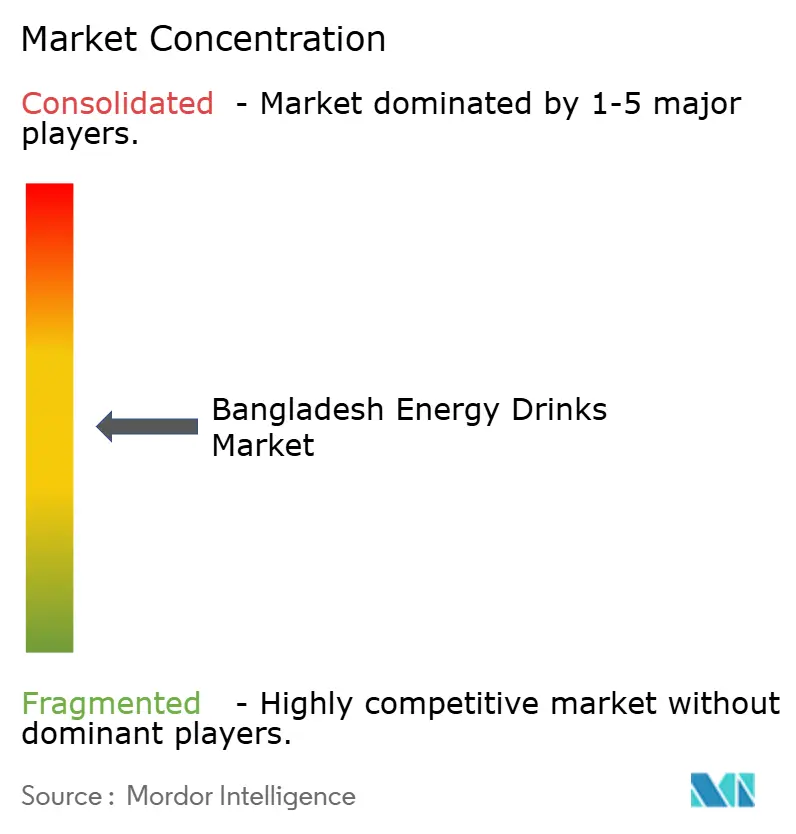
| Market Concentration | Medium |
Major Players.webp)
*Disclaimer: Major Players sorted in no particular order Image © Mordor Intelligence. Reuse requires attribution under CC BY 4.0. |
|
Bangladesh Energy Drinks Market Analysis by Mordor Intelligence
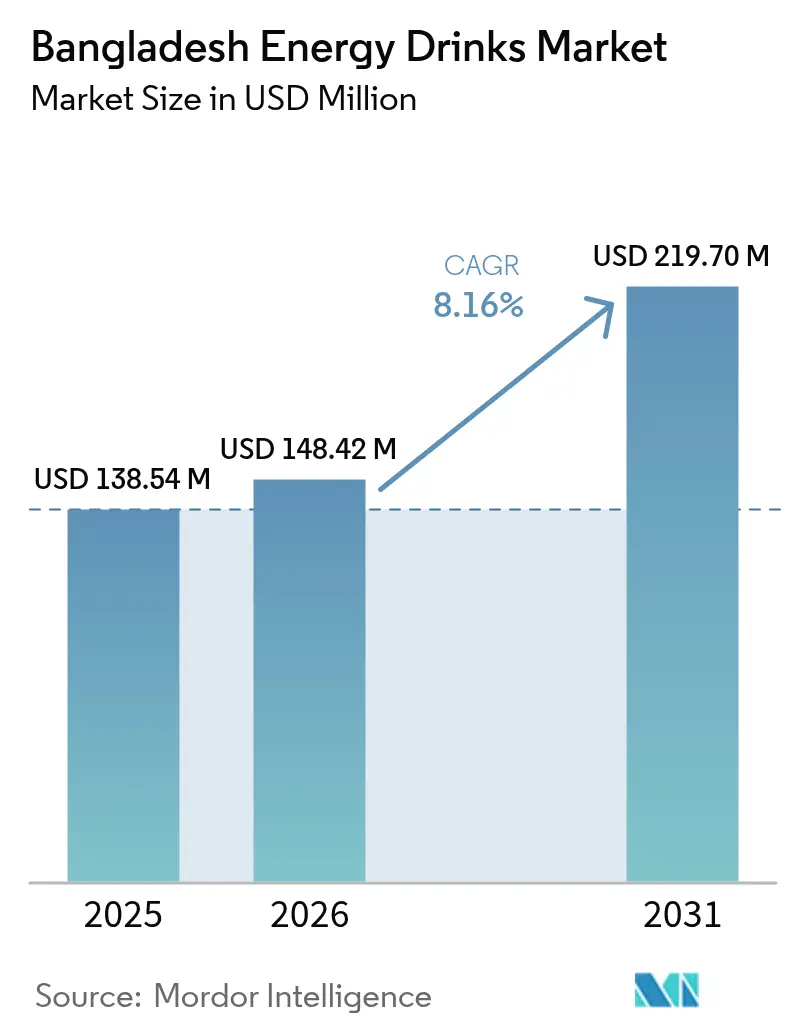
The Bangladesh energy drinks market size is expected to grow from USD 138.54 million in 2025 and USD 148.42 million in 2026 to USD 219.70 million by 2031, registering a CAGR of 8.16% between 2026 and 2031. Bangladesh’s energy drink market is expanding rapidly, driven by urban concentration in Dhaka and stricter food safety and halal compliance regulations. Longer commute times and growth in gig-based employment are increasing demand for convenient caffeine boosts, particularly among young consumers. Despite a high overall tax burden on beverages, brands are using organized retail and e-commerce channels to reduce supply chain layers and keep prices competitive. Multinationals like PepsiCo and Red Bull are strengthening their premium positioning through cricket sponsorships and digital influencer campaigns. Meanwhile, local players such as PRAN-RFL Group and Akij Group are defending share through aggressive pricing and in-store promotions.
Key Report Takeaways
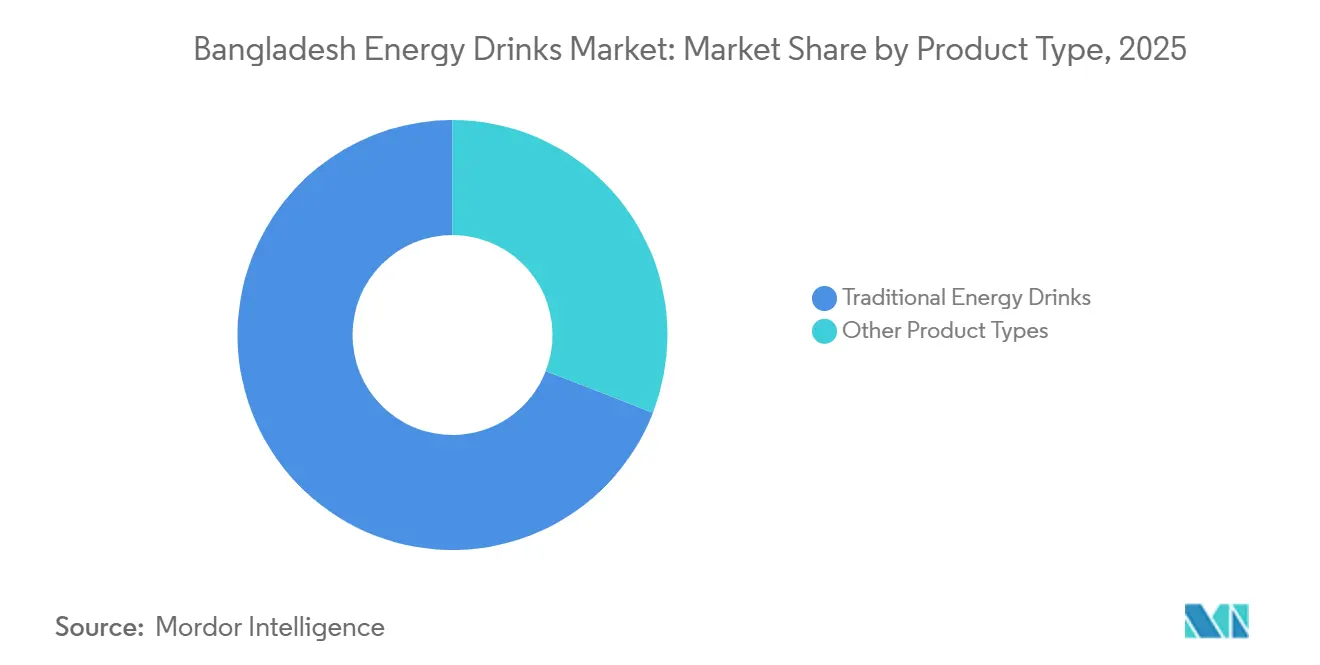
- By product type, traditional energy drinks held 69.12% of the Bangladesh energy drinks market share in 2025, whereas other product types are projected to register the quickest 8.57% CAGR through 2031.
- By packaging type, cans accounted for 42.05% of the Bangladesh energy drinks market size in 2025, while bottles represent the fastest-growing format at an 9.07% CAGR to 2031.
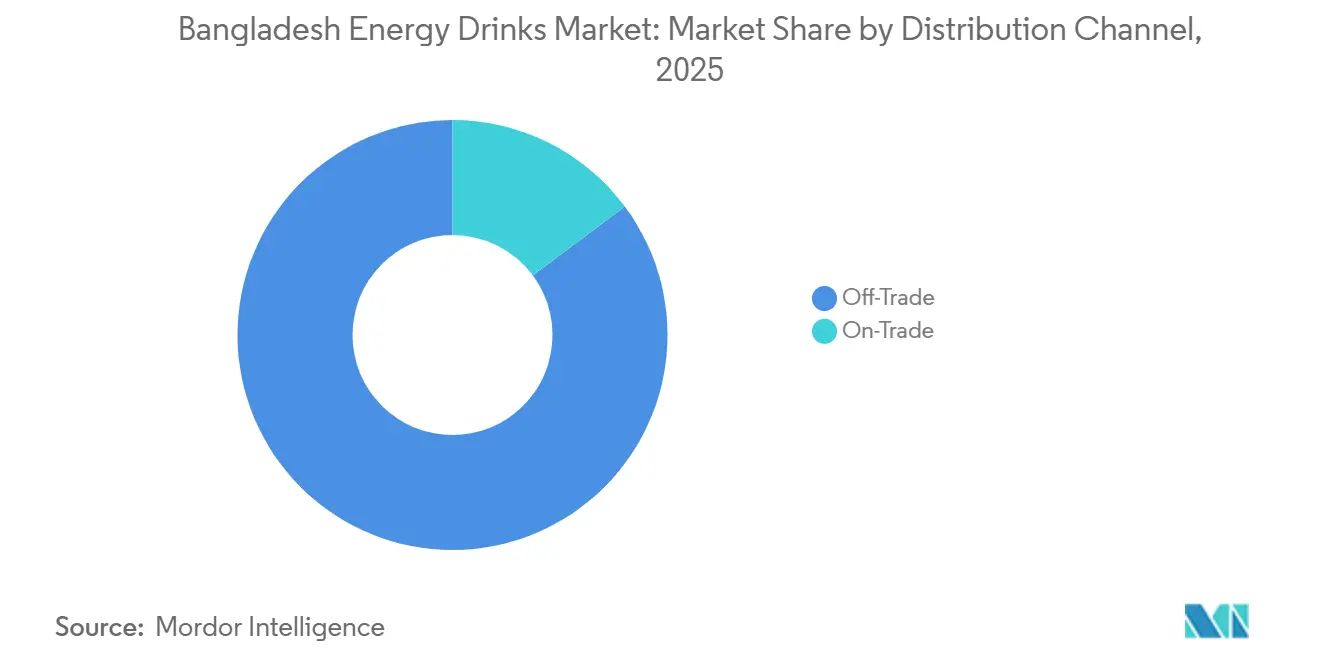
- By distribution channel, off-trade outlets commanded 85.20% of revenue in 2025, while on-trade venues are set to grow the fastest, advancing at a 8.95% CAGR to 2031.
- By geography, Dhaka dominated with 36.95% value share in 2025 and is projected to grow at 9.12% CAGR through 2031.
Note: Market size and forecast figures in this report are generated using Mordor Intelligence’s proprietary estimation framework, updated with the latest available data and insights as of 2026.
Bangladesh Energy Drinks Market Trends and Insights
Drivers Impact Analysis*
| Driver | (~) % Impact on CAGR Forecast | Geographic Relevance | Impact Timeline |
|---|---|---|---|
| Fast-paced urban lifestyles driving demand for convenient consumption options | +1.80% | Dhaka and Chittagong urban cores, spill-over to secondary cities | Medium term (2–4 years) |
| Growth of modern retail channels and expansion of cold-chain infrastructure | +1.50% | National, with early gains in Dhaka metro accounting for expanding Shwapno outlets | Long term (≥4 years) |
| Rising premiumization trend with increasing preference for healthier ingredients | +1.20% | Dhaka, Chittagong affluent segments; limited rural penetration | Medium term (2–4 years) |
| Strong promotional push through intensive advertising and event sponsorships | +1.00% | National, concentrated in cricket-heavy metros | Short term (≤2 years) |
| Introduction of sugar-free variants catering to health-conscious consumers | +0.90% | Urban Dhaka, Chittagong middle-class households | Medium term (2–4 years) |
| Halal certification enhancing consumer trust and strengthening demand | +0.70% | National, with export spillover to Middle East and Africa | Long term (≥4 years) |
| Source: Mordor Intelligence | |||
Fast-paced urban lifestyles driving demand for convenient consumption options
Rapid urban expansion in cities such as Dhaka and Chittagong is reshaping beverage preferences, as longer commutes, dense living conditions, and demanding service-sector jobs push consumers toward convenient, ready-to-drink energy options. With commute times often stretching beyond 90 minutes and inflation tightening discretionary spending, single-serve, affordable energy drink formats have gained traction among office workers, students, delivery riders, and night-shift employees. The gradual rise of modern retail and quick-commerce platforms has further strengthened impulse and repeat purchases, embedding functional beverages into daily routines. For instance, a study from PLOS Global Public Health highlights that 44.4% of adolescents now consume carbonated beverages daily, signaling a growing acceptance of Western-style energy products [1]Source: Munmun Shabnam Bipasha et al., “Sugar Sweetened Beverages Consumption among University Students of Bangladesh,” International Journal of Public Health Science, iaescore.com. University populations, particularly those balancing academic and part-time work commitments, represent a strong consumer base, but demand is equally visible among garment factory staff, IT professionals, and gig-economy couriers seeking sustained alertness. Together, these structural urban and employment shifts are steadily expanding the baseline consumption of energy drinks across Bangladesh’s metropolitan centers.
Growth of modern retail channels and expansion of cold-chain infrastructure
Bangladesh’s retail ecosystem is rapidly modernizing, strengthening the reach of energy drinks across urban and emerging semi-urban centers. Organized chains such as Shwapno, now operating hundreds of outlets nationwide, and Agora are streamlining procurement through direct-sourcing models, reducing intermediary mark-ups and enabling more competitive pricing for popular PET bottle formats. Policy support, including the withdrawal of VAT on supermarket purchases, has further stimulated store traffic and improved affordability for cost-sensitive shoppers. Meanwhile, online marketplaces like Chaldal and Daraz are enhancing convenience through doorstep delivery, particularly appealing to time-constrained consumers. On the supply side, major investments in temperature-controlled warehousing and high-capacity aseptic production lines are strengthening cold-chain efficiency and ensuring consistent product quality. Collectively, these advancements are improving shelf availability, maintaining optimal chill conditions, and reinforcing repeat consumption patterns within Bangladesh’s energy drink segment.
Rising premiumization trend with increasing preference for healthier ingredients
Increasing scrutiny over sugar and caffeine levels is redefining Bangladesh’s energy drink category, pushing brands to reformulate with lower sugar, balanced caffeine, and added functional ingredients such as vitamins and electrolytes. In 2025, ACME expanded its presence with ION positioned firmly within the energy drink segment, aligning with compliance standards set by the Bangladesh Standards and Testing Institution following tighter regulatory oversight. Similarly, Bruvana Sports+ entered the market as a performance-oriented energy drink, highlighting clean-label claims and the absence of artificial colors or sweeteners to attract health-aware urban consumers. Laboratory findings revealing elevated caffeine concentrations in certain products further accelerated reformulation and premium positioning strategies. Middle-class professionals are increasingly willing to pay more for energy drinks perceived as safer and functionally superior. Despite tax pressures, manufacturers are broadening sugar-free and fortified energy drink portfolios, transforming the category from a purely stimulant-based offering into a more lifestyle-driven segment.
Strong promotional push through intensive advertising and event sponsorships
As product differentiation narrows, competition in Bangladesh’s energy drink sector is increasingly driven by emotionally resonant branding rather than functional claims. Companies are investing heavily in cricket tie-ups, celebrity ambassadors, and hyper-local influencer campaigns to deepen youth engagement. Globe Soft Drinks has accelerated Royal Tiger’s growth through widespread television placements and large-format outdoor advertising that appeal to both metropolitan and semi-urban audiences. Global players such as PepsiCo (via Sting) and Red Bull are channeling substantial budgets into YouTube and Facebook video promotions to capture Bangladesh’s rapidly expanding digital population. Periods of geopolitical sensitivity have further reshaped market dynamics, enabling domestic brands to adopt patriotic positioning and gain traction when multinational sentiment weakens. Collectively, these strategies have shifted energy drinks from niche stimulants to culturally embedded lifestyle beverages within a relatively short span.
Restraints Impact Analysis*
| Restraint | (~) % Impact on CAGR Forecast | Geographic Relevance | Impact Timeline |
|---|---|---|---|
| Growing consumer concerns about excessive sugar and caffeine intake | -1.3% | National, with heightened scrutiny in Dhaka medical/academic circles | Medium term (2–4 years) |
| Increasing presence of counterfeit products disrupting market pricing | -1.1% | Dhaka, Chittagong, and peri-urban wholesale hubs | Short term (≤2 years) |
| Higher price sensitivity among consumers | -0.8% | Rural Bangladesh and lower-income urban segments | Short term (≤2 years) |
| Higher excise duties on carbonated soft drinks and energy drinks | -0.6% | National, affecting all formal-sector producers | Long term (≥4 years) |
| Source: Mordor Intelligence | |||
Growing consumer concerns about excessive sugar and caffeine intake
Growing clinical scrutiny is reshaping perceptions of energy drinks in Bangladesh, particularly among informed urban consumers. Independent academic assessments have identified caffeine content in leading 250 ml packs ranging roughly between 22 mg and 65 mg, while other laboratory reviews have flagged levels surpassing international reference thresholds, alongside sugar quantities that can approach or exceed recommended daily intake limits in a single serving. Healthcare practitioners, including specialists at BIRDEM General Hospital, have also cautioned against frequent consumption of electrolyte-style beverages due to elevated sodium levels and potential blood pressure risks, an important concern in a country with millions of diabetes patients. In response to mounting health concerns, the Bangladesh Food Safety Authority has taken enforcement actions against non-compliant manufacturers, while authorities have emphasized stricter labeling transparency for sugar and caffeine content. This evolving regulatory and medical narrative is encouraging a gradual shift toward moderated intake and sugar-free alternatives, slightly constraining projected category growth.
Higher excise duties on carbonated soft drinks and energy drinks
Raids conducted in March 2025 exposed an underground manufacturing network supplying imitation products to wholesale markets, where they are sold at prices up to 40% lower than authentic brands. This parallel supply chain significantly undermines legitimate players and results in substantial fiscal losses for the government. Recent crackdowns uncovered an informal supply network distributing imitation products across wholesale markets, where they are sold at significantly lower prices than established brands, resulting in notable revenue losses for the government. Despite multiple enforcement drives and legal actions in recent months, regulatory efforts have lacked consistency. Counterfeit energy drinks continue to reappear in retail channels, undermining consumer confidence in official quality certifications. This ongoing grey-market activity disrupts fair competition and challenges the stability of the organized segment. This persistent informal activity compresses margins for organized brands, limits their ability to pass on high excise costs, and ultimately constrains premiumization in the Bangladesh energy drinks sector.
*Our forecasts treat driver/restraint impacts as directional, not additive. The impact forecasts reflect baseline growth, mix effects, and variable interactions.
Segment Analysis
By Product Type: Traditional Formulations Drive Market Leadership
Traditional Energy Drinks remain the backbone of the Bangladesh energy drinks market, accounting for a dominant 69.12% share in 2025. Their strength lies in strong brand familiarity, affordable pricing, and expansive distribution reach across urban and semi-urban retail networks. Local brands such as Akij Food & Beverage Ltd. (Speed) and Globe Soft Drinks Ltd. (Royal Tiger) have strategically positioned themselves as cost-effective alternatives to international players, appealing to price-sensitive consumers. Competitive price points reinforce their accessibility among mass-market buyers. Established equity and deep retailer penetration continue to drive high-volume sales. However, increasing regulatory scrutiny and quality compliance requirements may gradually influence cost structures within this volume-driven segment.
Other Energy Drinks are emerging as the fastest-growing category, projected to expand at a CAGR of 8.57% through 2031. This segment includes electrolyte-infused, vitamin-enriched, sugar-free, and low-calorie formulations tailored to evolving consumer preferences. Rising health awareness, coupled with Bangladesh’s growing diabetic population, is accelerating demand for reduced-sugar and functional energy options. Urban professionals, particularly within the 26–35 age group, are increasingly drawn to compact, functional beverages that deliver targeted benefits beyond caffeine stimulation. Portfolio diversification by major players such as PRAN-RFL Group reflects a strategic shift toward premium and niche offerings. Supported by regulatory oversight from the Bangladesh Standards and Testing Institution, the segment is benefiting from rising consumer trust and gradual premiumization trends.



By Packaging Type: Cans Dominate While Bottles Surge
Cans remain the largest packaging segment, accounting for 42.05% of total sales in 2025, reflecting their strong association with premium quality and international standards. The aluminum format offers superior protection against light and oxygen, helping extend shelf life beyond six months in Bangladesh’s tropical climate. This preservation advantage supports taste consistency, a factor highly valued by urban consumers. Premium global brands such as Red Bull continue to leverage cans to reinforce aspirational positioning and justify higher price points. Despite higher unit costs, the format sustains demand due to its perceived authenticity and superior product integrity. While sustainability conversations are emerging, purchasing decisions remain primarily influenced by brand image and quality cues.
Bottles, particularly PET formats, represent the fastest-growing segment, projected to expand at a 9.07% CAGR, steadily narrowing the gap with cans. PET packaging offers 30–40% savings in raw material costs and reduces breakage risks during transportation across congested distribution routes. Its lighter weight and stackability improve logistics efficiency, especially for e-commerce and micro-warehouse deliveries. Manufacturers favor bottles for balancing affordability with product visibility, a key purchase driver in traditional retail. The format’s flexibility also enables varied pack sizes, supporting both urban convenience and rural price sensitivity. As affordability and distribution efficiency gain priority, bottles are increasingly becoming the operational backbone of Bangladesh’s energy drinks packaging landscape.
By Distribution Channel: Off-Trade Supremacy with On-Trade Growth
The off-trade segment emerged as the largest distribution channel in 2025, accounting for 85.20% of total market volume, reflecting Bangladesh’s strong reliance on retail-led beverage sales. Supermarkets, convenience outlets, and traditional grocery stores continue to anchor energy drink distribution across urban and semi-urban areas, while online grocery platforms such as Chaldal and Daraz drive a shift toward digital purchasing. According to the World Bank, internet usage in Bangladesh rose by 6% over the past two years to reach 45% in 2023, accelerating online grocery adoption and e-commerce-led beverage sales [2]Source: World Bank, "World Bank Database", data.worldbank.org. Modern trade players are further strengthening their position through app-based ordering, home delivery, and click-and-collect models, enabling brands to optimize visibility, promotions, and consumer engagement, reinforcing off-trade dominance.
In contrast, on-trade represents the fastest-growing segment, projected to expand at a CAGR of 8.95% through the forecast period. Although comparatively smaller in share, cafés, quick-service restaurants, hotels, and entertainment venues are increasingly positioning energy drinks as premium, high-margin offerings. Growth in co-working hubs, e-sports lounges, sports clubs, and corporate dining facilities, particularly in major cities such as Dhaka and Chittagong, is expected to gradually elevate on-premise consumption. As disposable incomes rise and lifestyle-oriented spending gains momentum, on-trade channels are becoming critical for brand visibility, experiential marketing, and premium product placements within Bangladesh’s evolving beverage landscape.
Geography Analysis
Dhaka, accounting for 36.95% of the 2025 market value and projected to expand at a robust 9.12% CAGR through 2031, remains the anchor of Bangladesh’s energy drinks market. As the country’s economic and administrative hub, it concentrates the highest disposable incomes and a dense urban workforce. Demanding work schedules, academic pressure, and prolonged commute times sustain steady consumption among students, professionals, and service workers. Organized retail presence, led by chains such as Shwapno and Agora, ensures strong product visibility and cold-chain access across income segments. Premium variants gain traction among corporate employees, while affordable local brands continue to drive high-volume sales. The division also serves as a strategic launchpad for new product introductions and premium SKU testing.
Chittagong Division continues to benefit from its role as Bangladesh’s primary port and industrial corridor. Export-oriented manufacturing, shipbreaking yards, and logistics operations generate consistent demand from industrial workers and shift-based employees seeking convenient energy solutions. Rising trade activity and industrial wages are strengthening household purchasing power, gradually narrowing the consumption gap with Dhaka. The region’s expanding urban base and retail modernization are supporting wider brand penetration. However, infrastructure bottlenecks and port-related congestion still pose operational challenges that can affect distribution efficiency and inventory cycles.
The Rest of Bangladesh, including rural and semi-urban areas across other divisions, remains comparatively underpenetrated but presents significant long-term headroom. According to the World Bank, urban population accounted for approximately 33% of Bangladesh’s total population in 2024, highlighting substantial rural consumption potential as infrastructure and retail access continue to expand [3]Source: World Bank, "World Bank Database", data.worldbank.org. Expanding road networks, rural electrification, and mobile connectivity are enabling deeper last-mile distribution. Remittance inflows are improving disposable incomes, encouraging trial of affordable, small-pack energy drink formats. Domestic conglomerates such as PRAN-RFL Group demonstrate how strong nationwide distribution can unlock demand beyond metropolitan centers. With continued infrastructure upgrades and retail formalization, these regions are positioned to become the next growth frontier for Bangladesh’s energy drinks industry.
Regulatory Landscape
Energy drinks in Bangladesh operate under food safety oversight led by the Bangladesh Food Safety Authority (BFSA), anchored by the Bangladesh Food Safety Act, 2013, which frames controls on ingredients, hygiene, and labeling for packaged beverages. On product standardization, the Bangladesh Standards and Testing Institution (BSTI) has issued a dedicated energy drink standard, BDS 2043:2025, specifying requirements as well as sampling and test methods, raising compliance expectations for brands positioning products as energy drinks.
On trade and pricing, energy drinks sit within Chapter 22 of the Bangladesh Customs Tariff (beverages, spirits, and vinegar), and importers and local players reference the FY 2025-2026 tariff schedule and National Board of Revenue duty tools for applicable duties and taxes. In parallel, BSTI has previously cautioned against marketing carbonated beverages as energy drinks, and the move to a defined standard increases the need for accurate category claims, transparent caffeine and sugar labeling, and documented conformity for both domestic production and imports.
Competitive Landscape
Competitive intensity in the Bangladesh energy drinks market remains moderate, as leading domestic groups command significant share while smaller and informal players fragment overall value capture. Established local companies such as PRAN-RFL Group, Globe Soft Drinks, Osotspa Co. Ltd, Red Bull GmbH, and Akij Food & Beverage, among others leverage deep-rooted distribution networks, cost-efficient production, and strong retailer relationships to protect their mass-market strongholds. Their scale advantages allow them to compete effectively on pricing while maintaining consistent nationwide availability across urban and semi-urban centers.
At the same time, competition is evolving beyond traditional carbonated energy drinks toward diversified functional beverage portfolios. Companies are extending into product portfolio into other performance-oriented formulations to tap emerging lifestyle trends and niche consumer segments. Premiumization is gradually gaining traction, particularly in urban areas, where higher-income consumers show interest in improved formulations and international-quality standards. This shift reflects a dual-track strategy, volume-led penetration in price-sensitive segments alongside selective premium positioning.
On the supply side, investments in automation, quality control technologies, and supply chain optimization are strengthening manufacturing efficiency and regulatory compliance. Certifications such as halal accreditation from BSTI reinforce credibility in both domestic and potential export markets, especially in Middle Eastern corridors. However, the regulatory framework governed by the Bangladesh Standards and Testing Institution (BSTI) and the Bangladesh Food Safety Authority (BFSA) raises entry barriers, favoring well-capitalized incumbents with the resources to meet evolving compliance and quality mandates.
Bangladesh Energy Drinks Industry Leaders
-
PRAN-RFL Group Ltd
-
Osotspa Co. Ltd
-
Red Bull GmbH
-
Globe Soft Drinks & AST Beverage Ltd.
-
Akij Food & Beverage Ltd
- *Disclaimer: Major Players sorted in no particular order

Market Opportunities and Future Outlook
Compliance and reformulation linked to BSTI standardization create whitespace for brands to differentiate via verifiable caffeine, sugar, and functional-ingredient positioning, especially as enforcement actions and medical scrutiny increase attention on ingredient transparency. Sugar-free, low-calorie, and electrolyte-forward extensions already have visible proof points in-market, including ACME Consumer Products Ltd launching ION in 2025 and the broader shift toward functional beverage propositions in urban centers.
Manufacturing capacity and route-to-market structures also open opportunity pockets for energy-drink adjacencies and packaging-led affordability. Large-scale beverage and liquid-food investments and financing moves signal a build-out of industrial capability that can support faster SKU iteration and wider cold-chain reach, with Akij Food & Beverage securing BSEC approval in March 2026 to issue a Tk 5 billion zero-coupon bond for refinancing and operational financing, and Akij Venture inaugurating a major packaged drinking water facility in Dhamrai in September 2025. In the wider beverage ecosystem, contract manufacturing agreements reported in 2026 (BD Thai Food & Beverage with Sajeeb Group and Evergreen Beverage) highlight a practical pathway to scale production without greenfield builds, while BEZA investment agreements at the National Special Economic Zone (July 2026) underscore a growing pipeline of food-processing capacity that can strengthen supplier ecosystems, packaging procurement, and distribution efficiencies relevant to energy drinks.
Recent Industry Developments
- July 2026: Akij Food & Beverage Ltd held its Annual Sales Conference 2026 on July 4-5, setting commercial priorities and pushing execution alignment across its sales and distribution organization. For a mass-market energy drink environment shaped by price sensitivity and retail availability, tighter go-to-market coordination supports faster rollout discipline, trade activation, and channel coverage across urban and secondary cities.
- March 2026: Akij Food & Beverage Ltd received Bangladesh Securities and Exchange Commission approval to issue a Tk 5 billion zero-coupon bond to support loan repayment and operational financing. The approval strengthens access to non-bank financing for large beverage players, which can help sustain working capital cycles and fund capability upgrades in production, quality systems, and distribution infrastructure.
- December 2024: PRAN-RFL Group announced sustainability actions targeting a 20% reduction in energy usage and 25% energy from renewable sources by 2030, alongside commitments to recycle all plastics and use 90% local ingredients. These goals tie directly to cost and resilience levers in packaging- and distribution-intensive beverages, reinforcing operational efficiency narratives that retailers and consumers increasingly scrutinize.


Research Methodology Framework and Report Scope
Market Definition and Coverage
For this study, the market includes the value of energy drink sales in Bangladesh across retail and foodservice points, counted at the point where a consumer purchase happens. Energy drinks are treated as stimulant beverages positioned for energy and alertness, and the sizing reflects the country-level demand pool.
Scope exclusions: This sizing does not count adjacent soft drink categories like carbonated sodas, sports drinks, juices, or ready-to-drink coffee unless they are sold and labeled as energy drinks.
Segmentation Overview
-
By Product Type
- Traditional Energy Drinks
- Other Energy Drinks
-
By Packaging Type
- Cans
- Bottles
-
By Distribution Channel
- On-Trade
-
Off-Trade
- Supermarkets/Hypermarkets
- Convenience/Grocery Stores
- Online Retail Stores
- Other Off-Trade Channels
-
By Region
- Dhaka
- Chittagong
- Rest of Bangladesh
Data Sources, Market Sizing, and Validation
Desk Research
Desk work was used to set the fact base on Bangladesh beverage demand, trade flow signals, and price direction so our assumptions start from real-world series. We referred to public sources such as Bangladesh Bureau of Statistics releases, National Board of Revenue and customs trade information, Bangladesh Bank macro and currency updates, and Ministry of Health or food safety notices where relevant to beverages.
We also used manufacturer and distributor disclosures such as annual reports, product catalogs, and investor presentations, along with retailer listings and reputed press coverage to map pack types, channel presence, and visible price points. For hard-to-find company details, we supplemented with paid subscriptions focused on company financials and intelligence, and an import and export shipment-level database to sanity check cross-border movements. These desk research sources are illustrative, and many other references were also used for data collection, validation, and clarification.
Primary Interviews and Surveys
Interviews and surveys with Bangladesh beverage producers, distributors, retailers, food-service buyers, and regulatory specialists are used to test channel shares, pack prices, availability, and tax effects. Respondents help fill gaps in public trade data and clarify whether reported products are sold as energy drinks in Bangladesh. Unusual responses are rechecked against customs, price, and retail evidence before assumptions are finalized.
Distribution of primary research fieldwork respondents
| Company type | Respondent position |
|---|---|
| Top tier: 25% | CXOs: 15% |
| Mid tier: 55% | Functional/Unit leaders: 30% |
| Smaller Players: 20% | Managers: 55% |
Market-Sizing & Forecasting
Sizing starts with a top-down build where beverage consumption indicators and channel-level availability are translated into an energy drink demand pool for Bangladesh, which is then expressed in value using observed price points. To keep the totals realistic, selective bottom-up approximations were used as cross-checks, mainly by sampling pack sizes and typical selling prices and then stress-testing volumes with distributor and retail feedback.
Key inputs that shaped the model included the share of sales coming from modern trade versus traditional outlets, the split of cans versus PET bottles, the typical pack size mix, retail price ranges and promotion frequency, and the pace of urban consumption in major cities. When a variable was missing for a sub-channel, the gap was handled by using the closest comparable channel signal and then revalidating it through interviews. For forecasting, scenario analysis was used, supported by primary inputs on expected pricing direction, distribution expansion, and consumer adoption, and then smoothed so the trend does not overreact to one-year shocks.
Data Validation & Update Cycle
All outputs are checked through a simple triangulation routine where the value result is reconciled against an independent view of volumes, pricing bands, and channel coverage, and any large variance is flagged for review. If an anomaly appears, we revisit the underlying assumptions, recheck the desk sources, and re-contact a small set of respondents to confirm what changed and what did not.
Before sign-off, the model and write-up go through multi-step analyst reviews so calculation logic, unit handling, and currency timing are consistent across years. The report is refreshed annually, and interim updates are made when material events occur, such as regulatory actions, major price resets, or significant distribution shifts. Right before delivery, a final pass is completed so clients receive the most current view available.
Mordor Intelligence's Bangladesh Energy Drinks Market Size Compared Against Other Published Estimates
Different published numbers for Bangladesh energy drinks can be seen even when the topic looks identical, because the studies often count different sales channels, use different base years, and apply different price and currency assumptions. We therefore present the benchmark in a way that can be traced back to a few observable signals, and then stress-tested with field checks.
Retail shelf price checks, pack-size splits, and channel presence in Dhaka and Chittagong are the evidence points that tie the 2025 market value to actual energy drink purchases as treated by Mordor Intelligence, instead of letting sports drinks or other functional beverages slip into the counted totals. Variations in other estimates typically come from treating the market as only off-trade, using a different currency conversion timing, or projecting prices forward using a flat uplift that is not rechecked with local trade feedback.
Benchmark comparison
| Source | Market Size | Gaps in Research Methodology |
|---|---|---|
| Mordor Intelligence | USD 138.54 M (2025) | |
| Global Consultancy A | USD 127.76 M (2024) | Uses a different base year and forecast window, and the category line between energy drinks and nearby functional beverages is not clearly spelled out, which can shift the starting market value. |
| Industry Brief B | USD 128.50 M (2024) | Publishes an earlier-year estimate with limited visibility on how on-trade and smaller retail outlets are treated, and the price build is not explained, which can compress the value outcome. |
The comparison mainly shows that year choice and scope discipline drive most of the spread, not just different growth opinions. By anchoring the model on visible price bands, pack formats, and channel coverage and then rechecking assumptions with local trade feedback, we get a balanced number that can be replicated and updated with the same steps.


Key Questions Answered in the Report
How large will the Bangladesh energy drinks market be by 2031?
It is projected to reach USD 219.70 million by 2031, advancing at a 8.16% CAGR from 2026.
Which product type grows fastest inside Bangladesh’s energy-drink space?
Other Product Types are expected to post the quickest 8.57% CAGR as consumers are exploring new product offerings.
What packaging trends should suppliers watch?
Cans still dominate with 42.05% share in 2025, but bottles are gaining traction at an 9.07% CAGR.
Why region shows the highest market growth?
Dhaka witnessed the highest market share of 36.95% in 2025, while also being the fastest-growing segment with 9.12% CAGR through 2031.
Page last updated on:





