Bahrain Foodservice Market Size and Share
Market Overview
| Study Period | 2021 - 2031 |
|---|---|
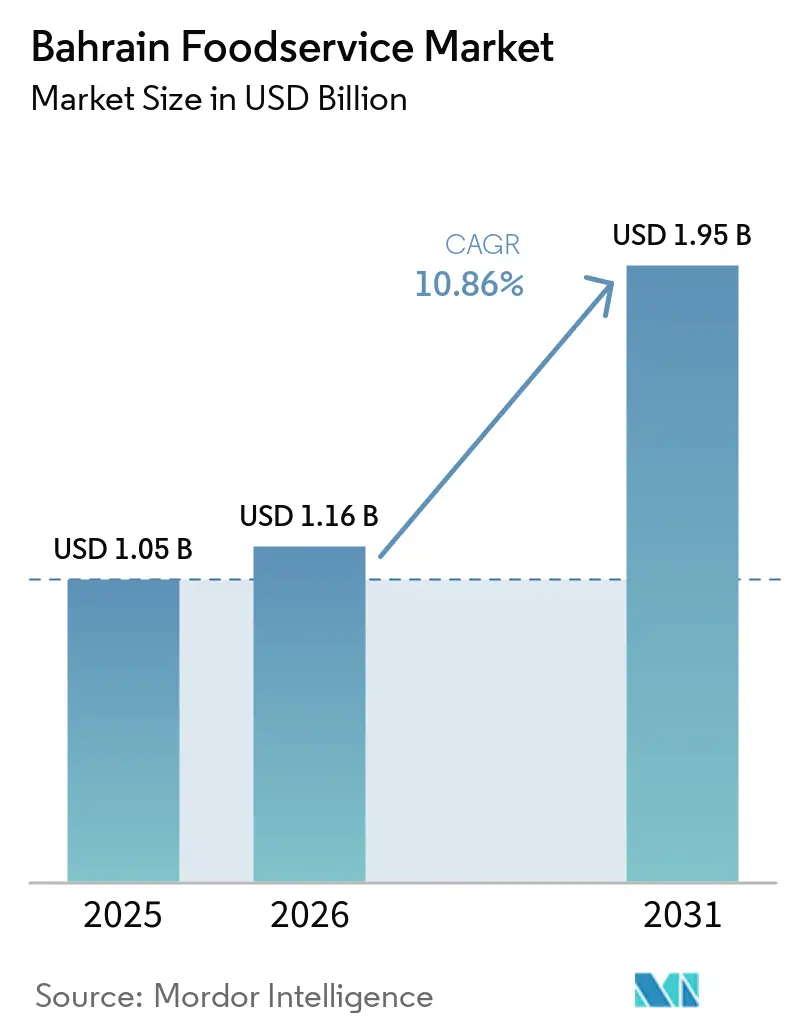
| Base Year Market Size (2025) | USD 1.05 Billion |
| Market Size (2026) | USD 1.16 Billion |
| Market Size (2031) | USD 1.95 Billion |
| Growth Rate (2026 - 2031) | 10.86 % |
| Fastest Growing Market | Quick Service Restaurants |
| Largest Market | Cloud Kitchen |
Major Players *Disclaimer: Major Players sorted in no particular order Image © Mordor Intelligence. Reuse requires attribution under CC BY 4.0. | |
Bahrain Foodservice Market Analysis by Mordor Intelligence
The Bahrain foodservice market size is expected to grow from USD 1.05 billion in 2025 to USD 1.16 billion in 2026 and is forecast to reach USD 1.95 billion by 2031 at 10.86% CAGR over 2026-2031. Healthy tourism inflows, a streamlined Sijilat licensing regime, rising digital-payment adoption, and sustained expatriate spending combine to keep the Bahrain foodservice market on a steep growth curve. Quick-service brands leverage Bahrain’s compact geography to saturate high-traffic sites, while cloud-kitchen operators compress real-estate costs and widen delivery radiuses. Customer traffic also benefits from government efforts to hold food prices in check; 30 companies were fined for price manipulation in February 2025, underscoring regulatory vigilance. At the same time, Red Sea shipping disruptions that quadrupled container rates expose the supply chain vulnerabilities inherent in a country where most food ingredients are imported. Operators that balance cost discipline, menu engineering, and omnichannel reach are positioned to tap the next phase of Bahrain foodservice market expansion.
Key Report Takeaways
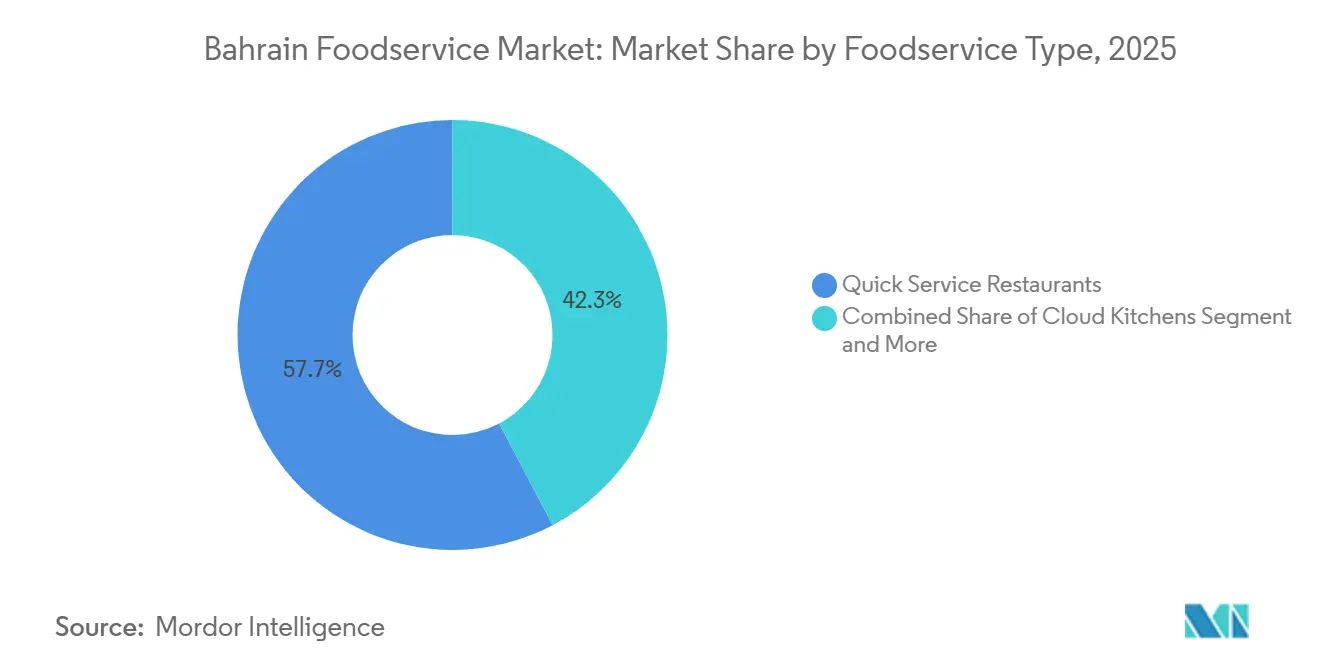
- By foodservice type, quick-service restaurants held a commanding 57.72% share of the Bahrain foodservice market in 2025, while cloud kitchens are forecast to grow at a 13.07% CAGR through 2031.
- By outlet format, chained outlets controlled 50.88% of the Bahrain foodservice market in 2025 and are growing at a 11.41% CAGR, outpacing independent competitors.
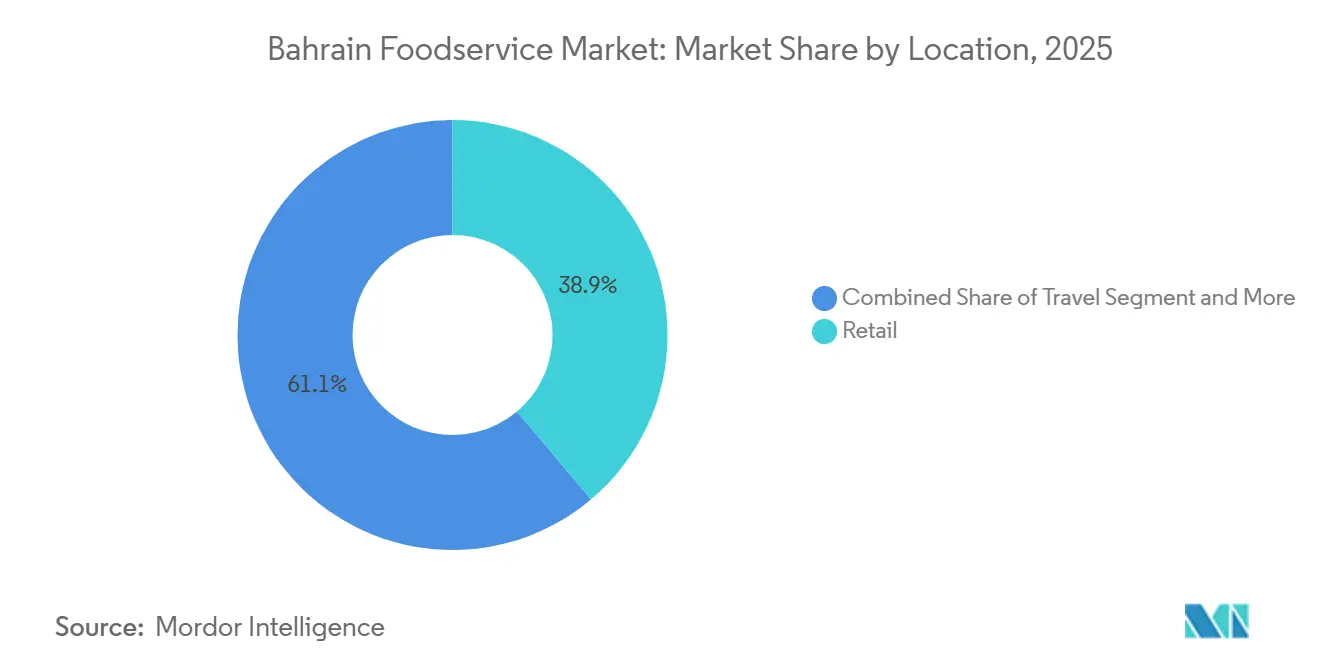
- By location, retail venues captured 38.85% of the Bahrain foodservice market in 2025, but travel locations are the fastest-growing, at a 11.12% CAGR through 2031 as airport and highway traffic accelerates.
- By service type, dine-in retained a 47.96% share in 2025, whereas delivery services are expanding at an 11.78% CAGR through 2031, driven by partnerships such as EazyPay–Talabat.
Note: Market size and forecast figures in this report are generated using Mordor Intelligence’s proprietary estimation framework, updated with the latest available data and insights as of 2026.
Bahrain Foodservice Market Trends and Insights
Drivers Impact Analysis*
| Driver | (~) % Impact on CAGR Forecast | Geographic Relevance | Impact Timeline |
|---|---|---|---|
| Rapid expansion of quick-service restaurant formats | +2.1% | National, concentrated in Manama and Muharraq | Medium term (2-4 years) |
| Growth of online food-delivery platforms & digital payments | +1.8% | National, with highest penetration in urban centers | Short term (≤ 2 years) |
| Tourism-led demand surge for F&B services | +2.3% | National, with early gains in Manama, Riffa, Muharraq | Medium term (2-4 years) |
| Increasing café culture & premium coffee consumption | +1.2% | National, concentrated in commercial districts | Long term (≥ 4 years) |
| Government subsidy reforms enabling menu-engineering profitability | +0.9% | National | Medium term (2-4 years) |
| Corporate & industrial catering contracts in oil & gas sector | +0.7% | National, concentrated in industrial zones | Long term (≥ 4 years) |
| Source: Mordor Intelligence | |||
Rapid Expansion of Quick-Service Restaurant Formats
The proliferation of QSR formats across Bahrain reflects a fundamental shift in consumer dining preferences toward speed and convenience, with over 100 American franchises now operating in the kingdom. Americana Restaurants International, the region's largest QSR operator, reported 113 new store openings in 9M 2024 despite revenue pressures, bringing its total restaurant count to 2,504 across the Middle East[1]. This expansion strategy demonstrates QSR operators' confidence in Bahrain's market fundamentals, particularly as tourism arrivals grew 7.1% in 2025, creating sustained demand for accessible dining options. The format's success stems from operational efficiencies that enable rapid scalability while maintaining consistent quality standards across multiple locations. ALBAIK's strategic positioning at Bahrain International Airport, operating 24/7 to capture transit passenger traffic, exemplifies how QSR brands leverage high-footfall locations to maximize revenue potential.
Growth of Online Food-Delivery Platforms & Digital Payments
Digital transformation in Bahrain's foodservice sector accelerated through strategic partnerships between payment processors and delivery platforms, with Talabat commanding over 80% market preference among consumers. The EazyPay-Talabat partnership launched in March 2024 streamlined online payment processing, while food delivery app revenues reached USD 361.1 million (BHD 135.9 million) in 2024, with projections exceeding USD 500 million by 2029 AlBilad Press. This growth trajectory reflects deeper structural changes in consumer behavior, where 43.8% online food delivery penetration in 2024 positions Bahrain among the region's most digitally mature markets. LuLu Exchange's partnership with Fintech Galaxy to enable account-to-account payments through Bahrain's Open Banking infrastructure represents the first licensed cross-border payments company to leverage this technology, signaling broader financial sector innovation supporting foodservice digitization[2]. The convergence of payment innovation and delivery logistics creates competitive advantages for operators who can integrate these capabilities effectively.
Tourism-Led Demand Surge for F&B Services
Bahrain's tourism sector drives foodservice demand through both direct visitor spending and infrastructure investments that create new dining venues, with travel services accounting for 29.8% of the kingdom's services exports. The opening of Time Out Market Bahrain in December 2024, featuring 3,000 square meters and 11 kitchens showcasing local culinary talent, demonstrates how tourism infrastructure investments create premium dining destinations that serve both visitors and residents. This development coincided with the 9th UN Tourism Forum on Gastronomy Tourism held in Bahrain, positioning the kingdom as a regional culinary destination. The strategic timing reflects government recognition of food and beverage services as tourism differentiators, particularly as international brands like SUSHISAMBA and ROKA establish Bahrain operations. Corporate catering contracts, including Gulf Hotel Bahrain's 3-year agreement with Bahrain International Circuit for premium event catering, illustrate how tourism infrastructure creates sustained B2B foodservice opportunities beyond direct consumer spending.
Increasing Café Culture & Premium Coffee Consumption
The emergence of sophisticated café culture in Bahrain reflects evolving consumer preferences toward experiential dining and premium beverage consumption, supported by Alshaya Group's expansion plans for 3,000 Starbucks locations across the Middle East by 2028. This cultural shift creates opportunities for specialty coffee operators and artisanal food concepts that cater to consumers seeking differentiated experiences beyond traditional quick-service offerings. The trend aligns with broader lifestyle changes among Bahrain's educated workforce, where café environments serve as informal meeting spaces and remote work locations. Premium positioning allows operators to command higher average order values while building customer loyalty through experiential differentiation. The café segment's growth potential stems from its ability to capture both morning commuter traffic and afternoon social gatherings, creating multiple revenue opportunities throughout the day.
Restraints Impact Analysis*
| Restraint | (~) % Impact on CAGR Forecast | Geographic Relevance | Impact Timeline |
|---|---|---|---|
| Rising operating costs amid intense competition | -1.4% | National, most acute in high-rent commercial areas | Short term (≤ 2 years) |
| Dependence on imported food and supply-chain volatility | -1.1% | National, affecting all operators reliant on imports | Medium term (2-4 years) |
| Emerging health regulations on sugar / trans-fats | -0.6% | National | Medium term (2-4 years) |
| Skilled-labor shortages despite nationalization drives | -0.8% | National, concentrated in hospitality-intensive areas | Long term (≥ 4 years) |
| Source: Mordor Intelligence | |||
Rising Operating Costs Amid Intense Competition
Escalating operational expenses create margin pressure for foodservice operators navigating competitive market dynamics, with government price oversight resulting in fines for 30 companies in February 2025 for food price manipulation attempts. This regulatory intervention highlights the tension between cost recovery needs and competitive pricing pressures that constrain operators' ability to pass through expense increases to consumers. The challenge intensifies as premium locations command higher rents while labor costs increase through Bahrainization requirements, creating a dual squeeze on profitability. Operators must balance cost management with service quality maintenance, particularly as consumer expectations rise alongside the market's premiumization trends. The competitive intensity, reflected in the market's moderate 5 out of 10 concentration score, prevents easy price coordination and forces operators to absorb cost increases through operational efficiency improvements rather than pricing power.
Dependence on Imported Food and Supply-Chain Volatility
Supply chain disruptions demonstrate Bahrain's vulnerability to external logistics challenges, with Red Sea shipping route disruptions elevating container costs from USD 1,000 to USD 4,000 for China-Mediterranean routes, directly impacting food import costs. This volatility affects operators' ability to maintain consistent menu pricing and ingredient availability, particularly for establishments dependent on imported specialty ingredients or processed foods. Cold chain management issues at Manama Central Market further compound supply reliability challenges, affecting produce quality and increasing waste rates for operators. The government's National Initiative for Agricultural Development and partnerships like the Edamah-Badia Farms hydroponic project represent long-term solutions, but immediate supply chain resilience requires operators to diversify sourcing strategies and build inventory buffers. Import dependency creates currency exposure risks that can rapidly alter cost structures when exchange rates fluctuate or shipping costs spike unexpectedly.
*Our forecasts treat driver/restraint impacts as directional, not additive. The impact forecasts reflect baseline growth, mix effects, and variable interactions.
Segment Analysis
By Foodservice Type: QSR Dominance Meets Cloud Innovation
Quick Service Restaurants maintain commanding market leadership with 57.72% share in 2025, reflecting Bahrain's consumer preference for convenient, standardized dining experiences that align with busy urban lifestyles and tourism demands. The segment's strength stems from operational scalability and brand recognition, with established players like Americana Restaurants demonstrating resilience through 113 new store openings in 9M 2024 despite revenue pressures from geopolitical tensions. QSR operators leverage prime locations including airports, malls, and high-traffic commercial areas to maximize customer reach while maintaining consistent service standards across multiple outlets. The format's success reflects deeper market dynamics where time-conscious consumers prioritize speed and predictability over dining ambiance, creating sustainable competitive advantages for well-positioned brands.
Cloud Kitchens emerge as the fastest-growing segment at 13.07% CAGR through 2031, driven by delivery-focused business models that optimize operational costs while expanding market reach beyond traditional geographic constraints. Kitopi's expansion into Bahrain, including the launch of its Zaroob brand, demonstrates how cloud kitchen operators can rapidly scale by leveraging technology platforms and centralized operations to serve multiple restaurant brands from single facilities. This growth trajectory reflects fundamental shifts in consumer behavior toward delivery-first dining, supported by digital payment adoption and sophisticated logistics networks. The segment's appeal lies in lower capital requirements compared to traditional restaurants, enabling rapid market entry and menu experimentation while maintaining operational flexibility to respond to changing consumer preferences.

By Outlet: Chain Consolidation Drives Market Evolution
Chained Outlets control 50.88% of the market share in 2025 while sustaining a 11.41% CAGR through 2031, indicating ongoing consolidation trends that favor branded operators with standardized operations and marketing capabilities. This dominance reflects consumer preferences for predictable experiences and recognized brands, particularly among tourists and business travelers who seek familiar dining options in unfamiliar locations. Chain operators benefit from economies of scale in procurement, marketing, and operational systems, enabling competitive pricing while maintaining consistent quality standards across multiple locations. The segment's growth trajectory suggests continued market share gains at the expense of independent operators who struggle to match the operational efficiencies and brand recognition of established chains.
Chained Outlets also represent the fastest-growing segment at a 7.41% CAGR, demonstrating the dual advantage of market leadership and growth momentum, which creates compounding competitive benefits. Major retailers like LuLu Group International are expanding to 13 hypermarkets in Bahrain, with a total investment of BD 200 million, illustrating how chain operators leverage financial resources and operational expertise to capture market opportunities. The growth acceleration reflects strategic advantages in site selection, supply chain management, and customer acquisition that enable rapid expansion while maintaining profitability. Chain operators can also leverage data analytics and customer loyalty programs to optimize menu offerings and pricing strategies, creating additional competitive moats against independent competitors.
By Location: Retail Strength Versus Travel Potential
Retail locations command 38.85% market share in 2025, reflecting the strategic importance of shopping centers and commercial complexes as dining destinations that capture both planned and impulse food consumption. These venues benefit from high foot traffic and extended operating hours that align with shopping patterns, creating multiple revenue opportunities throughout the day while sharing marketing costs with retail partners. Retail foodservice operators can leverage cross-promotional opportunities and shared customer bases to drive incremental sales while benefiting from established parking and infrastructure investments. The segment's strength demonstrates the symbiotic relationship between retail and foodservice operations, in which dining options enhance the shopping center's appeal while retail traffic provides consistent customer flow for restaurant operators.
Travel locations emerge as the fastest-growing segment at an 11.12% CAGR through 2031, driven by Bahrain's tourism renaissance and strategic investments in transportation infrastructure, which create new dining opportunities. ALBAIK's 24/7 operations at Bahrain International Airport exemplify how travel-focused foodservice can capture high-value transit customers while benefiting from extended operating hours and premium pricing opportunities. The segment's growth potential reflects increasing tourist arrivals and business travel that create sustained demand for convenient, quality dining options in transportation hubs. Travel locations also benefit from captive audiences with limited dining alternatives, enabling operators to maintain higher margins while serving customers who prioritize convenience over price sensitivity.
By Service Type: Tradition Meets Digital Evolution
Dine-in services maintain 47.96% market share in 2025, reflecting the enduring appeal of traditional restaurant experiences that provide social interaction and ambiance beyond mere food consumption. This segment benefits from higher average order values and opportunities for beverage sales, enhancing profitability while creating customer experiences that build brand loyalty and drive repeat visits. Dine-in operations also enable menu complexity and presentation standards that differentiate premium offerings while providing opportunities for upselling and cross-selling that maximize revenue per customer. The format's resilience demonstrates consumer appreciation for experiential dining that combines food quality with social and environmental factors that cannot be replicated through delivery channels.
Delivery services accelerate at 11.78% CAGR through 2031, driven by digital platform adoption and changing consumer preferences toward convenience-focused dining experiences. Food delivery app revenues of USD 361.1 million in 2024, projected to exceed USD 500 million by 2029, demonstrate the segment's rapid expansion and market acceptance. The growth trajectory reflects technological improvements in logistics, payment processing, and customer interface design that enhance delivery experience quality while reducing operational friction. Delivery operators benefit from expanded geographic reach and reduced real estate costs compared to traditional dine-in formats, enabling market penetration strategies that capture customers beyond traditional restaurant catchment areas.
Geography Analysis
Bahrain's strategic location within the GCC and its compact geography create a distinct foodservice market driven by tourism, expatriates, and local consumers. In Q2 2024, the accommodation and food services sector recorded a 10.6% year-over-year growth, supported by government initiatives like the National Initiative for Agricultural Development and partnerships with major retail operators. Manama, as the commercial hub, hosts high-end dining and international franchises, while Muharraq's proximity to the international airport fosters travel-focused foodservice opportunities. The Ministry of Industry, Commerce and Tourism's Sijilat system streamlines business registration, facilitating market entry for domestic and international operators.
Regional integration within the GCC enables foodservice operators to optimize procurement and operations across markets. Key players such as Americana Restaurants and Alshaya Group leverage this advantage, while LuLu Group's BD 200 million investment in 13 hypermarkets highlights the role of integrated retail-dining concepts in catering to residents and tourists. Bahrain's tourism strategy, exemplified by the 9th UN Tourism Forum on Gastronomy Tourism in November 2024, emphasizes food and beverage services as a key attraction for international visitors. Regulatory measures, including actions against 30 companies for price manipulation in February 2025, reflect the government's commitment to maintaining competitive market conditions and protecting consumer interests.
While Bahrain's geographic concentration supports efficient supply chain management, it also exposes the market to external disruptions, such as the Red Sea shipping challenges that raised container costs from USD 1,000 to USD 4,000. Investments in cold chain management at Manama Central Market and the Edamah-Badia Farms hydroponic project enhance supply chain resilience and support long-term growth. The kingdom's advanced digital infrastructure, with 43.8% online food delivery penetration in 2024, positions it as one of the region's most digitally mature markets. Proximity to Saudi Arabia and the UAE allows foodservice operators to leverage regional supply chains and operational synergies, serving a diverse customer base of residents, business travelers, and tourists.
Competitive Landscape
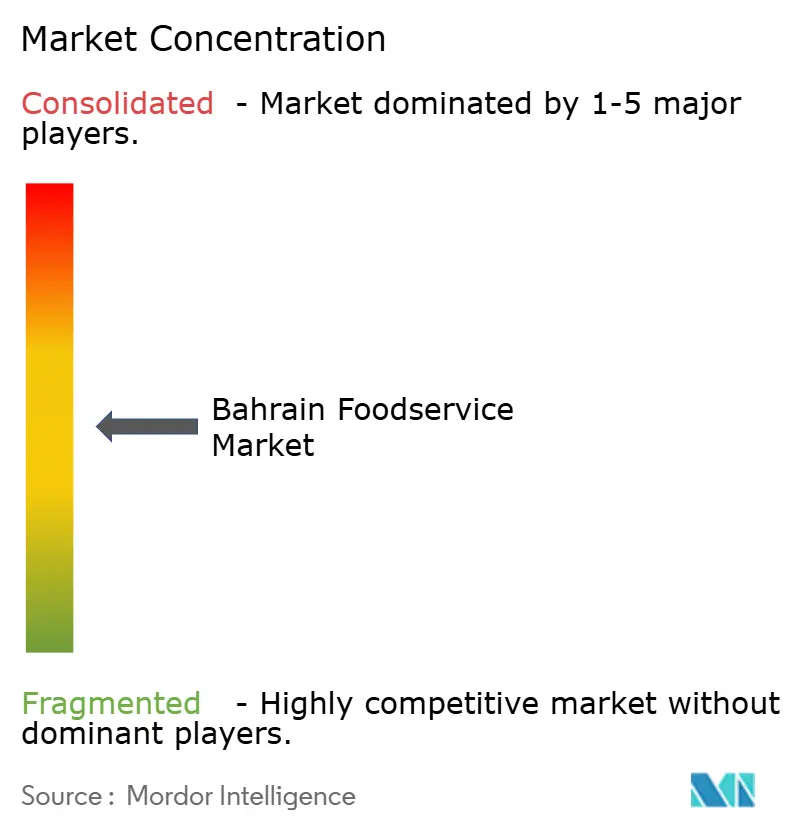
The Bahrain foodservice market demonstrates moderate concentration, with an intensity score of 5 out of 10. This creates opportunities for both established players and emerging disruptors to achieve growth through differentiated positioning and operational excellence. Prominent market leaders, including Americana Restaurants International, M.H. Alshaya Co., and Alabraaj Restaurants Group, leverage their regional scale and diverse brand portfolios to maintain competitive advantages. Concurrently, technology-driven operators such as Kitopi are introducing cloud kitchen models that challenge traditional restaurant formats. The competitive dynamics reflect an evolving industry landscape where traditional dine-in operators compete with delivery-focused platforms and hybrid models that integrate multiple service channels. Strategic partnerships, such as the EazyPay-Talabat collaboration launched in March 2024, highlight how technology integration enhances customer experience and operational efficiency, creating competitive differentiation.
Opportunities in premium casual dining and experiential concepts are emerging, as evidenced by the December 2024 opening of Time Out Market Bahrain. This facility spans 3,000 square meters and features 11 kitchens, showcasing curated local culinary talent. However, the regulatory environment poses challenges, with updated health certificate requirements set to take effect on January 1, 2025. These compliance barriers are likely to favor operators with advanced operational systems while potentially constraining smaller competitors. Despite these challenges, emerging disruptors are focusing on technology-enabled efficiency and customer convenience. Cloud kitchen operators, in particular, are achieving rapid scalability through centralized operations and data-driven menu optimization.
The competitive landscape is further shaped by government initiatives aimed at supporting digital transformation and tourism development. These initiatives are fostering market expansion opportunities, enabling multiple players to achieve growth simultaneously rather than competing for a static market share. The integration of technology and innovation within the foodservice market is driving significant changes, allowing both established and emerging players to adapt to evolving consumer preferences and operational demands. This dynamic environment underscores the potential for sustained growth and diversification within Bahrain's foodservice market.
Bahrain Foodservice Industry Leaders
-
Americana Restaurants International PLC
-
M.H. Alshaya Co. WLL
-
Alabraaj Restaurants Group
-
Alamar Foods Company
-
ALBAIK Food Systems Company SA
- *Disclaimer: Major Players sorted in no particular order
Recent Industry Developments
- May 2025: AlAbraaj Restaurants Group has announced the opening of two new restaurants in Bahrain: Sangam and LaRo Bistro & Rotisserie. Sangam, which specializes in Indian food, has opened in Al Aali Mall, Seef district. The restaurant offers a menu of traditional Indian dishes, including biryanis, curries, tandoor grills, fresh naan, and authentic Indian kulfi.
- December 2024: FoodFund International has announced the launch of Astéria, a new Greek restaurant located in the heart of Manama's Al Adliya district, Bahrain. Named after the Greek goddess of the stars, Astéria combines Greek dining traditions with a contemporary touch.
- December 2024: Apparel Group celebrated the grand opening of its homegrown restaurant, Sushi Library, at Marassi Galleria, marking another milestone in its commitment to enhancing the retail and dining landscape in Bahrain.
Bahrain Foodservice Market Report Scope
Cafes & Bars, Cloud Kitchen, Full Service Restaurants, Quick Service Restaurants are covered as segments by Foodservice Type. Chained Outlets, Independent Outlets are covered as segments by Outlet. Leisure, Lodging, Retail, Standalone, Travel are covered as segments by Location.| Cafes & Bars | By Cuisine | Bars & Pubs |
| Cafes | ||
| Juice/Smoothie/Desserts Bars | ||
| Specialist Coffee & Tea Shops | ||
| Cloud Kitchen | ||
| Full Service Restaurants | By Cuisine | Asian |
| European | ||
| Latin American | ||
| Middle Eastern | ||
| North American | ||
| Other FSR Cuisines | ||
| Quick Service Restaurants | By Cuisine | Bakeries |
| Burger | ||
| Ice Cream | ||
| Meat-based Cuisines | ||
| Pizza | ||
| Other QSR Cuisines |
| Chained Outlets |
| Independent Outlets |
| Leisure |
| Lodging |
| Retail |
| Standalone |
| Travel |
| Dine-in |
| Takeaway |
| Delivery |
| Foodservice Type | Cafes & Bars | By Cuisine | Bars & Pubs |
| Cafes | |||
| Juice/Smoothie/Desserts Bars | |||
| Specialist Coffee & Tea Shops | |||
| Cloud Kitchen | |||
| Full Service Restaurants | By Cuisine | Asian | |
| European | |||
| Latin American | |||
| Middle Eastern | |||
| North American | |||
| Other FSR Cuisines | |||
| Quick Service Restaurants | By Cuisine | Bakeries | |
| Burger | |||
| Ice Cream | |||
| Meat-based Cuisines | |||
| Pizza | |||
| Other QSR Cuisines | |||
| Outlet | Chained Outlets | ||
| Independent Outlets | |||
| Location | Leisure | ||
| Lodging | |||
| Retail | |||
| Standalone | |||
| Travel | |||
| Service Type | Dine-in | ||
| Takeaway | |||
| Delivery | |||
Market Definition
- FULL-SERVICE RESTAURANTS - A foodservice establishment where customers are seated at a table, give their order to a server and are served food at a table.
- QUICK SERVICE RESTAURANTS - A foodservice establishment that provides customers convenience, speed, and food offerings at lower prices. Customers usually help themselves and carry their own food to their tables.
- CAFES & BARS - A type of foodservice business that include bars and pubs that are licensed to serve alcoholic drinks for consumption, cafes that serve refreshments and light food items, as well as specialty tea and coffee shops, dessert bars, smoothie bars, and juice bars.
- CLOUD KITCHEN - A foodservice business that utilizes a commercial kitchen for the purpose of preparing food for delivery or takeout only, with no dine-in customers.
| Keyword | Definition |
|---|---|
| Albacore Tuna | It is one of the smallest species of tuna found in the six distinct stocks known globally in the Atlantic, Pacific, and Indian oceans, as well as the Mediterranean Sea. |
| Angus beef | It is beef derived from a specific breed of cattle indigenous to Scotland. It requires certification from the American Angus Association to receive the "Certified Angus Beef" quality mark. |
| Asian cuisine | It includes full-service offerings in restaurants that serve cuisines from cultures such as Chinese, Indian, Korean, Japanese, Bengali, Southeast Asian, etc. |
| Average Order Value | It is the average value of all orders made by the customers at a foodservice establishment. |
| Bacon | It is salted or smoked meat that comes from the back or sides of a pig. |
| Bars & Pubs | It is a drinking establishment that is licensed to serve alcoholic drinks for consumption on the premises. |
| Black Angus | It is beef derived from a black-hided breed of cows that don't have horns. |
| BRC | British Retail Consortium |
| Burger | It is a sandwich consisting of one or more cooked beef patties, placed inside a sliced bread roll or bun roll. |
| Café | It is a foodservice establishment serving various refreshments (mainly coffee) and light meals. |
| Cafes & Bars | It is a type of foodservice business that include bars and pubs that are licensed to serve alcoholic drinks for consumption, cafes that serve refreshments and light food items, as well as specialty tea and coffee shops, dessert bars, smoothie bars, and juice bars. |
| Cappuccino | It is an Italian coffee drink that is traditionally prepared with equal parts double espresso, steamed milk, and steamed milk foam. |
| CFIA | Canadian Food Inspection Agency |
| Chained Outlet | It refers to a foodservice establishment that shares brands, operates in several locations, has central management, and standardized business practices. |
| Chicken Tender | It refers to chicken meat prepared from the pectoralis minor muscles of a chicken bird. |
| Cloud Kitchen | It is a foodservice business that utilizes a commercial kitchen for the purpose of preparing food for delivery or takeout only, with no dine-in customers. |
| Cocktail | It is an alcoholic mixed drink made with either a single spirit or a combination of spirits, mixed with other ingredients such as juices, flavored syrups, tonic water, shrubs, and bitters. |
| Edamame | It is a Japanese dish prepared with soybeans (harvested before they ripen or harden) and cooked in its pod. |
| EFSA | European Food Safety Authority |
| ERS | Economic Research Service of the USDA |
| Espresso | It is a concentrated form of coffee, served in shots. |
| European cuisine | It includes full-service offerings in restaurants that serve cuisines from cultures such as Italian, French, German, English, Dutch, Danish, etc. |
| FDA | Food and Drug Administration |
| Fillet Mignon | It is a cut of meat taken from the smaller end of the tenderloin. |
| Flank Steak | It is a cut of beef steak taken from the flank, which lies forward of the rear quarter of a cow. |
| Foodservice | It refers to the part of the food industry which includes businesses, institutions, and companies which prepare meals outside the home. It includes restaurants, school and hospital cafeterias, catering operations, and many other formats. |
| Franks | Also known as frankfurter or Würstchen, it is a type of highly seasoned smoked sausage popular in Austria and Germany. |
| FSANZ | Food Standards Australia New Zealand |
| FSIS | Food Safety and Inspection Service |
| FSSAI | Food Safety and Standards Authority of India |
| Full service restaurant | It refers to a foodservice establishment where customers are seated at a table, give their order to a server, and are served food at a table. |
| Ghost Kitchen | It refers to a cloud kitchen. |
| GLA | Gross Leasable Area |
| Gluten | It is a family of proteins found in grains, including wheat, rye, spelt, and barley. |
| Grain-fed beef | It is beef derived from cattle that have been fed a diet supplemented with soy and corn and other additives. Grain-fed cows can also be given antibiotics and growth hormones to fatten them up more quickly. |
| Grass-fed beef | It is beef derived from cattle that have only been fed grass as feed. |
| Ham | It refers to the pork meat taken from the leg of a pig. |
| HoReCa | Hotels, Restaurants and Cafes |
| Independent Outlet | It refers to a foodservice establishment that operates with a single outlet or is structured as a small chain with no more than three locations. |
| Juice | It is a drink made from the extraction or pressing of the natural liquid contained in fruit and vegetables. |
| Latin American | It includes full-service offerings in restaurants that serve cuisines from cultures such as Mexican, Brazilian, Argentinian, Colombian, etc. |
| Latte | It is a milk-based coffee that is made up of one or two shots of espresso, steamed milk, and a thin layer of frothed milk. |
| Leisure | It refers to foodservice offered as a part of a recreation business, such as sports arenas, zoos, movie theaters, and museums. |
| Lodging | It refers to foodservice offerings at hotels, motels, guesthouses, holiday homes, etc. |
| Macchiato | It is an espresso coffee drink with a small amount of milk, usually foamed. |
| Meat-based cuisines | This inlcudes food items like fried chicken, steak, ribs, etc. where meat is the primary ingredient for the dish. |
| Middle Eastern cuisine | It includes full-service offerings in restaurants that serve cuisines from cultures such as Arabic, Lebanese, Iranian, Israeli, etc. |
| Mocktail | It is an non-alcoholic mixed drink. |
| Mortadella | It is a large Italian sausage or luncheon meat made of finely hashed or ground heat-cured pork, which incorporates at least 15% small cubes of pork fat. |
| North American | It includes full-service offerings in restaurants that serve cuisines from cultures such as American, Canadian, Caribbean, etc. |
| Pastrami | It refers to a highly seasoned smoked beef, typically served in thin slices. |
| PDO | Protected Designation of Origin: It is the name of a geographical region or specific area that is recognized by official rules to produce certain foods with special characteristics related to location. |
| Pepperoni | It is an American variety of spicy salami made from cured meat. |
| Pizza | It is a dish made typically of flattened bread dough spread with a savory mixture usually including tomatoes and cheese and often other toppings and baked. |
| Primal cuts | It refers to the major sections of the carcass. |
| Quick service restaurant | It refers to a foodservice establishment that provides customers convenience, speed, and food offerings at lower prices. Customers usually help themselves and carry their own food to their tables. |
| Retail | It refers to a foodservice outlet inside a mall. shopping complex or a commercial real estate building, where there are other businesses operating as well. |
| Salami | It is a cured sausage consisting of fermented and air-dried meat. |
| Saturated fat | It is a type of fat in which the fatty acid chains have all single bonds. It is generally considered unhealthy. |
| Sausage | It is a meat product made of finely chopped and seasoned meat, which may be fresh, smoked, or pickled and which is then usually stuffed into a casing. |
| Scallop | It is an edible shellfish that is a mollusk with a ribbed shell in two parts. |
| Seitan | It is a plant-based meat substitute made out of wheat gluten. |
| Self-service kiosk | It refers to a self-order point-of-sale (POS) system through which customers place and pay for their own orders at kiosks, enabling totally contactless and frictionless service. |
| Smoothie | It is a beverage made by placing all the ingredients in a container and processing them together, without removing the pulp. |
| Specialty coffee & tea shops | It refers to a foodservice establishment that serves only various types of tea or coffee. |
| Standalone | It refers to a restaurants that have an independent infrastructure setup and not connected to any other business. |
| Sushi | It is a Japanese dish of prepared vinegared rice, usually with some sugar and salt, accompanied by a variety of ingredients, such as seafood—often raw—and vegetables. |
| Travel | It refers to foodservice offerings such as airplane food, dining on long-distance trains, and foodservice on cruise ships. |
| Virtual Kitchen | It refers to a cloud kitchen. |
| Wagyu Beef | It is beef derived from any of four strains of a breed of black or red Japanese cattle that are valued for their highly marbled meat. |
Research Methodology
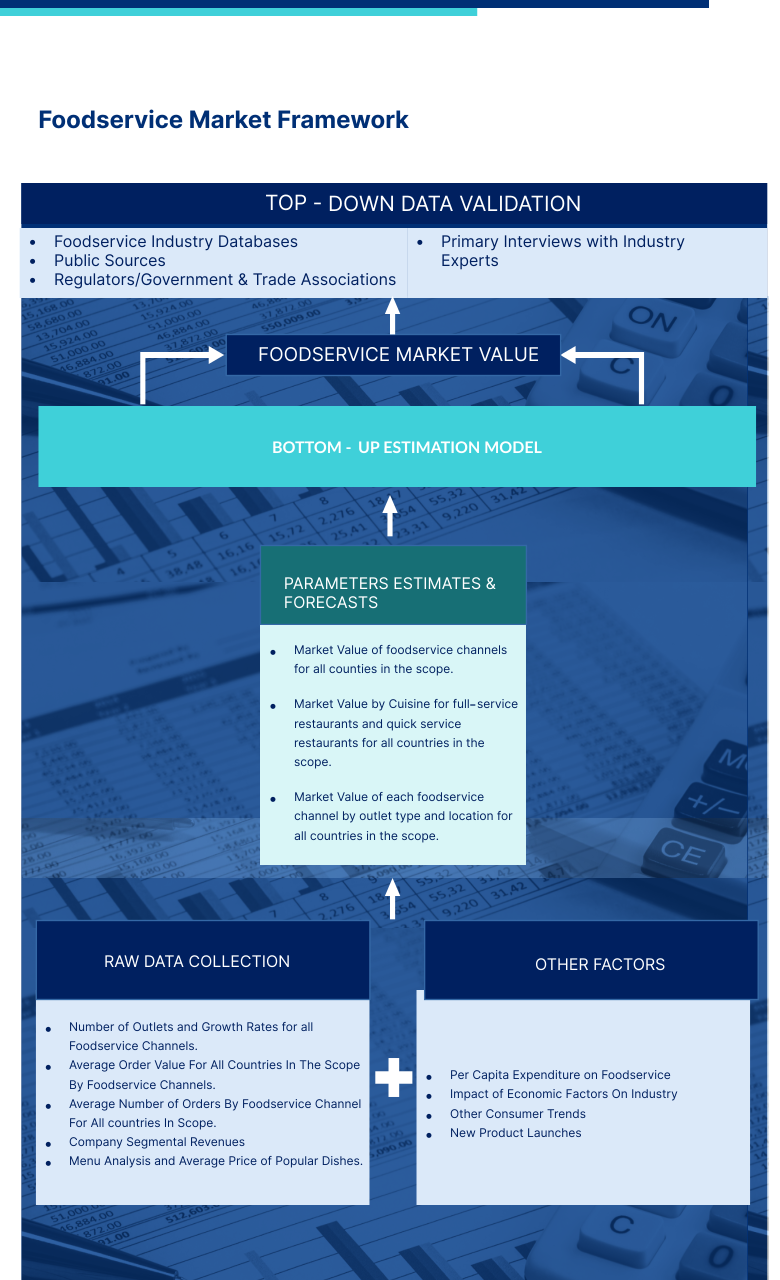
Mordor Intelligence follows a four-step methodology in all our reports.
- Step-1: Identify Key Variables: In order to build a robust forecasting methodology, the variables and factors identified in Step 1 are tested against available historical market numbers. Through an iterative process, the variables required for the market forecast are set, and the model is built on the basis of these variables.
- Step-2: Build a Market Model: Market size estimations for the forecast years are in nominal terms. Inflation is considered for average order value, and it is forecasted as per predicted inflation rates in the countries.
- Step-3: Validate and Finalize: In this important step, all market numbers, variables, and analyst calls are validated through an extensive network of primary research experts from the market studied. The respondents are selected across levels and functions to generate a holistic picture of the market studied.
- Step-4: Research Outputs: Syndicated Reports, Custom Consulting Assignments, Databases & Subscription Platforms