
Automotive Curtain Airbags Market Size and Share
Market Overview
| Study Period | 2020 - 2031 |
|---|---|
| Market Size (2026) | USD 4.71 Billion |
| Market Size (2031) | USD 6.09 Billion |
| Growth Rate (2026 - 2031) | 5.24 % |
| Fastest Growing Market | Africa |
| Largest Market | Asia Pacific |
| Market Concentration | Medium |
Major Players *Disclaimer: Major Players sorted in no particular order Image © Mordor Intelligence. Reuse requires attribution under CC BY 4.0. | |
Automotive Curtain Airbags Market Analysis by Mordor Intelligence
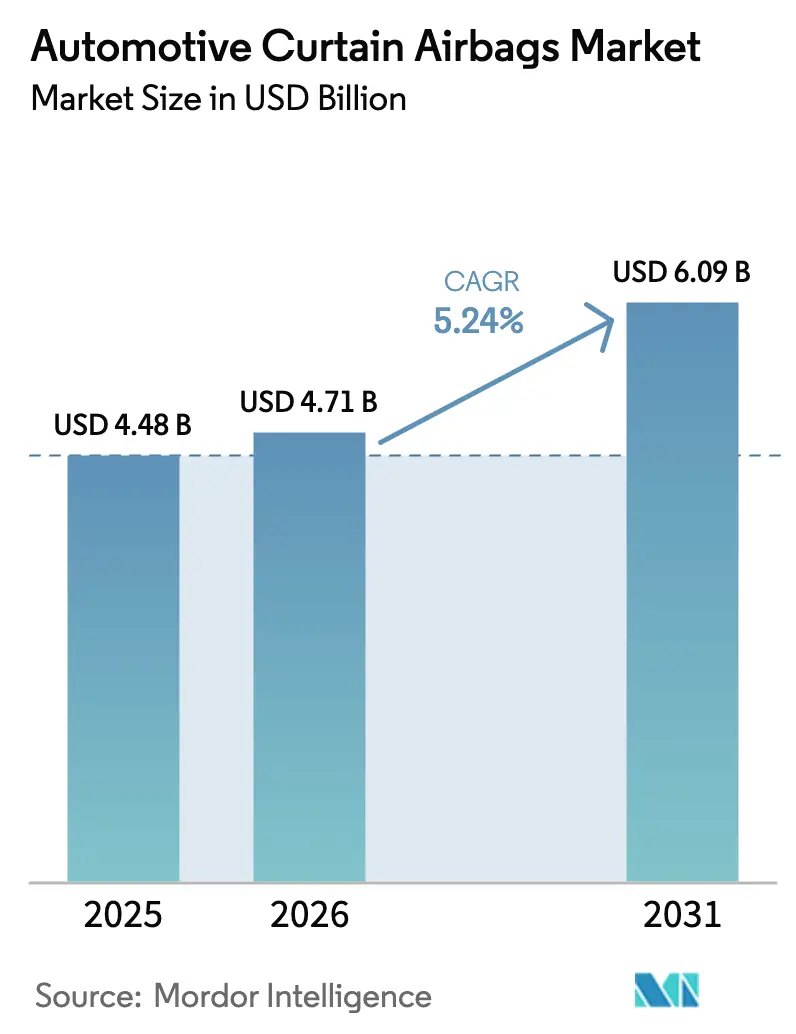
Automotive curtain airbags market size in 2026 is estimated at USD 4.71 billion, growing from 2025 value of USD 4.48 billion with 2031 projections showing USD 6.09 billion, growing at 5.24% CAGR over 2026-2031. This momentum reflects the convergence of stringent global side-impact legislation, the boom in sport-utility vehicle (SUV) deliveries, and the packaging freedom created by electric-vehicle (EV) skateboard platforms [1]“Side Curtain Airbag Safety Standards,” National Highway Traffic Safety Administration, nhtsa.gov. Mandatory compliance with FMVSS 214, Euro NCAP far-side protocols, and GTR 14 forces every volume carmaker to embed roof-rail curtains in both developed and emerging markets, accelerating standard fitment rates. Consumer demand for five-star crash scores across India, Brazil, and the ASEAN bloc intensifies OEM focus on full-length curtains, while joint ventures such as Toyobo-Indorama’s nylon-6,6 weaving plant in Thailand mitigate fabric tightness that previously throttled production. Rollover-oriented SUV lines and expansive crossover portfolios thus become the single largest absorption channel for Automotive curtain airbags market deployments worldwide.
Key Report Takeaways
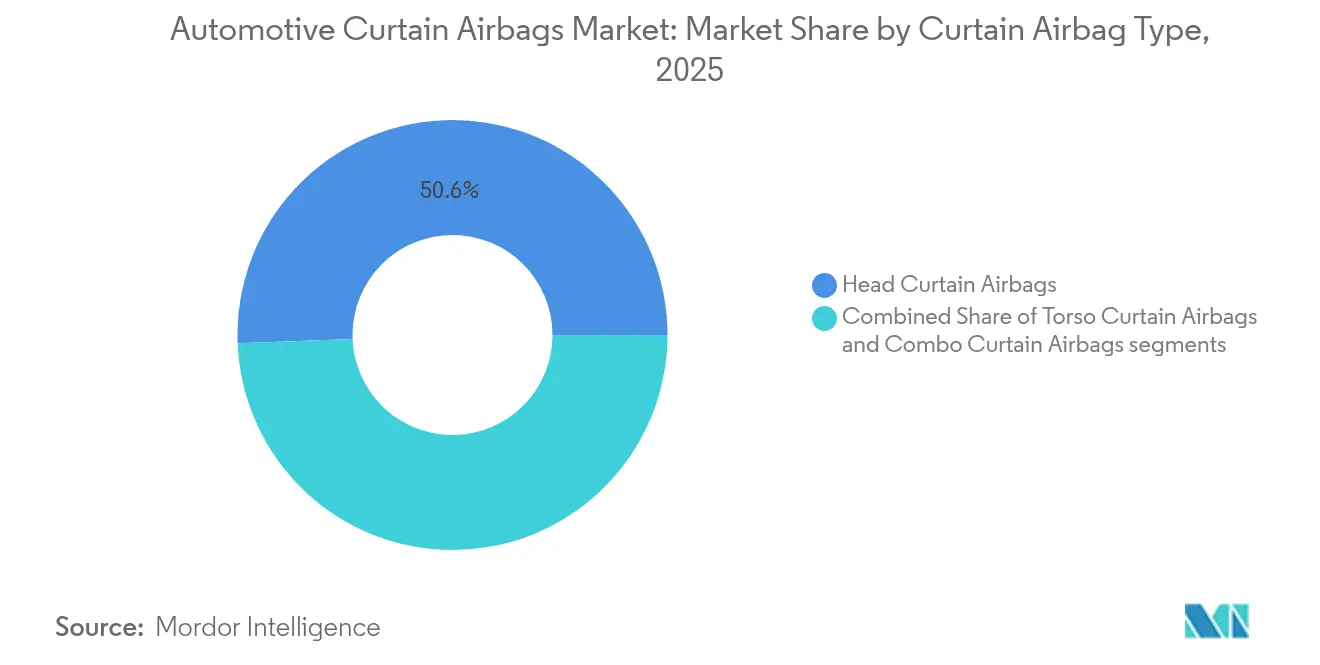
- By curtain airbag type, head-only designs led with 50.62% Automotive curtain airbags market share in 2025, while combo curtains—offering integrated head-torso coverage—are poised for the fastest 7.95% CAGR through 2031.
- By vehicle type, SUVs captured 43.89% of the Automotive curtain airbags market size in 2025 and will remain the fastest-growing body style at 8.74% CAGR to 2031.
- By end user, the OEM channel accounted for 88.64% of the Automotive curtain airbags market size in 2025; the aftermarket is forecast to grow 10.86% CAGR on retrofit demand.
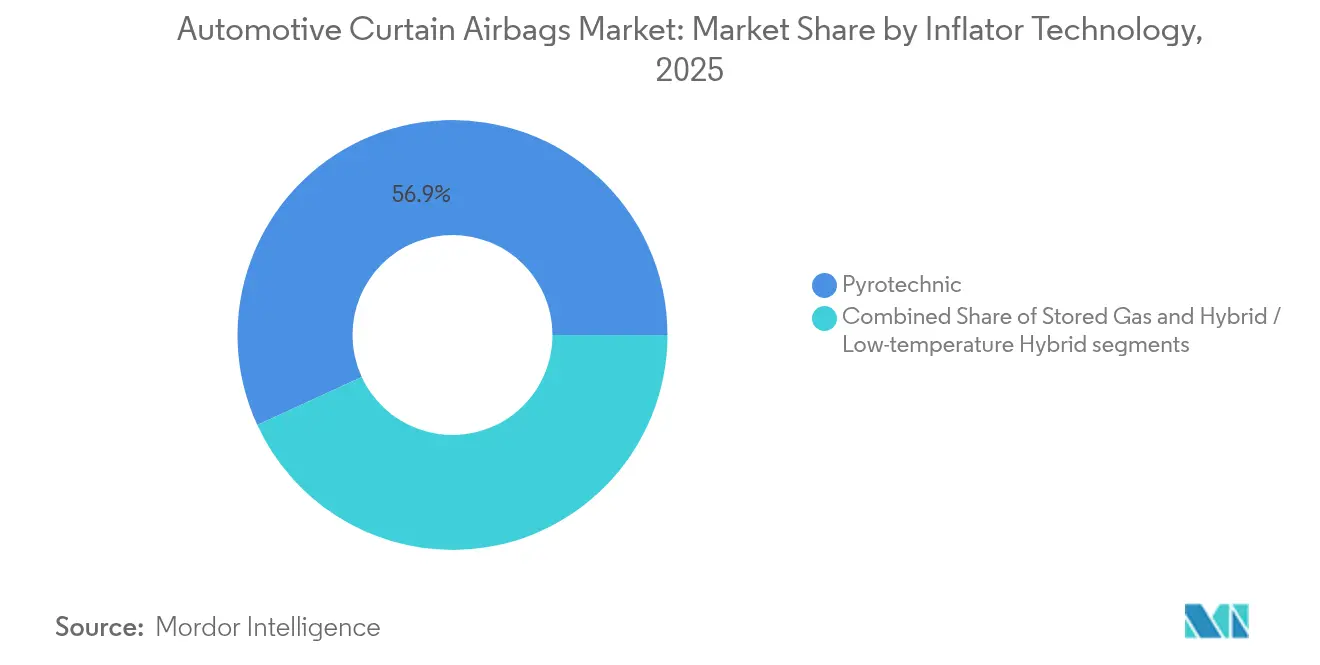
- By inflator technology, pyrotechnic units commanded 56.88% revenue share in 2025, whereas hybrid inflators are advancing at a 9.79% CAGR, the strongest rate among all inflator classes.
- By sales channel, franchised dealerships handled 85.52% shipments in 2025, but online and direct-to-consumer portals will post a 11.64% CAGR through 2031.
- By geography, Asia-Pacific held 45.74% revenue share in 2025; Africa is set to deliver the fastest 5.86% CAGR between 2026 and 2031.
Note: Market size and forecast figures in this report are generated using Mordor Intelligence’s proprietary estimation framework, updated with the latest available data and insights as of 2026.
Global Automotive Curtain Airbags Market Trends and Insights
Drivers Impact Analysis*
| Driver | (~) % Impact on CAGR Forecast | Geographic Relevance | Impact Timeline |
|---|---|---|---|
| Stricter Side-Impact & Rollover Regulations | +1.8% | Global, accelerated in Asia-Pacific | Medium term (2-4 years) |
| SUV/CUV Growth Driving Roof-Rail Airbag Adoption | +1.2% | North America and China lead | Short term (≤ 2 years) |
| ADAS Integration Boosts Passive Safety Content | +0.9% | North America and EU lead | Medium term (2-4 years) |
| 5-Star NCAP Demand in Emerging Markets | +0.7% | Asia-Pacific core; Middle East and Africa and South America follow | Long term (≥ 4 years) |
| EV Platforms Allow Larger Curtain Airbags | +0.6% | Global, premium EVs first | Long term (≥ 4 years) |
| Hybrid Inflators Enable Safe Robo-Taxi Deployment | +0.4% | Developed markets only | Long term (≥ 4 years) |
| Source: Mordor Intelligence | |||
Stringent Side-Impact & Rollover Regulations Drive Global Adoption
Global Technical Regulation 14 aligns head-injury criteria across markets and forces OEMs to specify curtain airbags on every platform, not just export trims. Australia’s new side-impact rule lowered occupant fatalities by 30% once curtain deployment became compulsory. [2]“Motor Vehicle Side Impact Regulation Update,” Department of Infrastructure Australia, infrastructure.gov.au Earlier, NHTSA projected its side-airbag mandate would save 311 lives per year—a target now verified through empirical crash-database reviews. With India moving toward mandatory six-airbag legislation and Brazil’s NCAP tying star ratings to roof-rail curtains, suppliers benefit from a regulatory cascade that eliminates optional-equipment status for side curtains. Consequently, volume commitments for fabric, inflators, and initiators stay locked years in advance, safeguarding capacity utilization even in cyclical downturns.
Rising Global SUV & CUV Penetration Increases Roof-Rail Fitment
SUV deliveries represent the fastest-growing light-vehicle category, a trend that directly lifts per-vehicle curtain count. Ford’s 15-ft-long, five-row airbag points to the engineering leap required to safeguard occupants in stretched vans and three-row crossovers. Insurance Institute for Highway Safety data corroborate a 37% drop in driver deaths when head-protecting curtains deploy. [3]“Driver Fatality Reduction with Head-Protecting Airbags,” Insurance Institute for Highway Safety, iihs.org China’s domestic SUV boom and India’s migration from hatchbacks to compact SUVs assure a multi-year uplift in curtain volumes, further embedding this driver in global demand curves.
Integration of ADAS with Passive Safety Suites
Advanced driver-assistance systems deliver real-time impact vectors and occupant status to airbag control units. Multi-stage hybrid inflators adjust vent holes on the fly, reducing over-pressure risk for small-stature occupants while still meeting Euro NCAP’s new far-side injury metric. Daimler benchmarks show 10 ms faster trigger times when ADAS sensors pre-tension restraints before impact. Automated diagnostics now ping cloud dashboards, enabling fleet managers to track inflator aging and schedule proactive service interventions.
Consumer Demand for 5-Star NCAP Ratings in Emerging Economies
Bharat NCAP’s 2024 launch made five-star results a showroom differentiator even for entry-level microcars. Latin NCAP’s “zero-star shame list” equally pressures OEMs in Brazil and Argentina. As middle-class buyers regard crash ratings as a status symbol akin to infotainment specs, curtains migrate from premium badges to base variants, solidifying structural demand in the Automotive curtain airbags market.
Restraints Impact Analysis*
| Restraint | (~) % Impact on CAGR Forecast | Geographic Relevance | Impact Timeline |
|---|---|---|---|
| Inflator Recalls Raise Legal & Risk Costs | -1.1% | North America & Japan focus | Short term (≤ 2 years) |
| Entry-Level Price Pressure Limits Standardisation | -0.8% | India, Brazil, Southeast Asia | Medium term (2-4 years) |
| Nylon & Initiator Shortages Delay Production | -0.6% | Global, Asia-Pacific hubs acute | Short term (≤ 2 years) |
| EV Battery Packs Reduce Need for Side Airbags | -0.4% | Premium EVs in developed markets | Long term (≥ 4 years) |
| Source: Mordor Intelligence | |||
Recalls & Litigations from Inflator Defects Raise Risk Premium
NHTSA’s 2024 recall of 298,700 Chrysler and Dodge sedans for Side Airbag Inflatable Curtain rupture risk revived public anxiety around shrapnel injuries. Legal settlements inflate supplier insurance premiums, while OEMs lengthen validation protocols, adding cost and delaying model launches. BMW, Kia, and Toyota faced similar curtain-related recalls in 2024–2025, reinforcing investor caution in the Automotive curtain airbags industry.
Price Pressure on Entry-Level Models Limits Standardization
India suspended its six-airbag rule to avoid a USD 200 retail-price hike on A-segment cars, underscoring affordability friction. Similar resistance surfaces in Brazil, Indonesia, and Nigeria, where entry-level buyer sensitivity hinders full safety feature migration until legislation removes choice. The resulting dual-spec production complicates supply chains and dilutes per-vehicle content gains.
*Our forecasts treat driver/restraint impacts as directional, not additive. The impact forecasts reflect baseline growth, mix effects, and variable interactions.
Segment Analysis
By Curtain Airbag Type: Head-Focused Designs Retain Dominance
Head-only curtains secured 50.62% of the Automotive curtain airbags market share in 2025, supported by a proven 31% fatality reduction in side-impact crashes. Regulatory agencies continue to weigh head-injury criteria heavily, ensuring perennial demand. Combo curtains, which merge head and torso coverage in a single module, log an 7.95% CAGR through 2031 and gain traction in premium three-row SUVs seeking simpler bill-of-material counts.
Manufacturers refine weaving density and vent-hole geometry to sustain six-second inflation, protecting occupants against secondary hits in multi-roll incidents. Autoliv’s latest three-row design spans 2.5 m and deploys in 35 ms, illustrating how suppliers address cabin length growth. As Chinese MPV platforms stretch to court ride-hailing services, ultra-long curtains promise the next adoption wave for the Automotive curtain airbags market.



By Vehicle Type: SUV Surge Sustains Long-Run Expansion
SUVs accounted for 43.89% of the Automotive curtain airbags market size in 2025 and are on pace for a 8.74% CAGR. Their high center of gravity increases rollover exposure, necessitating extended roof-rail coverage. Crossovers in the B- and C-segments sell briskly in China, India, and the United States, pushing suppliers to develop low-profile modules that clear panoramic-sunroof frames.
Sedans decline gradually, yet regional tastes in Japan and South Korea maintain steady curtain demand for compact four-doors. Pickup trucks and MPVs create lucrative niches; Ford’s commercial van curtain illustrates the complexity of spanning five seating rows without compromising deployment timing. EV SUVs bring new engineering variables: floor batteries stiffen side sills, transferring intrusion force upward, so curtains must remain inflated longer to prevent head contact with shattered glass.
By End User: OEM Installations Dominate but Retrofit Momentum Builds
Factory-equipped systems comprised 88.64% of demand in 2025 as homologation rules require full integration with ECU logic. Nonetheless, fleet operators chase lower insurance premiums by retrofitting older shuttle vans, enabling the aftermarket to chart an 10.86% CAGR. Indian state transport agencies have already issued tenders for retrofit kits covering 18,000 buses slated for interstate highways.
Retrofit challenges include laser-cutting roof rails and recalibrating crash sensors. Tier-ones partner with certified body shops to guarantee compliance, anchoring revenue even after vehicle point-of-sale. Digital VIN lookup portals streamline parts selection, ensuring correct inflator-chamber matching. The evolving split between OEM and retrofit volumes shapes a dynamic yet quality-critical aftermarket within the Automotive curtain airbags market.
By Inflator Technology: Hybrid Leads Future-Ready Innovation
Pyrotechnic inflators dominate at 56.88% share due to low unit cost and proven reliability under legacy engine-bay temperature cycles. Hybrid inflators, however, clock the quickest 9.79% CAGR, leveraging compressed-gas reservoirs to moderate combustion heat and widen deployment temperature envelopes. Robo-taxi cabins—subject to -30 °C winters and 55 °C desert rides—necessitate this resilience.
Stored-gas units retain niche roles in luxury coupes, where under-seat tanks spare roof-rail volume for acoustic headliners. Meanwhile, Japanese suppliers patent Bernoulli diffusers that entrain cabin air, expanding curtain volume without extra propellant. Such intellectual-property moats underpin competitive advantage in the Automotive curtain airbags industry.
By Sales Channel: Phygital Models Gain Ground
Franchised dealerships processed 85.52% of curtain-airbag parts flow in 2025, leveraging diagnostic hardware, structural welding tools, and warranty backing. Yet online portals will rise 11.64% CAGR to 2031 as fleet purchase managers bulk-order inflators, fabrics, and sensor kits via secure B2B dashboards. OEMs now publish digital torque specs, enabling field technicians to complete roof-rail retrofits in under two hours.
Hybrid “phygital” experiences dominate: customers select modules online but still visit certified centers for final fitment and calibration. Blockchain traceability tags confirm propellant batch origin, cushioning reputational risk after prior high-visibility recalls. This channel evolution supports deeper supplier-fleet engagement, reaffirming the Automotive curtain airbags market’s move toward connected aftermarket ecosystems.
Geography Analysis
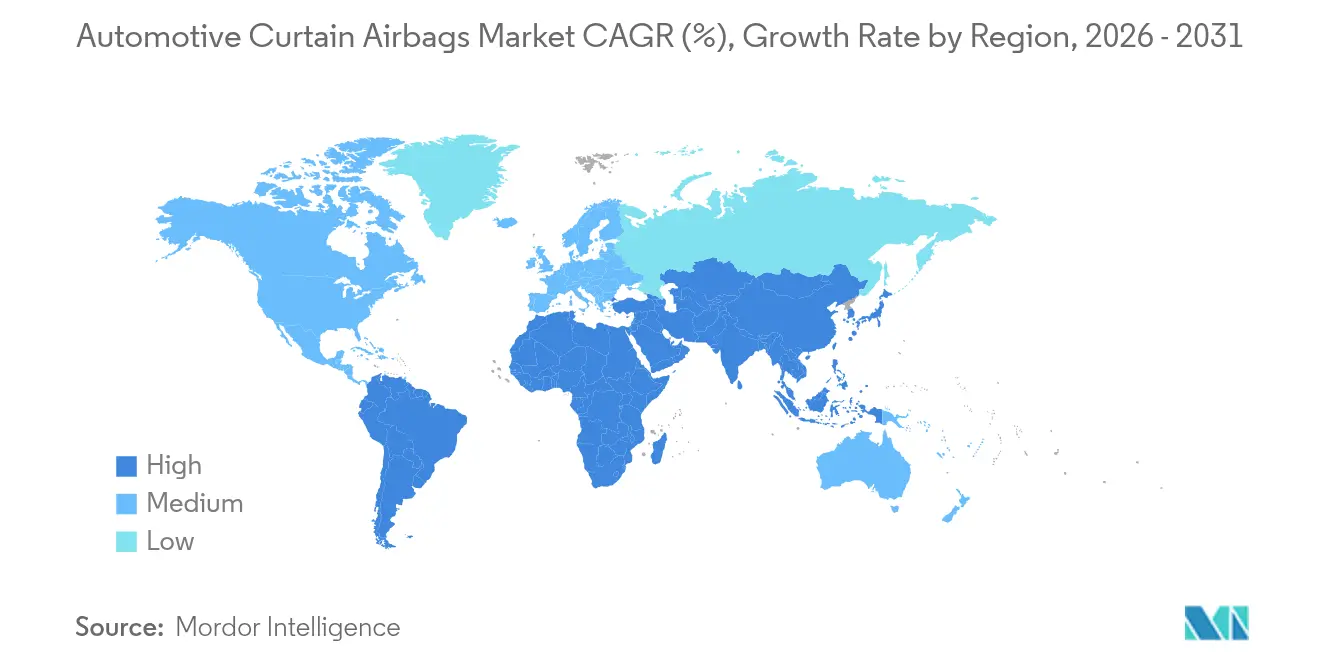
Asia-Pacific leads the Automotive curtain airbags market with 45.74% revenue share in 2025, driven by China’s large production base and India’s regulatory push for six airbags. Domestic OEMs such as Geely and Maruti embed full-length curtains even in sub-USD 10,000 hatches to meet export targets. Japan’s pyrotechnic expertise propels propellant chemistry breakthroughs at Daicel, which supplies hybrid inflators worldwide. South Korea pairs ADAS algorithms with passive systems to refine deployment timing across premium electric vehicle (EV) lineups.
North America remains pivotal through FMVSS 214 compliance and strong SUV sales. United States Level-4 autonomy pilots promote low-temperature hybrid inflators, giving suppliers a proving ground for extreme-climate solutions. Mexico’s assembly plants adopt identical curtain specifications for cross-border models, streamlining tier-one tooling. Canada supports module sub-assembly under regional parts-content rules, adding value to its auto sector.
Europe emphasizes sustainability and technology integration. Germany’s premium EV expansion drives advanced vent-hole metering, while France and Italy encourage mechanical stitching that enables rapid post-crash deflation to aid emergency access. Africa, while starting from a lower base, is the fastest-growing region with a 5.86% CAGR through 2031. South African CKD plants integrate dual-stage curtains aligned with EU export homologation. Kenya and Nigeria launch used-vehicle import restrictions, compelling new-car sales that bundle full safety suites. GCC states adopt UN R135, obliging Japanese and US SUV imports to include head-protecting curtains at customs inspection.

Regulatory Landscape
Global demand for curtain airbags is tied to side-impact and rollover or ejection protection requirements across major regulatory blocs. In the United States, NHTSA enforces FMVSS No. 226 (Ejection Mitigation). The standard uses displacement-based test procedures to check that side-curtain systems maintain window-area coverage during rollover and in specified side-impact events, so compliance depends on cushion geometry, tethering, and assembly tolerances.
Internationally, UNECE UN Regulation No. 95 (Lateral Collision Protection) under WP.29 continues to be updated through its amendment series. Supplement 1 to the 06 series entered into force on 12 June 2025. UNECE processes through mid-2026 also advanced further changes (Supplement 2 to the 06 series), which incorporate emerging test considerations for automated driving systems. This keeps suppliers and OEMs focused on validating curtain performance for broader occupant postures and vehicle use cases beyond conventional seating assumptions.
Value Chain Analysis
The curtain airbag value chain begins with upstream materials and energetics, including high-tenacity nylon 6,6 yarn and silicone-coated fabrics for the cushion, along with propellants, initiators, and metal components for inflators. Supply risk concentrates where specialized yarn capacity is clustered in Asia, notably Japan and South Korea, and where pyrotechnic inflator know-how and complexes are concentrated in mature manufacturing hubs, including Japan and Germany. Tier-1s and OEMs therefore tend to manage buffer stocks and dual-sourcing for critical inputs.
Midstream, Tier-1 integrators such as Autoliv and ZF convert fabrics and inflators into roof-rail curtain modules, then run validation and vehicle-specific tuning that links sensors, ECUs, and deployment logic. Downstream, most volume moves through long-term OEM supply agreements. The aftermarket relies more on certified installation and recalibration capabilities, which shifts pressure onto distributors and service networks to pair parts availability with diagnostic support to improve fitment accuracy and maintain recall-related traceability.
Competitive Landscape
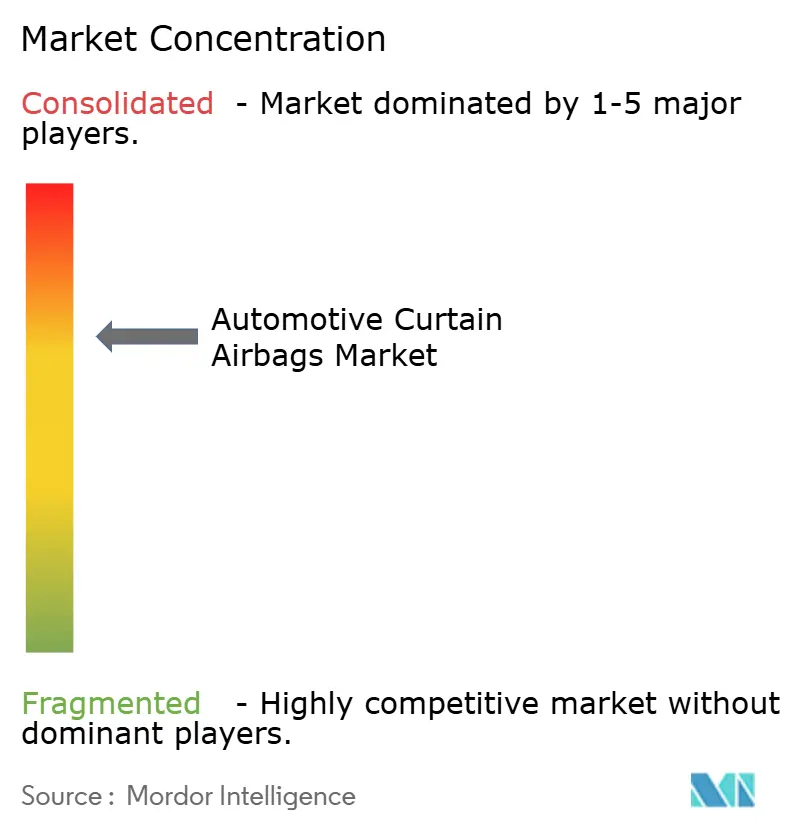
The Automotive curtain airbags market shows moderate concentration led by Autoliv, Joyson Safety Systems, ZF-TRW, Daicel, and Toyoda Gosei. Their global manufacturing footprints, extensive patent portfolios, and dual-continent weaving mills foster cost advantages and rapid innovation cycles. Autoliv’s 2024 partnership with Jiangling Motors added local inflation-module lines for Chinese EVs, cutting tariff exposure and freight emissions.
Joyson deployed blockchain lot control to trace every inflator pellet and bolster OEM confidence after past recall crises. ZF-TRW integrated curtain logic into its radar electronic control unit, trimming wiring mass as manufacturers pursue weight reduction. Daicel advances nano-coated propellant grains that resist moisture ingress, lengthening shelf life. Toyoda Gosei’s Neemrana expansion pairs bio-polyamide fabric weaving with local inflator machining to support Indian safety mandates.
Start-ups entering coated-yarn chemistry license anti-wicking finishes that raise burst-pressure tolerance and allow lighter modules. Safety certification still requires significant investment, limiting full-system entry to well-capitalized players. Competitive rivalry centers on sustainable materials, ADAS data integration, and hybrid inflator performance rather than unit-price discounting.
Automotive Curtain Airbags Industry Leaders
Continental AG
Autoliv, Inc.
Johnson Safety Systems
Hyundai Mobis Co., Ltd.
ZF Friedrichshafen AG
- *Disclaimer: Major Players sorted in no particular order

Market Opportunities and Future Outlook
Curtain airbag opportunities increasingly cluster around packaging innovation and China-focused platform wins, where EV architectures and local model cadence reward more compact modules and faster engineering cycles. Toyoda Gosei securing its first contract with a Chinese automaker, IM Motors, for curtain airbags on the LS9 (announced January 2026) points to active whitespace for suppliers that can combine compact packaging (reported as 15% more compact versus prior designs) with localized development support for Chinese luxury EV programs.
A second growth pocket is restraints designed for new seating positions and flexible interiors tied to advanced driver-assistance and automated driving use cases. In June 2026, ZF LIFETEC publicized an advanced four-airbag safety concept targeting comfort seating with increased recline, reinforcing movement toward adaptive restraint concepts where curtain airbags must coordinate with sensing and multi-stage deployment logic. At the same time, FMVSS 226 ejection mitigation performance targets expand the range of acceptable curtain deployment paths for non-traditional vehicle formats. This is reflected in Hyundai Mobis introducing a door-mounted curtain airbag concept for PBVs, which deploys vertically to address ejection protection constraints.
Recent Industry Developments
- July 2026: Autoliv signed a strategic cooperation framework agreement with XPENG Inc to develop and supply safer mobility solutions for global markets. The collaboration is designed to bring advanced restraint content, including curtain-airbag related integration, earlier into new-platform development cycles alongside fast-moving EV lineups.
- October 2025: Autoliv signed a Global Strategic Cooperation Framework Agreement with Great Wall Motor (GWM) to deepen the partnership across global programs. The agreement emphasizes localized operations and integrated safety-system development, supporting higher take rates of roof-rail curtain modules as GWM expands model and geography coverage.
- July 2024: Hyundai Mobis unveiled a door-mounted curtain airbag for Purpose Built Vehicles (PBVs) that deploys vertically and inflates in about 0.03 seconds. By targeting ejection-mitigation performance aligned with FMVSS 226, the concept expands curtain-airbag design space beyond roof-rail-only architectures for emerging vehicle formats.


Research Methodology Framework and Report Scope
Market Definition and Coverage
For this study, the market covers revenues generated from curtain airbag systems installed in road vehicles, counted at the point of OEM fitment and replacement demand, and tracked in USD across major automotive producing and consuming regions.
Scope exclusions: It excludes non-automotive airbags (such as industrial or aviation safety systems) and non-curtain airbag types that are not designed to deploy along the vehicle side roofline.
Segmentation Overview
- By Curtain Airbag Type
- Torso Curtain Airbags
- Head Curtain Airbags
- Combo Curtain Airbags
- By Vehicle Type
- Hatchback
- Sedan
- Sports Utility Vehicle
- Pick-up Trucks & MPVs
- By End User
- OEM
- Aftermarket
- By Inflator Technology
- Pyrotechnic
- Stored Gas
- Hybrid / Low-temperature Hybrid
- By Sales Channel
- Traditional Dealerships
- Online & Direct-to-Consumer
- By Geography
- North America
- United States
- Canada
- Rest of North America
- Europe
- Germany
- United Kingdom
- France
- Russia
- Rest of Europe
- Asia-Pacific
- China
- India
- Japan
- South Korea
- Rest of Asia-Pacific
- South America
- Brazil
- Argentina
- Rest of South America
- Middle East
- Saudi Arabia
- United Arab Emirates
- Rest of Middle East
- Africa
- South Africa
- Morocco
- Rest of Africa
- North America
Data Sources, Market Sizing, and Validation
Desk Research
Desk work starts with building the demand context for vehicles and safety content, and then narrowing it to curtain airbags. Public sources were reviewed for consistent anchors, such as vehicle production and registrations from sources such as OICA, road safety and restraint guidance from NHTSA and UNECE regulations, and test protocol updates from programs such as Euro NCAP. We also referenced crash and safety research literature from sources such as peer-reviewed journals to understand adoption triggers and technology shifts.
After the public data points were anchored, company disclosures were used to sanity check the direction of pricing and platform penetration, including annual reports, earnings decks, and verified press releases. In parallel, we used paid subscriptions for company financials and intelligence, a patent database to track inflator and fabric developments, and an import-export shipment-level database to cross-check trade flows of key components where disclosure was limited. These desk sources are illustrative only, and many other public and paid references were also used for data collection, validation, and clarification.
Primary Interviews and Surveys
Primary work was used to test what desk signals could not fully explain, especially the actual curtain airbag fitment rate by vehicle class and the real-world pricing range by region and channel. We spoke with a mix of vehicle safety stakeholders across APAC, EMEA, and the Americas, covering manufacturing, sourcing, engineering, and aftermarket distribution, so assumptions could be challenged and then corrected where needed. Inputs from these discussions were also used to confirm timing of regulatory pull-through and the pace of new platform launches that influence yearly volumes.
Distribution of primary research fieldwork respondents
| Company type | Respondent position | Region |
|---|---|---|
| Top tier: 33% | CXOs: 12% | APAC: 51% |
| Mid tier: 53% | Functional/Unit leaders: 39% | EMEA: 29% |
| Smaller Players: 14% | Managers: 49% | Americas: 20% |
Market-Sizing & Forecasting
Sizing was built using a top-down demand pool that reconstructs yearly curtain airbag value from vehicle production and sales, and then applies fitment and content assumptions by vehicle category and region. To keep it grounded, the model uses a small set of trackable inputs such as passenger car and light commercial production, estimated penetration of side-curtain systems by platform, average number of curtain modules per vehicle, average selling price progression, and the OEM versus aftermarket split.
Once the first totals were calculated, they were corroborated through selective bottom-up checks, including roll-ups from a sampled set of supplier revenues, channel checks on replacement volumes, and sampled ASP times estimated module shipments where the data was consistent. Where direct values were missing, gaps were handled by using proxy relationships, like applying penetration curves from similar safety features and adjusting for local regulation timing and model mix.
Forecasting was done using scenario analysis supported by a simple multivariate regression on vehicle output, safety content per vehicle, and regional mix shifts, and then refined with what experts expect for regulation enforcement and model refresh cycles. The outcome is a forecast that stays explainable on a call and can be reproduced with the same input series and a clear assumption log.
Data Validation & Update Cycle
Outputs are validated in steps so large jumps do not slip through. We compare totals against independent signals like vehicle build data, trade movements for relevant components, and disclosed safety system revenues, and then investigate variances before internal sign-off.
If a number looks off, assumptions are re-checked and, when needed, respondents are re-contacted to confirm the driver behind the change, such as a platform delay or a pricing reset. The report is refreshed annually, and interim updates are made when material events occur, after which a final pre-delivery pass is completed so clients receive the latest view.
Mordor Intelligence's Automotive Curtain Airbags Market Size Measured Against Other Published Estimates
Published market values for curtain airbags can differ even when they look like they cover the same thing, because the included product set, base year, and vehicle coverage are not always aligned. Differences also show up when sources treat OEM-installed modules and replacement demand differently, or when currency timing and price updates are handled in separate ways.
Front curtain airbags that deploy from non-roof locations sit outside Mordor Intelligence's scope here, and that single inclusion choice can move totals when other estimates bundle all curtain-like solutions into one line item. Gaps also come from how fitment rates are applied across passenger cars versus commercial vehicles, whether pricing is held flat or stepped down with scale, and how often assumptions are refreshed after regulation or platform changes.
Benchmark comparison
| Source | Market Size | Gaps in Research Methodology |
|---|---|---|
| Mordor Intelligence | USD 4.71 B (2026) | |
| Industry Association B | USD 4.70 B (2024) | Uses a broader curtain airbag definition that can include front and rear curtain variants, and it also applies a different base year with limited visibility into how OEM and aftermarket revenues are separated. |
| Global Consultancy A | USD 3.03 B (2025) | Anchors the model on a different base year and appears to apply more conservative fitment and pricing assumptions, which can understate value in high-content vehicle mixes, especially in Asia-Pacific. |
The spread in the table is mainly explained by scope alignment and timing alignment. When product boundaries are kept tight and variables like fitment, modules per vehicle, and price steps are updated using real platform and regulation signals, the final number becomes easier to trace and repeat year to year.


Key Questions Answered in the Report
How big is the Automotive curtain airbags market in 2026?
The Automotive curtain airbags market size is USD 4.71 billion in 2026 and is projected to reach USD 6.09 billion by 2031 at a 5.24% CAGR.
Which vehicle segment generates the highest demand for curtain airbags?
SUVs account for 43.89% of 2025 demand and are expanding at a 8.74% CAGR due to rollover-risk mitigation requirements.
Why are hybrid inflators gaining traction?
Hybrid inflators deliver consistent deployment across extreme temperatures, crucial for autonomous and premium EV applications, and they are forecast to grow 9.79% CAGR.
What region leads global curtain airbag adoption?
APAC holds 45.74% market share thanks to China’s production scale and India’s evolving six-airbag regulations.
Page last updated on:


 Your data is secure and never sold or shared.


