
Automotive Catalytic Converter Market Size and Share
Market Overview
| Study Period | 2020 - 2031 |
|---|---|
| Market Size (2026) | USD 120.39 Billion |
| Market Size (2031) | USD 177.87 Billion |
| Growth Rate (2026 - 2031) | 8.12 % |
| Fastest Growing Market | Asia Pacific |
| Largest Market | Asia Pacific |
| Market Concentration | Medium |
Major Players *Disclaimer: Major Players sorted in no particular order Image © Mordor Intelligence. Reuse requires attribution under CC BY 4.0. | |
Automotive Catalytic Converter Market Analysis by Mordor Intelligence
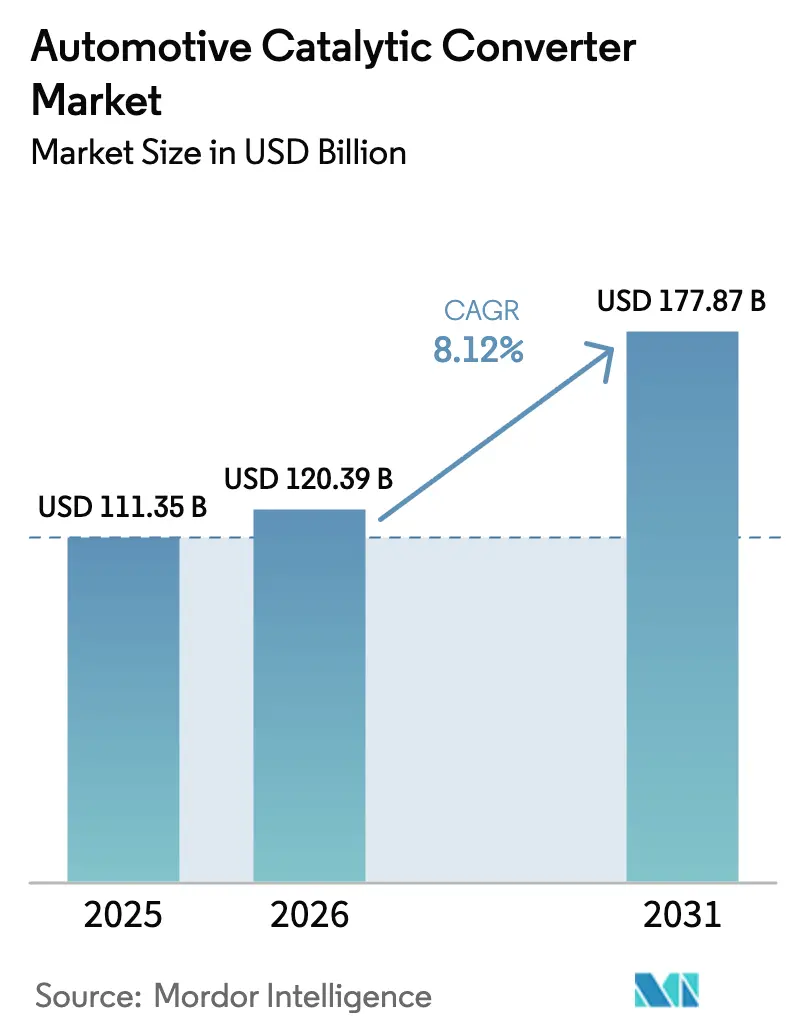
The catalytic converters market size is expected to grow from USD 111.35 billion in 2025 to USD 120.39 billion in 2026 and is forecast to reach USD 177.87 billion by 2031 at 8.12% CAGR over 2026-2031. The expansion reflects consistent regulatory tightening after 2025, including Euro 7, China 7, and updated United States standards, all of which mandate higher precious-metal loadings and advanced wash-coat chemistries. Further momentum comes from the rebound in global internal-combustion and hybrid vehicle production, precious-metal substitution strategies that cut cost risk, and retrofit activity in non-road machinery fleets. Supply chain resilience, new hydrogen internal-combustion projects, and promising single-material catalysts round out the opportunity set for the catalytic converters market.
Key Report Takeaways
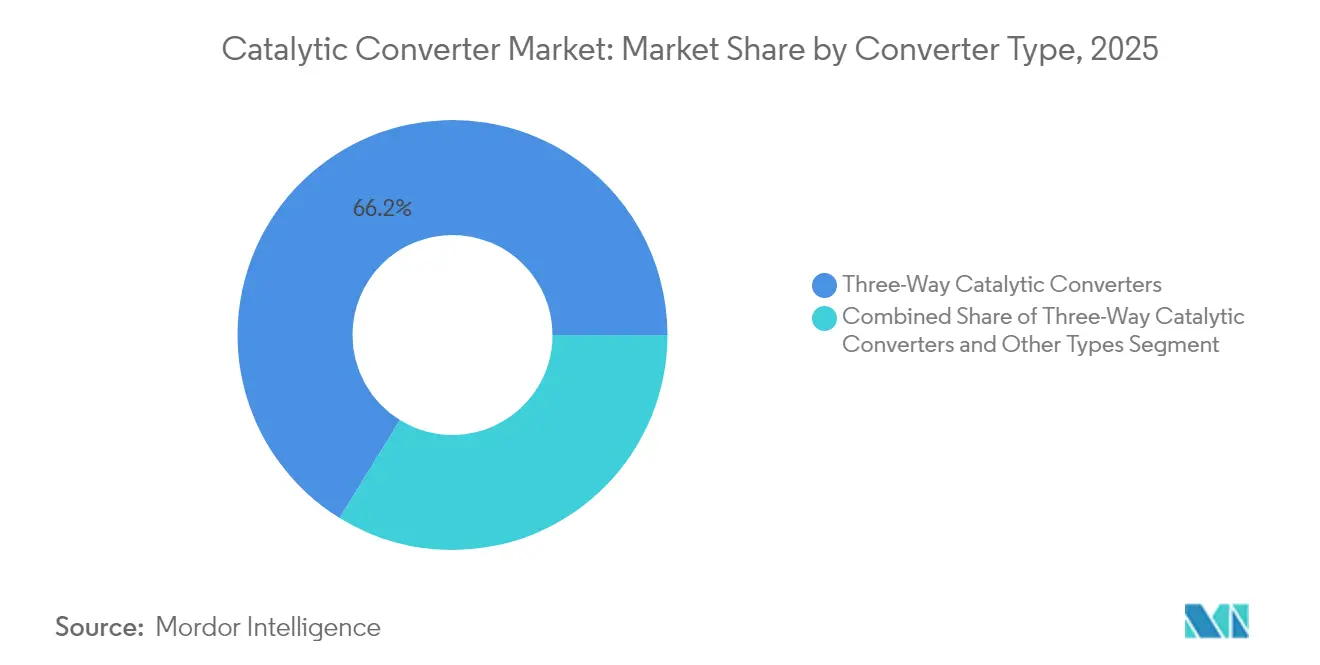
- By converter type, three-way systems held 66.20% of the catalytic converters market share in 2025, while the “other types” category is projected to grow at 11.59% CAGR through 2031.
- By vehicle type, passenger cars accounted for 63.05% of the catalytic converters market share in 2025; medium and heavy commercial vehicles are poised for the fastest 8.95% CAGR to 2031.
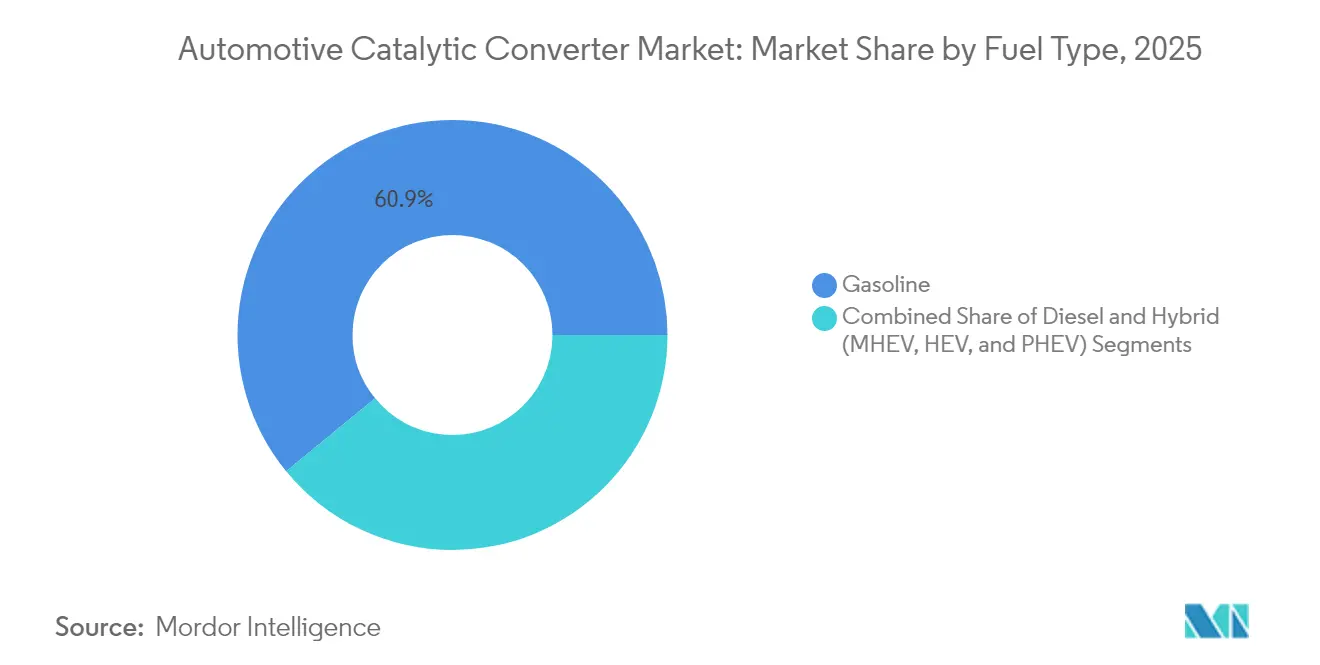
- By fuel type, gasoline powertrains captured 60.92% share of the catalytic converters market size in 2025, whereas hybrids are expected to expand at 9.01% CAGR during the forecast window.
- By substrate material, palladium substrates commanded 48.20% share of the catalytic converters market size in 2025; rhodium substrates led growth at a 6.48% CAGR.
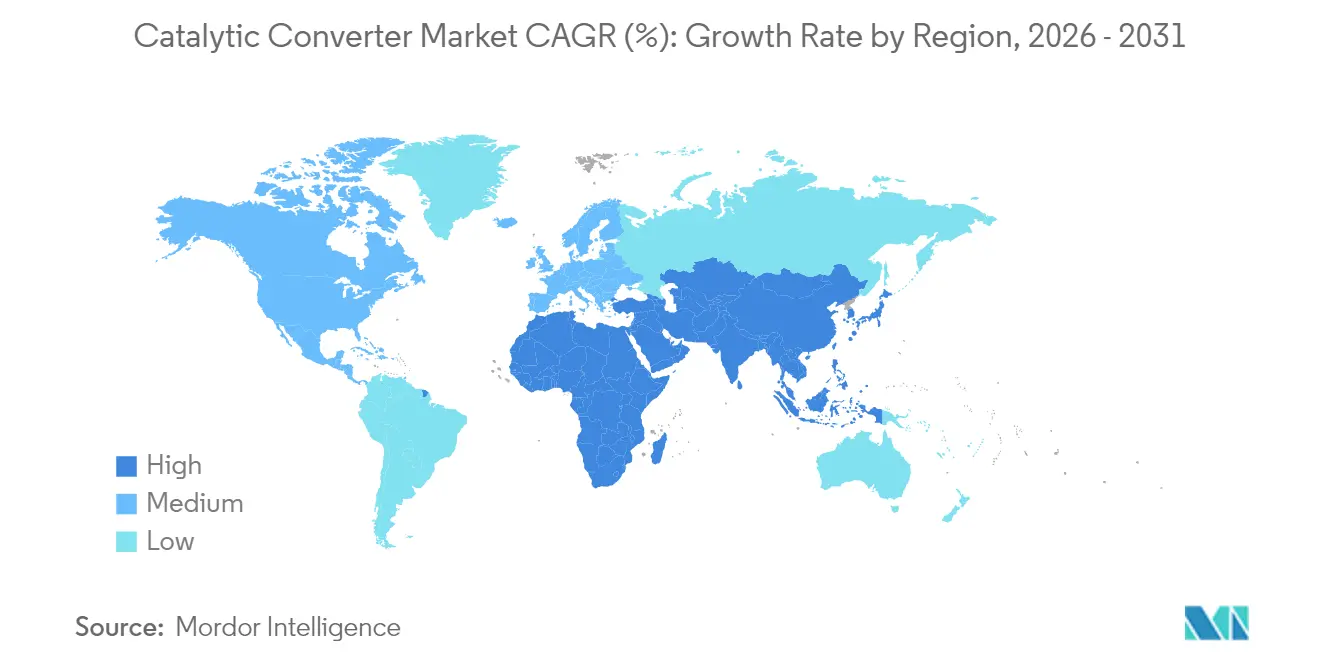
- By geography, Asia-Pacific dominated with 49.30% share of the catalytic converters market in 2025 and is also the fastest-growing region, advancing at 7.72% CAGR to 2031.
Note: Market size and forecast figures in this report are generated using Mordor Intelligence’s proprietary estimation framework, updated with the latest available data and insights as of 2026.
Market Trends and Insights
Drivers Impact Analysis of Automotive Catalytic Converter Market*
| Driver | (~) % Impact on CAGR Forecast | Geographic Relevance | Impact Timeline |
|---|---|---|---|
| Stringent Post-2025 Emission Legislation | +2.8% | Global, with early implementation in EU and China | Medium term (2-4 years) |
| Rebounding Global ICE And Hybrid Production Volumes | +1.9% | Global, concentrated in APAC and North America | Short term (≤ 2 years) |
| Precious-Metal Loadings in GDI and Mild-Hybrids | +1.6% | North America & EU, expanding to APAC | Medium term (2-4 years) |
| OEM Retrofit Demand from Non-Road/Mobile Machinery | +1.2% | EU Stage V, CARB Tier 5 regions, expanding globally | Long term (≥ 4 years) |
| Supply-Chain Gaps by Converter-Theft Recycling Boom | +0.8% | North America core, spill-over to EU | Short term (≤ 2 years) |
| Growing Incentives for Hydrogen-ICE Vehicles | +0.4% | EU and Japan early adoption, US emerging | Long term (≥ 4 years) |
| Source: Mordor Intelligence | |||
Stringent Post-2025 Emission Legislation Drives Technology Upgrades
Euro 7 begins phasing in from July 2025 and extends compliance durability to eight years/160,000 km, forcing automakers to specify thicker precious-metal layers and sophisticated gasoline particulate filters.[1] China 7 mirrors and, in several respects, exceeds Euro 7, requiring particulate-number limits and real-driving emissions testing across platforms. In the United States, tougher off-road and light-vehicle rules close historical regulatory gaps. Unified global thresholds remove the lag-time cushion OEMs once used, accelerating design cycles for advanced three- and four-way systems.
Rebound in Global ICE and Hybrid Production Volume Post-COVID
Worldwide light-vehicle output witnessed volume restoration across gasoline, diesel, and hybrid lines. Commercial trucks added volume on the back of logistics demand, while infrastructure stimulus in Asia-Pacific kept heavy-duty assembly lines active. Hybrids represented approximately 10% of production and need larger catalyst volumes to control cold-start emissions during frequent stop-start cycling. the China Association of Automobile Manufacturers is implementing a three-step development strategy targeting 20% carbon emissions reduction by 2035 through enhanced thermal efficiency and advanced emission control systems. Normalized factory utilization raises near-term unit shipments for the catalytic converters market despite longer-term electrification pressure.[2]
Higher Precious-Metal Loadings in GDI and Mild Hybrid Engines
Gasoline direct-injection powertrains reached 73% penetration in 2023 and emit finer particulates than port-fuel-injection designs, compelling automakers to integrate platinum-group metals and coated gasoline particulate filters. Turbocharging and mild-hybridization, both widespread in GDI applications, widen exhaust composition and temperature windows, demanding precise stoichiometric control and faster light-off. The resulting increase in PGM intensity strengthens revenue growth even as substitution initiatives seek cost neutrality.
OEM Retrofit Demand from Non-Road/Mobile Machinery ESG Pressure
Stage V and forthcoming Tier 5 rules require construction, agricultural and industrial equipment owners to retrofit legacy engines with advanced catalysts. Non-road engines frequently remain in service for two decades, creating incremental aftermarket demand extending well past 2030. Fleet operators adopt retrofit packages to satisfy corporate ESG pledges and municipal procurement criteria.
Restraints Impact Analysis of Automotive Catalytic Converter Market*
| Restraint | (~) % Impact on CAGR Forecast | Geographic Relevance | Impact Timeline |
|---|---|---|---|
| Extreme PGM Price Volatility | -1.8% | Global, concentrated impact in cost-sensitive markets | Short term (≤ 2 years) |
| BEV Acceleration Reducing Long-Term Unit Demand | -1.4% | EU and China leading, North America following | Medium term (2-4 years) |
| Crack-Down on Illicit PGM Sourcing | -0.9% | Global supply chains, Africa-sourced materials focus | Medium term (2-4 years) |
| Commercialisation of Single-Material Catalysts | -0.6% | Research-intensive markets, Japan and Germany leading | Long term (≥ 4 years) |
| Source: Mordor Intelligence | |||
Extreme Platinum-Group-Metal Price Volatility
Palladium’s fall from more than USD 3,000/oz in 2022 to under USD 1,000/oz in early 2025, and platinum’s swings between USD 900–1,100/oz, complicate sourcing budgets and encourage substitution. Suppliers hedge, but small participants struggle to offset price moves, reducing short-term margin visibility and delaying orders when cost shocks hit. Planned reductions in South African mine capex threaten to tighten supply later in the decade..
Accelerated BEV Penetration Reducing Long-Term Unit Demand
Electric vehicle adoption accelerated significantly in 2024, creating a structural shift that reduces the addressable market for catalytic converters as battery electric vehicles require no emission control systems. BloombergNEF's Economic Transition Scenario forecasts even more aggressive adoption rates, projecting electric vehicles to capture 45% of global passenger-vehicle sales by 2030 and 73% by 2040, with global passenger EV sales expected to increase from 13.9 million in 2023 to over 30 million by 2027. The transition's geographic variation creates opportunities for catalyst manufacturers to optimize their regional strategies, as markets with slower EV adoption rates maintain stronger demand for advanced emission control technologies.
*Our forecasts treat driver/restraint impacts as directional, not additive. The impact forecasts reflect baseline growth, mix effects, and variable interactions.
Automotive Catalytic Converter Market Segment Analysis
By Converter Type:
Advanced Multi-Functional Systems ExpandThree-way converters retained a 66.20% share of the catalytic converters market in 2025, reflecting their universal fit for stoichiometric gasoline engines. Tightening particulate-number and durability rules keep this format central to compliance, though metal loading and wash-coat formulations continue to evolve. The catalytic converters market size for three-way units is forecast to rise in line with overall vehicle production through 2031, underpinned by hybridization that magnifies cold-start events.
A new wave of four-way converters, lean-NOx traps, and combined selective catalytic-reduction systems clusters in the “other types” category, which is projected to grow at 11.59% CAGR. Laboratory work at Washington State University shows that nano-scale ceria clustering induced by high exhaust heat boosts activity tenfold while using less precious metal, a discovery that may reshape cost curves. Parallel research into self-regenerating perovskite catalysts aims to cut PGM content by up to 90%, setting the stage for broader adoption once production scale and durability benchmarks are met.

By Vehicle Type:
Commercial Fleets Accelerate GrowthPassenger cars dominated the 2025 volume with 63.05% catalytic converters market share, driven by their absolute production scale. Despite the portion declining modestly as electrification grows, passenger-car catalysts remain a staple due to long fleet lives, late-cycle hybrid launches, and emerging diesel-downsize gasoline strategies.
Medium and heavy commercial vehicles provide the fastest 8.95% CAGR. Logistics expansion, infrastructure spending, and stricter heavy-duty NOx ceilings push fleet managers toward higher-capacity catalyst bricks and longer warranties. Developers are already validating hydrogen-ICE systems for long-haul trucking, opening a fresh avenue for three-way catalysts that must tolerate 100% hydrogen streams at high exhaust temperatures while still curbing NOx. Off-road machinery, though niche, prolongs growth by tapping Stage V retrofit packages with bespoke pipe-fabricated housings.
By Fuel Type:
Hybridization Alters Catalyst Duty CyclesGasoline engines delivered 60.92% of the 2025 catalytic converters market size, underlining their entrenched share across most passenger segments. High-compression and boosted GDI designs elevate particulate output, necessitating gasoline particulate filters coated with platinum-group metals that sustain efficiency at lean conditions.
Hybrids—mild, full, and plug-in- are the fastest 9.01% CAGR segment as automakers layer electrified drive modules onto conventional engines. Frequent shutdowns require catalysts that light off in seconds and regenerate quickly under transient load, stimulating demand for electrically heated bricks and low-mass substrates. Diesel remains indispensable for long-haul freight but faces a shrinking share in light vehicles. Research into electrically heated diesel catalysts claims 75% NOx removal during low-temperature cycles, indicating the technology’s resilience even as volumes ebb.
By Substrate Material:
Substitution Strategies Shift PGM MixPalladium substrates led with a 48.20% share in 2025, but cost volatility encourages OEMs to specify platinum in new gasoline platforms where compatibility permits. Substitution reached 700 koz during 2024 and will likely persist over the entire seven-year vehicle cycles. Platinum thus captures incremental gasoline share while retaining diesel dominance as sulfur tolerance remains critical.
Rhodium, although used in smaller absolute volumes, is set for a 6.48% CAGR because no viable alternative exists for deep NOx reduction under high-oxygen exhaust. The “others” bucket, covering ceria-vanadia composites, advanced perovskites, and vanadium-oxide SCR formulations, remains exploratory yet strategically important for diversifying supply away from scarce PGMs. Early test cells show 10–14× faster ammonia-SCR reaction rates than classical vanadia/titania blends, hinting at sizeable, long-run displacement potential should scale-up succeed.
Geography Analysis
APAC Automotive Catalytic Converter Market
Asia-Pacific controlled 49.30% of the catalytic converters market revenue in 2025 and is expected to expand at a 7.72% CAGR through 2031. China anchors regional growth on the back of China 7 standards that embed particulate-number and real-driving protocols exceeding European thresholds. India adds volume as automotive production ramps up to meet both domestic mobility demand and export orders. Regional heavy-duty output benefits from infrastructure pipelines that stimulate truck and off-road equipment sales. Futures contracts for platinum and palladium listed on a new Guangzhou exchange further professionalize metal procurement, lessening price-shock exposure for local manufacturers.
North America Automotive Catalytic Converter Market
North America is forecast to grow at 5.02% CAGR. Updated federal rules demand 50% NMOG + NOx cuts by 2032 and force gasoline particulate-filter adoption. Texas, Michigan, and Ontario remain key production clusters for light-vehicle converters, while Tier 5 off-road proposals in California pull through advanced SCR systems for construction machinery. Investments in hydrogen-ICE testing labs illustrate the region’s commitment to alternative propulsion while still relying on after-treatment for NOx abatement.
Europe Automotive Catalytic Converter Market
Europe’s 4.72% CAGR reflects a mature vehicle base under pressure from mandated zero-emission sales after 2035. Near-term catalyst demand rises as Euro 7 introduces eight-year durability and extended temperature compliance windows. Leading suppliers focus on higher density wash-coats, electrically heated bricks, and combined NOx/particulate regeneration algorithms to meet the stringent Euro 7 limits. Retrofit activity in non-road fleets sustains aftermarket volumes once new-car demand flattens.
Regulatory Landscape
Post-2025 emissions policy tightens durability and real-world compliance requirements, elevating aftertreatment performance and calibration standards. In the European Union, Regulation (EU) 2024/1257 (Euro 7) resets type-approval requirements and extends durability, with application for new light-duty vehicle types beginning 29 November 2026; Commission Implementing Regulation (EU) 2025/1706 defines the technical methodologies used for Euro 7 exhaust and evaporative emission type-approval.
In the United States, rules covering MY 2027 and later heavy-duty engines are codified in 40 CFR 1036.104 for criteria pollutants, while EPA activity in 2026 includes a proposal under a comprehensive review of Tier 4 criteria-pollutant standards for light- and medium-duty vehicles that would adjust the phase-in schedule. Across major programs (Euro 7 and the emerging China 7 direction), attention has broadened toward ammonia (NH3) and nitrous oxide (N2O), reinforcing the need for advanced catalyst formulations and integrated particulate control on gasoline platforms.
Value Chain Analysis
The catalytic converter value chain spans upstream PGM supply and refining, substrate and catalyst component manufacturing, exhaust-system integration and vehicle assembly at OEMs and Tier 1 module suppliers, and aftermarket service and replacement. Core manufacturing steps include substrate extrusion or foil forming, washcoat preparation and application, PGM impregnation, and thermal stabilization and calcination, followed by canning into housings and integration with sensors and thermal management features.
Secondary supply through end-of-life recycling connects scrap collection, processing, smelting, and refining back into catalyst production, helping buffer volatility in primary PGM markets. Compliance-driven redesigns feed back into sourcing and production planning: the Euro 7 framework (Regulation (EU) 2024/1257) and its implementing methodologies (Implementing Regulation (EU) 2025/1706) push tighter control of substrate quality, washcoat uniformity, and metal loading to meet durability and type-approval demands by late-2026 for new M1 and N1 vehicle types in the EU.
Competitive Landscape
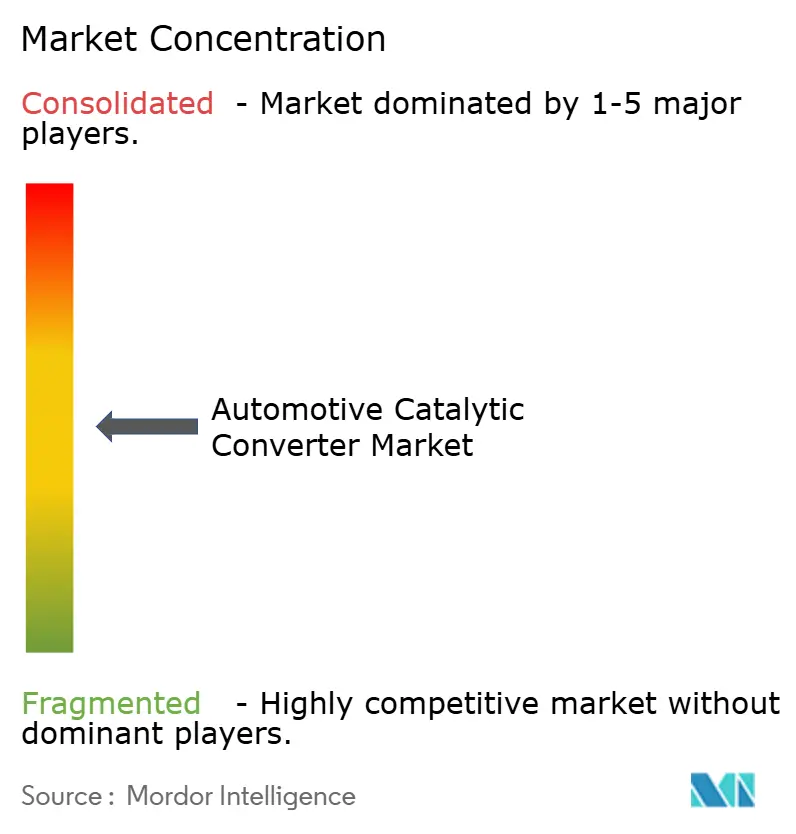
The market is moderately concentrated, with major players accounting for a prominent share. Scale economies in precious-metal recycling and sourcing deliver cost leverage while also creating barriers for smaller entrants. Technology differentiation is now the primary contest ground, with established players investing in hydrogen-ready converters, electro-thermal catalyst heaters, and machine-learning calibration models that optimize air-fuel ratios on the fly.
Regional specialization is evident. European groups emphasize deeply integrated exhaust modules for stringent legislative zones. Asian firms supply cost-effective systems for volume models, leveraging vertically integrated substrate production. North American producers concentrate on high-durability solutions for heavy trucks and off-road equipment. Closed-loop recycling schemes led by large refiners increasingly support OEM carbon-neutrality pledges by demonstrating full-life PGM traceability.
Innovation pipelines feature perovskite chemistries that slash PGM intensity, nano-structured wash-coats that regenerate in situ, and additive-manufactured honeycombs that cut weight without compromising surface area. Commercial rollout timelines hinge on scalable manufacturing and multi-year field durability validation, keeping traditional PGM catalysts dominant through most of the decade.
Automotive Catalytic Converter Industry Leaders
-
Tenneco Inc
-
Marelli Holdings Co., Ltd.
-
Eberspächer Group
-
Boysen Group
-
Futaba Industrial Co. Ltd.
- *Disclaimer: Major Players sorted in no particular order
Automotive Catalytic Converter Market Companies Covered in this Report
- Marelli Holdings Co., Ltd.
- Tenneco Inc. (Walker Emissions Control)
- HELLA GmbH and Co. KGaA
- Eberspächer Group
- Yutaka Giken Company Limited
- Futaba Industrial Co. Ltd.
- Boysen Group
- BOSAL International
- Katcon S.A. de C.V.
- Sejong Industrial Co., Ltd.
- Hanwoo Industrial Co. Ltd.
- Sango Co. Ltd.
- Benteler International AG
Market Opportunities and Future Outlook
A key whitespace arises from tighter durability and real-driving compliance requirements and evolving duty cycles of hybridized powertrains. Ultra-tight Euro 7 type-approval timing for new light-duty types beginning 29 November 2026 under Regulation (EU) 2024/1257 and the supporting methodologies in Implementing Regulation (EU) 2025/1706 drive near-term reengineering toward higher-activity catalyst layers, integrated gasoline particulate filtration, and improved low-temperature performance, elevating content value per vehicle when unit growth varies by region.
Closed-loop metals management and recycling-led cost and carbon control are expanding as PGM price volatility and traceability scrutiny increase procurement risk. The market also shows pull from off-road and non-road fleets under tightening emissions programs and from hydrogen-ICE development that still requires robust NOx control hardware. Technology pathways around reducing PGM intensity while sustaining conversion efficiency, including advanced washcoats, passive-SCR concepts, and scalable recycling processes for spent automotive catalysts, are linked to supply-chain resilience and OEM compliance programs rather than standalone R&D.
Recent Industry Developments in Automotive Catalytic Converter Market
- April 2026: Marelli showcased propulsion and thermal innovations at Auto China 2026, including exhaust gas management technologies relevant to modern aftertreatment packaging. The emphasis on integrated thermal and exhaust solutions supports tighter emissions compliance under hybrid and downsized ICE architectures and strengthens Marelli's positioning with China-facing OEM programs.
- December 2025: Tenneco's DRiV business expanded its Walker CARB-compliant CalCat portfolio by adding 118 catalytic converter part numbers, extending coverage to more than 9 million vehicles. The broader CARB-compliant offering reinforces aftermarket channel competitiveness as emissions enforcement and compliance verification increase in key US states.
- October 2024: Tenneco opened hydrogen-ICE testing facilities in Burscheid, Germany, and Ann Arbor, Michigan, along with a dedicated hydrogen materials lab in Nuremberg. The added capability accelerates validation of hydrogen-capable aftertreatment materials and systems, aligning catalytic converter development with emerging hydrogen engine programs while maintaining a focus on NOx control requirements.
Automotive Catalytic Converter Market Report Scope and Research Methodology
Market Definition and Coverage
For this study, the market covers the value of catalytic converters used in on-road vehicles to reduce tailpipe emissions, counted when the unit is sold for fitment in OEM production or as a replacement in the aftermarket.
Scope exclusions: Off-road equipment and non-automotive emission control uses are not counted in this market value.
Segments Covered in This Report
- By Converter Type
- Two-Way Catalytic Converters
- Three-Way Catalytic Converters
- Other Types
- By Vehicle Type
- Passenger Cars
- Light Commercial Vehicles
- Medium and Heavy Commercial Vehicles
- Off-Road and Non-Road Equipment
- Motorcycles and Powersports
- By Fuel Type
- Gasoline
- Diesel
- Hybrid (MHEV, HEV, and PHEV)
- By Substrate Material
- Platinum
- Palladium
- Rhodium
- Others (Cerium, Vanadium, and Perovskites)
- By Geography
- North America
- United States
- Canada
- Rest of North America
- South America
- Brazil
- Argentina
- Rest of South America
- Europe
- Germany
- United Kingdom
- France
- Italy
- Spain
- Russia
- Rest of Europe
- Asia-Pacific
- China
- India
- Japan
- South Korea
- Australia and New Zealand
- Rest of Asia-Pacific
- Middle East and Africa
- Saudi Arabia
- United Arab Emirates
- Turkey
- South Africa
- Nigeria
- Rest of Middle East and Africa
- North America
Data Sources, Market Sizing, and Validation
Desk Research
Desk research sets the boundaries and the basic demand pool so the model stays tied to real vehicle activity. We referenced public sources such as national vehicle registration statistics, transportation and environment agencies that publish emission rules and compliance timelines, customs trade data portals for relevant components, and trade association releases covering aftertreatment and emissions control.
To keep assumptions realistic, we also reviewed company annual reports, investor presentations, and reputable press for production plans, supply constraints, and capacity shifts. Where needed, paid subscriptions for company financials and news, patent databases, and shipment-level import and export data were used to cross-check price movements, technology changes, and trade direction. These examples are not exhaustive, and other public sources were also used for data collection, validation, and research clarification.
Primary Interviews and Surveys
Primary work was used to pressure-test the desk assumptions and refine key inputs such as OEM versus aftermarket mix, average selling price changes linked to precious metal pass-through, and the pace of platform shifts by fuel type. We spoke with component makers, channel partners, recyclers, and subject experts across APAC, EMEA, and the Americas so regional regulation timing and vehicle production patterns were not averaged too loosely.
Distribution of primary research fieldwork respondents
| Company type | Respondent position | Region |
|---|---|---|
| Top tier: 38% | CXOs: 18% | APAC: 43% |
| Mid tier: 41% | Functional/Unit leaders: 25% | EMEA: 33% |
| Smaller Players: 21% | Managers: 57% | Americas: 24% |
Market-Sizing & Forecasting
Sizing starts from a top-down build where vehicle production and parc signals, filtered by emission regulation penetration, are used to reconstruct the annual demand pool for converter fitment and replacement. That demand pool is then translated into value using price logic that reflects substrate choice and the pass-through of platinum group metal content, before being aligned to currency timing for the stated year.
To keep totals practical, we corroborated the output with selective bottom-up checks, such as sampled unit volumes by vehicle class, channel checks for replacement rates, and supplier-side revenue ranges where disclosure is available. When gaps appear, like limited visibility on informal aftermarket flows, assumptions are kept conservative and re-tested with expert feedback rather than being filled with aggressive extrapolation.
For forecasting, scenario analysis was applied around a core trend line so the model can react to swings in light vehicle production, diesel share changes, tighter emission steps, and precious metal price direction. Inputs tracked as part of the model include new vehicle production by region, aftermarket replacement cycles, the mix of gasoline versus diesel and hybrid platforms, average PGM loadings by converter type, and recycling-driven supply tightness that can affect pricing.
Data Validation & Update Cycle
Validation happens in layers so single-source bias does not determine the final number. We compare model outputs against independent signals such as regional vehicle production trends, trade patterns for relevant parts, and observable price movements for key inputs, and then anomalies are reviewed until the cause is clear.
Before sign-off, the work is checked through multi-step analyst reviews, and respondents are re-contacted when a major variance shows up in ASP, replacement rate, or regional mix. Reports are refreshed annually, and interim updates are made when material events occur, such as regulation changes or sharp commodity price shifts. Right before delivery, a fresh pass is completed so clients receive the most current view.
Mordor Intelligence's Automotive Catalytic Converter Market Estimate Compared With Other Published Estimates
Published market sizes for catalytic converters often differ because the timing of price capture and currency conversion can shift the value outcome significantly, particularly when precious metal prices move quickly. Differences also come from what is treated as a converter versus a wider aftertreatment system, and from how OEM and aftermarket revenues are blended.
Key gap drivers are usually visible once you check three items: whether the number is factory-gate versus end-market, whether replacement cycles are modeled from parc behavior or assumed as a flat ratio, and whether ASP progression is refreshed with metal price pass-through at the right month or quarter. In this report, the refresh cadence and the currency timing for annual ASP updates are handled with specific checks, which is why Mordor Intelligence lands at a lower 2026 value than some broader-scope figures.
Benchmark comparison
| Source | Market Size | Gaps in Research Methodology |
|---|---|---|
| Mordor Intelligence | USD 120.39 B (2026) | |
| Global Publisher A | USD 188.60 B (2025) | Uses a factory-gate framing with a broader definition that can group complete emission control systems and additional vehicle classes into the same bucket, and the year reported is different, which makes commodity-linked ASPs and FX timing hard to compare directly. |
| Industry Publisher B | USD 65.80 B (2024) | Lower base-year value suggests a narrower revenue capture or different inclusion rules for OEM versus aftermarket, and its horizon and regional weighting can shift totals when replacement rates and diesel shares are treated differently. |
The spread across published figures is mainly explained by scope boundaries and by when prices are taken for the year, rather than by one single demand indicator. By keeping the demand pool tied to vehicle production and parc-driven replacement behavior, and then updating ASP inputs with repeatable checks, our estimate stays traceable to clear steps that can be re-run when market conditions change.
Key Questions Answered in the Report
What is the current size of the catalytic converters market?
The catalytic converters market generated USD 120.39 billion in 2026 and is on track to reach USD 177.87 billion by 2031.
How fast is the catalytic converter market growing?
From 2026 to 2031, the market expands at an 8.12% compound annual growth rate.
Which converter type leads the global share?
Three-way catalytic converters commanded 66.20% of global revenue in 2025.
Why is Asia-Pacific the largest regional market?
China’s stringent China 7 standards, combined with India’s expanding vehicle production, give Asia-Pacific a 49.30% share and the fastest 7.72% CAGR.
What role do hydrogen internal-combustion engines play?
Hydrogen-ICE platforms for heavy trucks still require three-way catalysts to control NOx, opening a fresh demand stream even as electrification advances.