
Market Overview
| Study Period | 2020 - 2031 |
|---|---|
| Forecast Data Period | 2026 - 2031 |
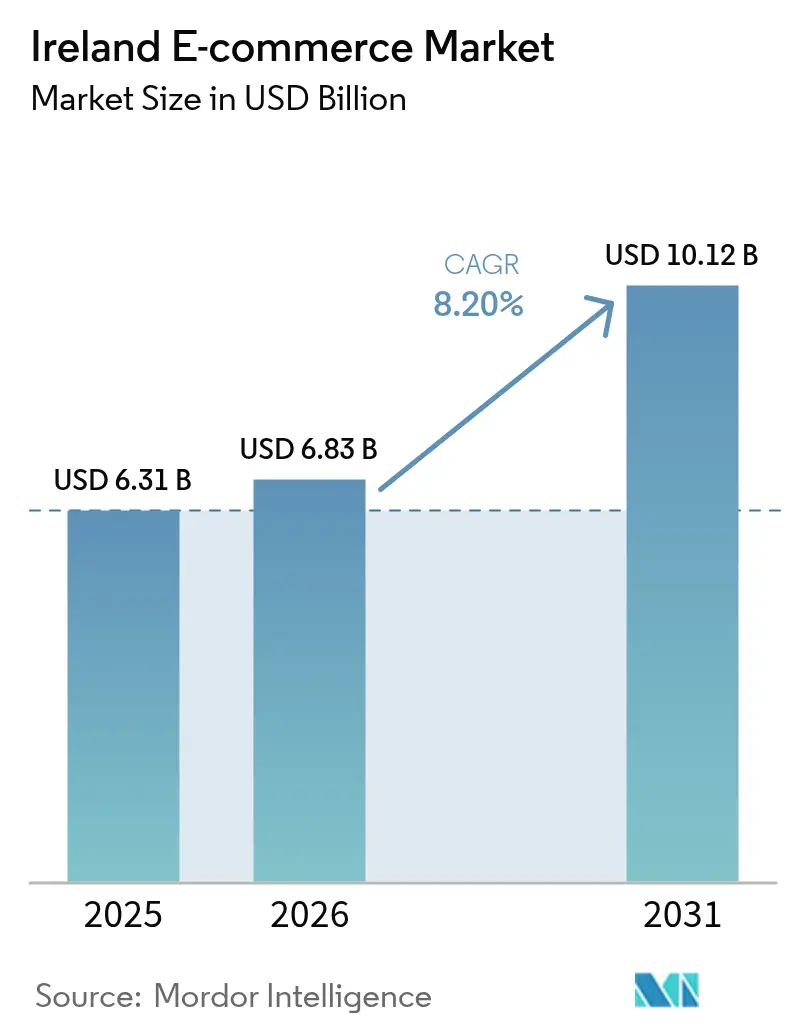
| Base Year Market Size (2025) | USD 6.31 Billion |
| Market Size (2026) | USD 6.83 Billion |
| Market Size (2031) | USD 10.12 Billion |
| Growth Rate (2026 - 2031) | 8.20 % |
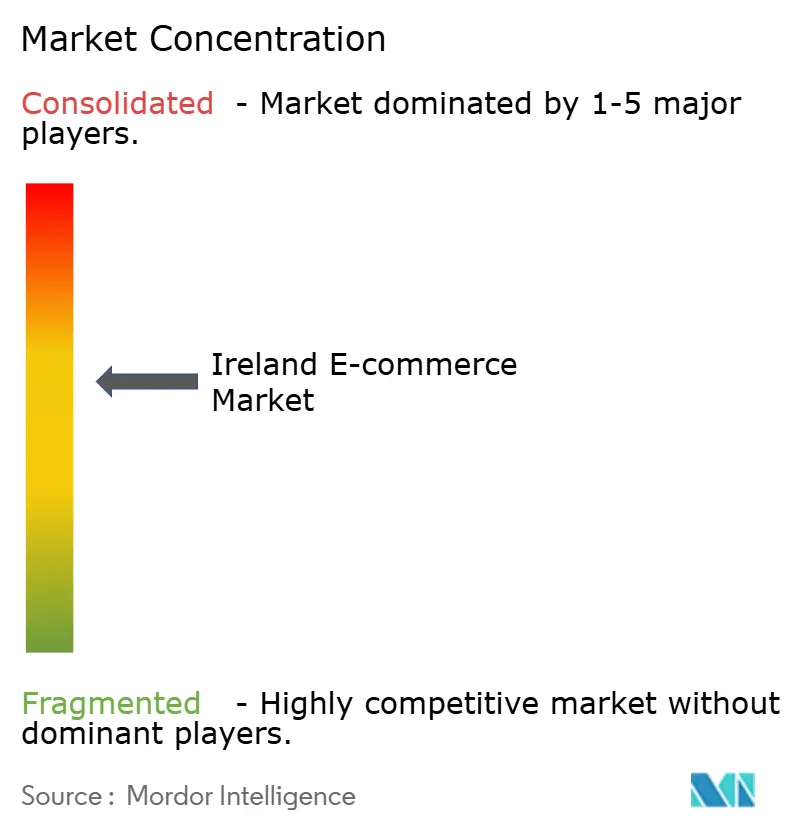
| Market Concentration | Medium |
Major Players *Disclaimer: Major Players sorted in no particular order Image © Mordor Intelligence. Reuse requires attribution under CC BY 4.0. | |
Ireland E-commerce Market Analysis by Mordor Intelligence
The Ireland e-commerce market size is expected to grow from USD 6.31 billion in 2025 to USD 6.83 billion in 2026 and is forecast to reach USD 10.12 billion by 2031 at 8.2% CAGR over 2026-2031. Demand momentum is underpinned by government programs that treat the digital economy as a strategic growth pillar worth the equivalent of 13% of national GDP.[1] Ireland’s unique position as an English-speaking, euro-denominated gateway between the EU and the UK adds further upside, especially after Brexit complicated direct UK-to-EU e-commerce flows. Same-day delivery roll-outs by An Post and global players such as Amazon have reset consumer expectations around speed, pushing average order values higher and encouraging omnichannel investments by domestic retailers.[2] An SME-focused policy mix—led by Grow Digital vouchers, tax credits and advisory hubs—is rapidly closing the technology adoption gap, with two-thirds of small firms now at basic digital intensity and almost the same share experimenting with AI and cloud tools. On the consumer side, raised contactless limits and the surge of Buy-Now-Pay-Later (BNPL) options are translating into larger basket sizes and materially lower cart-abandonment rates, while tighter EU consumer-rights rules have pushed trust indicators to historic highs.
Key Report Takeaways
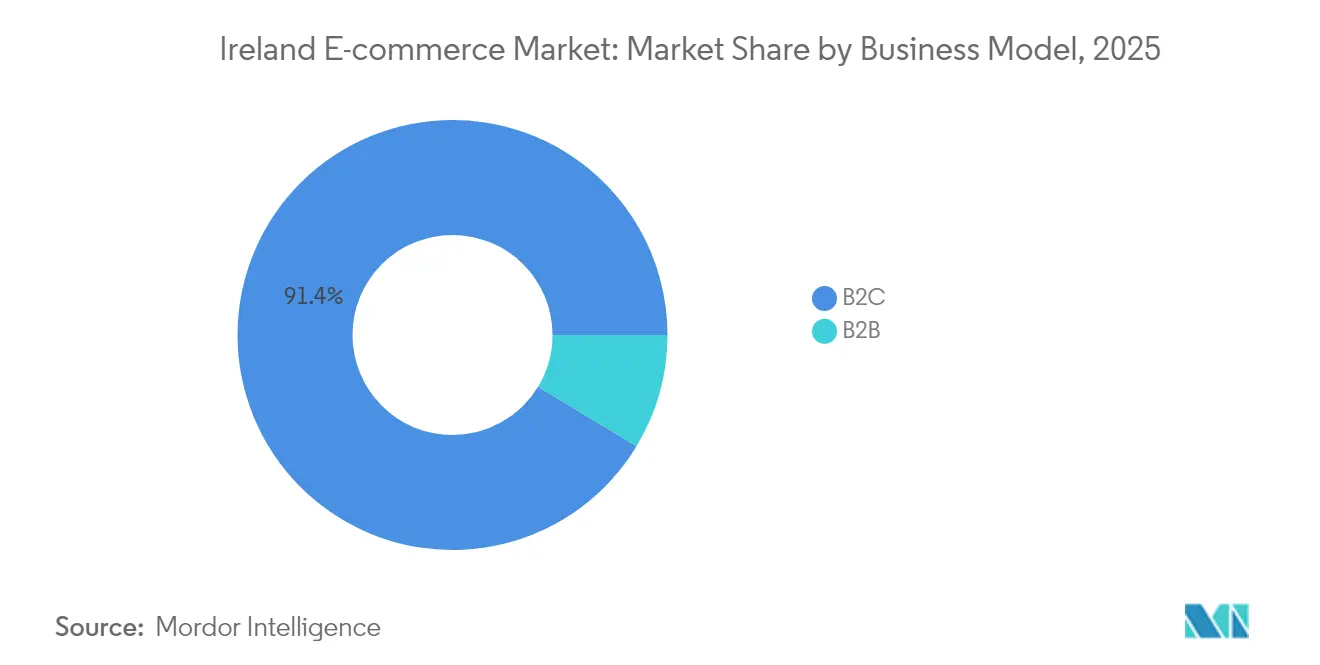
- By business model, the B2C segment held 91.35% of the Ireland e-commerce market share in 2025; B2B is projected to expand at a 12.4% CAGR to 2031.
- By device type, smartphones and tablets accounted for 67.10% of the Ireland e-commerce market size in 2025, with a 10.3% CAGR outlook through 2031.
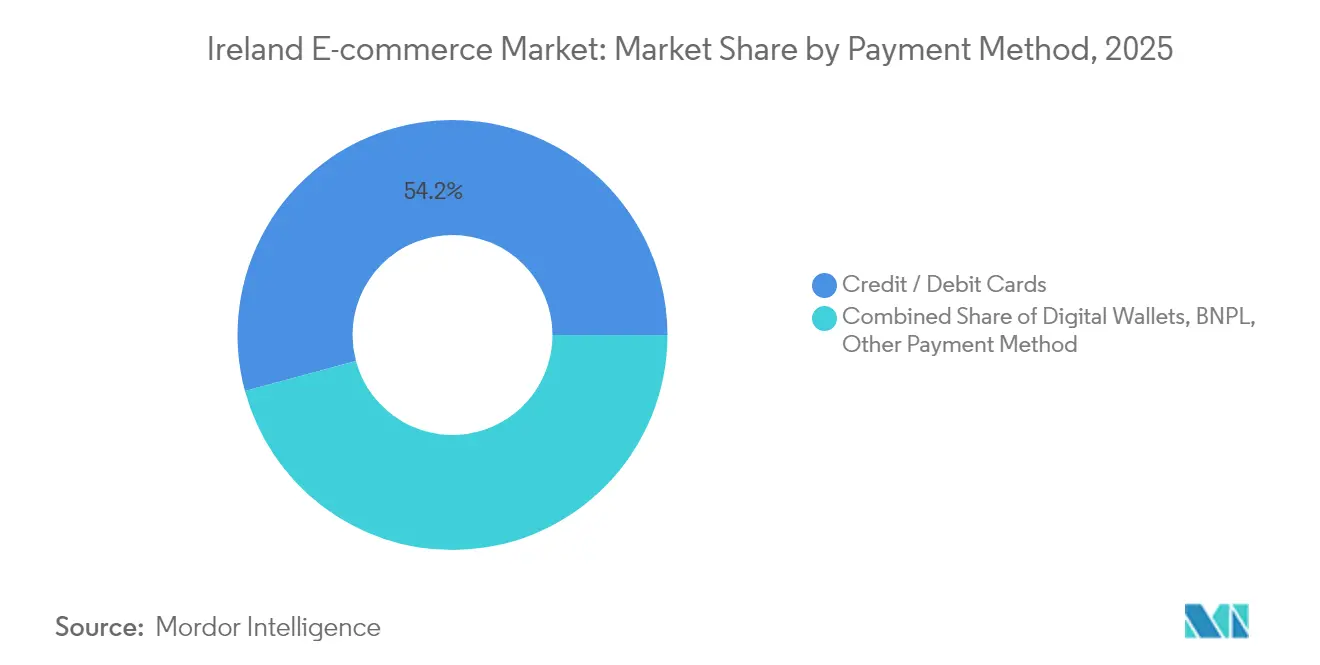
- By payment method, credit and debit cards retained 54.20% share of the Ireland e-commerce market size in 2025, while BNPL is advancing at a 13.1% CAGR to 2031.
- By B2C product category, fashion & apparel led with 26.40% revenue share in 2025, whereas beauty & personal care is the fastest-growing segment at a 11.8% CAGR.
Note: Market size and forecast figures in this report are generated using Mordor Intelligence’s proprietary estimation framework, updated with the latest available data and insights as of 2026.
Ireland E-commerce Market Trends and Insights
Drivers Impact Analysis*
| Driver | (~) % Impact on CAGR Forecast | Geographic Relevance | Impact Timeline |
|---|---|---|---|
| Proliferation of same-day delivery infrastructure across Irish urban centres | +1.8% | Dublin, Cork, Galway metropolitan areas | Short term (≤ 2 years) |
| Revised EU Digital Consumer Rights Directive boosting online consumer trust | +1.2% | National, with stronger impact in rural areas | Medium term (2-4 years) |
| Rapid increase in contactless debit-card limits driving higher AOV | +0.9% | National, concentrated in urban centers | Short term (≤ 2 years) |
| National Digital Strategy 2030 grants accelerating Irish SME webshop onboarding | +1.5% | National, prioritizing rural and underserved regions | Long term (≥ 4 years) |
| Buy-Now-Pay-Later adoption among millennials and Gen-Z shoppers | +1.1% | National, skewing toward 18-35 demographic clusters | Medium term (2-4 years) |
| Source: Mordor Intelligence | |||
Proliferation of Same-Day Delivery Infrastructure Across Irish Urban Centres
An Post, DPD and Fastway jointly operate 47 automated sortation sites and 312 parcel lockers, enabling retailers to promise same-day fulfilment to 2.1 million households that place orders before 14:00. Average order value for these orders is 23% higher than standard-delivery baskets, pushing omnichannel incumbents such as SuperValu to pilot micro-fulfilment robotics for inventory accuracy. The Ireland e-commerce market therefore enjoys metropolitan service levels comparable to the most advanced EU peers, yet rural customers remain on 2-3-day lead times, preserving scope for further growth.
Revised EU Digital Consumer Rights Directive Boosting Online Consumer Trust
The post-2024 rollout of the Digital Services Act (DSA) increased Irish consumer trust in online shopping to 78%, up from 65% a year earlier, as dispute-resolution times fell and chargebacks dropped 31%.[3] Oversight is split between media-regulator Coimisiún na Meán and the Competition & Consumer Protection Commission, providing a dual-layer enforcement structure that international platforms now view as a competitive advantage rather than a compliance cost. The Ireland e-commerce market thereby benefits from a trust dividend that directly lowers acquisition spend.
Rapid Increase in Contactless Debit-Card Limits Driving Higher AOV
Bank of Ireland data show a 34% surge in contactless volumes after the limit moved to EUR 50 (USD 54) in 2025. Instant settlement rails championed by the Central Bank have removed payment-friction points that historically deterred large online purchases. Digital wallets already represent 29% of all card transactions, and their mobile-first UX delivers conversion rates 18% above static card entry flows.
National Digital Strategy 2030 Grants Accelerating Irish SME Webshop Onboarding
Grow Digital vouchers distributed EUR 47 million (USD 51 million) to 9,400 SMEs in 2024, covering platform build-outs and digital marketing spend. Enterprise Ireland’s Digital-for-Business advisory added technical expertise to 3,200 firms, with 85% launching live web shops within six months. As a result, Ireland e-commerce market participation among SMEs now generates 30% of their total sales, outpacing the EU benchmark of 20%.
Restraints Impact Analysis*
| Restraint | (~) % Impact on CAGR Forecast | Geographic Relevance | Impact Timeline |
|---|---|---|---|
| Post-Brexit customs frictions raising delivery cost & transit time from UK sellers | -1.4% | National, with higher impact on border counties | Long term (≥ 4 years) |
| High last-mile logistics cost in rural West & Northwest counties | -0.8% | Connacht and Ulster regions primarily | Medium term (2-4 years) |
| Recurrent e-commerce cyber-breaches eroding shopper confidence | -0.6% | National, concentrated in high-value transaction segments | Short term (≤ 2 years) |
| Source: Mordor Intelligence | |||
Post-Brexit Customs Frictions Raising Delivery Cost & Transit Time From UK Sellers
Extra customs paperwork and EUR 8-15 (USD 9-16) handling fees per shipment add 2-4 days of latency on UK orders, cutting UK-to-Ireland cross-border volumes 27% since 2024. Many UK merchants have exited the market rather than navigate VAT thresholds below EUR 135 (USD 146), leading Irish consumers to source more goods from EU suppliers.
High Last-Mile Logistics Cost in Rural West & Northwest Counties Hinders Market
Despite the National Broadband Plan’s rollout to 544,000 premises, parcel carriers face 40-60% higher per-stop costs in Leitrim and neighbouring counties because of low drop densities and difficult terrain. Shared-delivery pilots remain fragmented, prolonging a two-speed Ireland e-commerce market in which rural cart conversion lags urban norms.
*Our forecasts treat driver/restraint impacts as directional, not additive. The impact forecasts reflect baseline growth, mix effects, and variable interactions.
Segment Analysis
By Business Model: B2B Acceleration Outpaces B2C Maturation
B2C transactions continued to dominate with a 91.35% share in 2025, yet B2B volumes are on course for a 12.4% CAGR through 2031 as manufacturing and services firms digitalise procurement. This interplay suggests that the Ireland e-commerce market size for B2B could approach a fifth of total GMV by decade-end. Enterprise Ireland subsidies and high SME cloud adoption rates underpin the trend, while Applied Nutrition’s 39% European growth demonstrates how digital wholesale channels bypass legacy distributors.
B2C growth is steady rather than explosive, helped by mobile checkout speeds that already capture 65% of all consumer orders. Government white-paper progress reports show 85% of digital-transformation milestones on track, implying further efficiency gains for both sides of the marketplace.

By Device Type: Mobile Dominance Drives Infrastructure Investment
Smartphones and tablets owned 67.10% traffic share in 2025 and are set to expand at 10.3% CAGR as 5G coverage matures. That places the device segment on course to account for roughly 74% of the Ireland e-commerce market size by 2031. The drive for low-latency commerce has spurred edge-computing nodes in metropolitan clusters, while desktop remains relevant for large-ticket B2B orders where specification review is more involved.
Voice assistants and smart TVs are still niche, but early adopters are experimenting with conversational commerce, pointing to new touchpoints for marketers who need to reach screen-agnostic consumers.
By Payment Method: BNPL Disrupts Traditional Card Dominance
Cards still process 54.20% of 2025 GMV, yet BNPL’s 13.1% CAGR outlook would move its share into the mid-teens by 2031, fuelled by transparent fee structures and embedded checkout UX. Digital wallets benefit from PSD2 open-banking rails, while the coming digital euro promises instant transactions that could compress merchant fees further. The Ireland e-commerce market share held by legacy cards will remain sizeable but less dominant as multi-rail payment orchestration becomes the norm.
By B2C Product Category: Beauty Emerges as Growth Leader
Fashion & apparel delivered 26.40% of consumer GMV in 2025, but beauty & personal care is the volume-weighted growth engine at a 11.8% CAGR. Hybrid work lifestyle keeps consumer electronics resilient, while on-demand food delivery platforms widen the addressable market for groceries. The Ireland e-commerce market size for discretionary categories therefore rides both self-care premiumisation and convenience demand, with omnichannel loyalty programs such as Levi’s Red Tab creating stickier customer relationships.
Geography Analysis
The domestic market boasts internet penetration above 95%, placing Ireland in the EU’s top quartile. Dublin alone generates roughly 40% of online turnover thanks to multinational tech clusters, a deep talent pool and dense last-mile networks. Cork and Galway form the next tier, aided by university ecosystems that accelerate digital-native consumption patterns.
Rural regions benefit from high-speed broadband but still pay 40-60% delivery premiums, a pricing delta that depresses transaction frequency. The Ireland e-commerce market size measured on a per-capita basis is therefore materially higher in Leinster versus Connacht and Ulster, reinforcing the case for logistics partnerships that aggregate rural demand onto shared routes.
On the cross-border front, 38% of Irish consumers still buy internationally despite post-Brexit frictions, helped by EU Digital Markets Act harmonisation that makes continental purchases seamless. Amazon’s Irish domain launch in March 2025, with EUR-priced inventory and one-day delivery promises, underscores the island’s producer-and-consumer role as a UK-EU bridge.
Regulatory Landscape
Ireland’s e-commerce regulatory environment is shaped by EU digital rules implemented through national legislation and enforced by multiple competent authorities. The Digital Services Act 2024 (Act No. 2 of 2024), enacted in February 2024, designates Coimisiun na Mean as Ireland’s Digital Services Coordinator, while the Competition and Consumer Protection Commission (CCPC) is designated as a competent authority with specific responsibilities for online marketplaces, including DSA-linked marketplace obligations. In parallel, online selling continues to be governed by consumer law requirements such as the Consumer Rights Act 2022, including prescribed pre-contract information and the 14-day cooling-off period for distance contracts.
Funding and enforcement mechanics have become more explicit under the DSA implementation framework. The Digital Services Act 2024 (Amendment) Act 2024 (Act No. 26 of 2024) provides for levies on intermediary service providers and online platform providers to fund supervision, reinforcing the compliance cost and reporting focus for platforms operating in Ireland. The CCPC also remains a key Irish enforcement body for EU rules that matter directly to merchants using large platforms, including the Platform-to-Business Regulation (EU 2019/1150) and the Geo-blocking Regulation (EU 2018/302), supporting transparency in ranking, terms changes, and access for EU consumers.
Value Chain Analysis
The Ireland e-commerce value chain covers merchant sourcing and brand ownership, store-front and marketplace enablement, payments and risk management, and domestic plus cross-border fulfillment. On the operations side, third-party logistics and fulfillment providers such as DPD Ireland, 2Flow, and Masterlink Logistics support warehousing, pick-pack-ship operations, inventory management, and last-mile delivery, which is central to service-level differentiation as same-day and next-day delivery expectations expand in major urban areas. Payments and compliance run in parallel, with acquiring, card rails, wallets, and BNPL options embedded into checkout, and with platform and consumer-protection requirements influencing how marketplaces onboard merchants and surface product and seller information.
Regulatory-linked costs and logistics bottlenecks influence margin structure across the chain. Ireland’s DSA implementation introduced levy-based funding for supervision, including the levy mechanism for consumer online platform providers (introduced via S.I. No. 190/2025, effective June 1, 2025), which adds an ongoing cost layer for in-scope platforms. Physical constraints also persist, including port capacity pressures affecting inbound flows, planning and permitting friction for digital infrastructure rollout, and an uneven cost-to-serve profile in rural counties, keeping fulfillment density and returns handling as key operational levers for merchants and their logistics partners.
Competitive Landscape
Competition remains intense but not yet winner-takes-all. Amazon’s local launch has escalated service-level expectations, yet domestic banners such as Tesco.ie and Currys.ie still defend share through click-and-collect convenience and local merchandising. SuperValu’s adoption of Tally shelf-scanning robots illustrates how traditional grocers weaponise technology to keep pace on stock accuracy and fulfilment speed.
Fintech innovation has become a battlefield differentiator. Wayflyer’s revenue-based financing model injects working capital into high-potential merchants, while Fiserv’s full takeover of AIB Merchant Services signals accelerating payment-stack consolidation. Market white space persists in rural fulfilment, B2B procurement and niche verticals that demand regulatory expertise, giving agile Irish startups room to manoeuvre before global giants pivot into those micro-segments.
Strategic moves now centre on ecosystem building rather than pure sales volume: parcel-locker alliances, embedded finance plays and multi-tenant marketplace platforms all feature prominently. The Ireland e-commerce market therefore trends toward service bundling, with logistics, payments and data analytics offered as integrated solutions that lock in both merchants and shoppers.
Ireland E-commerce Industry Leaders
-
Amazon.co.uk
-
Argos Distributors (Ireland) Limited
-
Tesco Ireland
-
Currys Ireland Limited
-
Littlewoods Ireland
- *Disclaimer: Major Players sorted in no particular order
Market Opportunities and Future Outlook
Opportunities in the Ireland e-commerce market are increasingly tied to higher service-level expectations, tighter platform regulation, and growing automation in fulfillment. On the supply side, new capacity and control points are being added, including Shein’s opening of a 16,000 square feet logistics facility in Greenogue Business Park, Rathcoole, Dublin (June 2026) and DPD Ireland’s announced EUR 10 million investment in a new Dublin distribution hub at Gateway Logistics Park, Newlands Cross, planned to use 270 autonomous robots and target throughput of 10,000 parcels per hour when operational (announced July 2026, operational target October 2026). These moves create whitespace for merchants and enablers that can integrate fast delivery, returns, and inventory accuracy into a single customer promise, particularly as service standards reset after platform localization and same-day delivery expansion.
A second opportunity area is compliance-led enablement and trust infrastructure for platforms and merchants operating under EU digital rules implemented in Ireland. With Coimisiun na Mean and the CCPC designated as competent authorities for the Digital Services Act, and levy-backed supervision mechanisms already in place, demand rises for tools and services that operationalize marketplace transparency, trader identification workflows, notice-and-action processes, and consumer-rights disclosures across web and mobile storefronts. Government digital programs also provide pull-through for SME digitization and public-sector digital usage, including the National Digital and AI Strategy (90 actions) and the Digital Public Services Plan 2030 (targets for online availability and digital consumption), supporting room for commerce software, analytics, and AI adoption services that smaller retailers can implement without large in-house teams.
Recent Industry Developments
- July 2026: DPD Ireland announced a EUR 10 million investment in a new Dublin distribution hub at Gateway Logistics Park, Newlands Cross, designed around automated sorting using 270 autonomous robots. The facility is planned to handle up to 10,000 parcels per hour and is targeted to be operational by October 2026, strengthening delivery speed and cut-off times for e-commerce merchants serving the Dublin metro area.
- June 2025: Fiserv completed its acquisition of AIB Merchant Services, combining acquiring, POS, and value-added payment services into a single offering for Irish merchants. The deal consolidates payment acceptance capabilities for retailers running omnichannel models and supports faster onboarding for online sellers that need cross-border processing options.
- February 2024: The Digital Services Act 2024 (Act No. 2 of 2024) was enacted in Ireland, designating Coimisiun na Mean as the Digital Services Coordinator and assigning the CCPC specific responsibilities for online marketplaces under the DSA framework. The implementation clarified supervisory roles for platform compliance, increasing the importance of governance, seller transparency, and consumer-protection processes across marketplaces and webshops.
Research Methodology Framework and Report Scope
Market Definition and Coverage
For this study, the Ireland e-commerce market is defined as the value of purchases made online by buyers in Ireland, covering domestic and cross-border transactions for goods and digitally delivered services, measured at the point of payment.
Scope exclusions: We exclude peer-to-peer classifieds, online gambling, and digital advertising revenues from the market totals.
Segmentation Overview
- By Business Model
- B2C
- B2B
- By Device Type
- Smartphone / Mobile
- Desktop and Laptop
- Other Device Types
- By Payment Method
- Credit / Debit Cards
- Digital Wallets
- BNPL
- Other Payment Method
- By B2C Product Category
- Beauty and Personal Care
- Consumer Electronics
- Fashion and Apparel
- Food and Beverages
- Furniture and Home
- Toys, DIY and Media
- Other Product Categories
Data Sources, Market Sizing, and Validation
Desk Research
Desk research was used to set the outer guardrails for what can reasonably be counted as e-commerce in Ireland, and to anchor key demand signals before interviews began. We relied on public sources such as the Central Statistics Office Ireland for online purchasing and household connectivity indicators, the European Commission for Digital Economy and Society context, and VAT related guidance from Irish authorities and EU frameworks that influence cross-border online buying. Additional directional inputs were taken from international trade and business guidance sources such as the US International Trade Administration, along with payments and retail disclosures available through annual reports and investor presentations.
To keep the model grounded in real commercial activity, we also reviewed press coverage, association updates, and retailer announcements that point to changes in delivery capability, returns policies, and checkout adoption. Where company level financial splits were not directly visible, we used paid databases for company financials and news screening, then cross-checked supporting facts using patent databases and contracts or tenders where relevant to logistics and fulfillment. These desk sources are illustrative, and many other public references were also used to collect data, validate assumptions, and clarify open questions during the work.
Primary Interviews and Surveys
Interviews and surveys with Ireland-based e-commerce executives, channel specialists, payment professionals, and retail managers clarify online demand, cross-border activity, average order values, and business-to-business sales within the Ireland market. Their input is used to test secondary indicators, address gaps in marketplace and enterprise coverage, and examine unusual assumptions before the model is finalized. Re-contact is considered when expert views conflict with observed Irish retail, payment, or shopper activity.
Distribution of primary research fieldwork respondents
| Company type | Respondent position |
|---|---|
| Top tier: 30% | CXOs: 15% |
| Mid tier: 45% | Functional/Unit leaders: 35% |
| Smaller Players: 25% | Managers: 50% |
Market-Sizing & Forecasting
Market sizing starts with a top-down build where national demand signals and online shopping behavior are converted into a value pool that matches Ireland purchase realities, and then reconciled to the included scope. In practice, we used indicators such as online shopper penetration, cross-border online purchase share, average order values by common baskets, category mix shifts (for example, apparel versus travel and tickets), and delivery and returns intensity as a practical proxy for transaction volume changes.
Once the macro pool was formed, selective bottom-up checks were used to keep the totals realistic, including sampled seller revenue roll ups where disclosures exist, channel checks on price and order sizes, and unit level sense checks using observed parcel activity trends and typical order frequency. Where disclosures were missing, gaps were handled by using peer benchmarks from similar operating models in Ireland and then adjusting them through interview feedback.
For forecasting, scenario analysis was applied around a central case, since e-commerce demand in a small open economy can move with consumer confidence, inflation, and cross-border pricing differences. Assumptions were then reviewed with experts for likely ranges on online adoption, average order value progression, and the pace of shift from offline to online in everyday categories. The final trajectory was taken only after these variables aligned consistently.
Data Validation & Update Cycle
Validation was done through simple but repeated checks, where model outputs were compared with independent signals like household online purchasing rates, observed shifts in key product baskets, and the practical constraints created by delivery coverage and returns. If a year showed an unusual jump or drop, it was flagged, reviewed by another analyst, and then rechecked through follow up conversations so outliers were not left unexplained.
Before sign-off, the full set of assumptions is reviewed step by step, and variances versus prior versions are documented so changes remain traceable. The report is refreshed annually, and interim updates are made when material events occur, such as tax changes that affect cross-border flows or a visible step change in delivery capability. Right before delivery, a final pass is completed so clients receive the latest updated view.
Mordor Intelligence's Ireland Ecommerce Market Size Versus Other Published Estimates
Published market values for Ireland e-commerce can differ even when the same year is being discussed, because authors do not always count the same types of transactions or apply the same timing and currency treatment. Differences also show up when one estimate relies more on retail only signals, while another includes digitally delivered services or cross-border purchases as part of the addressable value.
In our checks, the biggest gap drivers tend to be whether B2B is included, whether travel and ticketing are counted as e-commerce or left under services, and how cross-border orders are treated when payment is processed outside Ireland. Currency conversion timing also matters, since a yearly average rate versus a spot rate can move a USD figure. The table points to this spread, where purchases of digitally delivered services and cross-border checkout value are included in the total, a scope choice applied by Mordor Intelligence.
Benchmark comparison
| Source | Market Size | Gaps in Research Methodology |
|---|---|---|
| Mordor Intelligence | USD 6.31 B (2025) | |
| Government Trade Brief A | USD 6.69 B (2025) | Often presented as a retail oriented market figure with less explicit treatment of what is excluded, which can shift totals when services, B2B activity, and cross-border payment recognition are handled differently. |
| E-commerce Data Platform B | USD 6.61 B (2025) | Typically built from tracked online retail revenue definitions and category datasets, which may not fully align with inclusion of digitally delivered services and can apply different online share and category mapping assumptions. |
Across the three figures, the direction of difference is consistent with scope and accounting choices rather than a disagreement on Ireland's online shopping trend. By keeping the included transaction types explicit and then stress testing key levers like cross-border share and average order values, the final number stays easier to follow and repeat year to year.
Key Questions Answered in the Report
What is the current value of the Ireland e-commerce market?
The Ireland e-commerce market is valued at USD 6.83 billion in 2026 and is projected to hit USD 10.12 billion by 2031.
Which business model is expanding fastest?
B2B e-commerce is forecast to grow at a 12.4% CAGR to 2031, outpacing the mature but still dominant B2C segment.
Why is BNPL important in Ireland?
BNPL solutions are expanding at a 13.1% CAGR as millennials and Gen Z favour interest-free instalments over traditional revolving credit.
How significant is mobile commerce?
Smartphones and tablets account for 67.10% of online transactions today and are on course for a 10.3% CAGR, driven by 5G and mobile-wallet adoption.
What barriers limit rural e-commerce adoption?
Higher last-mile delivery costs—up to 60% above urban rates—and fewer parcel-locker locations keep rural conversion rates below urban benchmarks.
How has Brexit affected Ireland’s online retail?
Customs fees and longer transit times have reduced UK-origin orders by 27%, pushing Irish shoppers toward EU suppliers and domestic platforms.