
Market Overview
| Study Period | 2020 - 2031 |
|---|---|
| Forecast Data Period | 2026 - 2031 |
| Base Year Market Size (2025) | USD 3.02 Billion |
| Market Size (2026) | USD 3.13 Billion |
| Market Size (2031) | USD 3.74 Billion |
| Growth Rate (2026 - 2031) | 3.62 % |
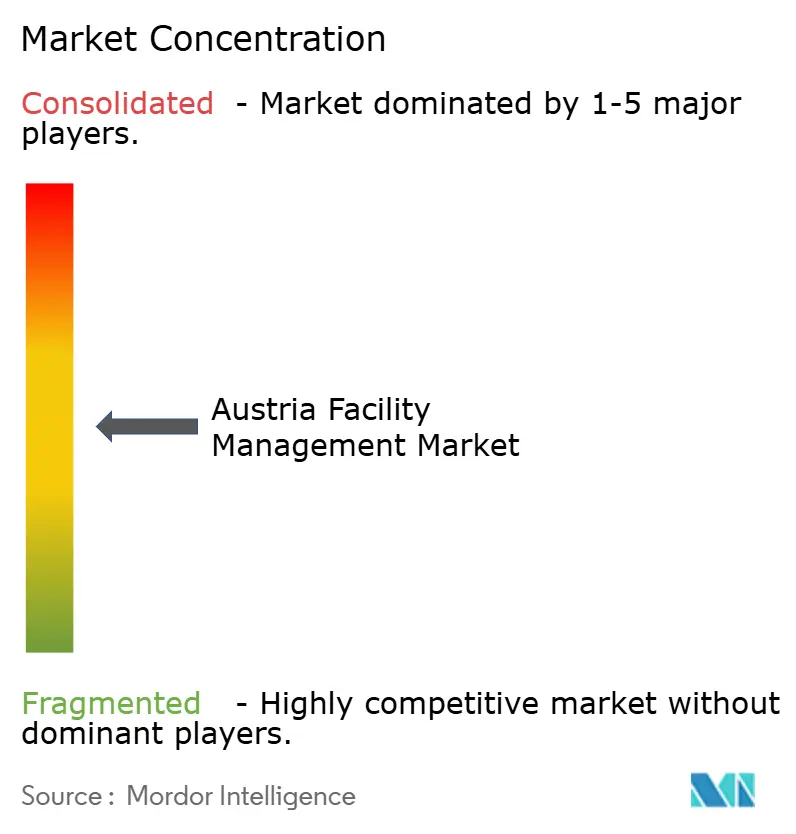
| Market Concentration | Medium |
Major Players *Disclaimer: Major Players sorted in no particular order Image © Mordor Intelligence. Reuse requires attribution under CC BY 4.0. | |
Austria Facility Management Market Analysis by Mordor Intelligence
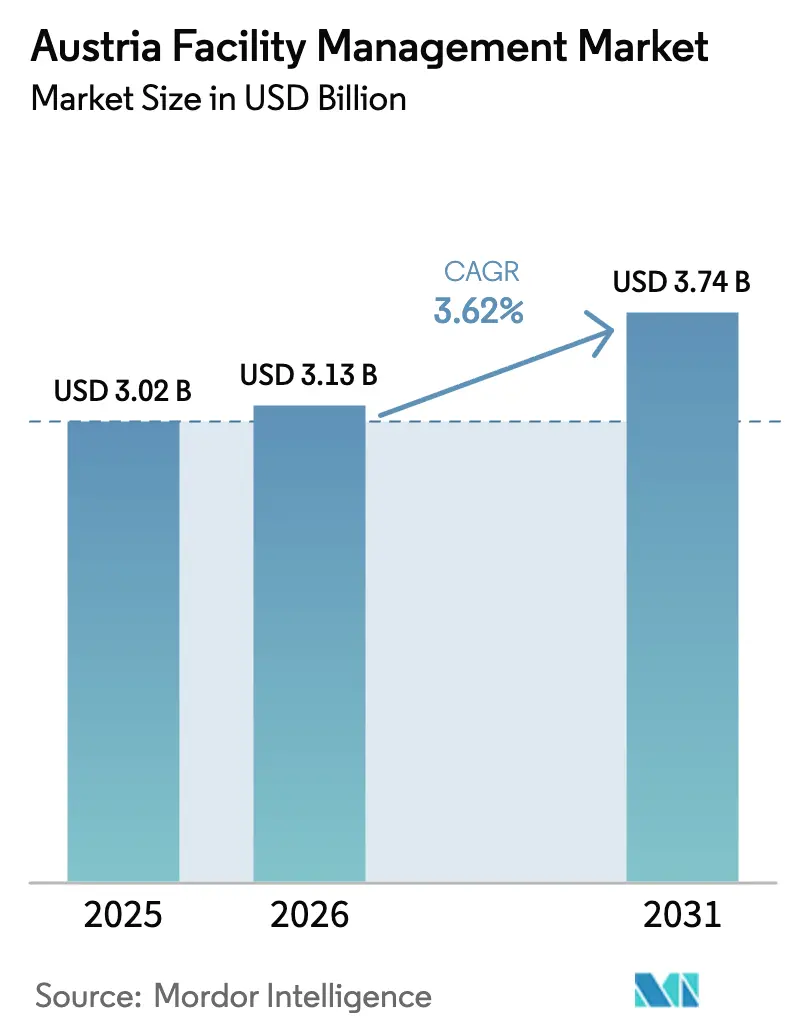
Austria facility management market size in 2026 is estimated at USD 3.13 billion, growing from 2025 value of USD 3.02 billion with 2031 projections showing USD 3.74 billion, growing at 3.62% CAGR over 2026-2031. Vienna’s climate-neutrality mandate, an energy cost upsurge of 19% following the phase-out of temporary subsidies, and the construction sector’s tentative 0.2% rebound are shaping service demand profiles. A decisive pivot toward building automation, smart-meter rollouts, and performance-linked contracts is fostering sustained investment in hard services even as soft services dominate day-to-day budgets. Heightened regulatory scrutiny around energy performance, especially in healthcare facilities that account for 6.7% of national CO₂ emissions, is prompting corporates to bundle services under integrated frameworks. Meanwhile, labour shortages and the 3.90% wage hike effective January 2025 continue to squeeze margins, accelerating digital twin and predictive-maintenance adoption among leading vendors.[1]
Key Report Takeaways
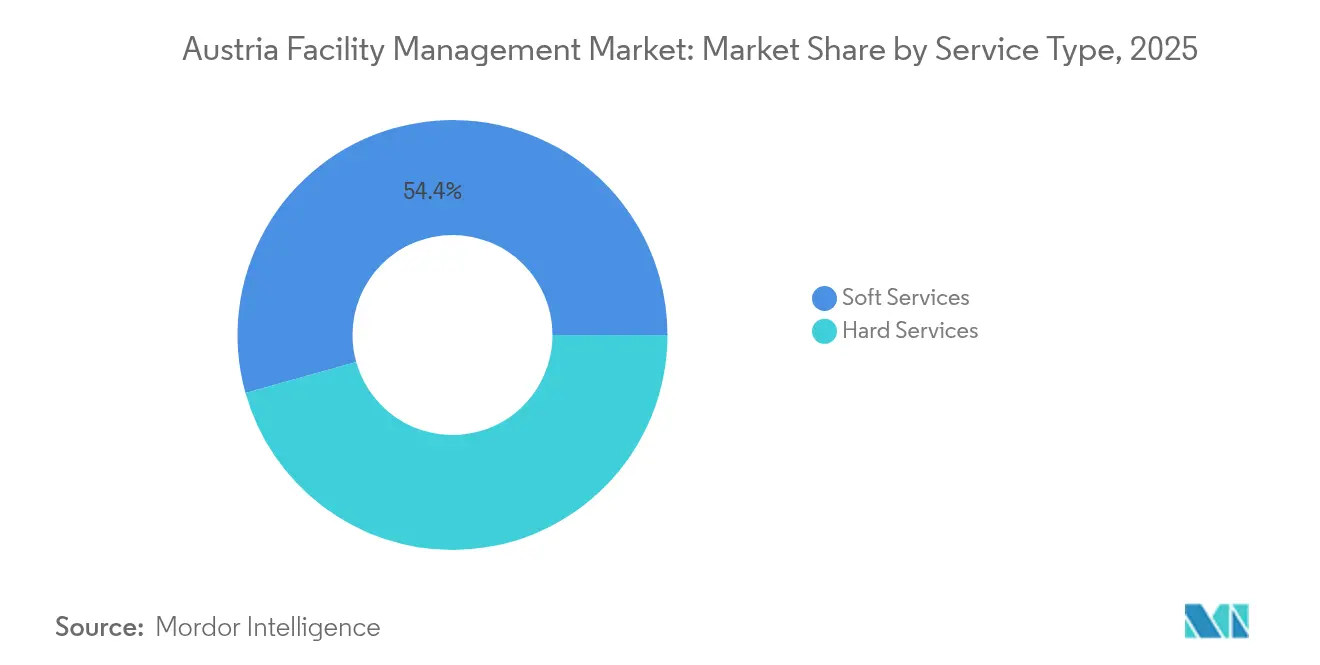
- By service type, soft services held 54.35% of the Austria facility management market share in 2025, while technical hard services are projected to expand at a 6.45% CAGR to 2031.
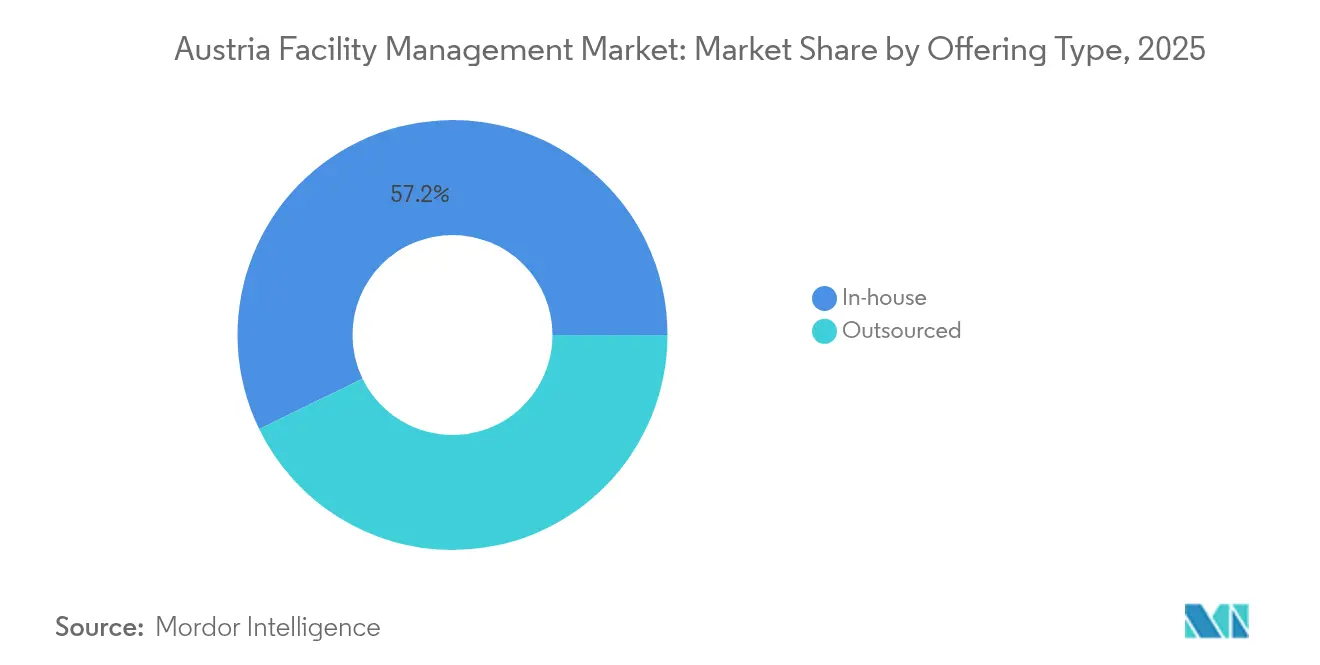
- By offering type, in-house delivery retained 57.20% share of the Austria facility management market size in 2025; integrated FM outsourcing is advancing at a 8.75% CAGR through 2031.
- By end-user Industry, the commercial segment accounted for 34.10% of the Austria facility management market in 2025, whereas healthcare is set to rise at a 7.05% CAGR between 2026 and 2031.
Note: Market size and forecast figures in this report are generated using Mordor Intelligence’s proprietary estimation framework, updated with the latest available data and insights as of 2026.
Austria Facility Management Market Trends and Insights
Drivers Impact Analysis*
| Driver | (~) % Impact on CAGR Forecast | Geographic Relevance | Impact Timeline | |
|---|---|---|---|---|
| Current Occupancy Rates: Hybrid Work Models Reshape Space Utilization | 1.20% | Vienna, Graz, Linz metropolitan areas | Medium term (2-4 years) | |
| Profitability Rates of Major FM Players: Margin Pressure Drives Innovation | 0.80% | National, concentrated in commercial hubs | Short term (≤ 2 years) | |
| Workforce Indicators – Labor Participation: Skill Shortages Reshape Service Delivery | 0.60% | National, acute in Vienna and Salzburg | Long term (≥ 4 years) | |
| Urbanization and Population Growth in Major Metros: Density Drives Service Complexity | 0.90% | Vienna, Graz, Linz, Salzburg | Long term (≥ 4 years) | |
| Current Occupancy Rates: Hybrid Work Models Reshape Space Utilization | 1.20% | Vienna, Graz, Linz metropolitan areas | Medium term (2-4 years) | |
| Profitability Rates of Major FM Players: Margin Pressure Drives Innovation | 0.80% | National, concentrated in commercial hubs | Short term (≤ 2 years) | |
| Source: Mordor Intelligence | ||||
Current Occupancy Rates - Hybrid Work Models
Flexible-work policies are shrinking traditional office footprints yet increasing daily fluctuations in space usage, prompting operators to adopt IoT occupancy sensors and cloud scheduling tools. Enhanced cleaning frequency, touch-free access, and dynamic energy-load balancing are becoming standard service add-ons. Vienna’s Smart City agenda encourages FM firms to integrate real-time building data into municipal dashboards to optimise energy and mobility flows. Providers responding fastest are embedding workplace-as-a-service models that bundle space analytics, remote helpdesk, and maintenance fulfilment, turning fluctuating demand into a recurring-revenue stream.[2]
Profitability Rates of Major Facility Management Players
A 3.90% baseline wage rise, and double-digit network-energy cost hikes have narrowed gross margins for most suppliers. Market leaders such as Dussmann lifted FM division sales 10.5% in 2023 by absorbing Janus Group’s healthcare portfolio and rolling out robotics-supported cleaning. Service providers are pooling procurement, automating back-office workflows, and piloting subscription-based energy-management modules that directly tie fees to consumption savings.[3]
Workforce Indicators - Labor Participation
Austria’s working-age population is on track to shrink 5-8% by 2030, aggravating shortages in HVAC, building automation, and technical cleaning. SIMACEK responds by widening Central-European recruitment funnels and running dual-education tracks with vocational schools. Growth in remote monitoring and predictive maintenance reduces onsite staffing dependency, yet the sector still invests heavily in AR-assisted repair guides and micro-credential programs to upskill existing teams.
Urbanization & Population Growth in Major Metros
Vienna targets a 35% greenhouse-gas reduction by 2030, embedding renewables and district-heating loops into dense mixed-use zones. Projects like the EUR 200 million Seestadt Aspern vocational campus deploy geothermal and photovoltaic systems that require life-cycle asset oversight. High-rise infill and transit-oriented development are expanding vertical-transport and façade-maintenance workloads, rewarding FM firms capable of bundling safety, energy, and community-engagement services into single contracts.
Restraints Impact Analysis*
| Restraint | (~) % Impact on CAGR Forecast | Geographic Relevance | Impact Timeline |
|---|---|---|---|
| Skilled Labor Shortages: Demographic Headwinds Constrain Growth | -1.10% | National, acute in Vienna and technical centers | Long term (≥ 4 years) |
| Technology Adoption Costs: Investment Barriers Delay Transformation | -0.70% | National, concentrated in SME segment | Medium term (2-4 years) |
| Skilled Labor Shortages: Demographic Headwinds Constrain Growth | -1.10% | National, acute in Vienna and technical centers | Long term (≥ 4 years) |
| Technology Adoption Costs: Investment Barriers Delay Transformation | -0.70% | National, concentrated in SME segment | Medium term (2-4 years) |
| Source: Mordor Intelligence | |||
Skilled Labor Shortages – Demographic Headwinds
Declining birth rates and retirements are eroding the talent pipeline, particularly for advanced BMS, HVAC, and fire-safety technicians. Providers lure scarce specialists with above-market wages and flexible rosters while investing in campus partnerships. Automation is filling gaps yet cannot fully replace competency in regulatory audits and complex retrofits, slowing project rollouts in sensitive facilities.
Technology Adoption Costs – Investment Barriers
Full-scale smart-building conversions cost EUR 50 000–500 000 per site and often exceed SME budget thresholds, stretching payback horizons beyond five years. Mandatory smart-meter deployment under the revised Electricity Economics Act illustrates the financial burden, with implementation costs of EUR 2.53 billion outweighing direct benefits. Leasing, energy-performance contracts, and staged retrofits are emerging as viable pathways, yet organizational inertia continues to delay transformative upgrades.
*Our forecasts treat driver/restraint impacts as directional, not additive. The impact forecasts reflect baseline growth, mix effects, and variable interactions.
Segment Analysis
By Service Type: Soft Services Dominate Amid Technical Transformation
Soft services captured 54.35% of the Austria facility management market share in 2025 thanks to enduring demand for cleaning, security, and hospitality functions. The category remains indispensable in offices, healthcare, and hospitality, even as vendors face tighter margins from labour cost inflation. Cleaning leads the sub-mix, with robotics-assisted floor care and antimicrobial coatings extending contract scope. Security services increasingly integrate cloud CCTV, biometric access, and cyber-monitoring to protect hybrid offices and data centers. Catering retains relevance by aligning menus with ESG metrics and waste-recovery programs.
Hard services are on a steeper growth path, rising at a 6.45% CAGR through 2031. Within hard services, MEP and HVAC retrofits gain urgency as Vienna prepares to phase out gas heating by 2040, driving adoption of heat pumps and thermal-storage systems. Building-automation and IoT suites unlock predictive-maintenance value, lengthening asset life and lowering energy use. The Austria facility management market size for technical services is poised to widen as asset owners demand ESG reporting aligned to EU taxonomy thresholds. Fire-safety compliance, lift-maintenance digitization, and façade-access robotics round out high-growth niches. Together, the diverging trajectories of soft and hard services underscore a marketplace bifurcating between volume-driven routines and expertise-driven technical disciplines.

By Offering Type: Integrated Models Gain Traction
In-house teams still delivered 57.20% of total services in 2025, sustained by owner preference for direct oversight of statutory compliance and cultural alignment. Yet skill shortages and the complexity of ESG disclosure rules are exposing capability gaps that internal departments struggle to fill. Companies therefore lean on targeted outsourcing for energy audits, waste valorisation, and asset-condition surveys.
Integrated facility management (IFM) outsourcing is the fastest-advancing format, on track for a 8.75% CAGR. Multi-year, outcome-based contracts like the 25-year PORR-Apleona vocational school engagement are setting new benchmarks for value capture and lifecycle risk transfer. The Austria facility management market size for bundled and single-service contracts is consequently expected to plateau, nudging suppliers toward end-to-end offerings that weave soft and hard services into shared digital platforms. Providers scoring highest on sustainability metrics, data transparency, and innovation pipelines are thus emerging as preferred partners for corporates navigating regulatory change.
By End-User Industry: Healthcare Leads Growth Trajectory
Commercial real estate dominated with 34.10% share in 2025, supported by IT-telecom hubs, logistics parks, and mixed-use malls. However, hybrid work has thinned weekday footfall, prompting landlords to recalibrate cleaning rosters and energy-set points.
Healthcare is the fastest-growing vertical, projected at 7.05% CAGR through 2031 as demographic ageing and clinical-infrastructure modernisation spur demand for high-specification FM. Hospitals require continuous HVAC calibration, infection-control cleaning, and resilience audits tied to 24/7 operations. The Austria facility management market size serving healthcare facilities is further buoyed by the sector’s commitment to carbon-neutrality pathways, opening opportunities for renewable-heat integration and circular-procurement services. Hospitality, benefiting from 18.1% RevPAR growth in April 2025, remains a bright spot for energy-efficient refurbishments, while institutional estates maintain steady demand anchored in public-funding cycles. Industrial complexes and multi-housing schemes also require specialised FM as they decarbonise process loads and enhance tenant amenities.
Geography Analysis
Vienna is the epicentre of the Austria facility management market, combining dense public administration, healthcare campuses, and corporate headquarters. Smart-city investments drive pilots in district heating, waste-heat recovery, and AI-enabled mobility nodes, yielding fertile ground for service innovation. The Austria facility management market size linked to Vienna alone is expected to outpace the national average as fresh capital migrates toward smart-district retrofits and net-zero public buildings.
Graz and Linz form the second tier of demand. Graz’s move2zero strategy to decarbonise its bus fleet amplifies need for depot energy management and fleet-charging maintenance, while the city’s industrial R&D spine seeds opportunities in laboratory FM and cleanroom upkeep. Linz, with a steel-centric industrial base transitioning to hydrogen, requires integrated hard-service bundles to modernise heavy plant utilities. Salzburg, driven by tourism and cultural venues, leans on adaptive cleaning rotations and guest-experience technologies that align with peak visitor seasons.
Regional markets outside the metropolitan quartet remain fragmented yet promising, particularly where hospital networks and vocational campuses concentrate. Rural renewable-energy installations, including wind-repowering projects, add pockets of specialised FM demand for turbine, substation, and access-road maintenance. Collectively, the geographic mosaic underscores a need for providers with both nationwide reach and local cultural fluency.
Regulatory Landscape
Facility management operations in Austria sit in a compliance-heavy environment covering business licensing, building operation duties, and workforce rules. Commercial facility activities and many site-level operating requirements are governed under the Trade Act (Gewerbeordnung 1994) and administered through district administrative authorities, which shapes how providers set up site procedures, subcontracting, and documentation.
On the digital and technical compliance side, Austria is pushing standardized data practices that link design, permitting, and operations more tightly. ÖNORM A 6241-1 (updated October 15, 2025) specifies requirements for digital building documentation and BIM-related data structures, while ÖNORM B 1801-6 supports standardized coding for facility identification used in CAFM integration. In Vienna, the BRISE-Vienna initiative shows the shift toward model-based approvals by applying OpenBIM and automation in the building permit process, raising the bar for interoperable as-built data that later feeds FM workflows.
Value Chain Analysis
The Austria facility management value chain starts with inputs from labor (technical trades and frontline services) and technology suppliers covering BMS/IoT devices, metering, and CAFM/IWMS software, then moves into service design, mobilization, and delivery across soft and hard services. Providers increasingly combine on-site execution with remote monitoring and reporting, reflecting customer demand to externalize energy documentation and sustainability reporting alongside day-to-day operations.
A visible shift is underway toward integrated delivery models and deeper technical capability, supported by M&A and partnerships that expand electrical engineering, IT infrastructure, and renewable-adjacent services. For example, STRABAG Property and Facility Services strengthened its technical stack through the acquisition of Kagerer Group (announced in 2025), adding competence in electrical engineering, IT infrastructure, and photovoltaic systems. Common bottlenecks remain at the integration layer, where legacy plant systems and fragmented tooling slow end-to-end data continuity, even as larger providers adopt cloud platforms, predictive maintenance analytics, and standardized asset coding to scale multi-site contracts.
Competitive Landscape
Austria’s facility management arena is moderately fragmented. ISS Österreich leverages a 7 000-strong workforce and data-driven KPIs to serve large commercial and institutional clients, sustaining revenue synergies across cleaning, catering, and technical services. SIMACEK, Austria’s largest privately held provider, generated more than EUR 200 million across Central Europe and continues to scale through technology partnerships and ESG reporting tools. Dussmann, fresh from a record EUR 3 billion group turnover, integrates robotics and green-energy retrofits to safeguard margins in a tight labour market.
Strategic differentiation tilts toward digitisation. Market leaders’ pilot digital twins, remote metering, and asset-health dashboards that shrink downtime and boost regulatory compliance. Mid-tier contenders bundle niche strengths-such as heritage-building conservation or high-security data-center protocols-into collaboration models with bigger integrators. Consolidation is expected to accelerate as smaller vendors grapple with capital-intensive technology mandates and wage inflation. Sustainable procurement, transparent Scope 3 reporting, and tenant-wellbeing metrics are emerging selection criteria in new tenders, favouring providers that embed ESG proof-points into contract SLA structures.[4]
Austria Facility Management Industry Leaders
-
ISS Facility Services GmbH
-
Apleona GmbH
-
STRABAG Property & Facility Services GmbH
-
Sodexo Österreich
-
SIMACEK Facility Management Group GmbH
- *Disclaimer: Major Players sorted in no particular order
Market Opportunities and Future Outlook
White space is opening where asset owners need FM partners that can convert building data into auditable outcomes, particularly for energy performance documentation and life-cycle asset oversight. Austria-specific standardization and digitization initiatives, including ÖNORM A 6241-1 updated in October 2025 and ÖNORM B 1801-6 coding for facility identification, support wider rollout of CAFM-connected asset registers and interoperable handover data. This creates opportunities for providers that package as-built validation, digital documentation, and ongoing technical maintenance under one SLA.
Technology-enabled FM services are also creating room for differentiated offerings built around digital twins and AI-supported operations. Government-backed R&D programs provide concrete momentum: the Austrian Research Promotion Agency (FFG) started the ELEVATE project in January 2026 (running through 2028) on data-driven facility management, digital twins, and generative AI for building operations, while the FacilityQ project (starting January 2026 through 2027) targets data continuity between BIM, CAFM, and AI systems. Separately, industry evidence from the Digital Findet Stadt Technologiereport 2026 shows AI usage rising from 8% (2024) to over 51% (2025) in Austria's building and real estate sector, reinforcing demand for practical integration services, workforce upskilling, and scalable analytics modules rather than bespoke one-off digitization.
Recent Industry Developments
- April 2026: STRABAG Property and Facility Services Austria extended its long-term partnership with WESTbahn and expanded the service scope to cover the new southern route between Vienna and Villach. The route extension broadens technical and operational FM workloads across a larger rail asset footprint, supporting longer-term utilization of multi-site maintenance teams and standardized service processes.
- March 2026: ISS Oesterreich highlighted the acquisition of Franye Klima- und Gebaeudetechnik (completed in December 2025) alongside the start of a large healthcare contract in Salzburg that began on February 1, 2026. The combined move strengthens ISS in building technology delivery while anchoring growth in healthcare facilities where HVAC reliability, hygiene, and compliance requirements are elevated.
- May 2025: PORR and Apleona started construction of a vocational school project in Seestadt Aspern, Vienna, with Apleona contracted to manage operations for 25 years after completion. The construction-to-operations linkage reinforces life-cycle FM contracting in Austria and increases the role of integrated providers that can align commissioning, documentation, and long-term performance management.
Research Methodology Framework and Report Scope
Market Definition and Coverage
For this study, the market is defined as the value of facility management services delivered for buildings and sites in Austria, covering hard services (MEP, HVAC, fire safety, asset upkeep) and soft services (cleaning, catering, security, office support), delivered through in-house teams or outsourced partners.
Scope exclusions: we exclude pure construction and one-time renovation project work that is not part of ongoing facility operations and maintenance.
Segmentation Overview
- By Service Type
- Hard Services
- Asset Management
- MEP and HVAC Services
- Fire Systems and Safety
- Other Hard FM Services
- Soft Services
- Office Support and Security
- Cleaning Services
- Catering Services
- Other Soft FM Services
- Hard Services
- By Offering Type
- In-house
- Outsourced
- Single FM
- Bundled FM
- Integrated FM
- By End-User Industry
- Commercial (IT and Telecom, Retail and Warehouses, etc.)
- Hospitality (Hotels, Eateries, Large-scale Restaurants)
- Institutional and Public Infrastructure (Govt, Education, Transportation)
- Healthcare (Public and Private Facilities)
- Industrial and Process (Manufacturing, Energy, Mining)
- Other End-user Industries (Multi-housing, Entertainment, Sports and Leisure)
Data Sources, Market Sizing, and Validation
Desk Research
Desk research helped us set the boundary of what counts as facility management in Austria and create a clean starting point for the sizing model. We used public and official sources such as Statistik Austria for services activity and labor context, Eurostat for comparable structural indicators, and Austrian government ministry publications for building, energy, and public procurement direction that influences outsourcing.
To keep definitions aligned to how services are bought and delivered, we also reviewed materials from sources such as the European Commission (energy performance and compliance guidance), relevant Austrian or EU occupational safety guidance, and trade association releases where service categories and market signals are discussed. Company annual reports, investor presentations, and reputable press coverage were added to understand contract structures, service bundling, and pricing indexation practices. Where needed, we used subscribed datasets selectively for company financials, news, and tender tracking to cross-check directional trends. These desk research sources are illustrative and not exhaustive, and other public references were used during data collection, validation, and clarification.
Primary Interviews and Surveys
We speak with facility managers, service providers, procurement leaders, property specialists, and building operations experts in Austria. Interviews and surveys clarify outsourcing rates, contract renewal timing, labor and energy cost changes, service budgets, and demand from commercial, public, healthcare, hospitality, and industrial sites within Austria. Responses are used to test secondary data, address gaps in reported activity, and adjust model assumptions before final analysis.
Distribution of primary research fieldwork respondents
| Company type | Respondent position |
|---|---|
| Top tier: 30% | CXOs: 18% |
| Mid tier: 47% | Functional/Unit leaders: 32% |
| Smaller Players: 23% | Managers: 50% |
Market-Sizing & Forecasting
Sizing starts with a top-down build where services output and employment cost signals are used to reconstruct the addressable facility services spend in Austria, then filtered by outsourcing penetration and typical contract coverage by building type. To avoid over-counting, the model separates hard and soft service intensity and then aligns it to end-use activity where FM is structurally needed, such as offices, healthcare, industrial sites, hospitality, and public infrastructure.
We corroborate totals using selective bottom-up approximations, mainly by sampling provider revenues, checking tender disclosures, and using simple volume times price logic for common service lines where rates are observable through interviews. Key inputs include outsourcing share by end-user, contract length and renewal patterns, wage and inflation pass-through expectations, the hard versus soft service mix, and the share of bundled or integrated delivery, which affects average pricing and margin. For forecasts, we apply scenario analysis around wage inflation, outsourcing adoption, and energy- and compliance-driven maintenance intensity, with assumptions aligned to what practitioners told us is plausible over the next few years. Where smaller, local providers have limited disclosures, we fill gaps using proportional allocation based on service footprints, then re-check the implied per-building spend against interview ranges.
Data Validation & Update Cycle
Outputs are checked through multiple steps so totals and sub-splits stay consistent with real-world signals. We compare model results with independent indicators like tender activity direction, reported revenue trends among service providers, and macro cost drivers, then rework any outliers that imply unrealistic spending per site or abnormal service mix shifts.
Before sign-off, assumptions are reviewed by another analyst, and follow-up questions are sent back to selected interviewees when a key variable moves beyond a reasonable band. The study is refreshed on an annual cycle, with interim revisions when material events occur, such as changes in public procurement patterns or sharp input-cost movements. Prior to delivery, we complete a final pass so clients receive an up-to-date view using the latest available inputs.
Mordor Intelligence's Austria Facility Management Market Sizing Compared With Other Published Estimates
Published market values for Austria facility management can look far apart because service coverage and timing choices are not standardized across sources. The gaps usually come from whether in-house delivery is counted, how integrated contracts are treated, and what year and currency conversion assumptions are used.
In this market, the refresh cadence matters because wage indexation and CPI-linked clauses can move realized pricing within a short period, and the FX conversion point can shift the USD total even when local demand is steady. For that reason, the checks are refreshed close to release and then locked consistently in Mordor Intelligence.
Benchmark comparison
| Source | Market Size | Gaps in Research Methodology |
|---|---|---|
| Mordor Intelligence | USD 3.13 B (2026) | |
| Regional Consultancy A | USD 4.80 B (2022) | The estimate is anchored to an earlier year and appears to apply a broader facility services boundary, which can pull in adjacent building services activities that are not ongoing FM operations. |
| Trade Advisory B | USD 7.55 B (2024) | The figure is often communicated as external facility services revenue and may include wider outsourced building services, and the implied EUR-to-USD conversion timing can also lift the reported USD value in certain periods. |
The table shows that most of the spread is explained by differences in scope and timing rather than a true disagreement on underlying demand. When in-house versus outsourced treatment is made explicit and pricing escalation is updated using observable index behavior, the resulting total becomes easier to trace back to repeatable inputs.
Key Questions Answered in the Report
What is the current size of the Austria facility management market?
It was valued at USD 3.13 billion in 2026.
How fast is the Austria facility management market expected to grow?
The market is forecast to post a 3.62% CAGR and reach USD 3.74 billion by 2031.
Which service category is expanding the quickest?
Technical hard services, growing at a 6.45% CAGR due to smart-building retrofits and energy-efficiency mandates.
Why is healthcare the fastest-growing end-user segment?
Ageing demographics and the sector’s drive toward carbon-neutral operations are boosting specialised FM demand.
What factors are pushing companies toward integrated outsourcing models?
Regulatory complexity, skill shortages, and the need for unified ESG reporting are encouraging adoption of integrated facility management contracts.
How are rising labor costs influencing FM providers?
A 3.90% salary rise, and ongoing talent shortages are spurring investment in automation and predictive maintenance to sustain profitability.