
Market Overview
| Study Period | 2021 - 2031 |
|---|---|
| Forecast Data Period | 2026 - 2031 |
| Base Year Market Size (2025) | USD 1.9 Billion |
| Market Size (2026) | USD 1.94 Billion |
| Market Size (2031) | USD 2.19 Billion |
| Growth Rate (2026 - 2031) | 2.42 % |
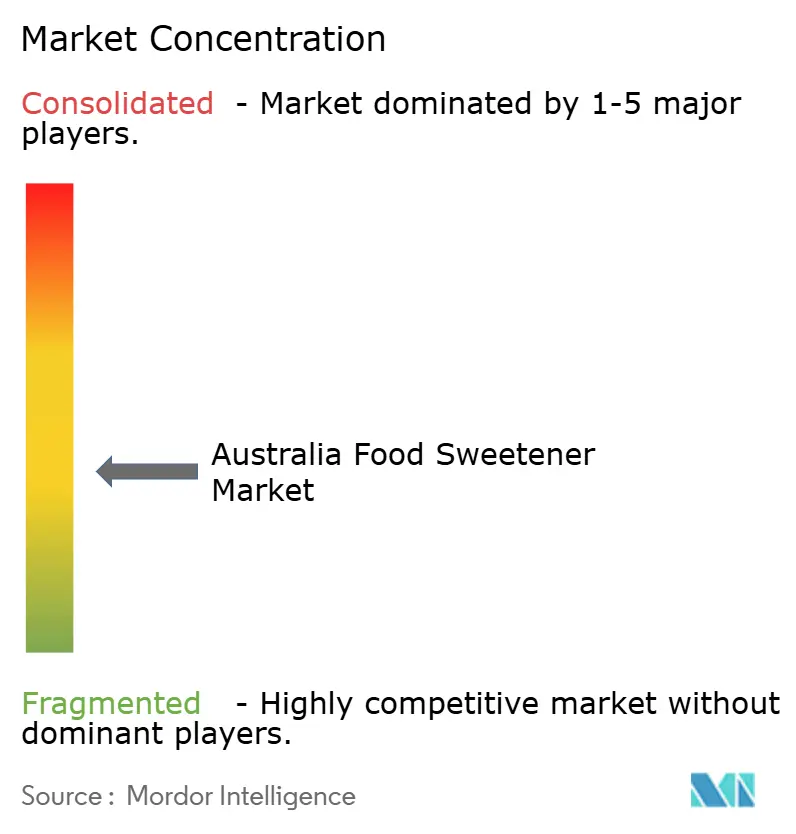
| Market Concentration | Medium |
Major Players *Disclaimer: Major Players sorted in no particular order Image © Mordor Intelligence. Reuse requires attribution under CC BY 4.0. | |
Australia Food Sweetener Market Analysis by Mordor Intelligence
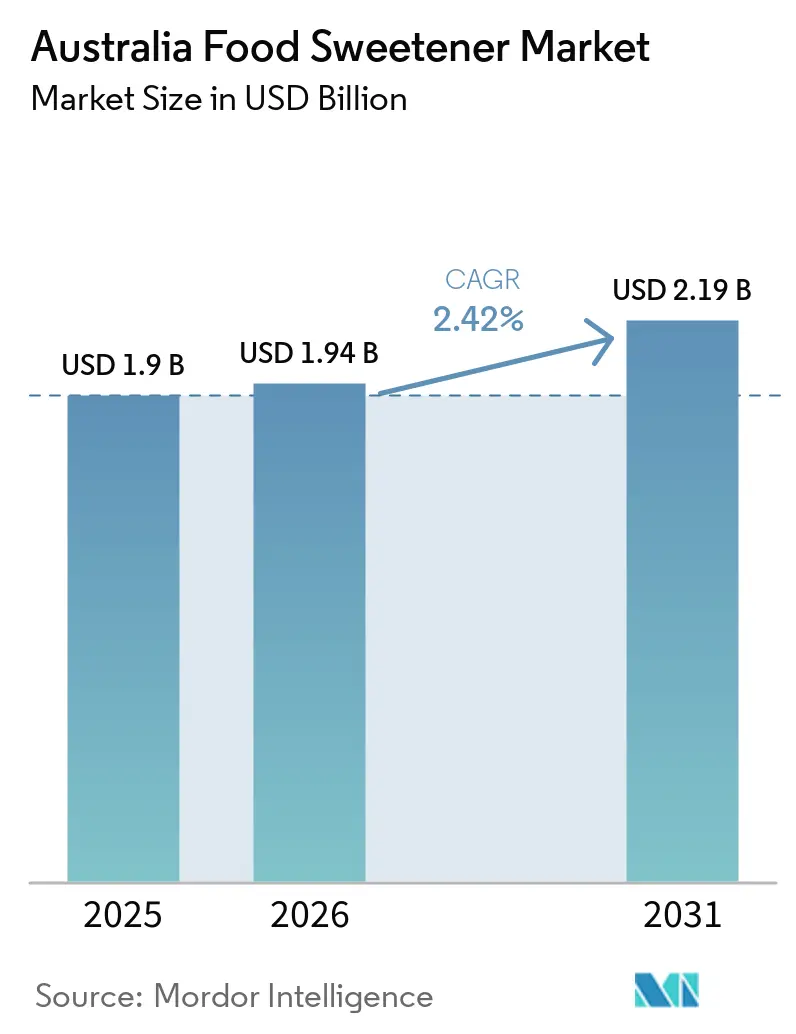
The Australia food sweetener market size was valued at USD 1.90 billion in 2025 and is projected to reach USD 1.94 billion by 2026 and USD 2.19 billion by 2031, at a CAGR of 2.42% during 2026-2031. The category is expanding in value even as lower-sugar diets reshape product formulation, because specialty ingredients usually carry higher unit values than conventional sucrose. Updated reformulation targets for carbonated soft drinks and sweetened yogurts are increasing the need for lower-calorie sweetening systems in food manufacturing [1]. Australian suppliers hold an established position in cane sugar while facing a growing need to develop specialty ingredients for local processors. High-intensity sweeteners, rare sugars, and blends are becoming more relevant where manufacturers need sweetness, reduced calories, acceptable taste, and claims that consumers can understand. The Australia food sweetener market is therefore shaped by reformulation, ingredient functionality, approval requirements, and the cost of producing specialty alternatives.
Key Report Takeaways
- By product type, sucrose held 65.14% of the Australia food sweetener market share in 2025, while high-intensity sweeteners are projected to grow at a CAGR of 3.76% through 2031.
- By form, solid products held 76.42% of the category in 2025, while liquid and syrup formats are projected to grow at a CAGR of 3.77% through 2031.
- By application, food accounted for 62.34% of the Australia food sweetener market size in 2025, while beverages are projected to grow at a CAGR of 3.89% through 2031.
Note: Market size and forecast figures in this report are generated using Mordor Intelligence’s proprietary estimation framework, updated with the latest available data and insights as of January 2026.
Australia Food Sweetener Market Trends and Insights
Drivers Impact Analysis*
| Driver | (~) % Impact on CAGR Forecast | Geographic Relevance | Impact Timeline |
|---|---|---|---|
| Rising Consumer Demand for Reduced-Sugar Products | +0.75% | National, with concentration in metropolitan retail and quick-service foodservice | Short term (≤ 2 years) |
| Growing Popularity of Plant-Based Food Formulations | +0.45% | National, led by premium and specialty retail channels | Medium term (2-4 years) |
| Advancements in Sweetener Extraction and Processing | +0.40% | Global supply chains, with emerging domestic research activity in Queensland | Medium term (2-4 years) |
| Rising Adoption of Clean-Label Food Ingredients | +0.45% | National, particularly functional foods, dairy, and better-for-you snacks | Short term (≤ 2 years) |
| Increasing Prevalence of Obesity and Diabetes | +0.60% | National, across all states and territories | Long term (≥ 4 years) |
| Growing Consumer Interest in Weight Management | +0.35% | National, extending to sports nutrition, protein products, and GLP-1-related diets | Medium term (2-4 years) |
| Source: Mordor Intelligence | |||
Rising Consumer Demand for Reduced-Sugar Products
Australia’s beverage sector reported a further reduction in total sugar sold during 2025 while sales volume increased, showing that product demand can continue when manufacturers reduce sugar in finished beverages. This pattern favors substitution rather than removal of sweetened products from portfolios. The Australia food sweetener market benefits when formulators replace sugar with ingredients that preserve sweetness and fit existing processing systems. The Healthy Food Partnership review has strengthened the policy basis for reformulation in carbonated soft drinks and sweetened yogurts. Liquid-compatible systems, including stevia concentrates and sucralose syrups, are relevant for continuous beverage production because they can be added with controlled dosing. Manufacturers still need to balance flavor, labeling, cost, and consumer acceptance when selecting replacement ingredients.
Growing Popularity of Plant-Based Food Formulations
The 2025 plant-based retail audit found that the number of plant-based products available in Australian supermarkets had declined since 2022, including a decline in meat alternatives [2]. The remaining products face closer competition with conventional foods that have also been reformulated for lower sugar or improved nutrition. This places greater emphasis on sweetness systems that support acceptable taste without compromising ingredient claims. Stevia, monk fruit, and isomaltulose are relevant where brands seek natural sourcing, non-GMO positioning, or organic-compatible formulations. Plant-based dairy products, particularly oat-based products, provide an application for stevia and erythritol blends in lower-calorie offerings. The Australia food sweetener market can therefore gain from demand for formulation systems that work in products with different protein, fat, and flavor profiles.
Advancements in Sweetener Extraction and Processing
Food Standards Australia New Zealand approved Application A1318 in August 2025, allowing an enzymatic route to convert rebaudioside A into rebaudioside [3]. The approval adds a permitted production route for steviol glycosides under the Australia New Zealand Food Standards Code. A 2025 scientific study reported a two-enzyme cascade for rebaudioside M production with a final titer of 38.8 g/L and a molar yield of 85.5%, supporting the commercial relevance of enzymatic production. The University of Queensland and MSF Sugar are working on microbial cell factories that convert Australian cane syrup into rare sugars. These developments may reduce reliance on conventional leaf extraction and give suppliers additional choices for ingredient production. The Australia food sweetener market may gain more resilient supply options if these pathways achieve scale and competitive costs.
Rising Adoption of Clean-Label Food Ingredients
The FSANZ Consumer Insights Tracker reported that 66% of consumers regularly use the Health Star Rating when making food purchases, while 39% trust health-benefit claims on food labels. This gap means that broad wellness claims may be less persuasive than clear information on the ingredient itself. Ingredients identified as stevia extract, monk fruit, or rare sugar can support a more direct labeling approach than generic artificial sweetener systems. D-allulose has an approved novel-food pathway in Australia and New Zealand, giving it a defined position for product development. The ingredient is relevant in functional dairy, sports nutrition, and confectionery where low-calorie positioning matters. The Australia food sweetener market is likely to reward suppliers that pair product performance with documentation that food companies can use in compliant labeling.
Restraints Impact Analysis*
| Restraint | (~) % Impact on CAGR Forecast | Geographic Relevance | Impact Timeline |
|---|---|---|---|
| High Production Costs of Specialty Sweeteners | -0.25% | Global supply chains, with pressure on premium sweeteners in cost-sensitive Australian manufacturing | Medium term (2-4 years) |
| Stringent Regulations on Food Additive Approvals | -0.15% | Australia and New Zealand under the FSANZ framework | Long term (≥ 4 years) |
| Consumer Concerns Regarding Artificial Sweetener Safety | -0.10% | National, affecting retail purchases across all states | Short term (≤ 2 years) |
| Volatility in Raw Material Supply and Pricing | -0.10% | Global, with exposure to Queensland cane supply and Chinese stevia sourcing | Medium term (2-4 years) |
| Source: Mordor Intelligence | |||
High Production Costs of Specialty Sweeteners
High-purity steviol glycosides, including rebaudioside D and rebaudioside M, and rare sugars such as allulose cost more to produce than sucrose or glucose syrups. This constrains their use in commodity bakery, processed meat, and mass-market confectionery. Enzymatic bioconversion can reduce some costs relative to leaf extraction, but it requires investment in bioreactors and proprietary enzymes. The UQ and MSF Sugar project identifies production cost as a central barrier to broader commercial use of rare sugars made from Australian cane syrup. Smaller manufacturers may not have the purchasing scale needed to justify high-intensity sweetener systems for all products. Cost convergence could improve over time, but the input does not support parity with sucrose costs during the forecast period.
Stringent Regulations on Food Additive Approvals
FSANZ regulates sweetener use through Standard 1.3.1 and Schedule 15 of the Australia New Zealand Food Standards Code. New sweeteners require safety assessment, dietary-exposure review, acceptable daily intake consideration, and permitted-use conditions. Application A1325, published in March 2025, seeks to extend the use of steviol glycosides to flour-based hotplate products. The application shows that even a limited extension into products such as crumpets, pikelets, and pancakes needs a complete regulatory assessment. These requirements create costs and longer launch timelines for ingredients such as bioconverted glycosides, sweet proteins, and fermentation-derived compounds. The joint Australia and New Zealand framework makes regulatory planning important for international suppliers entering the Australia food sweetener market.
*Our forecasts treat driver/restraint impacts as directional, not additive. The impact forecasts reflect baseline growth, mix effects, and variable interactions.
Segment Analysis
By Product Type: Sucrose Remains the Leading Ingredient While High-Intensity Sweeteners Expand
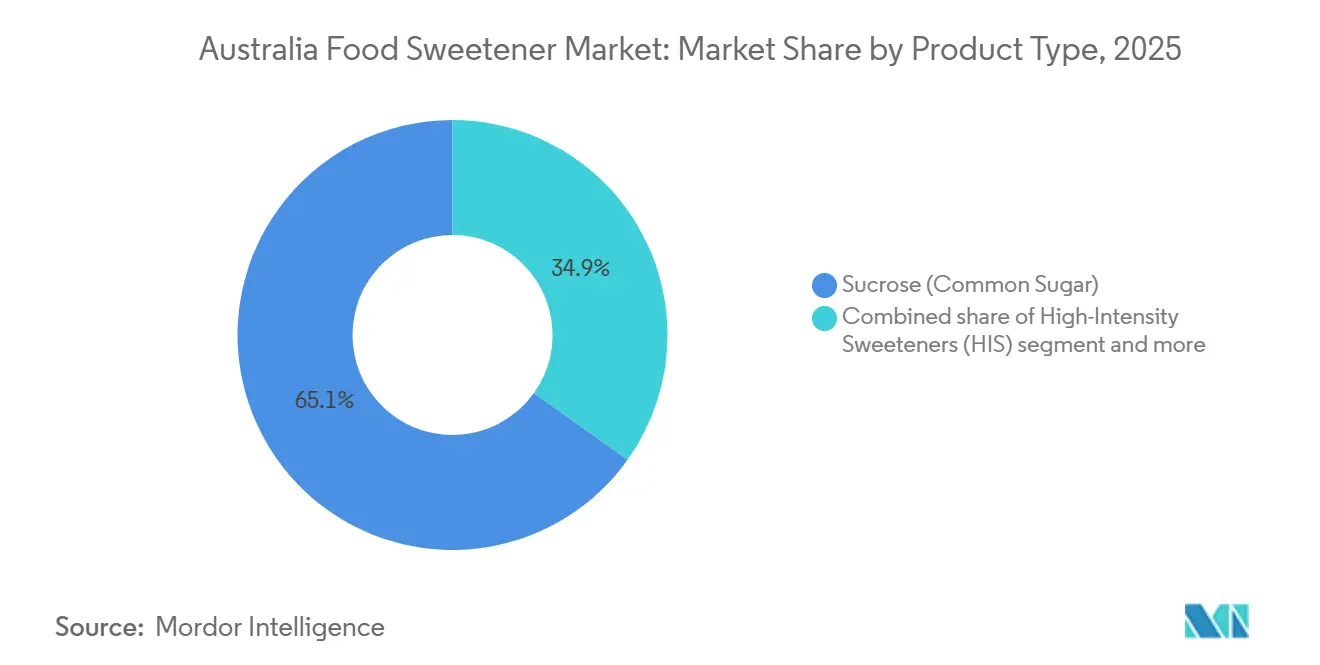
Sucrose held 65.14% of the Australia food sweetener market share in 2025, reflecting its established role in bakery and confectionery. It contributes sweetness, bulk, moisture retention, fermentation support, browning, and structure in finished products. These combined functions limit the ability of a single high-intensity sweetener to fully replace it. Starch sweeteners and sugar alcohols serve more specific purposes across food processing. Dextrose, high-fructose corn syrup, maltodextrin, sorbitol, xylitol, and erythritol support applications that need particular textural, processing, or sensory characteristics.
High-intensity sweeteners are projected to grow at a CAGR of 3.76% through 2031, making them the fastest-growing product category in the Australia food sweetener market. Stevia, sucralose, and acesulfame-K are used in beverage reformulation and functional-food development where calorie reduction is a priority. Application A1325 indicates continued regulatory activity around the use of steviol glycosides in additional food categories. Emerging specialty sweeteners and blended systems remain smaller categories. They gain attention where manufacturers require sweetness, calorie reduction, texture support, and an ingredient story that can be used on the package. This makes product selection more complex, but it broadens the range of options available to formulators.

By Form: Solid Products Remain Established While Liquid and Syrup Systems Grow Faster
Solid products held 76.42% of the category in 2025. Granulated and powdered sucrose remain deeply integrated into bakery, confectionery, dry blending, and retail tabletop uses. Crystalline polyols and high-purity stevia powders also fit existing dry ingredient systems. Solid formats offer shelf stability, straightforward measurement, and compatibility with common manufacturing equipment. They remain important in home baking and hot beverage applications where consumers use granular erythritol-stevia blends and tableted sweeteners.
Liquid and syrup products are projected to grow at a CAGR of 3.77% through 2031. Ready-to-drink beverages, sauces, condiments, and liquid dairy products favor dissolved systems because they remove a separate dissolution step. Liquid sucralose and stevia concentrates allow controlled dosing in continuous beverage lines. Kerry identified fermentation-derived Tastesense sweet-reduction technology as a growth area in its 2025 results. Syrups are also relevant in specialty coffee and quick-service foodservice, where granular sweeteners can create handling and solubility issues. The form decision remains linked to the manufacturer’s process, the finished product, and the desired level of sweetness control.
By Application: Food Holds the Largest Position While Beverages Lead Growth
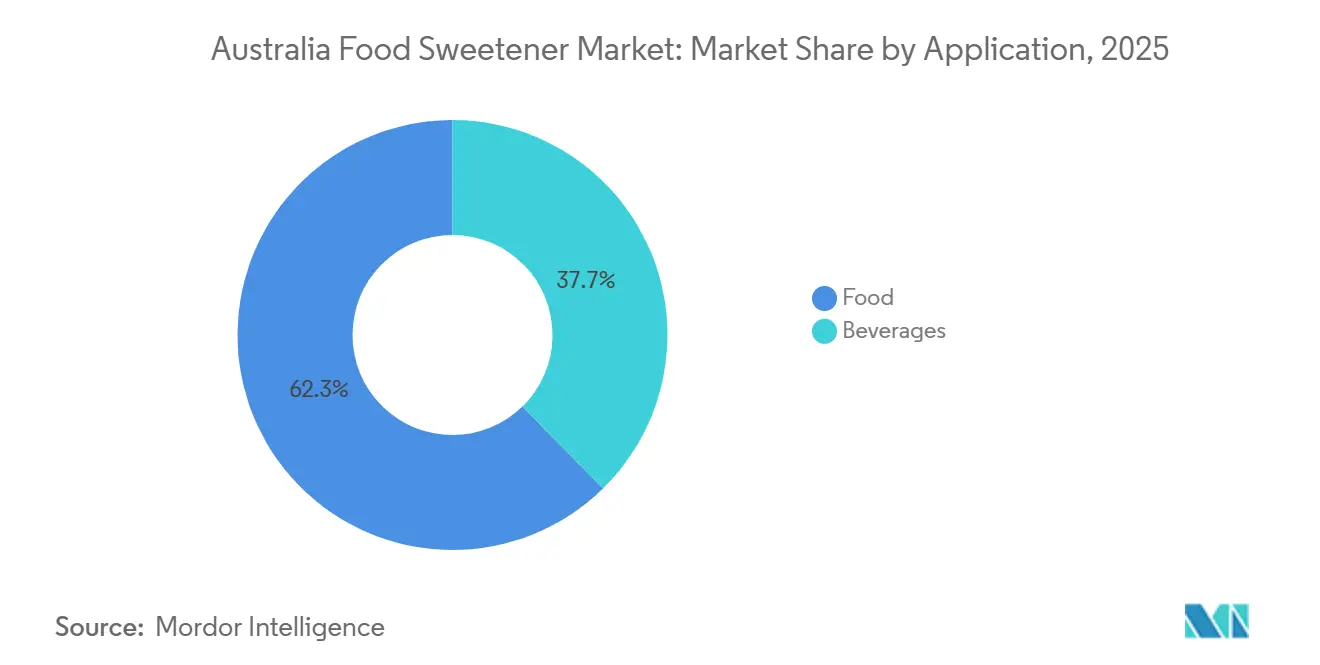
Food accounted for 62.34% of the Australia food sweetener market size in 2025. Bakery and confectionery are central to this position because they use sucrose for several functions beyond sweetness. Dairy and desserts are also active areas for reformulation. The Healthy Food Partnership review proposed a lower sugar target for sweetened yogurts, which may increase demand for alternative sweeteners. Nutraceuticals and functional foods are smaller but higher-value applications where natural sweeteners can command premium prices.
Beverages are projected to grow at a CAGR of 3.89% through 2031, the fastest rate among applications. Beverage companies are reformulating carbonated drinks, sports drinks, and ready-to-drink functional products. The Australian Beverage Council reported that sugar sales declined in 2025 while sales volume rose, indicating a continuing separation between beverage growth and sugar use. Soft drinks remain an important reformulation category. Sports drinks increasingly use stevia, sucralose, and erythritol blends to support zero-sugar and low-calorie positioning. Ready-to-drink tea, functional infusions, and flavored water are smaller applications where low-dose stevia can be useful.
Competitive Landscape
The Australia food sweetener market reflects competition between multinational ingredient suppliers and specialist domestic or regional providers. Sucrose remains structurally important, while specialty ingredients compete through formulation support, product performance, supply security, and labeling options. MSF Sugar and Naturally Sweet Products are developing positions in specialty ingredients and natural sweetener categories. Sweegen and BENEO also provide differentiated systems for Australian food formulators. This range of participants supports a fragmented competitive setting rather than a market controlled by a small group.
Ingredion announced a recommended all-cash acquisition of Tate & Lyle in June 2026, a transaction that would combine portfolios in starches, fibers, sucralose, and stevia. Tate & Lyle shareholders accepted the offer in July 2026, subject to required regulatory clearances. The proposed combination is expected to strengthen the supplier’s formulation and pricing position with food and beverage manufacturers after completion. Roquette launched its Shift & Lead plan in January 2026 after acquiring IFF Pharma Solutions during 2025. The move reflects continued portfolio expansion among specialty ingredient suppliers. Tate & Lyle also reported an October 2026 milestone with BioHarvest Sciences related to a next-generation sweetener development program.
Domestic capacity is another competitive theme in the Australia food sweetener market. The UQ and MSF Sugar rare-sugars project seeks to build a route from Australian cane syrup to low-calorie ingredients. QUT’s Pioneer BioPilot upgrade supports pilot-scale, food-grade fermentation work in Queensland. Sweegen’s Bestevia portfolio focuses on bioconverted rebaudiosides, while BENEO’s isomalt and Palatinose systems focus on functional carbohydrate applications. Smaller specialists compete through organic certification, specialty retail, and closer alignment with consumer interest in ingredient sourcing. The market concentration score consistent with this mix of large multinational suppliers, technology-focused ingredient providers, and domestic specialists.
Australia Food Sweetener Industry Leaders
-
Cargill, Incorporated
-
Archer Daniels Midland Company
-
Tate & Lyle PLC
-
Kerry Group PLC
-
Roquette Frères S.A.
- *Disclaimer: Major Players sorted in no particular order
Recent Industry Developments
- October 2026: Tate & Lyle PLC and BioHarvest Sciences announced a key development milestone in their next-generation sweetener programme, confirming that BioHarvest’s Botanical Synthesis™ platform can produce the targeted novel sweetening solution; the milestone advances the programme’s commercial potential as an alternative to conventional extraction or bioconversion routes for specialty sweeteners.
- June 2026: The University of Queensland officially opened its Biosustainability Hub, which includes a collaboration with MSF Sugar to convert Australian cane syrup into low-calorie rare sugars using microbial cell factories.
- September 2025: QUT launched an AUD 18 million upgrade to its Mackay-based Pioneer BioPilot, with support from Australian and Queensland governments and the Food and Beverage Accelerator.
Australia Food Sweetener Market Report Scope
The Australia Food Sweetener Market is Segmented by Product Type (Sucrose (Common Sugar), Starch Sweeteners, Sugar Alcohols, and High-Intensity Sweeteners (HIS)), by Form (Solid and Liquid/Syrup), and by Application (Food and Beverages). The Market Forecasts are Provided in Terms of Value (USD).
By Product Type
| Sucrose (Common Sugar) | |
| Starch Sweeteners and Sugar Alcohols | Dextrose |
| High-Fructose Corn Syrup (HFCS) | |
| Maltodextrin | |
| Sorbitol | |
| Xylitol | |
| Erythritol | |
| Other Starch Sweeteners and Sugar Alcohols | |
| High-Intensity Sweeteners (HIS) | Sucralose |
| Aspartame | |
| Saccharin | |
| Neotame | |
| Stevia | |
| Acesulfame-K | |
| Cyclamate | |
| Other High-Intensity Sweeteners (HIS) | |
| Other Product Types |
By Form
| Solid |
| Liquid/Syrup |
By Application
| Food | Bakery and Confectionery |
| Dairy and Desserts | |
| Meat and Savory Products | |
| Nutraceuticals and Functional Foods | |
| Sauces, Dressings and Spreads | |
| Other Foods | |
| Beverages | Soft Drinks |
| Sport Drinks | |
| Other Beverages |
| By Product Type | Sucrose (Common Sugar) | |
| Starch Sweeteners and Sugar Alcohols | Dextrose | |
| High-Fructose Corn Syrup (HFCS) | ||
| Maltodextrin | ||
| Sorbitol | ||
| Xylitol | ||
| Erythritol | ||
| Other Starch Sweeteners and Sugar Alcohols | ||
| High-Intensity Sweeteners (HIS) | Sucralose | |
| Aspartame | ||
| Saccharin | ||
| Neotame | ||
| Stevia | ||
| Acesulfame-K | ||
| Cyclamate | ||
| Other High-Intensity Sweeteners (HIS) | ||
| Other Product Types | ||
| By Form | Solid | |
| Liquid/Syrup | ||
| By Application | Food | Bakery and Confectionery |
| Dairy and Desserts | ||
| Meat and Savory Products | ||
| Nutraceuticals and Functional Foods | ||
| Sauces, Dressings and Spreads | ||
| Other Foods | ||
| Beverages | Soft Drinks | |
| Sport Drinks | ||
| Other Beverages | ||
Key Questions Answered in the Report
What is the projected value of the Australia food sweetener market?
The category is projected to reach USD 2.19 billion by 2031, growing at a 2.42% CAGR during 2026-2031.
Which product category is growing fastest in Australia?
High-intensity sweeteners are projected to grow at a CAGR of 3.76% through 2031.
Which form is gaining the most momentum?
Liquid and syrup sweeteners are projected to grow at a CAGR of 3.77% through 2031 because they fit beverage and liquid-food production.
What role does FSANZ play in sweetener innovation?
FSANZ assesses safety and permitted uses, including the 2025 approval of an enzymatic route for rebaudioside M production.