
Atomic Force Microscopy In Healthcare Market Size and Share
Market Overview
| Study Period | 2020 - 2031 |
|---|---|
| Market Size (2026) | USD 174.33 Million |
| Market Size (2031) | USD 246.22 Million |
| Growth Rate (2026 - 2031) | 7.15 % |
| Fastest Growing Market | Asia-Pacific |
| Largest Market | North America |
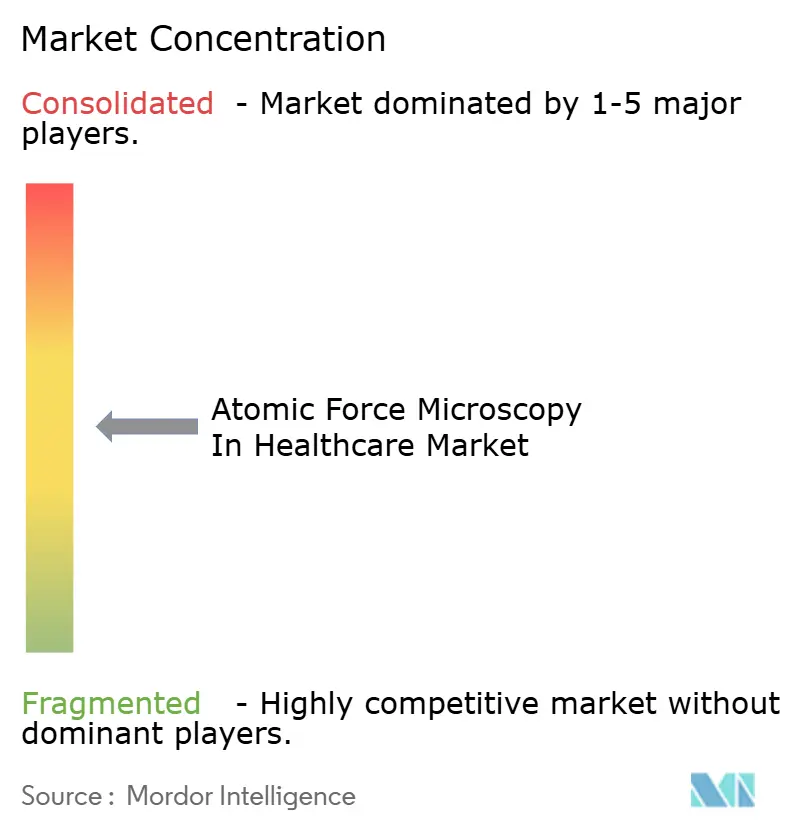
| Market Concentration | Medium |
Major Players *Disclaimer: Major Players sorted in no particular order Image © Mordor Intelligence. Reuse requires attribution under CC BY 4.0. | |
Atomic Force Microscopy In Healthcare Market Analysis by Mordor Intelligence
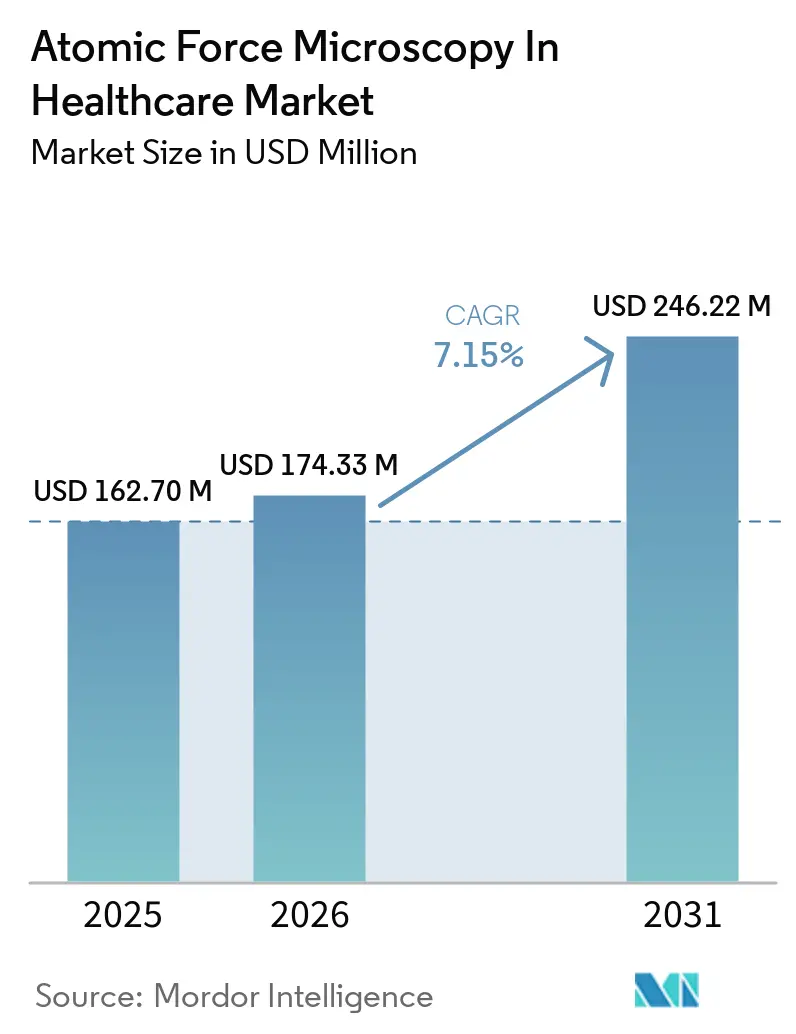
The Atomic Force Microscopy In Healthcare Market size is expected to increase from USD 162.70 million in 2025 to USD 174.33 million in 2026 and reach USD 246.22 million by 2031, growing at a CAGR of 7.15% over 2026-2031.
The atomic force microscopy (AFM) in healthcare market is gaining momentum as biopharma shifts toward biologics, mRNA therapeutics, and antibody drug conjugates, driving the need for label-free nanoscale characterization. AFM-IR spectroscopy enables precise drug distribution mapping within nanoparticles, helping detect loading heterogeneities that traditional methods often miss. This capability aligns with quality by design principles in regulated nanomedicine development, positioning AFM as a routine development tool rather than just a research option. The market is further supported by increased public research funding, improved biomedical imaging infrastructure, and the outsourcing of specialized characterization tasks to service providers. Vendors are enhancing competitiveness through faster scanning, automation, AI-driven analysis, and integrated workflows, fostering software-led growth and expanding AFM usage beyond expert operator labs.
Key Report Takeaways
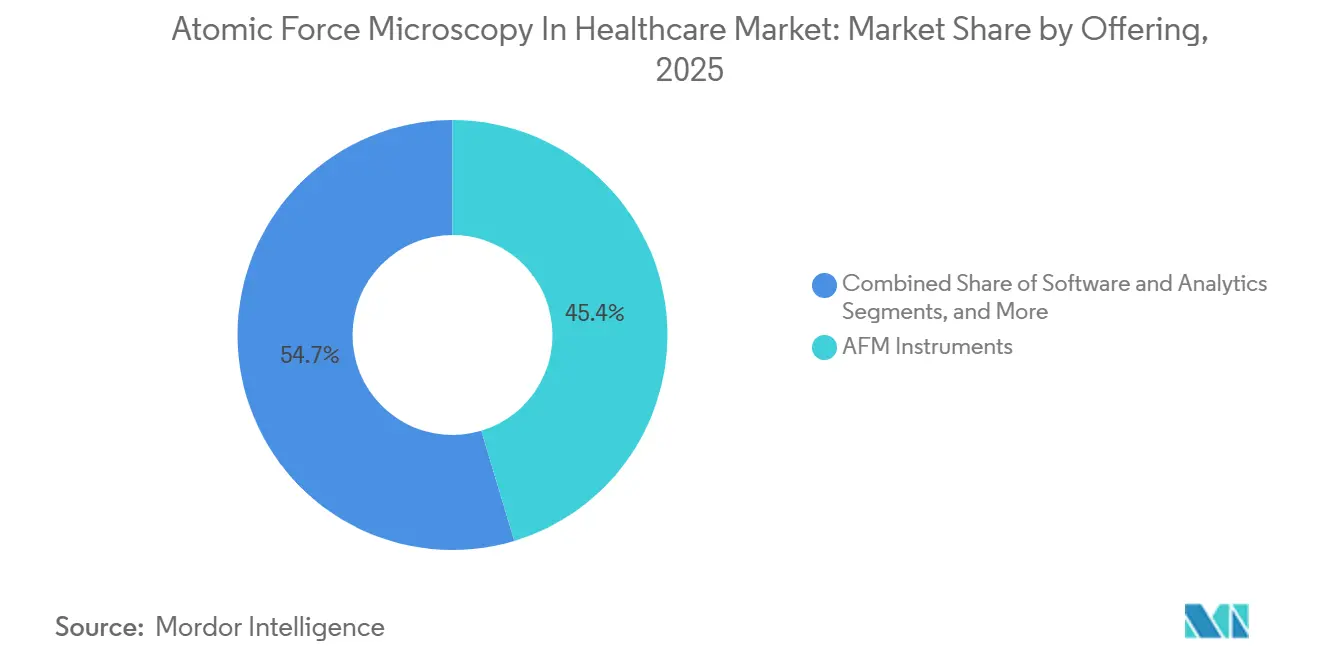
- By offering, AFM instruments held 45.35% revenue share in 2025, while software and analytics are projected to grow at an 8.12% CAGR through 2031.
- By application, biomolecular imaging and force spectroscopy accounted for 38.67% share in 2025, while drug discovery and formulation characterization are forecast to expand at a 9.10% CAGR through 2031.
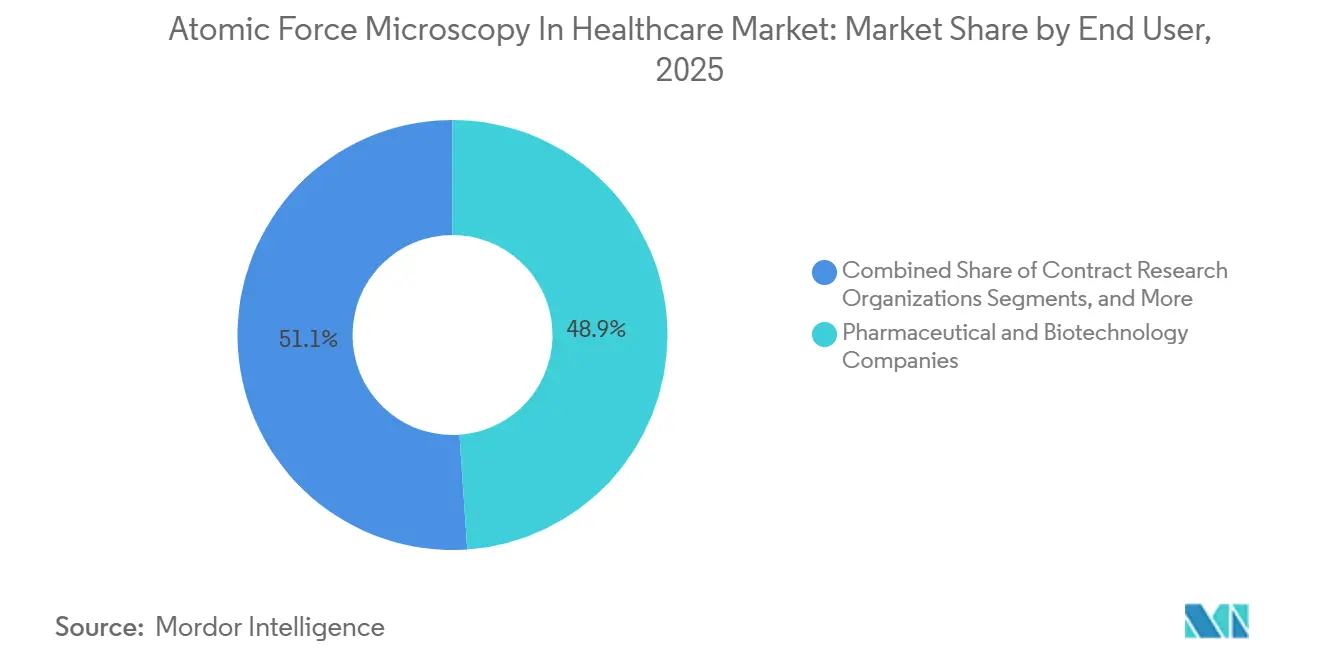
- By end user, pharmaceutical and biotechnology companies held 48.9% revenue share in 2025, while contract research organizations are projected to grow at a 7.98% CAGR through 2031.
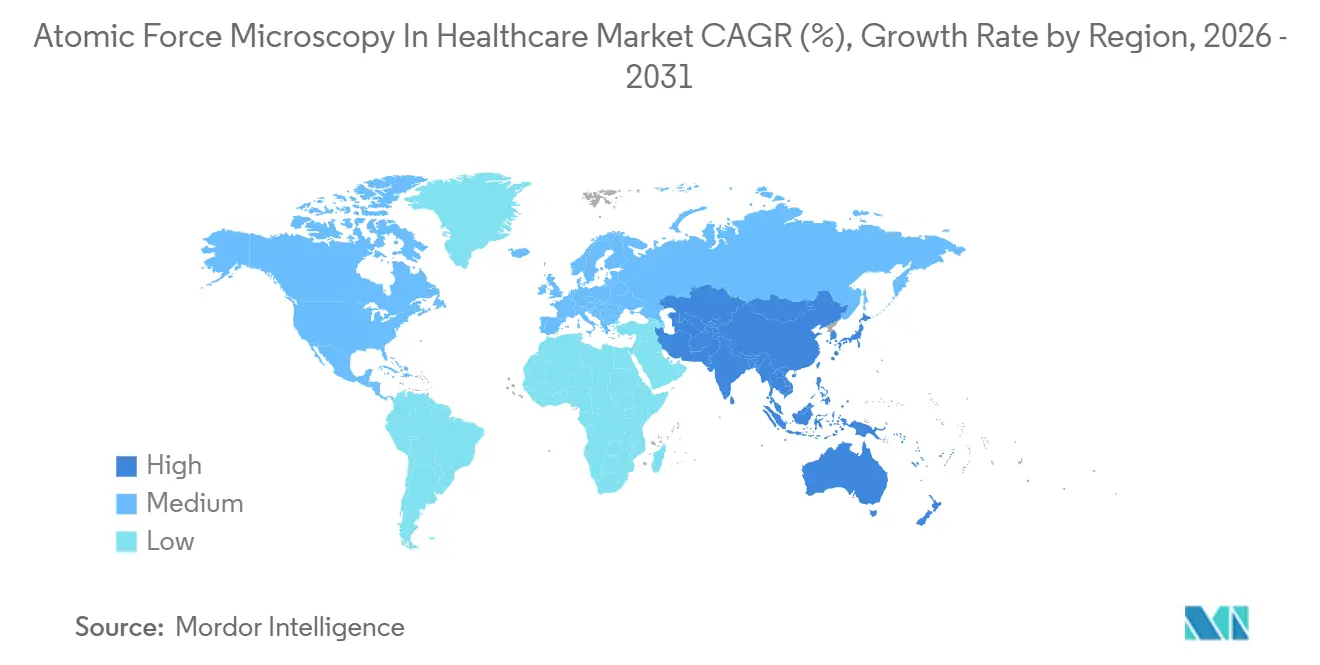
- By geography, North America held 41.20% of global revenue in 2025, while Asia-Pacific is expected to grow at an 8.55% CAGR through 2031.
Note: Market size and forecast figures in this report are generated using Mordor Intelligence’s proprietary estimation framework, updated with the latest available data and insights as of January 2026.
Market Trends and Insights
Drivers Impact Analysis of Atomic Force Microscopy In Healthcare Market*
| DRIVER | (~) % IMPACT ON CAGR FORECAST | GEOGRAPHIC RELEVANCE | IMPACT TIMELINE |
|---|---|---|---|
| Biopharma nanoparticle and biologics characterization demand | +2.0% | Global, with concentration in North America and Europe | Short term (≤ 2 years) |
| Rising public and private nanomedicine R&D funding | +1.5% | Global, strongest uplift in APAC (China, India, Japan) and North America | Medium term (2-4 years) |
| AI-enabled automation and analysis for easier AFM adoption | +1.0% | Global, with early commercial adoption in North America, Japan, South Korea | Medium term (2-4 years) |
| Label-free live-cell and biomolecular interaction imaging demand | +0.8% | North America and Europe core, spill-over to APAC | Short term (≤ 2 years) |
| Correlative AFM with Raman and fluorescence workflows | +0.5% | North America, Europe, academic-led adoption | Long term (≥ 4 years) |
| Biomaterials and medical-device surface nanomechanics demand | +0.4% | Global, Europe and North America regulatory influence | Medium term (2-4 years) |
| Source: Mordor Intelligence | |||
Biopharma Nanoparticle and Biologics Characterization Demand
The atomic force microscopy market in healthcare is advancing due to the integration of lipid nanoparticle drug delivery and the need for single nanoparticle resolution in development. AFM data provides detailed structural insights, such as mRNA coiling within lipid nanoparticles, surpassing the capabilities of other methods. Bruker’s AFM-IR feature on the Dimension platform enhances drug mass fraction quantification, offering a competitive edge over standalone tools. Early adoption of AFM-IR in formulation helps identify batch inconsistencies, reducing late-stage reformulation risks.
Rising Public and Private Nanomedicine R&D Funding
Public and institutional investments are driving growth in the atomic force microscopy market in healthcare. China launched its National Multimode Trans-Scale Biomedical Imaging Center in 2025, focusing on advanced molecular imaging for tumor and brain research.[1] India increased funding for nanomaterials and biotechnology through its Vigyan Dhara scheme and MAHA MedTech Mission, supporting high-precision imaging technologies. These initiatives strengthen procurement cycles at research institutions, fueling demand from academic and contract service providers.
AI-Enabled Automation and Analysis for Easier AFM Adoption
AI is simplifying the adoption of atomic force microscopy in healthcare by reducing reliance on highly trained operators. Innovations like AILA automate probe selection, scan optimization, and image analysis, while SimuScan generates high-fidelity AFM images for training models. Although full autonomy remains a challenge, automation tools like Park Systems’ SmartScan AI are making AFM more accessible to non-specialist formulation scientists, driving broader market adoption.
Label-Free Live-Cell and Biomolecular Interaction Imaging Demand
Demand for live cell and biomolecular interaction imaging is creating new opportunities in the atomic force microscopy market in healthcare. Kyoto University developed SimHS-AFMfit-MD, combining high-speed AFM video with molecular dynamics simulations to analyze protein dynamics.[2] Research from Kanazawa and Kyushu Universities visualized estrogen receptor alpha binding to DNA, aiding hormone-dependent cancer drug design. These advancements highlight the growing need for high-speed systems, particularly in Japan, which leads global research in this field.
Restraints Impact Analysis of Atomic Force Microscopy In Healthcare Market*
| RESTRAINT | (~) % IMPACT ON CAGR FORECAST | GEOGRAPHIC RELEVANCE | IMPACT TIMELINE |
|---|---|---|---|
| High capital cost and probe replacement burden | -1.2% | Global, most acute in MEA, South America, and smaller CRO segments | Short term (≤ 2 years) |
| Slow throughput for scaled screening workflows | -0.7% | Global, particularly constraining in pharma high-throughput discovery | Medium term (2-4 years) |
| Inter-lab reproducibility gaps in live-cell nanomechanics | -0.5% | North America and Europe, where inter-lab standardization is most scrutinized | Medium term (2-4 years) |
| Limited clinical validation of AFM-derived biomarkers | -0.4% | Global, most pressing in US and EU regulated clinical pathways | Long term (≥ 4 years) |
| Source: Mordor Intelligence | |||
High Capital Cost and Probe Replacement Burden
The high costs of atomic force microscopy (AFM) continue to restrict its adoption in the healthcare market, particularly outside major biopharma sites and research centers. Premium AFM platforms require significant upfront investment, and recurring expenses for specialized probes pose challenges for smaller labs and hospital units. In January 2026, Tanzhen Nano Technology raised over CNY 10 million to scale dry etching-based AFM probe production, aiming to reduce costs by 30–40% while maintaining quality. However, this effort addresses probe costs in China but does not mitigate the broader financial burden of instrument purchases, service contracts, and training. Smaller CROs and labs in emerging markets also face annual service costs of 10–15% of the instrument's value, further hindering adoption.
Slow Throughput for Scaled Screening Workflows
Throughput remains a key limitation in the atomic force microscopy healthcare market, as AFM scans one sample region at a time using tip-sample feedback. The SNAP framework was developed to improve efficiency and reduce variability, with studies indicating the need for 300–500 measurements per sample for accurate results. Nanosurf introduced a photothermal off-resonance technique, achieving pixel rates up to 25 kHz, significantly faster than traditional methods and enabling denser mapping. Despite these advancements, scaling parallel multi-well workflows to compete with flow cytometry or high-content imaging remains challenging. This restricts AFM's role to precision tasks, limiting its application in large-scale screening programs.
*Our forecasts treat driver/restraint impacts as directional, not additive. The impact forecasts reflect baseline growth, mix effects, and variable interactions.
Atomic Force Microscopy In Healthcare Market Segment Analysis
By Offering:
Automation Software Narrows the Instruments LeadIn 2025, AFM Instruments held a 45.35% share of the atomic force microscopy market in healthcare, highlighting the importance of capital equipment in driving revenue across pharmaceutical, biotech, and academic sectors. The dominance of hardware reflects the complexity of these systems, with each new generation offering advanced imaging modes, reduced noise levels, and enhanced sample compatibility, encouraging lab upgrades. For instance, Oxford Instruments launched the Jupiter Discovery AFM in May 2025, featuring a noise floor under 25 picometers and significantly faster scan rates. Probes and cantilevers remain a reliable revenue stream due to their frequent use in force spectroscopy and nanoindentation workflows.
Software and analytics are projected to grow at an 8.12% CAGR through 2031, making it the fastest-growing segment in the atomic force microscopy market for healthcare. This growth is driven by automated force curve analysis and AI-guided image interpretation, reducing reliance on expert operators. Open frameworks and vendor-specific tools are broadening usability, attracting data scientists and formulation teams. This shift increases switching costs, as customers become reliant on specific software environments for data management and analysis.

By Application:
Drug Discovery Accelerates as Biomolecular Imaging ConsolidatesIn 2025, Biomolecular Imaging and Force Spectroscopy accounted for 38.67% of the market revenue, reflecting their established role in structural biology, receptor-ligand studies, and single-molecule force spectroscopy. AFM remains a standard tool in academic and pharmaceutical labs for nanoscale visualization and force measurement. High-speed AFM has also demonstrated therapeutic applications, such as capturing real-time dynamics of receptor-DNA interactions. Other applications, including Cellular and Tissue Mechanics, Microbiology and Biofilms, and Clinical Diagnostics, further support the market's stability while enabling new developments.
Drug Discovery and Formulation Characterization are expected to grow at a 9.10% CAGR through 2031, making them the fastest-growing applications in the atomic force microscopy market for healthcare. This growth is driven by increased nanoparticle-based IND activity, single-particle characterization of LNP mRNA systems, and AFM-based cytotoxicity assays.
By End User:
CRO Outsourcing Unlocks Latent Market DemandIn 2025, Pharmaceutical and Biotechnology Companies held a 48.9% revenue share, confirming their dominant position in the atomic force microscopy market for healthcare. These companies invest in multi-system fleets, extended service agreements, and frequent upgrades, driven by regulatory requirements for nanoparticle characterization. Academic and Research Institutions, while numerous, face purchasing constraints tied to grant cycles and public funding. Hospitals and Clinical Research Centers remain in the early adoption phase, with limited commercial platforms available. Contract Research Organizations are projected to grow at a 7.98% CAGR through 2031, driven by outsourcing trends where pharma companies prefer specialized nanomechanical and surface characterization services. Vendors are also expanding into service-adjacent areas, blurring the line between instrument supply and outsourced analysis.
Geography Analysis
North America Atomic Force Microscopy in Healthcare Market
In 2025, North America accounted for 41.20% of the atomic force microscopy (AFM) market in healthcare, driven by a high concentration of biopharma innovators, a mature research ecosystem, and robust grant funding in mechanobiology and drug delivery. The U.S. leads regional demand as developers integrate AFM-IR into workflows for LNP-based therapeutics, while Canada strengthens academic contributions, and Mexico supports contract research and manufacturing-linked activities. Bruker reported that U.S. revenues represented 26% of its USD 3.44 billion turnover, highlighting North America's purchasing power in scientific instruments.
Europe Atomic Force Microscopy in Healthcare Market
Europe ranked as the second-largest regional market for atomic force microscopy in healthcare, maintaining leadership in publicly funded correlative AFM research. Germany and the U.K. anchor instrument development, while France, Italy, and Spain expand AFM-IR and multimodal system installations. The University of Bordeaux operates a VibrAFM platform with four coupled AFM systems, including Bruker BioScope instruments, for mechanobiology and cancer research. The University of Miskolc installed an AFM Raman FLIM system in September 2025, one of only three such platforms globally, reflecting Europe's demand for advanced systems.
APAC, MEA and South America Atomic Force Microscopy in Healthcare Market
Asia-Pacific is projected to grow at an 8.55% CAGR through 2031, the fastest among all regions, supported by government-backed infrastructure, expanding nanomedicine research, and large-scale institutional procurements in China, Japan, India, and South Korea. China's National Multimode Trans-Scale Biomedical Imaging Center, with a USD 237 million investment, became a major regional milestone in March 2025. Japan advances high-speed AFM research through Kyoto and Nagoya Universities, while India's MAHA MedTech Mission, valued at USD 90 million, facilitates access to advanced imaging systems. The Middle East, Africa, and South America remain emerging markets, with demand concentrated in GCC countries, South Africa, and Brazil, driven by public institutions and import financing.
Competitive Landscape
Bruker Corporation, Park Systems, Oxford Instruments (via Asylum Research), and Nanosurf lead the global atomic force microscopy (AFM) placements in healthcare. Secondary vendors like NT-MDT Spectrum Instruments, Nanonics Imaging, A.P.E. Research, DME Scanning Probe Microscopes, and Molecular Vista focus on niches such as high-speed imaging and AFM-IR. Buyers now prioritize workflow integration, AI-assisted operations, and seamless data transfer over resolution. Bruker’s Dimension Nexus, launched in December 2024, introduced PeakForce Tapping and over 50 AFM modes for multi-user facilities. Park Systems’ NX1, launched in April 2026, targets atomic-scale imaging in ambient conditions. These developments reflect a shift toward shared research environments.
Supply chain control has become a key competitive strategy in the healthcare AFM market. Park Systems strengthened its position in April 2026 by acquiring Rocky Mountain Nanotechnology, securing access to ultra-high purity platinum and platinum-iridium probes for electrical measurement modes and future nanoprobing systems. Oxford Instruments’ Jupiter Discovery emphasized faster scanning and easier access for larger sample workflows. Bruker’s FY2025 filing revealed that automation capabilities, initially developed for semiconductor metrology, are being adapted to meet higher throughput demands in biology and pharmaceuticals.
Smaller firms are leveraging software and clinical specialization to compete in the healthcare AFM market. ARTIDIS developed a nanomechanical diagnostic platform for rapid cancer biopsy assessments using AFM stiffness mapping. Nanosurf focuses on speed and software-driven usability, with its WaveMode NMA achieving pixel rates of 25 kHz in nanomechanical mapping. The 2026 launch of SimuScan highlights the potential of platform-level AI to reduce reliance on specialized operators and redefine bundled analysis software. However, probe commoditization, particularly from Chinese manufacturers, poses a risk by pressuring margins and increasing the importance of service, workflow integration, and application support as competitive advantages.
Atomic Force Microscopy In Healthcare Industry Leaders
-
A.P.E. Research S.r.l.
-
AFMWorkshop, LLC
-
Bruker Corporation
-
Anton Paar GmbH
-
JEOL Ltd.
- *Disclaimer: Major Players sorted in no particular order
Atomic Force Microscopy In Healthcare Market Companies Covered in this Report
- A.P.E. Research S.r.l.
- AFMWorkshop, LLC
- Anton Paar
- attocube systems AG
- Bruker
- CSInstruments
- DME Scanning Probe Microscopes
- Hitachi
- HORIBA Ltd.
- JEOL Ltd.
- Molecular Vista, Inc.
- NanoMagnetics Instruments Ltd.
- Nanonics Imaging Ltd.
- Nanoscience Instruments
- Nanosurf AG
- NT-MDT Spectrum Instruments
- Oxford Instruments
- Park Systems Corporation
- RHK Technology, Inc.
- Semilab Inc.
Recent Industry Developments in Atomic Force Microscopy In Healthcare Market
- April 2026: Park Systems acquired Rocky Mountain Nanotechnology LLC (RMN), entering probe manufacturing to strengthen supply chains for advanced electrical measurement modes and next-generation nanoprobing systems, with plans to establish a production facility in South Korea via technology transfer from RMN's Utah operations.
- April 2026: Park Systems launched the NX1, its highest-resolution AFM for atomic-scale imaging in ambient conditions, developed with Professor Franz J. Giessibl, offering a noise floor significantly lower than conventional systems and compatibility with both silicon cantilevers and the optional qPlus sensor.
- April 2026: Nanosurf installed a DriveAFM system in a glovebox at the IEMN facility in Lille, France, enabling nanoscale measurements in controlled inert atmospheres for air-sensitive biological and material samples.
- March 2026: SimuScan, a synthetic-data-driven deep learning framework for label-free autonomous AFM, was introduced to automate feature identification and imaging of nanostructured surfaces, DNA assemblies, and bacterial cells with minimal operator intervention.
- February 2026: Nanosurf delivered high-end industrial automated AFM systems designed for complex analytical tasks requiring precise metrology and automated software coordination, expanding its presence in regulated industrial sectors like pharmaceutical manufacturing.
Global Atomic Force Microscopy In Healthcare Market Report Scope
As per the scope of the report, Atomic Force Microscopy (AFM) is a scanning probe technique that maps a sample's surface at the nanoscale using a tiny probe on a flexible cantilever. In healthcare, it enables live imaging, mechanical testing, and molecular manipulation of living cells and tissues under physiological conditions.
The atomic force microscopy in healthcare market is segmented by offering, application, end-user, and geography. By offering, the market includes AFM instruments, probes and cantilevers, software and analytics, and services. By application, the market is segmented into cellular and tissue mechanics, biomolecular imaging and force spectroscopy, drug discovery and formulation characterization, biomaterials and medical device surface analysis, microbiology, virology, and biofilms, and clinical diagnostics and biosensing research. By end-user, the market is categorized into academic and research institutions, pharmaceutical and biotechnology companies, hospitals and clinical research centers, contract research organizations, and medical device and biomaterials companies. By geography, the market is analyzed across North America, Europe, Asia-Pacific, the Middle East and Africa, and South America. The report also covers the estimated market sizes and trends for 17 countries across major regions globally. The report offers the market sizes and forecasts in terms of value (USD) for the above segments.
Segmentation Overview
| AFM Instruments |
| Probes and Cantilevers |
| Software and Analytics |
| Services |
| Cellular and Tissue Mechanics |
| Biomolecular Imaging and Force Spectroscopy |
| Drug Discovery and Formulation Characterization |
| Biomaterials and Medical Device Surface Analysis |
| Microbiology, Virology, and Biofilms |
| Clinical Diagnostics and Biosensing Research |
| Academic and Research Institutions |
| Pharmaceutical and Biotechnology Companies |
| Hospitals and Clinical Research Centers |
| Contract Research Organizations |
| Medical Device and Biomaterials Companies |
| North America | United States |
| Canada | |
| Mexico | |
| Europe | Germany |
| United Kingdom | |
| France | |
| Italy | |
| Spain | |
| Rest of Europe | |
| Asia-Pacific | China |
| India | |
| Japan | |
| South Korea | |
| Australia | |
| Rest of Asia-Pacific | |
| Middle East and Africa | GCC |
| South Africa | |
| Rest of Middle East and Africa | |
| South America | Brazil |
| Argentina | |
| Rest of South America |
| By Offering | AFM Instruments | |
| Probes and Cantilevers | ||
| Software and Analytics | ||
| Services | ||
| By Application | Cellular and Tissue Mechanics | |
| Biomolecular Imaging and Force Spectroscopy | ||
| Drug Discovery and Formulation Characterization | ||
| Biomaterials and Medical Device Surface Analysis | ||
| Microbiology, Virology, and Biofilms | ||
| Clinical Diagnostics and Biosensing Research | ||
| By End User | Academic and Research Institutions | |
| Pharmaceutical and Biotechnology Companies | ||
| Hospitals and Clinical Research Centers | ||
| Contract Research Organizations | ||
| Medical Device and Biomaterials Companies | ||
| By Geography | North America | United States |
| Canada | ||
| Mexico | ||
| Europe | Germany | |
| United Kingdom | ||
| France | ||
| Italy | ||
| Spain | ||
| Rest of Europe | ||
| Asia-Pacific | China | |
| India | ||
| Japan | ||
| South Korea | ||
| Australia | ||
| Rest of Asia-Pacific | ||
| Middle East and Africa | GCC | |
| South Africa | ||
| Rest of Middle East and Africa | ||
| South America | Brazil | |
| Argentina | ||
| Rest of South America | ||
Key Questions Answered in the Report
What is the 2031 value of atomic force microscopy in healthcare?
The atomic force microscopy in healthcare market is expected to reach USD 246.22 million by 2031, rising from USD 174.33 million in 2026 at a CAGR of 7.15%.
Which region leads current demand for atomic force microscopy in healthcare?
North America leads with 41.20% of global revenue in 2025 because of strong biopharma activity, mature research infrastructure, and broad use in regulated characterization workflows.
Which region is growing fastest through 2031?
Asia-Pacific is the fastest-growing region with an 8.55% CAGR through 2031, supported by large public imaging investments and rising domestic biomedical R&D capacity.
Which offering category grows faster than hardware?
Software and Analytics is growing faster, with an 8.12% CAGR through 2031, as AI assisted image acquisition and automated force curve analysis reduce reliance on specialist operators.
Which application is expanding the fastest?
Drug Discovery and Formulation Characterization is the fastest-growing application at a 9.10% CAGR through 2031 because of stronger demand for single-particle characterization and formulation screening.
Why are CROs becoming more important users of AFM tools in healthcare?
Contract Research Organizations are projected to grow at a 7.98% CAGR through 2031 as pharmaceutical companies increasingly outsource low-throughput but high-precision nanomechanical and surface characterization work.