
Asia-Pacific Surveillance Camera Market Size and Share
| Study Period | 2019 - 2030 |
| Forecast Data Period | 2025 - 2030 |
| Historical Data Period | 2019 - 2023 |
| Market Size (2025) | USD 20.81 Billion |
| Market Size (2030) | USD 33.67 Billion |
| CAGR (2025 - 2030) | 10.10% |
| Market Concentration | Low |
Major Players *Disclaimer: Major Players sorted in no particular order |
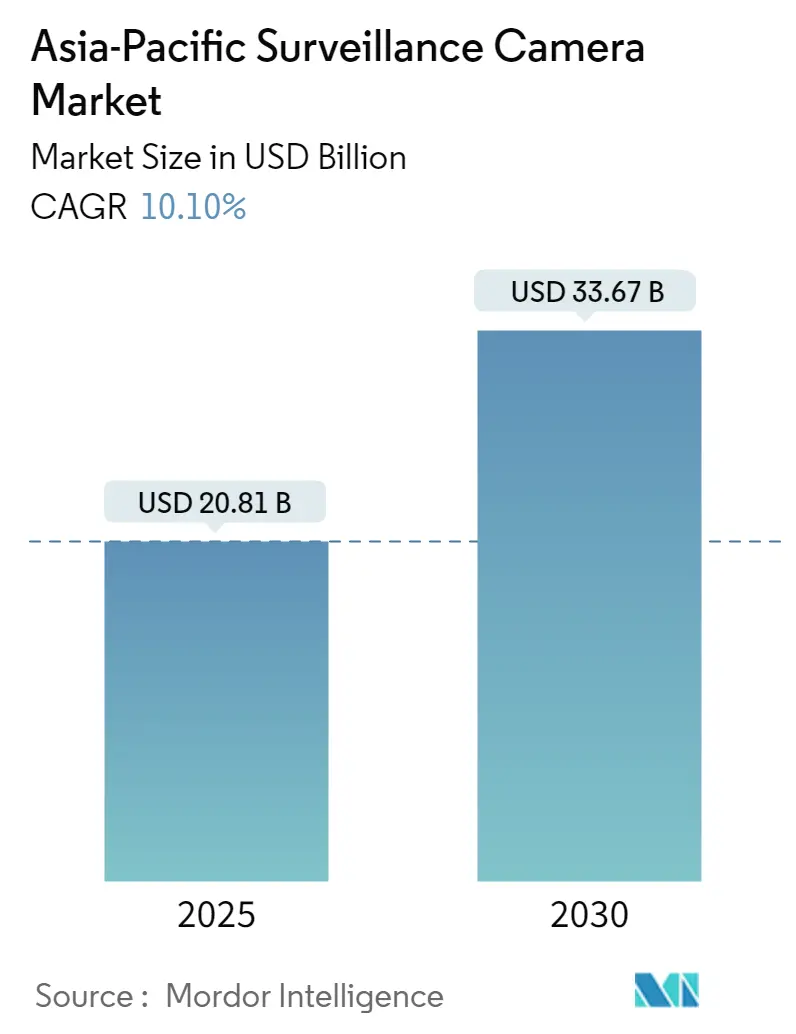
Asia-Pacific Surveillance Camera Market Analysis by Mordor Intelligence
The Asia-Pacific Surveillance Camera Market size is estimated at USD 20.81 billion in 2025, and is expected to reach USD 33.67 billion by 2030, at a CAGR of 10.1% during the forecast period (2025-2030).
In the past, video surveillance cameras were primarily used for security purposes. However, they are increasingly being utilized to improve the performance of businesses. Companies are searching for AI-compatible video surveillance systems capable of providing valuable insights from the data collected. These systems offer advanced features such as the ability to automatically detect and send real-time alerts regarding security risks and collect data to provide insights such as peak customer throughput or wait times. With the corporate sector growing significantly in Asia-Pacific, the demand for such solutions is also witnessing notable growth.
Asia-Pacific is poised for a surge in demand for surveillance cameras, driven by the robust growth potential of its end-user industries. Notably, as countries like India and China witness a rapid expansion in industrial infrastructure, the need for surveillance cameras for asset tracking and ensuring workplace safety is on the rise. Moreover, heightened crime rates in several nations are prompting increased investments by government and public authorities in advanced surveillance technologies, further bolstering the market's outlook.
Surveillance cameras in the region find extensive applications, spanning public spaces, infrastructure, and commercial establishments. With advancements like AI integration, the capabilities of video surveillance systems are broadening. For instance, in June 2023, Dahua Technology's AI cameras in China successfully alerted authorities when banners were raised, showcasing the increasing adoption of AI in governmental monitoring.
The convergence of big data, IoT, and deep learning algorithms is paving the way for AI-driven video surveillance. Highlighting this, in May 2024, more than 50 housing board projects in an Asian city embraced live video surveillance, empowered by cutting-edge AI. This AI not only proactively identified and flagged potential hazards during construction but also seamlessly integrated with existing CCTV setups, enhancing real-time hazard detection.
Such advancements are prompting public authorities to ramp up their investments in surveillance systems. A case in point is the Maharashtrian government's approval in January 2024 for installing over 6,000 CCTV cameras in Thane City, Mumbai. Additionally, the Thane police initiated the "Har Ghar Camera" campaign to further promote the adoption of surveillance cameras.
Yet, challenges loom, particularly concerning privacy and data protection compliance. The implementation of surveillance systems must navigate a complex web of laws and regulations, emphasizing the need for stringent privacy safeguards. Misuse of such technology can exacerbate privacy concerns, posing hurdles to the market's growth in Asia-Pacific.
Global valuation is built by aggregating outputs from multiple regions, with Asia forming one of the important contributors. Mordor Intelligence's global surveillance camera market size report represents that cumulative total.
Asia-Pacific Surveillance Camera Market Trends and Insights
IP-based Cameras are Gaining Momentum
- Digital cameras are increasingly capturing market share due to their numerous advantages over analog counterparts, particularly in security applications. Their capability to capture high-definition video and images significantly enhances the identification of individuals, objects, or events in recorded footage.
- One of the key features of digital security cameras is their remote monitoring capability. By leveraging internet connectivity, these cameras allow users to access live video feeds and recorded footage from any location with an internet connection. This functionality is crucial for homeowners and businesses, providing real-time monitoring, alerts, and the ability to remotely oversee property security.
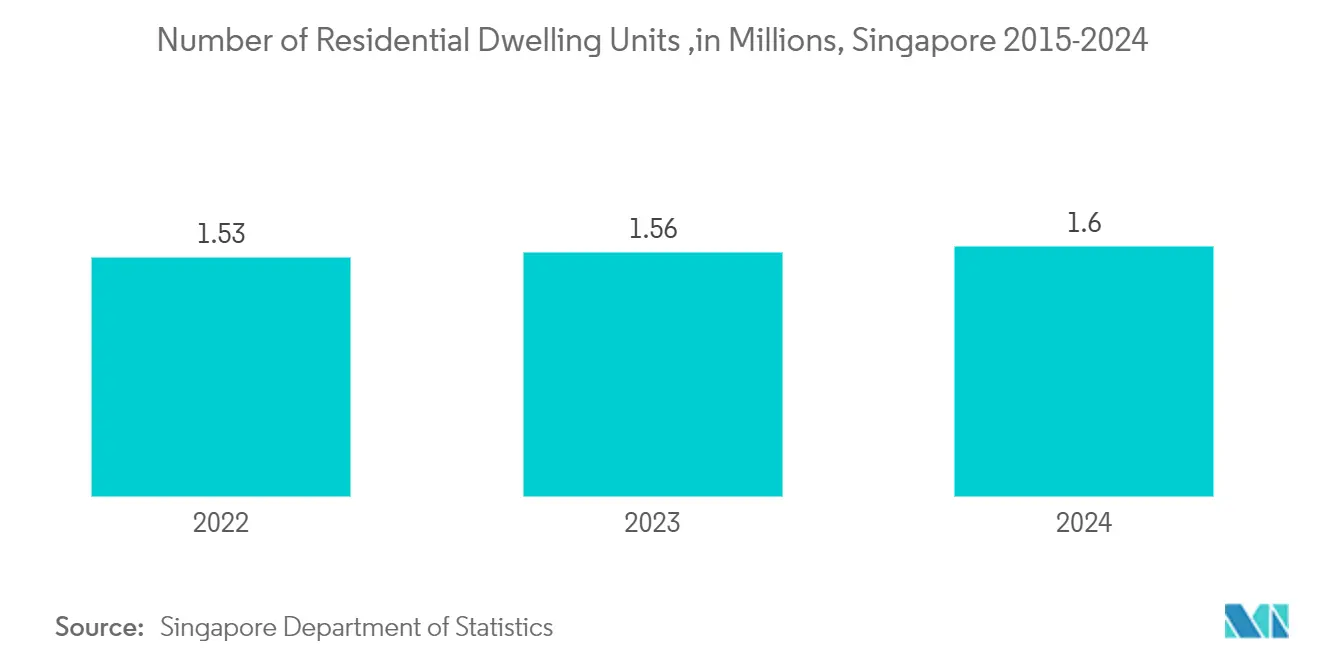
- In recent years, Singapore, renowned for its stringent safety measures, witnessed a substantial increase in the adoption of wireless IP cameras for residential surveillance. These advanced devices utilize internet connectivity to offer homeowners real-time monitoring, remote access, and a range of features that enhance traditional home CCTV systems. This technological advancement signifies a major shift in the home security landscape within the city-state, with wireless IP cameras becoming essential components of modern surveillance strategies. The integration of internet networks with these devices not only improves monitoring capabilities but also introduces innovative features, redefining residential security in Singapore.
- IP-based surveillance cameras are instrumental in reducing criminal activities such as theft and vandalism, particularly in railway stations. Their adoption is growing in public spaces. For example, in July 2023, Infinova, a leading provider of surveillance solutions, partnered with L&T to deploy surveillance cameras at the Bangalore Metro Rail Corporation (BMRCL). Infinova supplied nearly 2000 industrial-grade cameras for the project, which is expected to cover approximately 28 railway stations and three depots for the BMRCL.


India to Witness a Significant Growth
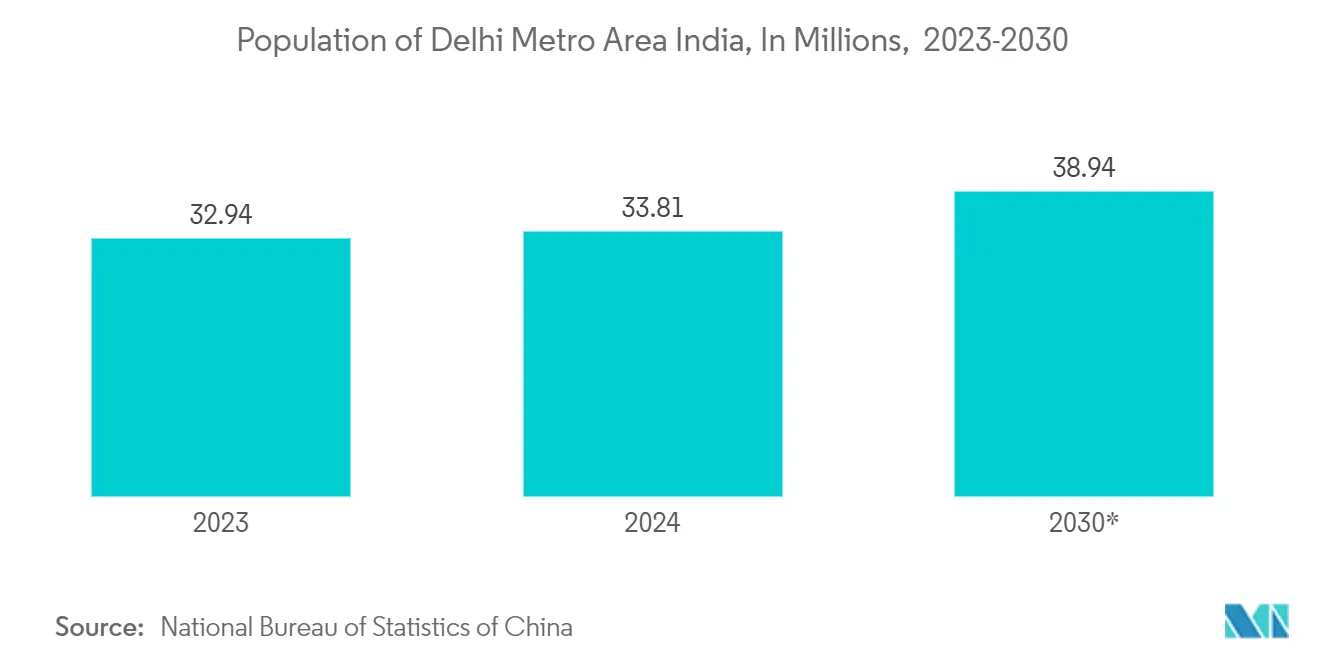
- India's rapid urbanization and expanding population have increased the need for surveillance cameras to ensure public safety and security in urban areas. The growing investment in smart cities is also a significant factor in driving this demand. As cities become increasingly interconnected and technologically sophisticated, the need for increased security, better urban planning, and more efficient resource management has increased. For instance, according to the Ministry of Finance, India's Smart City Mission expenditure was approximately INR 53 billion (~USD 0.64 billion) and was expected to surpass INR 68 billion (~USD 0.82 billion) by FY 2023.
- India is also witnessing a growing adoption of surveillance cameras in the transportation industry, as they are utilized to monitor traffic movements, identify bottlenecks, and regulate traffic signals. For example, in April 2024, the Delhi transport department intended to deploy 5,000 cameras at key junctions citywide. This initiative is a critical component of its strategy to implement an intelligent traffic management system (ITMS) for the national capital. According to officials, these cameras will initially facilitate surveillance and the issuance of traffic challans. Over time, their functionality will expand to include traffic and signal management, as well as public announcements.
- For instance, in August 2023, the Government of Maharashtra announced its plans to replicate the Kerala model of AI surveillance cameras to improve traffic enforcement in the state. The Government of Maharashtra has identified the AI camera project as a potential model for the whole country. Additionally, a surveillance camera system based on AI technology is being tested in a major road safety initiative on the Mumbai-Pune expressway to detect and report cases of distracted driving and cellphone use while driving. Such surveillance cameras have been successful in India and other countries in apprehending motorists who violate the law, including texting while driving.

Coverage of the surveillance camera market by Mordor Intelligence spans a wide geographic footprint, with regional analysis available for South America and Europe, alongside detailed country-level intelligence for India, Japan, China, France, United Kingdom, Brazil, and Canada, each shaped by local operating conditions.
Competitive Landscape
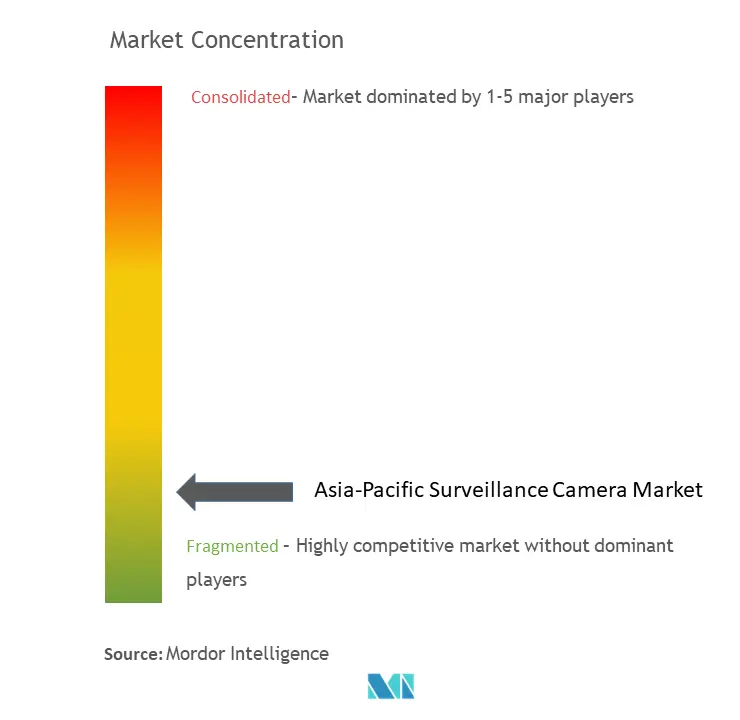
The Asia-Pacific surveillance camera market is highly competitive, owing to the presence of multiple local and global companies. With the demand growing, more players are entering the market, shifting the landscape toward a fragmented stage. Hence, to consolidate their market presence, vendors are adopting strategies like product innovation, partnerships, collaborations, and mergers and acquisitions. Some of the major players in the market include Milesight, Dahua Technology Co. Ltd, Hangzhou Hikvision Digital Technology Co. Ltd, and AnG India Ltd.
- In March 2024, Verkada, a cloud-based physical security solution provider, opened its new ASEAN headquarters in Singapore. The new Singapore office is the company's fourth in Asia-Pacific. The company's portfolio of products encompasses solutions, including access control systems, video security cameras, environmental sensors, intercoms, alarms, and workplace management tools.
- In August 2023, Eagle Eye Networks partnered with ESSCOR, a security integration firm, to provide enterprises in the Philippines with cloud video surveillance solutions that provide security, artificial intelligence (AI), cybersecurity assurance, and return on investment (ROI). The Eagle Eye Network's cloud video management system (VMS) is utilized by businesses of all sizes to centralize video surveillance and enhance security and operations.
Asia-Pacific Surveillance Camera Industry Leaders
Hangzhou Hikvision Digital Technology Co., Ltd.
Hanwha Vision Co., Ltd.
AnG India Ltd
Dahua Technology Co., Ltd
Milesight
- *Disclaimer: Major Players sorted in no particular order

Recent Industry Developments
- May 2024: Hanwha Vision debuted the industry's inaugural dual-lens barcode reader (BCR) camera, merging barcode recognition and video capture into a singular, efficient device. This innovation equips logistics firms with a streamlined approach to cutting costs, curbing losses, and enhancing operational efficiency. The AI-powered BCR camera adeptly tracks and identifies parcel barcodes on swift conveyors, boasting a remarkable speed of 2 m/s. Its image sensors, tailored for both barcode recognition and video monitoring, deliver crisp 4K resolution and a broad field-of-view (FoV) courtesy of a 25 mm lens. The camera seamlessly integrates with Hanwha Vision's cutting-edge vision logistics tracking software (VLTS).
- August 2023: Hikvision launched a 16 MP, 180-degree network camera, PanoVU. This camera adds to the existing range of PanoVU cameras from Hikvision, giving customers even more options regarding video security. According to the company, the camera was designed to withstand extreme weather conditions. Furthermore, these cameras offer intelligent human density counting and foot traffic analysis, allowing monitoring and analyzing people flow trends, facilitating proactive safety measures, and efficient crowd management.


Asia-Pacific Surveillance Camera Market Report Scope
Surveillance cameras are gaining popularity for their cost-effectiveness and user-friendly nature. This surge has seen a rise in installations across residential and commercial spaces, all aimed at enhancing security. Thanks to technological advancements, these cameras are reshaping the security landscape. They come in a variety of styles and resolutions, tailored for different needs, including indoor, outdoor, box, dome, bullet, IP, day and night, wireless, thermal imaging, PTZ, and beyond. The market is defined by the revenue accrued from the sales of different types of surveillance cameras over various end users across Asia-Pacific.
The Asia-Pacific surveillance camera market is segmented by type (analog-based, IP-based, and hybrid), end-user industry (government, banking, healthcare, transportation and logistics, industrial, and other end-user industries [educational institutions, retail, and enterprise]), and country (China, Japan, India, and Rest of Asia-Pacific). The market sizes and forecasts are provided in terms of value (USD) for all the above segments.
| Analog-based |
| IP-based |
| Hybrid |
| Government |
| Banking |
| Healthcare |
| Transportation and Logistics |
| Industrial |
| Other End-user Industries (Education Institutions, Retail, and Enterprises) |
| China |
| Japan |
| India |
| By Type | Analog-based |
| IP-based | |
| Hybrid | |
| By End-user Industry | Government |
| Banking | |
| Healthcare | |
| Transportation and Logistics | |
| Industrial | |
| Other End-user Industries (Education Institutions, Retail, and Enterprises) | |
| By Country*** | China |
| Japan | |
| India |


Key Questions Answered in the Report
How big is the Asia-Pacific Surveillance Camera Market?
The Asia-Pacific Surveillance Camera Market size is expected to reach USD 20.81 billion in 2025 and grow at a CAGR of 10.10% to reach USD 33.67 billion by 2030.
What is the current Asia-Pacific Surveillance Camera Market size?
In 2025, the Asia-Pacific Surveillance Camera Market size is expected to reach USD 20.81 billion.
Who are the key players in Asia-Pacific Surveillance Camera Market?
Hangzhou Hikvision Digital Technology Co., Ltd., Hanwha Vision Co., Ltd., AnG India Ltd, Dahua Technology Co., Ltd and Milesight are the major companies operating in the Asia-Pacific Surveillance Camera Market.
What years does this Asia-Pacific Surveillance Camera Market cover, and what was the market size in 2024?
In 2024, the Asia-Pacific Surveillance Camera Market size was estimated at USD 18.71 billion. The report covers the Asia-Pacific Surveillance Camera Market historical market size for years: 2019, 2020, 2021, 2022, 2023 and 2024. The report also forecasts the Asia-Pacific Surveillance Camera Market size for years: 2025, 2026, 2027, 2028, 2029 and 2030.
Page last updated on:
Asia-Pacific Surveillance Camera Market Report
Statistics for the 2025 Asia-Pacific Surveillance Camera market share, size and revenue growth rate, created by Mordor Intelligence™ Industry Reports. Asia-Pacific Surveillance Camera analysis includes a market forecast outlook for 2025 to 2030 and historical overview. Get a sample of this industry analysis as a free report PDF download.





