Asia-Pacific Biocontrol Agents Market Size and Share
Market Overview
| Study Period | 2018 - 2031 |
|---|---|
| Forecast Data Period | 2026 - 2031 |
| Base Year Market Size (2025) | USD 2.68 Billion |
| Market Size (2026) | USD 2.84 Billion |
| Market Size (2031) | USD 3.77 Billion |
| Growth Rate (2026 - 2031) | 5.85 % |
| Market Concentration | Low |
Major Players *Disclaimer: Major Players sorted in no particular order Image © Mordor Intelligence. Reuse requires attribution under CC BY 4.0. | |
Asia-Pacific Biocontrol Agents Market Analysis by Mordor Intelligence
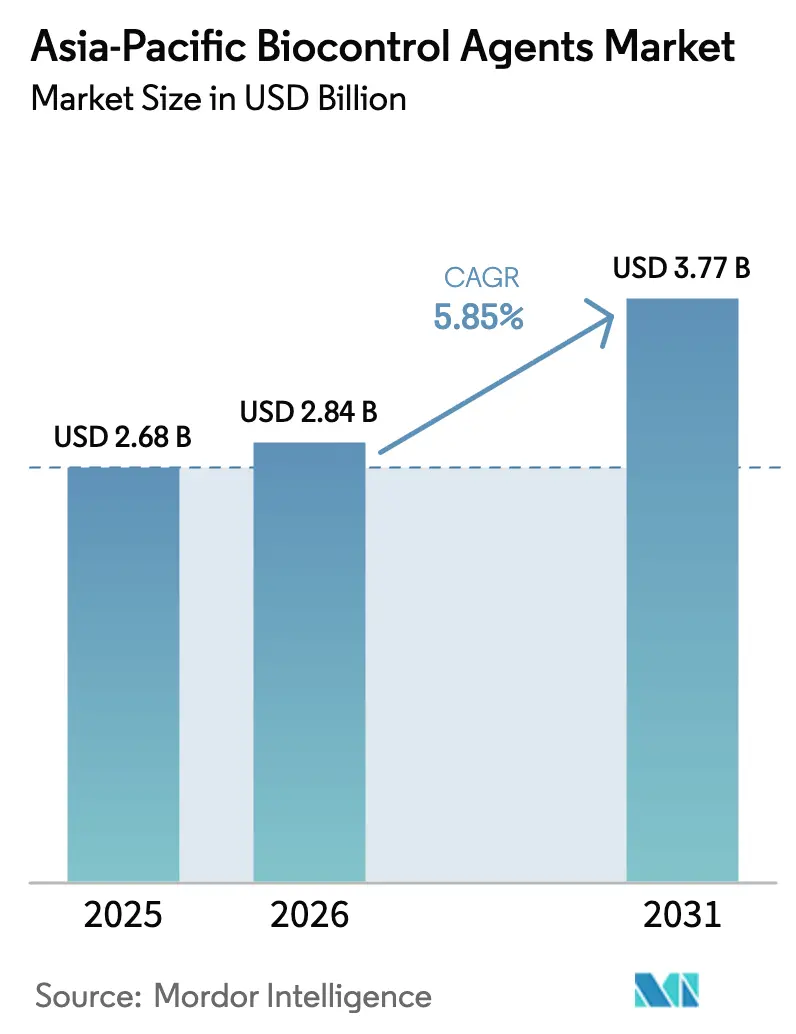
Asia-Pacific biocontrol agents market size in 2026 is estimated at USD 2.84 billion, growing from 2025 value of USD 2.68 billion with 2031 projections showing USD 3.77 billion, growing at 5.85% CAGR over 2026-2031. This growth stems from regulatory authorities across the region implementing stringent maximum residue limits on synthetic pesticides while simultaneously offering targeted subsidies for biological alternatives. The convergence of these regulatory pressures and economic incentives is transforming traditional chemical dependency into biological adoption at an unprecedented pace. Macrobials currently dominate with a commanding market share, primarily due to the scalability of entomopathogenic nematodes and parasitoids in row crop applications. The microbials segment demonstrates significant growth potential as bacterial and fungal biocontrol agents gain traction in precision agriculture applications across the region.
Key Report Takeaways
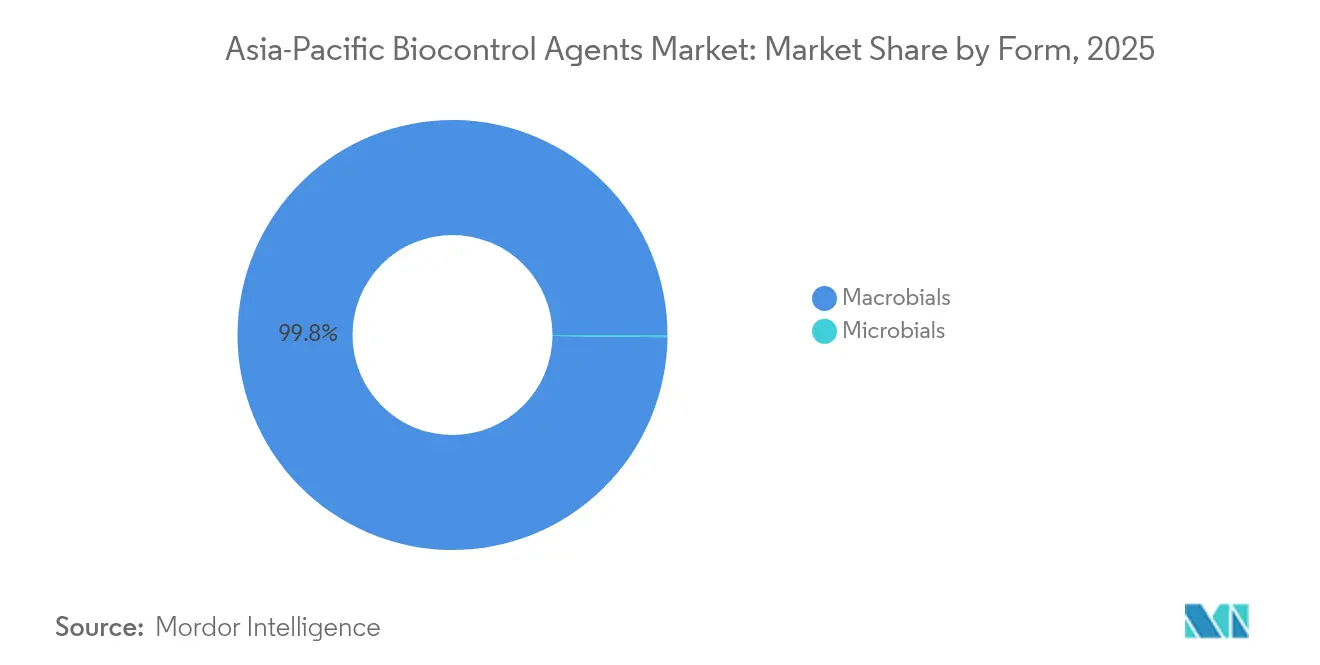
- By form, macrobials led with 99.84% revenue share in 2025; microbials are forecast to expand at a 6.01% CAGR to 2031.
- By crop type, row crops held 83.12% of the Asia-Pacific biocontrol agents market share in 2025, while horticultural crops recorded the highest projected CAGR at 6.05% through 2031.
- By country, India accounted for a 77.10% share of the Asia-Pacific biocontrol agents market size in 2025, while China is advancing at an 8.67% CAGR through 2031.
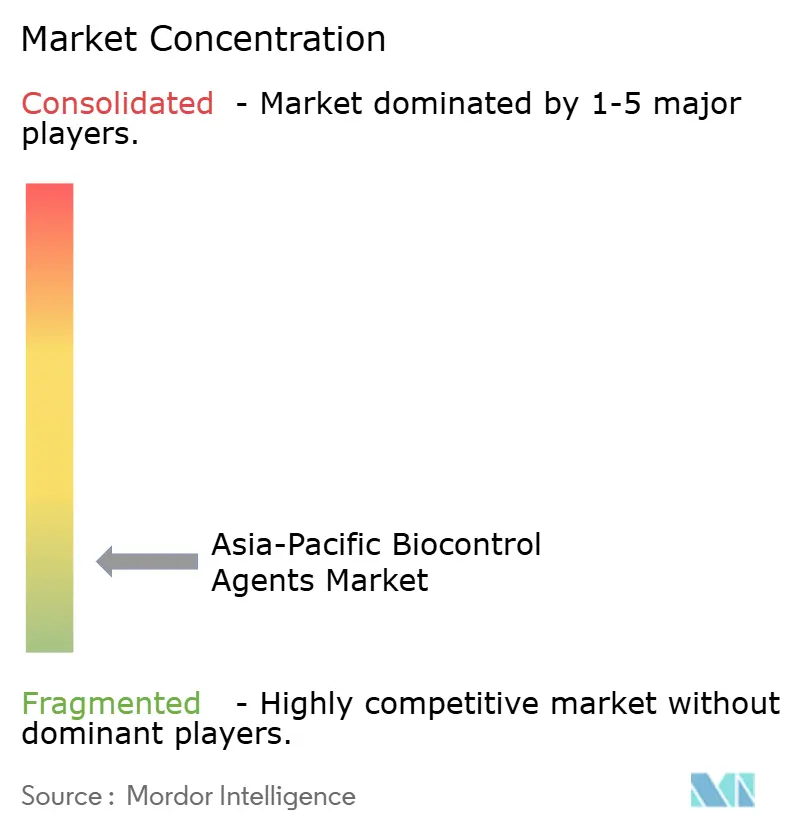
- The market concentration analysis reveals a fragmented competitive landscape where the top five players, Koppert, Biobest (BioFirst), Samridhi Crops, Andermatt, and T. Stanes, collectively hold less than 2% of the market share.
Note: Market size and forecast figures in this report are generated using Mordor Intelligence’s proprietary estimation framework, updated with the latest available data and insights as of 2026.
Asia-Pacific Biocontrol Agents Market Trends and Insights
Drivers Impact Analysis*
| Driver | (~) % Impact on CAGR Forecast | Geographic Relevance | Impact Timeline |
|---|---|---|---|
| Accelerated bans on high-residue synthetic pesticides | +1.8% | India, Thailand, Malaysia, China core markets | Medium term (2-4 years) |
| Rising resistance of pests to conventional chemistries | +1.2% | Asia-Pacific-wide, strongest in intensive farming regions | Long term (≥ 4 years) |
| Government subsidies on organic crop inputs | +1.0% | India, China, South Korea primary beneficiaries | Short term (≤ 2 years) |
| Integration of AI-enabled pest monitoring platforms | +0.8% | Japan, Australia, advanced farming regions | Medium term (2-4 years) |
| Expansion of controlled-environment agriculture acreage | +0.7% | China, Japan, Singapore leading adoption | Long term (≥ 4 years) |
| Carbon-credit premiums for biologically farmed produce | +0.4% | Australia, New Zealand, voluntary markets | Long term (≥ 4 years) |
| Source: Mordor Intelligence | |||
Accelerated Bans on High-Residue Synthetic Pesticides
Regulatory convergence across Asia-Pacific markets is creating a compliance-driven adoption wave that fundamentally alters input procurement strategies for commercial growers. Thailand's Department of Agriculture banned paraquat and chlorpyrifos in 2024, while India's Central Insecticides Board restricted 27 chemical active ingredients with immediate effect[1]. Malaysia's Pesticides Board implemented maximum residue limits aligned with Codex Alimentarius standards, effectively eliminating high-residue compounds from export-oriented crops. These regulatory actions create captive demand for biological alternatives as growers face immediate compliance requirements rather than gradual transition timelines. The enforcement mechanism differs significantly from voluntary adoption programs, as non-compliance results in market access restrictions for agricultural exports, particularly affecting high-value horticultural crops destined for developed markets.
Rising Resistance of Pests to Conventional Chemistries
Pest resistance patterns across Asia-Pacific reveal a biological imperative that transcends regulatory pressure, forcing growers toward multi-mode biocontrol strategies regardless of cost considerations. The brown planthopper in rice systems demonstrates resistance to 8 chemical classes across Vietnam, Thailand, and the Philippines, while diamondback moth populations in cruciferous crops show cross-resistance to synthetic pyrethroids and organophosphates [2]. Resistance management protocols now mandate biological rotation strategies, creating structured demand cycles for entomopathogenic fungi and bacterial agents. This biological pressure creates a unique market dynamic where biocontrol adoption becomes an operational necessity rather than an environmental preference, fundamentally altering purchasing decisions and budget allocations for integrated pest management programs.
Government Subsidies on Organic Crop Inputs
Subsidy architecture across major Asia-Pacific markets demonstrates coordinated policy support that reduces adoption barriers through direct cost intervention mechanisms. India's Paramparagat Krishi Vikas Yojana provides 50% subsidy coverage for certified biological inputs, while China's Ministry of Agriculture offers 30-40% cost reimbursement for registered biocontrol agents under its Green Development Program. South Korea's Rural Development Administration extends 60% subsidies for beneficial insect releases in greenhouse operations, creating immediate cost parity with synthetic alternatives. These subsidy mechanisms operate through direct payment systems rather than tax credits, providing immediate cash flow benefits that influence seasonal purchasing decisions and enable smaller growers to access premium biological products previously limited to large commercial operations.
Integration of AI-Enabled Pest Monitoring Platforms
Digital agriculture platforms transform biocontrol deployment from calendar-based applications to precision-timed releases based on real-time pest pressure analytics and environmental modeling. Japan's agricultural technology companies deploy IoT sensors integrated with machine learning algorithms that predict optimal release windows for specific biocontrol agents, improving field efficacy by 25-35% compared to traditional scouting methods. Australia's Commonwealth Scientific and Industrial Research Organization develops predictive models that correlate weather patterns with pest lifecycle stages, enabling preemptive biocontrol releases that intercept pest populations before economic thresholds. This technological integration creates data-driven demand patterns that optimize biocontrol inventory management and reduce waste from mistimed applications, fundamentally changing how biological agents are marketed and distributed to end users.
Restraints Impact Analysis*
| Restraint | (~) % Impact on CAGR Forecast | Geographic Relevance | Impact Timeline |
|---|---|---|---|
| Short shelf-life and cold-chain dependency | -0.9% | Tropical Asia-Pacific, infrastructure-limited regions | Short term (≤ 2 years) |
| Inconsistent field efficacy across diverse micro-climates | -0.7% | Southeast Asia, monsoon-affected regions | Medium term (2-4 years) |
| Limited harmonization of registration guidelines | -0.5% | ASEAN countries, regulatory fragmentation | Long term (≥ 4 years) |
| Price under-cutting from counterfeit bio-inputs | -0.3% | China, India, enforcement-limited markets | Medium term (2-4 years) |
| Source: Mordor Intelligence | |||
Short Shelf-Life and Cold-Chain Dependency
Temperature-sensitive biological agents require specialized storage and transportation infrastructure that adds significant cost burdens in tropical climates where ambient temperatures exceed optimal storage ranges for 8-10 months annually. Entomopathogenic nematodes lose 40-60% viability when exposed to temperatures above 25°C for extended periods, while bacterial biocontrol agents require continuous refrigeration at 2-8°C to maintain spore viability. Cold-chain infrastructure in Southeast Asia remains fragmented, with reliable refrigerated transport available primarily in major urban centers, limiting market penetration in rural agricultural regions where biocontrol demand is highest. Distribution costs increase by 15-25% compared to synthetic pesticides, creating price sensitivity challenges that particularly affect smallholder farmers operating on narrow profit margins.
Inconsistent Field Efficacy Across Diverse Micro-Climates
Micro-climatic variability across Asia-Pacific agricultural regions creates unpredictable performance outcomes that undermine grower confidence in biological solutions, particularly among first-time adopters with limited technical support. Monsoon patterns, humidity fluctuations, and temperature variations affect biocontrol agent survival and reproduction rates, leading to efficacy ranges of 30-85% depending on local environmental conditions. This performance variability contrasts sharply with synthetic pesticides that maintain consistent activity levels across diverse environmental conditions, creating adoption barriers among risk-averse commercial growers. Technical support infrastructure remains limited in rural areas, preventing proper application timing and environmental optimization that could improve biological control outcomes and reduce performance variability.
*Our forecasts treat driver/restraint impacts as directional, not additive. The impact forecasts reflect baseline growth, mix effects, and variable interactions.
Segment Analysis
By Form: Macrobials Dominate Through Scalable Production
Entomopathogenic nematodes and parasitoids drive macrobials to a dominant 99.84% Asia-Pacific biocontrol agents market share in 2025, reflecting the segment's scalability advantages in mass-rearing facilities and field application systems. Microbials represent the fastest-growing segment at 6.01% CAGR through 2031, driven by advances in fermentation technology and formulation stability that address traditional shelf-life limitations. Parasitoids benefit from established mass-rearing protocols developed by European biocontrol companies, enabling consistent quality and predictable release outcomes that appeal to commercial growers seeking reliable pest suppression. Predators face adoption challenges in open-field applications due to mobility and retention issues, limiting their market penetration primarily to controlled-environment agriculture, where physical barriers prevent dispersal.
The macrobials segment leverages decades of research investment in insect biology and mass-production techniques, creating entry barriers for new competitors lacking specialized facilities and technical expertise. Bacterial biocontrol agents within the microbials segment show particular promise in soil-borne pest management, where persistence and root zone colonization provide extended protection periods compared to foliar applications. Fungal biocontrol agents demonstrate efficacy against lepidopteran pests but require precise environmental conditions for spore germination and infection, limiting their adoption in variable climate regions. Other microbials, including viral and protozoan agents, remain niche applications due to host specificity and production complexity, though they offer potential for specialized pest problems where conventional solutions prove inadequate.

By Crop Type: Row Crops Lead Through Scale Economics
Row crops commanded 83.12% of the Asia-Pacific biocontrol agents market size in 2025, driven by the economic advantages of large-scale biocontrol applications across extensive monoculture systems where pest pressure and biological agent requirements remain predictable. Horticultural crops emerge as the fastest-growing segment at 6.05% CAGR through 2031, reflecting premium pricing tolerance and quality requirements that justify higher biological input costs. Cash crops, including cotton and sugarcane, demonstrate steady adoption rates but face cost sensitivity challenges that limit premium biocontrol product penetration. The segmentation reflects fundamental differences in economic models, where row crop profitability depends on input cost optimization while horticultural crops prioritize quality and residue-free production for export markets.
Large-scale row crop operations benefit from mechanized application systems and bulk purchasing agreements that reduce per-hectare biocontrol costs to competitive levels with synthetic alternatives. Horticultural crops, particularly those destined for export markets, face stringent residue requirements that create captive demand for biological solutions regardless of cost premiums. The integration of precision agriculture technologies in row crop systems enables targeted biocontrol applications based on pest pressure mapping, optimizing agent deployment and improving cost-effectiveness. Cash crop adoption patterns vary significantly by region, with premium markets showing higher biological acceptance rates while commodity-focused production maintains price sensitivity that favors synthetic alternatives.

Geography Analysis
India's dominance with 77.10% Asia-Pacific biocontrol agents market share in 2025 stems from extensive smallholder agriculture systems, where government subsidy programs reduce biocontrol adoption barriers and established distribution networks ensure rural market penetration. The country's diverse agro-climatic zones create varied pest pressure patterns that require multiple biocontrol solutions, driving demand across different biological agent categories. China's rapid 8.67% CAGR through 2031 reflects coordinated policy support through the Ministry of Agriculture's Green Development Program and substantial investments in controlled-environment agriculture infrastructure.
Southeast Asian markets, including Indonesia, the Philippines, Thailand, and Vietnam, demonstrate emerging adoption patterns constrained by infrastructure limitations and technical support gaps. Indonesia's palm oil sector shows increasing interest in biological solutions for sustainable certification requirements, while the Philippines focuses on vegetable export crops where residue-free production commands premium pricing. Thailand's fruit export industry drives biocontrol demand in mango and longan production systems, supported by government initiatives promoting sustainable agriculture practices.
The regulatory landscape across Asia-Pacific reveals significant harmonization challenges that create market entry barriers and limit cross-border product registration efficiency. ASEAN countries maintain individual registration requirements with limited mutual recognition agreements, forcing biocontrol companies to navigate multiple approval processes for regional market access.This regulatory fragmentation creates competitive advantages for established players with resources to manage multiple registration processes while limiting market entry opportunities for smaller biocontrol developers.
Competitive Landscape
Market concentration analysis reveals a fragmented competitive environment where the top five players control less than 2% of the Asia-Pacific biocontrol agents market revenue share, indicating significant opportunities for market share gains through strategic positioning and technological differentiation. Koppert Biological Systems maintains leadership through vertical integration strategies that span research, production, and distribution, while regional players like Samriddhi Crops India leverage local market knowledge and cost advantages to capture significant market positions.
Strategic patterns emphasize geographic expansion through local partnerships and production facility establishment rather than export-based market entry, reflecting the logistical challenges of international biocontrol agent transportation. Technology adoption centers on fermentation optimization, formulation stability, and application system integration, with leading companies investing in digital agriculture platforms that enhance biocontrol deployment precision.
White-space opportunities exist in specialized crop applications and emerging pest problems where conventional solutions prove inadequate, creating niche market segments for innovative biological approaches. Patent filings in biocontrol formulation and application technologies increased 23% in 2024, indicating sustained innovation investment across the competitive landscape. Competition intensity focuses on mass-rearing efficiency, quality standardization, and distribution network coverage rather than product differentiation, as biological efficacy remains the primary purchase criterion for commercial growers.
Asia-Pacific Biocontrol Agents Industry Leaders
-
Biobest Group NV
-
Koppert Biological Systems Inc.
-
Samriddhi Crops India Pvt Ltd
-
Andermatt Group AG
-
T. Stanes and Company Limited
- *Disclaimer: Major Players sorted in no particular order
Recent Industry Developments
- October 2025: ICAR–Indian Institute of Spices Research (IISR) developed “TrichoLime,” a granular lime-based Trichoderma formulation that neutralizes soil acidity while delivering a biocontrol agent against soil-borne pathogens.
- February 2024: PI Industries partnered with the Centre for Cellular And Molecular Platforms (C-CAMP) to commercialize two new biocontrol technologies: AphidControl (botanical insecticide) and XanthoControl (biocontrol agent). These solutions target aphids and Xanthomonas species, respectively, offering environmentally friendly alternatives to chemical pesticides.
- March 2023: Corteva Agriscience completed the acquisition of Symborg, a Spanish company specializing in microbiological technologies. This acquisition enhances Corteva's biologicals portfolio, particularly in biocontrol solutions, aligning with the growing demand for sustainable agricultural practices in the Asia-Pacific region
Asia-Pacific Biocontrol Agents Market Report Scope
| Macrobials | By Organism | Entamopathogenic Nematodes |
| Parasitoids | ||
| Predators | ||
| Microbials | By Organism | Bacterial Biocontrol Agents |
| Fungal Biocontrol Agents | ||
| Other Microbials |
| Cash Crops |
| Horticultural Crops |
| Row Crops |
| China |
| India |
| Japan |
| Australia |
| Vietnam |
| Thailand |
| Indonesia |
| Philippines |
| Rest of Asia-Pacific |
| Form | Macrobials | By Organism | Entamopathogenic Nematodes |
| Parasitoids | |||
| Predators | |||
| Microbials | By Organism | Bacterial Biocontrol Agents | |
| Fungal Biocontrol Agents | |||
| Other Microbials | |||
| Crop Type | Cash Crops | ||
| Horticultural Crops | |||
| Row Crops | |||
| Country | China | ||
| India | |||
| Japan | |||
| Australia | |||
| Vietnam | |||
| Thailand | |||
| Indonesia | |||
| Philippines | |||
| Rest of Asia-Pacific | |||
Market Definition
- AVERAGE DOSAGE RATE - The average application rate is the average volume of biocontrol agents applied per hectare of farmland in the respective region/country.
- CROP TYPE - Crop type includes Row crops (Cereals, Pulses, Oilseeds), Horticultural Crops (Fruits and vegetables) and Cash Crops (Plantation Crops, Fibre Crops and Other Industrial Crops)
- FUNCTION - The Crop Protection function of agirucultural biological include products that prevent or control various biotic and abiotic stress.
- TYPE - Biocontrol agents are the natural predators and parasitoids used to control various pests. Biocontrol agents include both microbials (Microorganisms) and macrobials (Insects).
| Keyword | Definition |
|---|---|
| Cash Crops | Cash crops are non-consumable crops sold as a whole or part of the crop to manufacture end-products to make a profit. |
| Integrated Pest Management (IPM) | IPM is an environment-friendly and sustainable approach to control pests in various crops. It involves a combination of methods, including biological controls, cultural practices, and selective use of pesticides. |
| Bacterial biocontrol agents | Bacteria used to control pests and diseases in crops. They work by producing toxins harmful to the target pests or competing with them for nutrients and space in the growing environment. Some examples of commonly used bacterial biocontrol agents include Bacillus thuringiensis (Bt), Pseudomonas fluorescens, and Streptomyces spp. |
| Plant Protection Product (PPP) | A plant protection product is a formulation applied to crops to protect from pests, such as weeds, diseases, or insects. They contain one or more active substances with other co-formulants such as solvents, carriers, inert material, wetting agents or adjuvants formulated to give optimum product efficacy. |
| Pathogen | A pathogen is an organism causing disease to its host, with the severity of the disease symptoms. |
| Parasitoids | Parasitoids are insects that lay their eggs on or within the host insect, with their larvae feeding on the host insect. In agriculture, parasitoids can be used as a form of biological pest control, as they help to control pest damage to crops and decrease the need for chemical pesticides. |
| Entomopathogenic Nematodes (EPN) | Entomopathogenic nematodes are parasitic roundworms that infect and kill pests by releasing bacteria from their gut. Entomopathogenic nematodes are a form of biocontrol agents used in agriculture. |
| Vesicular-arbuscular mycorrhiza (VAM) | VAM fungi are mycorrhizal species of fungus. They live in the roots of different higher-order plants. They develop a symbiotic relationship with the plants in the roots of these plants. |
| Fungal biocontrol agents | Fungal biocontrol agents are the beneficial fungi that control plant pests and diseases. They are an alternative to chemical pesticides. They infect and kill the pests or compete with pathogenic fungi for nutrients and space. |
| Biofertilizers | Biofertilizers contain beneficial microorganisms that enhance soil fertility and promote plant growth. |
| Biopesticides | Biopesticides are natural/bio-based compounds used to manage agricultural pests using specific biological effects. |
| Predators | Predators in agriculture are the organisms that feed on pests and help control pest damage to the crops. Some common predator species used in agriculture include ladybugs, lacewings, and predatory mites. |
| Biocontrol agents | Biocontrol agents are living organisms used to control pests and diseases in agriculture. They are alternatives to chemical pesticides and are known for their lesser impact on the environment and human health. |
| Organic Fertilizers | Organic fertilizer is composed of animal or vegetable matter used alone or in combination with one or more non-synthetically derived elements or compounds used for soil fertility and plant growth. |
| Protein hydrolysates (PHs) | Protein hydrolysate-based biostimulants contain free amino acids, oligopeptides, and polypeptides produced by enzymatic or chemical hydrolysis of proteins, primarily from vegetal or animal sources. |
| Biostimulants/Plant Growth Regulators (PGR) | Biostimulants/Plant Growth Regulators (PGR) are substances derived from natural resources to enhance plant growth and health by stimulating plant processes (metabolism). |
| Soil Amendments | Soil Amendments are substances applied to soil that improve soil health, such as soil fertility and soil structure. |
| Seaweed Extract | Seaweed extracts are rich in micro and macronutrients, proteins, polysaccharides, polyphenols, phytohormones, and osmolytes. These substances boost seed germination and crop establishment, total plant growth and productivity. |
| Compounds related to biocontrol and/or promoting growth (CRBPG) | Compounds related to biocontrol or promoting growth (CRBPG) are the ability of a bacteria to produce compounds for phytopathogen biocontrol and plant growth promotion. |
| Symbiotic Nitrogen-Fixing Bacteria | Symbiotic nitrogen-fixing bacteria such as Rhizobium obtain food and shelter from the host, and in return, they help by providing fixed nitrogen to the plants. |
| Nitrogen Fixation | Nitrogen fixation is a chemical process in soil which converts molecular nitrogen into ammonia or related nitrogenous compounds. |
| ARS (Agricultural Research Service) | ARS is the U.S. Department of Agriculture's chief scientific in-house research agency. It aims to find solutions to agricultural problems faced by the farmers in the country. |
| Phytosanitary Regulations | Phytosanitary regulations imposed by the respective government bodies check or prohibit the importation and marketing of certain insects, plant species, or products of these plants to prevent the introduction or spread of new plant pests or pathogens. |
| Ectomycorrhizae (ECM) | Ectomycorrhiza (ECM) is a symbiotic interaction of fungi with the feeder roots of higher plants in which both the plant and the fungi benefit through the association for survival. |
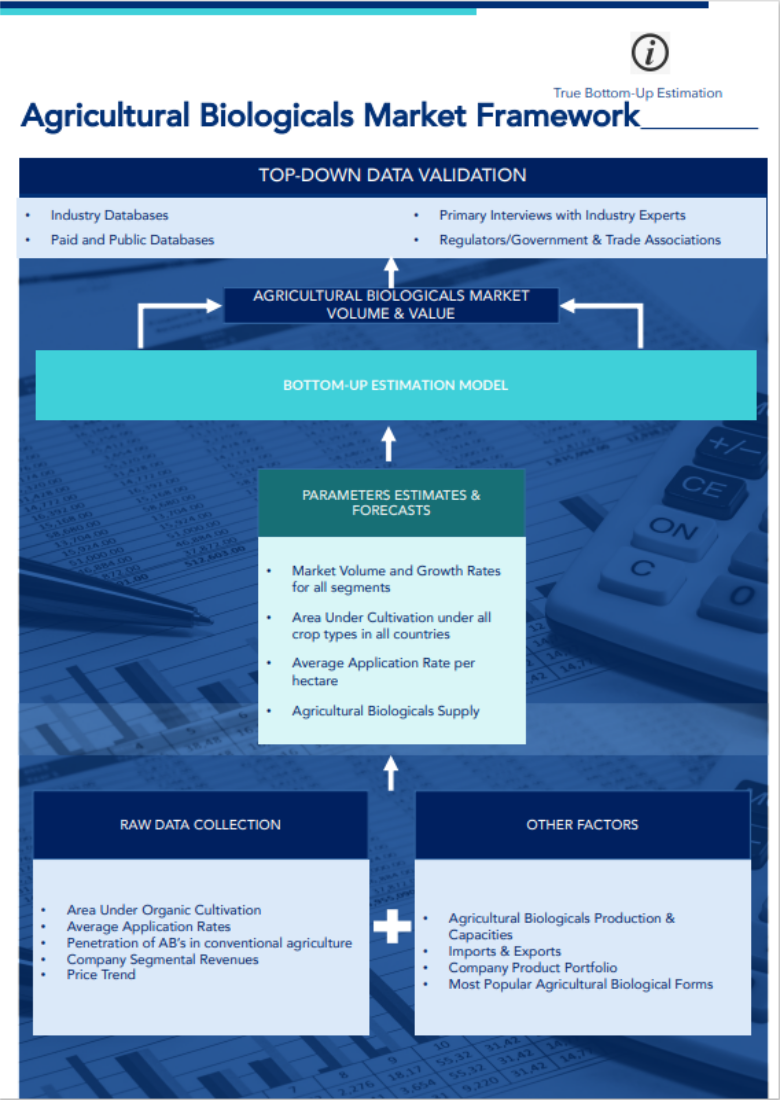
Research Methodology
Mordor Intelligence follows a four-step methodology in all our reports.
- Step-1: Identify Key Variables: In order to build a robust forecasting methodology, the variables and factors identified in Step-1 are tested against available historical market numbers. Through an iterative process, the variables required for market forecast are set and the model is built on the basis of these variables.
- Step-2: Build a Market Model: Market-size estimations for the forecast years are in nominal terms. Inflation is not a part of the pricing, and the average selling price (ASP) is kept constant throughout the forecast period.
- Step-3: Validate and Finalize: In this important step, all market numbers, variables and analyst calls are validated through an extensive network of primary research experts from the market studied. The respondents are selected across levels and functions to generate a holistic picture of the market studied.
- Step-4: Research Outputs: Syndicated Reports, Custom Consulting Assignments, Databases & Subscription Platforms.