
Market Overview
| Study Period | 2021 - 2031 |
|---|---|
| Forecast Data Period | 2026 - 2031 |
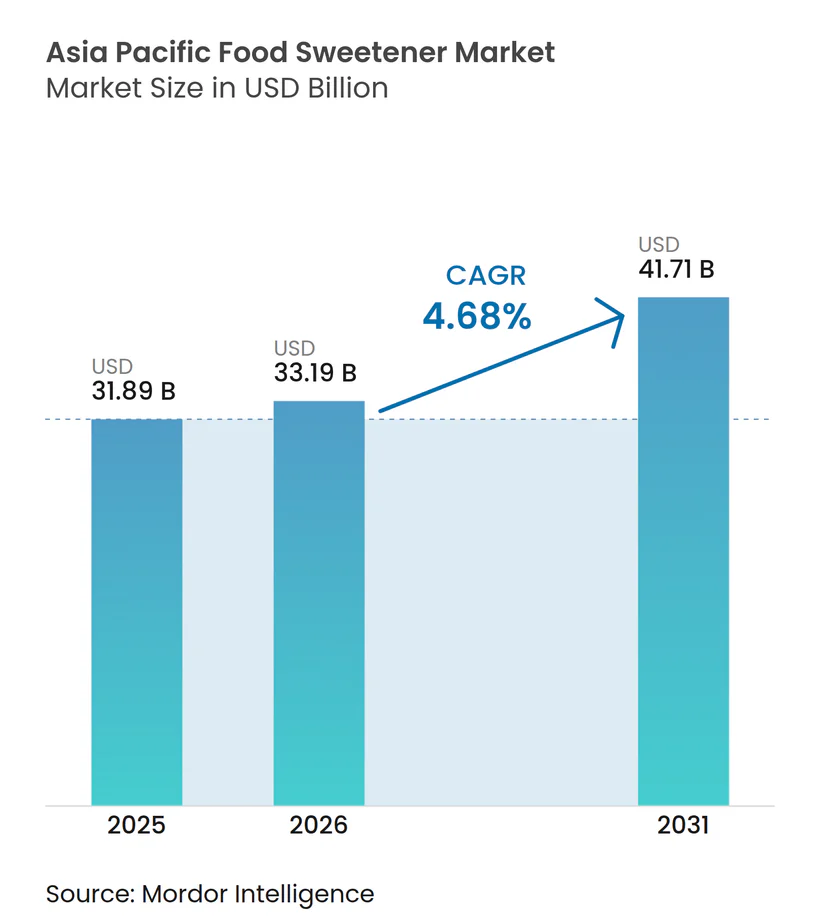
| Base Year Market Size (2025) | USD 31.89 Billion |
| Market Size (2026) | USD 33.19 Billion |
| Market Size (2031) | USD 41.71 Billion |
| Growth Rate (2026 - 2031) | 4.68 % |
| Market Concentration | Medium |
Major Players *Disclaimer: Major Players sorted in no particular order Image © Mordor Intelligence. Reuse requires attribution under CC BY 4.0. | |
Asia Pacific Food Sweetener Market Analysis by Mordor Intelligence
The Asia-Pacific food sweetener market size was valued at USD 31.89 billion in 2025 and estimated to grow from USD 33.19 billion in 2026 to reach USD 41.71 billion by 2031, at a CAGR of 4.68% during the forecast period (2026-2031). Rising income, urban living, and packaged food consumption are increasing demand for consistent sweetener inputs across the region. Reformulation is becoming more important as governments and consumers focus on added sugar, calorie content, and ingredient labels. Suppliers that can combine dependable supply with application support are better placed than suppliers focused only on bulk volume. Fermentation-derived ingredients and higher-purity steviol glycosides are widening the range of products available to manufacturers, although sucrose remains central to regional food production.
Key Report Takeaways
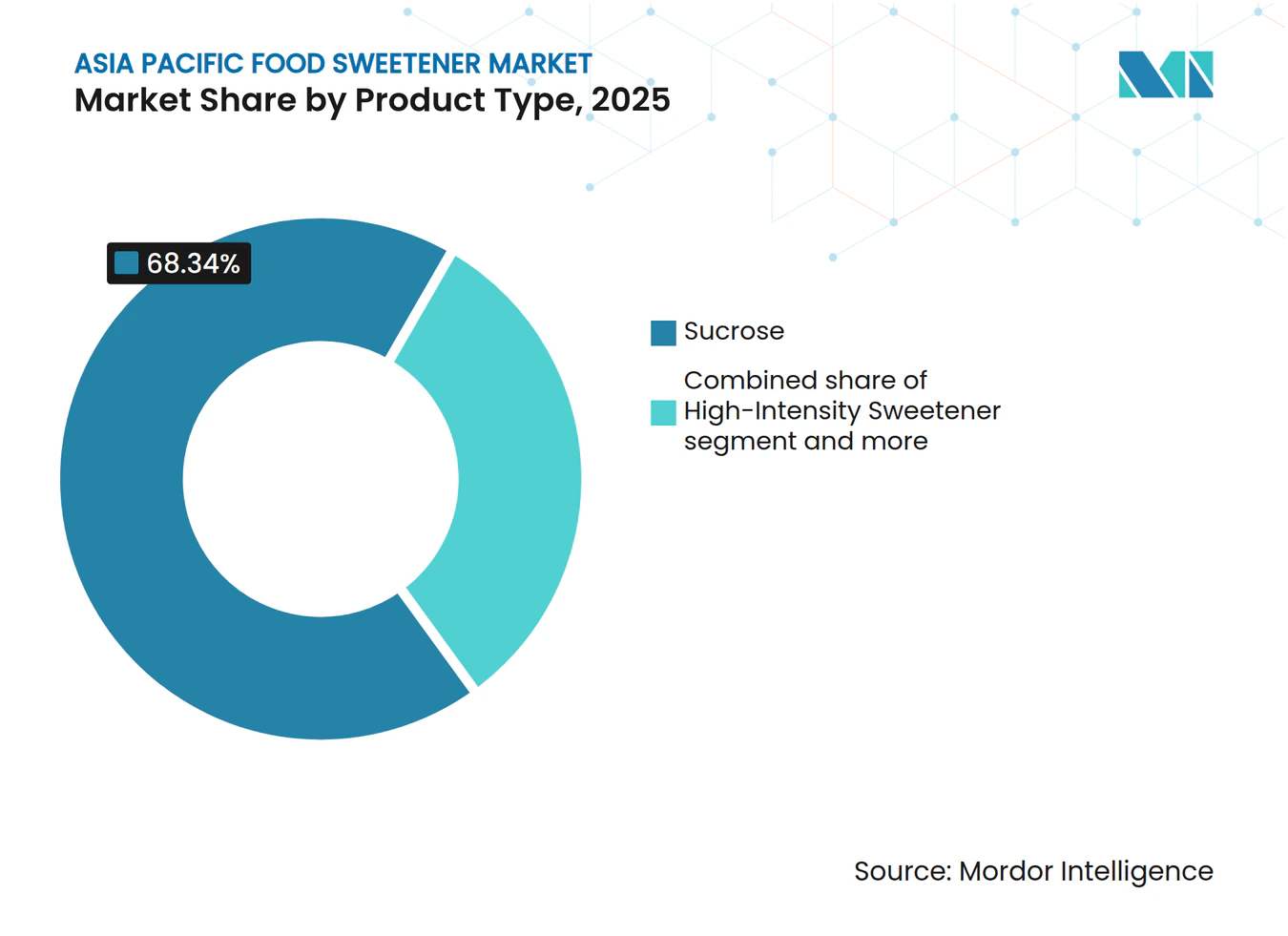
- By product type, sucrose held 68.34% of the Asia-Pacific food sweetener market share in 2025, while high-intensity sweeteners are projected to grow at a 6.03% CAGR through 2031.
- By source, plant-based sweeteners held 84.61% of the market in 2025, while fermentation-derived sweeteners are projected to grow at a 5.93% CAGR through 2031.
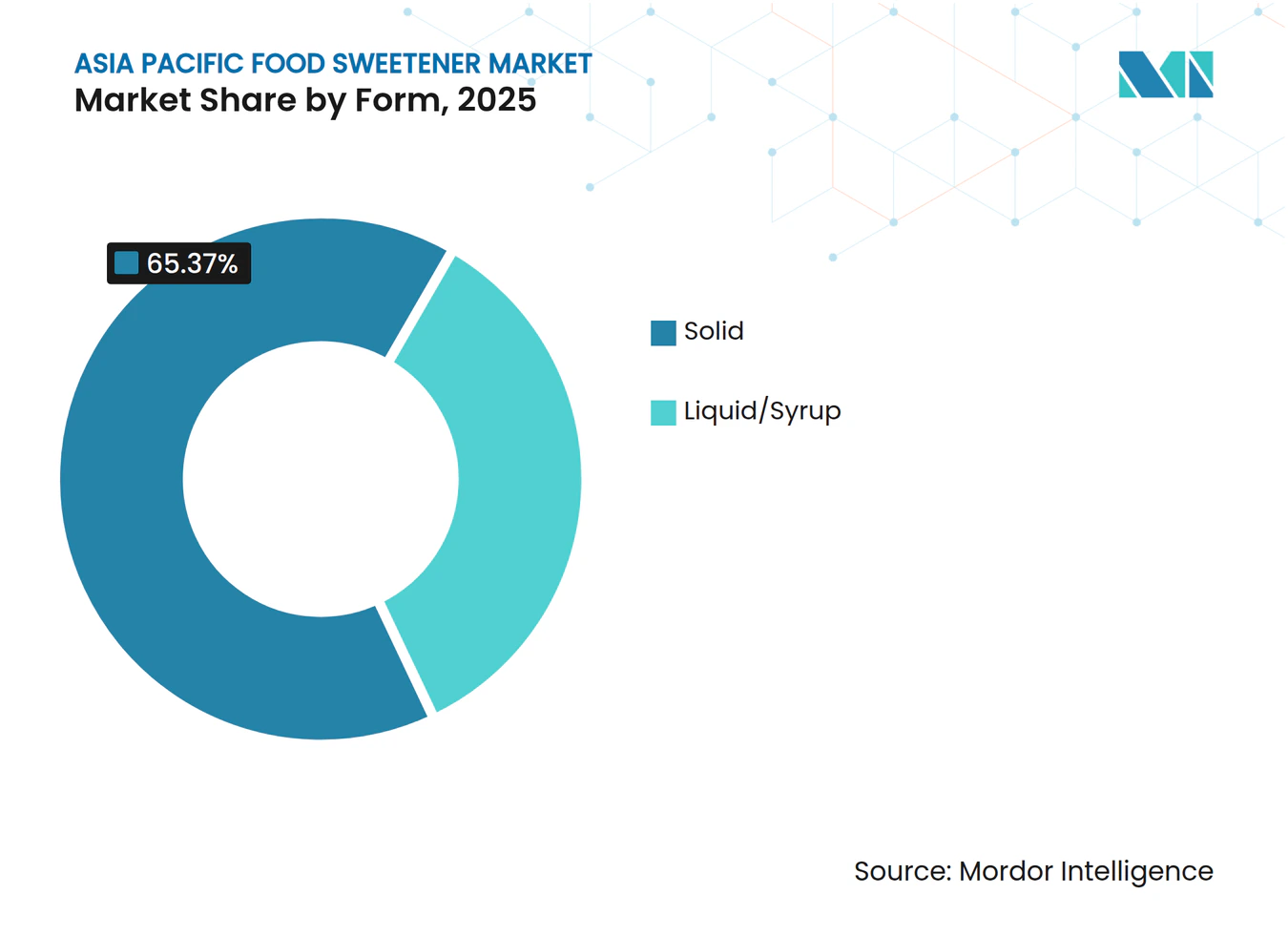
- By form, solid sweeteners held 65.37% of the market in 2025, while liquid and syrup formats are projected to grow at a 6.21% CAGR through 2031.
- By application, food held 59.51% of the market in 2025, while beverages are projected to grow at a 5.81% CAGR through 2031.
- By geography, China held 38.76% of the market in 2025, while India is projected to grow at a 5.77% CAGR through 2031.
Note: Market size and forecast figures in this report are generated using Mordor Intelligence’s proprietary estimation framework, updated with the latest available data and insights as of January 2026.
Market Trends and Insights
Drivers Impact Analysis of Asia Pacific Food Sweetener Market*
| Driver | (~) % Impact on CAGR Forecast | Geographic Relevance | Impact Timeline |
|---|---|---|---|
| Rising Demand for Low-Calorie and Sugar-Free Food Products | +1.0% | Asia-Pacific wide; concentrated in China, India, Japan | Short term (≤ 2 years) |
| Increasing Demand for Sweeteners in Dairy Products and Frozen Desserts | +0.6% | China, India, Southeast Asia | Medium term (2-4 years) |
| Expansion of the Processed and Packaged Food Industry | +0.8% | China, India, Indonesia, Vietnam | Medium term (2-4 years) |
| Growing Demand for Functional and Health-Oriented Food Products | +0.5% | Japan, South Korea, Australia, Singapore | Medium term (2-4 years) |
| Increasing Adoption of Natural and Plant-Based Sweeteners | +0.7% | Asia-Pacific wide; led by China and India | Short term (≤ 2 years) |
| Expansion of the Bakery and Confectionery Industry | +0.4% | China, India, Southeast Asia | Long term (≥ 4 years) |
| Source: Mordor Intelligence | |||
Rising Demand for Low-Calorie and Sugar-Free Food Products
The rising demand for low-calorie and sugar-free food products is driving the growth of the Asia-Pacific food sweetener market as consumers increasingly seek to reduce their sugar intake without compromising sweetness. The Food Safety and Standards Authority of India projected that India had around 134 million people with Type-2 diabetes in 2025, which supports demand for lower-glycemic sweetening options[1]. Growing awareness of obesity, diabetes, and other diet-related health concerns is encouraging food and beverage manufacturers to reformulate products using alternative sweeteners. Manufacturers are incorporating stevia, sucralose, aspartame, and sugar alcohols into beverages, confectionery, dairy products, and packaged foods. The expansion of reduced-sugar product ranges across supermarkets and e-commerce platforms is further improving consumer access to these alternatives. Additionally, demand for sugar-free beverages and low-calorie snacks is encouraging ingredient suppliers to develop sweeteners that offer improved taste and functionality.
Expansion of the Processed and Packaged Food Industry
Food manufacturing is becoming more formalized in Indonesia, Vietnam, Thailand, China, and India, which increases the need for ingredients with consistent quality and documented specifications. This change supports the Asia-Pacific food sweetener market because industrial producers require reliable grades rather than only commodity sugar. China’s revised GB 28050-2025 standard requires added disclosure of sugar and saturated fat on prepackaged foods from March 2027. The compliance date encourages manufacturers to review recipes and nutrition panels in advance. Food companies operating in several markets can also use a China-oriented reformulation program to simplify product development elsewhere in the region. Ingredient suppliers with technical teams can benefit because industrial customers may need help with sweetness, texture, solubility, and cost when they change a formulation.
Increasing Adoption of Natural and Plant-Based Sweeteners
Plant-derived ingredients continue to shape the Asia-Pacific food sweetener market because sugarcane, corn, and stevia have established supply chains in the region. China has an important role in stevia cultivation and processing, while India and Thailand provide considerable agricultural capacity for sugar-based inputs. The greater availability of stevia, erythritol, and other alternatives allows manufacturers to offer products that use natural or plant-based claims. Japan’s established familiarity with stevia gives producers a useful example of how regulatory acceptance and consumer experience can support long-term use. Precision fermentation is also making certain steviol glycosides more accessible by creating plant-identical molecules with consistent purity. This production route may help close the gap between higher-purity natural sweeteners and more conventional ingredients in applications that require a cleaner taste.
Expansion of the Bakery and Confectionery Industry
Bakery and confectionery demand is moving from local and informal production toward larger-scale manufacturing in China, India, and Southeast Asia. Industrial producers require sweeteners that perform consistently in baking, coating, texture development, and shelf-life management. This supports the Asia-Pacific food sweetener market because the quality requirement is often higher than for unstandardized production. Product developers also need to balance sweetness with water activity, browning, bulk, and mouthfeel when they reduce sucrose. Fortified bakery items that include protein, fiber, or vitamins create an additional need for ingredients that work together in a finished recipe. The long-term opportunity depends on the wider reach of organized retail and the ability of suppliers to offer cost-effective solutions for high-volume production.
Restraints Impact Analysis of Asia Pacific Food Sweetener Market*
| Restraint | (~) % Impact on CAGR Forecast | Geographic Relevance | Impact Timeline |
|---|---|---|---|
| Volatility in Sugarcane, Corn, and Other Raw Material Prices | -0.5% | Thailand, India, Indonesia, Vietnam | Short term (≤ 2 years) |
| Stringent Food Safety Regulations and Sweetener Approval Requirements | -0.4% | China, India, Australia, Japan | Medium term (2-4 years) |
| Consumer Concerns Regarding the Safety of Artificial Sweeteners | -0.4% | Japan, South Korea, Australia | Medium term (2-4 years) |
| Taste and Aftertaste Limitations of Certain Sugar Substitutes | -0.3% | Asia-Pacific wide | Long term (≥ 4 years) |
| Source: Mordor Intelligence | |||
Volatility in Sugarcane, Corn, and Other Raw Material Prices
Price changes in sugarcane and corn affect the cost base for sucrose, high-fructose corn syrup, maltodextrin, and related ingredients. This is a material issue for the Asia-Pacific food sweetener market because Thailand, India, Indonesia, China, and South Korea are linked to regional production or procurement of these inputs. Buyers can face different conditions in global and domestic markets when policy, weather, harvest timing, and import requirements affect local prices. Manufacturers that depend on large volumes of commodity inputs may respond with shorter procurement cycles, supplier diversification, or formulation changes. Volatility can also slow decisions on new product launches when an ingredient’s cost cannot be confidently maintained. This creates a practical advantage for suppliers with regional sourcing options and a broader range of sweetener formats.
Consumer Concerns Regarding the Safety of Artificial Sweeteners
Consumer concerns about artificial sweeteners are influencing product design in Japan, South Korea, and Australia. These concerns can affect demand even when a sweetener is permitted for food use, since brand owners may choose to reformulate before consumer sentiment weakens sales. The shift supports interest in stevia, erythritol, monk fruit, and fermentation-derived alternatives that can be positioned around source or purity. It also creates a communication challenge because claims about natural origin and low calories must be supported by a clear ingredient and regulatory story. Food Standards Australia New Zealand provides a compliance setting that influences labeling and ingredient approval decisions in the Oceania market[2]. The resulting preference shift may limit some artificial ingredients while expanding the need for alternatives that still meet taste and cost requirements.
*Our forecasts treat driver/restraint impacts as directional, not additive. The impact forecasts reflect baseline growth, mix effects, and variable interactions.
Asia Pacific Food Sweetener Market Segment Analysis
By Product Type:
Conventional Sucrose Leads, High-Intensity Sweeteners Drive GrowthSucrose held 68.34% of the Asia-Pacific food sweetener market in 2025, reflecting its widespread use in food processing and established distribution systems. The large position of sucrose is linked to its role in bakery, confectionery, dairy, beverages, and traditional foods. Manufacturers in China and India use sucrose at scale because it offers sweetness, bulk, texture, and a familiar production process. Replacing it can require changes to water activity, mouthfeel, browning, and ingredient costs. These reformulation needs help explain why the segment continues to lead despite stronger interest in alternatives. The Asia-Pacific food sweetener industry still relies on sucrose as the baseline against which other ingredients are assessed.
High-intensity sweeteners are projected to grow at a 6.03% CAGR through 2031, making them the fastest-growing product type. Their use is strongest where a producer wants to lower sugar content without adding comparable calorie volume. Stevia, sucralose, and aspartame remain relevant to beverages and functional food products, although their role varies by country and consumer preference. Starch sweeteners and sugar alcohols occupy a separate middle position because they offer different functions in recipes. High-fructose corn syrup remains important in beverage production, while xylitol and erythritol are used in dental and health-oriented products. China’s approval of D-allulose as a new food ingredient in July 2025 also provides manufacturers with an additional low-calorie option for beverage, dairy, and bakery applications.



By Source:
Plant-Based Inputs Dominate, Fermentation-Derived Routes Gain AttentionPlant-based sweeteners held 84.61% of the Asia-Pacific food sweetener market share in 2025. This position includes sucrose from sugarcane and beet, stevia, and several plant-derived sugar alcohols. Agricultural supply from China, India, and Thailand supports the segment’s scale and makes it difficult for new source categories to compete in commodity applications. Plant-based inputs are especially important where food producers need high volume and predictable costs. They also align with consumer interest in ingredient origin and clean-label positioning. The underlying agricultural base gives this segment a durable role in the Asia-Pacific food sweetener industry.
Fermentation-derived sweeteners are projected to grow at a 5.93% CAGR through 2031, supported by work on higher-purity steviol glycosides and sweet proteins. A 2025 study in Biotechnology Journal described engineering of Komagataella phaffii for brazzein production and reported a titer of 1.4 grams per liter in a 5-liter fed-batch bioreactor. This research is relevant because it illustrates progress toward production methods for sweet proteins that do not depend on conventional crop extraction. China, South Korea, and Singapore are presented in the supplied material as locations with interest in domestic precision fermentation capacity.
By Form:
Solid Formats Retain Scale, Liquid and Syrup Formats Grow FasterSolid sweeteners held 65.37% of the Asia-Pacific food sweetener market in 2025. Granulated sucrose, powdered sugar alcohols, crystalline high-intensity sweeteners, and stevia powders fit established storage and handling systems. These formats are particularly suitable for dry mixes, bakery products, confectionery, and other applications where a uniform dry ingredient is needed. Their use is also supported by infrastructure designed around bagged or bulk crystalline materials. Many food producers have production lines built for solids, which reduces the need to change equipment. This installed base gives solid sweeteners a continuing volume advantage in the Asia-Pacific food sweetener market.
Liquid and syrup forms are projected to grow at a 6.21% CAGR through 2031, the highest rate among the form segments. These formats include liquid sucrose, high-fructose corn syrup, invert sugar, and liquid high-intensity sweetener blends. Beverage and dairy manufacturers can use them for measured dosing without the dissolution steps associated with solid ingredients. This can improve process consistency and support brix control in larger production runs. Ready-to-drink tea, sports drinks, flavored milk, and carbonated beverages are contributing to demand in Southeast Asia. Liquid stevia concentrates are also relevant to premium ready-to-drink beverages in Japan and Australia where a producer seeks dispersibility and a natural ingredient position.

By Application:
Food Holds the Largest Position, Beverages Support GrowthFood held 59.51% of the Asia-Pacific food sweetener market in 2025. The segment includes bakery and confectionery, dairy and desserts, savory products, nutraceuticals, functional foods, sauces, dressings, and other processed foods. Bakery and confectionery make extensive use of sweeteners because sweetness, bulk, texture, and browning all matter to product performance. Dairy and dessert products also provide room for low-sugar recipes as flavored yogurt, ice cream, and cultured dairy reach more consumers in Vietnam, Indonesia, and India. Nutraceutical and functional foods add another source of demand where producers seek glycemic, prebiotic, or dental-health attributes.
Beverages are projected to grow at a 5.81% CAGR through 2031. Soft drink reformulation and the growth of sports and functional beverages are central to this result. Beverage producers can use high-intensity sweeteners and liquid stevia blends when they need to lower sugar while keeping a familiar taste. The decision affects more than one segment because it can change product type, source, and form at the same time. Sauces, dressings, and spreads also offer a smaller but growing outlet as modern retail expands the use of packaged condiments.
Geography Analysis
China Food Sweetener Market
China held 38.76% of the Asia-Pacific food sweetener market in 2025, reflecting its role as a large producer, processor, and consumer of sweeteners. The country’s Healthy China 2030 direction and Food and Nutrition Development Guidelines encourage lower added sugar intake and create a policy basis for reformulation[3]. China approved D-allulose as a new food ingredient in July 2025, which widened the options available to local food producers. The revised GB 28050-2025 nutrition labeling standard is set to require disclosure of sugar and saturated fat from March 2027. These measures can shorten planning cycles for manufacturers that need to update products and labels. China’s established stevia supply chain adds a separate advantage by supporting regional availability of plant-based alternatives.
India and Japan Food Sweetener Market
India is projected to record a 5.77% CAGR through 2031, making it the fastest-growing geography in the Asia-Pacific food sweetener market. The country’s large consumer base and expanding packaged food production support demand for ingredients that can be used at industrial scale. The FSSAI projection of 134 million people with Type-2 diabetes in 2025 adds to the rationale for lower-glycemic food and beverage options. Japan remains a high-value market with established consumer familiarity with stevia and a product mix that includes both sucrose and high-intensity sweeteners.
ASEAN Food Sweetener Market
Indonesia and Thailand are important Southeast Asian markets because their food and beverage sectors use considerable sweetener volumes. Thailand’s procurement conditions can be affected by supply disruption and changing harvest conditions, which encourages sourcing flexibility. Singapore has importance as a regional reference point for novel ingredient approvals and product innovation. Vietnam, the Philippines, Malaysia, and other markets expand the addressable base as urban income and packaged food retail grow.
Competitive Landscape
Market Concentration
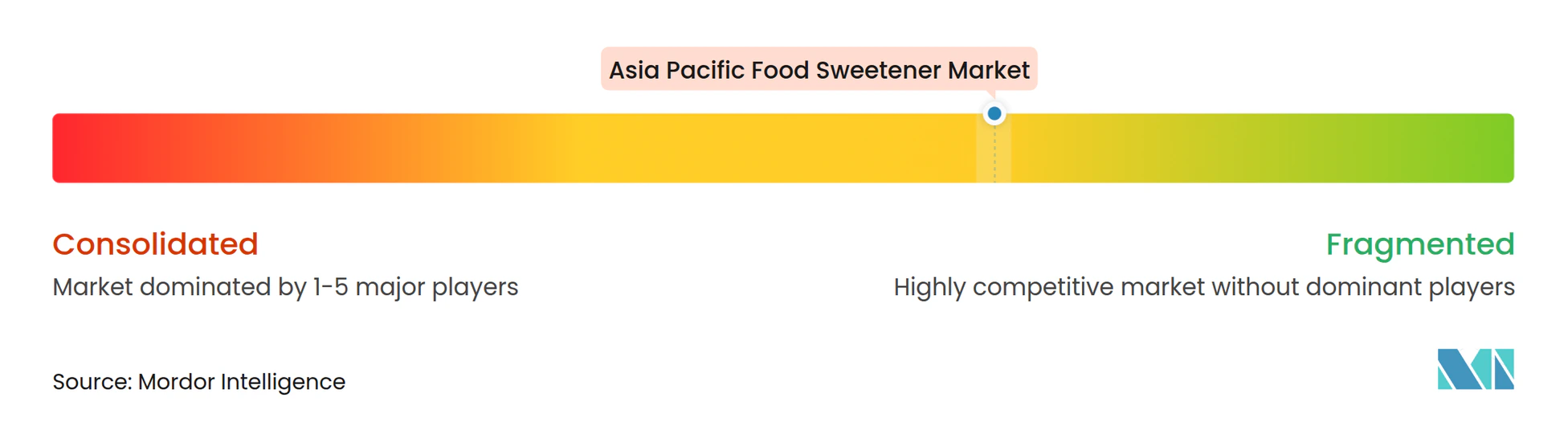
The Asia-Pacific food sweetener market has a semi-fragmented structure, with global ingredient companies competing alongside regional and domestic suppliers. Tate & Lyle, Cargill, ADM, Ingredion, Ajinomoto, Roquette Frères, and Kerry Group are identified in the supplied material as notable international participants. GLG Life Tech, EID Parry, Balrampur Chini Mills, and Gulshan Polyols are among the regional or country-focused participants named in the draft. Competition is moving beyond bulk supply toward support with formulation, ingredient blends, and product development. This shift matters because food manufacturers often need help maintaining sweetness and mouthfeel after cutting sugar.
GLG Life Tech is presented as a vertically integrated participant in stevia cultivation and glycoside extraction in China. Its position can support supply control and price management in a category where raw material access and processing are both important. Cargill announced an expansion of its Beijing plant in January 2026, including production lines for flavored beverage powders and coatings, as well as a high-bay warehouse. The company stated that the site supports application-development work for customers in China, North Asia, and the wider region. This move reflects an emphasis on local service and application capability rather than ingredient delivery alone.
ADM also added a bioconverted Reb-M stevia line to its SweetRight platform in 2025, joining other suppliers that have commercialized bioconverted Reb-M products. The increase in comparable Reb-M offerings makes application support, sensory performance, and regulatory readiness more important for differentiation. Open opportunities remain in sweet proteins and next-generation steviol glycosides, where production technology and approval pathways still matter.
Asia Pacific Food Sweetener Industry Leaders
-
Tate & Lyle PLC
-
Cargill, Incorporated
-
Archer Daniels Midland Company
-
Ingredion Incorporated
-
Tereos S.A.
- *Disclaimer: Major Players sorted in no particular order
Asia Pacific Food Sweetener Market Companies Covered in this Report
- Tate & Lyle PLC
- Cargill, Incorporated
- Archer Daniels Midland Company
- Ingredion Incorporated
- Tereos S.A.
- DuPont de Nemours, Inc.
- Ajinomoto Co., Inc.
- Südzucker AG
- Associated British Foods plc
- Kerry Group plc
- International Flavors & Fragrances Inc.
- Roquette Frères S.A.
- AGRANA Beteiligungs-AG
- GLG Life Tech Corporation
- Kesar Enterprises Limited
- EID Parry (India) Limited
- Balrampur Chini Mills Limited
- Shree Renuka Sugars Limited
- Dhampur Bio Organics Limited
- Gulshan Polyols Limited
Recent Industry Developments in Asia Pacific Food Sweetener Market
- March 2026: Cargill showcased EverSweet® stevia sweetener at AAHAR in India. Cargill highlighted EverSweet, a zero-calorie stevia sweetener, in its future-ready innovation showcase at AAHAR 2026 in New Delhi. The company presented ingredient solutions for food and beverage manufacturers seeking sugar-reduction options. Cargill stated that EverSweet was awaiting regulatory approval, so the showcase should not be interpreted as confirmation of commercial authorization in India.
- March 2026: Shandong Bailong Chuangyuan Bio-Tech obtained a production licence for D-allulose in China. The company announced that its D-allulose products had qualified for compliant mass production and market launch. The licence is an important commercial milestone for China's rare-sugar supply chain because it supports domestic production of a sweetener used in reduced-sugar food and beverage formulations.
- July 2025: China’s National Health Commission formally approved D-allulose as a new food ingredient, with the first commercial-scale approval granted to Weiyuan Hecheng, which employs a synthetic biology fermentation process. The approval gives food manufacturers access to an ingredient that delivers close to the taste profile of sucrose with 10% of its caloric content.
Asia Pacific Food Sweetener Market Report Scope
Food sweeteners are substances added to food and beverage products to impart sweetness, enhance flavor, or replace conventional sugar. The Asia-Pacific food sweetener market is segmented by product type, source, form, application and geography. Based on product type, the market is segmented into sucrose, starch sweeteners and sugar alcohols, high-intensity sweeteners, others. Based on source, the market is segmented into plant-based and fermentation/bio-engineered and artificial. Based on form, the market is segmented into solid, liquid/syrup. Based on application, the market is segmented into food and beverages. Based on geography, the market is segmented into China, Japan, India, Australia, South Korea, Indonesia, Thailand, Singapore, and Rest of Asia-Pacific. For each segment, the market sizing and forecasting have been done in value terms (USD billion).
Segmentation Overview
By Product Type
| Sucrose (Common Sugar) | |
| Starch Sweeteners and Sugar Alcohols | Dextrose |
| High-Fructose Corn Syrup (HFCS) | |
| Maltodextrin | |
| Sorbitol | |
| Xylitol | |
| Erythritol | |
| Other Sugar Alcohols | |
| High-Intensity Sweeteners (HIS) | Sucralose |
| Aspartame | |
| Saccharin | |
| Neotame | |
| Stevia | |
| Acesulfame-K | |
| Cyclamate | |
| Other HIS | |
| Others |
By Source
| Plant-based |
| Fermentation/Bio-engineered |
| Artificial |
By Form
| Solid |
| Liquid/Syrup |
By Application
| Food | Bakery and Confectionery |
| Dairy and Desserts | |
| Meat and Savory Products | |
| Nutraceuticals and Functional Foods | |
| Sauces, Dressings and Spreads | |
| Other Processed Foods | |
| Beverages | Soft Drinks |
| Sport Drinks | |
| Other Beverages |
By Country
| China |
| India |
| Japan |
| Australia |
| South Korea |
| Indonesia |
| Thailand |
| Singapore |
| Rest of Asia-Pacific |
| By Product Type | Sucrose (Common Sugar) | |
| Starch Sweeteners and Sugar Alcohols | Dextrose | |
| High-Fructose Corn Syrup (HFCS) | ||
| Maltodextrin | ||
| Sorbitol | ||
| Xylitol | ||
| Erythritol | ||
| Other Sugar Alcohols | ||
| High-Intensity Sweeteners (HIS) | Sucralose | |
| Aspartame | ||
| Saccharin | ||
| Neotame | ||
| Stevia | ||
| Acesulfame-K | ||
| Cyclamate | ||
| Other HIS | ||
| Others | ||
| By Source | Plant-based | |
| Fermentation/Bio-engineered | ||
| Artificial | ||
| By Form | Solid | |
| Liquid/Syrup | ||
| By Application | Food | Bakery and Confectionery |
| Dairy and Desserts | ||
| Meat and Savory Products | ||
| Nutraceuticals and Functional Foods | ||
| Sauces, Dressings and Spreads | ||
| Other Processed Foods | ||
| Beverages | Soft Drinks | |
| Sport Drinks | ||
| Other Beverages | ||
| By Country | China | |
| India | ||
| Japan | ||
| Australia | ||
| South Korea | ||
| Indonesia | ||
| Thailand | ||
| Singapore | ||
| Rest of Asia-Pacific | ||
Key Questions Answered in the Report
What is the forecast growth rate for Asia-Pacific food sweeteners?
The category is forecast to grow at a 4.68% CAGR from 2026 to 2031, increasing from USD 33.19 billion in 2026 to USD 41.71 billion by 2031.
Which product type leads food sweetener demand in Asia-Pacific?
Sucrose leads with 68.34% revenue share in 2025 because it remains widely used in large-scale food and beverage production.
Which sweetener category is growing the fastest by product type?
High-intensity sweeteners are expected to grow at a 6.03% CAGR through 2031 as manufacturers reformulate lower-calorie beverages and functional foods.
Why are natural sweeteners gaining demand across Asia-Pacific?
Sugar-reduction programs, clean-label preferences, and improved availability of stevia and related ingredients are increasing their use.
Which country has the largest food sweetener demand in the region?
China leads with 38.76% share in 2025, supported by its large food-processing base and new sugar-labeling requirements.