
Market Overview
| Study Period | 2021 - 2031 |
|---|---|
| Forecast Data Period | 2026 - 2031 |
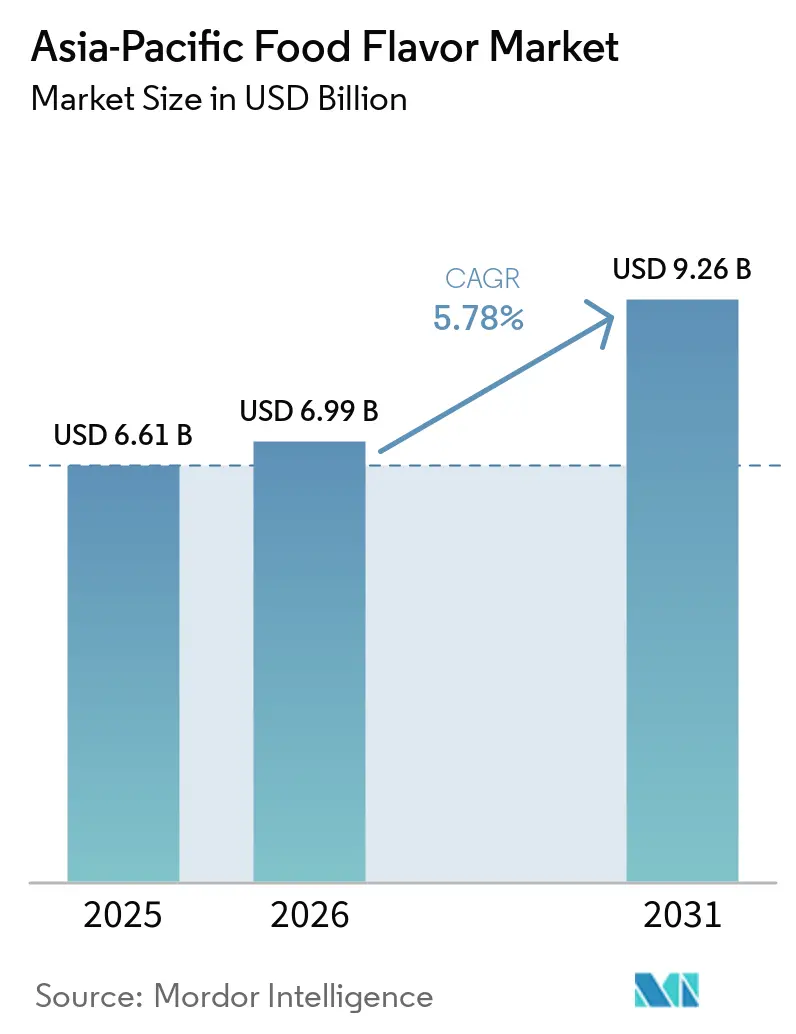
| Base Year Market Size (2025) | USD 6.61 Billion |
| Market Size (2026) | USD 6.99 Billion |
| Market Size (2031) | USD 9.26 Billion |
| Growth Rate (2026 - 2031) | 5.78 % |
| Market Concentration | Medium |
Major Players *Disclaimer: Major Players sorted in no particular order Image © Mordor Intelligence. Reuse requires attribution under CC BY 4.0. | |
Asia-Pacific Food Flavor Market Analysis by Mordor Intelligence
The Asia-Pacific food flavor market was valued at USD 6.61 billion in 2025 and is estimated to grow from USD 6.99 billion in 2026 to reach USD 9.26 billion by 2031, at a CAGR of 5.78% during the forecast period (2026–2031). Market growth is driven by the expanding use of flavor ingredients to improve taste, aroma, and sensory consistency across a diverse range of food and beverage products. The growing emphasis on ingredient transparency and clean-label formulations is creating opportunities for naturally derived flavor solutions, while advances in extraction, encapsulation, and flavor-delivery technologies are helping manufacturers improve ingredient stability, retain volatile aromatic compounds, and maintain consistent sensory performance during processing and storage.
Key Report Takeaways
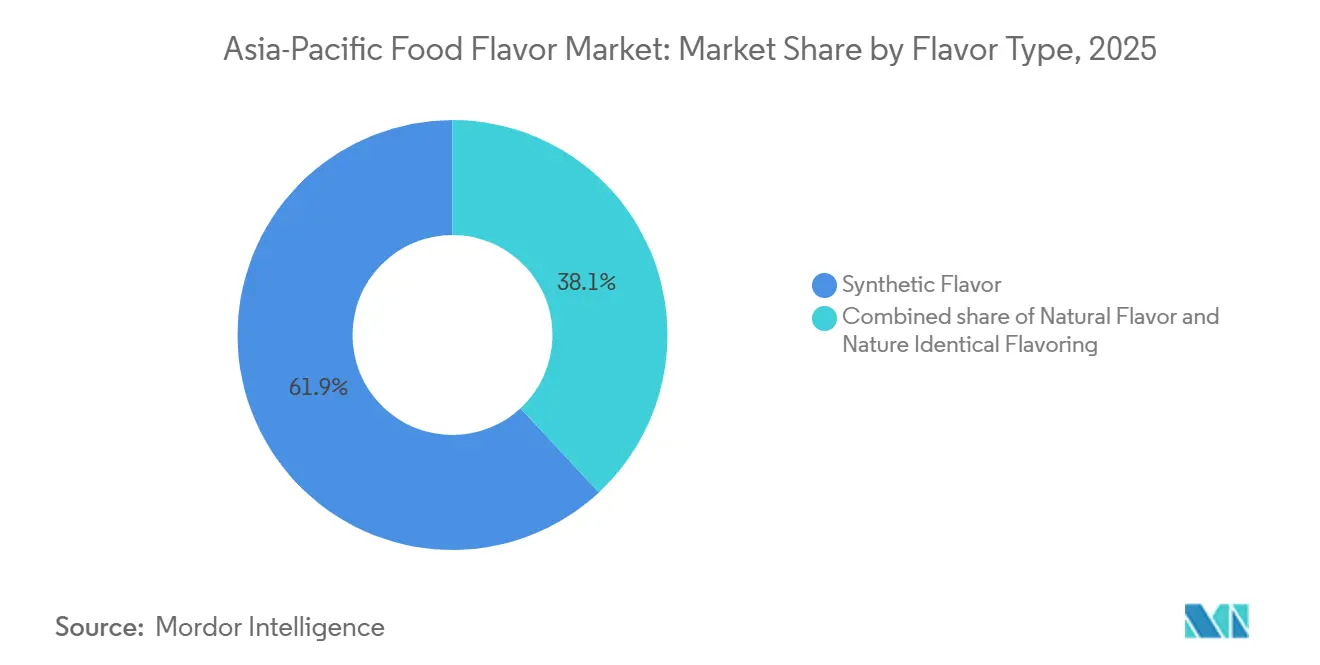
- By flavor type, synthetic flavor held 61.92% of the Asia-Pacific food flavors market share in 2025, while natural flavor is forecast to grow at a 7.49% CAGR through 2031.
- By form, liquid flavor accounted for 62.34% of the Asia-Pacific food flavors market share in 2025, while powder flavor is projected to expand at a 7.25% CAGR through 2031.
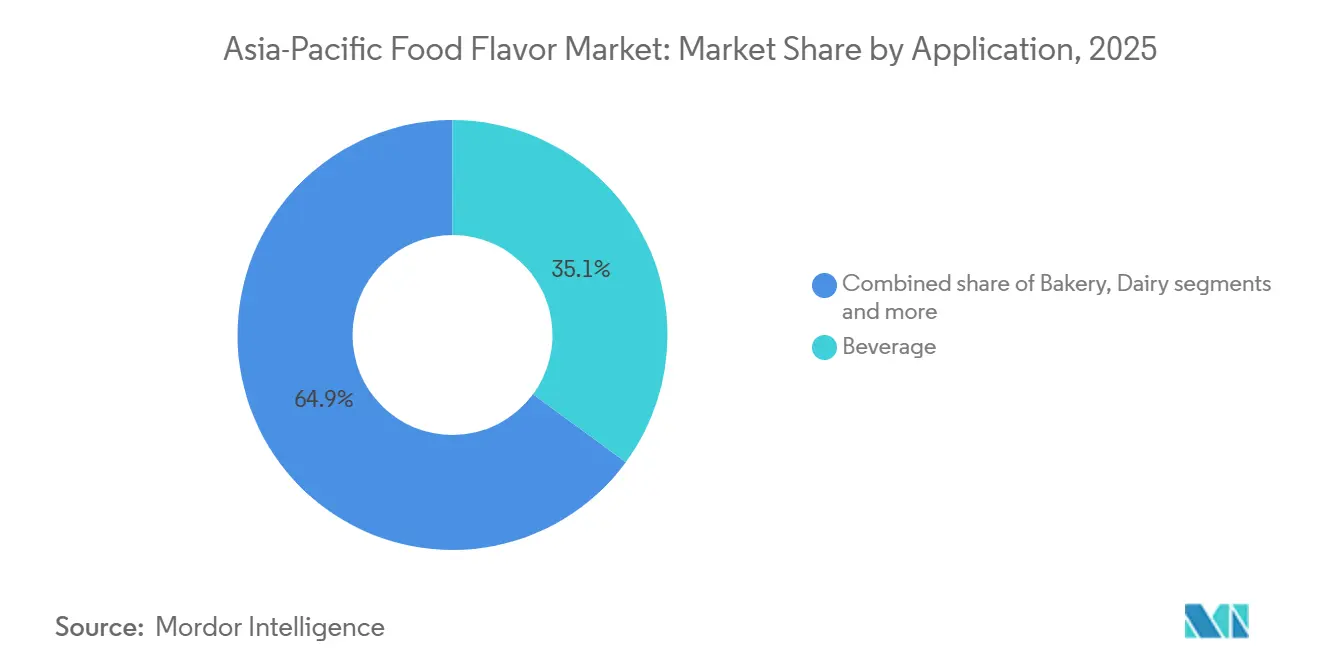
- By application, beverages commanded 35.09% of the Asia-Pacific food flavors market size in 2025 and are forecast to grow at a 7.29% CAGR through 2031.
- By country, China represented 42.32% of the Asia-Pacific food flavors market share in 2025, while India is projected to record the highest CAGR at 7.42% through 2031.
Note: Market size and forecast figures in this report are generated using Mordor Intelligence’s proprietary estimation framework, updated with the latest available data and insights as of January 2026.
Asia-Pacific Food Flavor Market Trends and Insights
Drivers Impact Analysis*
| Driver | (~) % Impact on CAGR Forecast | Geographic Relevance | Impact Timeline |
|---|---|---|---|
| Rising Demand for Convenience and Ready-to-Eat Foods | +1.2% | Asia-Pacific-wide, with the highest intensity in China, India, and Indonesia | Short term (≤ 2 years) |
| Growing Preference for Natural and Clean-Label Flavoring Ingredients | +1.0% | China, Japan, South Korea, Australia; spill-over to South Asian Countries | Medium term (2–4 years) |
| Increasing Demand for Bold, Spicy, Savory and Umami Flavor Profiles | +0.8% | China, South Korea, Southeast Asia; broadening globally | Short term (≤ 2 years) |
| Advancements in Flavor Encapsulation and Delivery Technologies | +0.7% | Japan, South Korea, Australia, China as production hubs | Long term (≥ 4 years) |
| Growing Popularity of Korean, Japanese and Other Asian-Inspired Flavors | +0.6% | South Korea and Japan as origin markets; radiating across ASEAN and global export channels | Medium term (2–4 years) |
| Expansion of Specialty Beverages and Innovative Beverage Flavor Profiles | +0.9% | India, China, Southeast Asia; premium tier in Japan and Australia | Medium term (2–4 years) |
| Source: Mordor Intelligence | |||
Rising Demand for Convenience and Ready-to-Eat Foods
Rising demand for convenience and ready-to-eat foods is driving the Asia-Pacific food flavors market, as consumers increasingly seek products that deliver consistent taste, aroma, and sensory appeal with minimal preparation time. The growing popularity of instant meals is encouraging manufacturers to develop flavor formulations that retain seasoning intensity, withstand processing and storage conditions, and deliver reliable taste upon preparation. According to the World Instant Noodles Association (WINA), instant noodle demand in 2025 reached 43.27 billion servings in China/Hong Kong and 14.54 billion servings in Indonesia, highlighting the substantial consumption of convenient food products in these markets[1]. This sustained demand creates opportunities for flavor suppliers to develop differentiated seasoning blends, savory profiles, and customized flavor systems that meet evolving consumer preferences while maintaining consistency across large-scale production.
Growing Preference for Natural and Clean-Label Flavoring Ingredients
Consumer preference for natural and clean-label flavoring ingredients is encouraging food manufacturers across Asia-Pacific to reconsider ingredient selection and formulation strategies. According to Cargill's Asia-Pacific IngredienTracker 2025 study, more than 70% of surveyed consumers across China, Indonesia, Australia, and Japan checked product labels before purchasing, reflecting greater attention to ingredient composition and transparency. The study also found that consumers tended to perceive familiar, natural-sounding, and plant-based ingredients more favorably than unfamiliar or scientific-sounding ingredients. These preferences are prompting manufacturers to explore naturally derived flavor compounds, botanical extracts, and simpler ingredient declarations to strengthen consumer trust.
Increasing Demand for Bold, Spicy, Savory and Umami Flavor Profiles
Growing consumer demand for bold, spicy, savory, and umami flavor profiles is encouraging flavor manufacturers to develop solutions that deliver greater sensory intensity, authentic taste, and complex flavor layering. In Asia-Pacific, consumer familiarity with chili-based seasonings, fermented ingredients, roasted aromatics, and broth-inspired flavors is creating opportunities for manufacturers to introduce distinctive taste combinations in packaged foods. For instance, Givaudan S.A. offers savory flavor solutions, including umami enhancement and roasted and grilled profiles inspired by Asian culinary traditions, helping food manufacturers develop richer and more distinctive sensory experiences. These solutions support the formulation of savory snacks, instant noodles, soups, sauces, seasonings, and ready-to-eat meals by enhancing taste depth and recreating characteristic cooking notes.
Advancements in Flavor Encapsulation and Delivery Technologies
Advances in flavor encapsulation and delivery technologies are expanding the functional role of flavor ingredients by improving volatile compound retention, sensory stability, controlled release, and shelf-life performance. Microencapsulation is evolving beyond its traditional use in protecting volatile flavor compounds into a multifunctional formulation approach that helps manufacturers address flavor degradation during processing, storage, and distribution, while supporting clean-label product development. Techniques such as spray drying, coacervation, and lipid-based encapsulation protect sensitive aroma compounds from exposure to oxygen, moisture, heat, and light, helping preserve the intended taste and aroma of finished products. Controlled-release systems enable flavors to be released at specific stages of food preparation or consumption, improving sensory impact and reducing flavor loss.
Restraints Impact Analysis*
| Restraint | (~) % Impact on CAGR Forecast | Geographic Relevance | Impact Timeline |
|---|---|---|---|
| Complex and Stringent Food Safety and Flavor Ingredient Regulations | -0.6% | Multi-market compliance pressure across the region; highest in Singapore, Japan, Australia | Medium term (2–4 years) |
| High Costs of Natural Flavor Extraction and Standardization | -0.8% | Global raw material sourcing with concentrated impact in India, Southeast Asia | Long term (≥ 4 years) |
| Dependence on Imported Specialty Flavor Ingredients and Supply Chain Vulnerabilities | -0.5% | South Asian markets, India, particularly geopolitical-sensitive routes | Medium term (2–4 years) |
| Allergen Cross-Contact Risks and Associated Quality-Control Costs | -0.4% | Australia, Japan, Singapore, markets with advanced allergen labeling compliance requirements | Short term (≤ 2 years) |
| Source: Mordor Intelligence | |||
Complex and Stringent Food Safety and Flavor Ingredient Regulations
Complex and stringent food safety regulations are restraining the Asia-Pacific food flavors market by increasing compliance requirements, formulation review costs, and the time required to commercialize flavor ingredients. For instance, China implemented GB 2760-2024, its revised National Food Safety Standard for the Use of Food Additives, on February 8, 2025, replacing GB 2760-2014. According to China's State Administration for Market Regulation, the revised standard modifies provisions for certain food flavoring substances, flavoring essences, preservatives, and processing aids[2]. It also requires affected food manufacturers to review product formulations, ingredient-use conditions, and labeling to ensure compliance. These changes can increase regulatory assessment and reformulation costs for flavor suppliers and their customers, particularly when existing ingredients or applications require reassessment.
High Costs of Natural Flavor Extraction and Standardization
High costs associated with natural flavor extraction and standardization can restrain the growth of the Asia-Pacific food flavors market by increasing ingredient production costs and limiting the commercial scalability of naturally derived flavoring solutions. Extracting flavor compounds from fruits, spices, herbs, flowers, and other botanical sources often requires specialized processes such as steam distillation, solvent extraction, and supercritical fluid extraction, along with additional purification and concentration steps. Variations in crop quality, seasonal availability, and the concentration of aromatic compounds can further increase raw material requirements and processing expenses. Manufacturers must also invest in analytical testing, quality control, and stabilization technologies to ensure consistent flavor profiles across production batches.
*Our forecasts treat driver/restraint impacts as directional, not additive. The impact forecasts reflect baseline growth, mix effects, and variable interactions.
Segment Analysis
By Flavor Type: Clean-Label Pressure Reshapes a Synthetic-Dominant Market
Synthetic flavor accounts for 61.92% of the Asia-Pacific food flavors market in 2025, supported by its ability to deliver precise sensory characteristics, predictable ingredient performance, and reproducible flavor profiles through controlled chemical synthesis. The segment benefits from the availability of individual aroma compounds that can be combined in specific proportions to achieve targeted flavor characteristics, giving formulators greater control over the intensity, balance, and uniformity of finished formulations. Unlike flavor ingredients whose composition can vary with agricultural conditions or extraction methods, synthetic compounds can be manufactured to defined specifications, supporting tighter quality control and reducing variability in formulation outcomes.
Natural flavor is the fastest-growing segment in the Asia-Pacific food flavors market, registering a CAGR of 7.49% over 2026–2031, driven by increasing preference for ingredients derived from recognizable natural sources and growing interest in the origin and composition of flavoring ingredients. Advances in extraction, distillation, enzymatic processing, and bioconversion are expanding the range of natural flavor profiles that manufacturers can develop, while improving control over aroma characteristics and ingredient consistency. The availability of diverse botanical materials, including herbs, spices, fruits, flowers, and plant extracts, provides flavor developers with opportunities to create distinctive sensory profiles aligned with evolving product formulation requirements.

By Form: Powder Gains Structural Ground as Liquid Holds Scale
Liquid flavor held a 62.34% share of the Asia-Pacific food flavors market in 2025, supported by its ease of incorporation, rapid dispersion, and precise dosing during industrial formulation. Its liquid state enables manufacturers to blend flavor compounds directly into compatible mixtures, facilitating uniform distribution and reducing the need for additional dissolution or dispersion steps. The segment benefits from formulation flexibility, as flavor concentration and intensity can be adjusted to meet specific product requirements while maintaining consistent sensory characteristics. Liquid formats also offer advantages in automated metering and continuous processing systems, where accurate ingredient delivery is essential for maintaining batch specifications and production efficiency.
Powder flavor is the fastest-growing form segment in the Asia-Pacific food flavors market, registering a CAGR of 7.25% over 2026–2031. Its growth is driven by improved storage and handling characteristics, ease of transportation, and compatibility with dry-blending processes. Compared with many liquid formulations, powdered flavors can reduce the need for liquid carriers and help manufacturers manage moisture levels in formulations where water content must remain controlled. Advances in spray drying, encapsulation, and carrier technologies are improving the retention of volatile aromatic compounds and helping protect sensitive flavor ingredients against oxidation and degradation. Powder formats also enable accurate premixing with other dry ingredients, supporting formulation consistency and simplifying ingredient handling during manufacturing.
By Application: Beverages Power Both Volume and Velocity
Beverages hold a 35.09% share of the Asia-Pacific food flavors market in 2025 and represent the fastest-growing application segment, registering a CAGR of 7.29% over 2026–2031. Growth is supported by continuous beverage product innovation, increasing demand for differentiated sensory experiences, and the development of flavor profiles that enhance product appeal and consumer acceptance. Flavor manufacturers are benefiting from opportunities to create distinctive fruit, tea, botanical, citrus, and specialty flavor combinations while addressing formulation requirements related to aroma retention, taste consistency, and stability. According to the Japan Soft Drink Association (J-SDA), Japan's soft drink production reached 23,596,300 kiloliters in 2024, an increase of 1.6% compared with the previous year, setting a record at that time[3]. This increase reflects continued activity in the country's soft drink industry and supports beverage manufacturing as a source of demand for flavor ingredients.
Beyond beverages, demand for food flavors is supported by product innovation across the dairy, bakery, and confectionery segments in the Asia-Pacific region. Dairy manufacturers are exploring flavored milk, yogurt, dairy desserts, and specialty dairy beverages, creating opportunities for flavor profiles that improve sensory appeal and differentiate formulations. In bakery, the development of packaged cakes, biscuits, pastries, and sweet baked goods is supporting demand for flavors that deliver distinctive aroma and taste while maintaining consistency during baking and storage. Confectionery producers are expanding flavor combinations across chocolates, candies, gummies, and other sweets, driving the use of fruit, citrus, caramel, cream, and regionally inspired profiles.
Geography Analysis
China holds a 42.32% share of the Asia-Pacific food flavors market in 2025, supported by its established flavor ingredient production capabilities, advanced chemical synthesis infrastructure, and extensive network of domestic ingredient suppliers. The country's technical expertise in aroma chemistry and flavor formulation enables manufacturers to produce standardized compounds, develop complex flavor blends, and maintain precise sensory specifications at commercial scale. Established capabilities in ingredient processing, analytical testing, and formulation development support the availability of specialized flavor solutions. China's role in regional ingredient sourcing and manufacturing also supports the supply of flavor compounds to downstream food producers, reinforcing its position as a major center for flavor ingredient production and consumption within Asia-Pacific.
India is the fastest-growing country market, registering a CAGR of 7.42% over 2026–2031, underpinned by a rapidly expanding processed food manufacturing base, a young consumer population with increasing exposure to global flavor profiles, and growing organized retail penetration in Tier-2 and Tier-3 cities. The increasing commercialization of regional food products is encouraging manufacturers to translate traditional taste profiles into standardized formulations suitable for large-scale production. The country's diverse culinary heritage creates opportunities for flavor developers to work with distinct spice combinations, regional seasonings, and emerging fusion profiles. Improvements in domestic food processing capabilities and greater emphasis on product differentiation are also encouraging manufacturers to refine flavor formulations to achieve consistent taste across production batches.
Japan's market is supported by sophisticated sensory research, precision formulation practices, and demand for carefully balanced flavor profiles, while Australia benefits from established food quality standards and growing interest in ingredient transparency. In Southeast Asia, Indonesia's diverse culinary traditions create opportunities for locally adapted flavor development, while Thailand's established expertise in tropical ingredients and distinctive spice combinations supports innovation in regional flavor profiles. Vietnam's evolving food manufacturing capabilities and culinary heritage provide opportunities for flavor solutions that reproduce traditional taste characteristics with greater consistency. Singapore's role as a regional center for food technology, ingredient trading, and product development supports access to specialized flavor ingredients and international formulation expertise.
Competitive Landscape
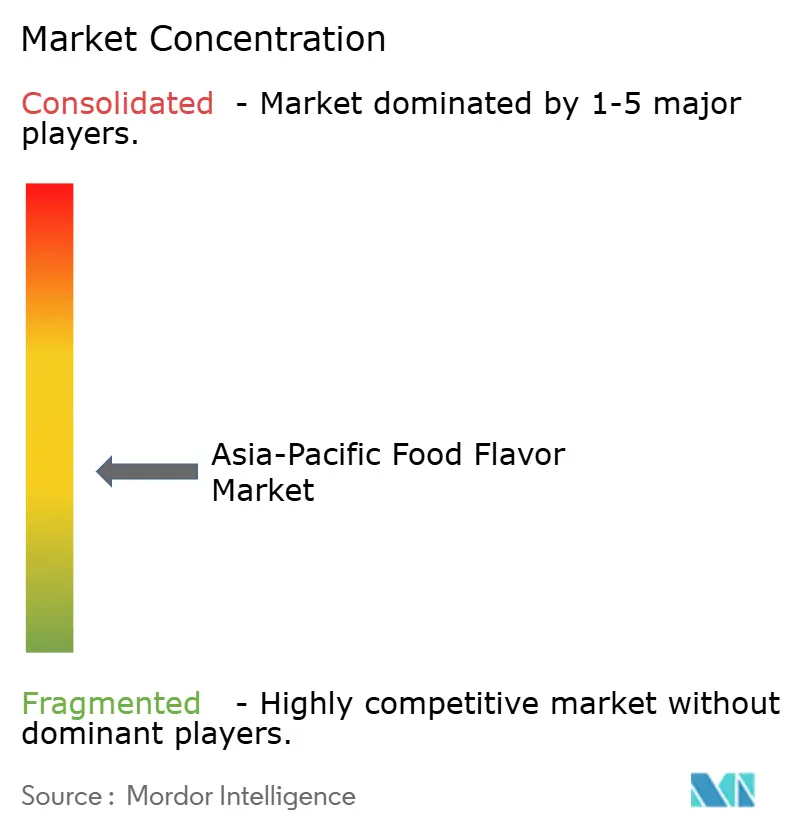
The Asia-Pacific food flavors market is moderately consolidated, with competition shaped by product differentiation, flavor innovation, technical expertise, and the ability to meet evolving food manufacturer requirements. Market participants compete to deliver consistent sensory performance, replicate authentic culinary profiles, and develop customized flavor systems suited to different processing conditions. Demand for natural ingredients, clean-label formulations, and distinctive regional tastes is encouraging suppliers to strengthen their formulation capabilities and expand their flavor portfolios. Established supplier relationships, regulatory compliance requirements, and the technical expertise needed to develop stable flavor solutions create entry barriers for smaller participants.
Leading companies, including Givaudan S.A., International Flavors & Fragrances Inc. (IFF), Symrise AG, dsm-firmenich AG, and Kerry Group plc, strengthen their competitive positions through research and development investments, application laboratories, and customer collaboration. Their innovation activities support the development and testing of flavor formulations for beverages, savory foods, confectionery, dairy products, and convenience foods. These capabilities enable manufacturers to address specific requirements related to flavor stability, taste modulation, processing performance, and sensory consistency. Investment in application testing and product development also helps suppliers respond more quickly to changing consumer preferences and provide tailored solutions for food manufacturers.
Beyond research and product development, competition is increasingly influenced by locally sourced natural extracts, ingredient traceability, and regional flavor customization. Access to botanical raw materials and expertise in extraction and standardization can help suppliers develop natural flavor portfolios that reflect local culinary traditions while maintaining consistent quality. Companies are also focusing on supply chain reliability, sustainable sourcing practices, and technologies that preserve volatile aromatic compounds and improve flavor performance during processing and storage. These capabilities are becoming important differentiators as manufacturers seek authentic taste experiences alongside ingredient transparency and dependable supply.
Asia-Pacific Food Flavor Industry Leaders
-
Givaudan S.A.
-
International Flavors & Fragrances Inc.
-
Symrise AG
-
DSM-Firmenich AG
-
Kerry Group plc
- *Disclaimer: Major Players sorted in no particular order
Recent Industry Developments
- July 2026: Givaudan inaugurated a new production facility in Cikarang, Indonesia, following an investment of CHF 50 million. The 24,000-square-meter facility produces savory, sweet, and snack flavor powders, expanding local manufacturing capacity and strengthening the company's ability to supply food manufacturers across Southeast Asia.
- August 2025: DSM-Firmenich inaugurated its expanded Thuravoor seasoning plant in Kerala, increasing capacity for ethylene oxide-free seasonings. The expansion supports clean-label seasoning development and improves the company's ability to supply customized flavor solutions to customers in India and other regional markets.
- July 2025: Kerry Group opened an expanded office and a new research, development, and applications (RD&A) facility in South Jakarta, Indonesia. The 1,200 sq m space includes a flavor creation and application lab, a sensory suite, and a collaborative co-creation lab.
Asia-Pacific Food Flavor Market Report Scope
Flavor is the sensory impression of a food or other substance and is determined mainly by the chemical senses of taste and smell. The Asia-Pacific Food Flavor Market is segmented by flavor type, form, application, and country. Based on flavor type, the market is segmented into natural flavor, synthetic flavor, and nature-identical flavoring. Based on form, the market is segmented into powder, liquid, and others. Based on application, the market is segmented into dairy, bakery, confectionery, savory snack, meat and seafood, beverage, and other food applications. Based on country, the market is segmented into China, India, Japan, Australia, Indonesia, South Korea, Thailand, Singapore, and the rest of Asia-Pacific. For each segment, the market sizing and forecast have been done based on value (in USD).
By Flavor Type
| Natural Flavor |
| Synthetic Flavor |
| Nature Identical Flavoring |
By Form
| Powder |
| Liquid |
| Others |
By Application
| Dairy |
| Bakery |
| Confectionery |
| Savory Snack |
| Meat and Seafood |
| Beverage |
| Other Food Applications |
By Country
| China |
| India |
| Japan |
| Australia |
| Indonesia |
| South Korea |
| Thailand |
| Singapore |
| Rest of Asia-Pacific |
| By Flavor Type | Natural Flavor |
| Synthetic Flavor | |
| Nature Identical Flavoring | |
| By Form | Powder |
| Liquid | |
| Others | |
| By Application | Dairy |
| Bakery | |
| Confectionery | |
| Savory Snack | |
| Meat and Seafood | |
| Beverage | |
| Other Food Applications | |
| By Country | China |
| India | |
| Japan | |
| Australia | |
| Indonesia | |
| South Korea | |
| Thailand | |
| Singapore | |
| Rest of Asia-Pacific |
Key Questions Answered in the Report
What is the size of the Asia-Pacific food flavors market?
The Asia-Pacific food flavors market is valued at USD 6.99 billion in 2026 and is projected to reach USD 9.26 billion by 2031, expanding at a CAGR of 5.78%.
Which flavor type holds the largest share in Asia-Pacific?
Synthetic flavor leads with a 61.92% share in 2025, supported by its cost efficiency, formulation consistency, and wide use in processed foods.
Which flavor type is growing fastest in the region?
Natural flavor is the fastest-growing flavor type, with a projected CAGR of 7.49% through 2031 as clean-label demand expands across premium and organized retail channels.
Which application generates the highest demand for food flavors?
Beverages hold the largest application share at 35.09% in 2025 and are also the fastest-growing application, with a forecast CAGR of 7.29% through 2031.