
Asia-Pacific Financial Advisory Market Size and Share
| Study Period | 2019 - 2030 |
| Forecast Data Period | 2025 - 2030 |
| Historical Data Period | 2019 - 2023 |
| Market Size (2025) | USD 15.15 Trillion |
| Market Size (2030) | USD 15.39 Trillion |
| CAGR (2025 - 2030) | 0.31% |
| Market Concentration | High |
Major Players *Disclaimer: Major Players sorted in no particular order |
Asia-Pacific Financial Advisory Market Analysis by Mordor Intelligence
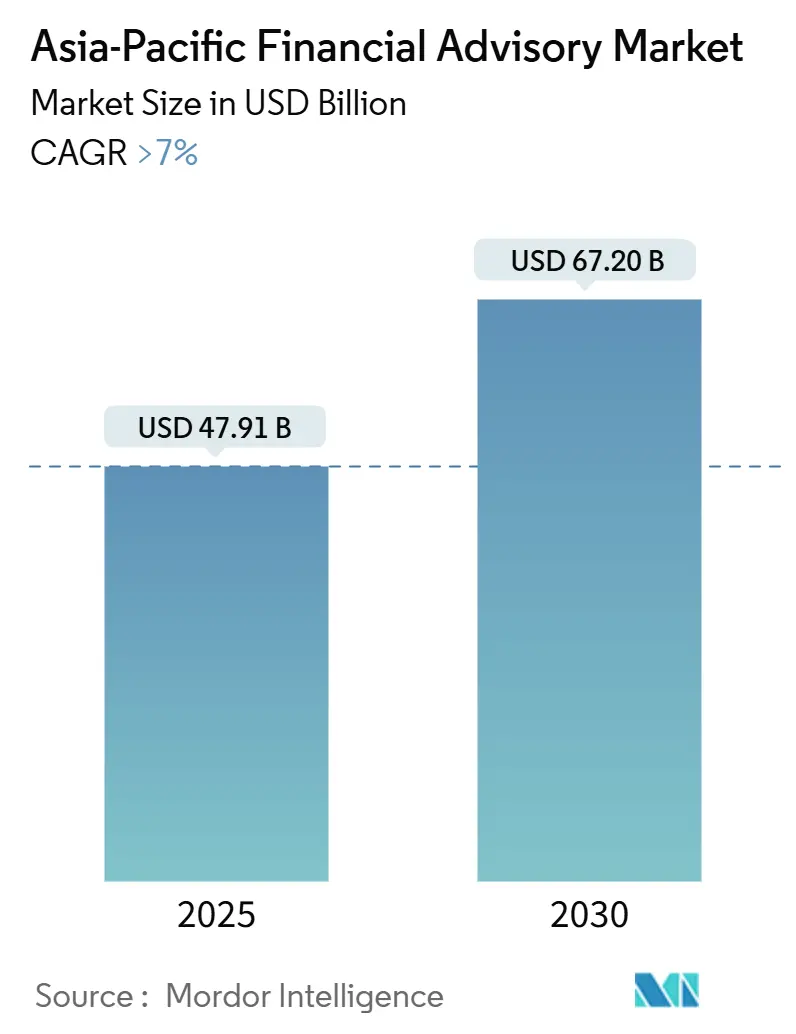
The Asia-Pacific Financial Advisory Market size is estimated at USD 47.91 billion in 2025, and is expected to reach USD 67.20 billion by 2030, at a CAGR of greater than 7% during the forecast period (2025-2030).
The Asia-Pacific financial advisory market is witnessing robust growth, fueled by rapid economic expansion in nations like China, India, and Southeast Asia. This surge is primarily attributed to a burgeoning middle class, a notable uptick in high-net-worth individuals (HNWIs), and evolving financial regulations that prioritize transparency and investor protection. Moreover, technological innovations, including digital platforms and robo-advisors, are reshaping the landscape, rendering advisory services more accessible and cost-efficient.
Key market segments encompass wealth management, insurance services, tax advisory, transaction advisory services, and risk management. Online platforms and direct sales serve as the primary channels for these services, addressing the needs of both individual and institutional clients. The market landscape is a blend of local firms renowned for their regional expertise and global giants like Morgan Stanley and UBS, who offer a diverse array of services.
Emerging trends, such as personalized financial advice, a focus on sustainability and ESG investing, and a surge in financial literacy, are molding the market's trajectory. Yet, hurdles like regulatory intricacies and fierce competition persist. Looking ahead, the market is poised for continued growth, buoyed by economic advancements, rising affluence, and relentless technological progress.
Asia-Pacific Financial Advisory Market Trends and Insights
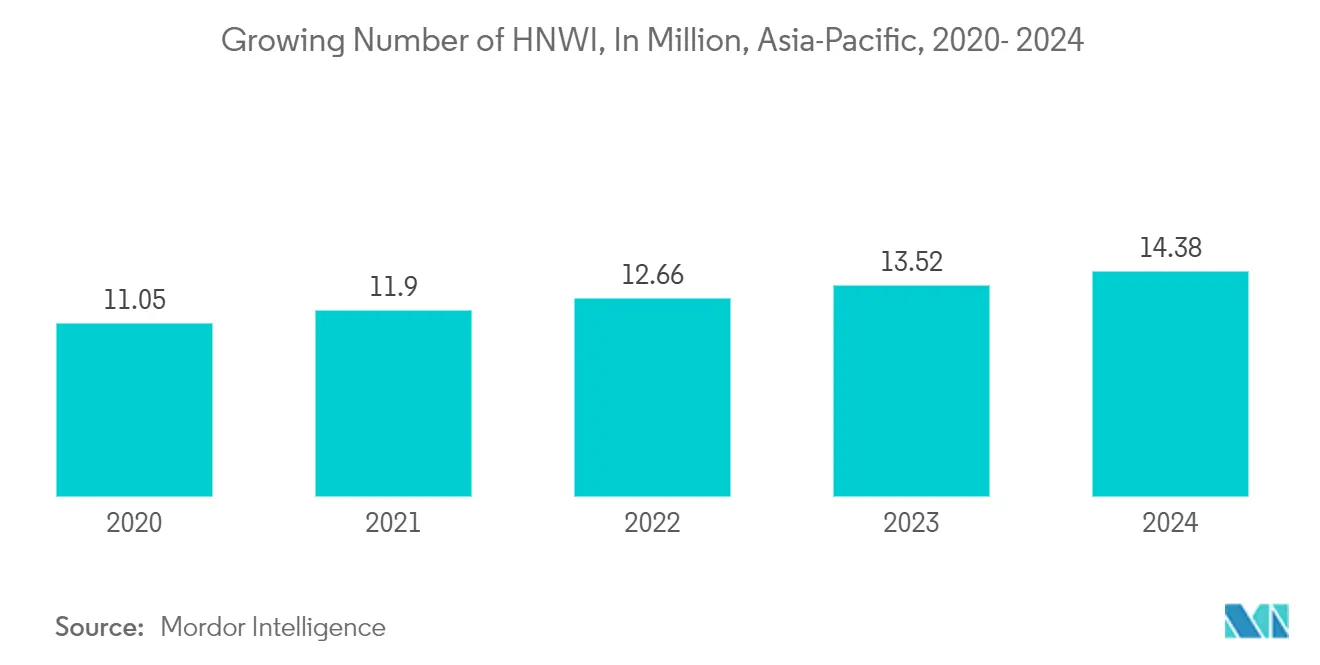
Growing Numbers of HNWI is Driving the Market in Major Economies in Asia-Pacific
In the Asia-Pacific region, a growing population of High-Net-Worth Individuals (HNWIs) is reshaping market dynamics. With their significant financial influence, these affluent individuals are driving the demand for tailored financial services.
HNWIs often pursue a range of investment avenues, extending beyond conventional asset classes. Their portfolios encompass equities, real estate, and alternative investments, such as venture capital and private equity. While their investment choices prioritize wealth preservation and growth, they also play a pivotal role in nurturing local capital markets and economic sectors.
Moreover, HNWIs bolster entrepreneurship and innovation by extending vital funding and backing to startups and burgeoning enterprises. Such investments not only spur job creation and technological progress but also invigorate the economies of nations like Japan, China, India, and Australia.
High-Net-Worth Individuals (HNWIs) are becoming increasingly instrumental in driving market expansion and shaping the financial landscape of the Asia-Pacific. Their influence reaches beyond financial markets, impacting various economic sectors and enhancing the region's overall economic growth.
The Evolution of Robo-Advisors is Driving Financial Services Through Technology
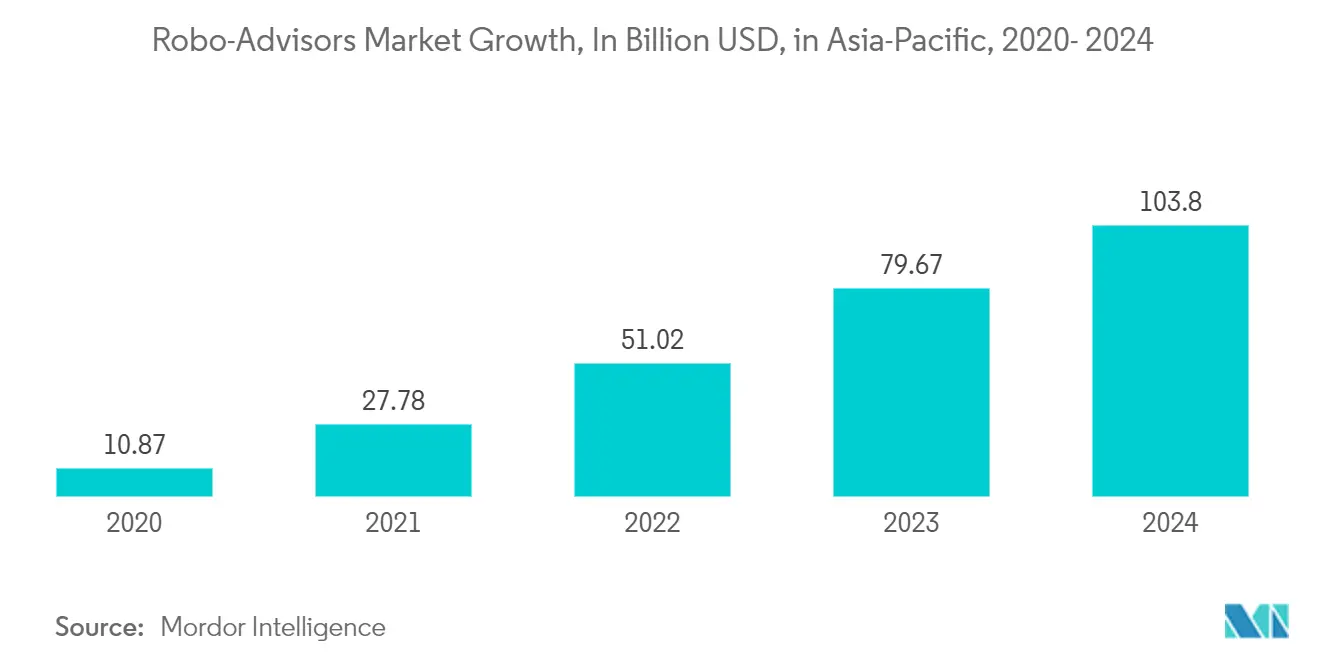
Robo-advisors, automated platforms that leverage algorithms for financial planning and investment management, epitomize the fintech surge and digital evolution in the financial services sector. Their rising popularity stems from their ability to deliver personalized advice and portfolio management efficiently and at scale.
Several pivotal factors fuel the adoption of robo-advisors. They primarily respond to the escalating demand for accessible and convenient financial services. Today's investors favor the digital ease of managing their portfolios, relishing the flexibility of accessing financial advice anytime, anywhere.
Moreover, robo-advisors break down barriers to sophisticated investment strategies. By offering affordable and transparent solutions, they empower a wider array of investors, including those with modest portfolios, granting them access once reserved for high-net-worth individuals.
Thanks to advancements in AI and ML, robo-advisors have seen a significant enhancement in their capabilities. These technological leaps enable platforms to swiftly sift through vast datasets, delivering tailored investment recommendations that align with individual risk profiles and financial goals.
The rise of robo-advisors signifies a monumental shift in how financial services are delivered and accessed. This melding of technology and finance is not just reshaping the industry's landscape but is also democratizing access to advanced financial management tools. By offering efficient and cost-effective solutions, robo-advisors are broadening their appeal, reaching investors who might have previously been sidelined from personalized wealth management.
In summary, robo-advisors stand as a testament to the transformative power of digital innovation in finance. They herald a new era, simplifying and making advanced investment strategies more affordable for both individuals and institutions. This shift not only underscores the growing prominence of fintech solutions but also emphasizes their pivotal role in fostering a more inclusive and efficient financial ecosystem.
Competitive Landscape
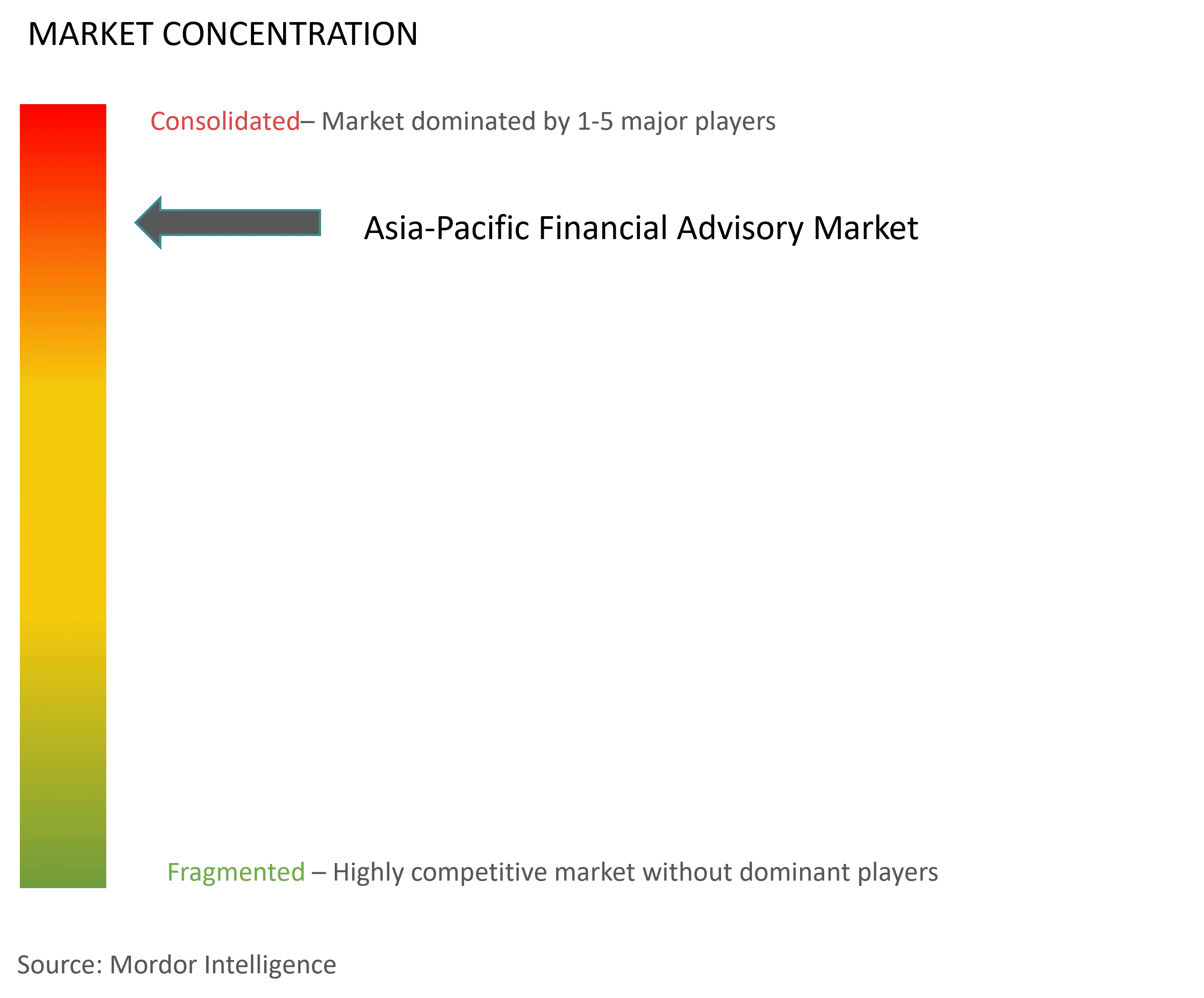
In the Asia-Pacific financial advisory market, leaders like PwC, UBS Wealth Management, Deloitte, J.P. Morgan Wealth Management, and Goldman Sachs Personal Financial Management dominate a consolidated landscape. With extensive service portfolios and a comprehensive regional presence, these firms compete fiercely to provide comprehensive advisory services across various sectors.
Asia-Pacific Financial Advisory Industry Leaders
-
PwC
-
Deloitte
-
KPMG
-
McKinsey & Company
-
Goldman Sachs
- *Disclaimer: Major Players sorted in no particular order
Recent Industry Developments
- September 2024: Interpath, a financial advisory consultancy based in the UK, has opened its first office in Hong Kong, marking its entry into the Asia-Pacific market. The firm aims to cement its presence in major financial hubs worldwide. Given Hong Kong's esteemed status as Asia's premier financial centre, especially in global restructuring and M&A, it's the perfect launchpad for Interpath's regional ambitions.
- January 2024: Deloitte has successfully acquired Giant Machines, a leading player in software engineering and digital solutions. Giant Machines offers a comprehensive suite of services, including market and user research, product strategy, prototyping, engineering, design, and product management.
Asia-Pacific Financial Advisory Market Report Scope
In the Asia-Pacific region, the financial advisory market offers expert guidance on wealth management, investments, tax planning, risk management, and transactions. Catering to individuals, businesses, and institutions, the market encompasses both traditional advisory services and digital platforms. This growth is fueled by the region's economic expansion, rising affluence, and technological progress.
The Asia-Pacific financial advisory market is segmented into service type, organization size, industry vertical, and country. By service type, the market is segmented into Corporate Finance, Accounting Advisory, Tax Advisory, Transaction Services, Risk Management, and Others. By organization size, the market is segmented into Large Enterprises, and Small & Medium-Sized Enterprises. By Industry Vertical, the market is segmented into BFSI, IT and Telecom, Manufacturing, Retail and E-Commerce, Public Sector, Healthcare, and Others. By country, the market is segmented into China, India, Japan, Australia, and Rest of Asia-Pacific. The report offers market size and forecasts for the Asia-Pacific financial advisory market in terms of value in (USD) for all the above segments.
| Corporate Finance |
| Accounting Advisory |
| Tax Advisory |
| Transaction Services |
| Risk Management |
| Others |
| Large Enterprises |
| Small & Medium-Sized Enterprises |
| BFSI |
| IT and Telecom |
| Manufacturing |
| Retail and E-Commerce |
| Public Sector |
| Healthcare |
| Others |
| China |
| India |
| Japan |
| Australia |
| Rest of Asia-Pacific |
| Type | Corporate Finance |
| Accounting Advisory | |
| Tax Advisory | |
| Transaction Services | |
| Risk Management | |
| Others | |
| By Organization Size | Large Enterprises |
| Small & Medium-Sized Enterprises | |
| By Industry Vertical | BFSI |
| IT and Telecom | |
| Manufacturing | |
| Retail and E-Commerce | |
| Public Sector | |
| Healthcare | |
| Others | |
| By Country | China |
| India | |
| Japan | |
| Australia | |
| Rest of Asia-Pacific |
Key Questions Answered in the Report
How big is the Asia-Pacific Financial Advisory Market?
The Asia-Pacific Financial Advisory Market size is expected to reach USD 15.15 trillion in 2025 and grow at a CAGR of 0.31% to reach USD 15.39 trillion by 2030.
What is the current Asia-Pacific Financial Advisory Market size?
In 2025, the Asia-Pacific Financial Advisory Market size is expected to reach USD 15.15 trillion.
Who are the key players in Asia-Pacific Financial Advisory Market?
PwC, Deloitte, KPMG, McKinsey & Company and Goldman Sachs are the major companies operating in the Asia-Pacific Financial Advisory Market.
What years does this Asia-Pacific Financial Advisory Market cover, and what was the market size in 2024?
In 2024, the Asia-Pacific Financial Advisory Market size was estimated at USD 15.10 trillion. The report covers the Asia-Pacific Financial Advisory Market historical market size for years: 2019, 2020, 2021, 2022, 2023 and 2024. The report also forecasts the Asia-Pacific Financial Advisory Market size for years: 2025, 2026, 2027, 2028, 2029 and 2030.
Asia-Pacific Financial Advisory Market Report
Statistics for the 2025 Asia-Pacific Financial Advisory market share, size and revenue growth rate, created by Mordor Intelligence™ Industry Reports. Asia-Pacific Financial Advisory analysis includes a market forecast outlook for 2025 to 2030 and historical overview. Get a sample of this industry analysis as a free report PDF download.