
Asia-Pacific Direct Methanol Fuel Cell Market Size and Share
Market Overview
| Study Period | 2021 - 2031 |
|---|---|
| Forecast Data Period | 2026 - 2031 |
| Historical Data Period | 2021 - 2024 |
| Growth Rate | 13.72 % |
| Market Concentration | Medium |
Major Players *Disclaimer: Major Players sorted in no particular order Image © Mordor Intelligence. Reuse requires attribution under CC BY 4.0. | |
Asia-Pacific Direct Methanol Fuel Cell Market Analysis by Mordor Intelligence
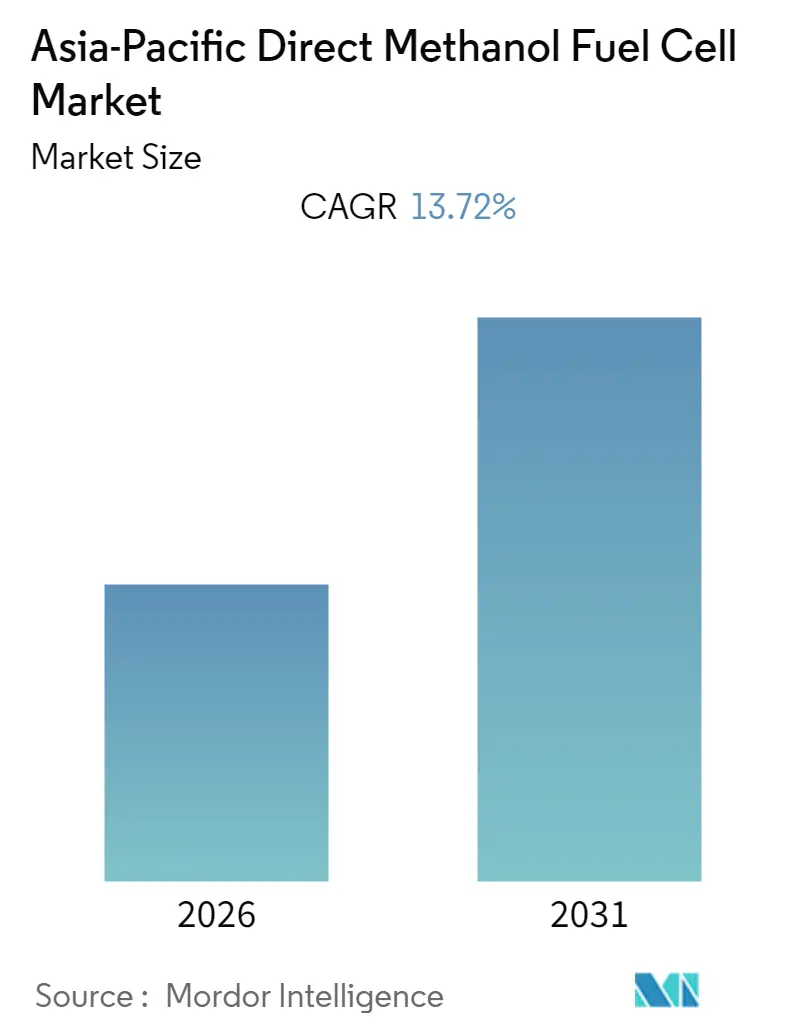
The Asia-Pacific Direct Methanol Fuel Cell Market size is expected to register a CAGR of 13.72% during the forecast period.
The market was negatively impacted by COVID-19 in 2020. Presently the market now reached pre-pandemic levels.
- Over the medium term, with the increasing focus on adopting clean energy and improving fuel efficiency, the use of fuel cells for various applications such as transportation, stationary, and portable applications is expected to drive market growth in the future.
- On the other hand, a wide variety of other fuel cell technologies are available, including solid oxide fuel cells, proton-electron membrane fuel cells, and alkaline fuel cells. It is expected to hamper the growth of the market.
- Nevertheless, the direct methanol fuel cell (DMFC) eliminates the need for charging infrastructure for the battery. In addition, methanol is relatively inexpensive, includes a relatively high energy density, and is easily transported and stored in warehouses, thus likely to support the market. In turn, this is likely to create huge opportunities for market players shortly.
- China is expected to dominate the direct methanol fuel cell market. Due to the growing use of electric vehicles and the increase in demand for consumer electronics caused by urbanization and power purchase parity, electric vehicle deployment is increasing.
Note: Market size and forecast figures in this report are generated using Mordor Intelligence’s proprietary estimation framework, updated with the latest available data and insights as of 2026.
Asia-Pacific Direct Methanol Fuel Cell Market Trends and Insights
Portable Segment to Dominate the Market
- A feat of miniaturization, the fuel cells are lightweight yet powerful and long-lasting. These fuel cells are leading the field in off-grid power & mobile applications for mission-critical communication, information technology, optronics, sensors, and auxiliary power. Fuel cells such as these rely on direct methanol fuel cell (DMFC) technology, which transforms methanol directly into electrical current. Cartridges of liquid methanol make transporting the fuel from one location to another easy.
- A fuel cell is an electrochemical device that converts a fuel like methanol into electricity efficiently and cleanly without burning. Fuel cells are permanently installed in notebook computers where batteries are now found. Fuel for the fuel cell is provided by a small disposable cartridge inserted into the computer.
- The advantages of a fuel cell are longer-lasting power compared to a rechargeable battery, instantaneous recharging by simply replacing the disposable fuel cartridge, nontoxic disposal, and lightweight. As a result, many companies are developing methanol fuel cells as a new, clean alternative power source for portable electronic devices.
- Notebook computers and mobile phones powered by fuel cells are projected to use approximately 100 disposable fuel cartridges during their useful lives, creating a recurring and potentially very large revenue stream. It was predicted that up to 22% of notebook computers and 2.5% of mobile phones would be powered by fuel cells, resulting in an annual demand for more than three billion cartridges.
- A fuel cell or cartridge made from methanol is efficient, clean, and safe. It is approved to carry on airplanes by the International Civil Aviation Organization. As a result of these approvals, portable electronic device fuel cells are expected to be adopted more widely and more rapidly.
- An increasing number of portable consumer electronic devices rely on batteries, such as laptops, smartphones, digital cameras, and music players, which is expected to increase the demand for portable batteries worldwide. Moreover, with the increased shipments of consumer electronics, such as smart watches, wearable health monitoring devices, and smart glasses, portable batteries are expected to grow tremendously during the forecast period.
- Asia-Pacific is the major hotspot for portable batteries. The significant factor of this growth is the high consumption of smartphones and other mobile accessories. The region accounts for over 60% of the global population, and the countries in the region are developing, thereby causing more demand for smartphones, tablets, and other portable accessories.
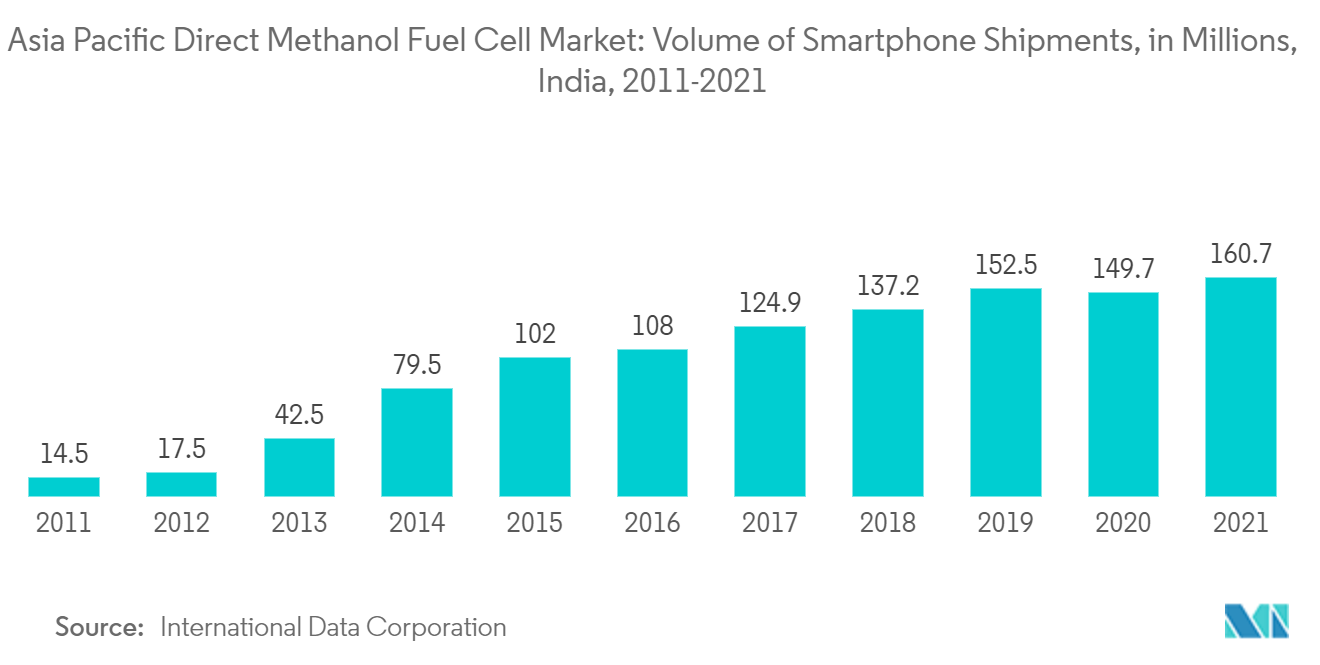
- In 2021, the number of smartphones shipped across India reached 160.7 million, up from 149.7 million in the previous year. The growth rate from year to year was 7.3%.
- Therefore, owing to the above points, the portable segment is expected to grow significantly during the forecast period.


China Expected to Dominate the Market
- In China, the market studied is mainly driven by the increasing deployment of electric vehicles and high demand for consumer electronics with urbanization and increasing power purchase parity.
- The future belongs to electric cars, and there is a hybrid system for extending their mileage. Direct methanol fuel cells (DMFCs) provide safe, lightweight, onboard battery charging, freeing car owners from worrying about running out of power. An electric vehicle battery is used in the hybrid system, along with a fuel cell cartridge and DMFC fuel cell.
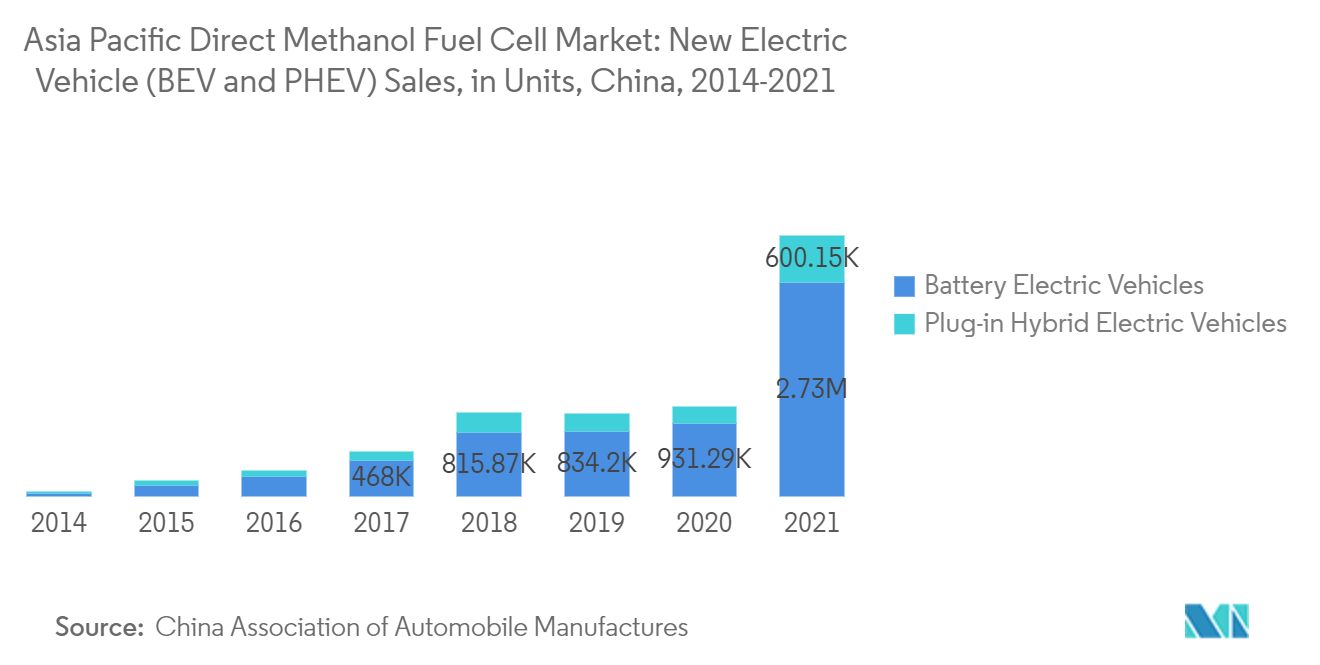
- China is the largest market for electric vehicles (EVs), with over 3.33 million EVs sold in 2021. It is expected to remain the world's largest electric car market. China accounted for almost 40% of global electric car sales in 2021.
- The increasing adoption of EVs is in line with the country's clean energy policy. The Government of China is planning to ease restrictions on automakers importing cars into the country to reduce the demand-supply gap.
- Policy developments include restricting investment in new internal combustion engines (ICE) vehicle manufacturing plants.
- Hence, with the increasing adoption of EVs and favorable government policies in the country, the use of direct methanol fuel cells is expected to increase as these cells can increase the range of the vehicle.
- Direct methanol fuel cells provide clean, quiet backup power for cellular base stations. The increasing penetration of telecommunication services provides an opportunity for the growth of the battery demand in the telecommunication segment in China. As of June 2022, 99.6% of internet users in China used mobile phones to access the internet. By the end of the first half of 2022, the number of mobile internet users in China had reached approximately 1.05 billion.
- Thus, with the rise in subscribers, the requirement for telecommunication towers in the country is expected to increase. It would foster the demand for fuel cells required for backup purposes.
- The abovementioned factors are expected to drive the demand for the direct methanol fuel cell market over the study period.
Regulatory Landscape
Across Asia-Pacific, DMFC commercialization is shaped by fuel and chemical handling rules for methanol, product safety approvals for portable power systems, and performance and testing requirements for fuel cell components and integrated systems. For portable applications, air-transport permissions for methanol fuel cell cartridges remain an important enabler for cross-border device and cartridge movement, supporting adoption in mission-critical and mobile use cases where logistics continuity matters.
Value Chain Analysis
The Asia-Pacific DMFC value chain starts with methanol supply, then moves through key component inputs (membranes, catalysts, bipolar plates and current collectors), along with balance-of-plant items such as pumps, valves, sensors, power electronics, and control systems. It then progresses through stack and system integration, packaging into portable, stationary, or range-extender form factors, and distribution via OEM channels, system integrators, and after-sales service networks.
A critical downstream element is fuel logistics for cartridges or bulk methanol, covering storage, transport, and end-user refueling workflows.
Competitive Landscape
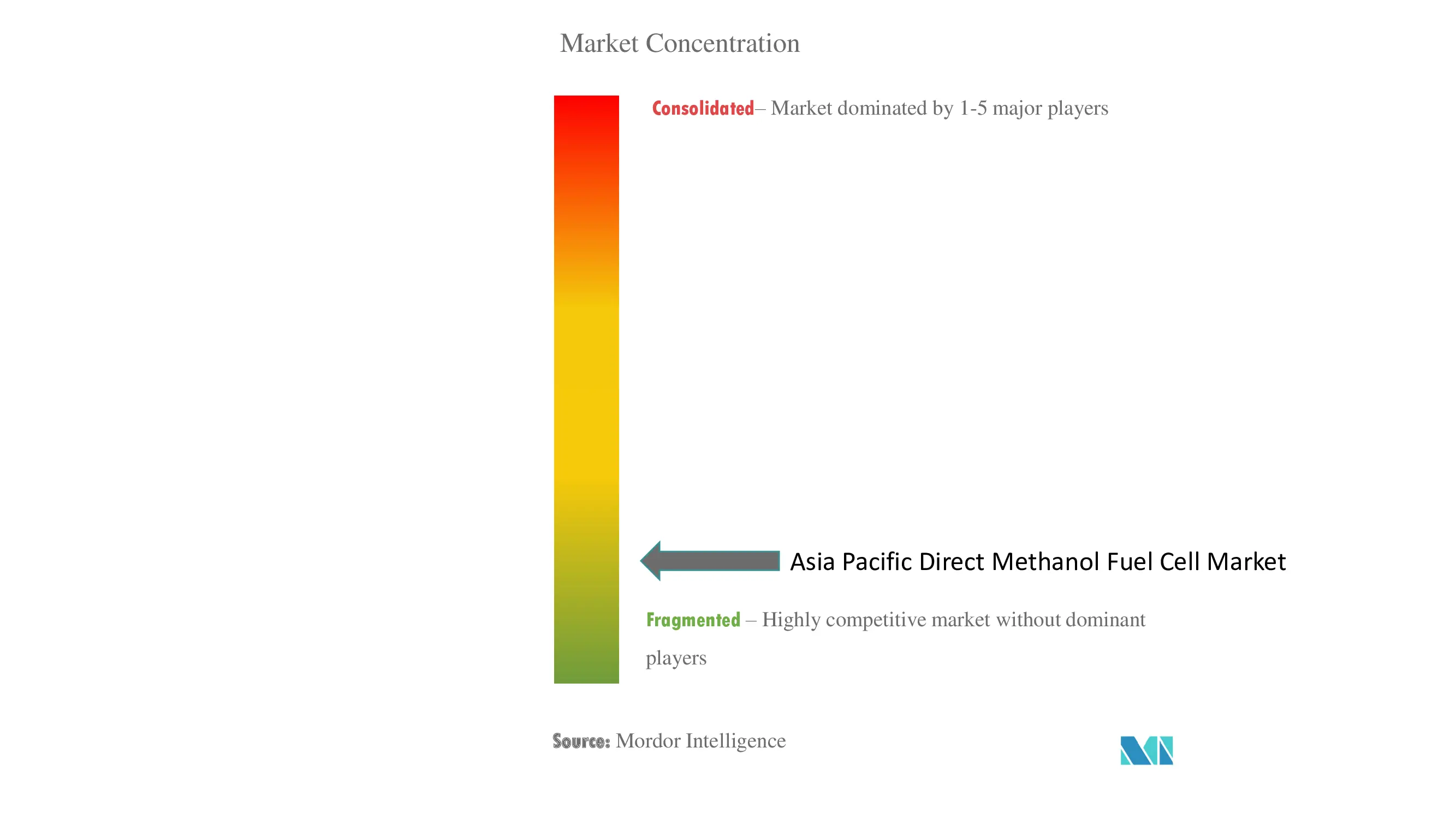
The Asia-Pacific direct methanol fuel cell market is moderately fragmented. Some of the major players in the market (in no particular order) include Fujikura Ltd., Horizon Fuel Cell Technologies, SFC Energy AG, Antig Technology Co., Ltd, and Viaspace Inc.
Asia-Pacific Direct Methanol Fuel Cell Industry Leaders
Fujikura Ltd.
Horizon Fuel Cell Technologies
SFC Energy AG
Antig Technology Co., Ltd
Viaspace Inc.
- *Disclaimer: Major Players sorted in no particular order

Market Opportunities and Future Outlook
High-value segments such as heavy-duty transport, rail, and stationary power are central opportunities for DMFC in Asia-Pacific. Horizon Fuel Cell Technologies' 10-year memorandum of understanding with BHEL for hydrogen trains and its 100-system supply contract for 42-ton trucks with Shanghai Wuliu point to tangible pipelines for durable DMFC solutions across mobility and infrastructure.
Recent Industry Developments
- March 2026: SFC Energy AG secured a EUR 6.6 million contract for off-grid energy supply via Oneberry Technologies for security applications in Southeast Asia. This contract expands DMFC deployment in high-security contexts and shows monetization of Oneberry's platform for APAC surveillance needs.
- March 2026: SFC Energy AG completed acquisition of 15% stake in Singapore-based Oneberry Technologies to establish Asia-Pacific regional hub. This supports local integration, deployment, and service capacity for DMFC off-grid power solutions across security and critical infrastructure applications, and it also creates a regional platform to accelerate AI-driven surveillance and mission-critical deployments in the APAC market.
- January 2026: Astral Route announced commercial deployment of a next-generation Methanol Portable Power System targeting civil emergency response, disaster recovery, and off-grid power needs. This adds product depth to portable methanol-based power options and supports faster field adoption where logistics and rapid refueling are decisive.


Research Methodology Framework and Report Scope
Market Definition and Coverage
We size the Asia-Pacific direct methanol fuel cell market as revenue generated from DMFC systems and related stacks sold for power generation across portable, stationary, and transportation uses within the region.
Scope exclusions: We exclude hydrogen fuel cells and reformer-based methanol systems that do not run on direct methanol electrochemistry.
Segmentation Overview
- Application
- Stationary
- Portable
- Transportation
- Geography
- China
- India
- Japan
- South Korea
- Rest of Asia Pacific
Data Sources, Market Sizing, and Validation
Desk Research
Desk work starts with building the demand setting, and we focus on signals that explain why DMFC adoption happens in Asia-Pacific. Public sources such as energy and emissions agencies, customs and trade statistics, and national standards bodies help us check what is being imported, certified, and deployed, especially for portable and backup power uses.
We also pull context from sources such as patent databases, peer-reviewed journals on DMFC performance and catalyst loadings, and government policy releases tied to clean power and resilient telecom networks. Company filings, investor decks, tender portals, and reputable press are used to anchor product launches, capacity moves, and pricing direction. For cross-checking financial scale and tracking smaller entities, we also use paid subscriptions for company financials and intelligence, plus patents-focused subscriptions when needed. The desk source list above is illustrative, and additional public and paid references are used to collect, validate, and clarify data points.
Primary Interviews and Surveys
Primary work is used to turn the desk inputs into a usable market model, and we validate what really ships versus what is announced. We interview and survey OEM-side teams, component suppliers, channel partners, and large end users such as telecom backup operators and industrial portable-power buyers, then reconcile differences across China, Japan, South Korea, India, and the rest of Asia-Pacific.
Distribution of primary research fieldwork respondents
| Company type | Respondent position |
|---|---|
| Top tier: 36% | CXOs: 17% |
| Mid tier: 42% | Functional/Unit leaders: 38% |
| Smaller Players: 22% | Managers: 45% |
Market-Sizing & Forecasting
Our main sizing path uses a top-down build that reconstructs regional demand by application, and then allocates it to countries using adoption and procurement signals that are visible and repeatable. In practice, we tie the model to shipment momentum of portable power units, deployment cycles for backup power including replacement timing, typical stack power ratings sold into each use case, and observed average selling prices that vary by power band.
The totals are corroborated using selective bottom-up approximations. Sampled unit volumes from channel checks are multiplied by country-level ASP ranges, then we sanity check against supplier and integrator revenue exposure. Where data is missing for smaller countries, gaps are handled through proxying from similar demand patterns and then re-checked with local interviews before finalizing.
For forecasting, we rely on scenario analysis because policy support, defense procurement timing, and portable electronics cycles can move faster than long-term averages. Key drivers used to shape the outlook include methanol cartridge availability and pricing direction, durability improvements that change replacement rates, government programs linked to clean backup power, and the pace of pilot-to-commercial conversions that experts flagged in calls.
Data Validation & Update Cycle
We validate outputs by cross-checking the model against independent signals, and then running variance checks at the country and application levels to spot unusual jumps. If an outlier shows up, we trace it back to the assumption that caused it, and we re-contact sources when the gap cannot be explained by policy changes, tenders, or product mix.
Before sign-off, the work goes through multiple analyst reviews, where inputs, conversions, and country splits are checked again so the logic stays consistent. Reports refresh annually, and interim updates are triggered when material events occur, such as sudden pricing shifts, major policy announcements, or supply constraints. Right before delivery, we do a fresh pass on key assumptions so clients receive an up-to-date view.
Mordor Intelligence's Asia Pacific Direct Methanol Fuel Cell Market Size Versus Other Published Estimates
Published market values for DMFCs in Asia-Pacific can look far apart, even when publishers refer to a similar technology family. The gap usually comes from differences in which year each publisher uses for pricing, what they count as DMFC revenue, and how often the model is refreshed when product mixes change.
In this study, currency conversion timing and ASP refresh rules are applied consistently around shipment periods. We re-validate those checks with interview feedback during updates, which is why our final number can diverge from slower refresh cycles reported by others, a practice used by Mordor Intelligence.
Benchmark comparison
| Source | Market Size | Gaps in Research Methodology |
|---|---|---|
| Mordor Intelligence | USD 0.42 B (2025) | |
| Regional Consultancy A | USD 0.28 B (2026) | Uses a later start year with a narrower commercialization lens, and the pricing base appears closer to early-period pilot pricing rather than blended ASPs across portable and backup deployments. |
| Industry Portal B | USD 0.36 B (2022) | Anchors the value to an older year and does not clearly show how country splits and application mix were updated, which can understate current revenues when transportation trials and backup replacements accelerate. |
The table shows that year choice and pricing logic can move the value noticeably, even before forecasting assumptions are considered. By keeping scope tied to direct methanol systems sold into the region and applying repeatable checks on ASPs, replacement timing, and country allocation, our estimate stays traceable to clear variables that can be re-tested as the market evolves.


Key Questions Answered in the Report
What is the current Asia-Pacific Direct Methanol Fuel Cell Market size?
The Asia-Pacific Direct Methanol Fuel Cell Market is projected to register a CAGR of 13.72% during the forecast period (2026-2031)
Who are the key players in Asia-Pacific Direct Methanol Fuel Cell Market?
Fujikura Ltd., Horizon Fuel Cell Technologies, SFC Energy AG, Antig Technology Co., Ltd and Viaspace Inc. are the major companies operating in the Asia-Pacific Direct Methanol Fuel Cell Market.
What years does this Asia-Pacific Direct Methanol Fuel Cell Market cover?
The report covers the Asia-Pacific Direct Methanol Fuel Cell Market historical market size for years: 2020, 2021, 2022, 2023, 2024 and 2025. The report also forecasts the Asia-Pacific Direct Methanol Fuel Cell Market size for years: 2026, 2027, 2028, 2029, 2030 and 2031.
Page last updated on:


 Your data is secure and never sold or shared.


