
Market Overview
| Study Period | 2021 - 2031 |
|---|---|
| Forecast Data Period | 2026 - 2031 |
| Historical Data Period | 2021 - 2024 |
| Growth Rate | 16.72 % |
| Market Concentration | High |
Major Players *Disclaimer: Major Players sorted in no particular order Image © Mordor Intelligence. Reuse requires attribution under CC BY 4.0. | |
Asia-Pacific Fuel Cell Market Analysis by Mordor Intelligence
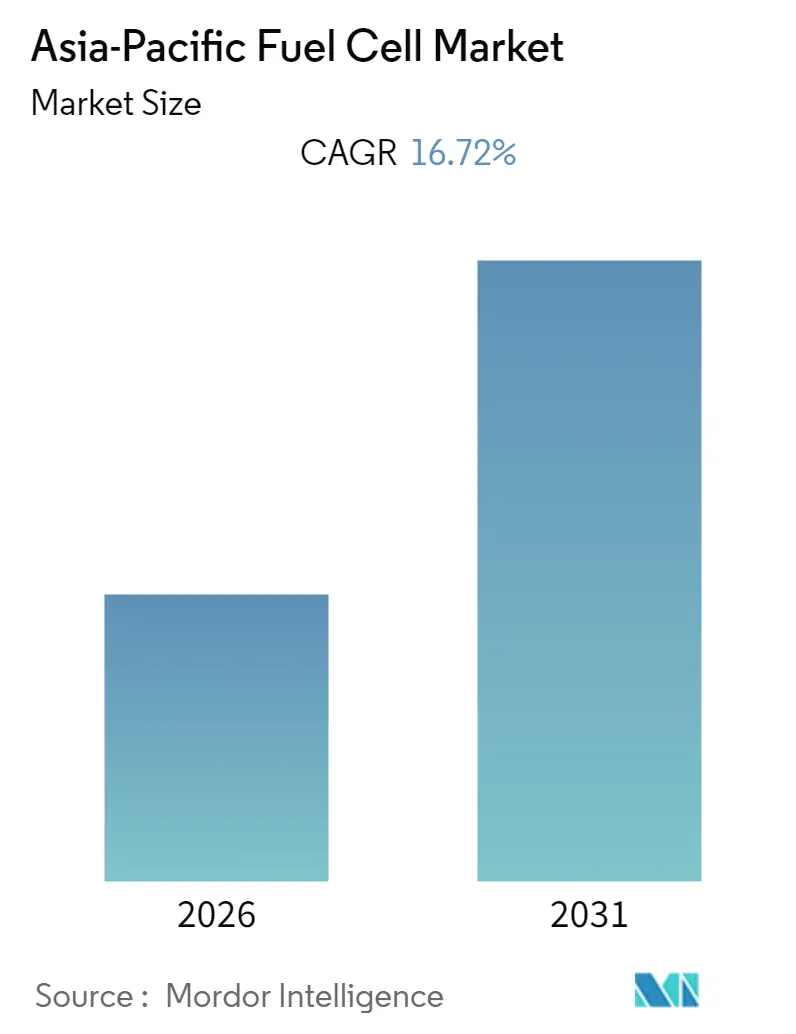
The Asia-Pacific Fuel Cell Market size is expected to register a CAGR of 16.72% during the forecast period (2026-2031).
- Transportation sector is expected to witness significant growth during the forecast period, owing to various factors such as increase in investments in hydrogen cars, and a rising number of fuel cell-based vehicles in the region.
- The increasing demand for electrical energy to sustain global development requires consistent heavy investments in energy efficient and clean energy sources. This has helped the market for the fuel cell to grow significantly in recent and is expected to do so in the forecast period.
- Japan is expected to dominate the market growth with majority of the demand coming from the residential and transportation sector, owing to the factors like economic growth rising focus on reducing greenhouse gases emissions, and rising fuel cell based vehicles.
Note: Market size and forecast figures in this report are generated using Mordor Intelligence’s proprietary estimation framework, updated with the latest available data and insights as of 2026.
Asia-Pacific Fuel Cell Market Trends and Insights
Transportation Sector to Dominate the Market
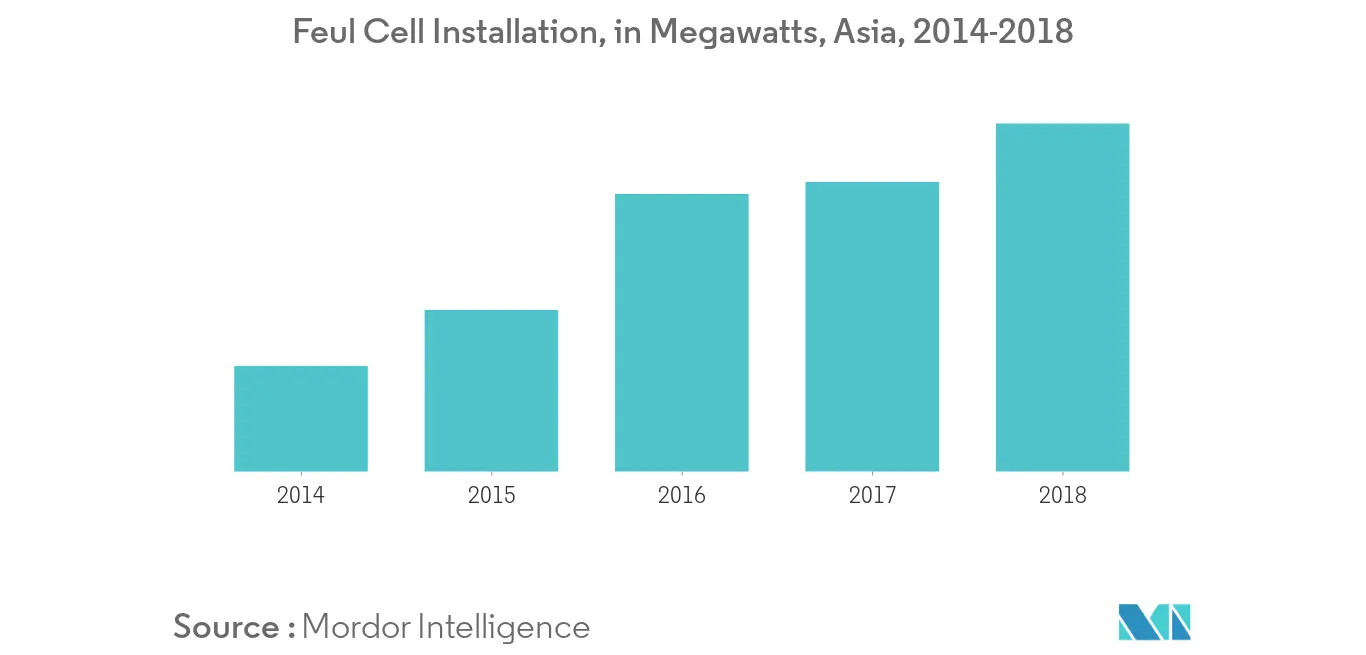
- Transportation sector has accounted for more than half of the market share in 2018 and is expected to continue its dominance in the coming years. The focus on clean energy usage in the transportation sector is creating increased opportunities for fuel cell business
- Japan and South Korea are expected to be pivotal in advancing the fuel cell electric vehicle technology, as Toyota and Hyundai-Kia claim to become the global leaders in fuel cell technology. Moreover, the phasing out of BEV incentives globally, from 2020, paralleled by government subsidies for fuel cell electric vehicles (FCEVs) in Asian countries, including China, Japan, and South Korea, is expected to open the floodgates to private sector investments and herald the start of a new era in fuel cell vehicle technology.
- There have been a massive increase in research and pilot testing of usage of fuel cells in transportation sector in order to increase efficiency and sustainability of fuel cell usage in vehicles.
- Japan had over 2800 fuel cell vehicles on road by end of 2018, the country has set a target of 40,000 fuel cell vehicles on road by 2020 and 80,000 by 2030.
- Therefore, with increase in fuel cell based vehicles, and phasing out of conventional fuel based vehicles, the market is expected to grow in forecast period.
Japan to Dominate the Market
- Japan has dominated the fuel cell market growth in 2018 and is expected to continue its dominance in the coming years as well. The region is expected to see an unprecedented increase during the forecast period.
- The country is leading in the region with vast applications of fuel cells, ranging from backup services for datacenters, combined heat and power for homes, automobile sector and many more. This is expected to provide a significant market growth for fuel cell market in the country.
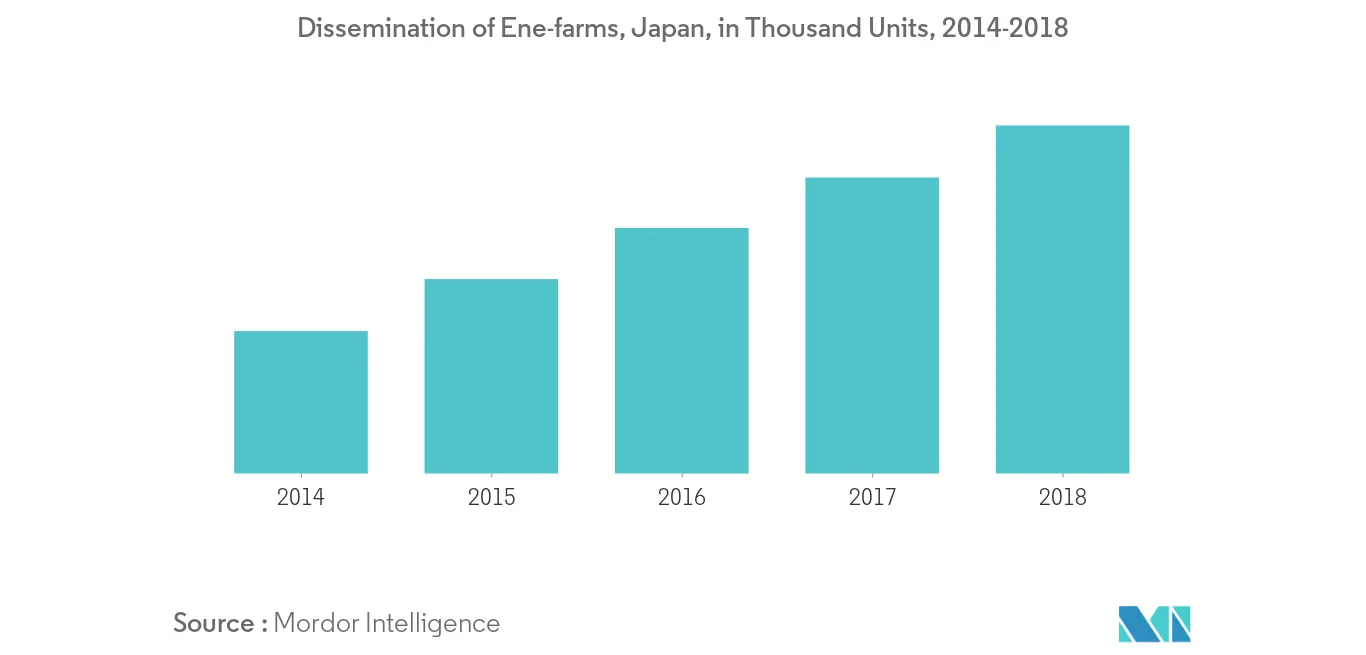
- Japan had implemented one of the most successful fuel cell commercialization programs, Ene-farm programme, in 2015. The program led to the deployment of over 120,000 residential fuel cell systems. Japan has added nearly 50,000 units (roughly 35 MW) of residential micro-CHP fuel cell systems in 2018, under the Ene-farm programme.
- Tokyo Metropolitan Government's (TMG's) plan to power several operations in 2020 Olympic and Paralympics games, which will be held at Tokyo, using fuel cell technology has created ample business opportunity for fuel cell companies. Toyota is planning to sell 100 fuel cell powered buses, including PEM type before the game starts. Also, the Tokyo government has created a reserve of USD 350 million to subsidize hydrogen-based fuel cell cars and refuelling stations for the same.
- Therefore, the aforementioned factors are expected to drive the market in forecast period, similar to the trend witnessed in recent years.
Value Chain Analysis
The regional fuel-cell value chain runs from upstream hydrogen production and primary energy inputs, to midstream conversion, storage, and logistics, and then to downstream system integration across stationary, transport, and portable applications. In upstream supply, resource-rich markets such as Australia are positioned as clean hydrogen supply hubs, while technology-importing markets such as Japan and South Korea anchor demand in power generation, industrial use, and mobility. One cross-border link already under development is the September 2025 MOU among Woodside Energy, Japan Suiso Energy (JSE), and The Kansai Electric Power Co., Inc. (KEPCO) to develop a liquid hydrogen supply chain between Australia and Japan, connecting Woodside's proposed H2Perth Project to receiving terminals in Japan.
Midstream roles include liquefaction, shipping, terminals, storage, and refueling infrastructure developers, with JSE and ENEOS Corporation cited as supply-chain actors in the report context, which helps connect hydrogen supply to vehicle and stationary-fuel-cell deployment programs. Downstream, OEMs and integrators convert hydrogen availability into end-use systems, including fuel cell vehicles and stationary power installations. For example, Hyundai Motor Group is active in shaping a waste-to-hydrogen ecosystem in Indonesia (April 2025) in partnership with Indonesian ministries and PT Pertamina (Persero), and Japan’s residential and industrial deployment pathways align with national targets for vehicles and fueling stations. Across the chain, deployment constraints continue to center on large-scale infrastructure investment needs, scaling production and logistics, and cost competitiveness versus incumbent energy technologies, so coordinated public-private programs and bankable offtake structures are key to moving from pilots to repeat deployments.
Competitive Landscape
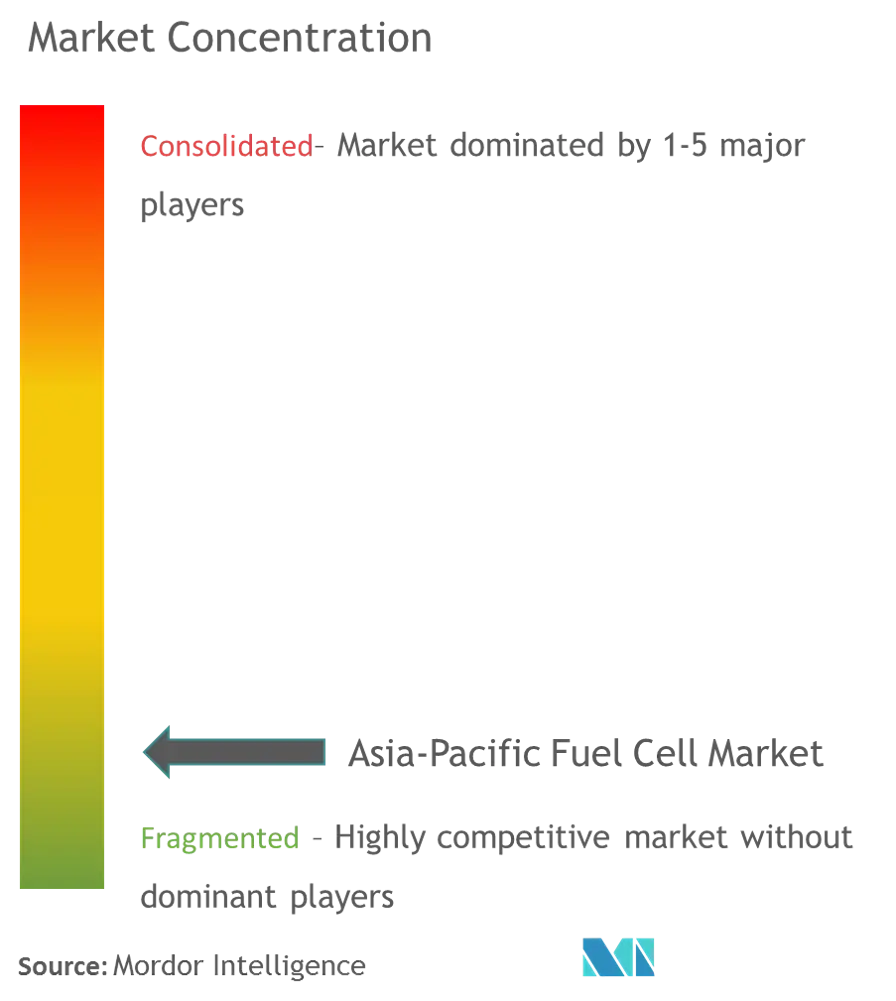
The Asia-Pacific fuel cell market is partially fragmented with a number of small and big players. Some of the major companies are Ballard Power Systems Inc., Toshiba Fuel Cell Power Systems Corporation, FuelCell Energy Inc., Mitsubishi Hitachi Power Systems Ltd, Fuji Electric Co Ltd among others.
Asia-Pacific Fuel Cell Industry Leaders
-
Ballard Power Systems Inc.
-
Toshiba Fuel Cell Power Systems Corporation
-
FuelCell Energy Inc.
-
Mitsubishi Hitachi Power Systems Ltd
-
Fuji Electric Co Ltd
- *Disclaimer: Major Players sorted in no particular order
Market Opportunities and Future Outlook
Stationary fuel cells and hydrogen-to-power projects offer a near-term opportunity as governments and corporates seek firm, low-carbon generation to support grid reliability and new loads. In South Korea, policy and market activity is translating into build-out and utilization, with commercial operations at Ulsan Hydrogen Power No. 1 (20 MW) beginning in April 2026. The country has also advanced demand-pull mechanisms such as the Clean Hydrogen Portfolio Standard introduced in May 2024, which requires power companies to prioritize electricity from clean hydrogen or ammonia. Together, these projects and portfolio-style procurement frameworks create room for more utility-scale and industrial behind-the-meter deployments, including multi-unit fuel cell parks and distributed generation for energy-intensive sites.
Mobility and infrastructure build-out is a second opportunity track tied to fleet and station deployment programs and local trial approvals. South Korea announced 2026 support budgets including KRW 576.2 billion to deploy 7,820 hydrogen vehicles (including 1,800 buses) and KRW 189.7 billion for refueling stations, targeting a cumulative 500+ stations by year-end, which can pull through demand for stacks, balance-of-plant, and service networks. Hong Kong is also expanding trial pipelines, with an inter-departmental working group having approved 38 hydrogen energy trial projects as of May 2026 (including fuel cell vehicles and power generators), which helps suppliers qualify equipment, establish safety cases, and form local partnerships. On the supply side, cross-border liquid hydrogen trade initiatives such as the Woodside-JSE-KEPCO MOU (September 2025) point to another commercialization route for markets with limited domestic low-carbon hydrogen supply, supporting the business case for import terminals, logistics services, and standardized fueling and handling arrangements.
Recent Industry Developments
- July 2026: Toshiba Energy Systems & Solutions activated a 500 kW pure hydrogen fuel cell system (H2Rex) at the Tanaka Kikinzoku Kogyo Shonan Plant in Kanagawa Prefecture, Japan. Built from five 100 kW units, the installation is positioned as an operational reference for industrial on-site hydrogen power and partial substitution of grid electricity. It strengthens the commercial proof base for pure-hydrogen fuel cells in factory settings, where uptime, integration, and safety requirements are stringent.
- June 2026: Ballard Power Systems announced an order for 15 MW of fuel cell systems for stationary applications, to be used in hydrogen gensets. The order adds volume to a segment that complements transport-led adoption, broadening demand for stacks and associated service support in the region. It also signals continued buyer interest in modular fuel cell power for distributed and backup generation use cases.
- December 2025: FuelCell Energy secured USD 25 million in debt financing from the Export-Import Bank of the United States (EXIM) to support fuel cell module production for the Gyeonggi Green Energy project in South Korea. The financing underwrites delivery capacity and reduces execution risk for a large, project-backed stationary deployment. It also illustrates how structured finance is being used to advance cross-border fuel cell projects tied to utility-grade power generation.
Research Methodology Framework and Report Scope
Market Definition and Coverage
For this methodology, the Asia-Pacific fuel cell market is defined as revenues generated from fuel cell systems and key stacks sold for stationary, transportation, and portable power uses across Asia-Pacific countries.
Scope exclusions: We exclude upstream hydrogen production and distribution, pure electrolyzer revenues, and broader balance-of-plant parts when they are sold as general industrial components without being tied to a fuel cell system.
Segmentation Overview
- Application
- Stationary
- Transport
- Portable
- Type
- Polymer Electrolyte Membrane Fuel Cells
- Phosphoric Acid Fuel Cells
- Solid Oxide Fuel Cells
- Others
- Geography
- China
- Japan
- South Korea
- Rest of Asia-Pacific
Data Sources, Market Sizing, and Validation
Desk Research
Desk research was used to build a clean fact base on deployments, policy signals, and technology direction before the model was finalized. We leaned on public sources such as the International Energy Agency, the International Renewable Energy Agency, and national energy and transport ministries in China, Japan, and South Korea, followed by customs and trade statistics where classification allowed reasonable proxies.
To align the demand picture with real activity, we also reviewed patent databases for technology intensity, along with company annual reports, investor presentations, and stock-exchange filings for production plans and capacity commentary. Industry association updates and reputable press were used to cross-check project announcements and commissioning timelines. In addition, a few paid subscriptions were used for company financials, news screening, and patents to reduce missed signals. The desk sources listed here are illustrative only, and many other public documents were also referenced for data collection, validation, and clarification.
Primary Interviews and Surveys
Primary work was used to confirm what is actually shipped and commissioned, and what remains in pilots or pre-commercial stages. We spoke with a mix of fuel cell stack and system participants, integrators, project developers, and end users across major Asia-Pacific markets, then followed up to close gaps around pricing, utilization, and procurement cycles.
We also collected input from policy and standards-facing roles to check how incentives translate into procurement decisions, how hydrogen availability constraints affect schedules, and how certification timelines feed into commissioning. This helped us stress-test near-term ramp assumptions tied to specific program timelines.
Distribution of primary research fieldwork respondents
| Company type | Respondent position |
|---|---|
| Top tier: 37% | CXOs: 16% |
| Mid tier: 44% | Functional/Unit leaders: 29% |
| Smaller Players: 19% | Managers: 55% |
Market-Sizing & Forecasting
Sizing started with a top-down demand pool reconstruction that ties Asia-Pacific fuel cell revenues to deployments by application, then converts those units into value using realistic ASP pathways by fuel cell type. Where the public trail was thin, we used adoption and penetration rates anchored to policy targets and confirmed project pipelines, then filtered them through expected commissioning and utilization timing.
To keep the totals grounded, selective bottom-up checks were added using sampled supplier roll-ups, channel conversations, and a simple volume times ASP math for a shortlist of countries and use cases. Key inputs used in the model included annual fuel cell shipment and commissioning indicators, announced capacity additions and ramp schedules, subsidy eligibility rules and expiry dates, hydrogen infrastructure readiness, and observed ASP moves tied to scale and localization. When bottom-up datapoints did not cover smaller countries, gaps were handled through proxy ratios based on vehicle and distributed-generation activity, followed by primary re-checks.
For forecasting, scenario analysis was used so the base case can be traced to drivers such as incentive continuity, project conversion rates, and supply constraints, and then stress-tested with more conservative and more aggressive ramps. The scenario weights were adjusted using expert consensus from interviews, and the final time series was checked for smoothness so step changes only appear where a real policy or commissioning trigger exists.
Data Validation & Update Cycle
Outputs were validated through multiple passes, starting with consistency checks at country and application level, followed by a review of outliers in growth rates, pricing, and implied shipment volumes. The model was compared against independent signals such as public deployment tallies, policy-driven procurement plans, and visible manufacturing expansion, then reconciled where the implied picture looked unrealistic.
Before sign-off, assumptions with the largest value impact, including ASP direction and commissioning timing, were reviewed by another analyst and re-confirmed with contacts when variance thresholds were crossed. Reports are refreshed annually, with interim updates triggered by material events such as major policy changes, large project delays, or new capacity announcements. Right before delivery, a final sweep is completed so clients receive the latest updated view based on the newest public and primary inputs.
Mordor Intelligence's Asia Pacific Fuel Cell Market Estimate Compared With Other Published Estimates
Published market sizes for Asia-Pacific fuel cells can look far apart because each publisher decides what to count as market revenue and how quickly adoption accelerates across transport, stationary, and portable use.
The main gap comes from whether the value includes wider hydrogen ecosystem revenues and loosely attached balance-of-plant sales, where Mordor Intelligence counts only fuel cell systems and stacks tied to the defined applications and then applies an ASP progression that is rechecked against real award and commissioning timing in the region.
Benchmark comparison
| Source | Market Size | Gaps in Research Methodology |
|---|---|---|
| Mordor Intelligence | USD 3.10 B (2024) | |
| Industry Research Desk A | USD 1.02 B (2024) | This estimate appears to apply a narrower captured revenue base and may lean on earlier-stage adoption in transport, which can undercount deployed stationary projects and near-term system ASPs in countries with active subsidy support. |
| Regional Consultancy B | USD 3.10 B (2024) | The number aligns on the year but the approach described relies more on internal databases with limited visibility on commissioning slippage, which can shift the split between announced projects and revenue that is actually realized in the base year. |
Across the published figures, the spread mostly comes from scope choices and how quickly projects are assumed to convert into shipped systems and recognized revenue. By keeping the inputs tied to observable deployments, policy triggers, and practical ASP checks, the final number stays explainable and repeatable, even when country-level disclosure is uneven.
Key Questions Answered in the Report
What is the current Asia-Pacific Fuel Cell Market size?
The Asia-Pacific Fuel Cell Market is projected to register a CAGR of 16.72% during the forecast period (2026-2031)
Who are the key players in Asia-Pacific Fuel Cell Market?
Ballard Power Systems Inc., Toshiba Fuel Cell Power Systems Corporation, FuelCell Energy Inc., Mitsubishi Hitachi Power Systems Ltd and Fuji Electric Co Ltd are the major companies operating in the Asia-Pacific Fuel Cell Market.
What years does this Asia-Pacific Fuel Cell Market cover?
The report covers the Asia-Pacific Fuel Cell Market historical market size for years: 2020, 2021, 2022, 2023 and 2024. The report also forecasts the Asia-Pacific Fuel Cell Market size for years: 2026, 2027, 2028, 2029, 2030 and 2031.