
Southeast Asia Compressed Natural Gas (CNG) Dispenser Market Size and Share
Market Overview
| Study Period | 2021 - 2031 |
|---|---|
| Forecast Data Period | 2026 - 2031 |
| Base Year Market Size (2025) | USD 32.39 Million |
| Market Size (2026) | USD 36.11 Million |
| Market Size (2031) | USD 60.33 Million |
| Growth Rate (2026 - 2031) | 10.81 % |
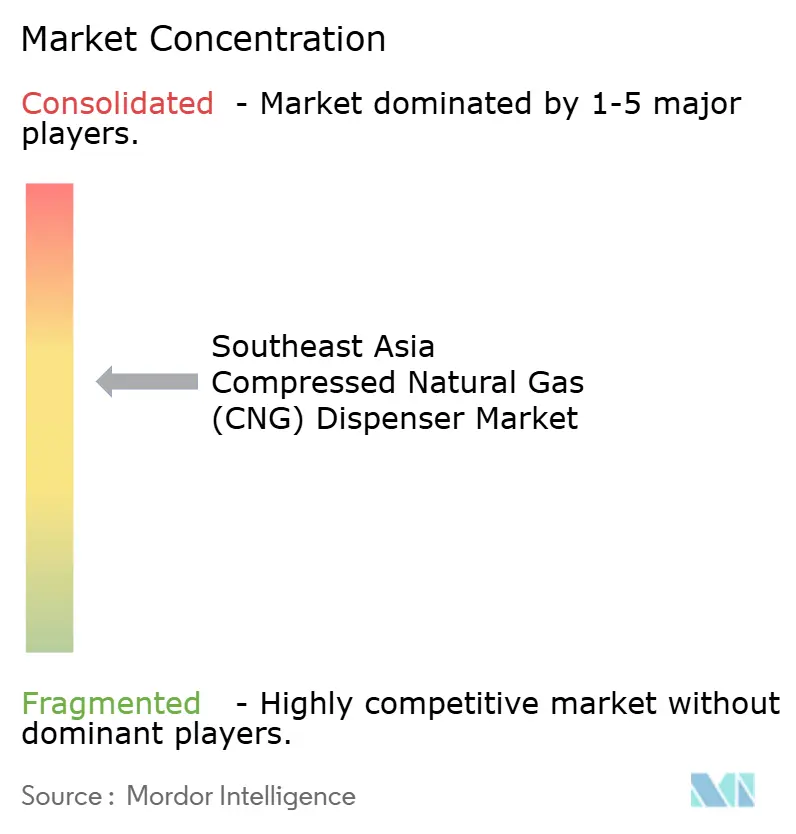
| Market Concentration | Medium |
Major Players *Disclaimer: Major Players sorted in no particular order Image © Mordor Intelligence. Reuse requires attribution under CC BY 4.0. | |
Southeast Asia Compressed Natural Gas (CNG) Dispenser Market Analysis by Mordor Intelligence
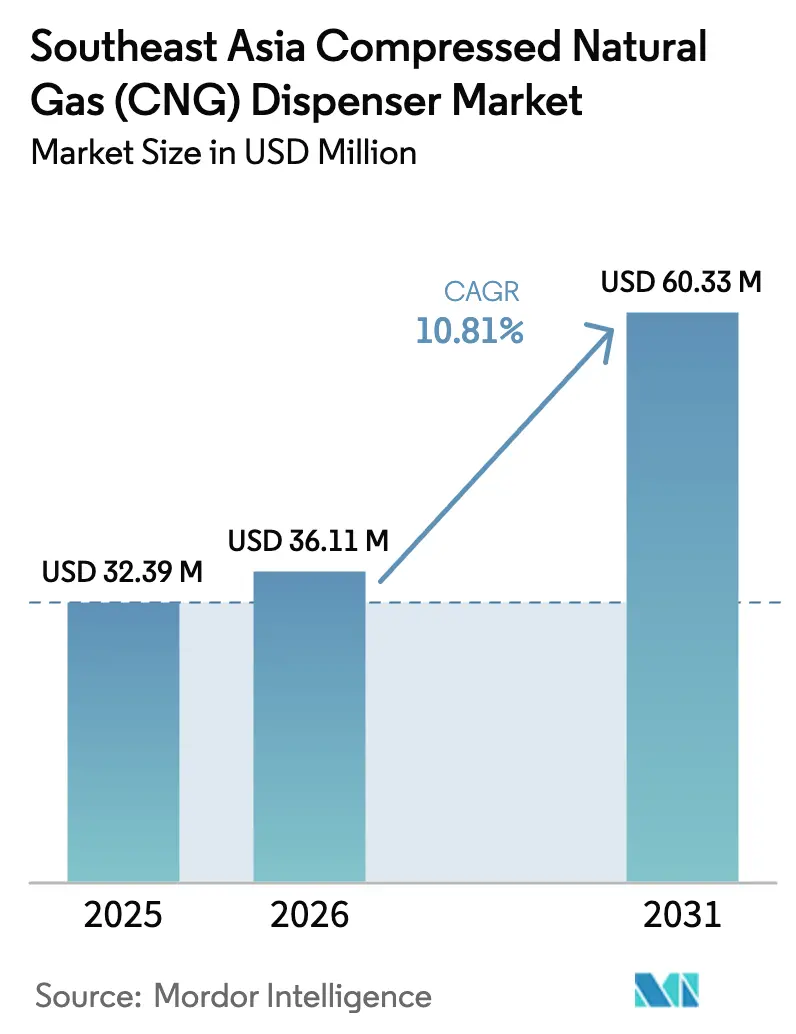
The Southeast Asia Compressed Natural Gas Dispenser Market size was valued at USD 32.39 million in 2025 and is estimated to grow from USD 36.11 million in 2026 to reach USD 60.33 million by 2031, at a CAGR of 10.81% during the forecast period (2026-2031).
This trajectory is underpinned by shifting demand from urban public-transport fleets, which now pivot to battery-electric drives, toward industrial, logistics, and mining operators that view CNG as a hedge against diesel volatility and a practical emissions-reduction tool when on-site electrification is impractical.[1]S&P Global, “Asia Pacific LNG Market Analysis,” S&P Global, spglobal.com Region-wide LNG import-terminal build-outs have expanded regasification capacity by 8.1 million t p.a. since 2023, cutting feedstock costs and improving dispenser project economics.[2]S&P Global, “Asia Pacific LNG Market Analysis,” S&P Global, spglobal.com Indonesia commands the largest national foothold through Pertamina’s state-backed stations and pipeline reach, whereas Vietnam delivers the fastest growth on the back of private depot investments that insulate manufacturing clusters from fuel-price swings.[3]International Energy Agency, “Southeast Asia Energy Outlook 2024,” IEA, iea.org Technology competition now centers on IoT-enabled, multi-hose systems that maximize throughput per square meter and cut downtime via predictive maintenance analytics.[4]Gilbarco Veeder-Root, “Fuel Dispensing Solutions,” Gilbarco, gilbarco.com Policy risk, however, remains a live threat: Malaysia’s 2025 NGV phase-out proved that electrification mandates can override favorable cost curves and instantly shrink the Southeast Asia CNG dispenser market.
Key Report Takeaways
- By dispenser configuration, dual-hose units led with 39.8% of Southeast Asia CNG dispenser market share in 2025, while multi-hose units are projected to grow at a 12.8% CAGR through 2031.
- By station type, fast-fill sites captured 55.5% share of the Southeast Asia CNG dispenser market size in 2025; mobile and portable stations are advancing at a 13.5% CAGR to 2031.
- By end user, public retail stations held a 52.2% share in 2025, whereas industrial and mining sites are forecast to register a 13.1% CAGR through 2031.
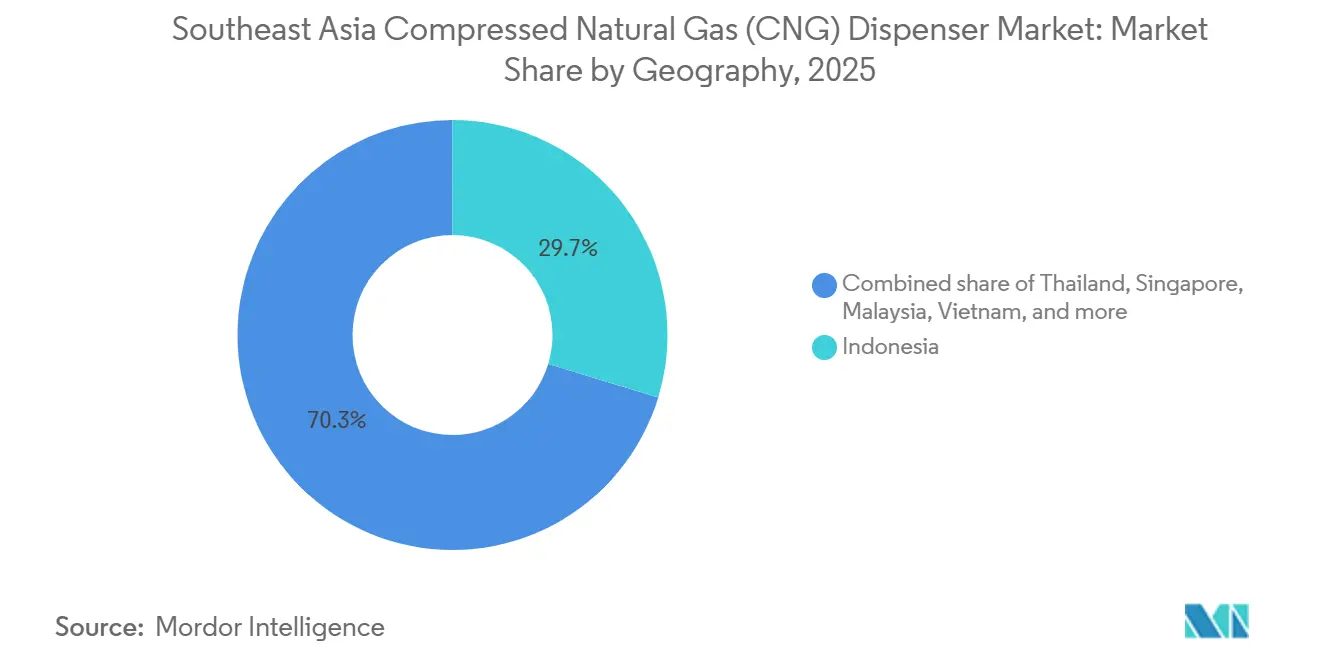
- By geography, Indonesia accounted for 29.7% of the Southeast Asia CNG dispenser market in 2025, whereas Vietnam is predicted to expand at a 13.9% CAGR between 2026 and 2031.
Note: Market size and forecast figures in this report are generated using Mordor Intelligence’s proprietary estimation framework, updated with the latest available data and insights as of January 2026.
Market Trends and Insights
Drivers Impact Analysis of Southeast Asia Compressed Natural Gas (CNG) Dispenser Market*
| Driver | (~) % Impact on CAGR Forecast | Geographic Relevance | Impact Timeline |
|---|---|---|---|
| Government NGV incentives & subsidy programs | 1.8% | Indonesia, Thailand (biogas focus), Philippines | Medium term (2-4 years) |
| Lower total cost of ownership vs gasoline & diesel | 2.9% | Indonesia, Vietnam, Philippines, Rest of Southeast Asia | Long term (≥ 4 years) |
| Growing city-bus fleet conversions to CNG | 0.7% | Indonesia, Philippines (limited urban impact due to EV shift) | Short term (≤ 2 years) |
| Regional pipeline & LNG import capacity build-out | 2.1% | Global Southeast Asia, strongest in Vietnam, Indonesia, Philippines | Medium term (2-4 years) |
| Rapid biogas-to-CNG project roll-outs | 1.3% | Thailand, emerging in Indonesia and Vietnam | Long term (≥ 4 years) |
| Adoption of IoT-enabled dispensers for predictive maintenance | 1.4% | Singapore, Thailand, Indonesia (urban stations) | Medium term (2-4 years) |
| Source: Mordor Intelligence | |||
Lower Total Cost of Ownership vs Diesel
Fleet operators in Indonesia and Vietnam have locked in five-to-seven-year CNG supply contracts that hedge against diesel swings exceeding 25% peak-to-trough in 2024, reducing depot payback periods to 3.2 years at throughputs above 150 vehicles daily. Delivered CNG costs in Java and Sumatra fell 18% after Pertamina’s pipeline extensions, cementing a 30-40% operating-cost gap versus diesel that persists even during LNG price spikes. Vietnamese manufacturers mirrored the shift as private depots grew 22% year-on-year in 2025, with operators citing maintenance and engine-life advantages that close only when utilization drops below 60%. The Southeast Asia CNG dispenser market, therefore, draws its core growth from heavy-duty fleets, not urban consumer vehicles, and is increasingly insulated from retail-price politics through direct gas-supply agreements.
Regional LNG Import Capacity Build-Out
Between 2023 and 2025, Vietnam’s Cai Mep and the Philippines’ new terminals added 8.1 million t p.a. of regasification, enabling station operators to source spot LNG cargoes when Asia-Pacific prices dip below USD 12/MMBtu. Indonesia’s state pipeline operator is pushing trunk lines into Central Java and South Sumatra, cutting virtual-pipeline truck costs. Thailand’s Eastern Economic Corridor pilots small-scale satellite LNG stations that could disrupt legacy pipeline distribution if capex falls beneath USD 2 million per site. Yet Singapore’s second terminal will not reach full output this decade, leaving operators there exposed to Malaysian pipeline imports and limiting network expansion.
Government NGV Incentives & Subsidies
Indonesia and the Philippines continue to channel fuel-tax rebates and vehicle-conversion grants toward NGV rollouts, while Thailand supports biomethane blending under its Alternative Energy Development Plan, lifting dispenser demand for units that can handle variable methane purity. Subsidy frameworks are, however, increasingly conditional on emissions outcomes, prompting operators to integrate telemetry that verifies greenhouse-gas savings. Medium-term policy visibility, therefore, underwrites purchase decisions, particularly for private-fleet depots considering multi-million-dollar commitments.
Adoption of IoT-Enabled Dispensers
Urban stations in Singapore and Bangkok retrofit dispensers with vibration, pressure, and flow sensors that feed predictive-maintenance platforms, cutting unplanned downtime by 30% and spare-parts inventories by up to 20%. Digital payment and remote shut-off features curb theft at unmanned depots, while dynamic pricing modules allow tariff changes in sync with LNG spot moves, subject to regulatory approval. Although retrofit costs run USD 8,000-12,000, high-throughput sites amortize them within two years, driving steady upgrade demand within the Southeast Asia CNG dispenser market.
Restraints Impact Analysis of Southeast Asia Compressed Natural Gas (CNG) Dispenser Market*
| Restraint | (~) % Impact on CAGR Forecast | Geographic Relevance | Impact Timeline |
|---|---|---|---|
| Rising competitiveness of battery-electric mobility | -2.4% | Thailand, Vietnam, Singapore (urban public transport) | Short term (≤ 2 years) |
| High upfront station CAPEX & land-leasing hurdles | -1.6% | Singapore, urban Indonesia, Malaysia, Thailand | Medium term (2-4 years) |
| Volatility of LNG spot prices impacting CNG retail price | -1.1% | Global Southeast Asia, most acute in import-dependent markets | Short term (≤ 2 years) |
| Urban zoning limits on high-pressure fueling facilities | -0.8% | Singapore, Bangkok, Ho Chi Minh City, Jakarta | Long term (≥ 4 years) |
| Source: Mordor Intelligence | |||
Rising Competitiveness of Battery-Electric Mobility
Bangkok’s 2025 order for 500 battery-electric buses and Ho Chi Minh City’s December 2025 conversion of 58 CNG buses to electric cut urban CNG demand by roughly 15% year-on-year. Malaysia’s July 2025 mandate eliminating 44,383 NGVs showed that policy can abruptly shrink the addressable base. With public-transport operators chasing zero-emission targets, dispenser utilization in city cores has dipped below break-even, forcing some sites to pivot to hydrogen or LPG. Regional suppliers are therefore redirecting sales teams toward industrial and mining clients less vulnerable to electrification.
High Upfront Station CAPEX & Land-Leasing Hurdles
Permanent fast-fill stations need USD 400,000-1 million before land costs, and lease premiums in Singapore or Bangkok can boost capital outlay by 30%, stretching paybacks beyond five years when traffic projections falter. Safety permits average 12-18 months in Indonesia and Vietnam, adding financing drag. Investors thus gravitate toward multi-hose retrofits of existing footprints or mobile units that cost one-third of full builds, despite higher per-kilogram compression costs. Until zoning eases or financing models evolve, station density in secondary cities will lag underlying vehicle adoption.
*Our forecasts treat driver/restraint impacts as directional, not additive. The impact forecasts reflect baseline growth, mix effects, and variable interactions.
Southeast Asia Compressed Natural Gas (CNG) Dispenser Market Segment Analysis
By Dispenser Configuration:
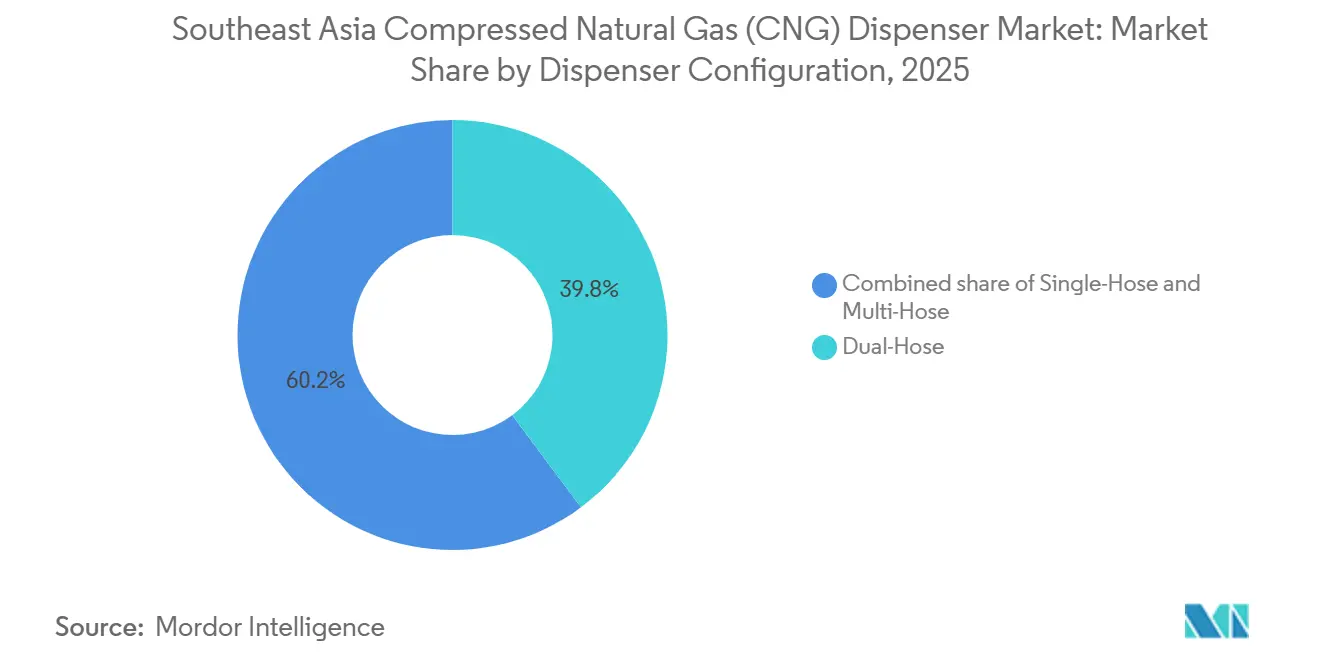
Space-Efficient Multi-Hose Designs Take HoldMulti-hose installations captured a rising share of the Southeast Asia CNG dispenser market as operators in Jakarta, Bangkok, and Ho Chi Minh City retrofit older dual-hose forecourts to serve three or four vehicles simultaneously. Dual-hose units still held 39.8% revenue in 2025, but multi-hose variants are projected to log a 12.8% CAGR, reflecting land constraints that make throughput per square meter critical. Single-hose equipment lingers in rural or low-traffic depots where simplicity trumps speed, although its share is ebbing as secondary cities tighten service-level rules.
Manufacturers now offer modular cabinets that add hoses in 12-month intervals, matching capex to realized demand and guarding against stranded assets. Integrating ISO 19880 compatibility prepares sites for future hydrogen blends with minimal retrofit, an insurance policy increasingly specified by risk-averse fuel retailers. Parker Hannifin and Gilbarco Veeder-Root have gained ground by bundling 24-hour parts support with software-subscription models that spread upfront costs across five-year service contracts. Chinese challengers compete on price but face perception gaps in premium urban stations, keeping competitive pressure moderate rather than destabilizing.



By Station Type:
Mobile Units Underpin Remote-Site GrowthFast-fill locations owned 55.5% of the Southeast Asia CNG dispenser market size in 2025 because retail motorists and taxi fleets demand sub-five-minute refuels. Yet mobile and portable stations are pacing future expansion with a 13.5% CAGR, answering mining and plantation operators who need relocatable infrastructure costing USD 150,000-300,000, roughly one-third of fixed-site capex. These containerized systems move within 48 hours, compress LNG or pipeline gas on site, and fuel 50-100 heavy vehicles daily in Kalimantan, Papua, and remote Vietnamese ports.
Fast-fill dominance faces headwinds from electric-bus adoption that curbs urban throughput, while mobile stations remain shielded because heavy equipment lacks viable battery alternatives. Time-fill depots, serving captive fleets overnight, are retrofitting fast-fill nozzles to improve asset utilization during daylight. Hybrid models are emerging that swing from slow-fill to burst refuels, powered by smart-compressor algorithms responding to real-time fleet needs.
By End User:
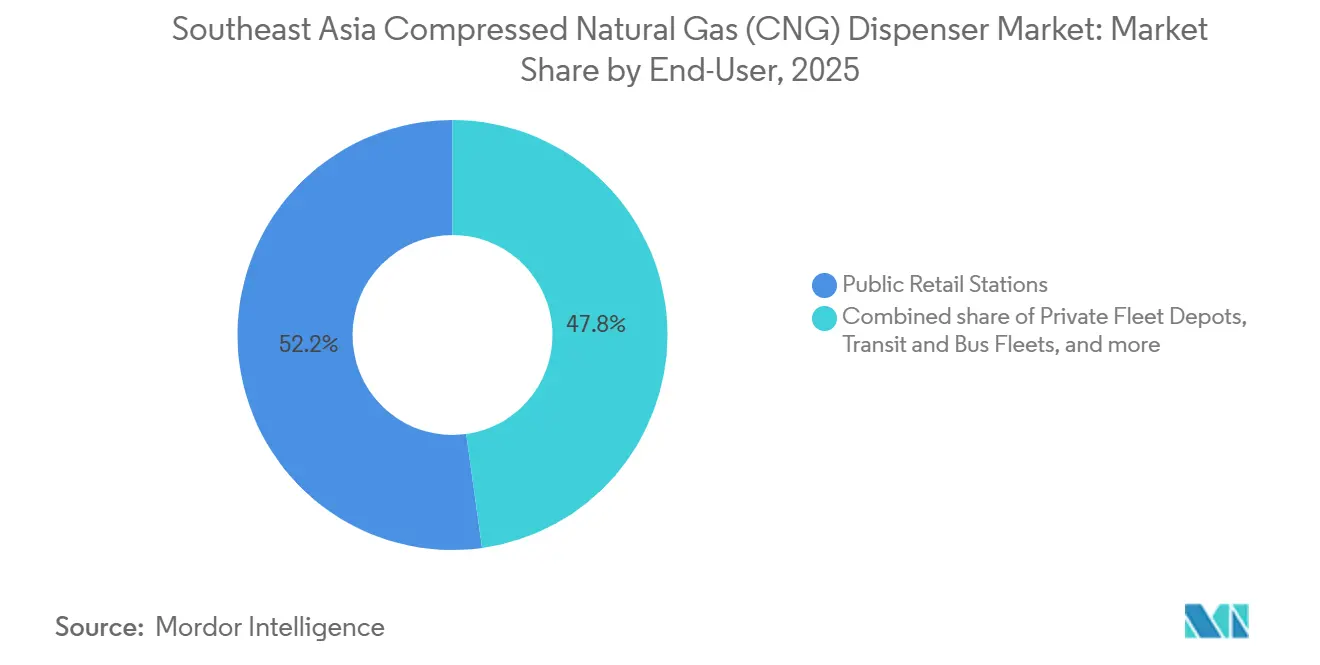
Industrial & Mining Demand Outpaces Public RetailPublic retail stations held 52.2% of market revenues in 2025, but industrial and mining customers are projected to post a 13.1% CAGR to 2031 as palm-oil mills, cement kilns, and ore haulers invest in private depots that secure 30-40% fuel savings versus diesel. A 500-truck logistics fleet in northern Vietnam achieves a 3.2-year payback on a USD 800,000 installation when diesel-CNG spreads stay above USD 0.30/liter.
Mining operators prize mobile dispensers that avoid 50-80 km dead-head journeys to public sites, reclaiming two hours of equipment uptime per shift. Transit fleets, once growth engines, are retreating as Bangkok, Kuala Lumpur, and Ho Chi Minh City electrify bus systems. Taxi cooperatives and delivery vans now purchase time-fill systems that refuel overnight at lower pressure, yet even these operators retrofit fast-fill guns for midday top-ups, reflecting a broader tilt toward operational flexibility.
Geography Analysis
Indonesia Compressed Natural Gas (CNG) Dispenser Market
Indonesia led with 29.7% of Southeast Asia's CNG dispenser market share in 2025, thanks to Pertamina's pipeline reach across Java, Sumatra, and Kalimantan. Delivered CNG costs fell 18% post-2023, fueling private-depot uptake among coal mines and palm-oil refineries. ISO 16923 safety codes adopted in 2025 reinforce high-capacity, multi-hose investments that established players can afford, effectively raising entry barriers.
Vietnam Compressed Natural Gas (CNG) Dispenser Market
Vietnam is forecast to log a 13.9% CAGR, the region's fastest, as manufacturers and logistics hubs anchor private depots inside industrial parks. The Cai Mep LNG terminal, fully online by September 2025, stabilized feedstock streams and allowed operators to arbitrage spot cargoes during demand troughs. Although Ho Chi Minh City's bus electrification trims urban volumes, industrial corridors along the Red River Delta and Mekong Delta remain robust. PetroVietnam Gas intends to exit retail CNG by 2029, increasing supply-side uncertainty but also opening room for independent distributors.
Thailand Compressed Natural Gas (CNG) Dispenser Market
Thailand shows a split profile. Bangkok's electric-bus push compresses city-station demand, yet 530 rural biogas plants channel biomethane into NGV blends under government mandates, requiring dispensers tolerant of fluctuating methane purity. Pilot trials in the Eastern Economic Corridor test unmanned fast-fill kiosks and remote monitoring that could revive the economy if reliability proves out.
Singapore Compressed Natural Gas (CNG) Dispenser Market
Singapore's market remains small but margin-rich. Land Transport Authority zoning restricts high-pressure fueling sites to industrial parks, capping station count and steering operators toward multi-hose retrofits to squeeze throughput from scarce land. The city-state's second LNG terminal is years away, keeping gas prices tethered to Malaysian pipeline imports and tempering dispenser rollouts.
ASEAN Compressed Natural Gas (CNG) Dispenser Market
Malaysia introduced the sharpest policy shock by ordering a full NGV phase-out in July 2025, yanking roughly 15% of regional fast-fill throughput overnight. Operators are mothballing dispensers, converting sites to LPG, or considering hydrogen, underscoring how policy can nullify economic fundamentals. The Philippines and the Rest of Southeast Asia hold embryonic networks but have gained LNG capacity and could accelerate if incentive frameworks crystallize.
Regulatory Landscape
Regulation for CNG dispensing across Southeast Asia is shaped by safety codes for high-pressure refueling stations, national gas-industry frameworks, and city-level siting constraints. Malaysia set a clear policy inflection by mandating a full NGV phase-out and ending CNG sales by July 1, 2025, citing safety and aging tank concerns. This change directly reduced utilization for existing fast-fill dispenser assets and increased perceived policy risk for new retail builds.
Country rules also affect equipment specifications and permitting timelines. In the Philippines, Republic Act No. 12120 (Natural Gas Industry Development Act) assigns the Department of Energy (DOE) and the Department of Trade and Industry, through the Bureau of Philippine Standards (DTI-BPS), to formulate Philippine National Standards for natural gas facilities, reinforcing compliance-driven procurement for dispensers and station packages. Malaysia also uses Standards Malaysia (SIRIM Berhad) MS 1204:2013 as a technical reference point, a code of practice for CNG compressor refueling stations. In Indonesia, a presidential regulation framework governs provision and distribution of fuel gas for land transportation, supporting state-linked rollout models that can accelerate or constrain station additions depending on program priorities.
Competitive Landscape
Global vendors Parker Hannifin, Gilbarco Veeder-Root, Censtar Science & Technology, and Tatsuno Corporation shape a moderately concentrated field, each vying on after-sales networks and IoT feature depth rather than sticker price. Gilbarco opened a Jakarta parts hub in November 2025, slicing service calls to 24-48 hours and justifying 15-20% equipment premiums for high-utilization sites. Parker co-markets predictive-maintenance software that couples vibration analytics with warranty extensions, locking clients into multi-year subscriptions.
Regional fabricators secure cost-sensitive deals in fast-fill stations by pairing localized assembly with shorter lead times. Yet quality perceptions and limited R&D budgets hinder their share of multi-hose and IoT-rich applications. Chart Industries’ trailer-mounted compressors penetrate mining and plantation segments by offering redeployable assets at one-third of permanent-site capex, tapping a white space insulated from urban electrification.
Future differentiation revolves around ISO 19880-compliant dual-fuel (CNG-hydrogen) designs. Forward-looking operators specify such a capability to hedge against hydrogen mandates, pushing suppliers with modular component architectures to the fore. Battery-electric fleet growth in urban cores compresses dispenser order books for public stations, so vendors now prioritize industrial, mining, and remote-site prospects where electrification hurdles remain high. Competitive intensity peaks in Indonesia and Vietnam, where tender activity is brisk, while Thailand and Singapore trend toward consolidation under fuel-retail incumbents that bundle gas supply with equipment leases.
Southeast Asia Compressed Natural Gas (CNG) Dispenser Industry Leaders
Parker Hannifin Corp
FTI International Group Inc.
Censtar Science & Technology Co., Ltd.
Scheidt & Bachmann Gmbh
ComTech Energy
- *Disclaimer: Major Players sorted in no particular order
Southeast Asia Compressed Natural Gas (CNG) Dispenser Market Companies Covered in this Report
- Parker Hannifin Corp
- Gilbarco Veeder-Root
- Censtar Science & Technology
- Tatsuno Corporation
- Scheidt & Bachmann
- Greka Engineering
- FTI International Group
- ComTech Energy
- Sanki Industry Group
- TGT Fuel Technologies India
- Compac Industries
- Tokheim Corporation
- ANGI Energy Systems
- WEH GmbH
- Linde Hydrogen & Gas Equipment
- Bosch Rexroth
- Chart Industries
- KwangShin Machine
- Armstrong Equipment
- Clean Energy Compression
Read Analysis of Southeast Asia Compressed Natural Gas (CNG) Dispenser Companies

Market Opportunities and Future Outlook
Opportunities in Southeast Asia increasingly center on private-fleet depots and remote heavy-duty use cases where station economics depend on throughput, uptime, and on-site control of fuel supply, rather than walk-in urban traffic. That focus supports demand for high-capacity, multi-hose dispensers and modular expansions at industrial and mining sites in Indonesia, including coal mines and palm-oil refineries, as operators prioritize serving more vehicles per square meter and reducing downtime through predictive maintenance and stronger after-sales support.
A second opportunity area is compliance-ready digitalization packaged into dispenser solutions, especially where incentive frameworks and corporate decarbonization programs require proof of emissions outcomes. The subsidy and incentive designs described in-market are becoming more conditional on verified greenhouse-gas savings, which creates demand for dispensers integrated with telemetry, remote monitoring, and data capture for reporting. At the same time, urban public-transport electrification (for example, Ho Chi Minh City actions in 2025) shifts attention away from city-bus corridors toward logistics, manufacturing clusters, and industrial parks that rely on direct gas-supply agreements, and can justify investment in IoT-enabled dispensers and multi-year service contracts.
Recent Industry Developments in Southeast Asia Compressed Natural Gas (CNG) Dispenser Market
- June 2026: Scheidt & Bachmann GmbH - Announced SIQMA product portfolio enhancements for energy retail solutions, following a major 2025 contract with EG Group. The rollout expands digital energy retail capabilities in Southeast Asia's dispenser ecosystem. It reinforces after-sales and data analytics differentiators, signaling a shift toward integrated energy retail platforms rather than pure dispenser hardware in the region.
- June 2026: Scheidt & Bachmann GmbH - Announced the introduction of SIQMA product portfolio enhancements for energy retail solutions, following a major 2025 contract with EG Group. The launch expands the company's energy retail technology footprint in Southeast Asia, strengthening customer service and operational analytics. It also supports modular, integrated deployments that link hardware with software services.
- July 2025: Government of Malaysia - Implemented a policy to phase out NGV powered vehicles and cease CNG sales by July 1, 2025, significantly impacting regional CNG infrastructure utilization. The policy reduces near-term CNG demand for public transport while accelerating shifts toward alternative propulsion across the region. It can also affect dispenser project economics by changing fleet fueling patterns across Southeast Asia.


Southeast Asia Compressed Natural Gas (CNG) Dispenser Market Report Scope and Research Methodology
Market Definition and Coverage
For this study, the market is defined as revenues generated from selling compressed natural gas (CNG) dispensing equipment installed at refueling stations across Southeast Asia, including associated dispenser hardware that enables metered CNG delivery to vehicles.
Scope exclusions: We exclude upstream and midstream gas equipment, full station construction, compressors and storage cascades sold as standalone systems, and ongoing maintenance services unless bundled into the dispenser sale value.
Segments Covered in This Report
- By Dispenser Configuration
- Single-Hose
- Dual-Hose
- Multi-Hose
- By Station Type
- Fast-Fill
- Time-Fill
- Mobile/Portable
- By End-User
- Public Retail Stations
- Private Fleet Depots
- Transit and Bus Fleets
- Industrial and Mining Sites
- By Geography
- Thailand
- Singapore
- Indonesia
- Malaysia
- Philippines
- Vietnam
- Rest of Southeast Asia
Data Sources, Market Sizing, and Validation
Desk Research
Desk work starts with building a country list and a station ecosystem view, since CNG dispenser demand typically follows NGV adoption and station rollout pace. We reference public energy and transport statistics and policy direction from sources such as ASEAN energy publications, IEA energy indicators, national energy ministries, and transport agencies, then use customs and trade flows from UN Comtrade and relevant national statistics portals.
To translate this context into sizing inputs, we also screen company filings, investor presentations, tender portals, and reputable press for station awards, equipment ordering patterns, and network expansion announcements. Patent databases are used selectively to understand dispenser feature direction, for example flow metering, safety interlocks, and multi-hose configurations. Where shipment-level trade views are available, an import or export shipment database may be used to sanity-check equipment movement, since broad public trade lines can be too mixed for dispenser-level inference. The sources listed here are illustrative, and other public documents were also used to clarify data points and validate assumptions.
Primary Interviews and Surveys
Primary work focuses on confirming what is actually being purchased and installed in the region, and how ordering differs between public retail stations and private fleet depots. We speak with a mix of station operators, EPC and integrator participants, component distributors, and vehicle fleet stakeholders across key Southeast Asian markets, then use these inputs to test pricing ranges, replacement cycles, and the split of new stations versus upgrades.
Because public data rarely states the number of dispensers per site or the typical configuration used, interviews are used to fill these gaps and align country-level assumptions before regional totals are finalized.
Distribution of primary research fieldwork respondents
| Company type | Respondent position |
|---|---|
| Top tier: 33% | CXOs: 13% |
| Mid tier: 53% | Functional/Unit leaders: 32% |
| Smaller Players: 14% | Managers: 55% |
Market-Sizing & Forecasting
Sizing is built using a top-down demand pool reconstruction that starts from each country's active and planned CNG refueling footprint, then converts it into dispenser revenues using realistic configuration and pricing assumptions. For each market, we estimate indicators such as CNG station counts and openings, typical dispensers per station, the split of fast-fill versus time-fill setups, average hoses per dispenser, and observed price bands by configuration, adjusted for import dependence and local assembly where relevant.
After this initial view is formed, we check totals with selective bottom-up approximations, including sampled quotes and installed-base replacement needs. We then adjust when the implied revenue per station does not match interview feedback. Where direct inputs are missing, gaps are handled using country proxies based on similarity in station formats, fleet mix, and procurement practices, and these assumptions are re-tested through follow-up calls.
For forecasting, we use scenario analysis anchored to policy support for NGVs, expected station commissioning pace, and capex cycles among fleet operators and fuel retailers. The model also tracks currency conversion timing and expected price movement for imported dispenser components, and these variables are stress-tested so growth does not rely on a single assumption.
Data Validation & Update Cycle
Validation is done through stepwise checks that compare model outputs with independent signals, including station pipeline announcements, NGV adoption indicators, and trade-flow direction for relevant equipment categories. We investigate outliers at the country level first, then re-check after aggregation so one market does not pull the regional trend off course.
Before sign-off, assumptions and calculations go through an internal analyst review, and we may re-contact respondents when a specific data point conflicts with the broader evidence trail. The report is refreshed annually, and interim updates are made when material events occur, such as major policy shifts, large station network awards, or abrupt changes in fuel pricing dynamics. A final pre-delivery review pass is completed so clients receive an updated view at the time of purchase.
Mordor Intelligence's Southeast Asia Compressed Natural Gas Dispenser Market Size Compared Against Other Published Estimates
Published market sizes for CNG dispensers in Southeast Asia can differ more than buyers expect, even when the scope looks narrow. The main reasons usually come down to how each publisher draws scope boundaries, what base year is used, and whether the model is tied back to station and installation realities.
Some estimates fold dispensers into a broader natural gas refueling equipment bucket, which can pull in compressors, storage, and wider station packages. In Mordor Intelligence's estimate, only dispenser revenues are counted for Southeast Asia, and station construction and standalone compression equipment are kept out, so the number tracks dispenser ordering and replacement cycles more cleanly.
Benchmark comparison
| Source | Market Size | Gaps in Research Methodology |
|---|---|---|
| Mordor Intelligence | USD 32.39 M (2025) | |
| Global Consultancy A | USD 41.70 M (2025) | Uses a wider station-equipment definition that blends dispensers with compression, storage, and station build components, and it tends to apply higher equipment-per-station ratios without consistent configuration checks by country. |
| Industry Association B | USD 27.90 M (2025) | Focuses mainly on new station additions and reported project announcements, which can undercount replacements and multi-dispenser sites, and it often applies conservative pricing that does not reflect imported component costs. |
The table shows that the spread is mostly explained by what gets included with the dispenser and how installations per site are assumed. By keeping the math traceable to station counts, configuration splits, and realistic price bands, the estimate stays easier to reproduce and to update when new stations or retrofit programs appear.


Key Questions Answered in the Report
What is the projected value of the Southeast Asia CNG dispenser market in 2031?
Forecasts peg the market at USD 60.33 million by 2031, at a 10.81% CAGR during 2026-2031.
Which country leads dispenser sales today?
Indonesia holds 29.7% share, buoyed by Pertamina's extensive CNG network and pipeline infrastructure advantages.
Which segment is growing fastest?
Mobile and portable stations serving mining and plantation sites are expanding at a 13.5% CAGR through 2031.
How will Malaysia's 2025 NGV phase-out affect demand?
The policy removed about 15% of regional fast-fill throughput, forcing operators to redeploy assets or exit urban retail niches.
What technology features are most sought after?
Multi-hose dispensers with IoT-enabled predictive maintenance and integrated digital payment dominate new orders.
How vulnerable is the market to electric-vehicle uptake?
Urban public-transport demand is declining, but industrial and remote heavy-duty applications still favor CNG, tempering overall impact.
Page last updated on:


 Your data is secure and never sold or shared.


