
Asia-Pacific Tire Pressure Monitoring System (TPMS) Market Size and Share
Market Overview
| Study Period | 2019 - 2031 |
|---|---|
| Forecast Data Period | 2026 - 2031 |
| Base Year Market Size (2025) | USD 2.13 Billion |
| Market Size (2026) | USD 2.31 Billion |
| Market Size (2031) | USD 3.51 Billion |
| Growth Rate (2026 - 2031) | 8.73 % |
| Market Concentration | Medium |
Major Players *Disclaimer: Major Players sorted in no particular order Image © Mordor Intelligence. Reuse requires attribution under CC BY 4.0. | |
Asia-Pacific Tire Pressure Monitoring System (TPMS) Market Analysis by Mordor Intelligence
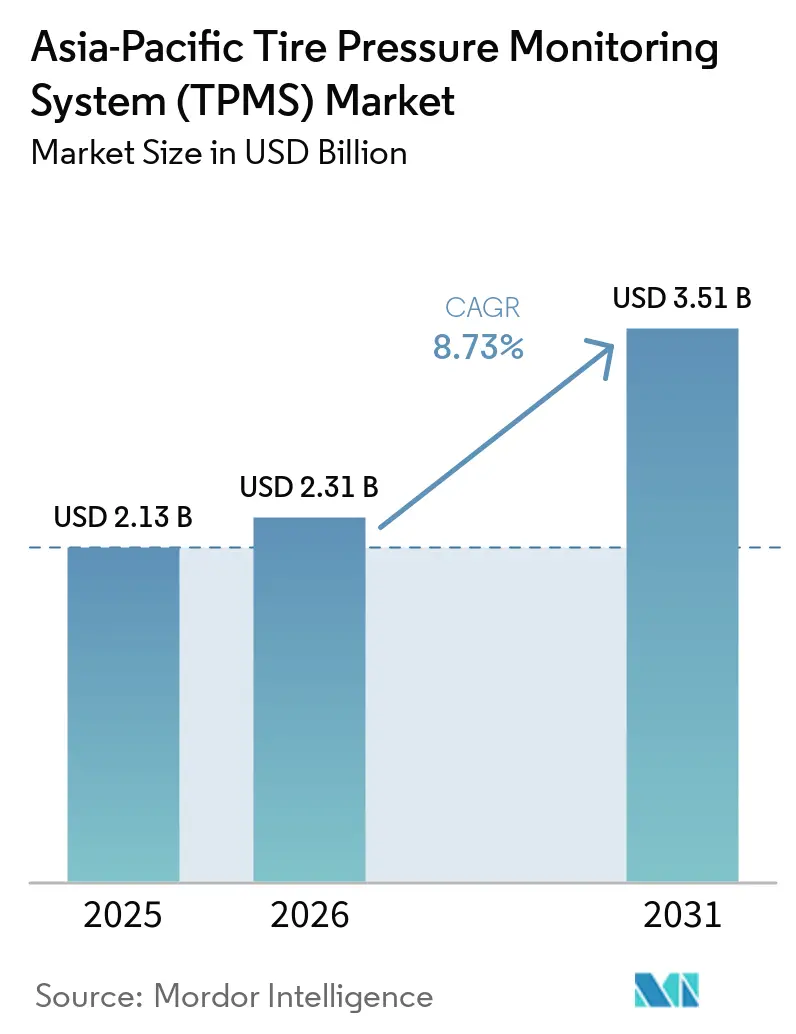
The Asia-Pacific tire pressure monitoring system market was valued at USD 2.13 billion in 2025 and is expected to reach USD 2.31 billion in 2026 and USD 3.51 billion by 2031, at an 8.73% CAGR over 2026-2031. Regulatory mandates continue to anchor baseline demand because fitment requirements in China are already established, India moved to mandatory compliance for new passenger vehicles from November 2025, and Japan completed the shift toward 433 MHz harmonization for a broader regional standard path in 2026. The Asia-Pacific tire pressure monitoring system market is also being lifted by electric vehicle adoption, as rolling resistance affects battery use, making real-time tire pressure data part of range management rather than just a warning function. Telematics integration is broadening the product role as pressure, temperature, and motion data move into connected maintenance workflows, which is driving demand for direct systems, BLE-enabled sensors, and remote software support. Competition is tightening between global Tier-1 suppliers and local Asian manufacturers as regional MEMS production, 433 MHz standardization, and broader EV programs narrow historical cost gaps and improve fitment scale. Growth still faces limits from price sensitivity in entry vehicles, sealed-sensor replacement costs, and rising cybersecurity requirements after published research showed that common 433 MHz signals can expose sensor identifiers in plaintext.
Key Report Takeaways
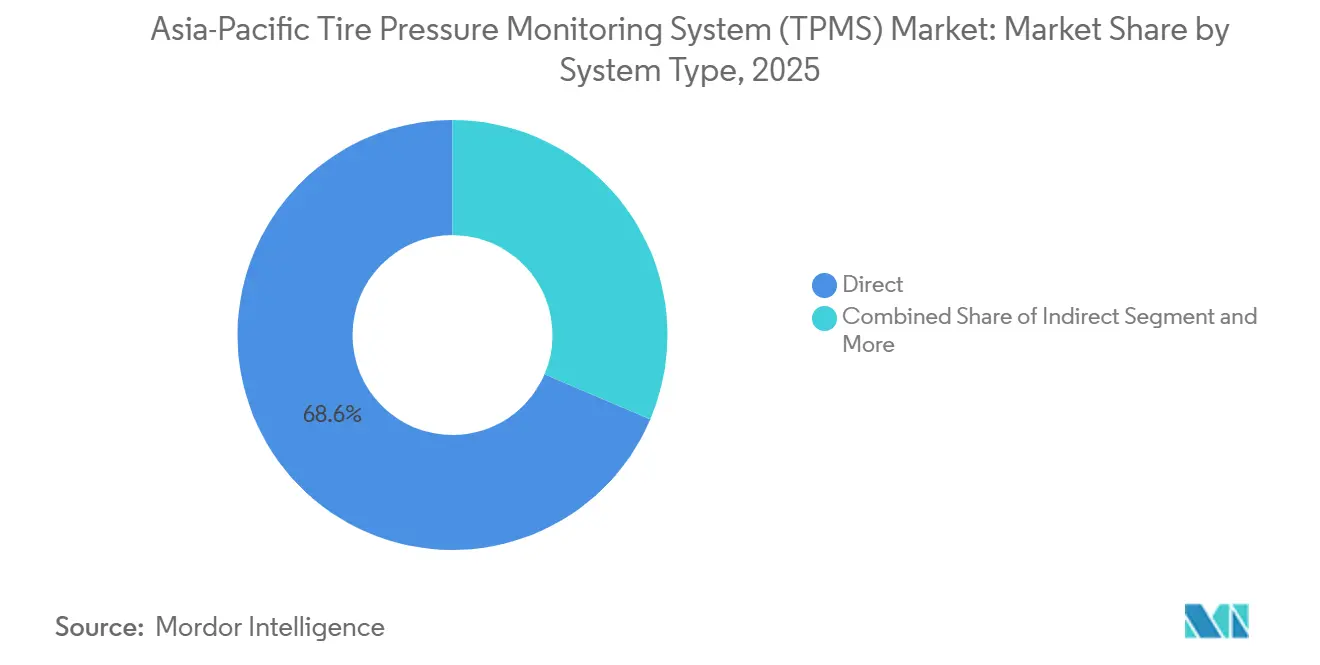
- By system type, direct TPMS led with 68.55% of revenue in 2025, while hybrid TPMS is forecast to grow at 11.02% CAGR through 2031.
- By sensor technology, MEMS capacitive sensors held 52.61% of revenue in 2025 and also recorded the highest projected CAGR of 9.12% through 2031.
- By fitting method, valve-stem sensors accounted for 61.40% of revenue in 2025, while embedded-tire modules are projected to expand at 10.34% CAGR through 2031.
- By frequency band, 433 MHz represented 71.31% of 2025 revenue, while the ≥2.4 GHz and UWB cohort is advancing at 10.78% CAGR through 2031.
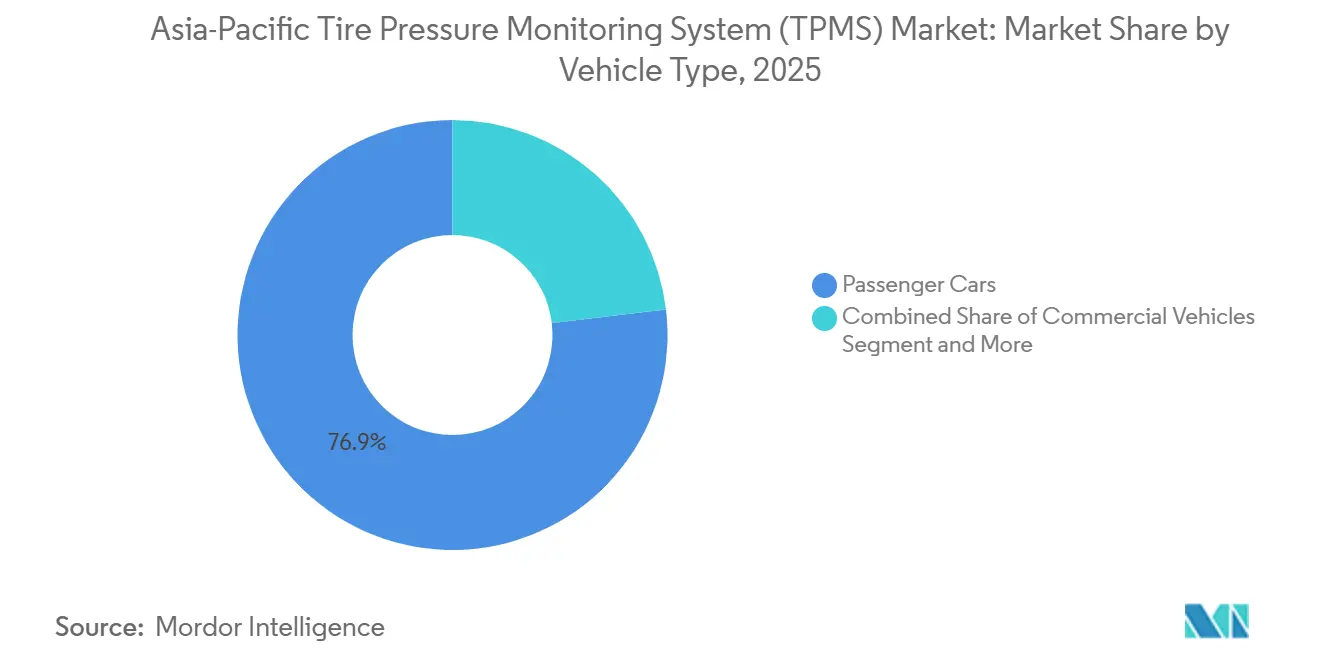
- By vehicle type, passenger cars held 76.85% of the Asia-Pacific tire pressure monitoring system market share in 2025 and also posted the fastest CAGR at 9.68% through 2031.
- By sales channel, OEM factory-fit installations captured 82.50% of revenue in 2025, while the aftermarket retrofit channel is projected to grow at 10.11% CAGR through 2031.
- By country, China captured 51.80% of the Asia-Pacific tire pressure monitoring system market share in 2025 and will expand with the fastest CAGR at 9.21% through 2031.
Note: Market size and forecast figures in this report are generated using Mordor Intelligence’s proprietary estimation framework, updated with the latest available data and insights as of 2026.
Worldwide, activity is shaped by contributions from multiple regions, with Asia representing one of the more structurally developed among them. The global report on automotive tpms market by Mordor Intelligence reflects how these regional layers combine into a single system.
Asia-Pacific Tire Pressure Monitoring System (TPMS) Market Trends and Insights
Drivers Impact Analysis*
| Driver | (~) % Impact on CAGR Forecast | Geographic Relevance | Impact Timeline |
|---|---|---|---|
| Mandatory TPMS Regulations | +2.8% | China, India, ASEAN, and spillover to South Korea | Short term (≤ 2 years) |
| Fuel Efficiency and Range Optimization | +1.9% | China, India, and South Korea are growing | Medium term (2-4 years) |
| BLE-Enabled Battery-Less TPMS | +1.5% | China and Japan are core, and India is emerging | Medium term (2-4 years) |
| Fleet-Telematics Integration | +0.9% | China, India, Australia, and South Korea | Medium term (2-4 years) |
| 433 MHz Harmonization in Japan | +0.8% | Japan, with a supply-chain spillover to South Korea | Short term (≤ 2 years) |
| Localized MEMS Sensor Production | +0.6% | China and Japan are core, with APAC-wide benefit | Long term (≥ 4 years) |
| Source: Mordor Intelligence | |||
Mandatory TPMS Regulations Across China, India, and ASEAN
The Asia-Pacific tire pressure monitoring system market is moving through a staged regulatory expansion rather than a one-time jump in demand. China already created a large fitted base when GB 26149-2017 required TPMS on Category M passenger vehicles from January 2020, which established long-run OEM pull and a growing replacement cycle. India then shifted a major vehicle market from voluntary installation to mandatory compliance from November 2025, which added a fresh layer of rule-based demand to the region in 2026. This sequencing matters because suppliers that learned to build low-cost sensor architectures for China are now better placed to compete for Indian OEM programs that still face tight cost targets. Japan aligned the 433 MHz band in 2025, with full implementation completed in 2026, while South Korea already maintains an established fitment regime, and that combination is helping standardize sourcing across Northeast Asia. ASEAN remains earlier in the policy cycle, yet vehicle safety goals and larger fleets keep the rulemaking direction supportive for future fitment growth.
OEM Demand for Fuel Efficiency and EV Range Optimization
In the Asia-Pacific tire pressure monitoring system market, OEMs increasingly treat TPMS as an efficiency component rather than a narrow safety item. This shift is strongest in battery electric vehicles because under-inflation raises rolling resistance and directly affects usable range, which turns pressure visibility into an operating input for both automakers and drivers. Continental's second-generation module launch from its Bangalore plant in June 2024 expanded local production to 3.3 million wheel units per year and tied pressure, temperature, and motion sensing to smartphone-based data display, which shows how the product is being packaged as a connected function rather than a simple warning lamp. The value proposition also rises in software-defined vehicle programs because tire data can be routed into chassis-control logic, diagnostic tools, and maintenance alerts with little additional hardware burden. That is why premium direct systems continue to gain preference in passenger vehicle platforms where range performance and software integration already influence the option mix. The result is a stronger case for higher-value TPMS specifications across China, India, Japan, and South Korea, especially in new EV nameplates.
BLE-Enabled Battery-Less TPMS for Fast-Growing EV Segment
The Asia-Pacific tire pressure monitoring system market is also being reshaped by BLE-enabled sensor designs that fit more naturally into connected EV architectures. Bosch introduced the SMP290 in June 2025 as a fully integrated MEMS-based TPMS sensor with Bluetooth Low Energy on a single die, which marked a visible step toward simpler wireless integration for automakers. The design logic is important because BLE can use wireless infrastructure that is already present for other vehicle functions, which reduces the need for a separate sub-GHz receiver path in some architectures. Cybersecurity also becomes a stronger selling point in this segment because AES-128 support and ISO 21434 alignment answer a real weakness that academic research identified in plaintext 433 MHz transmissions. Sensata's BLE TPMS platform extends the value case by enabling bidirectional over-the-air firmware updates, which helps resolve field issues without replacing hardware and reduces lifecycle service friction [1]. As BLE support spreads through EV platforms, the regional product mix is gradually moving toward smartphone-native and software-updatable monitoring rather than fixed-function RF-only designs.
Fleet-Telematics Integration for Predictive Maintenance
The Asia-Pacific tire pressure monitoring system market is gaining an additional demand layer from connected fleet operations. Fleet operators want more frequent tire condition data because unscheduled stoppages quickly raise costs in public transport, logistics, and long-haul vehicle use. In India, Manatec Mobility links TPMS with AIS 140 compliant tracking units, and the company states that its system is the only ASRTU-approved solution for state transport undertakings, which shows that fleet integration is now tied to formal operating requirements rather than optional retrofits [2]. In China, Lupital combines BLE 5.0 sensing with tire-vibration modeling trained on large lifecycle datasets, which pushes the product beyond threshold alerts and toward failure prediction. This changes the commercial logic for suppliers because fleets accept a higher system price when the data can flow directly into telematics dashboards and maintenance scheduling. It also favors direct TPMS architectures over basic indirect alternatives in heavier-use vehicle populations where data frequency and reliability matter more than the lowest upfront cost.
Restraints Impact Analysis*
| Restraint | (~) % Impact on CAGR Forecast | Geographic Relevance | Impact Timeline |
|---|---|---|---|
| Price Sensitivity in Two-Wheelers and Cars | -1.2% | India, Indonesia, Vietnam, and broader ASEAN | Short term (≤ 2 years) |
| High Replacement-Battery Cost | -0.8% | APAC-wide, with sharper pressure in India and the rest of APAC | Medium term (2-4 years) |
| Chip-Supply Volatility | -0.5% | China, Japan, and South Korea OEM supply chains | Short term (≤ 2 years) |
| RF-Hacking and Cyber-Security | -0.4% | APAC-wide, with elevated importance in China under GB 44495-2024 | Medium term (2-4 years) |
| Source: Mordor Intelligence | |||
Price Sensitivity in Two-Wheelers and Entry-Level Cars
In the Asia-Pacific region, tire pressure monitoring systems (TPMS) face affordability challenges, particularly in two-wheelers and budget-friendly passenger vehicles. This issue is most pronounced in India. For instance, TVS Motor Company introduced TPMS exclusively through a premium dynamic kit, which positioned the feature beyond the reach of mainstream motorcycle buyers. In the mass market, where two-wheelers are typically priced at entry-level ranges, a TPMS package proves hard to justify. Without regulatory support or a clearer operational benefit, many consumers hesitate. Consequently, despite the region's higher sales of two-wheelers compared to cars in several countries, TPMS adoption in two-wheelers lags significantly behind that in passenger cars. The scenario shifts slightly with electric two-wheelers. Here, the sensitivity to range makes tire pressure monitoring economically vital. This relevance boosts the appeal of low-cost BLE cap-sensor pilots, a feature less emphasized in traditional internal combustion models. Yet, the overarching challenge of affordability continues to slow the expansion of the addressable market relative to the technology's growth.
High Replacement-Battery Cost in Aftermarket
The Asia-Pacific tire pressure monitoring system market also faces a slower-than-expected replacement curve as early direct-fit sensors move deeper into their battery end-of-life window. Many sensors fitted during the first large regulatory wave were sealed units, so battery depletion does not lead to a low-cost cell change and instead requires full sensor replacement. In practical terms, aftermarket replacement sets often cost USD 20 to USD 60 per wheel, which can turn a four-wheel service event into a meaningful maintenance bill for owners of entry and mid-range vehicles. The cost becomes harder to accept in markets where small workshops still lack programming tools, relearn equipment, or standardized service routines for newer TPMS models. That combination encourages delayed replacement, which reduces the safety benefit originally expected from mandatory fitment and slows realized aftermarket revenue against volume planning assumptions. The result is not a collapse in demand, but a slower conversion of the installed base into recurring service revenue than many suppliers would prefer.
*Our forecasts treat driver/restraint impacts as directional, not additive. The impact forecasts reflect baseline growth, mix effects, and variable interactions.
Segment Analysis
By System Type: Direct Dominance Gives Way to Hybrid Uptake
Direct TPMS held 68.55% of the Asia-Pacific tire pressure monitoring system market share in 2025, which reflected the region's preference for in-wheel data, tire-position accuracy, and stronger compliance alignment in passenger vehicle programs. China remained central to that pattern because its large regulated passenger-car base favored systems that could provide continuous pressure and temperature information at the wheel level. The direct format also fits better with battery electric vehicle programs where OEMs want reliable real-time data that can be tied to range management, diagnostics, and software-defined control functions. Indirect TPMS still kept a place in cost-sensitive vehicle programs because it uses ABS wheel-speed signals and avoids extra in-wheel hardware, which lowers the bill of materials for entry models. Software providers such as NIRA Dynamics support that value case by showing how pressure estimation can be handled through algorithms on existing vehicle platforms.
Hybrid TPMS is projected to grow at 11.02% CAGR through 2031, which makes it the fastest-rising architecture in this system split. Its appeal comes from balancing the low hardware burden of indirect systems with the accuracy benefits of direct sensing, which is useful in EV platforms already stretched by battery and power electronics cost. New-generation blowout-warning concepts also show how direct and hybrid layouts can push data to chassis controllers within milliseconds, which expands their role beyond dashboard alerts. That matters because pressure sensing is beginning to support stabilization logic and advanced driver-assistance functions in higher-end vehicle programs. Suppliers that can qualify direct or hybrid output against ADAS interface needs have a clearer path to higher average selling prices than suppliers limited to basic compliance products. Indirect systems will still remain relevant in lower-priced vehicles, but the product hierarchy is shifting toward architectures that can deliver richer data and better integration.

By Sensor Technology: MEMS Capacitive Consolidates Market Leadership
MEMS capacitive sensors captured 52.61% of revenue in 2025 and also posted the fastest projected CAGR at 9.12% through 2031, which gave them both scale leadership and the strongest growth profile in the Asia-Pacific tire pressure monitoring system market. That double position reflects how regional fabs in China and Japan have improved output, narrowed cost gaps, and made MEMS designs easier for domestic OEMs to standardize across high-volume vehicle lines. As those supply chains matured, the technology moved from a premium option into a more routine specification for direct TPMS programs in mainstream passenger vehicles. The economics are especially favorable when local wafer production, module assembly, and final vehicle integration take place within the same regional sourcing ecosystem. That local scale advantage also puts pressure on imported sensor designs that historically carried a brand premium but now face stronger domestic alternatives.
The investment case remains active because sensor performance, power use, and package size still matter in next-generation EV and connected-vehicle applications. STMicroelectronics used its Taiwan Tech Day in December 2025 to outline MEMS evolution relevant to automotive sensing, which signaled that low-power and in-tire capability upgrades are still moving through the product pipeline [3]. Strain-gauge and piezoelectric sensors remain much smaller in revenue terms, but they still matter in specialized use cases where energy harvesting, vibration response, or alternative measurement formats are under evaluation. Piezoelectric concepts are particularly relevant to battery-less roadmaps, although commercial adoption across Asia-Pacific is still at an early stage. The "Others" category, including optical and SAW approaches, remains niche and is mainly tied to programs that value specialized performance more than scale cost. For now, MEMS capacitive remains the clear center of gravity because it matches regional manufacturing strength with the broadest OEM demand.
By Fitting Method: Valve-Stem Scale Meets Embedded-Tier Ambition
Valve-stem sensors accounted for 61.40% of revenue in 2025, which kept them as the main fitting method across both OEM and aftermarket installations in the Asia-Pacific tire pressure monitoring system market size mix. Their lead comes from simple serviceability because technicians can replace a valve-stem sensor quickly and without the more involved procedures often needed for deeply integrated alternatives. That makes the format practical for passenger vehicles, workshop networks, and replacement demand where installation time affects both labor cost and customer acceptance. The method also fits well with the installed base created by earlier direct-TPMS rollouts, especially in China and other large vehicle markets where replacement demand is starting to matter more. Pacific Industrial strengthened the accessibility case in April 2025 by launching a cap-type valve sensor that does not require tire demounting, which directly addresses one of the biggest installation barriers in aftermarket and two-wheeler use.
Band-mounted and rim-mounted sensors continue to serve narrower but important roles in commercial-vehicle and specialist applications where inner-liner placement is already part of the service routine. Even so, embedded-tire modules are expected to grow at 10.34% CAGR through 2031, which makes them the fastest-growing fitting method in the regional split. That growth is tied to premium EV programs where placing the sensor closer to the air cavity can support better measurement consistency and deeper integration with smart-tire designs. The concept also aligns with OEM efforts to move more sensing capability into the tire itself as connected mobility functions expand. Interest is strongest where EV premiumization is already visible, especially in China and South Korea, because those programs are more willing to carry the extra engineering cost. The current market still favors valve-stem scale, but embedded solutions are emerging as the higher-value route for advanced fitments.
By Frequency Band: 433 MHz Leads as BLE Redraws Connectivity
The 433 MHz band represented 71.31% of 2025 revenue, which kept it as the dominant communication standard across the Asia-Pacific tire pressure monitoring system market. Its lead reflects both installed-base momentum and the practical advantages of using one broad regional band rather than maintaining multiple national variants. Japan's move to permit 433.05 to 434.79 MHz for TPMS and RKE removed a long-standing engineering complication because suppliers no longer need a Japan-only 315 MHz path for future products at the same scale. That change matters for Taiwanese, Korean, and multinational suppliers because fewer SKUs reduce inventory burden, simplify annual coverage updates, and shorten validation cycles. It also supports wider cross-border sourcing because platform designers can use a more consistent component pool across multiple APAC vehicle programs.
The ≥2.4 GHz and UWB cohort is forecast to grow at 10.78% CAGR through 2031, which makes it the fastest-rising connectivity class in this segment. BLE is the main reason because EVs already carry wireless infrastructure for other connected functions, and TPMS can increasingly ride on that same architecture instead of staying in a separate sub-GHz silo. That design path also supports smartphone-based monitoring and remote update capability, both of which matter more as the product becomes part of the connected vehicle stack. The 315 MHz band will still hold a legacy role in older Japanese vehicles and related aftermarket parts through the transition period, so it will not disappear immediately. Melexis illustrates the bridging strategy with a system-in-package that supports both 315 MHz and 433 MHz on one die, which helps suppliers manage old and new installed bases at the same time. Over time, the standard still points toward broader 433 MHz use in conventional products and more BLE-led growth in connected EV platforms.
By Vehicle Type: Passenger Cars Shape Revenue, Two-Wheelers Signal Next Frontier
Passenger cars generated 76.85% of revenue in 2025 and also posted the fastest forecast CAGR at 9.68% through 2031, which made them both the largest and the fastest-growing vehicle category in the Asia-Pacific tire pressure monitoring system market. That combination is closely tied to the region's electric passenger-car expansion because OEMs are more willing to specify premium direct TPMS designs when tire pressure has a measurable effect on range, ride quality, and software-based diagnostics. Passenger cars also benefit first from regulatory mandates, which means the category captures both compliance-driven demand and higher-value content upgrades. The result is a self-reinforcing revenue pattern where more advanced sensor architectures, connected features, and broad OEM fitment keep lifting the average value per vehicle set. Commercial vehicles still add a stable contribution because fleets value data frequency, telematics integration, and reduced downtime more than the lowest acquisition price.
Two-wheelers remain the biggest untapped opportunity in volume terms, but they also show the sharpest price resistance. India alone sells far more two-wheelers than passenger cars, yet TPMS penetration is still low because most buyers operate within strict affordability limits. The electric two-wheeler shift changes that equation because range anxiety makes tire pressure management easier to justify on economic grounds. Low-cost BLE cap sensors designed for tubeless electric scooters show how suppliers are trying to bring the feature below earlier pricing thresholds, and that could widen adoption if scale improves. A single major OEM decision to standardize this type of system would materially change the revenue outlook for the two-wheeler segment. Until that happens, passenger cars will continue to define the value center of the regional business while two-wheelers represent the next large but still emerging frontier.
By Sales Channel: OEM Fit Leads but Aftermarket Gains Traction
OEM factory-fit installations accounted for 82.50% of revenue in 2025, which left vehicle assembly lines as the dominant route to market in the Asia-Pacific tire pressure monitoring system market size structure. The reason is straightforward because TPMS is deeply tied to platform engineering, validation cycles, and software integration, so established suppliers benefit from long qualification windows and high switching costs. Those qualification cycles often last 18 to 24 months, which gives incumbent Tier-1 companies a meaningful defensive advantage once they secure a place in an OEM program. Schrader's position reflects that pattern because the company states that its TPMS coverage extends across more than 50% of OEM vehicle platforms worldwide, and it maintains a regional presence in Shanghai to support APAC demand. This structure favors suppliers that can manage sensor design, system integration, validation support, and regional logistics as one package.
The aftermarket channel, however, is projected to grow at 10.11% CAGR through 2031, which makes it the faster-moving sales route even from a much smaller base. Three forces support that growth because early direct-fit sensors are aging into replacement, India's new passenger-vehicle rule is widening awareness, and BLE-based kits are making retrofit monitoring easier for consumers. Pacific Industrial's cap-type product launch in April 2025 showed how the channel is becoming more accessible when installation no longer requires tire demounting or complex workshop intervention. Price competition is sharper here than in OEM supply, especially where Chinese and Taiwanese brands compete through e-commerce and workshop networks with faster model coverage updates and lower unit pricing. That means the aftermarket will expand quickly, but its economics will remain more fragmented and more sensitive to cost than the factory-fit business. The overall sales mix, therefore, still favors OEM leadership even as retrofit demand becomes a more visible second growth layer.
Geography Analysis
China accounted for 51.80% of the Asia-Pacific tire pressure monitoring system market share in 2025 and is projected to grow at 9.21% CAGR through 2031, which keeps it as both the largest and the fastest-growing named geography in the regional picture. The country's scale comes from the overlap of mandatory passenger-car fitment, high vehicle production, and a local sensor ecosystem that has moved well beyond simple assembly. That combination gives OEM programs access to deeper domestic sourcing, shorter supply chains, and better cost control than many neighboring markets can offer. China is also entering a new demand phase because a large wave of vehicles fitted under the earlier mandate is moving into the first meaningful replacement cycle for direct-sensor batteries. At the same time, GB 44495-2024 raises cybersecurity expectations in 2026 by pushing vehicle electronics toward secure update capability, which supports suppliers already positioned around BLE and stronger software support.
Japan and South Korea form the region's premium-technology corridor within the Asia-Pacific tire pressure monitoring system market. Japan's 433 MHz harmonization removed a long-standing country-specific hurdle, which should reduce engineering complexity and widen the supplier base for future vehicle programs. Pacific Industrial remains an important reference point in Japan because the company describes itself as the only domestic TPMS transmitter manufacturer and a major tire-valve supplier, which underlines how specialized the local supply chain still is. South Korea adds a stable demand base and also connects to broader regional sourcing because suppliers such as Continental use India-based production to support Korean OEM programs alongside domestic Indian demand. Together, these two markets matter less for sheer volume than for setting the premium and connectivity direction of product design.
India is moving into a step-change phase because AIS 150 turned new passenger-vehicle TPMS fitment into a compliance issue rather than a discretionary feature from late 2025 onward. Continental's Bangalore expansion to 3.3 million wheel units per year, with a stated goal of doubling capacity within 3 years, shows that suppliers already view India as a long-duration manufacturing and demand platform rather than a short-term catch-up story. Australia and the rest of Asia-Pacific remain less uniform because local regulation is earlier or less defined, yet imported vehicle platforms and Chinese-origin fitment standards are still spreading TPMS across Indonesia, Thailand, Vietnam, and Malaysia. That means formal regulation is not the only driver, but a broader rulemaking shift would still accelerate adoption materially across the remaining regional markets.
Regulatory Landscape
TPMS demand in Asia-Pacific is anchored by mandatory fitment and technical-performance rules that increasingly reference UNECE frameworks. China mandates TPMS on M1 passenger vehicles under GB 26149-2017 (with nationwide fitment since 2020 in this report context), and it also extends test and performance structure to commercial vehicles through JT/T 1429-2022 for M2, M3, and N categories, widening the homologation scope beyond passenger cars.
Regulatory harmonization and updates continue through UN Regulation No. 141, which several regional regimes mirror or use for type-approval alignment. In June 2026, UNECE WP.29 GRBP advanced work requesting draft supplements to UN R141, reflecting an ongoing shift from baseline pressure-warning compliance to updated performance requirements that intersect with newer vehicle functions (including automated driving system considerations). This raises documentation and validation requirements for suppliers selling across multiple Asia-Pacific jurisdictions.
Value / Supply-Chain Analysis
The TPMS value chain in Asia-Pacific runs from MEMS pressure-sensing dies, microcontrollers and RF front-ends, and battery components through sensor packaging and module assembly, then into Tier-1 integration (receiver/ECU, antennas, software diagnostics) and OEM vehicle installation. Replacement and retrofit are handled via tire shops and fleet service networks. The semiconductor and module-assembly footprint is concentrated in China, Japan, and South Korea, while global Tier-1 integrators such as Continental, Denso, and ZF coordinate design, validation, and OEM delivery. Specialized component providers such as NXP and Sensata support core electronics.
Standards increasingly shape interfaces and downstream integration rather than only sensor accuracy. ISO 21750 provides TPMS performance guidance, ISO 24163-1:2024 addresses clamp-in valve interfaces for M1/N1, and ISO 15638-23:2025 reflects telematics data exchange needs in commercial freight. As UN R141 alignment broadens across vehicle categories, suppliers put more emphasis on test capability, cybersecurity-ready software stacks, and multi-market RF configurations. Supply risks cluster around foundry capacity and workforce constraints, as well as single-source dependencies in some battery-chemistry processing steps.
Competitive Landscape
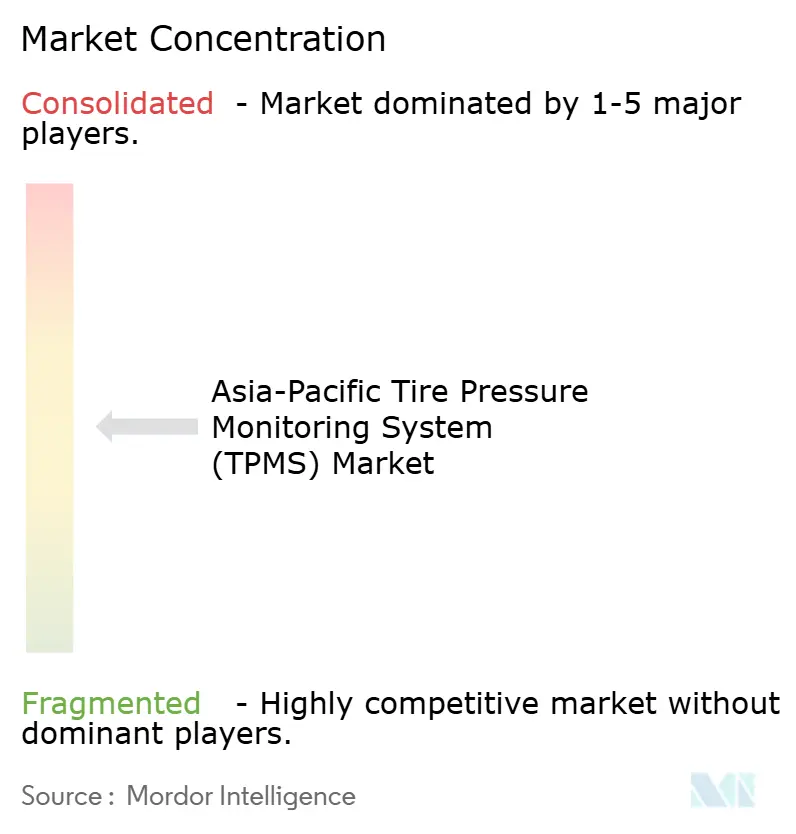
The Asia-Pacific tire pressure monitoring system market remains moderately concentrated at the top and fragmented across the mid-tier. Global Tier-1 suppliers such as Schrader, Continental, and ZF Friedrichshafen continue to dominate OEM relationships because they combine sensor design, validation support, and vehicle integration capability at scale. Asian challengers are becoming more visible, especially in China and Taiwan, where local suppliers compete through cost discipline, faster platform adaptation, and stronger presence in the replacement channel. The aftermarket side is more fragmented because brands such as CUB Elecparts, Orange Electronic, and Steelmate can win business through aggressive pricing and quicker model coverage updates. This leaves the regional structure split between a relatively defended OEM layer and a much more contested retrofit layer.
Technology strategy is now the clearest dividing line inside the Asia-Pacific tire pressure monitoring system market. Bosch used the SMP290 launch to signal a move toward BLE, stronger security, and simpler integration for connected vehicles, which improves its fit with EV-focused OEM programs. Sensata is pushing a similar direction through BLE sensors with bidirectional OTA support, which gives it a stronger service and lifecycle proposition for both OEM and replacement use. Continental's manufacturing expansion in Bangalore is another strategic move because it strengthens regional supply security and places production closer to India's new compliance-driven demand. Pacific Industrial's cap-type sensor launch shows a different path, where the competitive advantage comes from easier installation and wider retrofit reach rather than only deeper OEM integration. These moves show that product architecture, connectivity, and serviceability now matter as much as base sensor accuracy.
The competitive burden is also rising because cybersecurity and software expectations are lifting the technical floor for every supplier in the Asia-Pacific tire pressure monitoring system market. Plaintext transmission risks and secure-update expectations reduce the room for low-end producers to compete only on price when OEMs now ask for stronger compliance alignment. Even with that higher bar, white space remains open in mass-market two-wheeler systems, embedded smart-tire modules for premium EVs, and fleet products linked to AIS 140 workflows in India. No single Pan-APAC supplier clearly leads all 3 of those spaces today, which means the next phase of competition is still open. The regional market, therefore, looks stable at the top, active in the middle, and still unsettled in several high-growth niches.
Asia-Pacific Tire Pressure Monitoring System (TPMS) Industry Leaders
-
Schrader TPMS Solutions (Sensata Technologies)
-
Continental AG
-
Pacific Industrial Co., Ltd.
-
Huf Hülsbeck & Fürst GmbH & Co. KG
-
ZF Friedrichshafen AG
- *Disclaimer: Major Players sorted in no particular order
Market Opportunities and Future Outlook
Commercial-vehicle and fleet fitment creates whitespace where regulation and operational ROI overlap. China already has a dedicated technical framework for commercial-vehicle TPMS (JT/T 1429-2022 for M2/M3/N categories), and the market is also pulled by fleet-analytics offerings that convert pressure and temperature streams into maintenance actions, including Goodyear TPMS Connect and Continental ContiConnect Lite. This mix supports direct TPMS nodes that can be treated as connected devices, particularly when fleets move toward condition-based tire maintenance rather than mileage-only servicing.
Vehicle architecture changes also open opportunities for suppliers that can deliver secure, updateable sensors and gateways. BLE-enabled TPMS, as reflected in Bosch SMP290 and in single-chip BLE designs referenced in the report context, alongside CAN-FD and Automotive Ethernet integration, supports OTA calibration and diagnostics. This aligns with OEM efforts to reduce variant complexity after Japan aligned to 433 MHz in February 2025. A second demand pocket is the 2026-onward replacement cycle in China as early-mandate vehicles reach typical sensor-battery end-of-life, which lifts demand for universal programmable sensors and installer-friendly retrofit kits in the aftermarket channel.
Recent Industry Developments
- March 2026: Pacific Industrial Co., Ltd. launched its TPMS PMR-H101 tire pressure sensor in Japan. The release refreshes its OE-facing sensor lineup in a market that has been simplifying RF variants after the 433 MHz shift, supporting platform reuse across regional vehicle programs.
- April 2025: Pacific Industrial Co., Ltd. introduced an aftermarket, smartphone-integrated cap-type tire pressure monitoring sensor (PMC-0001) for passenger vehicles. The addition expands its reach beyond factory-fitment into consumer-led retrofits, aligning with rising aftermarket replacement and app-based diagnostics demand.
- June 2024: Continental expanded passenger-vehicle TPMS production in Bangalore, India, by adding a new TPMS assembly line with initial capacity of 3.3 million wheel units per year. The investment strengthens local supply for Indian OEMs and builds an export-capable hub for wider Asia-Pacific requirements.
Research Methodology Framework and Report Scope
Market Definition and Coverage
For this study, the market is defined as revenue earned from automotive tire pressure monitoring systems sold and installed across Asia Pacific, covering both factory-fit and retrofit demand and the associated system components.
Scope exclusions: We exclude non-automotive tire monitoring use cases and general tire-pressure tools that are not purpose-built TPMS for vehicles.
Segmentation Overview
- By System Type
- Direct
- Indirect
- Hybrid
- By Sensor Technology
- MEMS Capacitive
- Strain-Gauge
- Piezoelectric
- Others (Optical, SAW, etc.)
- By Fitting Method
- Valve-Stem (Snap-In and Clamp-In)
- Band / Rim-Mounted
- Embedded-Tire Module
- By Frequency Band
- 315 MHz
- 433 MHz
- ≥2.4 and UWB
- By Vehicle Type
- Passenger Cars
- Commercial Vehicles
- Two-Wheelers
- By Sales Channel
- OEM Factory-Fit
- Aftermarket Retrofit
- By Country
- China
- Japan
- India
- South Korea
- Australia
- Rest of Asia-Pacific
Data Sources, Market Sizing, and Validation
Desk Research
Desk research helped set the outer boundaries for demand and pricing, before assumptions were tested in the field. We reviewed public vehicle production and sales series, safety rule notifications, and fitment trends to understand how TPMS adoption changes by country and vehicle category.
Typical sources included government road transport and safety regulator releases (with UNECE regulation texts referenced by local authorities where applicable), national statistics offices, customs and trade portals where available, and association publications tied to automotive components and road safety. We also used company annual reports, earnings notes, investor presentations, and credible press coverage to confirm mix movements such as direct versus indirect systems and frequency band preferences. In addition, we referenced paid subscriptions for company financials and news screening, and for patent databases to track sensor design activity and adoption timing. The sources named above are illustrative only, and other public and internal references were also used for collection, clarification, and validation.
Primary Interviews and Surveys
Primary interviews and surveys were used to stress-test adoption rates, typical system pricing, and the mix shift between OEM and aftermarket across the main Asia Pacific vehicle hubs. We spoke with stakeholders across component supply, vehicle manufacturing, distribution, and service networks, and the input helped close gaps left by public data and confirm which assumptions were reasonable.
Because this is a regional market, the fieldwork covered different parts of Asia Pacific to capture country-level differences in regulation timing, fitment penetration, and replacement behavior before final totals were approved.
Distribution of primary research fieldwork respondents
| Company type | Respondent position |
|---|---|
| Top tier: 29% | CXOs: 13% |
| Mid tier: 53% | Functional/Unit leaders: 33% |
| Smaller Players: 18% | Managers: 54% |
Market-Sizing & Forecasting
The core sizing used a top-down approach in which vehicle production and parc signals were reconstructed into a TPMS demand pool, then filtered by penetration rates for factory-fit and retrofit replacement cycles. After shaping the demand pool, pricing was applied using typical system ASP ranges by vehicle type and by system type, and the country results were rolled up to Asia Pacific.
To keep the model grounded, we also ran selective bottom-up approximations using supplier and channel checks, where sampled volumes and ASPs were multiplied and compared against the country totals before finalizing. Inputs that mattered most included passenger car versus commercial vehicle production, TPMS fitment mandates and enforcement timing, direct versus indirect mix, replacement sensor cycle behavior, frequency band preferences (315 MHz and 433 MHz), and local currency movement that can shift reported USD revenue even when unit demand is steady. Where direct volume visibility was limited, gaps were handled through proxy indicators like vehicle output, installed base, and replacement rates, followed by analyst review and field validation.
For forecasting, we used scenario analysis so adoption speed, mix shift, and pricing normalization could be adjusted by country and then recombined. The scenarios were anchored in what experts described as plausible outcomes for regulation changes, OEM sourcing cycles, and sensor ASP progression across the forecast window.
Data Validation & Update Cycle
Outputs were checked through multiple passes so that large changes were not accepted without a clear demand or price driver. We compared results against independent signals such as vehicle production trends, import and export patterns for relevant parts categories, and reported capacity or shipment commentary in public disclosures.
If variance appeared at the country level, analysts revisited the penetration and ASP inputs, and follow-up conversations were used to confirm whether the change was real or driven by timing and currency translation. The report is refreshed annually, and interim updates are made when material events occur such as regulation shifts or sharp pricing changes. Before delivery, a final analyst review is completed so the client receives the most current view based on the latest available inputs.
Mordor Intelligence's Asia Pacific Automotive Tpms Market Size Compared With Other Published Estimates
Published market numbers for APAC automotive TPMS often do not match because the study boundary and the timing of pricing updates are not consistent across sources. Differences also come from how direct versus indirect systems are treated, whether two-wheelers are included, and whether the value is tied to OEM fitment only or also counts aftermarket replacement.
In refresh-led checks, the timing of currency conversion and the cadence of ASP updates can move the USD market value even when unit trends are similar, and that effect shows up in the spread below. A repeatable set of checks on OEM fitment by country, followed by replacement-cycle validation, is what keeps the annual refresh in Mordor Intelligence aligned to the demand pool rather than a single-year revenue snapshot.
Benchmark comparison
| Source | Market Size | Gaps in Research Methodology |
|---|---|---|
| Mordor Intelligence | USD 2.13 B (2025) | |
| Regional Consultancy A | USD 1.50 B (2024) | Uses an earlier base year and a simpler OEM-led view, and the pricing appears to be held broadly constant, which can understate the USD value when direct TPMS mix and ASPs rise. |
| Trade Journal B | USD 3.19 B (2023) | Likely reflects a broader scope boundary for the region, and the USD conversion timing plus a faster growth assumption can lift the starting value compared with a refreshed country-by-country ASP curve. |
Overall, the spread is mainly explained by year alignment and how pricing and scope are handled, not by a single disagreement on demand direction. By keeping the steps traceable to penetration, replacement cycles, and a refreshed ASP and currency treatment, the resulting market size stays easier to reproduce and to reconcile when assumptions are challenged.
Key Questions Answered in the Report
What is the current size of the Asia-Pacific tire pressure monitoring system market?
The Asia-Pacific tire pressure monitoring system market stood at USD 2.31 billion in 2026 and is projected to reach USD 3.51 billion by 2031, growing at 8.73% CAGR over the forecast period.
Which vehicle category contributes the most revenue in this space?
Passenger cars led with 76.85% of 2025 revenue and also showed the fastest growth at 9.68% CAGR, largely because EV adoption is strongest in this category and supports premium direct TPMS fitment.
Why is 433 MHz still the leading communication band?
The 433 MHz band held 71.31% of 2025 revenue because it offers broad installed-base compatibility, and Japan's regulatory alignment now supports wider regional standardization for future products.
Why is the aftermarket growing faster than OEM factory fitment?
OEM still dominates current revenue, but the aftermarket is growing at 10.11% CAGR because earlier direct-fit sensors are moving into battery replacement cycles and easier retrofit products are improving access.