
Market Overview
| Study Period | 2021 - 2032 |
|---|---|
| Forecast Data Period | 2027 - 2032 |
| Base Year Market Size (2026) | USD 0.91 Billion |
| Market Size (2027) | USD 1 Billion |
| Market Size (2032) | USD 1.63 Billion |
| Growth Rate (2027 - 2032) | 10.22 % |
| Market Concentration | Medium |
Major Players *Disclaimer: Major Players sorted in no particular order Image © Mordor Intelligence. Reuse requires attribution under CC BY 4.0. | |
Asia-Pacific Apheresis Market Analysis by Mordor Intelligence
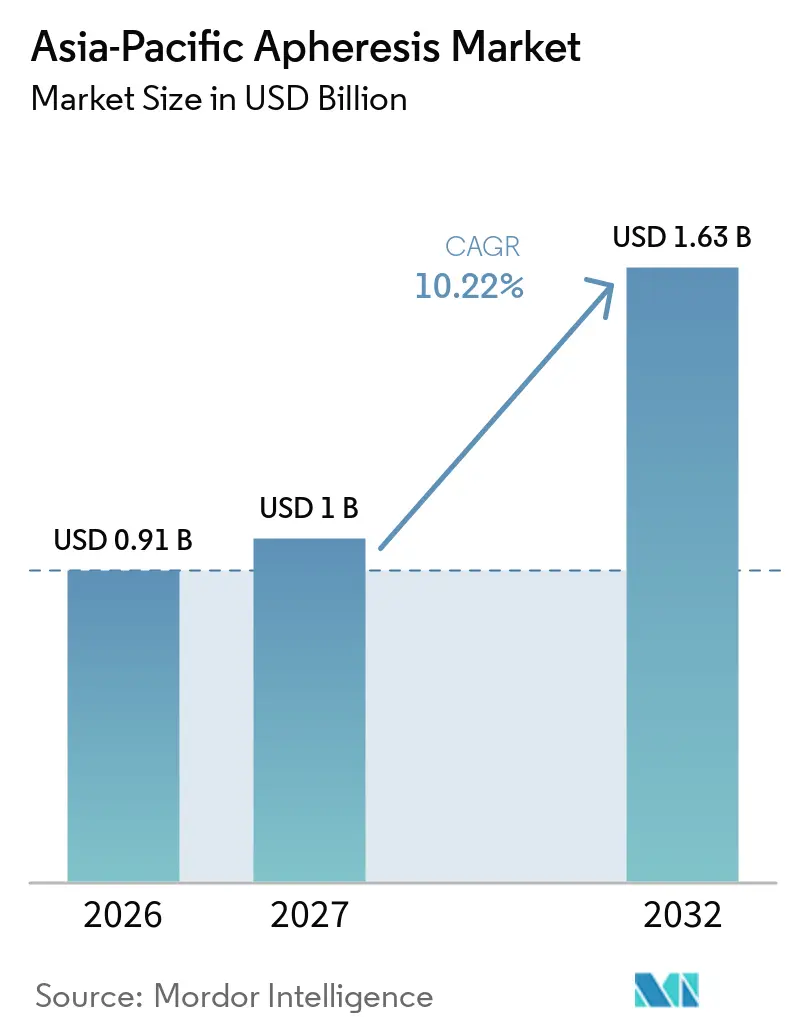
The Asia-Pacific Apheresis Market size is projected to be USD 0.91 billion in 2026, USD 1 billion in 2027, and reach USD 1.63 billion by 2032, growing at a CAGR of 10.22% from 2027 to 2032.
Rising adoption of precision cell-separation platforms that support CAR-T manufacturing, neurology protocols, and national blood-safety programs positions the Asia Pacific apheresis market for sustained double-digit expansion. China’s regulatory push for component separation, Japan’s reimbursement stability, and India’s neurology-driven demand are the dominant revenue anchors. At the same time, membrane-filtration photopheresis, single-use disposables, and outpatient specialty-clinic models are injecting fresh growth vectors. Device vendors that couple equipment placement with technologist training and local manufacturing enjoy a competitive edge as hospitals seek turnkey solutions to offset workforce and capital constraints.
Key Report Takeaways
- By product, apheresis disposables accounted for 56.02% of the Asia Pacific apheresis market in 2026; devices are the fastest-growing product segment, with a 11.46% CAGR.
- By procedure type, plasmapheresis led the Asia Pacific apheresis market with 41.67% share in 2026, while photopheresis is projected to advance at a 13.62% CAGR through 2032.
- By technology, centrifugation accounted for 67.79% of revenue in 2026, yet membrane filtration is forecast to expand at a 12.03% CAGR between 2027 and 2032.
- By application, neurology indications accounted for 28.08% in 2026; autoimmune diseases are the fastest-growing application, with a 12.65% CAGR.
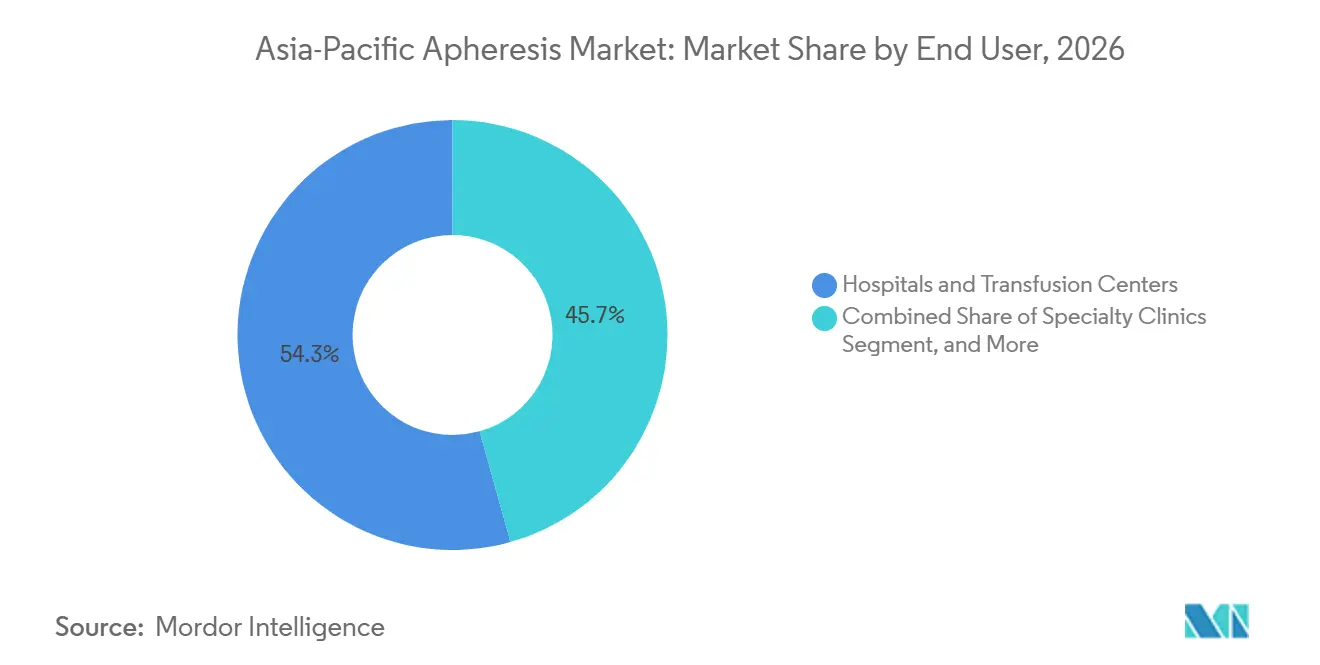
- By end user, hospitals and transfusion centers generated 54.34% 2026 revenue, but specialty clinics are slated to grow at 11.81% CAGR as lower-acuity procedures migrate to outpatient settings.
- By country, China retained 36.78% of the Asia Pacific apheresis market share in 2026; India is the fastest climber, with a 13.28% CAGR to 2032.
Note: Market numbers in this report are based on Mordor Intelligence's proprietary estimation framework, which combines nine months of actuals with Q4 projections for base year 2026.
Market Trends and Insights
Drivers Impact Analysis of Asia-Pacific Apheresis Market*
| Driver | (~) % Impact on CAGR Forecast | Geographic Relevance | Impact Timeline |
|---|---|---|---|
| Growing Prevalence of Hematologic & Autoimmune Disorders | +2.1% | India, China, Japan; spillover to Southeast Asia | Medium term (2-4 years) |
| Rising Demand for Convalescent Plasma Programs | +0.8% | Global, with early adoption in Australia, Singapore | Short term (≤ 2 years) |
| Expansion of Cell & Gene Therapy Manufacturing Hubs in APAC | +2.5% | Japan, Singapore, South Korea, China | Long term (≥ 4 years) |
| Government-Funded Blood-Safety Modernization Initiatives | +1.9% | India, China, Australia | Medium term (2-4 years) |
| Rapid Adoption of Single-Use Apheresis Disposables | +1.4% | China, India, Japan | Short term (≤ 2 years) |
| Accelerated Adoption of Advanced Plasmapheresis Technologies | +1.3% | Japan, South Korea, Australia; diffusion to India, China | Medium term (2-4 years) |
| Source: Mordor Intelligence | |||
Growing Prevalence of Hematologic & Autoimmune Disorders
Neurological autoimmune conditions are reshaping procedure volumes in India, where myasthenia gravis, Guillain-Barré syndrome, and chronic inflammatory demyelinating polyneuropathy already account for more than 60% of therapeutic plasma-exchange cases.[1] Initiating treatment within seven days of symptom onset drives functional recovery to 83%, prompting emergency departments to pre-authorize apheresis before electromyography confirmation. China’s new reimbursement for hyperviscosity syndrome and Japan’s pediatric-optimized kits are widening the addressable base, while the Southeast Asia TPE Consortium harmonizes protocols across 12 tertiary centers, boosting safety and training capacity.
Rising Demand for Convalescent Plasma Programs
The infrastructure created for COVID-19 now supports readiness for emerging infections. Australia maintains a surge capacity of 500 apheresis donations per week, which can be activated within 72 hours of a public health declaration. Japan invested JPY 2.4 billion in automated platforms that fractionate plasma into hyperimmune globulin concentrates, while China’s draft ISO 13485 guidance would harmonize quality standards and enable stockpiling agreements with Singapore. Selective collection of high-titer units via apheresis has cut downstream fractionation losses by up to 40%, demonstrating the long-term economic rationale of keeping these programs active.
Expansion of Cell & Gene Therapy Manufacturing Hubs In APAC
Japan’s conditional approval pathway has green-lit 17 regenerative therapies since 2019, each starting with leukapheresis.[2] Terumo BCT responded by fusing its Global Therapy Innovations unit with its core apheresis division to offer integrated leukapheresis-washing systems that can trim CAR-T production time from 21 to 14 days. China’s Hainan Free Trade Port now grants 15% corporate tax to firms localizing apheresis manufacture, and Singapore earmarked 40% of 2024 biomedical grants for cell-therapy projects, all of which stipulate FACT-JACIE-certified apheresis sourcing.
Government-Funded Blood-Safety Modernization Initiatives
India aims to lift component separation to 70% of total collections by 2028, budgeting INR 8.5 billion (USD 102 million) to procure 450 additional devices. China mandates at least two dual-needle systems at every blood station serving more than 500,000 residents, a move worth about USD 120 million in annual tenders. Australia tightened post-market surveillance following filter delamination events, requiring GS1 traceability for disposables and mandating upgrades to quality management systems.[3]
Restraints Impact Analysis of Asia-Pacific Apheresis Market*
| Restraint | (~) % Impact on CAGR Forecast | Geographic Relevance | Impact Timeline |
|---|---|---|---|
| High Capital Cost of Apheresis Devices | -1.8% | India, Southeast Asia; moderate impact in Chinese tier-3 cities | Short term (≤ 2 years) |
| Shortage of Trained Apheresis Nurses & Technologists | -1.5% | APAC-wide, acute in India, Indonesia, Philippines | Medium term (2-4 years) |
| Reimbursement Gaps for Therapeutic Procedures | -0.9% | India, China tier-3 cities, much of Southeast Asia | Medium term (2-4 years) |
| Supply-Chain Vulnerability for Filters & Kits | -0.7% | Global, with acute episodes in Australia, New Zealand | Short term (≤ 2 years) |
| Source: Mordor Intelligence | |||
High Capital Cost of Apheresis Devices
Equipment prices range from USD 80,000 to USD 250,000, placing them out of reach for many district hospitals where annual equipment budgets fall below USD 500,000. Pay-per-procedure models at USD 150-200 cover placement, kits, and maintenance shift costs, aligning with operating budgets and shortening payback periods, but Chinese volume-based procurement slated for 2026 could drop headline prices by 20-30%, favoring local manufacturers with Class III approvals.
Shortage of Trained Apheresis Nurses & Technologists
Only 15% of Southeast Asian tertiary hospitals retain dedicated apheresis staff, and regional training centers graduate far fewer technologists than demand dictates. Attrition remains high as trainees migrate to higher-pay dialysis roles, prompting vendor-sponsored curricula and remote-mentoring platforms that bundle education with equipment sales.
*Our forecasts treat driver/restraint impacts as directional, not additive. The impact forecasts reflect baseline growth, mix effects, and variable interactions.
Asia-Pacific Apheresis Market Segment Analysis
By Product:
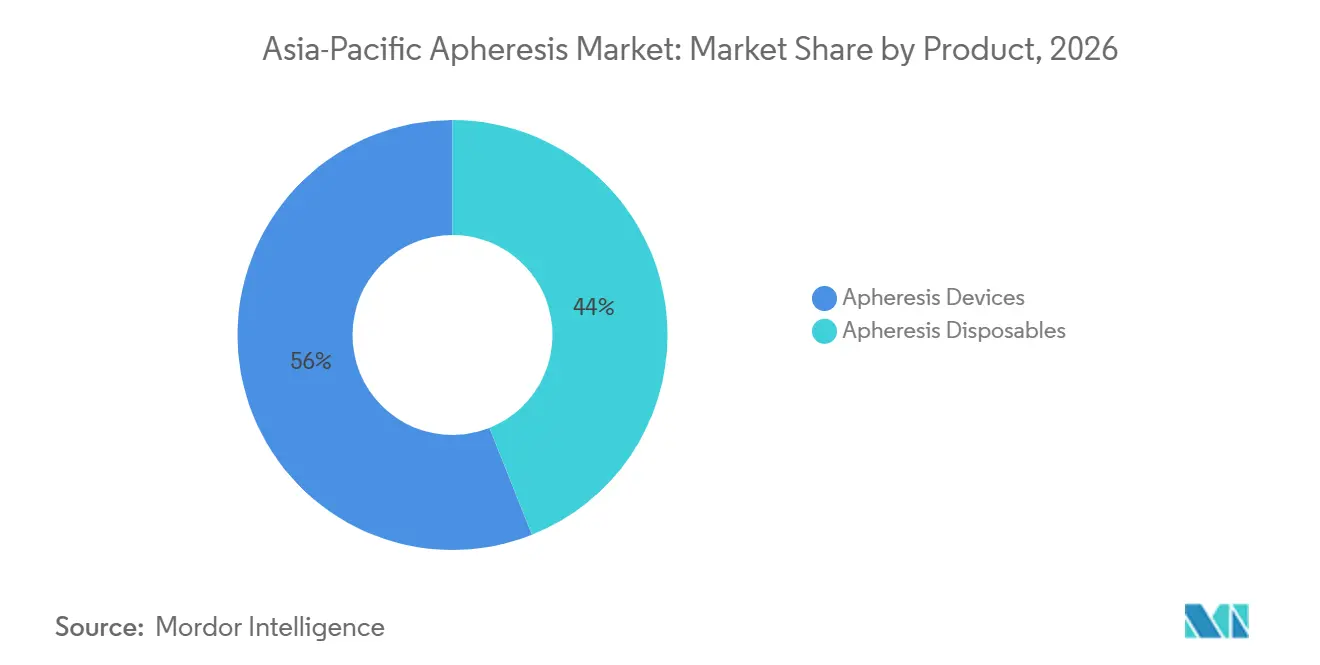
Disposables Anchor Revenue, Devices Drive GrowthDisposables accounted for 56.02% of the 2026 revenue in the Asia Pacific apheresis market, as every installed separator consumes 200-400 kits annually. Devices remain the growth engine with an 11.46% CAGR thanks to dual-mode centrifugal-membrane platforms that support photopheresis and future CAR-T workflows. Terumo BCT’s integrated leukapheresis-washing system commands 15-20% price premiums yet compresses cell-therapy production timelines by 30%, reinforcing capital-upgrade intent among high-volume centers.
Hospitals in Beijing, Shanghai, and Guangzhou report that single-use kits trimmed labor by 22 minutes per procedure, freeing scarce nurses to manage higher caseloads and directly supporting the Asia Pacific apheresis market expansion. Ped-sized 120 mL bowls from Haemonetics now enable safe collection for patients weighing less than 15 kg, carving a niche that strengthens vendor differentiation.
By Procedure Type:
Photopheresis Outpaces Legacy ModalitiesPlasmapheresis retained 41.67% procedure share in 2026, equaling roughly USD 0.34 billion of the Asia Pacific apheresis market size, underpinned by Japan’s JPY 90,000-384,000 reimbursement band. Photopheresis, however, is expanding at a 13.62% CAGR due to rising second-line use for graft-versus-host disease and new approvals for Crohn’s disease, cutaneous T-cell lymphoma, and solid-organ rejection. Inline photopheresis halves session time, making outpatient models feasible and accelerating adoption across Australia and South Korea.
Leukapheresis volumes grow in tandem with 17 approved Japanese regenerative therapies and 5 new South Korean TIL protocols, each requiring 3-5 sessions per patient. Plateletpheresis growth is capped by donor scarcity, as Japan’s eligible donor pool shrank by 8% since 2020. LDL apheresis remains a niche yet stable treatment and is dominated by Kaneka’s adsorption columns, which spare HDL and coagulation factors.
By Technology:
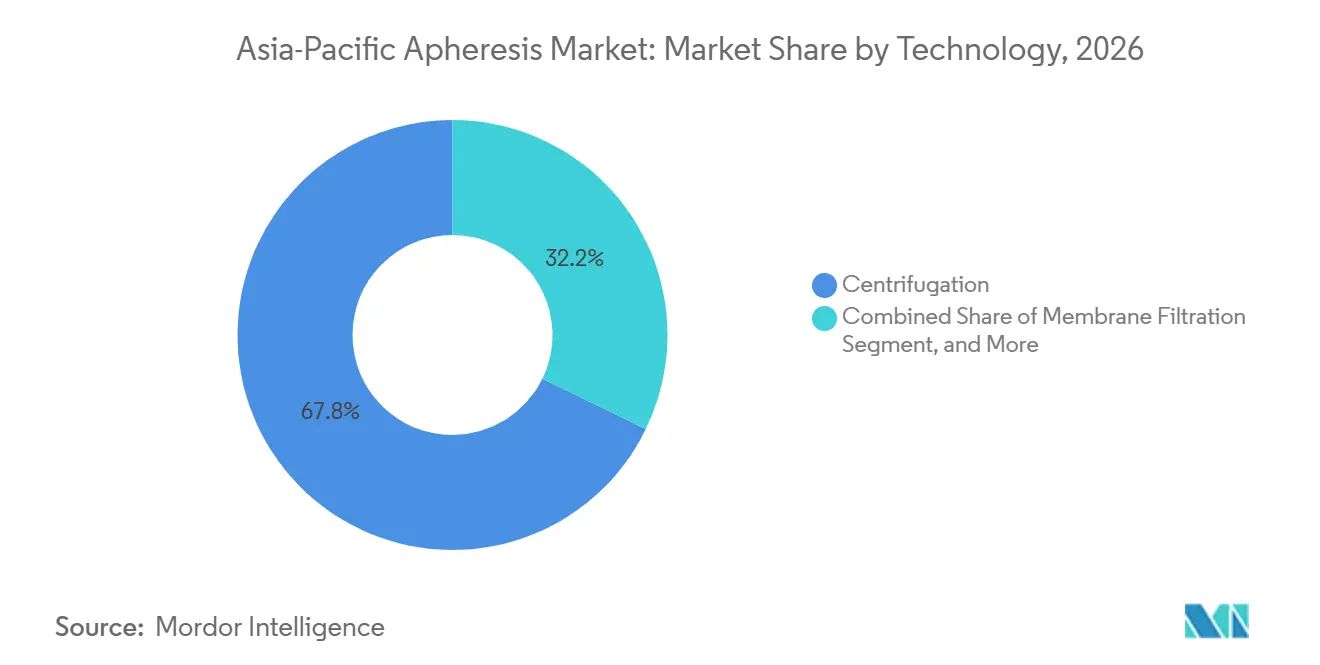
Membrane Filtration Gains on Inline EfficiencyCentrifugation still accounts for 67.79% revenue on the strength of legacy Haemonetics and Terumo fleets, yet membrane filtration is clocking a 12.03% CAGR. Fresenius Kabi’s inline Amicus-Phelix photopheresis module, already installed at 12 Japanese centers, delivers an overall response rate of 71% with just 5.9% adverse events, underscoring its clinical edge. Adsorption columns serve LDL and antibody-mediated transplant rejection, offering selective removal profiles unmatched by other technologies.
China’s forthcoming Unique Device Identification requirement forces all platforms to comply by 2026, harmonizing regulations and smoothing multicountry rollouts, which in turn bolsters Asia Pacific apheresis market penetration.

By Application:
Autoimmune Diseases Surge on Clinical EvidenceNeurology indications led with a 28.08% share in 2026, fueled by therapeutic plasma exchange for myasthenia gravis and Guillain-Barré syndrome, which achieves 83% recovery when started early. Autoimmune diseases are the fastest-growing segment, with a 12.65% CAGR, expanding beyond neurology into systemic lupus erythematosus and catastrophic antiphospholipid syndrome. Hematology remains high-value but low-volume, dominated by thrombotic thrombocytopenic purpura, where 24/7 readiness commands premium pricing.
Oncology adds a durable demand layer as every CAR-T therapy starts with leukapheresis, although donor-pool limits keep platelet collections from matching that trajectory. Renal uses grow with rising transplant activity in China and India, where 8-10% of recipients experience antibody-mediated rejection treatable by plasma exchange.
By End-user:
Specialty Clinics Capture Outpatient MigrationHospitals and transfusion centers generated 54.34% of 2026 revenue, but specialty clinics are racing ahead with a 11.81% CAGR. Outpatient models cut session costs by 30-40% by avoiding inpatient bed fees and operating with 1:4 nurse-to-patient ratios. China’s GMP update raises compliance costs for small labs, nudging lower-acuity plateletpheresis and LDL apheresis toward centralized high-volume clinics that can amortize regulatory overheads. Research institutes remain a sub-10% sliver yet drive innovation such as selective T-regulatory-cell apheresis prototypes from Japan’s RIKEN.
Geography Analysis
China Apheresis Market
China held 36.78% market share in the Asia Pacific apheresis market in 2026, propelled by a National Health Commission mandate for component separation and dual-needle acquisitions worth USD 120 million annually. The 2026 Unique Device Identification rule and domestic-content preference under volume-based procurement favor Terumo BCT’s USD 15 million Shenzhen joint venture slated for 2027 production.
Japan Apheresis Market
Japan offers predictable reimbursement—JPY 90,000-384,000 per plasmapheresis session—and quick device approval cycles that have enabled Fresenius Kabi to install inline photopheresis systems in nearly all transplant centers, trimming adverse events from 14.8% to 5.9%.
India Apheresis Market
India is expanding the fastest, at a 13.28% CAGR through 2032, underpinned by a plan to raise component separation to 70% and fund 450 new devices. Early-intervention protocols for Guillain-Barré and myasthenia gravis deliver 76-83% recovery, strengthening the clinical case for increased capacity.
Australia, South Korea and ASEAN Apheresis Market
Australia’s Therapeutic Goods Administration now requires quarterly adverse-event reporting for disposables and reimburses photopheresis at USD 950 per session, encouraging device upgrades. South Korea subsidizes membrane-filtration plasmapheresis at KRW 2.5 million, incentivizing hospitals to transition from aging centrifugal models. The rest of Asia-Pacific shows patchy adoption; Singapore mandates FACT-JACIE-certified apheresis for grant recipients, whereas Indonesia and the Philippines rely on consortium training to standardize protocols.
Regulatory Landscape
Regulation for apheresis systems and single-use kits across Asia-Pacific is shaped by country-specific device pathways, with a visible move toward traceability and quality-system upgrades. In Australia, the Therapeutic Goods Administration (TGA) is implementing Unique Device Identification (UDI) with mandatory requirements for high-risk medical devices from July 2026, and it also introduced a streamlined Consent to Supply (CtS) process tied to UDI compliance. Japan continues to rely on the Pharmaceuticals and Medical Devices Agency (PMDA) and the Ministry of Health, Labour and Welfare (MHLW) for device reviews and approvals, supporting a steady cadence of improved-device clearances and broader use of conditional registration mechanisms for selected medical devices and IVDs.
China remains the most consequential regulatory anchor for regional scaling due to its blood-safety modernization and tightening manufacturing oversight. Mandatory compliance with China’s revised Good Manufacturing Practice (GMP) for Medical Devices (Announcement No. 107 of 2025) takes effect in November 2026, directly impacting marketing authorization holders and contract manufacturers supplying apheresis-related disposables and platforms. Alongside this, regulatory reliance and convergence initiatives tracked by APACMed highlight how some markets (notably Australia, Singapore, and India) can use reference approvals to expedite registration, while local in-country representation remains a consistent market-entry requirement across major APAC jurisdictions.
Competitive Landscape
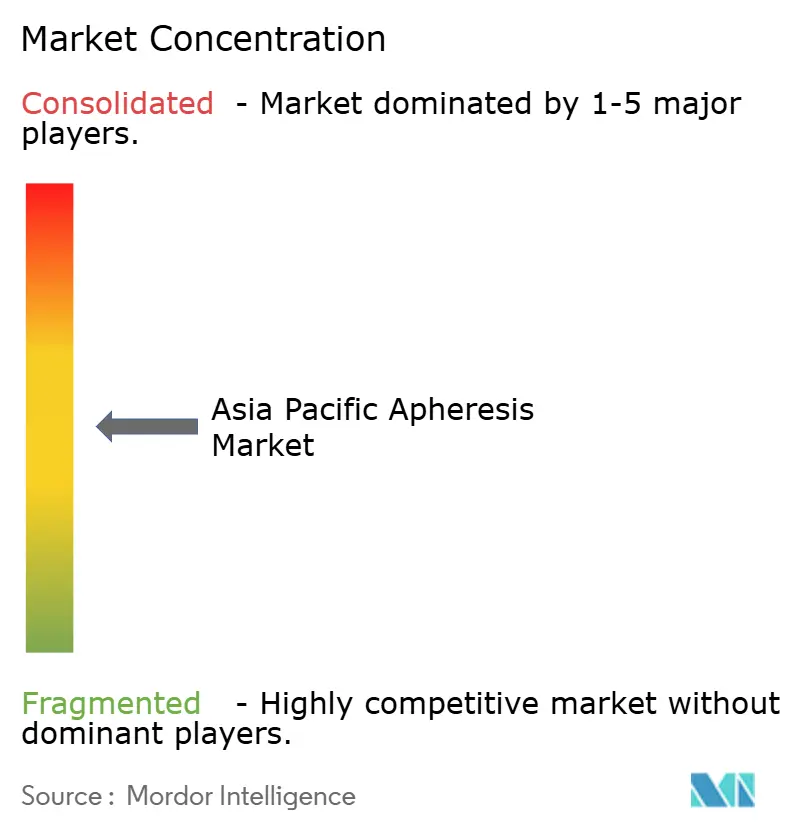
The Asia Pacific apheresis market is moderately concentrated: Terumo BCT, Haemonetics, Fresenius Kabi, Asahi Kasei, and Baxter together hold roughly 60-65% share, leaving scope for Kaneka, Nikkiso, and emerging contract-service providers. Terumo BCT’s integrated product roadmap bundles leukapheresis, washing, and photopheresis, offering a one-stop platform that resonates with CAR-T developers. Fresenius Kabi differentiates through inline photopheresis, which halves chair time and secures premium pricing.
Haemonetics’ pediatric 120 mL bowl kit strengthens its foothold in a previously underserved segment, while Asahi Kasei leverages adsorption-column know-how in LDL therapy. Contract mobile units in India have demonstrated 40% lower costs than hospital-owned setups, pressuring vendors to roll out pay-per-procedure financing. Regulatory harmonization between China’s UDI and Japan’s ISO 13485 aligns markets, cutting market-entry time for smaller players, making service and training partnerships central to defending incumbents’ market share.
Asia-Pacific Apheresis Industry Leaders
-
B. Braun Melsungen AG
-
Cerus Corporation
-
Kaneka Corporation
-
Terumo Corporation
-
Asahi Kasei Medical Co., Ltd.
- *Disclaimer: Major Players sorted in no particular order
Asia-Pacific Apheresis Market Companies Covered in this Report
- Asahi Kasei
- B. Braun
- Baxter
- Cerus
- Cytosorbents Corporation
- Fresenius
- Fresenius
- Haemonetics
- Infomed
- Kaneka
- MacoPharma
- Mallinckrodt (Therakos)
- Medica S.p.A.
- Miltenyi Biotec
- Nikkiso Co., Ltd.
- Terumo
Market Opportunities and Future Outlook
A key gap is at the intersection of therapeutic apheresis and cell and gene therapy (C>) collection, where hospitals and transfusion networks are standardizing upstream leukapheresis quality to meet advanced-therapy sourcing requirements. In March 2026, Terumo Blood and Cell Technologies launched its APAC C> Ecosystem Blueprint and tied it to regional partnerships (including GenScript and Singapore’s Advanced Cell Therapy and Research Institute, ACTRIS), reinforcing demand for integrated collection-to-processing workflows rather than standalone separator placements. This creates opportunities for vendors that bundle apheresis devices, validated disposables, training, and documentation packages aligned to cell-therapy quality expectations, particularly in Japan, Singapore, South Korea, and China, where regenerative and cell-therapy hubs are active.
A second opportunity centers on expanding access through lower-footprint service models and harmonized operating standards in Southeast Asia and other emerging APAC systems. Evidence from Malaysia indicates that in-house, neurology-driven therapeutic plasma exchange (TPE) units can be deployed in resource-limited public hospitals using both centrifugation and membrane filtration approaches, supporting capacity buildout beyond flagship tertiary centers. Regionally, the Asia Pacific Blood Network (APBN) 2025-2030 strategy emphasizes harmonizing standards and improving supply-demand matching (including use of AI), which supports more standardized procurement and interoperable consumables logistics across blood services. Disease-specific guidance also drives procedure demand: South Korea’s public health guidance recognizing TPE for cytokine removal in severe fever with thrombocytopenia syndrome (SFTS) supports institution-level protocolization and reimbursement discussions that can translate into incremental device placements and recurring kit utilization where cases concentrate.
Recent Industry Developments in Asia-Pacific Apheresis Market
- June 2026: Cerus Corporation highlighted new Asia-linked real-world evidence for its INTERCEPT Blood System at the 39th International ISBT Congress in Kuala Lumpur, including discussion of data from Thailand and bacterial contamination risk considerations in China. The update strengthens the company's positioning with regional blood centers and hospital transfusion services that are prioritizing blood safety modernization and standardized processing workflows.
- January 2025: Haemonetics Corporation completed the sale of its whole blood assets to GVS S.p.A for USD 67.8 million, including an upfront payment and potential earn-outs. The divestiture sharpened Haemonetics focus on its apheresis franchise, reinforcing investment attention on automated collection platforms and the associated disposable kit pull-through that underpins recurring revenue.
- November 2024: Terumo Blood and Cell Technologies announced a localization initiative in China with a USD 15 million investment in manufacturing in Hangzhou covering the Trima Accel Automated Blood Collection System and Spectra Optia apheresis platform. The move aligns production and supply assurance with domestic procurement and health-system priorities, supporting faster fulfillment and competitiveness in large public tenders.
Asia-Pacific Apheresis Market Report Scope and Research Methodology
Market Definition and Coverage
For this study, the Asia Pacific apheresis market is defined as the revenue generated from apheresis devices and related single-use disposables used to separate blood components for donor collection and therapeutic procedures across healthcare and research settings in the region.
Scope exclusions: We exclude whole blood collection without component separation and general blood banking equipment that is not used specifically for apheresis procedures.
Segments Covered in This Report
- By Product
- Apheresis Devices
- Apheresis Disposables
- By Procedure Type
- Plasmapheresis
- Plateletpheresis
- Leukapheresis
- LDL Apheresis
- Photopheresis
- Other Procedures
- By Technology
- Centrifugation
- Membrane Filtration
- Adsorption Columns
- By Application
- Neurology
- Hematology
- Renal Disorders
- Autoimmune Diseases
- Oncology & Cell Therapy
- Other Applications
- By End-user
- Hospitals & Transfusion Centers
- Specialty Clinics
- Blood Component Providers
- Research & Academic Institutes
- By Country
- China
- Japan
- India
- Australia
- South Korea
- Rest of Asia-Pacific
Data Sources, Market Sizing, and Validation
Desk Research
Desk work built a base understanding of procedure adoption, disease burden signals, and health system capacity across Asia Pacific, then translated those signals into workable model assumptions. We reviewed public sources such as the World Health Organization, national health ministries and statistical bureaus, customs and trade statistics portals, and publications from blood-service or transfusion medicine associations to map demand signals and system readiness.
We also used peer-reviewed medical journals for therapy guidelines and utilization cues, plus hospital and laboratory accreditation guidance where it shaped access and treatment pathways. Company annual reports, investor decks, and credible press releases were reviewed to understand product mix changes and pricing direction, and a paid subscription focused on company financials and news supported cross-checks on disclosures and timeline events. These desk sources are illustrative, and other public materials were also used for data collection, validation, and clarification during the research.
Primary Interviews and Surveys
Primary interviews and structured surveys were conducted with hospital transfusion teams, blood component providers, specialty clinics, and distribution partners across key Asia Pacific countries. The interviews were used to validate procedure mix, average replacement cycles, consumable usage per procedure, and realistic pricing bands, then to check whether the desk assumptions held across different care settings.
Distribution of primary research fieldwork respondents
| Company type | Respondent position |
|---|---|
| Top tier: 33% | CXOs: 19% |
| Mid tier: 46% | Functional/Unit leaders: 23% |
| Smaller Players: 21% | Managers: 58% |
Market-Sizing & Forecasting
Sizing started with a top-down build where procedure demand pools were reconstructed using disease prevalence cues, treated population estimates, and country-level healthcare capacity indicators, then converted into device and disposable demand. To keep the model operational, we focused on repeatable inputs such as apheresis procedure volumes by major therapy area, installed base and utilization per device, average disposables used per procedure, replacement and service patterns, and country-level pricing and reimbursement signals.
Once the output was formed, we checked it using selective bottom-up approximations, including channel checks on sampled average selling prices multiplied by indicative volumes, and supplier-level rollups for major product categories. Adjustments were made when gaps were explained by access constraints or uneven adoption. When direct volume signals were limited for a country, proxy indicators such as tertiary hospital counts, blood center density, and import patterns for relevant consumables were used, then calibrated through primary feedback.
For forecasting, we applied scenario analysis supported by simple regression-style relationships between procedure growth and drivers such as aging trends, oncology and autoimmune treatment intensity, plasma fractionation activity, and expansion of specialized care centers. The final forecast was refined after experts confirmed the most likely pace of technology shift between centrifugation and membrane-based systems, and the expected direction of pricing in local currency terms.
Data Validation & Update Cycle
Outputs were cross-checked against independent signals, including procedure trend commentary, trade movement direction for key consumables, and reported capacity additions at hospitals and blood centers. We reviewed the results for any spikes that did not align with on-the-ground adoption.
If large variances appeared by country or procedure type, selected respondents were re-contacted to confirm whether the change reflected real adoption or a modeling assumption. Before sign-off, a second analyst reviewed key inputs, calculations, and conversion logic, followed by a final consistency pass across all segments so totals reconcile cleanly. Reports are refreshed annually, and interim updates are made when material policy, reimbursement, or supply events change demand or pricing, with a last check run before delivery so clients get the most current view supported by available information.
Mordor Intelligence's Asia Pacific Apheresis Market Size Versus Other Published Estimates
Published market sizes for Asia Pacific apheresis often differ because authors use different procedure coverage, treat pricing differently, and anchor the base year to different healthcare conditions. Even small methodological choices, such as counting service revenue or bundling adjacent blood collection items, can shift the total when scaled across multiple countries.
Some external estimates appear to bundle broader blood collection and transfusion equipment, and they may also apply a more aggressive long-range growth curve without re-checking procedure mix shifts by country. In Mordor Intelligence modeling, we count only apheresis-specific devices and single-use disposables tied to defined procedures, and the 2025 value is kept aligned to validated procedure adoption, technology split, and local pricing bands before extending the forecast.
Benchmark comparison
| Source | Market Size | Gaps in Research Methodology |
|---|---|---|
| Mordor Intelligence | USD 0.82 B (2025) | |
| Regional Consultancy A | USD 0.37 B (2024) | Uses an earlier base year and extends the forecast horizon further, which can understate the current market if procedure adoption accelerated after 2024. Country coverage and pricing normalization are less transparent, and service versus product revenue treatment is not clearly separated. |
| Global Consultancy B | USD 1.98 B (2022) | Anchors to a much older base year and appears to include a wider set of therapeutic and transfusion related equipment categories, which can inflate the addressable pool beyond apheresis-specific systems. The approach also relies on broad regional averages for pricing and utilization, which can overstate totals in lower access countries. |
The spread in the table mainly comes from what gets counted within apheresis and how quickly older base-year assumptions are allowed to carry forward. By sticking to procedure-linked demand drivers and checking pricing and utilization with multiple respondent types, the estimate stays traceable to clear inputs and can be repeated when new country data becomes available.
Key Questions Answered in the Report
How fast is CAR-T manufacturing growth increasing device demand in Asia Pacific apheresis market?
Leukapheresis volumes linked to 17 Japanese approvals and new South Korean TIL protocols are driving double-digit equipment utilization increases through 2032.
Which application area is the quickest to expand?
Autoimmune diseases are advancing at a 12.65% CAGR on strong evidence for early plasma exchange in neurology and expanding use in systemic lupus and antiphospholipid syndrome.
Why are single-use disposables gaining ground over reusable bowls?
China’s 2026 GMP update raised cleaning-validation costs, and single-use kits cut labor time by 22 minutes per procedure while mitigating cross-contamination risk.
What limits plateletpheresis growth despite stable demand?
Donor-pool shrinkage, especially in aging Japan, constrains collection capacity even as oncology support needs persist.
How does volume-based procurement in China affect equipment pricing?
Centralized tenders expected from 2026 could shave 20-30% off list prices, benefiting local manufacturers and hospitals upgrading legacy fleets.