
Articulated Robot Market Size and Share
Market Overview
| Study Period | 2020 - 2031 |
|---|---|
| Market Size (2026) | USD 30.56 Billion |
| Market Size (2031) | USD 57.63 Billion |
| Growth Rate (2026 - 2031) | 13.52 % |
| Fastest Growing Market | South America |
| Largest Market | Asia Pacific |
| Market Concentration | Medium |
Major Players *Disclaimer: Major Players sorted in no particular order Image © Mordor Intelligence. Reuse requires attribution under CC BY 4.0. | |
Articulated Robot Market Analysis by Mordor Intelligence
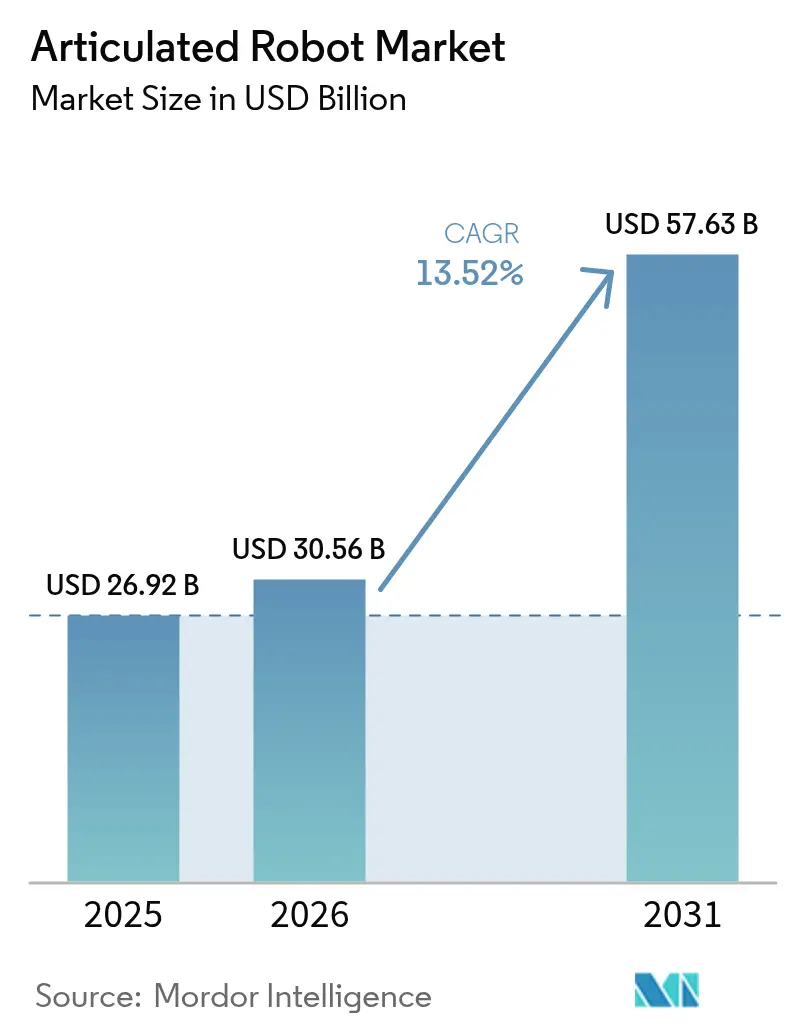
Articulated Robot Market size in 2026 is estimated at USD 30.56 billion, growing from 2025 value of USD 26.92 billion with 2031 projections showing USD 57.63 billion, growing at 13.52% CAGR over 2026-2031. Surging demand for smart manufacturing solutions, sovereign production policies, and AI-enabled collaborative systems underpin this expansion. Intensifying capital expenditure in electric-vehicle production, sustained warehouse automation roll-outs by e-commerce majors, and growing precision-oriented food applications further reinforce momentum. Meanwhile, component makers are responding to semiconductor and servo-motor bottlenecks with vertical-integration strategies, and energy-efficient robotic designs are gaining traction as users chase lower operating costs. Competitive strategies are bifurcating: incumbents such as ABB pursue structural spin-offs to sharpen focus, while start-ups leverage cloud-connected platforms to shorten deployment times.
Key Report Takeaways
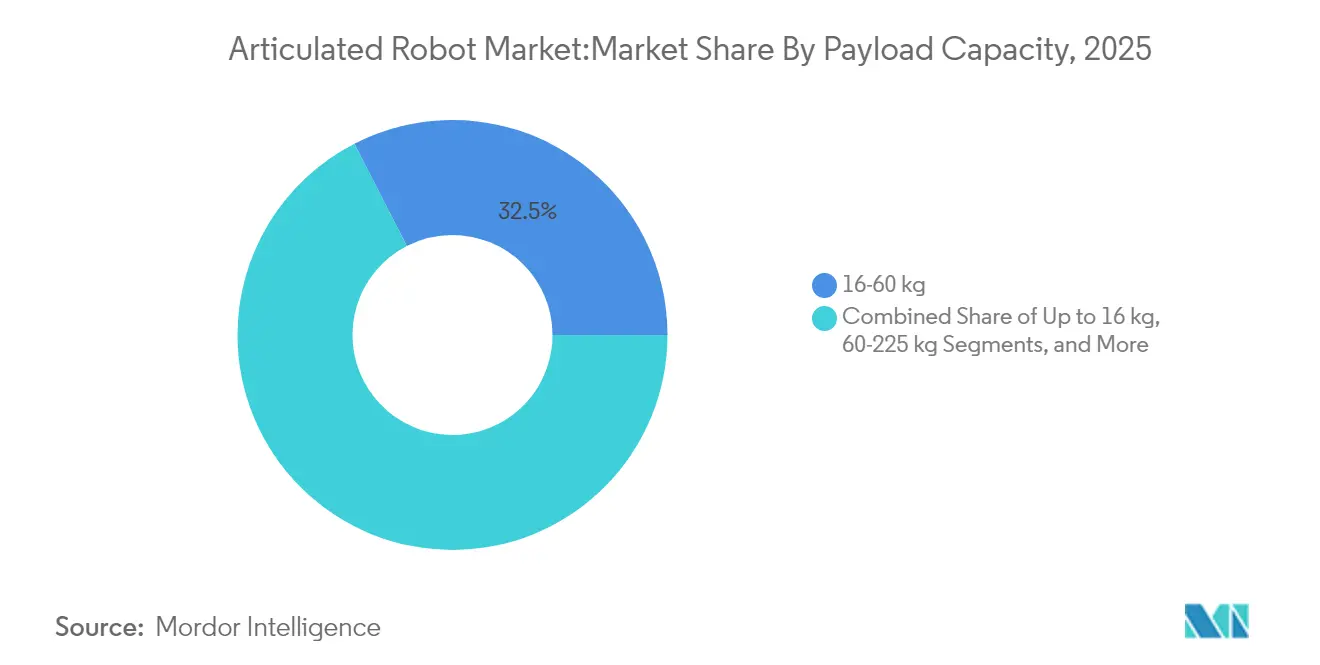
- By payload capacity, the 16–60 kg segment led with 32.54% of articulated robot market share in 2025, whereas robots up to 16 kg are projected to post the fastest 15.42% CAGR through 2031.
- By axis type, 6-axis systems controlled 51.35% revenue in 2025, yet 7-axis and above configurations are forecast to expand at a 15.98% CAGR during 2026–2031.
- By application, material handling commanded 28.96% of articulated robot market size in 2025, while packaging and palletizing should accelerate at a 15.18% CAGR to 2031.
- By end-user industry, food and beverages accounted for 24.78% share of the articulated robot market size in 2025; automotive is expected to grow the fastest at 15.71% CAGR through 2031.
- By geography, Asia-Pacific held 42.05% of 2025 revenue, whereas South America is poised to record the highest 14.86% CAGR to 2031.
Note: Market size and forecast figures in this report are generated using Mordor Intelligence’s proprietary estimation framework, updated with the latest available data and insights as of 2026.
Market Trends and Insights
Drivers Impact Analysis of Articulated Robot Market*
| Driver | (~) % Impact on CAGR Forecast | Geographic Relevance | Impact Timeline |
|---|---|---|---|
| Shift toward Industry 4.0-led automation | +2.8% | Global (APAC, Europe lead) | Medium term (2-4 years) |
| Rising labor cost and skilled-worker shortage | +3.2% | North America, EU, APAC hubs | Short term (≤ 2 years) |
| Government incentives for smart manufacturing | +1.9% | Primarily APAC | Long term (≥ 4 years) |
| Automotive e-mobility cap-ex boom | +2.1% | Global EV clusters | Medium term (2-4 years) |
| AI-enabled adaptive articulated cobots | +1.7% | North America and EU early adoption, APAC scale deployment | Long term (≥ 4 years) |
| Fulfilment-center automation by e-commerce majors | +1.5% | Global (North America, Europe lead) | Short term (≤ 2 years) |
| Source: Mordor Intelligence | |||
Shift toward Industry 4.0-led automation
Manufacturers are linking articulated robots with AI analytics and IoT sensors to create closed-loop production ecosystems that self-optimise quality, uptime, and energy consumption. Foxconn’s lights-off sites cut headcount by 150,000 yet sustained output by embedding predictive-maintenance algorithms in robotic workcells. Xiaomi’s 24/7 smartphone facility demonstrates the scalability of such dark-factory models. These deployments shift automation economics from manpower substitution to product-mix agility, enabling rapid re-tooling for customised lots and variant introductions.
Rising labor cost and skilled-worker shortage
Robot operating costs of USD 1.60–2.00 per hour now undercut human wages exceeding USD 5.50 in many regions, tilting ROI calculations decisively toward automation. General Motors and John Deere trimmed welding labor expenses by 50% and defects by 25% after adopting robotic welding cells. Warehouse operators such as GXO Logistics have turned to Apollo humanoids to bridge head-count gaps while improving safety metrics. Ageing demographics in Europe and East Asia anchor this driver for the long term.
Government incentives for smart manufacturing
Subsidies and tax abatements for Industry 4.0 upgrades in China, South Korea and India are catalysing articulated robot market adoption. Singapore’s Enterprise Development Grants reimburse up to 50% of automation project costs, while Japan’s subsidies cover system-integration expenses, smoothing the path for SMEs. Brazil’s Finame credit line supports local robotics purchases, underpinning South America’s rapid growth trajectory. These programmes typically target multi-year horizons, enhancing investment visibility for vendors and users.
Automotive e-mobility cap-ex boom
EV assemblers require highly flexible robots for battery module handling and lightweight material joining. Hyundai Motor Group’s USD 21 billion US programme includes Boston Dynamics collaboration to scale next-generation articulated systems. [1]Steve Crown, “Hyundai Motor Group commits to U.S. growth with USD 21 billion investment,” Hyundai Motor Group, hyundaimotorgroup.com ABB’s Auburn Hills facility upgrade focuses on EV-specific paint and sealing cells, signalling supplier alignment to this cap-ex wave. As global EV output rises, demand for robots with high repeatability and battery-safe cleanliness standards is set to intensify.
Restraints Impact Analysis of Articulated Robot Market*
| Restraint | (~) % Impact on CAGR Forecast | Geographic Relevance | Impact Timeline |
|---|---|---|---|
| High upfront acquisition and integration cost | -2.1% | Global, hits SMEs hardest | Short term (≤ 2 years) |
| Scarcity of system-integration talent | -1.8% | North America and EU, expanding to APAC | Medium term (2-4 years) |
| Cyber-security risk in connected robot controllers | -1.3% | Global, with heightened concern in critical infrastructure | Long term (≥ 4 years) |
| Servo-motor and semiconductor supply bottlenecks | -1.9% | Global, APAC concentration | Short term (≤ 2 years) |
| Source: Mordor Intelligence | |||
High upfront acquisition and integration cost
Total cost of an articulated robot cell can double once integration, safety equipment, and training are included, discouraging smaller enterprises. Latin American SMEs cite limited access to integrators and finance as key barriers to adoption. Robots-as-a-Service models mitigate this restraint by converting cap-ex into opex; Formic reported 200,000 contracted production hours at 99.8% uptime, highlighting investor appetite for pay-per-use automation.
Servo-motor and semiconductor supply bottlenecks
Chip-set lead times and rare-earth magnet shortages continue to disrupt robot deliveries. Despite easing constraints, analysts expect full normalization only by early 2025. Potential Chinese restrictions on titanium and heavy rare-earth exports pose downside risk, pressuring Western OEMs to diversify supply chains or pursue vertical integration.
*Our forecasts treat driver/restraint impacts as directional, not additive. The impact forecasts reflect baseline growth, mix effects, and variable interactions.
Articulated Robot Market Segment Analysis
By Payload Capacity:
Lightweight Precision Drives GrowthThe ≤ 16 kg class is projected to outpace all others at a 15.42% CAGR on the back of electronics, pharma, and collaborative deployments, whereas the 16–60 kg segment retained 32.54% of articulated robot market share in 2025. Users favour lighter platforms for speed, energy thrift, and human-adjacent safety. Freedom Fresh Australia’s macadamia line runs 0.39-second cycles with a lightweight SCARA unit, underscoring productivity gains in food packing. Energy-efficiency pressures are driving material innovations: carbon-fibre arms from Cognibotics cut consumption by 90% while maintaining rigidity.
Demand for 60–225 kg and > 225 kg robots remains stable in automotive body-shop and foundry tasks, yet growth decelerates as OEMs sweat installed assets rather than expand footprint. High-payload arms increasingly integrate shape-memory alloy grippers that slash pneumatic energy use by 90%. Over 2026-2031, the articulated robot market size for heavy-duty classes is forecast to expand at single-digit rates, supported by EV battery pack lifting and wind-turbine component handling.



By Axis Type:
Advanced Configurations Gain MomentumSix-axis models captured 51.35% of revenue in 2025, anchoring the articulated robot market as the de-facto workhorse for welding, painting and precision assembly. Cost points now span under USD 5,000 for light units to beyond USD 500,000 for clean-room variants. Modular controllers are shrinking installation footprints, a boon for SMEs with space constraints.
Seven-axis and hyper-dexterous formats are the fastest-rising niche, charting a 15.98% CAGR. Yamaha’s YA series elbows rotate around confined fixtures, enabling shorter takt times in dense production cells. Parallel-topology robots studied by MDPI promise higher stiffness-to-weight ratios for pick-and-place cycles. As automotive interiors grow more complex and consumer electronics trend toward miniaturisation, demand for extra axes to navigate tight envelopes will intensify.
By Application:
Packaging Automation AcceleratesMaterial handling remained the largest application in 2025, accounting for 28.96% of the articulated robot market size amid rising warehouse mechanisation. Yet, packaging and palletising cells are tipped to surge at a 15.18% CAGR as omni-channel retailers seek faster fulfilment. Cognibotics’ HKM1800 executes over 2,000 cycles per hour for e-commerce parcel sorting, highlighting throughput advantages.
Welding and soldering lines stay relevant for EV chassis and battery busbar joins. Inspection stations increasingly use AI-vision to detect micro-defects: automated pharma pack lines now scan 7,200 vials per hour versus 2,000 manually. Specialty deployments include nuclear-plant thickness checks where robots function in 80 °C, 95% humidity environments.

By End-user Industry:
Food Sector Leads AdoptionFood and beverages seized 24.78% of the articulated robot market share in 2025 on the back of safety, hygiene, and labour-scarcity priorities. Tasteful Selections’ potato bagging line uses FANUC delta robots and soft grippers to cut waste and lost-time injuries. Heineken’s bottle-picking robot improved operator ergonomics while sustaining belt speeds.
Automotive lines are poised for the fastest 15.71% CAGR as EV modules demand high-precision adhesive dispensing and torque-controlled fastening. Electronics assemblers harness cobots for connector placements, gaining 25% line-speed lifts with Marelli’s implementation. Medical-device plants, metals shops, and logistics operators round out demand, together underpinning articulated robot industry diversification.
Geography Analysis
APAC Articulated Robot Market
Asia-Pacific retained its dominance with 42.05% revenue in 2025, propelled by China’s scale and Japan’s innovation ecosystems. Regional governments fund lighthouse projects that accelerate SME uptake, stabilising articulated robot market size gains even as domestic wage growth tempers cost advantages. Japan’s Robot Tax Credit and Korea’s AI Voucher Scheme keep pipeline activity robust.
South America Articulated Robot Market
South America is forecast to grow the fastest at 14.86% CAGR through 2031, underwritten by foreign direct investments in automotive electrification and agri-automation. Brazil’s SOLIX field robot shows how AI vision extends articulated design into open-field crop management. Case IH’s USD 20 million Sorocaba upgrade embeds AI to command 90% harvester functions, demonstrating regional appetite for advanced robotics.
North America and EMEA Articulated Robot Market
North America posted 12% year-on-year installation growth in 2024—totaling 44,303 units—supported by federal reshoring incentives and EV supply-chain projects. Europe faces energy-price headwinds yet invests in local capacity; Yaskawa’s EUR 31.5 million Slovenian hub will localise 80% of EMEA robot deliveries by 2027. The Middle East and Africa remain nascent but attract pilots in construction and petrochemical maintenance, laying the groundwork for long-run articulated robot market adoption.


Regulatory Landscape
Industrial articulated robots are governed primarily through machinery safety standards and product-safety frameworks rather than robotics-specific statutes. ISO 10218-1:2025 and ISO 10218-2:2025, which cover industrial robot safety requirements for robot and robot system integration, are key global anchors. Recent updates focus on risk reduction for integration and include cybersecurity considerations, along with clearer guidance for collaborative operation and manual load/unload procedures.
In the European Union, regulatory treatment of AI embedded in industrial machinery continues to be clarified. As of May 2026, a provisional approach discussed by EU legislators steers AI-enabled machinery toward compliance under the EU Machinery Regulation (2023/1230) rather than duplicative coverage under the EU AI Act. The European Commission is empowered to adjust Annex III via delegated acts to address AI-related safety requirements. In the United States, trade-policy uncertainty remains a factor for robot pricing and sourcing, with the National Association of Manufacturers (NAM) submitting opposition in October 2025 to potential Section 232 tariffs affecting robotics and industrial machinery imports.
Value Chain Analysis
The articulated robot value chain begins with upstream component ecosystems supplying servomotors and drives, controllers, reducers, sensors, cabling, and vision systems, followed by OEM design and manufacturing of robot arms and factory-installed controllers. Midstream value creation centers on system integration, where integrators and OEM solution teams design workcells (safety systems, end-of-arm tooling, conveyors, vision, and software) and tailor deployments to applications such as welding, palletizing, dispensing, and inspection. This integration layer is also where shortages of system-integration talent and long commissioning cycles can constrain throughput.
Downstream, distribution, field service, and lifecycle support (spares, preventive maintenance, and software updates) influence realized uptime and fleet expansion across multi-site manufacturers and logistics operators. Recent supply-chain strategies show OEMs and users tightening partnerships and local capability: Yaskawa completed construction of Robot Plant No. 5 in October 2025 to support more integrated production of AC servos and robots, while Kawasaki Robotics signaled a 2026 consolidation of a service and engineering base in Nagoya to strengthen local engineering support and co-creation. Large end-user programs are increasingly structured around deployment partnerships rather than one-off purchases, including DHL Group signing an agreement in May 2025 with Boston Dynamics for global deployment of more than 1,000 additional Stretch robots.
Competitive Landscape
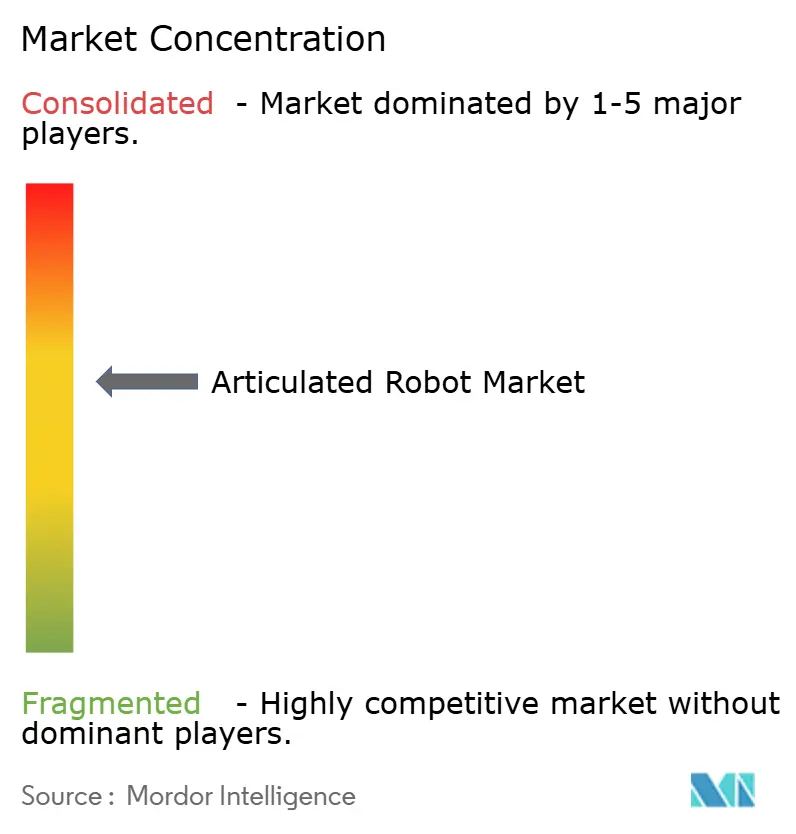
The articulated robot market features a moderately concentrated field where the top five incumbents—ABB, FANUC, Yaskawa, KUKA, and Kawasaki—control an estimated 55–60% of shipments. ABB’s decision to spin off its USD 2.3 billion robotics arm in 2026 aims to sharpen capital allocation and talent attraction. [3]Peter Campbell, “ABB Q1 profit beats forecasts as company announces robotics spin-off,” Reuters, reuters.com FANUC continues to widen its delta-robot range for high-hygiene sectors, while Yaskawa scales European assembly to compress lead times.
Chinese OEMs now account for 52% of global installations, leveraging domestic demand and vertically integrated supply chains to undercut pricing. Start-ups such as RoboForce target niche gaps with 1 mm-accuracy arms guided by spatial AI, attracting USD 10 million in seed funding. Formic’s pay-per-output service model appeals to risk-averse SMEs, signalling a business-model pivot from product to uptime value.
Technology raceways focus on AI-driven adaptability and energy efficiency. Patent filings for obstacle-recognition algorithms are rising, with AI Inc. securing a US patent for comprehensive 3-D workspace mapping. Energy-saving grippers and carbon-fibre arms demonstrate how vendors combine hardware and software innovation to trim total cost of ownership, converging toward ‘net-zero factory’ aspirations.
Articulated Robot Industry Leaders
ABB Ltd.
FANUC Corporation
Yaskawa Electric Corp.
KUKA AG
Kawasaki Heavy Industries Ltd.
- *Disclaimer: Major Players sorted in no particular order
Articulated Robot Market Companies Covered in this Report
- ABB Ltd.
- FANUC Corporation
- Yaskawa Electric Corp.
- KUKA AG
- Kawasaki Heavy Industries Ltd.
- Mitsubishi Electric Corp.
- Nachi-Fujikoshi Corp.
- DENSO Corp.
- Seiko Epson Corp.
- Stäubli International AG
- Hyundai Robotics Co., Ltd.
- Comau SpA
- Omron Adept Technology Inc.
- Universal Robots A/S
- Dürr AG (Paint Robots)
- Estun Automation Co., Ltd.
- SIASUN Robot & Automation Co.
- JAKA Robotics Ltd.
- Techman Robot Inc.
- Precise Automation Inc.
- CMA Robotics SpA
- Güdel Group AG
- IAI Corporation
- Aubo Robotics Inc.
- Robot Industrial Association (RIA)

Market Opportunities and Future Outlook
A key whitespace sits at the intersection of industrial articulated arms and AI-assisted deployment. Users want faster commissioning and broader task flexibility without specialist programming. Industry initiatives and public roadmaps point to the technical direction, including Henrik I. Christensen (UCSD), who published a global robotics technology roadmap in June 2026 emphasizing cross-cutting advances in perception, sensing, soft robotics, and materials that align with articulated-arm use cases in variable-item handling and higher-mix assembly.
In parallel, IT/OT convergence highlighted by the International Federation of Robotics in 2026 supports demand for robots that integrate more cleanly with plant data stacks and production systems. In this context, connectivity, cyber-aware controllers, and fleet-level observability are becoming purchase criteria rather than add-ons. On the adoption side, the report context points to ongoing multi-country support for smart manufacturing upgrades, including Singapore Enterprise Development Grants (up to 50% reimbursement for automation project costs), Japanese subsidies covering system-integration expenses for SMEs, and Brazil Finame credit supporting local robotics purchases. Demand is also concentrated in packaging-intensive food operations and EV-related manufacturing cells for hygienic handling, palletizing, adhesive dispensing, and battery-module handling. Business-model innovation remains a practical lever for cost-sensitive adopters, with Robots-as-a-Service platforms (such as Formic, which reported surpassing 200,000 production hours in January 2025) lowering barriers by converting upfront cell costs into uptime-linked operating fees.
Recent Industry Developments in Articulated Robot Market
- July 2026: Kawasaki Robotics expanded collaboration with Dexterity Inc. to scale warehouse-logistics automation using the RL030N 8-degree-of-freedom robot arm platform. The collaboration highlights a shift toward higher-dexterity articulated platforms and partner-built autonomy stacks for trailer loading and other dynamic material-handling environments.
- June 2026: Yaskawa Electric demonstrated a deformable object manipulation system for wire harness handling using SoftBank's AI Data Center GPU Cloud as a development platform for Physical AI. The demonstration links scalable AI compute with robot control to address non-rigid assembly tasks.
- March 2026: South Korea's trade authorities imposed final anti-dumping duties of 17.45% to 19.85% on certain imported industrial vertical articulated robots. The decision can reshape pricing and sourcing strategies for affected manufacturers and buyers within Korea, increasing urgency around localization, channel adjustments, and compliance planning.


Articulated Robot Market Report Scope and Research Methodology
Market Definition and Coverage
This market covers revenues generated from newly manufactured articulated industrial robots, meaning multi-axis robotic arms with three to seven rotary joints, along with their factory-installed controllers, sold for industrial tasks like welding, painting, assembly, palletizing, and pick-and-place.
Scope exclusions: The sizing excludes SCARA, delta, and gantry robots, and it also excludes rentals, refurbishment services, and spare parts sales.
Segments Covered in This Report
- By Payload Capacity
- Up to 16 kg
- 16 – 60 kg
- 60 – 225 kg
- Above 225 kg
- By Axis Type
- 4-Axis
- 5-Axis
- 6-Axis
- 7-Axis and Above
- By Application
- Material Handling
- Welding and Soldering
- Assembly
- Painting and Dispensing
- Packaging and Palletizing
- Inspection and Quality Assurance
- Others
- By End-user Industry
- Automotive
- Electrical and Electronics
- Metals and Machinery
- Pharmaceutical and Medical Devices
- Food and Beverages
- E-commerce and Logistics
- Other End-User Industries
- By Geography
- North America
- United States
- Canada
- Mexico
- South America
- Brazil
- Argentina
- Chile
- Rest of South America
- Europe
- Germany
- United Kingdom
- France
- Italy
- Spain
- Russia
- Rest of Europe
- Asia-Pacific
- China
- India
- Japan
- South Korea
- Singapore
- Malaysia
- Australia
- Rest of Asia-Pacific
- Middle East and Africa
- Middle East
- United Arab Emirates
- Saudi Arabia
- Turkey
- Rest of Middle East
- Africa
- South Africa
- Nigeria
- Egypt
- Rest of Africa
- Middle East
- North America
Data Sources, Market Sizing, and Validation
Desk Research
Desk research was used to set the boundaries, establish initial demand signals, and anchor the model to public data series that can be tracked year over year. The work drew on sources such as International Federation of Robotics releases, UN Comtrade trade statistics for robotics-related categories, World Bank and OECD manufacturing indicators, and US Census Bureau industrial production and shipments data where relevant. Safety and product context were also checked using standards and guidance from bodies such as ISO and NIST, since articulation, axis count, and industrial use cases can otherwise get mixed in public writeups.
In parallel, company filings, annual reports, investor presentations, and credible press coverage were reviewed to understand pricing direction, backlogs, and capacity expansion notes that influence shipment timing. Where needed, paid database subscriptions were used for company financials and intelligence, news and financials, and patent databases to sanity check technology shifts that can move average selling prices (ASP) over time. The desk sources listed above are illustrative, and additional public materials were also reviewed for data collection, validation, and clarification.
Primary Interviews and Surveys
Primary interviews and surveys focused on validating what was visible in public data and filling gaps around shipment mix, controller bundling, and ASP progression by payload and axis configuration. We spoke with a balanced set of stakeholders across the value chain, including robot manufacturers, component ecosystem participants, system integrators, and end-user manufacturing teams. Coverage across APAC, EMEA, and the Americas was kept, so regional adoption cycles were not smoothed away. The respondent inputs were then used to confirm assumptions, flag outliers, and tighten the final market totals.
Distribution of primary research fieldwork respondents
| Company type | Respondent position | Region |
|---|---|---|
| Top tier: 38% | CXOs: 13% | APAC: 40% |
| Mid tier: 40% | Functional/Unit leaders: 42% | EMEA: 36% |
| Smaller Players: 22% | Managers: 45% | Americas: 24% |
Market-Sizing & Forecasting
Sizing starts with a top-down build that reconstructs demand from industrial automation adoption and manufacturing output signals, then translates that demand pool into articulated-robot revenue using shipment and pricing logic. Key inputs include industrial robot installation trends, manufacturing production indices, automotive and electronics capex cycles, factory automation penetration in discrete manufacturing, and typical replacement and upgrade timing for robot cells. Because articulated robots are frequently purchased as part of a broader automation project, the model also checks lead-time changes and controller inclusion practices to avoid overstating revenues.
After forming the top line, selective bottom-up approximations are used to corroborate the total, including sampled ASP multiplied by implied unit volumes, channel checks with integrators on project sizes, and a roll-up of visible revenue exposure from major suppliers where disclosures allow. When the bottom-up view has gaps, conservative interpolation is used based on comparable application mixes and payload classes, rather than forcing a full supplier sum. For forecasting, scenario analysis is paired with an exponential smoothing baseline. The future path of the main drivers is agreed through expert consensus, then converted into shipments and ASP movement in USD.
Data Validation & Update Cycle
Outputs are validated through cross-checks against independent signals, including installation trends, manufacturing activity, and visible order cycle commentary, before the numbers are finalized. If a region or application shows an unusual swing, the assumptions are reviewed again and follow-up outreach is triggered to confirm whether the change reflects real demand or a data timing issue.
A multi-step internal review is applied so that calculations, currency conversions, and growth logic are checked by another analyst before sign-off. The report is refreshed annually, and interim updates are made when material events occur, such as sudden capex slowdowns or large policy shifts that affect factory automation. Before delivery, a final pass is done to reflect the most recent public updates and interview learnings available at that time.
Mordor Intelligence's Articulated Robot Market Size Compared Against Other Published Estimates
Published market sizes for articulated robots often differ even when all parties track the same factory automation trend, because the definition of what gets counted and when it is converted to USD can change the total. Variances commonly come from whether the estimate captures only OEM robot and controller revenues, or also adds software, services, and integration, and from whether values are reported in current dollars versus a constant-dollar view.
In this study, the spread is largely explained by refresh timing and pricing treatment, where FX rates are set to a consistent reference period and ASP movement is validated against shipment mix and adoption signals before totals are finalized, which is the approach applied by Mordor Intelligence.
Benchmark comparison
| Source | Market Size | Gaps in Research Methodology |
|---|---|---|
| Mordor Intelligence | USD 30.56 B (2026) | |
| Global Publisher A | USD 17.30 B (2022) | Uses an earlier base year and a broader offering structure that can blend software and services with robot hardware, so the number is not directly comparable to a shipment-and-controller OEM revenue view. |
| Industry Publisher B | USD 11.80 B (2025) | Builds the market using a wider component scope (for example, arms, sensors, drives, and end effectors) which can shift revenue attribution and reduce alignment with an OEM shipment value for articulated robots. |
Reading the figures side by side, most of the variance comes from scope boundaries and timing choices, rather than a disagreement on whether adoption is rising. By keeping the counted revenue line tied to shipped articulated robots and factory-installed controllers, and then rechecking pricing and mix assumptions with external signals, the resulting number stays transparent and repeatable for decision-making.


Key Questions Answered in the Report
What is the current articulated robot market size and growth outlook?
The Articulated Robot Market was valued at USD 30.56 billion in 2026 and is projected to reach USD 57.63 billion by 2031, translating to a 13.52% CAGR.
Which region will grow the fastest through 2031?
South America is expected to post the highest 14.86% CAGR, driven by foreign investments in automotive electrification and agricultural robotics.
Why are lightweight articulated robots gaining popularity?
≤ 16 kg robots deliver higher speeds, lower energy consumption and safer human collaboration, spurring a 15.42% CAGR for this payload class.
What industries lead articulated robot adoption today?
Food and beverages hold 24.78% of 2025 revenue, leveraging robots for packaging, palletising and processing tasks.
How are supply-chain constraints affecting the articulated robot industry?
Semiconductor and rare-earth shortages are extending lead times and elevating costs, prompting OEMs to diversify suppliers and pursue vertical integration strategies.
What business models help SMEs overcome high upfront robot costs?
Robots-as-a-Service converts large cap-ex into predictable operating fees, offering uptime-guaranteed solutions that reduce adoption barriers.
Page last updated on:





