
Market Overview
| Study Period | 2020 - 2031 |
|---|---|
| Forecast Data Period | 2026 - 2031 |
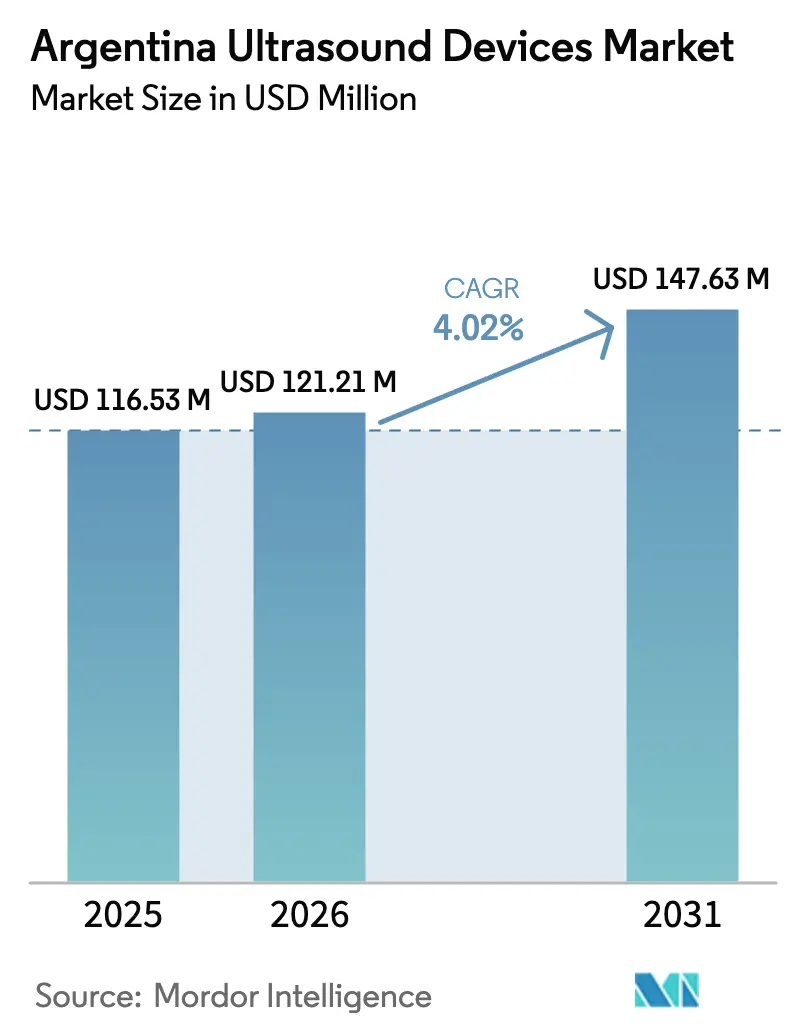
| Base Year Market Size (2025) | USD 116.53 Million |
| Market Size (2026) | USD 121.21 Million |
| Market Size (2031) | USD 147.63 Million |
| Growth Rate (2026 - 2031) | 4.02 % |
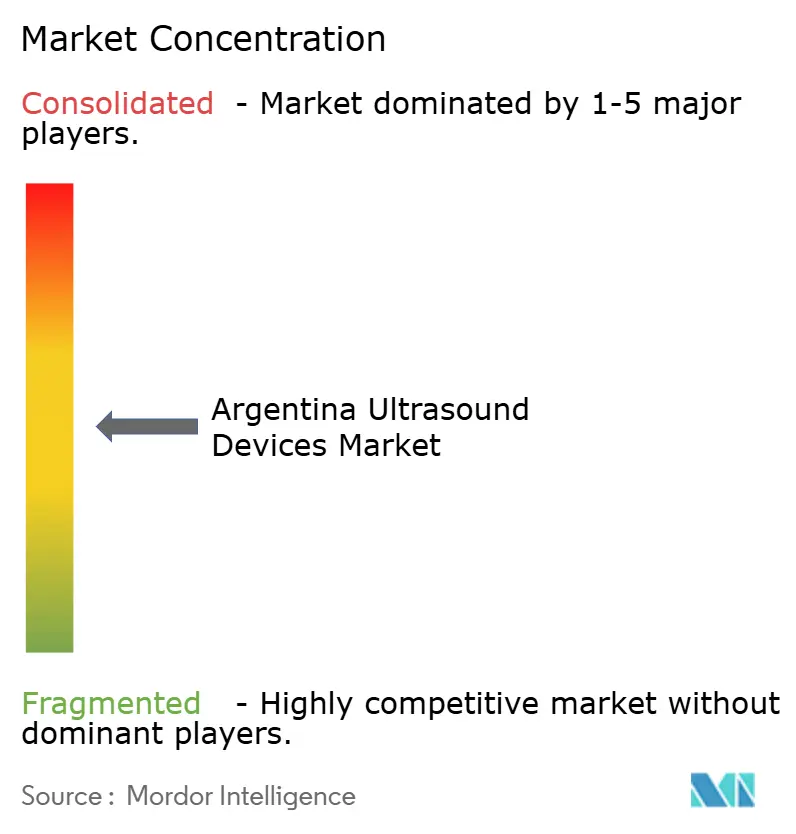
| Market Concentration | Medium |
Major Players *Disclaimer: Major Players sorted in no particular order Image © Mordor Intelligence. Reuse requires attribution under CC BY 4.0. | |
Argentina Ultrasound Devices Market Analysis by Mordor Intelligence
The Argentina Ultrasound Devices Market size is expected to grow from USD 116.53 million in 2025 to USD 121.21 million in 2026 and is forecast to reach USD 147.63 million by 2031 at 4.02% CAGR over 2026-2031.
Rising demand for real-time diagnostics in chronic disease management, the mandatory roll-out of electronic prescriptions from January 2025, and a World Bank–backed USD 535 million health-system modernization package are the foremost growth catalysts. Supply, however, remains import-dependent, exposing stakeholders to currency volatility even as local distributors deepen partnerships with multinational manufacturers. Intensifying competition around AI-enabled workflow automation, handheld form factors, and tele-ultrasound connectivity is reshaping pricing and procurement dynamics across public and private institutions. Long-term demographic aging and the government’s pivot toward value-based care further reinforce medium-term growth visibility.
Key Report Takeaways
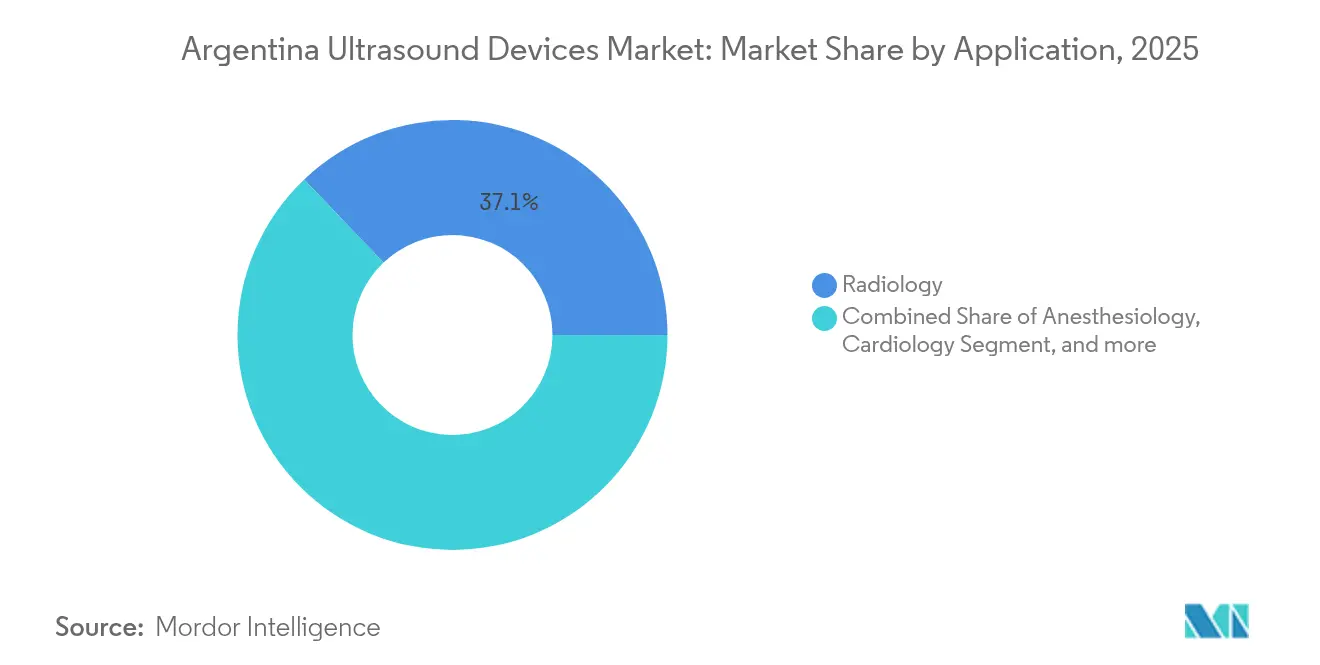
- By application, radiology led with 37.12% revenue share in 2025, while critical care is forecast to expand at a 6.18% CAGR through 2031.
- By technology, 3D & 4D technology captured 37.42% of Argentina ultrasound devices market share in 2025; high-intensity focused ultrasound is projected to grow fastest at 5.71% CAGR.
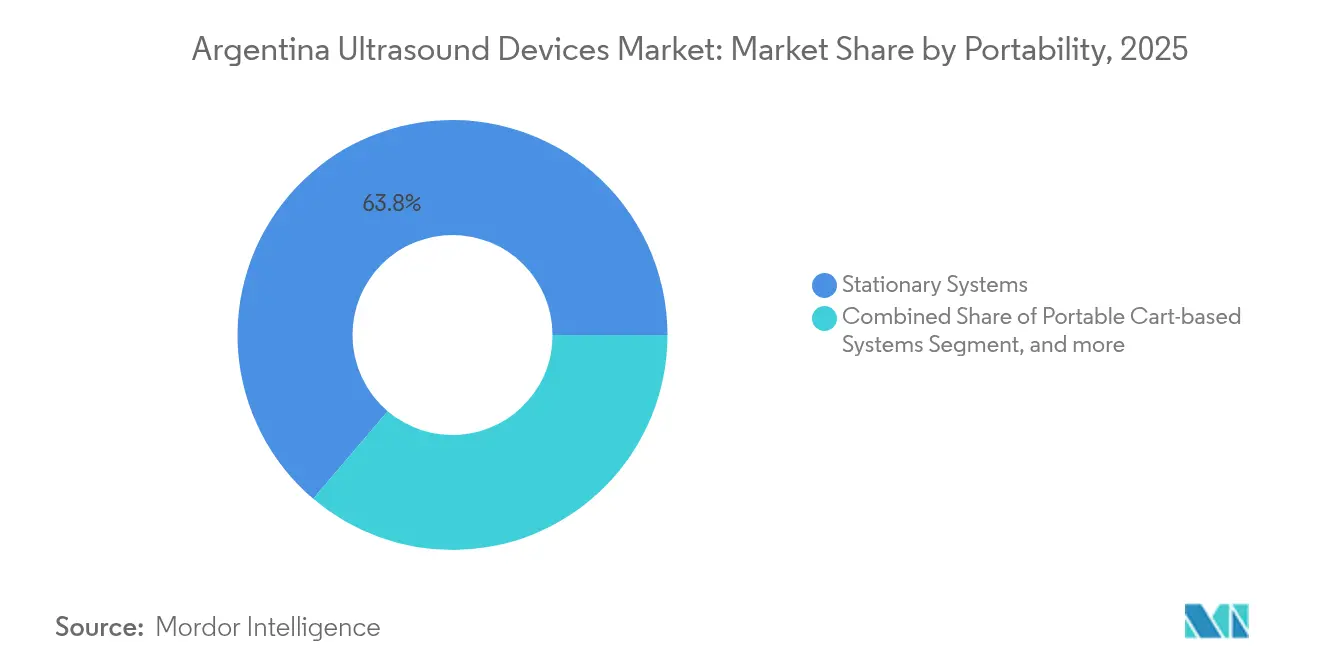
- By portability, stationary systems held 63.78% share of Argentina ultrasound devices market size in 2025, whereas handheld/pocket devices are set to increase at an 7.65% CAGR to 2031.
- By end user, public hospitals accounted for 42.68% usage share in 2025, yet home-health settings are on track for the highest 7.12% CAGR through 2031.
Note: Market size and forecast figures in this report are generated using Mordor Intelligence’s proprietary estimation framework, updated with the latest available data and insights as of 2026.
Argentina Ultrasound Devices Market Trends and Insights
Drivers Impact Analysis*
| Driver | (~) % Impact on CAGR Forecast | Geographic Relevance | Impact Timeline |
|---|---|---|---|
| Growing chronic disease prevalence | +1.2% | National; urban hubs | Long term (≥ 4 years) |
| Expansion of point-of-care ultrasound (POCUS) | +0.8% | Public hospitals nationwide | Medium term (2-4 years) |
| Maternal-health initiatives | +0.5% | Underserved provinces | Medium term (2-4 years) |
| AI-powered workflow automation | +0.7% | Major metropolitan areas | Short term (≤ 2 years) |
| Tele-ultrasound in remote regions | +0.4% | Rural Patagonia & north | Long term (≥ 4 years) |
| Integration in value-based care | +0.3% | Private sector | Long term (≥ 4 years) |
| Source: Mordor Intelligence | |||
Growing Chronic Disease Prevalence
An aging population and the post-pandemic surge in non-communicable diseases are lifting utilization of cardiac, vascular, and musculoskeletal scanning. Maternal mortality climbed to 7.4 per 10,000 births in 2024, underscoring unmet prenatal imaging needs. AI-assisted ultrasound shortens exam times, supporting over-burdened clinicians tackling higher patient volumes. Argentina’s Universal Child Allowance, covering 4.37 million beneficiaries, reinforces steady pediatric demand for routine sonographic monitoring.[1] These factors collectively underpin sustained equipment replacement cycles and fresh installations across tertiary hospitals.
Expansion of Point-of-Care Ultrasound (POCUS) in Emergency & Primary Care
Handheld systems deliver bedside diagnostics without dedicated radiology suites. Devices such as Butterfly iQ+, Clarius, and Vscan Air now demonstrate performance approaching cart-based machines, yet cost a fraction and operate from smartphones. Workforce shortages PAHO projects a regional gap of up to 2 million health workers by 2030, making user-friendly POCUS indispensable, especially for general practitioners in provincial clinics.[2]Argentina’s 29 medical schools already embed ultrasound proficiency into curricula, ensuring incoming physicians view POCUS as standard practice.
Federal & State-Supported Maternal Health Initiatives
UNDP-funded programs valued at USD 671.3 million for universal health coverage and USD 19.7 million for early-childhood support mandate wider prenatal screening in low-resource districts. AI-driven fetal assessment software can slash measurement time from 2 minutes to 5 seconds per exam, raising throughput and diagnostic confidence. ANMAT’s streamlined 90- to 365-day device registration windows further expedite availability of advanced obstetric systems.
AI-Powered Workflow Automation in Private Imaging Centers
Partnerships such as GE HealthCare-NVIDIA integrate autonomous scanning protocols that reduce repetitive strain on sonographers and unify image quality. Acquisitions like Samsung Medison’s USD 92.4 million purchase of Sonio highlight the premium attached to domain-specific AI algorithms. Financial upsides include fewer rejected claims and improved reimbursement accuracy, factors that resonate with cash-flow-conscious private providers.
Restraints Impact Analysis*
| Restraint | (~) % Impact on CAGR Forecast | Geographic Relevance | Impact Timeline |
|---|---|---|---|
| Supply-chain disruptions & import dependency | -0.9% | Nationwide | Short term (≤ 2 years) |
| Shortage of skilled sonographers | -0.6% | Rural provinces | Medium term (2-4 years) |
| Fragmented healthcare funding | -0.4% | Provincial variability | Long term (≥ 4 years) |
| Infrastructure gaps in remote areas | -0.3% | Patagonia & north | Long term (≥ 4 years) |
| Source: Mordor Intelligence | |||
Supply-Chain Disruptions & Import Dependency
Roughly 80% of ultrasound units are imported, leaving buyers exposed to currency swings and freight delays. Global component shortages that began in 2022 continue to impact probe availability, while 224% domestic inflation in 2024 squeezed hospital budgets.[3] Strategic sourcing alliances and local warehousing are becoming essential risk-mitigation tactics.
Shortage of Skilled Sonographers
Residency bottlenecks mean fewer than half of new medical graduates secure advanced imaging training slots, constraining throughput in provincial hospitals. AI-assisted acquisition and automated measurements partly offset the human gap but cannot fully replace specialized expertise, limiting volume growth in high-acuity settings.
*Our forecasts treat driver/restraint impacts as directional, not additive. The impact forecasts reflect baseline growth, mix effects, and variable interactions.
Segment Analysis
By Application: Critical Care Drives Innovation
Radiology retained leadership with 37.12% of Argentina ultrasound devices market share in 2025, underpinned by entrenched imaging workflows in large urban hospitals. Critical care, however, posts the highest 6.18% CAGR as emergency physicians adopt bedside scanning to manage hemodynamic instability and guide interventions. The Argentina ultrasound devices market size attributed to critical-care deployments is forecast to gain further momentum as AI algorithms quantify lung and cardiac metrics within seconds, expediting triage decisions. Secondary growth pockets include cardiology, gynecology/obstetrics, and musculoskeletal imaging, each benefiting from specialized software packages that automate complex measurements and reduce inter-observer variability.
In gynecology/obstetrics, government-funded prenatal programs spur installations of 3D-enabled systems across provincial maternity centers, while private clinics race to offer AI-augmented fetal anomaly scans. Cardiology leverages Siemens’ Acuson Origin, whose deep-learning engine captures over 5,000 echocardiographic data points per exam, minimizing manual input errors. Musculoskeletal and vascular sub-segments gain traction through elastography and Doppler enhancements that raise diagnostic yield without radiation exposure.

By Technology: AI Integration Accelerates Innovation
3D & 4D modalities commanded 37.42% share in 2025, reflecting local appetite for volumetric imaging in obstetrics and interventional planning. High-intensity focused ultrasound is projected to outpace other technologies at 5.71% CAGR, buoyed by non-invasive oncology and pain-management procedures. The Argentina ultrasound devices market size derived from HIFU remains small but illustrates a pivot toward therapeutic applications that compress hospital stays.
Across all platforms, embedded AI now automates segmentation, quantification, and reporting. Canon’s Smart Fusion overlays CT/MRI datasets onto live ultrasound, facilitating lesion targeting without contrast agents. 2D ultrasound endures as a budget-friendly workhorse for primary care, and Doppler remains indispensable in cardiology and nephrology. Emerging elastography systems provide quantitative tissue stiffness data, aiding early fibrosis detection.
By Portability: Handheld Revolution Transforms Access
Stationary consoles still dominate with 63.78% share, prized for premium transducers and advanced processing that complex cases demand. Yet handheld units are the fastest risers at an 7.65% CAGR, democratizing imaging in ambulances, field clinics, and home settings. The Argentina ultrasound devices market size attributable to handhelds expands as devices like Butterfly iQ3 integrate 3D visualization and AI-guided workflows. Port-based systems serve middle-ground needs in operating theaters and outpatient suites, balancing mobility with performance.
Comparative assessments show no single handheld outperforms rivals in every application; instead, vendors optimize for cardiac, superficial, or abdominal use cases. Real-time AI coaching mitigates operator variability, a critical factor in rural deployments where formal sonography training is scarce.
By End User: Public Sector Leadership Faces Private Innovation
Public hospitals captured 42.68% of Argentina ultrasound devices market share in 2025, supported by universal-coverage mandates and multilateral financing that shield procurement budgets during economic turbulence. Diagnostic centers and private hospitals increasingly adopt AI-rich premium systems to shorten patient backlogs and secure higher reimbursements. The Argentina ultrasound devices market size flowing into home-health environments grows fastest at 7.12% CAGR, propelled by tele-ultrasound platforms that connect nurses and general practitioners with remote specialists in real time.
Fragmentation across public, social-insurance, and private payors complicates procurement cycles, often prolonging tender approvals but also creating niche opportunities for vendors able to navigate multi-stakeholder negotiations. Ambulatory surgical centers constitute an emerging channel where portable scanners facilitate minimally invasive procedures, aligning with cost-containment policies.
Geography Analysis
Argentina’s ultrasound adoption skews heavily toward Buenos Aires and the Central region, where 40% of the population resides and ICU bed density peaks at 2,567 units. These hubs concentrate high-end platform sales and specialist expertise. Provincial disparities remain stark; remote northern and Patagonian provinces face infrastructure gaps that slow diffusion of advanced imaging. Government e-prescription mandates and health-information-exchange projects are expected to unify data flows, thereby lowering integration hurdles for field-deployed devices.
Targeted UNDP and World Bank investments exceeding USD 700 million, focusing on maternal and universal coverage programs and channeling funds into ultrasound procurement for provincial hospitals. MERCOSUR regulatory harmonization eases cross-border supply logistics, yet currency devaluation and inflation continue to disrupt planning cycles. Innovations in tele-ultrasound, riding on 87.2% internet penetration, help bridge geographic gaps by enabling metropolitan radiologists to supervise scans performed in community clinics.
Provincial health-equity mapping using census and geospatial analytics identifies high-vulnerability districts, guiding deployment of handheld units where static imaging suites are unviable. Wealthier provinces such as Córdoba adopt premium AI consoles, while northern areas prioritize rugged, battery-operated systems. These divergent needs reinforce the importance of a tiered product portfolio for vendors seeking national coverage.
Regulatory Landscape
Ultrasound devices in Argentina fall under ANMAT (Administracion Nacional de Medicamentos, Alimentos y Tecnologia Medica) medical product oversight and must be registered in the Registro de Productores y Productos de Tecnologia Medica before commercialization. In February 2026, ANMAT Disposicion 236/2026 introduced a simplified pathway for foreign-origin Class I and II medical devices, shifting eligible products from shipment-by-shipment approvals toward a sworn-statement notification model, including a 48-hour post-importation notification mechanism for covered imports.
The reform leaves higher-risk Class III and IV products under prior import authorization. It also increases the importance of compliant importer-of-record operations and electronic processing via ANMAT platforms (e.g., HELENA, THEMIS). Alongside the import streamlining, policy moves that facilitate the importation of used and refurbished medical equipment add another compliance layer for buyers and distributors, particularly around lifecycle documentation, traceability, and post-market responsibilities under ANMAT supervision.
Value Chain Analysis
Argentina's ultrasound devices value chain is anchored in multinational OEM manufacturing and an import-led supply model, with local authorized representatives and importers handling ANMAT registration dossiers, customs clearance, and downstream distribution. Documentation requirements such as Certificates of Free Sale from the country of origin and technical evidence from OAA-recognized bodies shape supplier selection and onboarding, while the shift toward electronic submissions and sworn-statement notifications raises the operational burden on local regulatory and quality teams.
On the demand side, public-sector procurement is a major channel, with tenders run through government platforms such as COMPR.AR and structured specifications that affect configuration mix, including console versus portable setups, probes, software options, and service terms. Distributors and service partners provide installation, training, and maintenance across provinces, which remains significant given the skilled sonographer constraint and the need to keep probes and systems in service. Warehousing and logistics orchestration by local operators also influences lead times and uptime for hospitals and imaging centers.
Competitive Landscape
The market exhibits moderate concentration: global majors GE HealthCare, Siemens Healthineers, and Philips collectively exceed 60% share, while agile disruptors target white-space niches. Acquisitions Samsung Medison’s USD 92.4 million purchase of Sonio and GE HealthCare’s USD 51 million buyout of Intelligent Ultrasound underline a strategic race for AI competencies. Partnerships with cloud leaders (e.g., GE with AWS) accelerate the development of generative-AI reporting tools that promise faster clinical turnaround.
Butterfly Network’s USD 76 million capital raise funds next-gen chip-based probes intended to lower entry price points and expand handheld penetration. Canon and Olympus co-develop endoscopic ultrasound to tap interventional and gastroenterology demand. Local distributors strengthen after-sales networks to offset import lead times, while some are exploring joint-assembly models to hedge currency risk.
Competitive differentiation increasingly hinges on workflow metrics, scan duration, automated reporting, and reimbursement success rather than solely on image resolution. Vendors demonstrating measurable productivity gains secure premium placements in budget-constrained private hospitals. Rural market access, conversely, rewards cost-effectiveness, portability, and tele-guidance features.
Argentina Ultrasound Devices Industry Leaders
-
GE Healthcare
-
Mindray Medical International Limited
-
Koninklijke Philips N.V.
-
Canon Medical Systems
-
Siemens Healthineers
- *Disclaimer: Major Players sorted in no particular order
Market Opportunities and Future Outlook
Regulatory and import-process simplification creates whitespace for faster refresh cycles in Class I and II imaging portfolios, particularly in import-dependent categories where time-to-availability affects both public tenders and private imaging networks. The February 2026 ANMAT Disposicion 236/2026, along with earlier 2025 streamlining measures for Class I and II devices, expands the pool of compliant models entering the market with less administrative friction, which supports upgrades toward newer software-enabled ultrasound configurations across both premium and mid-tier sites.
A second opportunity is tied to procurement expansion and budget-stretching pathways in the public sector. Programs and mechanisms such as PROSEPU II provide a structured route for equipment acquisition, and the 2026 policy change enabling the import of used and refurbished medical devices, including the removal of the Certificate of Import of Used Goods requirement, broadens the accessible installed base for provincial hospitals. This creates room for vendors and distributors offering certified refurbished systems with bundled service, probe availability management, and training, especially in provinces where infrastructure and staffing constraints favor rugged configurations and simplified workflows.
Recent Industry Developments
- June 2026: Mindray Argentina launches the Resona A20 ultrasound platform at the CIR - FAARDIT - SORDIC 2026 congress in Cordoba. The introduction broadens AI-enabled scanning capabilities in the Argentina market and strengthens Mindray's competitive position across public and private healthcare channels. The update reinforces Mindray's AI augmentation trajectory within the local ultrasound ecosystem.
- April 2026: Mindray hospital Santojanni incorporated a Mindray DC-40 ultrasound system via distributor Digimed Ultrasonido. Public-hospital procurement of ultrasound devices in Argentina continues to expand, increasing Mindray installed base and public-sector footprint in 2026. The distributor collaboration improves access to ultrasound imaging in major urban facilities.
- July 2024: Argentine UFIS government financing package purchase delivering 900 Mindray multi-parameter monitors and 50 VINNO ultrasound units via CSH. The public-sector equipment deployment highlights demand for ultrasound systems and channel partnerships led procurement with Mindray. It also reflects how financing mechanisms are shaping equipment mix and scale in the public segment.
Research Methodology Framework and Report Scope
Market Definition and Coverage
For this methodology, the market covers ultrasound imaging systems sold and installed in Argentina for clinical diagnosis, including hospital, clinic, and point-of-care use, and valued as equipment revenue in USD.
Scope exclusions: The sizing excludes service contracts, consumables such as gel, and non-ultrasound imaging modalities.
Segmentation Overview
- By Application
- Anesthesiology
- Cardiology
- Gynecology / Obstetrics
- Musculoskeletal
- Radiology
- Critical Care
- Urology
- Vascular
- Other Applications
- By Technology
- 2D Ultrasound Imaging
- 3D & 4D Ultrasound Imaging
- Doppler Imaging
- High-Intensity Focused Ultrasound
- Other Technologies
- By Portability
- Stationary Systems
- Portable Cart-based Systems
- Hand-held / Pocket Devices
- By End User
- Public Hospitals
- Private Hospitals & Clinics
- Diagnostic Imaging Centers
- Ambulatory Surgical Centers
Data Sources, Market Sizing, and Validation
Desk Research
Desk research starts with mapping the Argentina demand pool and the supply flow of ultrasound equipment. We used public sources such as UN Comtrade and the World Integrated Trade Solution for HS-level import values and units, and the World Bank and IMF for macro and currency context that affects USD conversion.
To anchor health system realities in Argentina, we reviewed sources such as the World Health Organization and PAHO country dashboards, Argentina Ministry of Health publications where available, and peer-reviewed clinical journals to understand procedure trends that typically use ultrasound. Company annual reports, investor decks, distributor announcements, and reputable press were also used to confirm product mix shifts such as portable adoption and replacement cycles. In a few cases, paid subscriptions for company financials and patent databases helped validate business scale signals and technology direction. These sources are illustrative only, and we also referenced other public documents and datasets for cross-checks and clarifications.
Primary Interviews and Surveys
Primary work in Argentina focused on checking what gets purchased, how often systems are replaced, and what features drive pricing for ultrasound equipment. We spoke with a mix of hospital imaging leaders, biomedical teams, distributors, and clinical users across major provinces, and then used their inputs to confirm assumptions taken from desk research and to close gaps where public data was thin.
Distribution of primary research fieldwork respondents
| Company type | Respondent position |
|---|---|
| Top tier: 35% | CXOs: 18% |
| Mid tier: 44% | Functional/Unit leaders: 22% |
| Smaller Players: 21% | Managers: 60% |
Market-Sizing & Forecasting
Sizing is built using a top-down approach where import and demand signals are reconstructed into an equipment revenue view for Argentina, and then pressure-tested with selective bottom-up checks. The top layer uses trade value and unit trends for ultrasound machines, adjusted for channel mix and typical hospital procurement timing, and then aligned to the installed base and replacement cadence discussed in interviews.
To keep the model realistic for Argentina, we track inputs year by year, including public versus private purchasing share, the mix shift toward portable and handheld systems, average selling price movement by technology generation, and utilization-driven demand in applications such as obstetrics and cardiology. Exchange-rate timing matters in Argentina, so we keep pricing and conversion assumptions consistent within a year before rolling them forward. Where unit data is incomplete by product type, gaps are handled using conservative mix splits based on distributor feedback and cross-checked against known shipment patterns.
For forecasting, scenario analysis is used, guided by consensus ranges from experts on procurement budgets, replacement cycles, and the pace of portable adoption. The scenarios are blended into a base case that stays traceable to variables an analyst can re-check and update.
Data Validation & Update Cycle
Validation is done through several checks that look for mismatches between model outputs and independent signals. We compare implied units, implied average prices, and import intensity against what respondents see in tenders and hospital buying, and then review any outliers before final sign-off.
A second analyst reviews the assumptions and arithmetic, followed by a final consistency pass across the historical trend and the forecast curve. The study is refreshed annually, and interim updates are triggered when material events occur, such as major currency moves or policy changes affecting imports. Before delivery, we run a fresh update sweep so clients receive the most current view available.
Mordor Intelligence's Argentina Ultrasound Devices Market Size Measured Against Other Published Estimates
Published market sizes can vary even when the topic name looks the same, because the counted revenue pool and the year of currency conversion are not always consistent. Differences usually come from whether studies treat ultrasound as equipment only or fold in services, probes, and refurbished systems, and then how they handle inflation-driven pricing.
The main gap comes from including aftermarket and service revenue, where Mordor Intelligence counts only new ultrasound system equipment sales in Argentina and keeps the USD series aligned to year-specific pricing and exchange-rate timing rather than using a single blended conversion.
Benchmark comparison
| Source | Market Size | Gaps in Research Methodology |
|---|---|---|
| Mordor Intelligence | USD 116.53 M (2025) | |
| Trade Data Digest A | USD 28.40 M (2023) | Built from a single HS code import line for ultrasound machines, which can miss local distribution markups, in-country inventory timing, and non-captured product classes like some handheld units. |
| Industry Aggregator B | USD 135.00 M (2024) | Uses a broader diagnostic monitoring bucket and allocates a share to ultrasound using generalized splits, which can overstate ultrasound equipment when modalities and accessories are blended. |
The spread is largely explained by what gets counted and how the USD value is converted across years. By tying the estimate to observable unit and price signals, and then sanity-checking them with procurement and user feedback, the final number stays repeatable and easier to audit when assumptions are updated.
Key Questions Answered in the Report
How large is the Argentina ultrasound devices market in 2026?
It is valued at USD 121.21 million in 2026 and is forecast to reach USD 147.63 million by 2031 at a CAGR of 4.02% over 2026-2031.
Which application is growing fastest?
Critical-care ultrasound shows the highest 6.18% CAGR due to greater bedside adoption in ICUs and emergency departments.
What technology segment leads current revenue?
3D & 4D systems hold 37.42% share, reflecting demand for volumetric imaging in obstetrics and surgical planning.
Why are handheld devices important?
Handheld probes are forecast to grow at 7.65% CAGR because they expand access in ambulances, rural clinics, and home-health settings.
How dependent is Argentina on imports for ultrasound equipment?
Imports supply about 80% of domestic demand, exposing buyers to exchange-rate risk and global supply disruptions.
Which provinces are priority targets for tele-ultrasound roll-outs?
Remote northern and Patagonian regions with limited specialist access are top priorities for tele-enabled scanning programs.