
Market Overview
| Study Period | 2020 - 2031 |
|---|---|
| Forecast Data Period | 2026 - 2031 |
| Base Year Market Size (2025) | USD 113.19 Billion |
| Market Size (2026) | USD 148.18 Billion |
| Market Size (2031) | USD 569.87 Billion |
| Growth Rate (2026 - 2031) | 30.92 % |
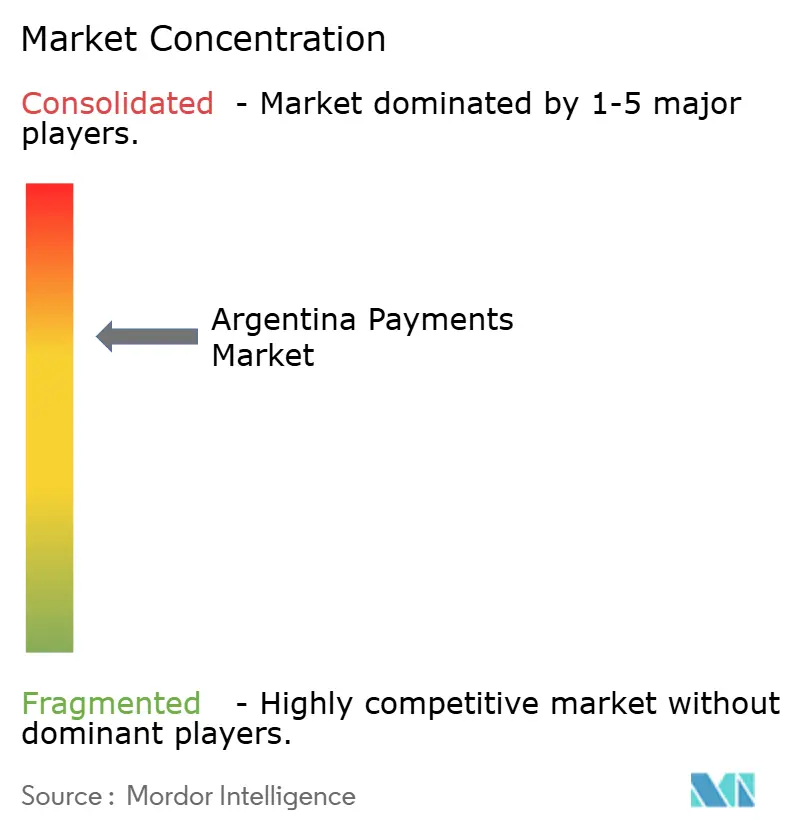
| Market Concentration | Medium |
Major Players *Disclaimer: Major Players sorted in no particular order Image © Mordor Intelligence. Reuse requires attribution under CC BY 4.0. | |
Argentina Payments Market Analysis by Mordor Intelligence
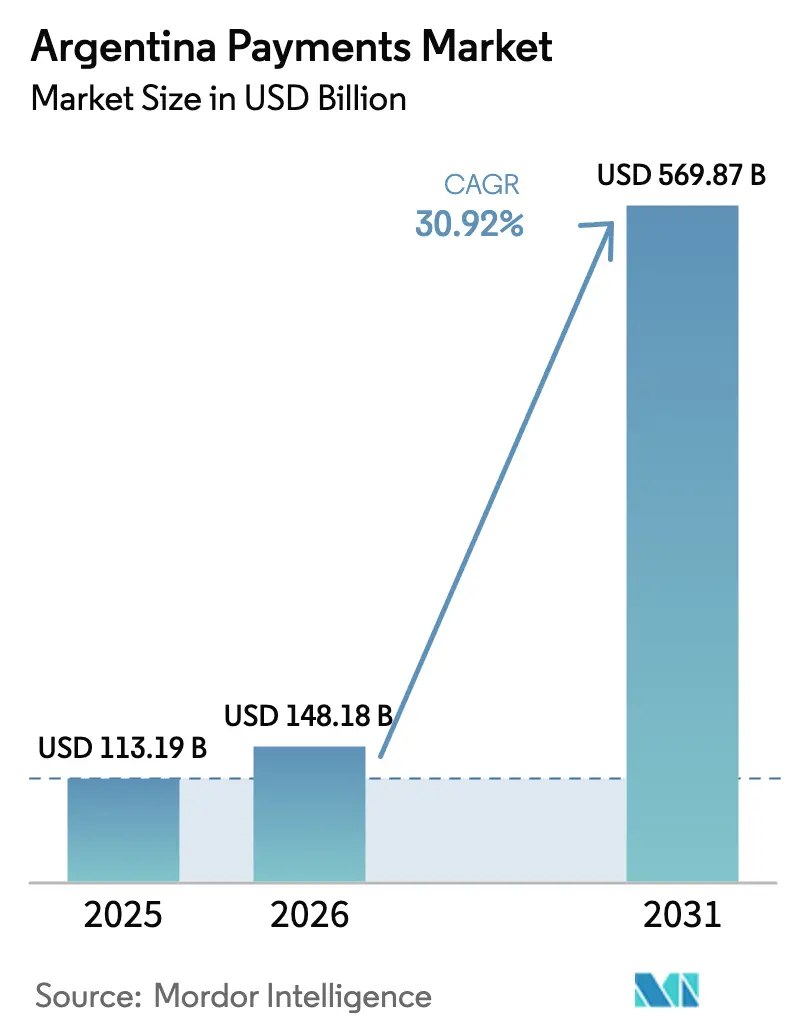
The Argentina payments market size is expected to grow from USD 113.19 billion in 2025 to USD 148.18 billion in 2026 and is forecast to reach USD 569.87 billion by 2031 at 30.92% CAGR over 2026-2031. A synchronized policy mix of monetary tightening, gradual foreign-exchange liberalization, and nationwide QR-code interoperability is reshaping transaction habits at scale. Consumers and businesses are shifting from cash toward mobile wallets, account-to-account rails, and contactless POS cards in search of speed, transparency, and inflation protection. Network effects are accelerating because every new QR-accepting merchant increases the utility of virtual wallets, while rising smartphone penetration lowers onboarding costs. Competitive intensity is escalating as fintech challengers cultivate multi-service ecosystems around high-yield wallet balances, forcing incumbent banks to defend share with bundled offerings and biometric security upgrades. Emerging cross-border corridors, especially with Brazil, signal a new opportunity set for providers that can reconcile local compliance with instant settlement.
Key Report Takeaways
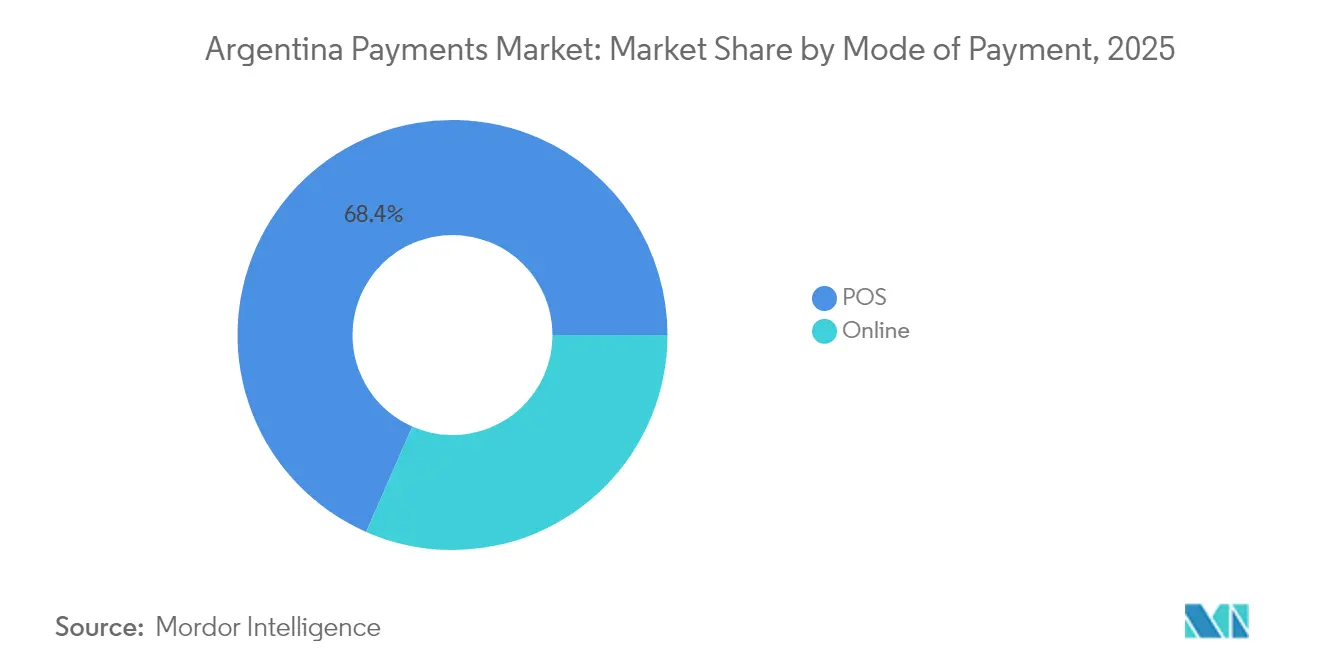
- By mode of payment, POS transactions led with 68.42% of Argentina payments market share in 2025, whereas online digital wallets and account-to-account transfers are expanding at 31.48% CAGR through 2031.
- By interaction channel, POS maintained a 70.36% revenue share in 2025; e-commerce and m-commerce are advancing at a 32.12% CAGR to 2031.
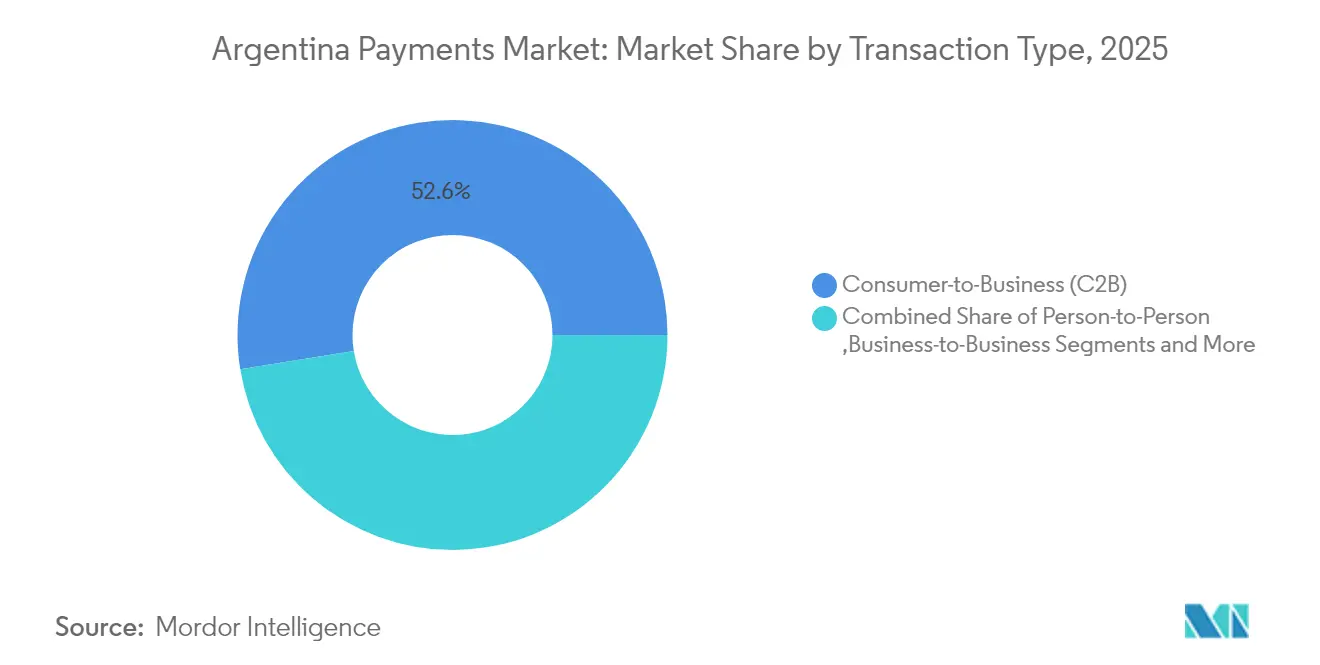
- By transaction type, C2B transactions held 52.55% share of the Argentina payments market size in 2025, while remittances and cross-border payments post the fastest 33.02% CAGR through 2031.
- By end-user industry, retail commanded 27.62% share of the Argentina payments market size in 2025; healthcare exhibits the highest 31.18% CAGR between 2026-2031.
Note: Market size and forecast figures in this report are generated using Mordor Intelligence’s proprietary estimation framework, updated with the latest available data and insights as of 2026.
Argentina Payments Market Trends and Insights
Drivers Impact Analysis*
| Driver | (~) % Impact on CAGR Forecast | Geographic Relevance | Impact Timeline |
|---|---|---|---|
| E-commerce and m-commerce surge | +8.2% | National, with concentration in Buenos Aires, Córdoba, Rosario | Medium term (2-4 years) |
| Government digital-payment push (Transferencias 3.0) | +6.6% | National | Short term (≤ 2 years) |
| Smartphone penetration boom | +4.9% | National, with urban concentration | Medium term (2-4 years) |
| Real-time payments and interoperable QR rise | +5.9% | National, with early adoption in major urban centers | Short term (≤ 2 years) |
| Hyper-inflation fuels digital-wallet and crypto use | +3.9% | National | Short term (≤ 2 years) |
| Open-banking and embedded-finance ecosystems | +3.3% | National, initially concentrated in Buenos Aires | Long term (≥ 4 years) |
| Source: Mordor Intelligence | |||
E-commerce and m-commerce surge
Argentina’s online retail turnover reached USD26.7 billion in 2023 and is projected to grow 17% annually to 2027. Mobile transactions climbed 248% in H1 2024, establishing the handset as the primary checkout device for a broad demographic. Merchants respond with omnichannel gateways that support one-click payments and installment plans, tactics that stabilize sales despite macro volatility. Installments, once premium, are now baseline, allowing households to spread large-ticket purchases and manage inflation risk. The feedback loop between shopper expectations and payment optionality sustains double-digit online volume growth.
Government digital-payment push (Transferencias 3.0)
Transferencias 3.0 mandates that any QR code generated in Argentina must be readable by every licensed wallet, eliminating proprietary silos. Millions of interoperable account-to-account transactions now clear in 15 seconds or less, supporting financial inclusion in regions with scarce card terminals. The February 2025 extension into public transport sets the stage for daily-use micropayments at metro gates, buses, and trains. [1]Banco Central de la República Argentina, “Means of Payment,” bcra.gob.ar This expansion is expected to compress cash usage further and strengthen open-banking data flows that underpin embedded finance models.
Smartphone penetration boom
Handset ownership reached 81% of the population, enabling 68% of Argentinians to transact via mobile at least weekly. Wallet providers integrate biometric login and tokenized card credentials to improve security without adding friction. The device also functions as a budgeting dashboard, delivering push notifications on spending categories and savings yields. These value layers deepen engagement and raise switching costs, amplifying the network moat of leading platforms.
Real-time payments and interoperable QR rise
Real-time rails account for 36.6% of payouts and are expected to climb at 24.4% annually to 2028. Merchants can accept digital payments with only a printed QR, avoiding costly hardware and settlement delays. The February 2025 regulation that standardizes QR in public transport will introduce millions of daily commuters to the rail, accelerating mass-market adoption.
Restraints Impact Analysis*
| Restraint | (~) % Impact on CAGR Forecast | Geographic Relevance | Impact Timeline |
|---|---|---|---|
| Escalating fraud and charge-backs | -4.9% | National, with higher impact in urban areas | Medium term (2-4 years) |
| FX controls hamper cross-border flows | -2.6% | National, with greater impact on import-dependent businesses | Short term (≤ 2 years) |
| Fragmented rails drive high merchant fees | -3.3% | National, with disproportionate impact on SMEs | Medium term (2-4 years) |
| Data-privacy / localization burden | -2.3% | National | Long term (≥ 4 years) |
| Source: Mordor Intelligence | |||
Escalating fraud and charge-backs
Rapid digitalization has exposed merchants to sophisticated phishing, synthetic identity, and AI-enabled card-testing scams. The resulting charge-back ratios threaten margins and can trigger scheme fines. Providers must deploy layered defenses—behavioral analytics, device fingerprinting, and consortium data sharing—to safeguard user trust. Smaller acquirers face cost barriers, fuelling consolidation as scale becomes essential for fraud-model training. [2]Bank for International Settlements, “Faster Digital Payments: Global and Regional Perspectives,” bis.org
FX controls hamper cross-border flows
Although April 2025 reforms allow instant access to U.S. dollars for imports, operational gaps persist as enterprises recalibrate treasury workflows and compliance rules. Until bank and customs systems fully synchronize, friction will remain in supplier payments and remittance corridors. Short-term uncertainty tempers the pace at which merchants integrate global checkout options, slowing the revenue potential of cross-border commerce.
*Our forecasts treat driver/restraint impacts as directional, not additive. The impact forecasts reflect baseline growth, mix effects, and variable interactions.
Segment Analysis
By Mode of Payment: Digital wallets reshape financial habits
Point-of-Sale retained 68.42% of the Argentina payments market share in 2025, with debit-card transactions rising to 2.979 billion and credit-card swipes to 1.913 billion. Familiarity, installment compatibility, and widespread terminal coverage underlie this resilience. Yet inflation-weary consumers increasingly favor wallets that credit daily interest on idle balances, eroding card primacy. The Argentina payments market size linked to online digital wallets and account-to-account transfers is projected to expand at 31.48% CAGR, powered by instant settlement and bonus yield features. Mercado Pago commands nearly 80% of wallet float, but challengers such as Naranja X entice users with 76% annual yields, nudging share away from incumbents.
Digital wallets now bundle bill pay, micro-insurance, and small-ticket investing, deepening user stickiness. Retailers accept wallet QR codes alongside cards, creating hybrid checkout flows that let customers split payment across instruments. Inflation-indexed savings vehicles embedded in wallets appeal to gig-economy workers who lack formal bank relationships. Consequently, the Argentina payments market demonstrates a shift toward multi-utility wallets rather than single-purpose payment apps.



By Interaction Channel: Mobile commerce accelerates
Physical POS captured 70.36% of 2025 revenue, confirming the centrality of in-store shopping. Tap-to-pay usage exceeds 70% of in-store volume, illustrating how contactless technologies refresh established channels. The Argentina payments market size processed through POS is expected to grow steadily, albeit slower than digital channels, as retailers modernize terminals to accept EMV-co-branded wallets.
Conversely, e-commerce and m-commerce record a 32.12% CAGR outlook on the back of 81% smartphone penetration. Social platforms embed storefronts that route payments via deep links to pre-credentialed wallets, reducing checkout abandonment. Transaction data gathered across mobile touchpoints feeds AI recommendation engines, enabling merchants to tailor offers by cohort. The convergence of transport QR codes with mobile wallets will elevate daily active users, boosting repeat purchase frequency and reinforcing brand loyalty.
By Transaction Type: Cross-border payments surge
C2B flows dominate at 52.55% share in 2025, underpinned by retail turnover and service-sector ubiquity. BNPL, valued at USD282 million in 2023, is gaining traction within C2B as consumers seek inflation-mitigation via installment spreads. Merchants integrate BNPL providers directly into checkout stacks, preserving cart conversion while outsourcing credit risk.
Remittances and cross-border transfers present the fastest 33.02% CAGR through 2031. Revised FX rules now allow businesses to settle imports on customs clearance, unlocking liquidity. Brazilian tourists already make instant peso payments through the Pix-Mercado Pago bridge without currency conversion, demonstrating the network’s utility. Payment providers that combine transparent FX pricing with real-time rails are positioned to capture wallet share from informal channels.
By End-user Industry: Healthcare digitalization accelerates
Retail held 27.62% of 2025 revenue, reflecting the sector’s transaction intensity and early QR adoption. Loyalty integration is the next competitive frontier as grocers and pharmacies link wallet IDs to reward engines that issue instant cashback at checkout. Data analytics from receipt-level information drive dynamic pricing strategies and personalised upsells.
Healthcare charts a 31.18% CAGR to 2031. Hospital groups embed card-on-file and wallet pay-by-link inside telemedicine portals, reducing admission time and improving cash collection. Outcome-based reimbursement models, encouraged by multilateral lenders, further digitize payment flows between insurers, providers, and patients. High ticket sizes and recurrent billing open scope for installment plans and medical BNPL, expanding average revenue per user for payment gateways.
Geography Analysis
Argentina’s metropolitan corridors spearhead digital adoption. Buenos Aires alone accounts for more than 35% of wallet transactions, followed by Córdoba and Rosario, where university populations drive mobile-first behavior. Transferencias 3.0 ensures any wallet can scan any QR nationwide, narrowing the urban-rural acceptance gap. As public transport integrates QR in the Buenos Aires subway, commuters in Greater Buenos Aires are expected to generate millions of micro-payments weekly, a template set for provincial roll-out within two years.
Border states observe heightened demand for interoperable FX-light solutions. The Pix linkage with Brazil allows instantaneous settlement in pesos while debiting reais, a feature attracting retailers in Misiones and Corrientes that rely on Brazilian shoppers. The International Monetary Fund underscores that regional payment interoperability could shave transaction costs by 50% and shorten settlement cycles from days to seconds.
Patagonia and the northwest provinces lag in digital density due to connectivity gaps but benefit from low-cost QR acceptance that circumvents card-terminal logistics. Government-subsidised fibre projects and 4G expansion will lift bandwidth, enabling wallet providers to extend cashback campaigns that accelerate on-boarding. Regional banks partner with fintechs to bundle micro-loans inside wallets, addressing credit deserts without branch build-outs.
Regulatory Landscape
Argentina's payments ecosystem is overseen primarily by Banco Central de la Republica Argentina (BCRA) through the National Payment System (SNP) rulebook, covering payment service providers (PSP), wallets, acquiring and payment initiation, and the interoperability rails behind Transferencias 3.0 (T3). Under T3, QR interoperability is mandated so that any QR generated in Argentina can be read by any licensed wallet, reinforcing account-to-account and payment-with-transfer acceptance across merchants and use cases.
In 2026, the BCRA reinforced operational mandates through Communication A 8406, which set an implementation deadline of August 31, 2026 for "cobro con transferencia" availability in specific collection use cases (notably loan collections), tightening the compliance timetable for PSPs and acceptors connected to the real-time rails. Beyond payments authorization and registration requirements, providers also face cross-cutting obligations around data protection oversight (AAIP) and tax reporting and controls administered by ARCA, which shape KYC, recordkeeping, and transparency expectations for digital commerce transactions.
Value Chain Analysis
The Argentina payments value chain starts with end users (consumers and businesses) and merchants across POS, e-commerce, and m-commerce, then flows through merchant acceptance (QR and POS terminals), payment facilitators/aggregators, acquirers and processors, and finally into clearing and settlement via BCRA-supervised infrastructure (including transfer rails and clearing houses). Interoperable "payment with transfer" (PCT) under Transferencias 3.0 has become a central acceptance layer, enabling printed or in-app QR to route account-to-account payments with near-real-time confirmation, while card rails continue to anchor a large share of in-store payments.
Non-bank PSPs and PSPs offering payment accounts (PSPCPs) sit between merchants and the rails, providing wallets, payment initiation, and reconciliation tooling, and coordinating risk controls such as fraud screening and customer authentication. The ecosystem is increasingly platform-led, where commerce enablers (marketplaces and merchant platforms) integrate payments, credit, and logistics to reduce drop-off and improve cash conversion; Mercado Libre's announced USD 3.4 billion investment plan for Argentina in 2026, oriented to technology and logistics expansion, illustrates how adjacent infrastructure spending can reinforce payments throughput by improving delivery performance, return flows, and merchant onboarding into unified acceptance stacks.
Competitive Landscape
The Argentina payments market is shifting from fragmented to oligopolistic as scale economics favour platforms with large float balances and robust fraud-detection engines. Mercado Pago retains user primacy on back of its marketplace heritage and USD250 million debt raise in September 2024, earmarked for expanded credit lines and AI tooling. The firm’s antitrust action against 36 banks in August 2024 frames the debate over open access versus proprietary rails, with regulators balancing inclusion against systemic stability.
Traditional banks consolidate around MODO, positioning it as a joint defence against fintech incursion. However, competitive parity requires rapid iteration that bank governance sometimes slows. To compensate, BBVA Argentina reported that 93.9% of 2023 sales occurred on digital channels, illustrating a pivot to mobile origination. The bank deploys behavioural analytics to approve personal loans within minutes, mirroring fintech turnaround times.
Second-tier challengers such as Ualá leverage recent USD300 million Series E funding to build a full-stack offering: prepaid cards, wealth tools, and small-business acceptance kits. GeoPagos targets enterprise clients with white-label acquiring solutions, enabling retailers to circumvent card-network fees via direct account debits. Competitive vectors increasingly centre on yield, cross-border utility, and embedded-finance plug-ins that allow non-financial apps to hold and move value.
Argentina Payments Industry Leaders
Servicios Electrónicos de Pago S.A. (PagoFácil)
GIRE S.A. (Rapipago)
PayU Argentina S.R.L.
Paysafe Limited
Google Pay (Alphabet Inc.)
- *Disclaimer: Major Players sorted in no particular order

Market Opportunities and Future Outlook
A primary whitespace sits in scaling interoperable wallet and PCT acceptance beyond early adopter segments into recurring, high-frequency collections and industry-specific flows, supported by the expanding base of regulated participants. BCRA registration figures signal broadening supply: PSPCPs in the BCRA register rose to 219 as of April 2026 (from 170 in November 2024), and as of May 2026 the ecosystem included 90 interoperable digital wallets and 63 PCT acceptors, creating room for specialized orchestration, routing, reconciliation, and fraud tooling that improves reliability across heterogeneous integrations.
Embedded credit inside payment journeys is another monetization layer that is already visible in official credit reporting, and it opens opportunities for providers that can combine underwriting with compliant data reporting and merchant distribution. As of December 2025, 6.7 million individuals held a digital credit product through fintech providers (a net increase of 2 million during 2025), while non-financial credit providers reached a financing balance of 13.9 trillion pesos by February 2026, with the fintech group showing the highest dynamism (47% year-on-year growth). These dynamics, combined with the Open Finance System created by Decree 353/2025 (with BCRA designated for implementation and oversight), support demand for API-based consented data access, payment initiation, and merchant-embedded financing that connects wallets, marketplaces, and offline acceptance points into measurable conversion and retention outcomes.
Recent Industry Developments
- April 2026: Mercado Libre announced a USD 3.4 billion investment plan for Argentina in 2026, aimed at technology and logistics expansion.
- April 2025: Banco Central de la Republica Argentina (BCRA) removed foreign-exchange restrictions affecting import payments, enabling businesses to pay for imports upon customs clearance and permitting unlimited US dollar purchases through bank accounts. This regulatory shift reduces friction in cross-border settlement workflows and supports providers building corridors and merchant checkout options tied to international sourcing.
- September 2024: Mercado Pago raised USD 250 million in debt financing to fund expanded credit lines and AI tooling within its ecosystem. The funding supports wallet-centric product depth, including risk models that influence acceptance decisions and credit-linked payment experiences for consumers and SMEs.


Research Methodology Framework and Report Scope
Market Definition and Coverage
For this study, the Argentina payments market is counted as the gross value of payment transactions executed in the country by consumers and businesses across in-store, in-app, and online channels, using cards, wallets, account-to-account rails, and cash on delivery.
Scope exclusions: We exclude motor vehicle purchases, real estate transfers, mortgage or loan repayments, utility bill payments, and securities trading.
Segmentation Overview
- By Mode of Payment
- Point-of-Sale
- Card (Debit, Credit, Pre-paid)
- Digital Wallets (Apple Pay, Google Pay, Interac Flash)
- Cash
- Other POS (Gift-cards, QR, Wearables)
- Online
- Card (Card-Not-Present)
- Digital Wallet and Account-to-Account (Interac e-Transfer, PayPal)
- Other Online (COD, BNPL, Bank Transfer)
- Point-of-Sale
- By Interaction Channel
- Point-of-Sale
- E-commerce/M-commerce
- By Transaction Type
- Person-to-Person (P2P)
- Consumer-to-Business (C2B)
- Business-to-Business (B2B)
- Remittances and Cross-border
- By End-user Industry
- Retail
- Entertainment and Digital Content
- Healthcare
- Hospitality and Travel
- Government and Utilities
- Other End-user Industries
Data Sources, Market Sizing, and Validation
Desk Research
We start by mapping the legal and operating setup for payments in Argentina and then connect it to measurable volume signals. Public sources such as Banco Central de la Republica Argentina publications on retail payments, IMF and World Bank macro series, UN Comtrade trade statistics for payment hardware proxies, and peer-reviewed papers on payment adoption are used to anchor the demand context.
Next, we build a fact base around payment instrument usage, channel split, and regulated participant counts by referencing central bank statistical releases, government and regulator websites, association releases (including card and banking associations), and reputable press coverage on payment rails and rule changes. For company level context, we use filings and investor materials where available, plus selectively use paid subscriptions for company financials and news screening. We also run patent lookups when we need to validate product and capability claims. This list is not exhaustive, and many other public and paid sources were also consulted to collect data, validate assumptions, and clarify open questions.
Primary Interviews and Surveys
Our team validates the model through interviews and structured surveys with issuers, acquirers, PSPs, merchants, and payment technology enablers that touch card, wallet, transfer, and cash-on-delivery flows. Respondent input helped us align transaction-value growth with on-the-ground pricing, acceptance constraints, and consumer usage patterns across Argentina.
We also include sector specialists who track regulation and FX constraints so the channel and instrument assumptions stay consistent with what operators report in current payment cycles.
Distribution of primary research fieldwork respondents
| Company type | Respondent position |
|---|---|
| Top tier: 33% | CXOs: 15% |
| Mid tier: 48% | Functional/Unit leaders: 34% |
| Smaller Players: 19% | Managers: 51% |
Market-Sizing & Forecasting
We size the market mainly by reconstructing transaction value from payment instrument and channel indicators, then applying adoption and usage rates over a consistent base year. In practice, the top-down build ties together reported retail payments activity, payment account growth, and channel mix, which we translate into annual gross transaction value in USD using consistent currency timing.
To keep results grounded, we corroborate totals with selective bottom-up checks, including sample merchant acceptance math (active merchants times average ticket times frequency), and provider level roll-ups where public disclosures allow it. Key inputs used in the model include payment account penetration, card and prepaid transaction growth, QR and POS share shifts, ecommerce payment mix, and changes in inflation and FX conversion that affect how ARS transaction values translate to USD.
For forecasting, we use scenario analysis supported by short time-series smoothing on the main drivers, since payment behavior can shift quickly when rails, fees, or FX rules change. Where a bottom-up signal is missing for a channel, we fill the gap using comparable acceptance and usage ratios from adjacent channels and then re-check the final total against central bank reported activity patterns.
Data Validation & Update Cycle
We triangulate outputs across independent signals and check that instrument-level growth, channel mix, and macro conditions move in the same direction before sign-off. Outliers are reviewed in a second pass, and if a variance cannot be explained by a clear trigger such as a rule change or a sharp FX move, we re-contact interviewees to confirm what changed.
The report is refreshed annually, with interim updates when there are material policy changes, payment-rail launches, or sharp shifts in inflation and exchange rates. Before delivery, an analyst performs a fresh review of the latest public releases so clients receive an up-to-date view that matches the most recent market signals.
Mordor Intelligence's Argentina Payments Market Size Versus Other Published Estimates
Published market values for Argentina payments often differ because the authors do not always count the same transaction pool, and they convert local currency to USD using different timings and assumptions. In payments, even a small change in what gets counted as a payment flow can move the total materially.
The biggest gap usually comes from scope choices, especially when an estimate focuses only on ecommerce or only on card payments. The main gap also comes from whether offline POS, QR wallet flows, and account-to-account transfers are included together. Mordor Intelligence counts gross transaction value across these rails and channels while keeping excluded items like loan repayments and utility bills outside the total.
Benchmark comparison
| Source | Market Size | Gaps in Research Methodology |
|---|---|---|
| Mordor Intelligence | USD 113.19 B (2025) | |
| Trade Journal A | USD 202.60 B (2025) | Covers only card payments value (debit, credit, and charge), so wallet QR, account-to-account transfers, and cash-on-delivery flows are not captured, which makes it not comparable to a full payments-rail total. |
| Payments Data Library B | USD 26.70 B (2023) | Tracks ecommerce transaction volume only and typically excludes in-store POS, P2P transfers, and B2B payment flows, so the figure represents a narrower online checkout use case. |
The table shows that the spread is explained less by math and more by what is being counted. By tying the total to clearly defined payment rails and channels, and by applying consistent currency conversion timing, we keep the market number traceable to repeatable inputs that can be rechecked as new payment statistics are released.


Key Questions Answered in the Report
What is the current size of the Argentina payments market?
The Argentina payments market is valued at USD 148.18 billion in 2026.
How fast is the market expected to grow?
It is projected to expand at a 30.92% CAGR, reaching USD 569.87 billion by 2031.
Which payment method is growing the quickest?
Online digital wallets and account-to-account transfers are advancing at 31.48% CAGR through 2031.
Why are cross-border payments important for Argentina?
Liberalized FX rules and the Pix integration with Brazil position cross-border transfers as the fastest-growing segment at 33.02% CAGR.
How is government policy influencing payment adoption?
The Transferencias 3.0 framework mandates QR interoperability nationwide, boosting real-time account-to-account payments.
Which end-user industry offers the highest growth potential?
Healthcare payments, driven by telehealth and outcome-based financing, are forecast to grow 31.18% annually through 2031.
Page last updated on:




