
Market Overview
| Study Period | 2020 - 2031 |
|---|---|
| Forecast Data Period | 2026 - 2031 |
| Base Year Market Size (2025) | USD 20.58 Billion |
| Market Size (2026) | USD 23.52 Billion |
| Market Size (2031) | USD 45.86 Billion |
| Growth Rate (2026 - 2031) | 14.29 % |
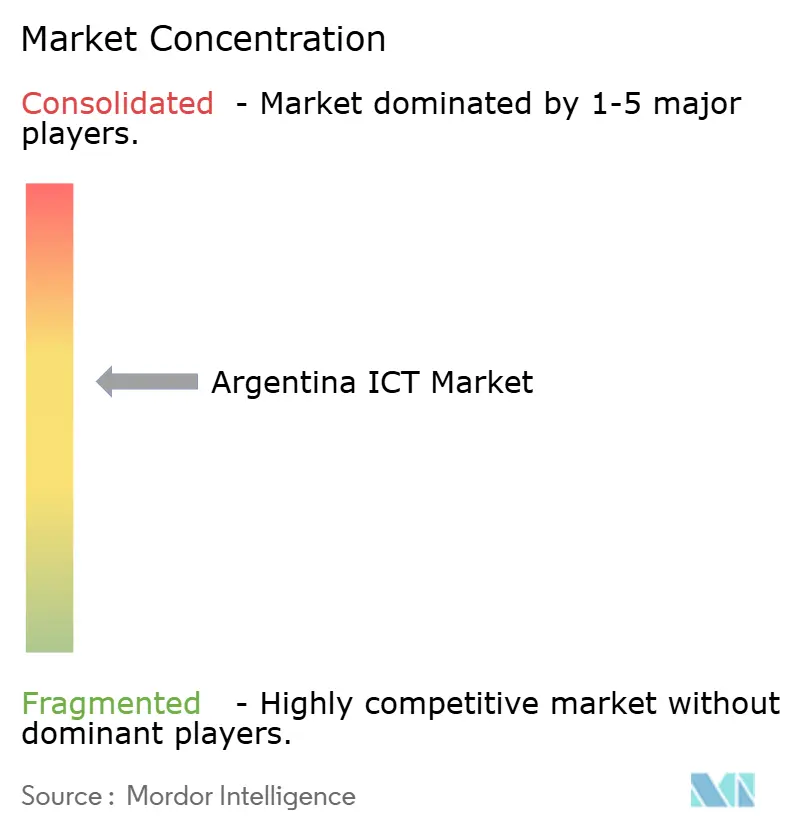
| Market Concentration | Medium |
Major Players
*Disclaimer: Major Players sorted in no particular order Image © Mordor Intelligence. Reuse requires attribution under CC BY 4.0. |
|
Argentina ICT Market Analysis by Mordor Intelligence
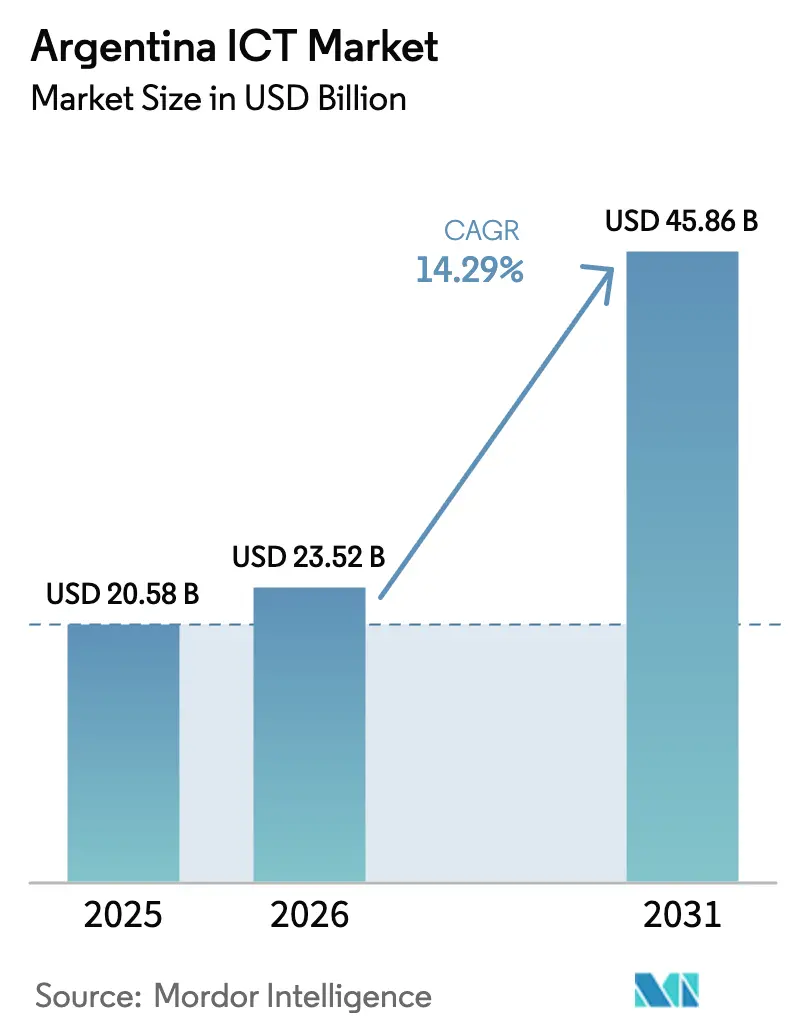
The Argentina ICT market size is expected to grow from USD 20.58 billion in 2025 to USD 23.52 billion in 2026 and is forecast to reach USD 45.86 billion by 2031 at 14.29% CAGR over 2026-2031. The surge traces to deregulation that opened satellite internet competition, dismantled currency controls, and endorsed a digital-first public-service mandate. Private operators rolled out standalone 5G networks while federal and provincial agencies digitized more than 180 services, compressing paperwork lead times from weeks to hours. Enterprises accelerated cloud migration to offset hardware import delays and to tap favorable exchange rates for export services. Energy-efficient data centers in Buenos Aires and tax incentives for projects over USD 200 million further deepen the Argentina ICT market growth runway.
Key Report Takeaways
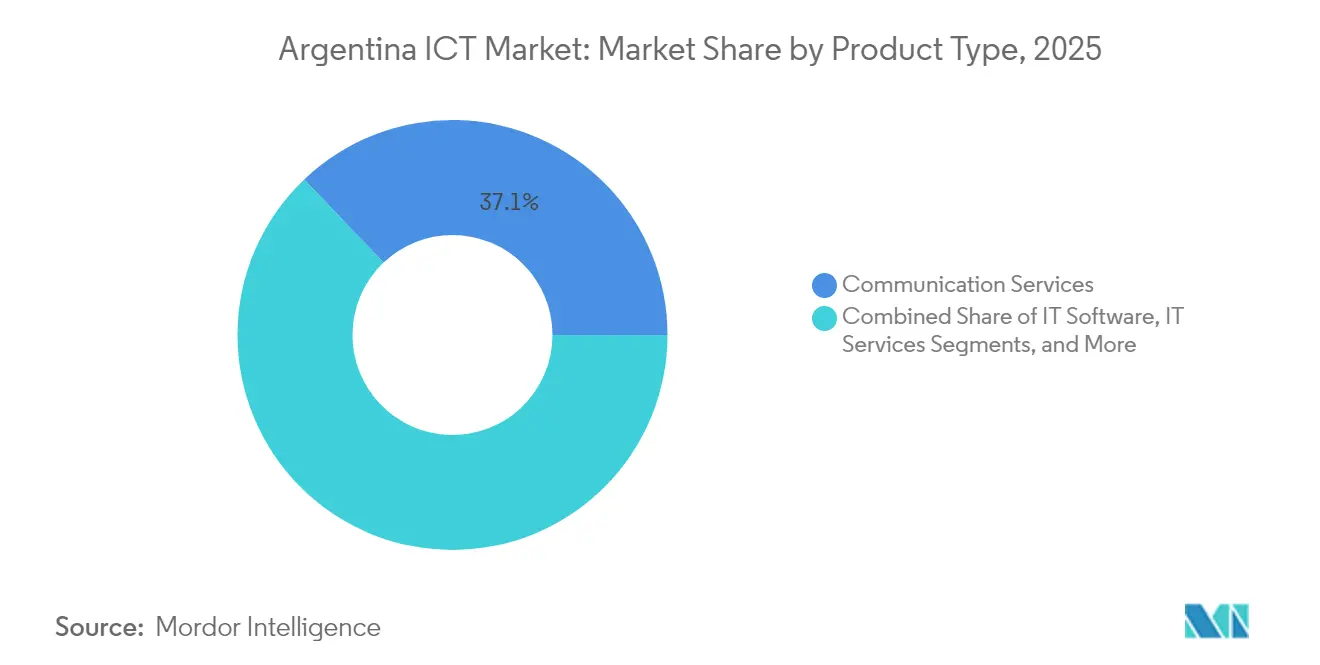
- By Product Type, Communication Services held 37.12% of Argentina ICT market share in 2025; Cloud Services are projected to post the fastest 14.55% CAGR through 2031.
- By Enterprise Size, Large Enterprises accounted for 60.72% revenue in 2025, whereas SMEs are set to lead with a 14.89% CAGR to 2031.
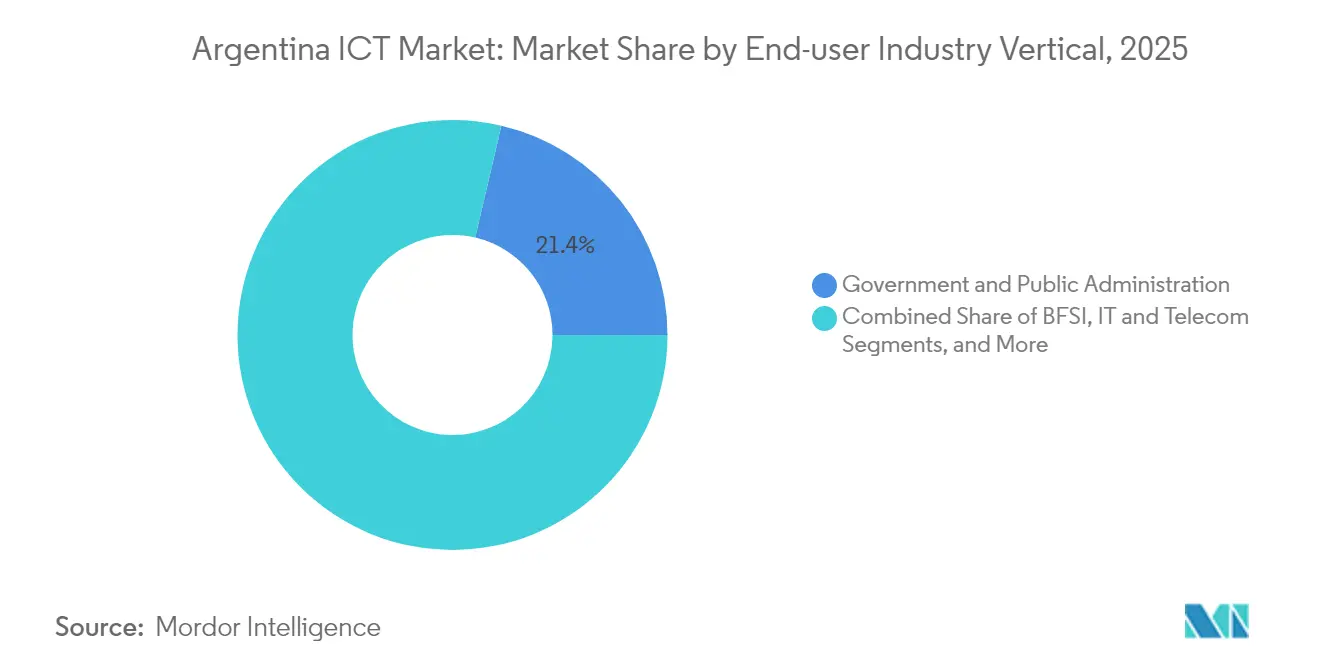
- By End-user Industry Vertical, Government and Public Administration made up 21.35% of 2025 demand, and Gaming and Esports is positioned to expand at a 15.12% CAGR to 2031.
Note: Market size and forecast figures in this report are generated using Mordor Intelligence’s proprietary estimation framework, updated with the latest available data and insights as of 2026.
Argentina ICT Market Trends and Insights
Drivers Impact Analysis*
| Driver | (~) % Impact on CAGR Forecast | Geographic Relevance | Impact Timeline |
|---|---|---|---|
| Government digital-public-services expansion | +2.8% | National with focus on Buenos Aires and provincial capitals | Medium term (2-4 years) |
| Roll-out of 5G spectrum and infrastructure | +3.2% | Buenos Aires, Córdoba, Santa Fe with national expansion | Medium term (2-4 years) |
| Acceleration of cloud and SaaS adoption by enterprises | +2.1% | Nationwide, strongest in AMBA tech corridors | Short term (≤ 2 years) |
| Remote-work led broadband upgrades | +1.4% | Suburban and secondary cities nationwide | Short term (≤ 2 years) |
| Public-private edge data-center initiatives | +1.8% | Buenos Aires, Mendoza, Córdoba zones | Long term (≥ 4 years) |
| Peso-hedge demand for IT export services | +2.3% | Software clusters across the country | Medium term (2-4 years) |
| Source: Mordor Intelligence | |||
Government Digital-Public-Services Expansion
The Mi Argentina platform unified more than 180 public services and processed millions of digital transactions in 2024, illustrating how state digitization stimulates enterprise demand for cybersecurity, cloud hosting, and workflow software. [1]ENACOM, “Reglamento de Gestión Documental Electrónica,” argentina.gob.ar The GDE system cut documentation cycles from weeks to hours, pushing ministries toward paperless operations that ripple into private sector efficiency projects. Digital signatures, e-invoice mandates, and open-data portals reinforce a legal backbone that legitimizes electronic records in court and commerce. Provincial administrations clone the federal blueprint, spreading procurement of SaaS and AI analytics beyond Buenos Aires. ENACOM enforces data-protection rules aligned with international norms, which bolsters confidence among multinationals evaluating the Argentina ICT market. These policies combine to lift the adoption of enterprise platforms that underpin public-sector digital engagement.
Roll-out of 5G Spectrum and Infrastructure
Claro’s Nokia-powered launch and Telecom Argentina’s standalone 5G core deliver sub-10-millisecond latency, enabling industrial automation use cases that neighboring countries cannot yet support.[2]Nokia, “Nokia and Claro Expand 5G in Argentina,” nokia.com Additional spectrum auctions scheduled for 2025 cement a roadmap for contiguous coverage that extends to logistics corridors in Santa Fe and Córdoba. Manufacturers integrate machine-vision quality checks over private 5G slices, while smart-city pilots deploy edge AI for traffic management. Spectrum licenses require rural build-out, expanding broadband reach and indirectly enlarging the Argentina ICT market. The low-latency grid also supports cloud gaming and immersive learning, spawning service niches for carriers and hyperscalers.
Acceleration of Cloud and SaaS Adoption by Enterprises
Microsoft and the SME ministry trained more than 100,000 participants in Azure, AI, and cybersecurity by 2025, closing critical skills gaps that historically stunted SaaS uptake. SAP partner Baitcon reports a wave of S/4HANA migrations as firms race to retire legacy R/3 ahead of the 2027 deadline, a trend mirrored by IBM channel allies. Subscription pricing buffers budgets from peso volatility, appealing to finance managers wary of capital spend. Hybrid architectures flourish, blending local data residency with scalable cloud analytics for manufacturing and BFSI clients. Collectively, these shifts add urgency to vendor roadmaps and inject fresh momentum into the Argentina ICT market.
Remote-Work Led Broadband Upgrades
Starlink’s entry at ARS 56,100 per month forces incumbents to boost speeds and broaden fiber footprints, while Amazon Kuiper’s 2025 arrival promises even lower rates and local-currency billing. Software developers in Rosario, Mendoza, and Mar del Plata gain access to stable low-latency links that match metropolitan quality, encouraging diaspora talent to remain in regional cities. Enterprises adopt SD-WAN overlays to bond satellite and terrestrial links, safeguarding uptime for global client delivery. Accelerated last-mile upgrades enlarge the Argentina ICT market addressable base by turning connectivity from a constraint into an enabler. Broadband competition also cuts prices for rural schools and clinics, supporting inclusive digitization.
Restraints Impact Analysis*
| Restraint | (~) % Impact on CAGR Forecast | Geographic Relevance | Impact Timeline |
|---|---|---|---|
| Chronic economic instability and high inflation | -3.1% | National, most severe in consumer and SME segments | Short term (≤ 2 years) |
| Import controls on ICT hardware | -2.4% | National, concentrated impact on hardware-dependent sectors | Medium term (2-4 years) |
| Cybersecurity and AI skills shortage | -1.8% | National, acute in Buenos Aires and technology corridors | Long term (≥ 4 years) |
| Rising energy costs for data-center operations | -1.2% | Buenos Aires, Córdoba, and industrial zones | Medium term (2-4 years) |
| Source: Mordor Intelligence | |||
Chronic Economic Instability and High Inflation
Inflation decelerated to 117.8% in 2024 yet still erodes purchasing power, prompting enterprises to defer capital IT projects and pivot toward opex-based SaaS. Peso swings inflate the local currency sticker price of licenses denominated in USD, pressuring SME budgets. Investors factor macro risk into discount rates, raising hurdle returns for long-dated ICT ventures. Consumer electronics demand remains elastic, reducing near-term growth in the Argentina ICT market. Conversely, fintech and export-service providers thrive under volatility, proving that sub-segments can outperform macro headwinds.
Import Controls on ICT Hardware
SEDI registration, statistical charges, and 35% tariffs add 15–30 days to inbound hardware deliveries, complicating timelines for data-center buildouts and 5G base-station expansion.[3]US Trade Administration. "Argentina - Information and Communication Technology." trade.gov Value-added resellers monetize the complexity but pass compliance costs through to clients. Enterprises respond by extending refresh cycles and adopting virtualized alternatives that lighten hardware footprints. Hybrid cloud strategies gain traction as an import-mitigation tactic, although latency-sensitive industries still need local gear. Overall, import frictions cap the upside for hardware-heavy slices of the Argentina ICT market.
*Our forecasts treat driver/restraint impacts as directional, not additive. The impact forecasts reflect baseline growth, mix effects, and variable interactions.
Segment Analysis
By Product Type: Communication Services Lead Infrastructure Modernization
Communication Services captured 37.12% of Argentina ICT market share in 2025 as telcos funneled capital into standalone 5G cores and fiber backhaul, cementing network readiness for data-intensive workloads. The segment underpins demand for OTT video, IoT telemetry, and high-frequency trading links that ride on low-latency bandwidth. Cloud Services, projected to post a 14.55% CAGR, represent the pivot away from capex-heavy server rooms toward scalable IaaS and PaaS models. IT Services follow with managed-service contracts that blend on-site support and remote monitoring, cushioning enterprises against talent shortages. IT Hardware trails due to import delays that stretch procurement timelines and inflate landed costs.
The service-centric pivot signals that buyers prioritize flexibility and rapid deployment over ownership, a stance reinforced by peso volatility. Cybersecurity spending courses through every category, rising from USD 1.58 billion in 2024 to an expected USD 2.35 billion by 2029, a trend that puts integrated platform vendors in pole position. Argentina ICT market size for Communication Services is forecast to expand steadily as 5G monetization broadens, while the relative importance of hardware depreciates. Vendors tie connectivity with SaaS bundles, enabling cross-sell synergies that raise average revenue per user and defend margins against price competition.



By Enterprise Size: SMEs Drive Digital Transformation
Large Enterprises controlled 60.72% of 2025 revenue, leveraging dedicated IT budgets to roll out ERP, CRM, and data-lake initiatives that span multiple business units. However, SMEs outpace with a 14.89% CAGR as cloud vouchers, no-code platforms, and government-sponsored training democratize access to advanced tooling. Argentina ICT market size attributable to SMEs is projected to climb sharply as fintech solutions replace bank branch visits and virtual wallets reach 64% usage penetration.
SMEs display agility, adopting pay-as-you-go models that shield cash flow and reduce lock-in. Survey data show 68% of SME executives in software and IT expect higher sales in 2025, further energizing demand for SaaS, cybersecurity, and digital marketing stacks. Large Enterprises confront legacy integration and compliance challenges that slow decision cycles, yet they sustain baseline volume for tier-one vendors within the Argentina ICT industry. Dual-track growth broadens the customer pyramid, forcing suppliers to segment offerings and pricing with precision.
By End-user Industry Vertical: Gaming Emerges as Growth Leader
Government and Public Administration delivered 21.35% of 2025 demand as electronic invoicing, digital IDs, and open data portals required robust software, cybersecurity, and systems integration. Gaming and Esports, buoyed by the BA Gaming program and nationwide tournaments, is forecast to grow at a 15.12% CAGR, catalyzed by affordable 5G latency and municipal esports labs. BFSI continues to ride fintech momentum with 383 firms expanding 11.7% year over year, relying on micro-services and API-based wallets.
Manufacturing taps IoT sensors and digital twins for predictive maintenance, while Healthcare expands telemedicine built on encrypted video and AI-assisted triage. Energy and Utilities harness smart-grid management software that reconciles renewable intermittency with consumer demand. Retail and Logistics lean on real-time inventory visibility and last-mile route optimization, themes that intersect with the Argentina ICT market appetite for analytics and automation. The wide spectrum of vertical use cases diffuses risk and supports an all-weather growth profile.
Geography Analysis
Buenos Aires anchors the Argentina ICT market with the densest concentration of data centers, cloud points of presence, and headquarters for Globant, Mercado Libre, and major telcos. The metro hosts edge facilities optimized for AI inference, while city grants bankroll pilot projects in blockchain land registries and e-mobility. Córdoba and Santa Fe emerge as secondary hubs thanks to university talent and public-private incubators that specialize in ag-tech and industrial automation.
Satellite internet extends advanced connectivity to Patagonia, Cuyo, and Northwest regions, reducing the urban-rural digital divide and spawning micro-outsourcing clusters in cities such as Salta and Neuquén. RIGI incentives lure hyperscaler investments to Mendoza where low seismic risk and cool nighttime temperatures favor efficient data-center operations. Cross-border links position Argentina as a nearshore alternative for North American clients, shortening latency compared with Asian destinations.
The national dispersion of skilled labor, renewable resources, and policy incentives allows provinces to carve niche competencies, reinforcing resilience across the Argentina ICT market. Initiatives such as the proposed nuclear-powered AI hub in Patagonia signal ambition to convert natural advantages into high-value services infrastructure. As network backbones and talent pipelines mature, regional ecosystems inside Argentina interconnect into an integrated digital economy that also plugs seamlessly into Latin American trade corridors.
Regulatory Landscape
Argentina’s ICT regulatory framework is anchored by Ley Argentina Digital 27.078 (as amended) and is overseen primarily by ENACOM under the Secretariat of Innovation, Science and Technology. In April 2024, Decree 302/2024 pushed the sector further toward deregulation by replacing state price controls with a market-based “fair and reasonable” standard for ICT service pricing, which affects how operators structure retail and wholesale offers amid inflation and competitive pressure.
On the equipment side, ENACOM Resolution 57/2026 introduced a modernized homologation scheme for telecom devices, with implementation effective September 1, 2026. The approach shifts parts of certification and conformity assessment to recognized private agencies while keeping continuity through RAMATEL registrations, which remain valid for three years under current rules during the transition, with the stated goal of reducing friction for device approvals and network rollouts.
Value Chain Analysis
Argentina’s ICT value chain runs from international OEMs and software publishers to local importers and distributors, then to telcos and tower/fiber infrastructure owners, systems integrators and managed service providers, and vertical solution developers serving government, BFSI, and industry. Hardware inflows are shaped by compliance and approval requirements, including homologation, which increases the influence of local channel partners, financing, and inventory planning. It also pushes some buyers toward cloud and virtualized alternatives when lead times stretch.
Network deployment and service delivery rely on regulated infrastructure sharing, with passive infrastructure governed by the Reglamento de Comparticion de Infraestructura Pasiva (RCIP), including compensation mechanisms for shared assets such as utility poles. Public programs also feed through the chain via ENACOM-managed instruments such as Universal Service Fund (FSU) resources, which support connectivity and public-interest platforms (for example, projects tied to emergency alerting capabilities), creating procurement pull-through for carriers, integrators, cybersecurity vendors, and cloud hosting providers.
Competitive Landscape
Global vendors like IBM, Microsoft, and SAP command strategic accounts through extensive local partner networks that tailor solutions to Spanish-language workflows and regulatory specifics. Telco infrastructure remains concentrated among Claro, Telecom Argentina, and Telefónica Movistar, yet satellite entrants Starlink and upcoming Amazon Kuiper disrupt pricing and coverage assumptions.
Local champions Globant, Baitcon, and ADP Consultores leverage cultural proximity and agile delivery to win modernization projects from mid-market clients that prize rapid iteration. Fintech disruptors Mercado Pago, Ualá, and Naranja X exploit high cash usage and inflation hedging behavior, registering double-digit growth despite macro pressures. Cybersecurity service providers scramble to staff SOCs amid soaring incident rates, opening doors for niche MSSP specialists.
Import barriers and currency swings reward firms with logistics know-how and hedged balance sheets. Vendors that bundle financing with hardware or offer peso-indexed SaaS tiers edge competitors reliant on hard-currency billing. Overall, rivalry centers on navigating regulation, delivering talent at scale, and capturing vertical niches driving the Argentina ICT market expansion.
Argentina ICT Industry Leaders
-
Microsoft Australia Pty Ltd
-
Amazon Web Services Australia Pty Ltd
-
Telstra Group Limited
-
Alphabet Inc. (Google Australia Pty Ltd)
-
IBM Australia Limited
- *Disclaimer: Major Players sorted in no particular order

Market Opportunities and Future Outlook
Government-led digitization and public-safety communications are generating specific demand for software platforms, carrier enablement, systems integration, and security. In July 2026, Argentina moved ahead with implementing the AlertAR mobile emergency alert system using Cell Broadcast technology, alongside a public tender. This supports spending on carrier network upgrades, message-orchestration platforms, monitoring, and resilience services across mobile operators and public agencies.
Backbone connectivity and content-related initiatives also present active opportunity pockets. In July 2026, ENACOM and the province of Chubut formalized the Chubut Hub Digital 2030 initiative to establish a second international subsea fiber optic cable landing point, creating additional capacity routes, redundancy, and options for regional edge hosting outside AMBA. In the same period, ENACOM launched the Programa de Innovacion Audiovisual (PIA), adding momentum for production technology, cloud workflows, distribution platforms, and related cybersecurity and rights management tooling across Argentina’s audiovisual and digital media value chain.
Recent Industry Developments
- July 2026: Substrate AI won a contract from the Government of the City of Buenos Aires to implement the Serenity Star platform as the base for BAX, the government's AI assistant. The initiative supports public sector digital services and signals Argentina's growing AI delivery capabilities in government contexts.
- July 2026: Lakaut launched FID (Firma Instantánea Digital), a cloud-based digital signature platform for individuals and SMEs. The service supports faster digital onboarding and regulatory compliant workflows, reinforcing Argentina's digital services infrastructure.
- July 2026: ADATA introduced TRUSTA, an enterprise storage and processing brand for datacenters and servers, in collaboration with distributors Stylus, Elit, AIR Computers, and Microglobal. The development expands local hardware supply chains for cloud and datacenter deployments and may enable peso-denominated options.


Research Methodology Framework and Report Scope
Market Definition and Coverage
For this report, the Argentina ICT market is defined as the value of spending and revenues linked to information and communications technology within Argentina, covering core IT and communications products and services used by enterprises, government, and consumers.
Scope exclusions: We exclude informal or unreported transactions and any double-counting between bundled telecom plans and the underlying IT components.
Segmentation Overview
-
By Product Type
-
IT Hardware
- Computer Hardware
- Networking Equipment
- Peripherals
- IT Software
-
IT Services
- IT Consulting and Implementation
- IT Outsourcing (ITO)
- Business Process Outsourcing (BPO)
- Managed Security Services
- Cloud and Platform Services
- IT Infrastructure
- IT Security/Cybersecurity
- Communication Services
-
IT Hardware
-
By Enterprise Size
- Small and Medium-sized Enterprises
- Large Enterprises
-
By End-user Industry Vertical
- Government and Public Administration
- BFSI
- IT and Telecom
- Energy and Utilities
- Retail, E-commerce, and Logistics
- Manufacturing and Industry 4.0
- Healthcare and Life Sciences
- Oil and Gas
- Gaming and Esports
- Other Verticals
Data Sources, Market Sizing, and Validation
Desk Research
Desk research starts with mapping the Argentina ICT demand pool and the local supply structure, before any numbers are modeled. To do that, we review public statistics and policy signals such as ENACOM publications, INDEC macro series, and official trade data that helps track imported ICT equipment flows by category.
We also use sources such as ITU connectivity indicators, World Bank digital development metrics, and OECD-style definitions where relevant, and then cross-check them against company filings, annual reports, investor presentations, and reputable press coverage on network and cloud investments. When deeper context is needed, paid databases are used selectively for company financials and intelligence, patent databases, and shipment-level import and export records to validate directional trends. These sources are not exhaustive, and many other public and paid references were used for data collection, validation, and clarification.
Primary Interviews and Surveys
Primary work is used to pressure-test assumptions that are hard to observe in public data, especially pricing trends, mix shifts, and adoption timing for key ICT services. We speak with operators, IT service providers, distributors, large buyers, and channel participants across Argentina so the model reflects real buying behavior and contracting patterns. Respondent input is then used to close gaps from desk research and to triangulate the final market totals before forecasts are extended.
Distribution of primary research fieldwork respondents
| Company type | Respondent position |
|---|---|
| Top tier: 27% | CXOs: 13% |
| Mid tier: 58% | Functional/Unit leaders: 39% |
| Smaller Players: 15% | Managers: 48% |
Market-Sizing & Forecasting
Sizing starts with a top-down build where national ICT spend is reconstructed using a mix of macro indicators and sector signals, then split into ICT buckets aligned with what buyers in Argentina actually procure. After forming the totals, we corroborate them with selective bottom-up checks such as sampled supplier revenues, channel discussions on volumes, and sanity checks on average selling price movements for common ICT categories.
For Argentina, key inputs include mobile and fixed broadband penetration, 4G to 5G rollout timing, enterprise cloud migration pace, import dependency for hardware (and related trade and FX effects), public sector digitization programs, and inflation-linked pricing behavior in long-term contracts. Where some sub-areas have limited visibility, we estimate them using proxy indicators and then tighten the ranges through follow-up calls with local experts.
For forecasting, we use scenario analysis so the outlook can reflect different paths for exchange rate normalization, investment cycles, and enterprise IT budget recovery. The scenarios are anchored to what interviewees expect for volume growth and price evolution. The final forecast is presented as a single base case after extreme assumptions are removed and the inputs are aligned to observable market signals.
Data Validation & Update Cycle
Validation is done through triangulation across desk inputs, interview feedback, and independent market signals such as subscriber bases, broadband traffic growth, and import patterns. These are checked for consistency with the modeled revenue trajectory. Outliers are reviewed at multiple steps, and if a key variable moves in an unexpected direction, the assumptions are rechecked and the relevant experts are contacted again.
Before sign-off, the model is reviewed for arithmetic integrity, unit consistency, and year-to-year reasonableness. We also compare it against known investment announcements and regulatory changes that could shift spend timing. Reports are refreshed annually, with interim updates when material events occur, and a final update pass is completed before delivery so clients receive the latest view.
Mordor Intelligence's Argentina Ict Market Size Compared Against Other Published Estimates
Published ICT market numbers for Argentina can look far apart because different authors mix categories and valuation methods, and they also pick different years or exchange-rate treatments. We keep the comparison practical by focusing on what is counted, what is not counted, and how the USD values are translated across volatile periods.
Telecom infrastructure expenses sit outside Mordor Intelligence's scope in this estimate, which is one reason our 2025 value does not line up with figures that explicitly fold in infrastructure spending and report a smaller, FX-sensitive USD total. Other gaps often come from whether the estimate uses value added versus gross revenue, how bundled telecom plans are allocated, and whether the publisher refreshes assumptions after inflation and currency changes.
Benchmark comparison
| Source | Market Size | Gaps in Research Methodology |
|---|---|---|
| Mordor Intelligence | USD 20.58 B (2025) | |
| Industry Analyst Brief A | USD 5.32 B (2024) | Uses a value-added framing and also includes telecom products and services with explicit infrastructure expense lines, and the USD series is heavily affected by the conversion approach during high FX volatility. |
| Business News Desk B | USD 3.20 B (2023) | Cites a narrow, snapshot USD figure with limited visibility on category coverage, and it is presented without a transparent bridge from subscriptions, usage, and pricing into full-year ICT revenue. |
The table shows that the spread is mainly explained by category inclusion, valuation basis, and currency translation, rather than a simple disagreement on demand direction. By keeping inputs tied to observable adoption signals and by documenting how major ICT buckets are constructed, the resulting market size stays traceable to clear steps that can be rechecked as new data comes in.


Key Questions Answered in the Report
What is the projected value of the Argentina ICT market in 2031?
The sector is forecast to reach USD 45.86 billion by 2031, reflecting a 14.29% CAGR over 2026-2031.
Which segment is growing fastest within the Argentina ICT space?
Cloud Services are expected to expand at a 14.55% CAGR through 2031 as enterprises migrate workloads to scalable platforms.
How are SMEs influencing technology demand in Argentina?
SMEs are projected to post a 14.89% CAGR by leveraging cloud vouchers, fintech tools, and government-backed training that lower adoption barriers.
Why is 5G important for Argentina’s digital agenda?
Standalone 5G networks enable low-latency applications in manufacturing, logistics, and gaming, making them a cornerstone for next-generation digital services.
What challenges do hardware imports face?
SEDI registration, tariffs up to 35%, and extended currency-approval timelines add 15–30 days to delivery, raising costs and slowing infrastructure deployments.
How is satellite internet shaping connectivity?
Starlink’s rollout and Amazon Kuiper’s planned launch boost rural broadband competition, prompting incumbent ISPs to enhance fiber and pricing models.
Page last updated on:





