
Market Overview
| Study Period | 2020 - 2031 |
|---|---|
| Forecast Data Period | 2026 - 2031 |
| Historical Data Period | 2020 - 2024 |
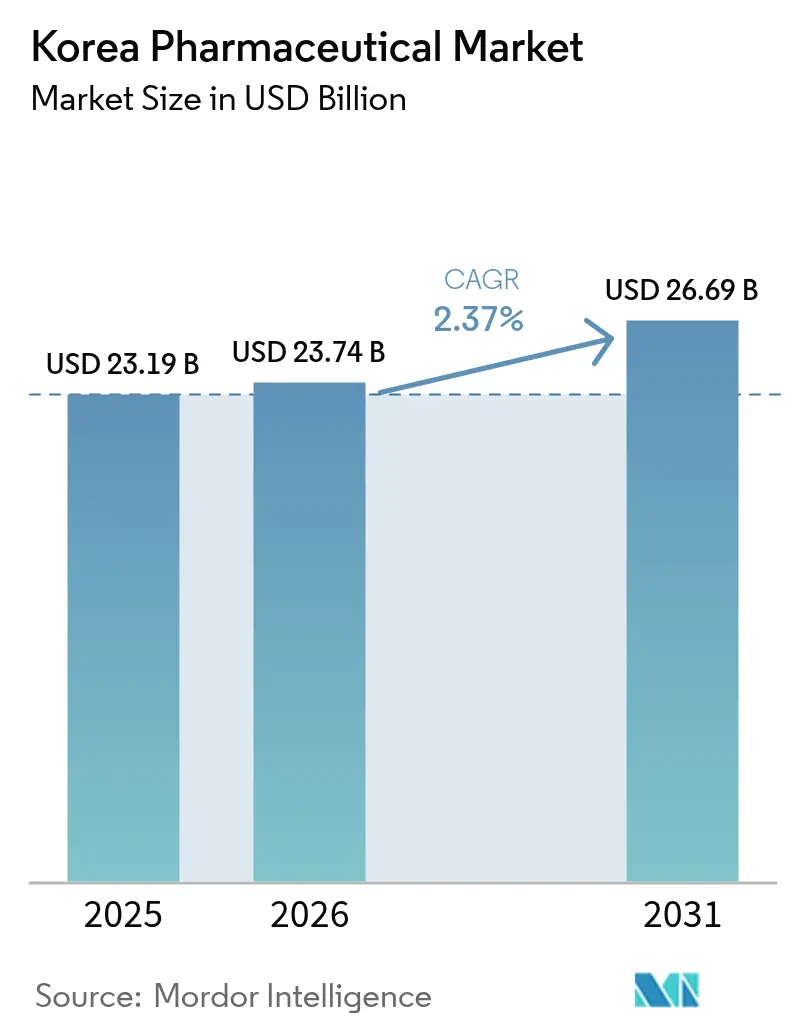
| Base Year Market Size (2025) | USD 23.19 Billion |
| Market Size (2026) | USD 23.74 Billion |
| Market Size (2031) | USD 26.69 Billion |
| Growth Rate (2026 - 2031) | 2.37 % |
Major Players *Disclaimer: Major Players sorted in no particular order Image © Mordor Intelligence. Reuse requires attribution under CC BY 4.0. | |
Korea Pharmaceutical Market Analysis by Mordor Intelligence
The Korea pharmaceutical market size is expected to grow from USD 23.19 billion in 2025 to USD 23.74 billion in 2026 and is forecast to reach USD 26.69 billion by 2031 at 2.37% CAGR over 2026-2031. This modest rise sits at the intersection of a super-aged society, export-oriented biologics capacity, and pricing rules that favor value-based care. Government funding for biomedical R&D climbs 15% in 2025, signaling sustained political will to back novel therapies even as the actual-transaction-price scheme continues to restrain reimbursement ceilings. Biologics plants in Songdo now supply leading multinationals and drive record pharma exports, while data-protection reforms grant 4–10 years of exclusivity depending on drug class. Cardiovascular drugs dominate scripts because 45.2% of middle-aged and senior Koreans have hypertension. Oncology lines, benefitting from accelerated MFDS review and aggressive R&D tax credits, post the fastest growth through 2030. Digital health laws and the coming debate on tele-pharmacy hint at longer-term channel disruption that could reshape the Korea pharmaceutical market.
Key Report Takeaways
- By therapeutic category, cardiovascular therapies held 14.05% of the Korea pharmaceutical market share in 2025; oncology is projected to expand at a 4.24% CAGR to 2031.
- By drug type, prescription medicines represented 86.88% of the Korea pharmaceutical market size in 2025, while OTC products advance at a 3.04% CAGR through 2031.
- By technology, small molecules accounted for 67.42% of the Korea pharmaceutical market size in 2025; biologics are moving at a 3.72% CAGR to 2031.
- By formulation, tablets commanded 51.55% share of the Korea pharmaceutical market size in 2025, and injectables are climbing at a 2.86% CAGR through 2031.
- By distribution channel, hospital pharmacies controlled 45.62% of the Korea pharmaceutical market size in 2025; online pharmacies register the quickest 3.81% CAGR to 2031.
Note: Market size and forecast figures in this report are generated using Mordor Intelligence’s proprietary estimation framework, updated with the latest available data and insights as of 2026.
Korea Pharmaceutical Market Trends and Insights
Drivers Impact Analysis*
| Driver | (~) % Impact on CAGR Forecast | Geographic Relevance | Impact Timeline |
|---|---|---|---|
| Supportive government policy framework for biopharma industrialization | +0.7% | National and export markets | Medium term (2-4 years) |
| Aging population and rising chronic disease burden | +0.6% | Nationwide, urban hubs | Long term (≥4 years) |
| Surge in biosimilar adoption backed by domestic manufacturing scale | +0.5% | Domestic and EU/US export corridors | Medium term (2-4 years) |
| Growing export-oriented CDMO contracts from NA & EU clients | +0.3% | North America and Europe | Short term (≤ 2 years) |
| Universal national health insurance coverage driving drug consumption | +0.2% | Nationwide | Long term (≥ 4 years) |
| Duty-free access to the EU and United States | +0.4% | Nationwide | Short term (≤ 2 years |
| Source: Mordor Intelligence | |||
Supportive Government Policy Framework for Biopharma Industrialization
The 2023 “Bio Economy 2.0” plan lifts biopharma funding to 36.7 billion won in 2025, trims approval-to-reimbursement lag via an MFDS linkage system, and cements Seoul’s position as the world’s top city for industry-sponsored trials. These levers fuel pipeline expansion across antibody-drug conjugates, RNA therapeutics, and cell therapies, enhancing export competitiveness for the Korea pharmaceutical market.
Aging Population and Rising Chronic Disease Burden
With citizens 65+ passing the 20% threshold in 2025, chronic illness prevalence soars. Out-of-pocket medical costs for seniors managing multiple conditions average USD 1,163.8 versus USD 456.1 for peers without comorbidities [1]Soojin Park, “Effects of Changes in Multiple Chronic Conditions on Medical Costs among Older Adults in South Korea,” Healthcare, mdpi.com.Government “Essential Healthcare” packages that bolster local clinics and telemonitoring expand long-term demand for antihypertensives, statins, and antidiabetics across the Korea pharmaceutical market.
Surge in Biosimilar Adoption Backed by Domestic Manufacturing Scale
Samsung Biologics’ fifth plant raises capacity to 784,000 liters. Korea now ranks second worldwide in FDA-approved biosimilars and develops 1.5 new entries per year. This scale advantage underpins brisk export wins for trastuzumab and adalimumab copies and cements the Korea pharmaceutical market as a global biosimilar hub.
Growing Export-Oriented CDMO Contracts from NA & EU Clients
Contracts exceeding USD 13 billion link Korean plants with 16 of the top-20 multinational drug makers. Celltrion alone targets USD 2.1 billion in annual CDMO sales by 2031. These deals fortify supply chains for European and U.S. launches, elevating the Korea pharmaceutical market in global value networks.
Restraints Impact Analysis*
| Restraint | (~) % Impact on CAGR Forecast | Geographic Relevance | Impact Timeline |
|---|---|---|---|
| Drug re-pricing policy compresses margins | -0.4% | Nationwide, stronger on innovators | Medium term (2-4 years) |
| Risk-sharing agreements delay ultra-orphan launches | -0.3% | National specialty segments | Short term (≤ 2 years) |
| Heavy reliance on imported API | -0.3% | Global supply chains | Short term (≤ 2 years) |
| GMP-qualified workforce shortage | -0.2% | Nationwide manufacturing hubs | Medium term (2-4 years) |
| Source: Mordor Intelligence | |||
Drug Re-pricing Policy Compresses Margins
Actual-transaction-price audits and tougher volume caps cut list prices after market launch. Generics still lack decisive price gaps versus originals, curbing competition [2]Da Hye Lee, “International Comparison of Generic Competition, Prices, and Usage Trends: South Korea and G20 Countries,” Frontiers in Public Health, frontiersin.org. Oncology absorbs 46.2% of new-drug spending, squeezing funds for other areas and heightening pressure to renegotiate rebates within the Korea pharmaceutical market.
Risk-Sharing Agreements Delay Ultra-Orphan Launches
Sixty-eight products sit under Korea’s RSA list, but complex rebate models extend negotiations beyond the statutory 30 days [3]MedPath, “South Korea Accelerates Drug Reimbursement Process with New Pilot Program,” MedPath, trial.medpath.com. Although rare-disease drugs can bypass cost-effectiveness proofs, definitional disputes over “innovative new drug” stall approvals. These delays moderate near-term uptake for ultra-orphan therapies in the Korea pharmaceutical market.
*Our forecasts treat driver/restraint impacts as directional, not additive. The impact forecasts reflect baseline growth, mix effects, and variable interactions.
Segment Analysis
By Therapeutic Category: Chronic Diseases Reshape Treatment Paradigms
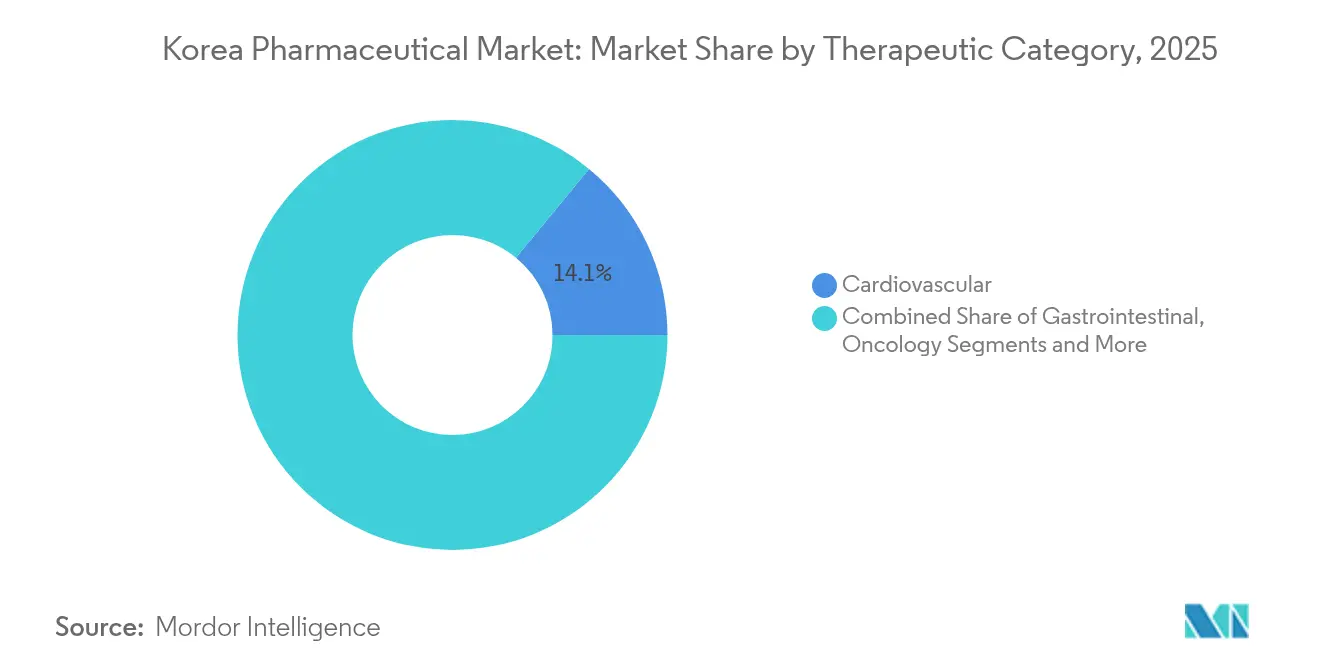
Cardiovascular drugs delivered 14.05% of the Korea pharmaceutical market size in 2025, driven by high hypertension prevalence and strong compliance with combination pills. Oncology outpaces all others at a 4.24% CAGR, backed by accelerated MFDS reviews and robust venture funding for antibody-drug conjugates showcased at AACR 2025.
Anti-diabetic segments gain traction as DPP4 and SGLT2 inhibitors secure guideline status, while GI therapies rebound on new acid-blocker launches such as Fexuclue, whose sales jumped 57% in early 2024. Respiratory products stabilize post-COVID, and rare-disease portfolios benefit from strengthened data exclusivity, increasing their viability inside the Korea pharmaceutical market.



By Drug Type: Prescription Leadership Amid OTC Acceleration
Prescription products held 86.88% Korea pharmaceutical market share in 2025, cemented by universal insurance and strict physician-dispense separation. Branded drugs survive list-price erosion through line-extension reformulations, while generics struggle to win volume due to identical pricing rules.
OTC medicines, though smaller, clock a 3.04% CAGR, helped by a 2012 law that lets convenience stores sell select analgesics. Consumer self-care apps guide dosing and refill alerts, deepening penetration of vitamins and digestive aids within the Korea pharmaceutical market.
By Technology: Biologics Gain Momentum Against Small Molecules
Small molecules still represent 67.42% of the Korea pharmaceutical market size in 2025 thanks to cost advantages and oral convenience. Process intensification and continuous manufacturing keep margins stable.
Biologics rise at a 3.72% CAGR, propelled by mega-capacity in Songdo and the Advanced Regenerative Medicine Act that sets clear CMC and follow-up rules. Biosimilars unlock hospital savings, freeing budgets for breakthrough checkpoint inhibitors and cell therapies, reinforcing the Korea pharmaceutical market as a biologics powerhouse.
By Formulation: Tablets Dominate While Injectables Advance
Tablets made up 51.55% of 2025 volume, favored for low cost and stability. Continuous-tableting lines and taste-mask coatings extend product life cycles across chronic care.
Injectables gain a 2.86% CAGR due to biologics and long-acting depots. Pre-filled syringes and auto-injectors reduce clinic time, while nanoparticle suspensions improve solubility for poorly absorbed APIs . Formulators also explore cyclodextrin complexes such as KLEPTOSE® for antibody stabilization.
By Route of Administration: Oral Dominance with Parenteral Growth
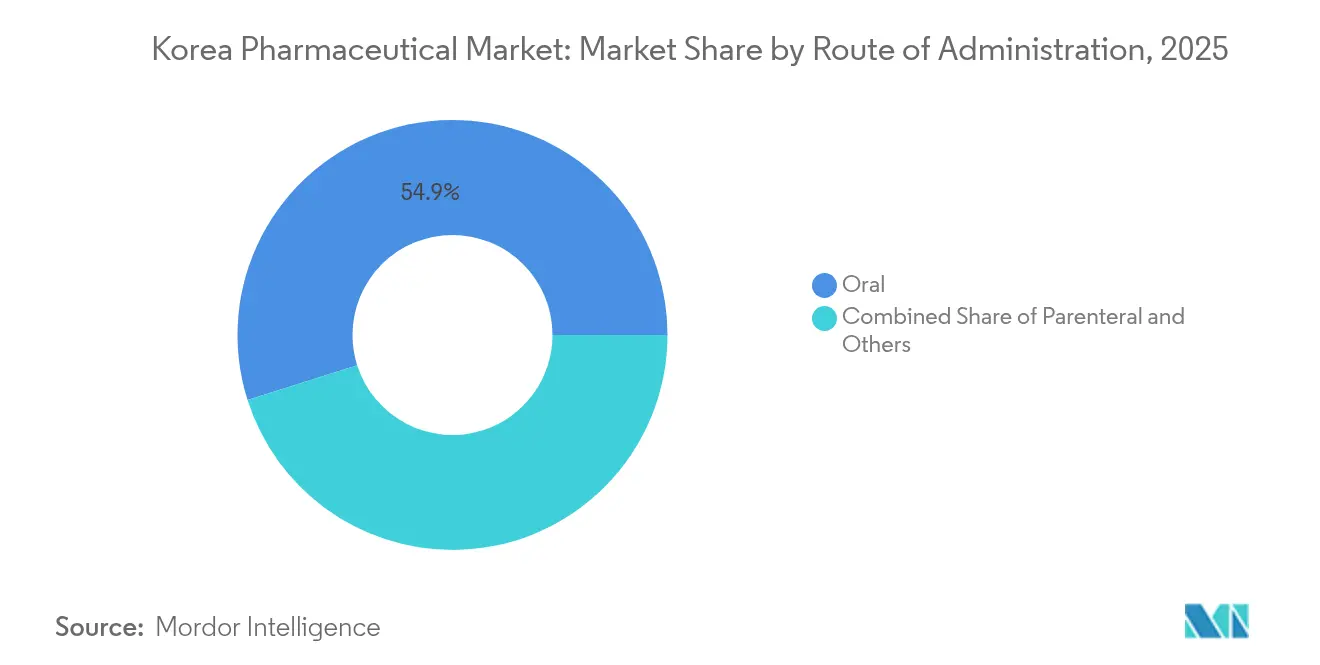
Oral drugs account for 54.88% of prescriptions, reflecting 73.1% patient preference for pills. Nanotechnology now tackles peptide absorption hurdles, widening the future oral pipeline.
Parenterals grow at 2.94% CAGR as biologics, vaccines, and gene therapies demand direct bloodstream delivery. Dual-chamber syringes and mRNA-ready cold-chains spread quickly, reinforcing the Korea pharmaceutical market’s readiness for next-wave therapies.
By Distribution Channel: Hospital Dominance Amid Digital Transformation
Hospital pharmacies controlled 45.62% of 2025 spending, aided by bundled tenders and embedded e-procur¬ement systems. Retail pharmacies focus on chronic-care counseling but face thinner margins after convenience stores entered OTC sales.
Online pharmacies, though currently restricted, deliver a 3.81% CAGR for wellness lines, previewing significant upside once tele-pharmacy rules evolve. The Digital Medical Products Act, effective January 2025, sets cybersecurity and performance standards for digital therapeutics, laying groundwork for future virtual dispensing inside the Korea pharmaceutical market.
Geography Analysis
Metropolitan clusters-Seoul, Busan, Incheon-absorb most prescriptions due to dense hospital networks and earlier adoption of innovative drugs. Seoul hosts the world’s highest tally of industry trials, letting firms gauge real-world effectiveness quickly and target formulary inclusion faster than in secondary cities. Smart-hospital projects, with AI-assisted dosing and robotics, fortify big-city lead in the Korea pharmaceutical market.
Rural districts, facing depopulation, record lower cancer-screening uptake. Older adults prefer to age in familiar settings despite travel barriers, pressing wholesalers to refine cold-chain logistics and community pharmacies to expand home-delivery services. Government tele-health pilots aim to close monitoring gaps, improving chronic-disease medication adherence across the Korea pharmaceutical market.
Special economic zones, led by Songdo Bio Cluster, concentrate manufacturing and R&D. Tax breaks, bonded warehouses, and streamlined customs speed biologic exports to the EU and U.S. Additional 17 bio-clusters under development will spread this model nationwide, diversifying geographic contribution and enlarging the Korea pharmaceutical market footprint.
Regulatory Landscape
South Korea regulates pharmaceuticals primarily through the Ministry of Food and Drug Safety (MFDS) for approvals, GMP, and post-market safety, while reimbursement and listing decisions sit with the Ministry of Health and Welfare (MOHW) under the National Health Insurance framework. MFDS implemented a 240-day drug approval review timeline effective June 1, 2026, and shortened the first review feedback timeline for applications to about 25 days, supporting faster and more predictable development-to-launch planning, especially for oncology and rare-disease products.
Compliance tightening and IP-like protections are also changing go-to-market strategy. The Pharmaceutical Affairs Act introduced a Contract Sales Organization (CSO) reporting system and mandatory training effective October 2024, raising distributor and field-force governance, and the new Pharmaceutical Data Protection System replaced the prior re-examination program effective February 21, 2025, with 4 to 10 years of data protection depending on the drug class. The government’s 3rd Comprehensive Plan for the Development and Support for the Bio-Pharmaceutical Industry (2023-2027) anchors policy support for clinical trials and exports, reinforcing Korea’s position as both an innovation and manufacturing base.
Competitive Landscape
Competition blends rising domestic giants with entrenched multinationals. Samsung Biologics runs the planet’s largest single-site biologics facility and secures CDMO contracts with 16 of the top-20 pharma producers. Celltrion funnels biosimilar profits into 13 novel candidates and eyes a 2027 Nasdaq listing. Yuhan Corporation’s EGFR-targeting Lazertinib is Korea’s first home-grown oncology product to clear the FDA, unlocking a USD 750 million global sales horizon.
Multinationals defend territory with checkpoint inhibitors and cardiometabolic blockbusters, partnering with local CROs for streamlined development and co-promotion. Mid-tier firms pivot toward dermatology, metabolic, or ophthalmology niches, reducing direct collision with bigger players.
Digital innovation becomes the new divider. AI-driven discovery start-ups compress lead-optimization cycles, and drug-delivery ventures attract USD 19.9 million VC funding since 2024. Manufacturing plants deploy predictive maintenance, minimizing downtime and reinforcing Korea pharmaceutical market quality credentials.
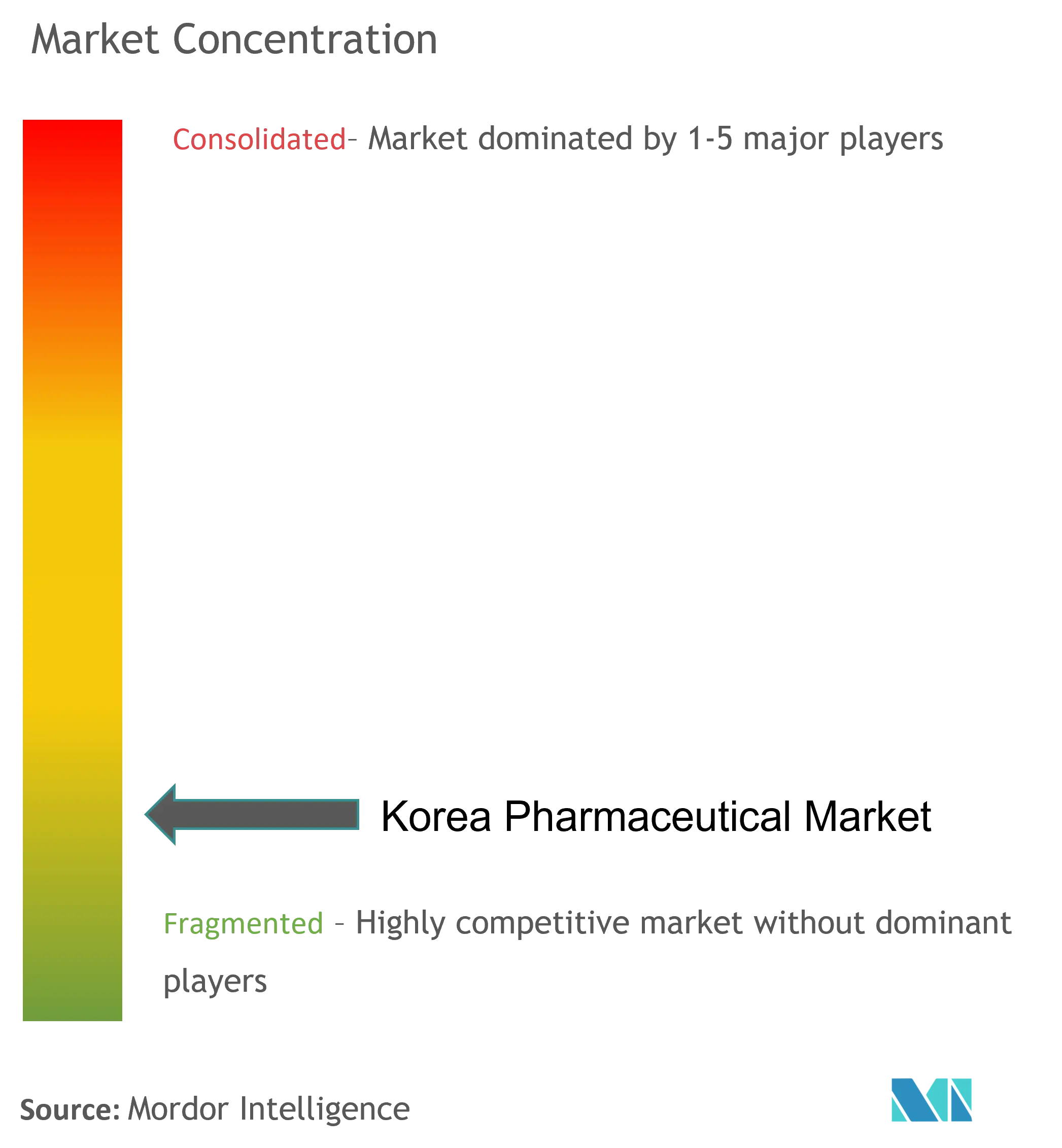
Korea Pharmaceutical Industry Leaders
AbbVie Inc.
AstraZeneca plc
Bayer AG
SAMSUNG PHARM. Co., LTD.
GlaxoSmithKline plc
- *Disclaimer: Major Players sorted in no particular order

Market Opportunities and Future Outlook
Songdo-centric biologics manufacturing and CDMO scale continue to feed investment pipelines and create clearer demand for fill-finish services and specialized biologics capabilities tied to export programs. In March 2026, Celltrion announced a KRW 1.2 trillion investment to expand production capacity at its Songdo plants, while Samsung Biologics and Lotte Biologics pursued capacity additions in the same cluster. This intensifies competition locally but also broadens Korea’s role in global outsourced manufacturing.
On the demand and commercialization side, policy and funding actions are reshaping where value accrues across innovators, generics, and enabling technologies. MOHW finalized a National Health Insurance drug pricing system improvement plan that reduces generic prices to 45% of the original drug price starting in the second half of 2026, pushing manufacturers toward differentiated portfolios and higher-value formulations. Innovation incentives are also being sharpened through tighter innovative-pharma certification standards (announced March 2026) that raise R&D-to-revenue thresholds, and through capital support such as the 1 trillion won pharma-bio mega-fund announced in July 2026 (with KRW 900 billion slated for deployment in 2026). With the Digital Medical Products Act in force since January 24, 2025, and a government plan to open genomic and bio-big data to domestic researchers in November 2026, AI-enabled R&D, digital therapeutics, and data-driven clinical development appear as concrete build-out areas linked to named programs and regulatory infrastructure.
Recent Industry Developments
- July 2026: AstraZeneca Korea signed a joint research agreement with Korean startup Azcuris to discover small-molecule medicines for respiratory and Th2-mediated diseases using a protein-protein interaction platform. The agreement extends local discovery work beyond commercialization and supports Korea as a sourcing base for platform-driven early R&D programs.
- June 2026: AbbVie Korea opened applications for its 2026 AbbVie Korea Partnering Day (scheduled for September 16), setting up 1:1 meetings between AbbVie executives and local biotech companies for potential licensing, research collaboration, and investment. This adds more structured deal flow between Korean innovators and a global pharma partner for specialty and pipeline assets.
- April 2026: Bayer Korea signed an MOU with the Korea Drug Development Fund (KDDF) to promote open innovation and identify promising domestic pharmaceutical and biotech startups. The partnership formalizes a scouting and co-development channel that links multinational R&D needs with Korea’s venture and translational ecosystem.


Research Methodology Framework and Report Scope
Market Definition and Coverage
For this study, the Korea pharmaceutical market is defined as the value of medicines sold for use in South Korea, covering prescription drugs and over-the-counter drugs across major therapeutic use areas.
Scope exclusions: medical devices, diagnostics, and hospital consumables are not counted in this market size.
Segmentation Overview
- By Therapeutic Category
- Anti-infectives
- Cardiovascular
- Gastrointestinal
- Anti-diabetic
- Respiratory
- Oncology
- Others
- By Drug Type
- Prescription Drugs
- Branded
- Generics
- OTC Drugs
- Prescription Drugs
- By Technology
- Small Molecules
- Biologics
- Biosimilars
- By Formulation
- Tablets
- Capsules
- Injectables
- Others (Topicals, Patches, etc.)
- By Route of Administration
- Oral
- Parenteral
- Others (Inhalational, Transdermal)
- By Distribution Channel
- Hospital Pharmacies
- Retail Pharmacies
- Online Pharmacies
Data Sources, Market Sizing, and Validation
Desk Research
Desk research was used to set the market boundary, build initial demand indicators, and cross-check how the industry is tracked in public statistics. We mainly relied on public health system and regulator outputs, such as the Korean Ministry of Food and Drug Safety (MFDS) for approvals and safety updates, and the National Health Insurance Service (NHIS) and HIRA for reimbursed medicine utilization and claims-linked spending signals.
To keep assumptions grounded, we also referenced international and research-led sources such as OECD Health Statistics, WHO health expenditure series, and peer reviewed journals that report prescription patterns and disease burden in South Korea. Company annual reports, investor presentations, and trusted press were used to validate product launches, therapy focus, and the direction of pricing. Where needed, a paid subscription database for company financials and a patent database were used to improve consistency on revenue splits and pipeline timing. The desk sources named here are illustrative and not exhaustive, and additional public datasets and documents were reviewed for data collection, validation, and clarification.
Primary Interviews and Surveys
Primary work focused on validating what is purchased and prescribed, and how demand differs by therapy mix, channel, and funding route in South Korea. We spoke with manufacturers, distributors, hospital pharmacy stakeholders, and healthcare system experts, and the inputs were used to sanity check utilization trends, price movements, and the split between branded and generic prescriptions. When assumptions looked unstable, we tested the points again with a second set of respondents so the model does not lean on one viewpoint.
Distribution of primary research fieldwork respondents
| Company type | Respondent position |
|---|---|
| Top tier: 30% | CXOs: 14% |
| Mid tier: 54% | Functional/Unit leaders: 32% |
| Smaller Players: 16% | Managers: 54% |
Market-Sizing & Forecasting
We estimated market size using a top-down approach where health spending signals and reimbursed medicine utilization are used to reconstruct total pharma value, then adjusted using therapy mix and channel checks specific to South Korea. Those totals were subsequently corroborated with selective bottom-up approximations like sampled product level volume and average selling price logic, plus supplier and distributor roll ups where disclosures were available, so the final number stays practical and explainable.
Key inputs that guided the model included reimbursed prescription volumes and spend trends, the branded versus generic mix, therapy area shifts (for example, chronic disease categories versus acute anti-infectives), pricing and reimbursement direction, and the pace of new drug approvals that change the high value share. For forecasting, we used scenario analysis supported by a simple multivariate view of drivers, where growth is linked to aging-related demand, utilization intensity, and expected pricing actions, and then refined using expert views on policy and reimbursement timing. Where bottom-up visibility was limited (for example, for some private pay OTC demand), we used channel based proxies and rechecked the results against claims and retail signals.
Data Validation & Update Cycle
Outputs were validated through stepwise checks so the final totals align with independent signals and do not move for the wrong reason. We compared model results against reimbursed spending patterns, approval and launch timing, and broad health expenditure direction, and then reviewed outliers at therapy and channel level before sign-off.
If a large variance showed up, the assumptions were traced back to the driver, followed by a re-contact to primary respondents when needed. Reports are refreshed annually, and interim updates are made when material policy changes, pricing actions, or major launches shift the outlook. Before delivery, a final review pass is completed so clients receive the most current view available at that time.
Mordor Intelligence's Korea Pharmaceutical Market Size Measured Against Other Published Estimates
Published market sizes for pharmaceuticals in South Korea often do not match because different authors choose different market baskets, time bases, and pricing logic, and then apply different checks to reconcile the totals. The benchmark table makes the spread easy to see, and it usually comes down to what is counted as pharmaceuticals versus adjacent health products, plus how reimbursement and private pay demand are treated.
The table shows a gap that is commonly driven by scope and valuation choices, and in Mordor Intelligence's model the total focuses on medicines sold for use in South Korea, covering prescription and OTC, without folding in medical devices or non-drug hospital consumables. Some published figures also lean on list prices instead of net realized levels, or use different currency conversion timing that shifts the USD value for the same local market. Assumptions were kept tied to therapy mix, approval and launch timing, and channel signals so the final market size can be traced back to clear inputs.
Benchmark comparison
| Source | Market Size | Gaps in Research Methodology |
|---|---|---|
| Mordor Intelligence | USD 23.19 B (2025) | |
| Industry Association A | USD 24.80 B (2025) | Often reports a broader sales basket that can blend medicines with adjacent health products, and it may lean on list price assumptions that sit above reimbursed net levels. |
| Trade Journal B | USD 21.60 B (2025) | Typically relies heavily on reimbursed prescription tracking and may miss part of private pay OTC and non-reimbursed hospital use, which can pull the total down. |
Across sources, the main takeaway is that medicine-only coverage and pricing treatment usually explain most of the spread. With repeatable checks against reimbursement signals and channel mix, we can keep year to year movement aligned with what is actually changing in demand and pricing.


Key Questions Answered in the Report
How big is the Korea Pharmaceutical Market?
The Korea Pharmaceutical Market size is expected to reach USD 23.74 billion in 2026 and grow at a CAGR of 2.37% to reach USD 26.69 billion by 2031.
Which therapy area is expanding fastest?
Oncology posts the highest trajectory with a 4.24% CAGR, buoyed by accelerated MFDS approvals and robust domestic R&D funding.
Who are the key players in Korea Pharmaceutical Market?
AbbVie Inc., AstraZeneca plc, Bayer AG, SAMSUNG PHARM. Co., LTD. and GlaxoSmithKline plc are the major companies operating in the Korea Pharmaceutical Market.
Why are biosimilars central to Korea’s export growth?
Domestic plants rank second globally in FDA-approved biosimilars and offer cost-competitive monoclonal antibodies that drive shipments to Europe and the U.S.
Page last updated on:





